Reed – introduction to Ogham

From Ireland Calling

It is widely believed in academic circles that reed is a modern, neo-pagan introduction to the Ogham, much like the tree calendar itself.

It was first promoted as an Ogham by Robert Graves in his book The White Goddess. However, the reed’s importance to Celtic life and folklore are indisputable.

Reed gained a reputation as a protective tree from its use as thatch for the rooftops homes.

For this reason it was also made into talismans and charms believed to protect the wearer from evil. Mats were often woven out of reeds which gave the house a sweet smell, associating the reed with cleansing the home.

Scholarship

The Druids also used reeds to make writing implements and paper, thus associating the reed with knowledge, scholarship and wisdom.

Physicians would use reeds as tools for administering treatments but arrows, the weapons of death, were also made out of reeds. Because of these two contrasting uses the reed gained an association with both death and healing.

Souls of the ‘otherworld’ join the living…

28 October Daily Correspondence Digest for the Southern Hemisphere’s Moon Phase and Planetary Positions

You can use this link to go forward or backward in time for Moon phase information. If you are curious you can even find out what phase the Moon was in when you or anyone else, you know was on the date the person was born.

From Moongiant.com

The Moon’s current phase for today and tonight is a Third Quarter phase. Sometimes called a Last Quarter Moon, this phase occurs roughly 3 weeks after the New Moon when the Moon is three quarter of the way through it’s orbit around the earth. If you live in the northern hemisphere the Moons left side will be illuminated and the right side will be dark. For those of you in the southern hemisphere it will be the opposite with the right side illuminated. On the day of the Third Quarter phase the Moon will rise around midnight on the eastern horizon and set in the west around noon the next day. In the days following the Third Quarter Phase the Moon’s illumination will decrees each day until the New Moon.

Visit the October 2021 Moon Phases Calendar to see all the daily moon phase for this month.

Last Quarter Phase

The Last Quarter on October 28 has an illumination of 53%. This is the percentage of the Moon illuminated by the Sun. The illumination is constantly changing and can vary up to 10% a day. On October 28 the Moon is 21.85 days old. This refers to how many days it has been since the last New Moon. It takes 29.53 days for the Moon to orbit the Earth and go through the lunar cycle of all 8 Moon phases.

The 8 Lunar Phases

There are 8 lunar phases the Moon goes through in its 29.53 days lunar cycle. The 4 major Moon phases are Full Moon, New Moon, First Quarter and Last Quarter. Between these major phases, there are 4 minor ones: the Waxing Crescent, Waxing Gibbous, Waning Gibbous and Waning Crescent. For more info on the Moon Cycle and on each phase check out Wikipedia Lunar Phase page.

Phase Details

Phase: Last Quarter
Illumination: 53%
Moon Age: 21.85 days
Moon Angle: 0.50
Moon Distance: 397,159.80 km
Sun Angle: 0.54
Sun Distance: 148,597,775.81 km

Useful Moon Resources

October 27 On This Day in History

Important Events

312 Roman Emperor Constantine the Great is said to have received his famous Vision of the Cross

1795 Pinckney’s Treaty [Treaty of San Lorenzo] signed by Spain and US, establishing the southern boundary of the US and giving Americans right to navigate the Mississippi River

1962 Black Saturday during the Cuban Missile Crisis: An American spy plane is shot down over Cuba and the navy drops warning depth charges on Soviet submarines

1982 China announces its population has reached 1 billion plus people

1986 British government deregulates financial markets in a “Big Bang”, enhancing London’s status as a financial capital while increasing income inequality

Today’s Historical Events

Today’s Historical Events in Film and TV

Today’s Historical Events in Music

Today’s Historical Events in Sports

Astronomy Picture of the Day

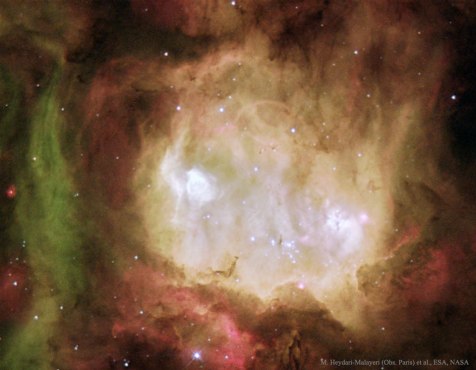
Halloween and the Ghost Head Nebula

Image Credit: Mohammad Heydari-Malayeri (Observatoire de Paris) et al., ESANASA

Explanation: Halloween’s origin is ancient and astronomical. Since the fifth century BC, Halloween has been celebrated as a cross-quarter day, a day halfway between an equinox (equal day / equal night) and a solstice (minimum day / maximum night in the northern hemisphere). With a modern calendar however, even though Halloween occurs next week, the real cross-quarter day will occur the week after. Another cross-quarter day is Groundhog Day. Halloween’s modern celebration retains historic roots in dressing to scare away the spirits of the dead. Perhaps a fitting tribute to this ancient holiday is this view of the Ghost Head Nebula taken with the Hubble Space Telescope. Similar to the icon of a fictional ghost, NGC 2080 is actually a star forming region in the Large Magellanic Cloud, a satellite galaxy of our own Milky Way Galaxy. The Ghost Head Nebula (NGC 2080) spans about 50 light-years and is shown in representative colors.

October 27 Daily Correspondence Digest for the Northern Hemisphere’s Moon Phase and Planetary Positions

You can use this link to go forward or backward in time for Moon phase information. If you are curious you can even find out what phase the Moon was in when you or anyone else, you know was on the date the person was born.

From Moongiant.com

Tomorrow the Moon will be in a Waning Gibbous Phase. This is the first phase after the Full Moon occurs. It lasts roughly 7 days with the Moon’s illumination growing smaller each day until the Moon becomes a Last Quarter Moon with an illumination of 50%. The average Moon rise for this phase is between 9pm and Midnight depending on the age of the phase. The moon rises later and later each night setting after sunrise in the morning. During this phase the Moon can also be seen in the early morning daylight hours on the western horizon.

Visit the October 2021 Moon Phases Calendar to see all the daily moon phase for this month.

Today’s Waning Gibbous Phase

The Waning Gibbous on October 27 has an illumination of 63%. This is the percentage of the Moon illuminated by the Sun. The illumination is constantly changing and can vary up to 10% a day. On October 27 the Moon is 20.94 days old. This refers to how many days it has been since the last New Moon. It takes 29.53 days for the Moon to orbit the Earth and go through the lunar cycle of all 8 Moon phases.

The 8 Lunar Phases

There are 8 lunar phases the Moon goes through in its 29.53 days lunar cycle. The 4 major Moon phases are Full Moon, New Moon, First Quarter and Last Quarter. Between these major phases, there are 4 minor ones: the Waxing Crescent, Waxing Gibbous, Waning Gibbous and Waning Crescent. For more info on the Moon Cycle and on each phase check out Wikipedia Lunar Phase page.

Phase Details

Phase: Waning Gibbous
Illumination: 63%
Moon Age: 20.94 days
Moon Angle: 0.50
Moon Distance: 400,549.81 km
Sun Angle: 0.54
Sun Distance: 148,637,613.73 km

Useful Moon Resources

27 October Daily Correspondence Digest for the Southern Hemisphere’s Moon Phase and Planetary Positions

You can use this link to go forward or backward in time for Moon phase information. If you are curious you can even find out what phase the Moon was in when you or anyone else, you know was on the date the person was born.

From Moongiant.com

Tomorrow the Moon will be in a Waning Gibbous Phase. This is the first phase after the Full Moon occurs. It lasts roughly 7 days with the Moon’s illumination growing smaller each day until the Moon becomes a Last Quarter Moon with an illumination of 50%. The average Moon rise for this phase is between 9pm and Midnight depending on the age of the phase. The moon rises later and later each night setting after sunrise in the morning. During this phase the Moon can also be seen in the early morning daylight hours on the western horizon.

Visit the October 2021 Moon Phases Calendar to see all the daily moon phase for this month.

Today’s Waning Gibbous Phase

The Waning Gibbous on October 27 has an illumination of 63%. This is the percentage of the Moon illuminated by the Sun. The illumination is constantly changing and can vary up to 10% a day. On October 27 the Moon is 20.94 days old. This refers to how many days it has been since the last New Moon. It takes 29.53 days for the Moon to orbit the Earth and go through the lunar cycle of all 8 Moon phases.

The 8 Lunar Phases

There are 8 lunar phases the Moon goes through in its 29.53 days lunar cycle. The 4 major Moon phases are Full Moon, New Moon, First Quarter and Last Quarter. Between these major phases, there are 4 minor ones: the Waxing Crescent, Waxing Gibbous, Waning Gibbous and Waning Crescent. For more info on the Moon Cycle and on each phase check out Wikipedia Lunar Phase page.

Phase Details

Phase: Waning Gibbous
Illumination: 63%
Moon Age: 20.94 days
Moon Angle: 0.50
Moon Distance: 400,549.81 km
Sun Angle: 0.54
Sun Distance: 148,637,613.73 km

Useful Moon Resources

If you need to calculate the planetary positions for a specific use and time, click on this link

Currentplanetarypositions.com

To figure out GMT (Greenwich Mean Time) to your local time use this link

For Your Local Time and Date

Southeastern Hemisphere

The time for the Custom Planetary Positions is from the local time in Melbourne, Victoria, Australia 

27 October 2021
06:00 am GMT 5:00 PM AEDT
Zodiac: Tropical (Standard Western)

Sun:04 Scorpio 02
Moon:16 Cancer 20
Mercury:15 Libra 57
Venus:20 Sagittarius 57
Mars:27 Libra 45
Jupiter:22 Aquarius 28
Saturn:07 Aquarius 06
Uranus:13 Taurus 09 Rx
Neptune:20 Pisces 44 Rx
Pluto:24 Capricorn 25
True Lunar Node:01 Gemini 59
Mean Lunar Node:03 Gemini 01 Rx
Lilith (Black Moon):11 Gemini 10
Chiron:09 Aries 38 Rx
Ceres:11 Gemini 04 Rx
Pallas:09 Pisces 31 Rx
Juno:23 Sagittarius 55
Vesta:19 Scorpio 06
Eris:24 Aries 08 Rx
Fire:4
Earth:2
Air:8
Water:5
Cardinal:6
Fixed:5
Mutable:8

 Southwestern Hemisphere

The time for the Custom Planetary Positions is from the local time in Sao Paulo, Brazil, South America

27 October 2021
08:00 pm GMT 5:00 PM BRT
Zodiac: Tropical (Standard Western)

Sun:04 Scorpio 37
Moon:23 Cancer 21
Mercury:16 Libra 40
Venus:21 Sagittarius 32
Mars:28 Libra 09
Jupiter:22 Aquarius 29
Saturn:07 Aquarius 07
Uranus:13 Taurus 07 Rx
Neptune:20 Pisces 44 Rx
Pluto:24 Capricorn 25
True Lunar Node:02 Gemini 00
Mean Lunar Node:02 Gemini 59 Rx
Lilith (Black Moon):11 Gemini 14
Chiron:09 Aries 36 Rx
Ceres:11 Gemini 00 Rx
Pallas:09 Pisces 29 Rx
Juno:24 Sagittarius 06
Vesta:19 Scorpio 24
Eris:24 Aries 08 Rx
Fire:4
Earth:2
Air:8
Water:5
Cardinal:6
Fixed:5
Mutable:8

Astronomy Picture of the Day

Discover the cosmos! Each day a different image or photograph of our fascinating universe is featured, along with a brief explanation written by a professional astronomer.

Today’s Astronomy Picture is a Video. Click here to watch it.

Jupiter Rotates

Video Credit & Copyright: JL DauvergneMusic: Oro Aqua (Benoit Reeves)

Explanation: Observe the graceful twirl of our Solar System’s largest planet. Many interesting features of Jupiter’s enigmatic atmosphere, including dark belts and light zones, can be followed in detail. A careful inspection will reveal that different cloud layers rotate at slightly different speeds. The famous Great Red Spot is not visible at first — but soon rotates into view. Other smaller storm systems occasionally appear. As large as Jupiter is, it rotates in only 10 hours. Our small Earth, by comparison, takes 24 hours to complete a spin cycle. The featured high-resolution time-lapse video was captured over five nights earlier this month by a mid-sized telescope on an apartment balcony in ParisFrance. Since hydrogen and helium gas are colorless, and those elements compose most of Jupiter’s expansive atmosphere, what trace elements create the observed colors of Jupiter’s clouds remains a topic of research.


Discovery + Outreach: Graduate student research position open for APOD


October 26 On This Day in HIstory

Important Events

1850 Robert McClure sights the fabled Northwest Passage for the first time (from Banks Island towards Melville Island)

1861 Pony Express (Missouri to California) ends after 19 months

1863 International conference begins in Geneva aimed at improving medical conditions on battlefields – beginning of the Red Cross

1977 Last natural case of smallpox discovered in Merca district, Somalia. Considered the anniversary of the eradication of smallpox, the most spectacular success of vaccination

2019 Raid by US Special Forces kills ISIS founder Abu Bakr al-Baghdadi in Syria

Today’s Historical Events

Today’s Historical Film and TV’s Events

Today’s Historical Music’s Events

Today’s Historical Sport’s Events


Ancient Roman God Terminus

Terminus

From Pantheon.org – For Sources and References Roman God Terminus

“Border.” A Roman divinity presiding over boundaries and frontiers. His worship is said to have been instituted by Numa who ordered that every one should mark the boundaries of his landed property by stones to be consecrated to Jupiter (Ζεὺς ὅριος), and at which every year sacrifices were to be offered at the festival of the Terminalia.1 These sacred boundaries existed not only in regard to private property, but also in regard to the state itself, the boundary of which was not to be transgressed by any foreign foe. But in later times the latter must have fallen into oblivion, while the termini of private property retained their sacred character even in the days of Dionysius, who states that sacrifices of cakes, meal, and fruit (for it was unlawful to stain the boundary stones with blood), still continued to be offered.

The god Terminus himself appears to have been no other than Jupiter himself, in the capacity of the protector of boundaries.2 The Terminus of the Roman state originally stood between the fifth and sixth milestone on the road towards Laurentum, near a place called Festi, and that ancient/boundary of the Ager Romanus (“the field of Rome“) continued to be revered with the same ceremonies as the boundaries of private estates.3 Another public Terminus stood in the temple of Jupiter in the Capitol, and above it there was an opening in the roof, because no Terminus was allowed to be under cover.4 This is another proof that Terminus was only an attribute of Jupiter, although tradition gave a different reason for this circumstance; for when that temple was to be founded, and it was necessary to exaugurate other sanctuaries standing on the same site, all the gods readily gave way to Jupiter and Juno, but the auguries would not allow the sanctuaries of Terminus and Juventas to be removed. This was taken as an omen that the Roman state would remain ever undiminished and young, and the chapels of the two divinities were inclosed within the walls of the new temple. Here we may ask, what had a Terminus to do on the Capitol, unless he was connected or identical with Jupiter?

October 26 Daily Correspondence Digest for the Northern Hemisphere’s Moon Phase and Planetary Positions

You can use this link to go forward or backward in time for Moon phase information. If you are curious you can even find out what phase the Moon was in when you or anyone else, you know was on the date the person was born.

From Moongiant.com

The Moon’s current phase for today and tonight is a Waning Gibbous Phase. This is the first phase after the Full Moon occurs. It lasts roughly 7 days with the Moon’s illumination growing smaller each day until the Moon becomes a Last Quarter Moon with an illumination of 50%. The average Moon rise for this phase is between 9pm and Midnight depending on the age of the phase. The moon rises later and later each night setting after sunrise in the morning. During this phase the Moon can also be seen in the early morning daylight hours on the western horizon.

Visit the October 2021 Moon Phases Calendar to see all the daily moon phase for this month.

Today’s Waning Gibbous Phase

The Waning Gibbous on October 26 has an illumination of 72%. This is the percentage of the Moon illuminated by the Sun. The illumination is constantly changing and can vary up to 10% a day. On October 26 the Moon is 20.04 days old. This refers to how many days it has been since the last New Moon. It takes 29.53 days for the Moon to orbit the Earth and go through the lunar cycle of all 8 Moon phases.

The 8 Lunar Phases

There are 8 lunar phases the Moon goes through in its 29.53 days lunar cycle. The 4 major Moon phases are Full Moon, New Moon, First Quarter and Last Quarter. Between these major phases, there are 4 minor ones: the Waxing Crescent, Waxing Gibbous, Waning Gibbous and Waning Crescent. For more info on the Moon Cycle and on each phase check out Wikipedia Lunar Phase page.

Phase Details

Phase: Waning Gibbous
Illumination: 72%
Moon Age: 20.04 days
Moon Angle: 0.49
Moon Distance: 403,115.63 km
Sun Angle: 0.54
Sun Distance: 148,677,728.94 km

Useful Moon Resources

Scorpio Horoscope for 2021

(I should have started this with Capricorn on January 1st, 2021 as most people follow the Gregorian calendar. But there are many of us who walk a pagan path the follow the Wheel of The Year and celebrate the new year October 31st through November 1st. Which Makes Scorpio the first accepted zodiac sign of the year. Personally I follow the 13 Zodiac Signs to go with the 13 months of the Celtic Tree Calendar. More about the 13 Zodiac Signs and Celtic Tree Months in other posts.)

The symbols and star constellation for Scorpio

DATES: According to sunsigns.org begin October 23rd and end on November 22nd

To read the full yearly Scorpio Horoscope for 2021

Scorpio 2021 Horoscope – A Look At The Year Ahead

The Scorpio 2021 horoscope advises discretion, which can sometimes be difficult for Scorpios to manage. Keep your romantic relationships on the down-low. Keep information about your work and finances to yourself as well. Being too social about these things may put them in jeopardy. So, try to live this year coyly; doing so will lead you to success.

Scorpio 2021 Love Predictions

The love prediction for Scorpio in 2021 suggests a major change in your romantic relationship. If you are already dating someone, then this might be the perfect year for you to become engaged. It is best to propose between

mid-April and the first week of May, when Venus is in Taurus.

If engagement is not on your mind, then it is other big questions that will rear their head in your relationship. Is it the right time to have a baby? If you are single, should you try to begin a romantic relationship? If you are in a relationship, is it time to break up? Consider these questions early on in the year. By autumn, Mars in Capricorn will let you know what to do.

Scorpio Career Prospects For 2021…

Scorpio Finance 2021 Forecasts…

Scorpio Family Predictions 2021…

Health Horoscope For the SCORPION…

Scorpio Social Life Changes…

2021 Forecasts for Scorpio Birthdays…

Scorpio 2021 Monthly Horoscopes


26 October Daily Correspondence Digest for the Southern Hemisphere’s Moon Phase and Planetary Positions

You can use this link to go forward or backward in time for Moon phase information. If you are curious you can even find out what phase the Moon was in when you or anyone else, you know was on the date the person was born.

From Moongiant.com

The Moon’s current phase for today and tonight is a Waning Gibbous Phase.

This is the first phase after the Full Moon occurs. It lasts roughly 7 days with the Moon’s illumination growing smaller each day until the Moon becomes a Last Quarter Moon with an illumination of 50%. The average Moon rise for this phase is between 9pm and Midnight depending on the age of the phase. The moon rises later and later each night setting after sunrise in the morning. During this phase the Moon can also be seen in the early morning daylight hours on the western horizon.

Visit the October 2021 Moon Phases Calendar to see all the daily moon phase for this month.

Today’s Waning Gibbous Phase

The Waning Gibbous on October 26 has an illumination of 72%. This is the percentage of the Moon illuminated by the Sun. The illumination is constantly changing and can vary up to 10% a day. On October 26 the Moon is 20.04 days old. This refers to how many days it has been since the last New Moon. It takes 29.53 days for the Moon to orbit the Earth and go through the lunar cycle of all 8 Moon phases.

The 8 Lunar Phases

There are 8 lunar phases the Moon goes through in its 29.53 days lunar cycle. The 4 major Moon phases are Full Moon, New Moon, First Quarter and Last Quarter. Between these major phases, there are 4 minor ones: the Waxing Crescent, Waxing Gibbous, Waning Gibbous and Waning Crescent. For more info on the Moon Cycle and on each phase check out Wikipedia Lunar Phase page.

Phase Details

Phase: Waning Gibbous
Illumination: 72%
Moon Age: 20.04 days
Moon Angle: 0.49
Moon Distance: 403,115.63 km
Sun Angle: 0.54
Sun Distance: 148,677,728.94 km

Useful Moon Resources

A Thought for Today

Dear Sisters, Brothers, and Honored Guests today I leave you with this thought…

One thing I would like to add to Frank Lloyd Wright’s quote is

Anywhere you go the forests, water ways, or a walk around your block take a bag with you for trash. As Pagans, which first meant peasant but as evolve to mean people who follow nature’s spiritual paths, it is our duty to pick up what others were to lazy to dispose of properly. I started out doing this on my own as my children grew old enough to take a walk outside with me and than doing the same with my grandchildren. Who passed it on to their playmates and still do it even with some of my grandchildren being over 20, a couple in college, and the others starting in grammar or pre-school. So I ask you not to think of Earth Day is only on April 22 but as it being every day of the week.

Blessed be dear ones.

October 25 Today in History

Important Events

1415 Battle of Agincourt: Henry V’s forces defeat larger French army and the longbow defeats the armoured knight

1854 The infamous “Charge of the Light Brigade” during the Battle of Balaclava in the Crimean War results in over 100 killed

1962 US Ambassador to the UN Adlai Stevenson demands USSR UN rep Zorin answer regarding Cuban missile bases saying “I am prepared to wait for my answer until hell freezes over”

1971 United Nations votes to expel the Chinese Nationalist ruled Taiwan and admit the Communist People’s Republic of China

2017 Chinese Premier Xi Jinping unveils his new ruling council in the Great Hall of the People, none of the five are young enough to succeed him

Today’s Historical Events

Today’s Historical Events in Film and TV

Today’s Historical Events in Music

Today’s Historical Events in Sports

Ancient Rome A superstitious Society

From HistoryCooperative.org – To read the rest of the article about Omens and Superstations

A superstitious Society

Compare to modern society, the Romans seem extremely superstitious. But then today’s major religions have all throughout their past discouraged, even combatted, superstitions. Also our sciences and our technological world allows little room for superstition.

The Romans lived in an era previous to this. Their world was full of unexplained phenomena, darkness and fear. To Romans these superstitions were a perfectly natural part in the relationship between gods and men.

The Roman habit of interpreting natural phenomena as signs from the beyond stemmed from the Etruscans. The Etruscans, who developed reading omens and auspices into a form of science, knew different means of divination. In their beliefs the signs they read were sent to them by a mythical boy called Tages, who in their mythology was to have been ploughed up from the earth.

They would seek to read the future by examining the entrails of sacrificial animals, the liver being of special importance for that purpose. They would observe lighting and interpret its meanings. And they would try and put meaning to any unusual phenomena which occured.

The belief that objects, or living beings could possess special spiritual properties was widespread in primitive societies. The Romans were no strangers to this idea. Stones, trees, springs, caves, lakes, swamps, mountains – even animals and furniture – were all deemed to be hosts to spirits (numina). Stones in particular were often seen to contain spirits, especially if they were boundary stones, dividing one man’s property from the other.

It is very telling that the Latin word for such a boundary is terminus and that there actually was a Roman god called Terminus. This odd deity took the form of a huge piece of rock which rested in the temple of Jupiter on the Capitoline Hill. Apparently several attempts to move the bolder when…

Bad Luck Go Away!’ Candle Spell to Remove a Curse

If you’ve been wondering how to make bad luck go away, you should know that the answer is very simple: Bring in the energy of good luck!

How this Spell Works

A great way to do this is by casting a double-intention good luck spell.

The first intention is to remove all bad luck from you, so we will use salt and the power of the green candle. You can also take a cleansing bath to wash away any negativity that is clinging to you.

The rest of the ritual will focus on visualizing and drawing positive energies that will manifest opportunities for growth and success in you life. Cinnamon has purifying properties that eliminate bad energies and attract good luck.

Follow the steps indicated below and banish bad luck from your life with a simple spell break ritual.

For the rest of this spell from Spell 8.com

5 Ways Chamomile Tea Benefits Your Health

(This article is not meant to replace anything you have been prescribed by your primary health care provider. Always check with them before starting to use any herbs for medicinal purposes. Chamomile id from the Daisy Family. So it is possible to be allergic to it if you are allergic to any species of Daisy)

From Healthline.com

Chamomile tea is a popular beverage that also offers a variety of health benefits.

Chamomile is an herb that comes from the daisy-like flowers of the Asteraceae plant family. It has been consumed for centuries as a natural remedy for several health conditions.

To make chamomile tea, the flowers are dried and then infused into hot water.

Many people enjoy chamomile tea as a caffeine-free alternative to black or green tea and for its earthy, somewhat sweet taste.

Furthermore, chamomile tea is loaded with antioxidants that may play a role in lowering your risk of several diseases, including heart disease and cancer.

Chamomile has properties that may aid sleep and digestion, as well.

This article will discuss 5 potential health benefits of drinking chamomile tea.

1. May Improve Sleep Quality…

October 25 Daily Northern Hemisphere Current Moon Phase and Planetary Positions

You can use this link to go forward or backward in time for Moon phase information. If you are curious you can even find out what phase the Moon was in when you or anyone else, you know was on the date the person was born.

From Moongiant.com

The Moon’s current phase for today and tonight is a Waning Gibbous Phase. This is the first phase after the Full Moon occurs. It lasts roughly 7 days with the Moon’s illumination growing smaller each day until the Moon becomes a Last Quarter Moon with an illumination of 50%. The average Moon rise for this phase is between 9pm and Midnight depending on the age of the phase. The moon rises later and later each night setting after sunrise in the morning. During this phase the Moon can also be seen in the early morning daylight hours on the western horizon.

Visit the October 2021 Moon Phases Calendar to see all the daily moon phase for this month.

Today’s Waning Gibbous Phase

The Waning Gibbous on October 25 has an illumination of 80%. This is the percentage of the Moon illuminated by the Sun. The illumination is constantly changing and can vary up to 10% a day. On October 25 the Moon is 19.15 days old. This refers to how many days it has been since the last New Moon. It takes 29.53 days for the Moon to orbit the Earth and go through the lunar cycle of all 8 Moon phases.

The 8 Lunar Phases

There are 8 lunar phases the Moon goes through in its 29.53 days lunar cycle. The 4 major Moon phases are Full Moon, New Moon, First Quarter and Last Quarter. Between these major phases, there are 4 minor ones: the Waxing Crescent, Waxing Gibbous, Waning Gibbous and Waning Crescent. For more info on the Moon Cycle and on each phase check out Wikipedia Lunar Phase page.

Phase: Waning Gibbous
Illumination: 80%
Moon Age: 19.15 days
Moon Angle: 0.49
Moon Distance: 404,773.38 km
Sun Angle: 0.54
Sun Distance: 148,718,109.12 km

Useful Moon Resources

25 October Daily Correspondence Digest for the Southern Hemisphere’s Moon Phase and Planetary Positions

You can use this link to go forward or backward in time for Moon phase information. If you are curious you can even find out what phase the Moon was in when you or anyone else, you know was on the date the person was born.

From Moongiant.com

Today the Moon will be in a Waning Gibbous Phase. This is the first phase after the Full Moon occurs. It lasts roughly 7 days with the Moon’s illumination growing smaller each day until the Moon becomes a Last Quarter Moon with an illumination of 50%. The average Moon rise for this phase is between 9pm and Midnight depending on the age of the phase. The moon rises later and later each night setting after sunrise in the morning. During this phase the Moon can also be seen in the early morning daylight hours on the western horizon.

Visit the October 2021 Moon Phases Calendar to see all the daily moon phase for this month.

Today’s Waning Gibbous Phase

The Waning Gibbous on October 25 has an illumination of 80%. This is the percentage of the Moon illuminated by the Sun. The illumination is constantly changing and can vary up to 10% a day. On October 25 the Moon is 19.15 days old. This refers to how many days it has been since the last New Moon. It takes 29.53 days for the Moon to orbit the Earth and go through the lunar cycle of all 8 Moon phases.

The 8 Lunar Phases

There are 8 lunar phases the Moon goes through in its 29.53 days lunar cycle. The 4 major Moon phases are Full Moon, New Moon, First Quarter and Last Quarter. Between these major phases, there are 4 minor ones: the Waxing Crescent, Waxing Gibbous, Waning Gibbous and Waning Crescent. For more info on the Moon Cycle and on each phase check out Wikipedia Lunar Phase page.

Phase Details

Phase: Waning Gibbous
Illumination: 80%
Moon Age: 19.15 days
Moon Angle: 0.49
Moon Distance: 404,773.38 km
Sun Angle: 0.54
Sun Distance: 148,718,109.12 km

Useful Moon Resources

Southeastern Hemisphere

The time for the Custom Planetary Positions is from the local time in Melbourne, Victoria, Australia 

25 October 2021
05:00 am GMT 4:00 PM AEDT
Zodiac: Tropical (Standard Western)

Sun:02 Scorpio 00
Moon:22 Gemini 08
Mercury:13 Libra 42
Venus:18 Sagittarius 52
Mars:26 Libra 24
Jupiter:22 Aquarius 25
Saturn:07 Aquarius 03
Uranus:13 Taurus 14 Rx
Neptune:20 Pisces 47 Rx
Pluto:24 Capricorn 24
True Lunar Node:01 Gemini 55
Mean Lunar Node:03 Gemini 07 Rx
Lilith (Black Moon):10 Gemini 57
Chiron:09 Aries 43 Rx
Ceres:11 Gemini 17 Rx
Pallas:09 Pisces 41 Rx
Juno:23 Sagittarius 17
Vesta:18 Scorpio 00
Eris:24 Aries 09 Rx
Fire:4
Earth:2
Air:9
Water:4
Cardinal:5
Fixed:5
Mutable:9

Southwestern Hemisphere

The time for the Custom Planetary Positions is from the local time in Sao Paulo, Brazil, South America

25 October 2021
07:00 pm GMT 4:00 PM BRT
Zodiac: Tropical (Standard Western)

Sun:02 Scorpio 35
Moon:29 Gemini 01
Mercury:14 Libra 18
Venus:19 Sagittarius 28
Mars:26 Libra 47
Jupiter:22 Aquarius 26
Saturn:07 Aquarius 04
Uranus:13 Taurus 12 Rx
Neptune:20 Pisces 46 Rx
Pluto:24 Capricorn 24
True Lunar Node:01 Gemini 57
Mean Lunar Node:03 Gemini 05 Rx
Lilith (Black Moon):11 Gemini 01
Chiron:09 Aries 41 Rx
Ceres:11 Gemini 14 Rx
Pallas:09 Pisces 38 Rx
Juno:23 Sagittarius 28
Vesta:18 Scorpio 19
Eris:24 Aries 09 Rx
Fire:4
Earth:2
Air:9
Water:4
Cardinal:5
Fixed:5
Mutable:9

October 24 Daily Correspondence Digest for the Northern Hemisphere’s Moon Phase and Planetary Positions

You can use this link to go forward or backward in time for Moon phase information. If you are curious you can even find out what phase the Moon was in when you or anyone else, you know was on the date the person was born.

From Moongiant.com

The Moon’s current phase for today and tonight is a Waning Gibbous Phase. This is the first phase after the Full Moon occurs. It lasts roughly 7 days with the Moon’s illumination growing smaller each day until the Moon becomes a Last Quarter Moon with an illumination of 50%. The average Moon rise for this phase is between 9pm and Midnight depending on the age of the phase. The moon rises later and later each night setting after sunrise in the morning. During this phase the Moon can also be seen in the early morning daylight hours on the western horizon.

Visit the October 2021 Moon Phases Calendar to see all the daily moon phase for this month.

Today’s Waning Gibbous Phase

The Waning Gibbous on October 24 has an illumination of 87%. This is the percentage of the Moon illuminated by the Sun. The illumination is constantly changing and can vary up to 10% a day. On October 24 the Moon is 18.26 days old. This refers to how many days it has been since the last New Moon. It takes 29.53 days for the Moon to orbit the Earth and go through the lunar cycle of all 8 Moon phases.

The 8 Lunar Phases

There are 8 lunar phases the Moon goes through in its 29.53 days lunar cycle. The 4 major Moon phases are Full Moon, New Moon, First Quarter and Last Quarter. Between these major phases, there are 4 minor ones: the Waxing Crescent, Waxing Gibbous, Waning Gibbous and Waning Crescent. For more info on the Moon Cycle and on each phase check out Wikipedia Lunar Phase page.

Phase Details

Phase: Waning Gibbous
Illumination: 87%
Moon Age: 18.26 days
Moon Angle: 0.49
Moon Distance: 405,478.83 km
Sun Angle: 0.54
Sun Distance: 148,758,741.90 km

Useful Moon Resources


If you need to calculate the planetary positions for a specific use and time, click on this link

Currentplanetarypositions.com

To figure out GMT (Greenwich Mean Time) to your local time use this link

For Your Local Time and Date


Northeastern Hemisphere

The time for the Custom Planetary Positions is from the local time in Frankfurt, Germany, Europe

24 October 2021
05:00 pm GMT 7:00 PM CET
Zodiac: Tropical (Standard Western)

Sun:01 Scorpio 30
Moon:16 Gemini 15
Mercury:13 Libra 13
Venus:18 Sagittarius 21
Mars:26 Libra 04
Jupiter:22 Aquarius 24
Saturn:07 Aquarius 02
Uranus:13 Taurus 15 Rx
Neptune:20 Pisces 47 Rx
Pluto:24 Capricorn 24
True Lunar Node:01 Gemini 55
Mean Lunar Node:03 Gemini 09 Rx
Lilith (Black Moon):10 Gemini 54
Chiron:09 Aries 44 Rx
Ceres:11 Gemini 21 Rx
Pallas:09 Pisces 44 Rx
Juno:23 Sagittarius 08
Vesta:17 Scorpio 45
Eris:24 Aries 10 Rx
Fire:4
Earth:2
Air:9
Water:4
Cardinal:5
Fixed:5
Mutable:9

Northwestern Hemisphere

The time for the Custom Planetary Positions is from the local time in Denver, Colorado, USA

October 24, 2021
10:00 pm GMT 4:00 PM MT
Zodiac: Tropical (Standard Western)

Sun:01 Scorpio 42
Moon:18 Gemini 42
Mercury:13 Libra 25
Venus:18 Sagittarius 34
Mars:26 Libra 12
Jupiter:22 Aquarius 24
Saturn:07 Aquarius 02
Uranus:13 Taurus 14 Rx
Neptune:20 Pisces 47 Rx
Pluto:24 Capricorn 24
True Lunar Node:01 Gemini 55
Mean Lunar Node:03 Gemini 08 Rx
Lilith (Black Moon):10 Gemini 55
Chiron:09 Aries 43 Rx
Ceres:11 Gemini 19 Rx
Pallas:09 Pisces 43 Rx
Juno:23 Sagittarius 12
Vesta:17 Scorpio 51
Eris:24 Aries 10 Rx
Fire:4
Earth:2
Air:9
Water:4
Cardinal:5
Fixed:5
Mutable:9