

Category: Daily Posts
A Thought for Today

A Voodoo quote.
Until we meet again dear sisters, brothers, and honored guests may you blessed be.
Witchcraft/Magickal Correspondence Digest for Thursday
Thursday (Thor’s day)
Planet: Jupiter
Colors: Purple, Deep Blue
Crystals: Amethyst, Lepidolite, Sugilite, Tin
Aroma: Melissa, Clove, Oakmoss, Jupiter Oil, Cinnamon, Musk, Nutmeg, and Sage
Herb: Cinquefoil Ruled by the planet Jupiter and dedicated to Thor, god of thunder and agricultural work. His parallels in various European Traditions include Zeus, Taranis, Perun, and Perkunas.
Magical aspects: controlled optimism, energetic growth, physical well-being, material success, expansion, money/wealth, prosperity, leadership, and generosity.
Thursday is the day of Jupiter, the largest of the planets and said to be the most powerful. Spellcasters would be wise to use this day for attempting wealth, success and prosperity spells.
Thursday is also associated (in Greek mythology) to Thor – Thor’s day – and some even say that Jupiter and Thor are one in the same. Both are strong and powerful, yet wise and just. Try a small prayer to Jupiter before commencing any ritual on Thursday as a sign of respect. This is the proper day of the week to perform spells and rituals involving luck, happiness, health, legal matters, male fertility, treasure, wealth, honour, riches, clothing, money, desires, business, group pursuits, joy, laughter, and expansion.
May 5 Astronomy Picture of the Day
Discover the cosmos! Each day a different image or photograph of our fascinating universe is featured, along with a brief explanation written by a professional astronomer.
2022 May 5
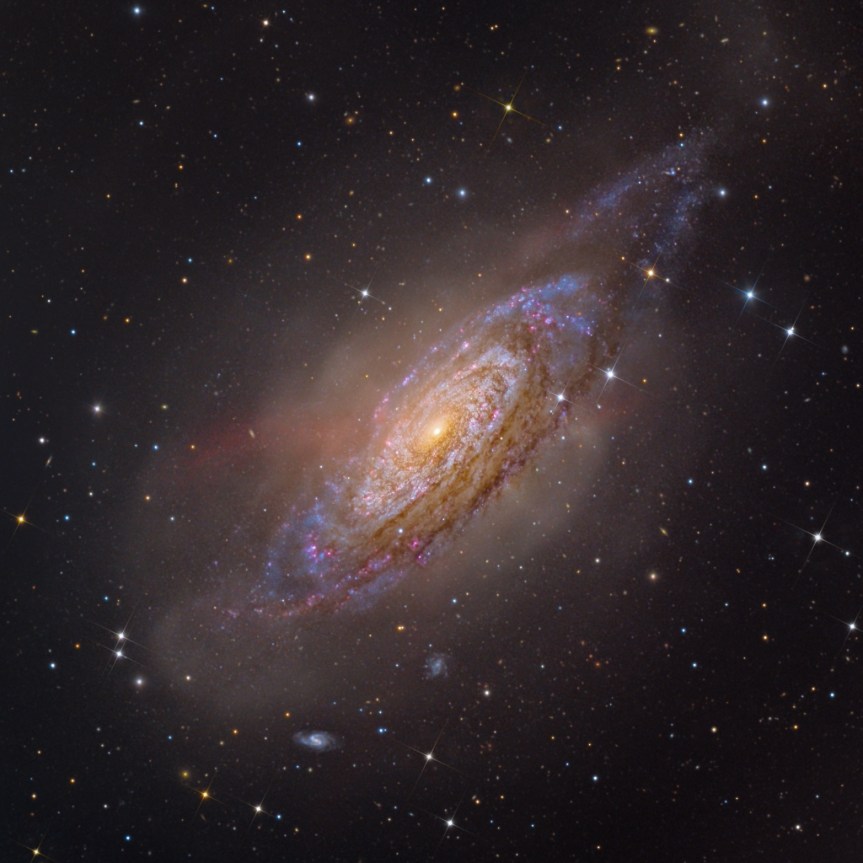
NGC 3521: Galaxy in a Bubble
Image Credit & Copyright: Mark Hanson and Mike Selby
Explanation: Gorgeous spiral galaxy NGC 3521 is a mere 35 million light-years away, toward the northern springtime constellation Leo. Relatively bright in planet Earth’s sky, NGC 3521 is easily visible in small telescopes but often overlooked by amateur imagers in favor of other Leo spiral galaxies, like M66 and M65. It’s hard to overlook in this colorful cosmic portrait though. Spanning some 50,000 light-years the galaxy sports characteristic patchy, irregular spiral arms laced with dust, pink star forming regions, and clusters of young, blue stars. This deep image also finds NGC 3521 embedded in fainter, gigantic, bubble-like shells. The shells are likely tidal debris, streams of stars torn from satellite galaxies that have undergone mergers with NGC 3521 in the distant past.
Let’s Have Some Fun – Printable Coloring Page – The Oak King
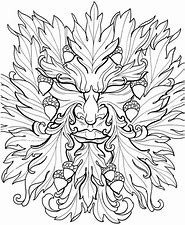
The Legend of the Holly King and the Oak King
In many Celtic-based traditions of neopaganism, there is the enduring legend of the battle between the Oak King and the Holly King. These two mighty rulers fight for supremacy as the Wheel of the Year turns each season. At the Winter Solstice, or Yule, the Oak King conquers the Holly King, and then reigns until Midsummer, or Litha. Once the Summer Solstice arrives, the Holly King returns to do battle with the old king, and defeats him. In the legends of some belief systems, the dates of these events are shifted; the battle takes place at the Equinoxes, so that the Oak King is at his strongest during Midsummer, or Litha, and the Holly King is dominant during Yule. From a folkloric and agricultural standpoint, this interpretation seems to make more sense.
“the rebirth of the Sun or the Oak King. On this day the light is reborn and we celebrate the renewal of the light of the year. Oops! Are we not forgetting someone? Why do we deck the halls with boughs of Holly? This day is the Holly King’s day — the Dark Lord reigns. He is the god of transformation and one who brings us to birth new ways. Why do you think we make “New Year’s Resolutions”? We want to shed our old ways and give way to the new!”
Often, these two entities are portrayed in familiar ways— the Holly King frequently appears as a woodsy version of Santa Claus. He dresses in red, wears a sprig of holly in his tangled hair, and is sometimes depicted driving a team of eight stags. The Oak King is portrayed as a fertility god, and occasionally appears as the Green Man or other lord of the forest.
Click here to read the rest of this article
Let’s Have Some Fun – Printable Coloring Page – The Holly King
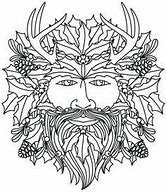
Never-Ending Battle Of The Oak King and Holly King – Confrontation Of The Light And The Darkness
A. Sutherland – AncientPages.com – Holly King is a character in Pagan folklore. Celtic myths describe his fight against his brother, Oak King. He presides over the six months of the year following the summer solstice.
The fight between King Holly and King Oak symbolizes the clash between the cold season (the winter period) and the hot season (the summer period). The kings remain in never-ending “battle,” reflecting the seasonal cycles of the year. It is about solar light and darkness, crop renewal, and successful growth.
The Oak King is ruling the waxing year, and the Holly King is leading the waning year, having attributes in the form of holly and other evergreens. During warm days of Midsummer, the Oak King is mighty and at the height of his strength.
These two mythical pagan figures – symbolizing the changing seasons – personify the winter and summer in numerous folklore and mythological traditions.
The Holly King must accept it and wait patiently to regain power at the Autumn equinox. Then, he has his strength peak during mid-winter.
The Oak King is reborn during this time, with a new power to meet Spring equinox and preserve the legacy. Many consider that the Holly King and Oak King story has its origin in Celtic mythology.
The Celts divided the year into two periods and made Holly King and Oak King the representatives of these two seasons. Let us also remember a clear and dark season among the Celts, thus marking the wheel of time.
Click here to read the rest of this article
A Laugh for Today

Happy hump day!
May 4 Astronomy Picture of the Day
Discover the cosmos! Each day a different image or photograph of our fascinating universe is featured, along with a brief explanation written by a professional astronomer.
2022 May 4
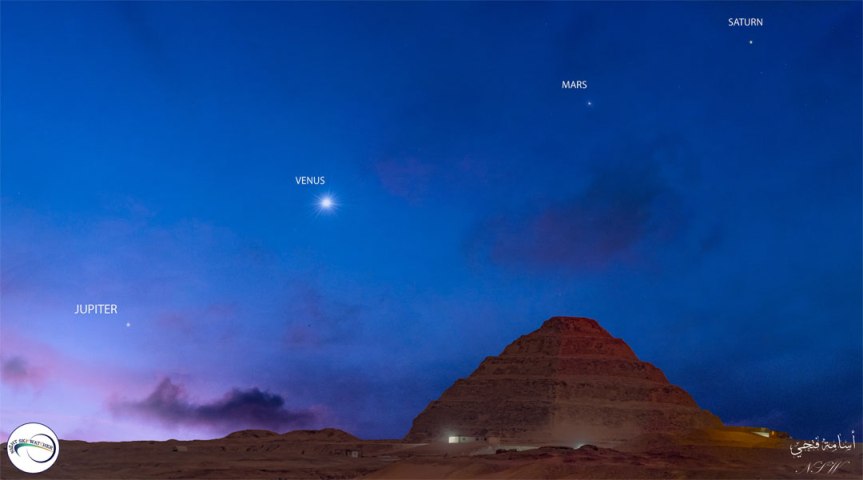
Planets Over Egyptian Pyramid
Image Credit & Copyright: Osama Fatehi
Explanation: The early morning planet parade continues. Visible the world over, the planets Jupiter, Venus, Mars and Saturn have been lining up in the pre-dawn sky since mid-April. In the featured image taken last month, these planets were captured over the Step Pyramid of Djoser, a UNESCO World Heritage Site. Located in the Saqqara necropolis of Egypt, the pyramid was constructed in the 27th century BC and is one of the oldest pyramids known. The two-image composite includes a foreground image taken during evening blue hour, and a background image captured from the same location the following morning. The morning planet line-up is slowly changing. At the end of last month, planets Jupiter and Venus switched places, while at the end of this month, Jupiter and Mars will switch after passing within one-degree of each other. Of course, this picturesque planetary angular alignment is a coincidence, as all of these worlds continue to orbit the Sun as they have for billions of years, well before even the ancient Pyramid of Djoser was built.
Notable Submissions to APOD: Morning Planet Parade 2022
Anthropologist Believes Ancient Human Species Could Still Be Alive In The Forests Of Flores Island
In 2003, archaeologists looking for evidence of the migration of modern humans from Asia to Australia stumbled across a small, fairly complete skeleton of an extinct human species on the Indonesian island of Flores, which came to be known as Homo floresiensis. Or, as it became more commonly known, the Hobbit, after the small, breakfast-guzzling creatures from J.R.R. Tolkein’s The Hobbit.
The species was initially thought to have survived until relatively recently, around 12,000 years ago, before further analysis pushed that date back to around 50,000 years. But one retired professor of anthropology at the University of Alberta says that evidence that the species’ continued existence may have been overlooked, and the Hobbit may still be alive today, or at least within living memory.
In an opinion piece for The Scientist promoting his upcoming book Between Ape and Human, Gregory Forth argues that palaeontologists and other scientists have overlooked Indigenous knowledge and accounts of an “ape-man” living in the forests of Flores.
“My aim in writing the book was to find the best explanation — that is, the most rational and empirically best supported — of Lio accounts of the creatures,” Forth wrote in the piece. “These include reports of sightings by more than 30 eyewitnesses, all of whom I spoke with directly. And I conclude that …
Click here to read the rest of this article from newsbreak.com
A Thought for Today

Until we meet again dear sisters, brothers, and honored guests may you blessed be.
May 3 Astronomy Picture of the Day
Discover the cosmos! Each day a different image or photograph of our fascinating universe is featured, along with a brief explanation written by a professional astronomer.
2022 May 3
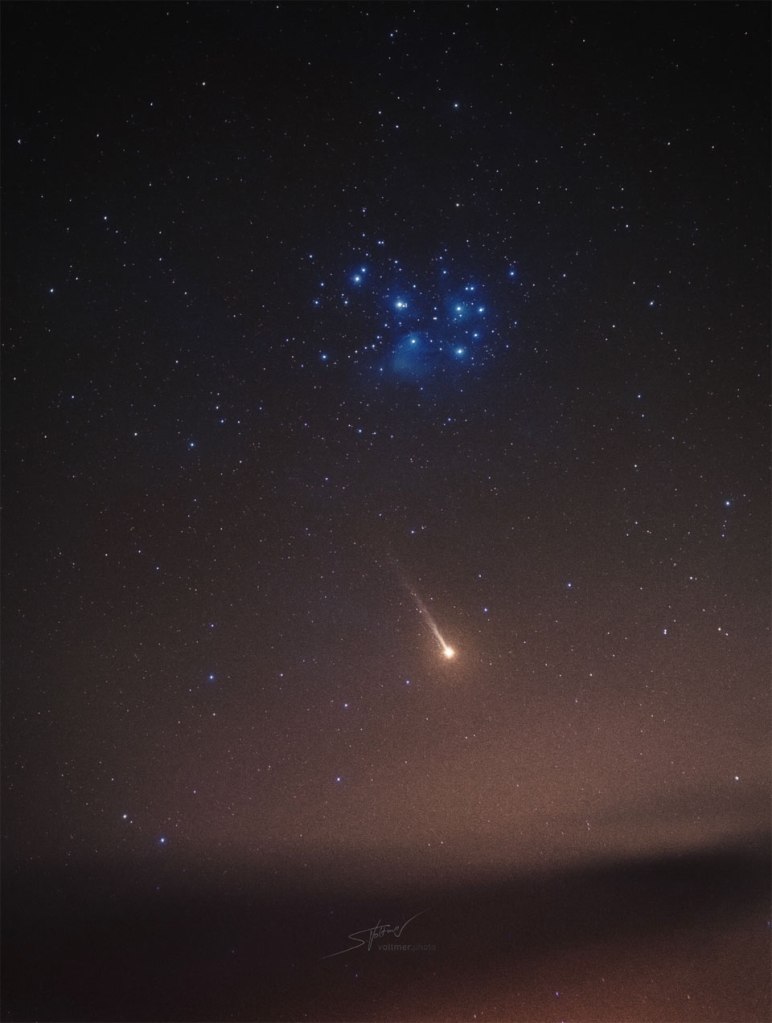
Mercury’s Sodium Tail
Image Credit & Copyright: Sebastian Voltmer
Explanation: That’s no comet. Below the Pleiades star cluster is actually a planet: Mercury. Long exposures of our Solar System’s innermost planet may reveal something unexpected: a tail. Mercury‘s thin atmosphere contains small amounts of sodium that glow when excited by light from the Sun. Sunlight also liberates these molecules from Mercury’s surface and pushes them away. The yellow glow from sodium, in particular, is relatively bright. Pictured, Mercury and its sodium tail are visible in a deep image taken last week from La Palma, Spain through a filter that primarily transmits yellow light emitted by sodium. First predicted in the 1980s, Mercury’s tail was first discovered in 2001. Many tail details were revealed in multiple observations by NASA‘s robotic MESSENGER spacecraft that orbited Mercury between 2011 and 2015. Tails, of course, are usually associated with comets.
PAGAN CALENDAR OF OBSERVANCES
MAY 1: BELTANE SABBAT: Festival of Spring and Fertility. Sidhe Day. Beltaine – Celtic festival marking the arrival of summer in ancient times.
MAY 4: Celtic/British Festival of Cerridwen and Brigit: Corn Goddesses of Fertility
May 4 – Celtic Festival of Cerridwen and Brigit – Corn Goddesses of fertility, healing, and poets.
– St. Monica’s Day (Irish)
– Veneration of the Thorn (Irish)
– Festival of Sheila Na Gig (Irish)
MAY 6: – Shepherd’s Day – Day to meditate on Deity as Lord of Animals: Dumuzi (Old Sumerian), Osiris (Egyptian), Pan (Old Greek), Shiva Pasupati (Hindu).
– Eyvind Kelve (Norse)
MAY 9: – Greek Feast of Artemis
MAY 9-12: Lemuria – Roman festival when the spirits of the dead are thought to revisit their homes.
MAY 13: – Roman Garland Day, Offering garlands to Neptune.
– Month of Hawthorn, Celtic festival of the tree.
– Our Lady of Fatima Day (Portugal)
MAY 14: – Isis Day in ancient Egypt
MAY 14: -16 Feast of Divine Love and Compassion – Source of healing and beneficence, honoring the Goddess as Isis (Old Egyptian), Oshun (Yoruba/Santeria), Lakshmi (Hindu).
MAY 15: – Festival of Vesta (Roman)
– Maia and Mercury’s Day (Roman)
MAY 18: – Celtic Feast of Greek God Pan – Who represents the masculine in Nature and protects men throughout their lives. Men recognized the transitions in their lives and honored male fertility.
MAY 19: Celtic Feast of Brigid – In which sacred healing wells and springs were adorned with flowers in honor of Goddess Brigid, daughter of Mother Goddess Danu and Father God Dagda.
MAY 21: Dark/Bright Mother Goddess Day—honoring Hecate/Demeter; Uma; Kali/Parvati .
MAY 26: – Festival of Diana begins (ends 31st) (ancient Roman holiday)
MAY 28: FEAST OF BENDIDIA—family feast day honoring of the Goddess of the Moon, Dark Moon, Underworld, Secret Wisdom and Witches.
May 30 – Frigg’s Day, Northern Goddess, spouse of Odin (Teutonic “heathen” European pre-Christian holiday)
– Feast of the Queen of the Underworld Begins (Roman)
– Feast of the Queen of Heaven (European)
From WiccanFamilyTemple.org
All Post Will Be Caught Up Tomorrow
I have been up since 6:00 AM yesterday and will mess up the posts if I try to do them this morning. I have finally taken my prescription pain medicine so hopefully I will finally be able to get some sleep.I was up 26 hours before being able to fall asleep. Continue reading “All Post Will Be Caught Up Tomorrow”
May 2 Astronomy Picture of the Day
Discover the cosmos! Each day a different image or photograph of our fascinating universe is featured, along with a brief explanation written by a professional astronomer.
2022 May 2
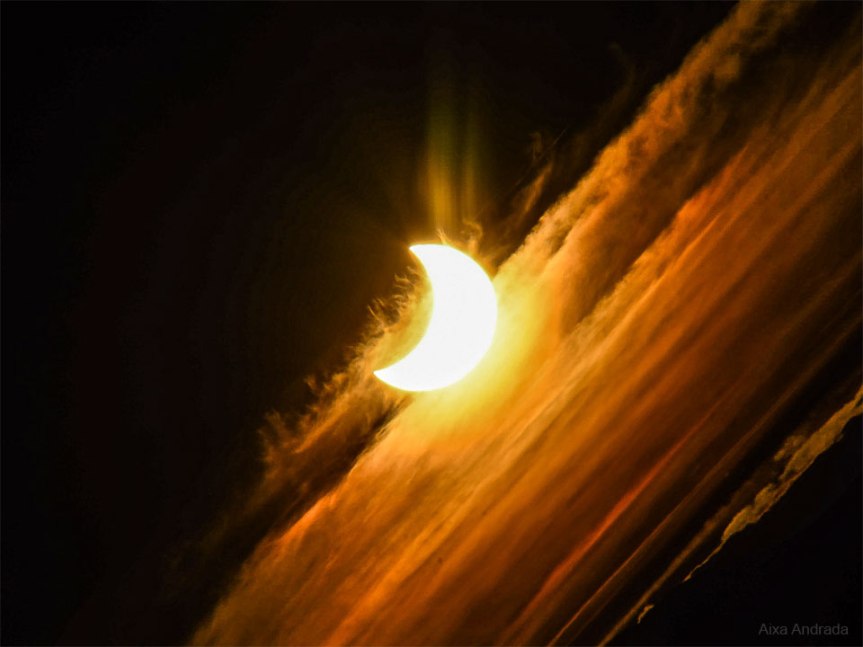
Partial Solar Eclipse over Argentina
Image Credit & Copyright: Aixa Andrada
Explanation: What’s happened to the Sun? Two days ago, parts of South America were treated to a partial solar eclipse — where the Moon blocked out part of the Sun. The featured image shows an image of the partially eclipsed Sun through clouds as it was setting over Patagonia, Argentina. In the tilted image, Earth is toward the right. During the eclipse, the Moon moved partly between Earth and the Sun. Although a visually impressive sight, the slight dimming of surroundings during this partial eclipse was less noticeable than dimming created by a thick cloud. In about two weeks, all of South America and part of North America will experience a total lunar eclipse — where the Earth moves completely between the Moon and the Sun. In about two years, a total solar eclipse will cross North America.
May 1 Astronomy Picture of the Day
Discover the cosmos! Each day a different image or photograph of our fascinating universe is featured, along with a brief explanation written by a professional astronomer.
2022 May 1

First Horizon-Scale Image of a Black Hole
Image Credit: Event Horizon Telescope Collaboration
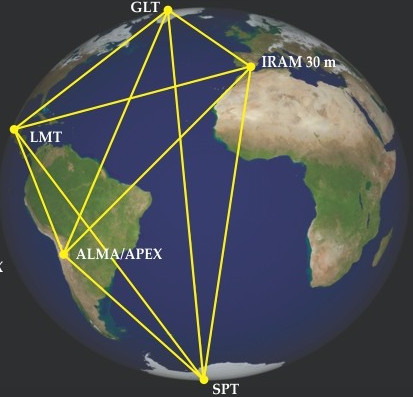
Explanation: What does a black hole look like? To find out, radio telescopes from around the Earth coordinated observations of black holes with the largest known event horizons on the sky. Alone, black holes are just black, but these monster attractors are known to be surrounded by glowing gas. This first image resolves the area around the black hole at the center of galaxy M87 on a scale below that expected for its event horizon. Pictured, the dark central region is not the event horizon, but rather the black hole’s shadow — the central region of emitting gas darkened by the central black hole’s gravity. The size and shape of the shadow is determined by bright gas near the event horizon, by strong gravitational lensing deflections, and by the black hole’s spin. In resolving this black hole’s shadow, the Event Horizon Telescope (EHT) bolstered evidence that Einstein’s gravity works even in extreme regions, and gave clear evidence that M87 has a central spinning black hole of about 6 billion solar masses. Since releasing this featured image in 2019, the EHT has expanded to include more telescopes, observe more black holes, track polarized light,and is working to observe the immediately vicinity of the black hole in the center of our Milky Way Galaxy.
This week is: Black Hole Week
New EHT Results to be Announced: Next Thursday
Edinburgh’s Beltane Fire Festival celebrates the rebirth of summer with fire, dance and drumming
When it comes to big, wild gatherings, Edinburgh is best known for the Fringe Festival, that month long revel dedicated to art, music and drama. There is a much older, if lesser-known, festival however, that’s an equally spectacular event – the Beltane Fire Festival.
The Beltane Fire Festival marks the dawn of summer and the end of frost with bonfires, feasting and rituals meant to appease the aos si – fairy folk who are significantly more bloodthirsty than the ones you find in most modern fairytales.
Along with holidays like Samhuinn, Imbolc and Lùnastal, Beltane was one of the most important, sacred days of the year. Today, this homage to an ancient Celtic holy day once celebrated throughout Ireland, Scotland and the Isle of Man still takes place annually on the 1st of May, or the next closest weekend night.
The ritual of Beltane
The modern Beltaners, as the members of the Fire Society are affectionately known, have taken these elements and run with them, creating a wild, vivid event that mingles historic Scottish folk practices, reconstructed Celtic ritual and …
Click here to read the rest of this article
A Thought for Today

Following your intuition especially when writing a spell will help move you in the direction you should be going. To me my intuition is my spirit guides helping me to stay on my true-life path.
Until we meet again dear sisters, brothers, and honored guests may you blessed be.
Some Witchcraft/Magickal Correspondence Digest for Saturday
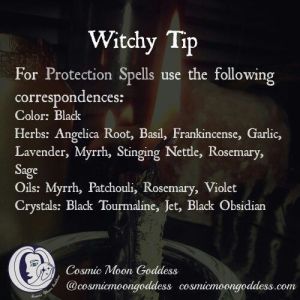

From Learning Religions
Named for the god Saturn—is a good time to wrap things up.
Colors: black and dark purple,
Metal: lead
This day is connected to: goddess Hecate.
Gemstones: Apache tear, obsidian, and hematite
Plants: such as thyme, mullein, and the cypress tree.
Magical workings: focus on agriculture and creativity, fortune and hope, protection and banishment of negativity. Put up a barrier to keep the unwelcome out, eliminate the things that make you miserable, and wash your hands of anything other than your hopes, dreams, and goals.
April 30 Astronomy Picture of the Day
Discover the cosmos! Each day a different image or photograph of our fascinating universe is featured, along with a brief explanation written by a professional astronomer.
2022 April 30
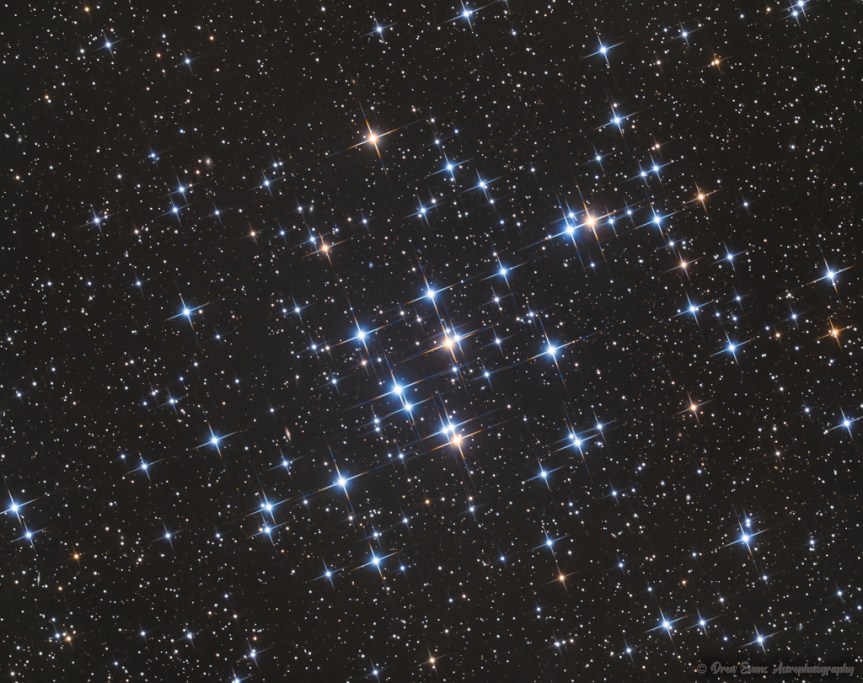
M44: The Beehive Cluster
Image Credit & Copyright: Drew Evans
Explanation: A mere 600 light-years away, M44 is one of the closest star clusters to our solar system. Also known as the Praesepe or the Beehive cluster its stars are young though, about 600 million years old compared to our Sun’s 4.5 billion years. Based on similar ages and motion through space, M44 and the even closer Hyades star cluster in Taurus are thought to have been born together in the same large molecular cloud. An open cluster spanning some 15 light-years, M44 holds 1,000 stars or so and covers about 3 full moons (1.5 degrees) on the sky in the constellation Cancer. Visible to the unaided eye, M44 has been recognized since antiquity. Described as a faint cloud or celestial mist long before being included as the 44th entry in Charles Messier’s 18th century catalog, the cluster was not resolved into its individual stars until telescopes were available. A popular target for modern, binocular-equipped sky gazers, the cluster’s few yellowish tinted, cool, red giants are scattered through the field of its brighter hot blue main sequence stars in this telescopic group snapshot. Dramatic diffraction spikes highlighting the brighter cluster members were created with string crossed in front of the telescope’s objective lens.




You must be logged in to post a comment.