
Day: March 12, 2024
Witchcraft – Definition, History, Varieties, & Facts
Witchcraft, traditionally, the exercise or invocation of alleged supernatural powers to control people or events, practices typically involving sorcery or magic. Although defined differently in disparate historical and cultural contexts, witchcraft has often been seen, especially in the West, as the work of crones who meet secretly at night, indulge in cannibalism and orgiastic rites with the Devil, or Satan, and perform black magic. Witchcraft thus defined exists more in the imagination of contemporaries than in any objective reality. Yet this stereotype has a long history and has constituted for many cultures a viable explanation of evil in the world. The intensity of these beliefs is best represented by the European witch hunts of the 14th to 18th century, but witchcraft and its associated ideas are never far from the surface of popular consciousness and—sustained by folk tales—find explicit focus from time to time in popular television and films and in fiction.
Meanings
The modern English word witchcraft has three principal connotations: the practice of magic or sorcery worldwide; the beliefs associated with the Western witch hunts of the 14th to the 18th century; and varieties of the modern movement called Wicca, frequently mispronounced “wikka.”
The terms witchcraft and witch derive from Old English wiccecraeft: from wicca (masculine) or wicce (feminine), pronounced “witchah” and “witchuh,” respectively, denoting someone who practices sorcery; and from craeft meaning “craft” or “skill.” Roughly equivalent words in other European languages—such as sorcellerie (French), Hexerei (German), stregoneria (Italian), and brujería (Spanish)—have different connotations, and none precisely translates another. The difficulty is even greater with the relevant words in African, Asian, and other languages. The problem of defining witchcraft is made more difficult because the concepts underlying these words also change according to time and place, sometimes radically. Moreover, different cultures do not share a coherent pattern of witchcraft beliefs, which often blend other concepts such as magic, sorcery, religion, folklore, theology, technology, and diabolism. Some societies regard a witch as a person with inherent supernatural powers, but in the West witchcraft has been more commonly believed to be an ordinary person’s free choice to learn and practice magic with the help of the supernatural. (The terms West and Western in this article refer to European societies themselves and to post-Columbian societies influenced by European concepts.) The answer to the old question “Are there such things as witches?” therefore depends upon individual belief and upon definition, and no single definition exists. One thing is certain: the emphasis on the witch in art, literature, theatre, and film has little relation to external reality.
False ideas about witchcraft and the witch hunts persist today. First, the witch hunts did not occur in click here to read the rest of this article
Spell For Tuesday – Uncrossing Spell
(YOU CAN COPY AND PASTE ANY SPELLS POSTED TO A DOCUMENT TO PRINT AND/OR SAVE ON YOUR COMPUTER)
Written by Francisco Huanaco
Uncrossing’ means getting rid of all unwanted and unneeded energies and attachments. 💫 If you believe you may be suffering from a hex-related illness or a run of misfortune, try an uncrossing ritual.
There are many different ways to do an uncrossing spell. Almost all cultures have a version of this ritual, which is mainly for removing negative energies. Keep reading and learn how to uncross yourself if you feel someone has cast a harmful spell against you.
How this Uncrossing Spell works
Bay leaf 🍃 is a strongly protective herb with commanding aspects. In the Middle ages, bay leaves were used to protect people from the plague in various spells and charms. Learn more about Bay Leaf Magic.
Cinnamon promotes healing and is used for opening roads and in purification rituals. More spells with Cinnamon.
Two incense sticks ⚔️ are going to act as our uncrossing agent. Some practitioners prefer to use oils, but in this case we will cross two Frankincense sticks to symbolize the act of physically uncrossing all negative energies.
Uncrossing Spell
Learn how to do an uncrossing ritual with incense, a white candle, and herbs: Bay leaf and Cinnamon.
INGREDIENTS
1 handful of Bay leaves
2 Frankincense sticks
Cinnamon powder (or ground cinnamon)
1 white candle
1 dish
Lighter or matches
DIRECTIONS
Start your ritual by visualizing a circle or simply take three deep breaths as you empty your mind.
Light the white candle on your altar.
Place the bay leaves on the dish.
Sprinkle the cinnamon on top. As you do this, say: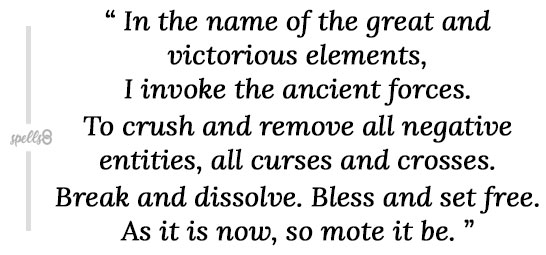
Cross the two sticks of incense on the dish and light them.
Let the incense and the candles burn completely. Don’t let candles burn unattended!
All disturbances, hexes, negative influences and curses will now begin to disappear. If you’re dealing with a particularly strong energy, you can repeat this uncrossing ritual with new incense sticks and candles for 7 consecutive days.
Once you’re done, bury or throw away all the remains in the compost or trash as you say Thanks.
March 12 and 13, 2024 Current Moon Phase for the Northern and Southern Hemispheres

You can use this link to go forward or backward in time for Moon phase information. If you are curious, you can even find out what phase the Moon was in when you or anyone else was born.
The 8 Lunar Phases
There are 8 lunar phases the Moon goes through in its 29.53 days lunar cycle. The 4 major Moon phases are Full Moon, New Moon, First Quarter and Last Quarter. Between these major phases, there are 4 minor ones: the Waxing Crescent, Waxing Gibbous, Waning Gibbous and Waning Crescent. For more info on the Moon Cycle and on each phase check out Wikipedia Lunar Phase page.
Useful Moon Resources
Check the weather before a night of Moon gazing at weather.com
For a list of all the current meteor showers visit American Meteor Society
Source: MoonGiant.com

Northern Hemisphere
March 12, 2024
The Moon’s current phase for today and tonight is a Waxing Crescent Phase. Best seen in the west after the sun dips below the horizon at sunset. This is the first Phase after the New Moon and is a great time to see the features of the moon’s surface. The moon is close to the sun in the sky and mostly dark except for the right edge of the moon which becomes brighter as the days get closer to the next phase which is a First Quarter with a 50% illumination.
Visit the March 2024 Moon Phases Calendar to see all the daily moon phase for this month.
Today’s Waxing Crescent Phase
The Waxing Crescent on March 12 has an illumination of 7%. This is the percentage of the Moon illuminated by the Sun. The illumination is constantly changing and can vary up to 10% a day. On March 12 the Moon is 2.45 days old. This refers to how many days it has been since the last New Moon. It takes 29.53 days for the Moon to orbit the Earth and go through the lunar cycle of all 8 Moon phases.
Phase Details
Phase: Waxing Crescent
Illumination: 7%
Moon Age: 2.45 days
Moon Angle: 0.54
Moon Distance: 366,448.81 km
Sun Angle: 0.54
Sun Distance: 148,699,319.83 km
Illumination: 7%
Moon Age: 2.45 days
Moon Angle: 0.54
Moon Distance: 366,448.81 km
Sun Angle: 0.54
Sun Distance: 148,699,319.83 km
Southern Hemisphere
13 March 2024
The Moon’s current phase for today and tonight is a Waxing Crescent Phase. Best seen in the west after the sun dips below the horizon at sunset. This is the first Phase after the New Moon and is a great time to see the features of the moon’s surface. The moon is close to the sun in the sky and mostly dark except for the right edge of the moon which becomes brighter as the days get closer to the next phase which is a First Quarter with a 50% illumination.
Visit the March 2024 Moon Phases Calendar to see all the daily moon phase for this month.
Today’s Waxing Crescent Phase
The Waxing Crescent on March 13 has an illumination of 14%. This is the percentage of the Moon illuminated by the Sun. The illumination is constantly changing and can vary up to 10% a day. On March 13 the Moon is 3.58 days old. This refers to how many days it has been since the last New Moon. It takes 29.53 days for the Moon to orbit the Earth and go through the lunar cycle of all 8 Moon phases.
Phase Details
Phase: Waxing Crescent
Illumination: 14%
Moon Age: 3.58 days
Moon Angle: 0.54
Moon Distance: 369,626.95 km
Sun Angle: 0.54
Sun Distance: 148,739,836.82 km
Illumination: 14%
Moon Age: 3.58 days
Moon Angle: 0.54
Moon Distance: 369,626.95 km
Sun Angle: 0.54
Sun Distance: 148,739,836.82 km
A Thought for Today
Dear Sisters, Brothers, and Honored Guests welcome to WOTC!
If you would to see some information on any tradition of witchcraft please put it in the comment section. I will try to find some information to post about it.
May your life be filled with all things positive!
 Witches Of The Craft®
You must be logged in to post a comment.