


After a long and seriously unforgiving winter, folks in the Northern Hemisphere are finally reaping the benefits of summer, as June 21 marks the official 2021 summer solstice. Many of us are already marking our calendars with beach days, hikes, and picnics galore — but if you’re looking to tap into the spiritual aspect of the seasonal shift, there are several solstice rituals you can do to welcome summer, in all its glory.
From gifting friends with sachets as a natural mosquito deterrent, to enjoying a seasonal feast of locally-grown goodies, there are so many fun ways to welcome and celebrate summer, sustainably.


You can use this link to go forward or backward in time for Moon phase information. If you are curious you can even find out what phase the Moon was in when you or anyone else, you know was on the date the person was born.
The Moon’s current phase for today and tonight is a Waning Gibbous Phase. This is the first phase after the Full Moon occurs. It lasts roughly 7 days with the Moon’s illumination growing smaller each day until the Moon becomes a Last Quarter Moon with an illumination of 50%. The average Moon rise for this phase is between 9pm and Midnight depending on the age of the phase. The moon rises later and later each night setting after sunrise in the morning. During this phase the Moon can also be seen in the early morning daylight hours on the western horizon.
Visit the December 2021 Moon Phases Calendar to see all the daily moon phase for this month.
The Waning Gibbous on December 21 has an illumination of 95%. This is the percentage of the Moon illuminated by the Sun. The illumination is constantly changing and can vary up to 10% a day. On December 21 the Moon is 16.84 days old. This refers to how many days it has been since the last New Moon. It takes 29.53 days for the Moon to orbit the Earth and go through the lunar cycle of all 8 Moon phases.
There are 8 lunar phases the Moon goes through in its 29.53 days lunar cycle. The 4 major Moon phases are Full Moon, New Moon, First Quarter and Last Quarter. Between these major phases, there are 4 minor ones: the Waxing Crescent, Waxing Gibbous, Waning Gibbous and Waning Crescent. For more info on the Moon Cycle and on each phase check out Wikipedia Lunar Phase page.
Check the weather before a night of Moon gazing at weather.com
For a list of all the current meteor showers visit American Meteor Society

If you need to calculate the planetary positions for a specific use and time, click on this link
To figure out GMT (Greenwich Mean Time) to your local time use this link
The time for the Custom Planetary Positions is from the local time in Frankfurt, Germany, Europe
21 December 2021
04:00 pm GMT 5:00 PM CEST
Zodiac: Tropical (Standard Western)

The time for the Custom Planetary Positions is from the local time in Chicago, Illinois, USA
December 21, 2021
11:00 pm GMT 5:00 PM CST
Zodiac: Tropical (Standard Western)


Take a deep breath as we enter this time of the winter solstice on December 21 in the northern hemisphere. Think of it as a sacred gateway: an ending and a new beginning. With all the noise of 2021, it is time for some much-needed quiet and inner nourishment. Mother Nature is asking us to reflect, recalibrate, and strengthen our ability to shine in the world.
The winter solstice is the shortest day of the year and the longest night. At this time, many cultures believe that the archetypal Great Mother gave birth to a sun child (the Egyptian deity Isis gave birth to sun god Horus; the Greek Leto gave birth to a shining Apollo.) This is a moment to hold the light for yourself and others. Here are eight rituals to help you do so.
On the night of the solstice, unplug your phone, TV, and tablets. Instead of turning on electric lights, eat dinner by candlelight and…
For the past six months, the days have grown shorter and the nights have grown longer in the Northern Hemisphere. But that’s about to reverse itself.
Winter solstice 2021, the shortest day of year and the official first day of winter, is on Tuesday, December 21. How it all works has fascinated people for thousands of years.
First we’ll look at the science and precise timing behind the solstice. Then we’ll explore some ancient traditions and celebrations around the world.


1620 Mayflower Pilgrims come ashore at in Plymouth Bay, traditionally thought to be at Plymouth Rock, Massachusetts [OS=Dec 11]
1898 Scientists Pierre and Marie Curie discover radium
1968 Apollo 8: 1st manned Moon voyage launched with Frank Borman, Jim Lovell and William Anders
1988 Lockerbie disaster: A terrorist bomb destroys Pan Am Flight 103 mid-air, over Scotland; kills all 259 passengers and crew on board, and 11 people on the ground [1]
1991 Soviet Union formally dissolves as 11 of 12 republics sign treaty forming Commonwealth of Independent States
1163 Hurricane hits villages in Holland/Friesland, causing floods
1561 Antoine Perrenot de Granvelle, Archbishop of Mechelen, made Cardinal
1582 Flanders adopts the Gregorian calendar, skipping 11 days making the next day Jan 1, 1583
1598 Battle of Curalaba: the Mapuche people led by Pelentaru revolt and inflict a major defeat on Spanish troops in southern Chile
1620 Mayflower Pilgrims come ashore at in Plymouth Bay, traditionally thought to be at Plymouth Rock, Massachusetts [OS=Dec 11]
1650 Johan de Witt installed as Dutch Pensionary of Dordrecht
1784 John Jay becomes acting US Secretary of State (1789-90)
1788 Hue Tay Son becomes emperor Quang Trung of Vietnam

1914 1st feature-length silent film comedy “Tillie’s Punctured Romance” released starring Marie Dressler, Mabel Normand and Charlie Chaplin
1925 “Battleship Potemkin”, Soviet silent film directed by Sergei Eisenstein, starring Aleksandr Antonov, Vladimir Barksy and Grigori Aleksandrov, premieres in Moscow
1933 Fox Films signs Shirley Temple aged 5, to a studio contract
1934 French film “Zouzou” premieres in Paris, starring Josephine Baker; 1st black woman to star in a major motion picture
1937 The first full-length animated feature film and the earliest in the Walt Disney Animated Classics series, “Snow White and the Seven Dwarfs”, premieres at the Carthay Circle Theatre
1949 “Samson and Delilah”, directed and produced by Cecil B. DeMille, starring Hedy Lamarr and Victor Mature, premieres in New York
1952 WSBT TV channel 22 in South Bend, IN (CBS) begins broadcasting
1953 KOMU TV channel 8 in Columbia, MO (NBC/PBS) begins broadcasting
1920 Jerome Kern/BG DeSylva’s musical “Sally” premieres in NYC
1941 David Diamond’s 1st Symphony premieres
1945 “Billion Dollar Baby” opens at Alvin Theater NYC for 219 performances
1946 “If the Shoe Fits” closes at Century Theater NYC after 20 performances
1950 Cole Porter‘s musical “Out of this World” premieres at New Century Theater NYC; runs for 157 performances
1960 Ornette Coleman records his influential album “Free Jazz: A Collective Improvisation”, establishes the name for the Free Jazz sound
1961 Beatles record “Sweet Georgia Brown” & “Ready Teddy”
1968 Glen Campbell‘s album “Wichita Lineman” goes to #1 in the US
1891 1st game of basketball, based on rules created by James Naismith, played by 18 students in Springfield, Massachusetts
1918 Red Sox trade Dutch Leonard, Ernie Shore & Duffy Lewis to Yankees for Ray Caldwell & Slim Love, Frank Gilhooey, Al Walters & $15,000
1925 Test batsman Hunter “Stork” Hendry scores career best unbeaten 325 for Victoria against New Zealand in drawn tour match at the Melbourne Cricket Ground
1926 Soccer team DOS Struggle forms
1932 Giants sign former outfielder Billy Southworth as a coach
1936 Bradman‘s 2nd consecutive Test Cricket duck! Australia all out for 80
1937 O’Reilly completes 14-98 for cricket match, NSW v South Aust
1937 Chicago Black Hawks left wing Paul Thompson becomes first player in NHL history to score a goal against his brother; scores on bro Cecil of the Boston Bruins with just 9 seconds left in regulation; Bruins win though, 2-1
Discover the cosmos! Each day a different image or photograph of our fascinating universe is featured, along with a brief explanation written by a professional astronomer.
2021 December 21
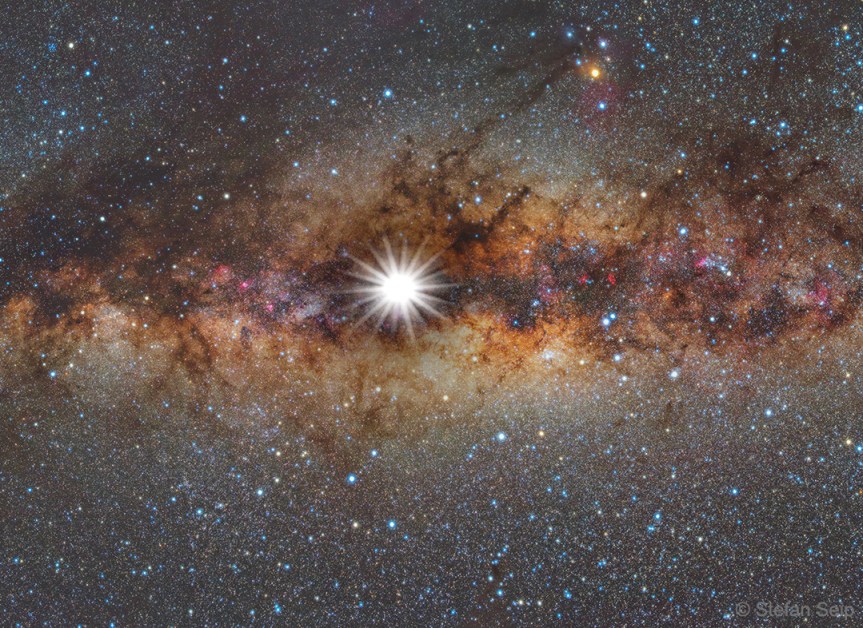
Explanation: Welcome to December’s solstice, first day of winter in the north and summer for the southern hemisphere. Astronomical markers of the seasons, solstice and equinox dates are based on the Sun’s place in its annual journey along the ecliptic, through planet Earth’s sky. At this solstice, the Sun reaches its maximum southern declination of -23.5 degrees today at 15:59 UTC, while its right ascension coordinate on the celestial sphere is 18 hours. That puts the Sun in the constellation Sagittarius in a direction near the center of our Milky Way galaxy. In fact, if you could see today’s Solstice Sun against faint background stars and nebulae (that’s really hard to do, especially in the daytime …) your view might look something like this composited panorama. To make it, images of our fair galaxy were taken under dark Namibian night skies, then stitched together in a panoramic view. From a snapshot made on 2015 December 21, the Sun was digitally overlayed as a brilliant star at today’s northern winter solstice position, close to the center of the Milky Way.
Discovery + Outreach: Graduate student research position open for APOD
Today and tonight the Moon will be in a Waning Gibbous Phase. This is the first phase after the Full Moon occurs. It lasts roughly 7 days with the Moon’s illumination growing smaller each day until the Moon becomes a Last Quarter Moon with an illumination of 50%. The average Moon rise for this phase is between 9pm and Midnight depending on the age of the phase. The moon rises later and later each night setting after sunrise in the morning. During this phase the Moon can also be seen in the early morning daylight hours on the western horizon.
Visit the December 2021 Moon Phases Calendar to see all the daily moon phase for this month.
The Waning Gibbous on December 21 has an illumination of 95%. This is the percentage of the Moon illuminated by the Sun. The illumination is constantly changing and can vary up to 10% a day. On December 21 the Moon is 16.84 days old. This refers to how many days it has been since the last New Moon. It takes 29.53 days for the Moon to orbit the Earth and go through the lunar cycle of all 8 Moon phases.
There are 8 lunar phases the Moon goes through in its 29.53 days lunar cycle. The 4 major Moon phases are Full Moon, New Moon, First Quarter and Last Quarter. Between these major phases, there are 4 minor ones: the Waxing Crescent, Waxing Gibbous, Waning Gibbous and Waning Crescent. For more info on the Moon Cycle and on each phase check out Wikipedia Lunar Phase page.
Check the weather before a night of Moon gazing at weather.com
For a list of all the current meteor showers visit American Meteor Society
21 December 2021
06:00 am GMT 5:00 PM AEDT
Zodiac: Tropical (Standard Western)

21 December 2021
08:00 pm GMT 5:00 PM BRT
Zodiac: Tropical (Standard Western)
 Witches Of The Craft®


You must be logged in to post a comment.