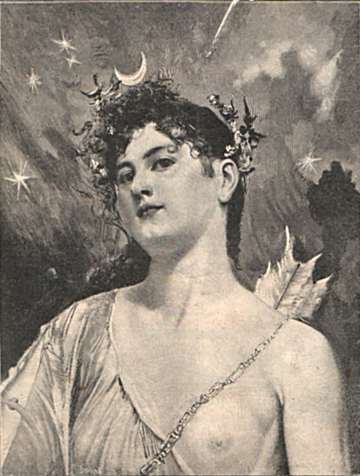
The Calydonian Hunt: Diana

THE COMMENTARY GAZETTE

In that day of the chase, there was one enterprise renowned above all others, the great hunt of Calydon. Thither, in search of high adventure, went all the heroes of Greece, just as they joined the quest of the Golden Fleece, and, in a later day, went to the rescue of Fair Helen in the Trojan War.

For Oeneus, king of Calydon, had neglected the temples of Diana, and she had sent a monstrous boar to lay waste all the fields and farms in the country. The people had never seen so terrible a beast, and they soon wished that they had never offended the goddess who keeps the woods clear of such monsters. No mortal device availed against it, and, after a hundred disasters, Prince Meleager, the son of Oeneus, summoned the heroes to join him in this perilous hunt.

The prince had a strange story. Soon after his birth, Althea, the queen, had seen in a vision the three Fates spinning the thread of life and crooning over their work. For Clotho spins the thread, Lachesis draws it out, and Atropos waits to cut it off with her glittering shears. So the queen beheld them, and heard them foretell that her baby should live no longer than a brand that was then burning on the hearth. Horror inspired the mother. Quick as a thought she seized the brand, put out the flame, and laid it by in some safe and secret place where no harm could touch it. So the child gathered strength and grew up to manhood.

He was a mighty hunter, and the other heroes came gladly to bear him company. Many of the Argonauts were there, Jason, Theseus, Nestor, even Atalanta, that valorous maiden who had joined the rowers of the Argo, a beloved charge of Diana. Boyish in her boldness for wild sports, she was fleet of foot and very lovely to behold, altogether a bride for a princely hunter. So Meleager thought, the moment that he saw her face.

Together they all set out for the lair of the boar, the heroes and the men of Calydon,–Meleager and his two uncles. Phlexippus and Toxeus, brothers of Queen Althea…..Read More


Druids: C. Julius Caesars perspective

THE COMMENTARY GAZETTE


During Caesars’ fight for the control of Gaul he finally came to the understanding, that the one unifying force of the Celts was their religion. The Druid held a promenade place in Celtic society, they administered as judges and advisors amongst other duties. The following are exerts from his communiqués to Rome concerning the progress and his perspective on the war. Caesar acknowledged their power and authority and decided to discredit and destroy the Druids, in an effort to complete his conquest of Gaul.

Book VI (53BCE) Customs of the Gauls:

Chapter 13

“The two privileged classes are the Druids and the knights. The Druids are in charge of Religion. They have control over public and private sacrifices, and give rulings on all religious questions. Large numbers of young men go to them for instruction, and they are greatly honoured by the people.

In almost all disputes, between communities or between individuals, the Druids act as judges. If a crime is committed, if there is a murder, or if there is dispute about an inheritance or a boundary, they are the ones who give a verdict and decide on the punishment or compensation appropriate in each case. Any individual or community not abiding by their verdict is banned from the sacrifices, and this is regarded among the Gaul’s as the most severe punishment. Those who are banned in this way are reckoned as sacrilegious criminals. Every one shuns them: no one will go near or speak to them for fear of being contaminated in some way by contact with them. If they make any petitions there is no justice for them, and they are excluded from any position of importance.

There is one Druid who is above all the rest, with supreme authority over them. When he dies, he is succeeded by whichever of the others is most distinguished. If there are several of equal distinction, the Druids decide by vote, though sometimes they even fight to decide who will be their leader.

On a fixed date each year they assemble in a consecrated place in the territory of the Carnutes: that area is supposed to be the center of the whole country of the Gaul. People who have disputes to settle assemble there from all over the country and accept the judgements of the Druids…..Read More

The Hidden Golden Chair

THE COMMENTARY GAZETTE


It is a good many years since Mrs. Mary Jones, Corlanau, Llandinorwig, Carnarvonshire, told me the following tale.  The scene of the story is the unenclosed mountain between Corlanau, a small farm, and the hamlet, Rhiwlas.  There is still current in those parts a tale of a hidden golden chair, and Mrs. Jones said that it had once been seen by a young girl, who might have taken possession of it, but unfortunately she did not do so, and from that day to this it has not been discovered. The tale is this:

There was once a beautiful girl, the daughter of poor hardworking parents, who held a farm on the side of the hill, and their handsome industrious daughter took care of the sheep.  At certain times of the year she visited the sheep-walk daily, but she never went to the mountain without her knitting needles, and when looking after the sheep she was always knitting stockings, and she was so clever with her needles that she could knit as she walked along.  The Fairies who lived in those mountains noticed this young woman’s good qualities.  One day, when she was far from home, watching her father’s sheep, she saw before her a most beautiful golden chair. She went up to it and found that it was so massive that she could not move it.  She knew the Fairy-lore of her neighbor-hood, and she understood that the Fairies had, by revealing the chair, intended it for her, but there she was on the wild mountain, far away from home, without anyone near to assist her in carrying it away.

And often had she heard that such treasures were to be taken possession of at once, or they would disappear forever.  She did not know what to do, but all at once she thought, if she could by attaching the yarn in her hand to the chair connect it thus with her home, the chair would be hers’ forever.  Acting upon this suggestion she forthwith tied the yarn to the foot of the chair, and commenced unrolling the ball, walking the while homewards. But long before she could reach her home the yarn in the ball was exhausted; she, however, tied it to the yarn in the stocking which she had been knitting, and again started towards her home, hoping to reach it before the yarn in the stocking would be finished, but she was doomed to disappointment, for that gave out before she could arrive at her father’s house.  She had nothing else with her to attach to the yarn. She, however, could now see her home, and she began to shout, hoping to gain the ear of her parents, but no one appeared. In her distress she fastened the end of the yarn to a large stone, and ran home as fast as she could.  She told her parents what she had done, and all three proceeded immediately towards the stone to which the yarn had been tied, but they failed to discover it. The yarn, too, had disappeared…..Read More

Fairy Rewards (Welsh)

THE COMMENTARY GAZETTE

Fairy treasures seen by a Man near Ogwen Lake

Another tale, similar to the preceding one, is told by my friend, Mr. Hugh Derfel Hughes, in his Hynafiaethau Llandegai a Llanllechid, pp. 35, 36.  The following is a translation of Mr. Hughes’s story:-

It is said that a servant man penetrated into the recesses of the mountains in the neighbourhood of Ogwen Lake, and that he there discovered a cave within which there was a large quantity of brazen vessels of every shape and description.  In the joy of his heart at his good fortune, he seized one of the vessels, with the intention of carrying it away with him, as an earnest that the rest likewise were his.

But, alas, it was too heavy for any man to move. Therefore, with the intention of returning the following morning to the cave with a friend to assist him in carrying the vessels away, he closed its month with stones, and thus he securely hid from view the entrance to the cave.  When he had done this it flashed upon his mind that he had heard of people who had accidentally come across caves, just as he had, but that they, poor things, had afterwards lost all traces of them. And lest a similar misfortune should befall him, he determined to place a mark on the mouth of the cave, which would enable him to come upon it again, and also he bethought himself that it would be necessary, for further security, to indicate by some marks the way from his house to the cave.  He had however nothing at hand to enable him to carry out this latter design, but his walking stick.  This he began to chip with his knife, and he placed the chips at certain distances all along the way homewards.  In this way he cut up his staff, and he was satisfied with what he had done, for he hoped to find the cave by means of the chips. Early the next morning he and a friend started for the mountain in the fond hope of securing the treasures, but when they arrived at the spot where the chip-marked pathway ought to begin, they failed to discover a single chip, because, as it was reported-“They had been gathered up by the Fairies.” And thus this vision was in vain….Read More

THE BALLAD OF AILIE FAA

THE COMMENTARY GAZETTE

(A poem of the Borderlands)

Sir Robert has left his castle ha’, The castle of fair Holmylee,

And gone to meet his Ailie Faa, Where no one might be there to see.

He has sounded shrill his bugle horn, But not for either horse or hound;

And when the echoes away were borne, He listened for a well-known sound.


He hears a rustling among the leaves, Some pattering feet are drawing near;

Like autumn’s breathings among the sheaves, So sweet at eventide to hear:

His Ailie Faa, who is sweeter far Than the white rose hanging upon the tree,

Who is fairer than the fairies are That dance in moonlight on the lea.


Oh! there are some flowers, as if in love, Unto the oak their arms incline;

And tho’ the tree may rotten prove, They still the closer around it twine:

So has it been until this hour, And so in coming time ’twill be,

Wherever young love may hang a flower, ‘Twill think it aye ane trusty tree…..Read More

Egypt: the burial Mastabas

THE COMMENTARY GAZETTE

Between the Fayum and the apex of the Delta, the Lybian range expands and forms a vast and slightly undulating table-land, which runs parallel to the Nile for nearly thirty leagues. The Great Sphinx Harmakhis has mounted guard over its northern extremity ever since the time of the Followers of Horus.

Hewn out of the solid rock at the extreme margin of the mountain-plateau, he seems to raise his head in order that he may be the first to behold across the valley the rising of his father the Sun. Only the general outline of the lion can now be traced in his weather-worn body. The lower portion of the head-dress has fallen, so that the neck appears too slender to support the weight of the head. The cannon-shot of the fanatical Mamelukes has injured both the nose and beard, and the red colouring which gave animation to his features has now almost entirely disappeared. But in spite of this, even in its decay, it still bears a commanding expression of strength and dignity. The eyes look into the far-off distance with an intensity of deep thought, the lips still smile, the whole face is pervaded with calmness and power. The art that could conceive and hew this gigantic statue out of the mountain-side, was an art in its maturity, master of itself and sure of its effects. How many centuries were needed to bring it to this degree of development and perfection!….Read More

Dictionary of Gods

Dictionary of Gods


Adonis (Greek)
A youth who was loved by both Aphrodite and Persephone. He was killed by a wild boar while hunting. His name, from the Phoenecian adon, meant “lord”. Adonis was born from a myrrh tree. He is related to the seasonal vegetation myth and the Babylonian dying God, Tammuz.
Apollon, Apollo (Greco-Roman)
God of the sun, medicine, and prophecy. His symbols were the lyre, the bow, and the laurel. Apollo is the Latin spelling of the God’s name. Apollon is the transliteration of the Greek spelling of his name.
His epithet, Phoebus, means, “bright” or “shining”. In Rome, he displaced any deities with solar connections. During the Roman empire, his Greek shrine in the city of Phocis, at Delphi, was consulted by many people, including eminent Romans. The epithet, Pythian Apollo, referred to his oracular spirit speaking through his priestess at Delphi, the Phoebad, or Pythia. Apollo had numerous other oracular shrines in Greece and Rome.
Another of his titles was Smintheios or Smintheus, meaning “mouse” or “of the mice.”
Apulu (Etruscan)
A God depicted as a handsome youth, and was often pictured with the Goddess Artini. His name indicates he was the Etruscan counterpart of the Greek Apollo.


Bacchus (Roman)
The God of wine and ecstatic rites. His rites, known as the Bacchanal, were viewed by some staunch Romans as unbridled debauchery, and the nocturnal worship was repressed by a decree by the Roman Senate in 186 bce. Eventually it was accepted as a respectable mystery religion.
Bacchantes were women dedicated to his worship. They dressed in animal skins and roamed the fields and mountains filled with the God’s divine ecstasy.
Bonus Eventus (Roman)
A rural God in charge of the “Good Event” of the harvest. Later, he became of God of luck or success.


Deus Fidius (Sabine)
Guardian of hospitality.
di parentes, divi parentes (Roman)
“Di” is the plural of the Latin word deus meaning “god,” and literally means “gods.” The di parentes were the Roman spirits of dead family members and ancestors. From the name, they may have been venerated as collectively deified ancestors. The di parentes were honored during the Parentalia, February 13-21. On February 13, a Vestal Virgin performed the opening public rites for the collective Roman di parentes at the “tomb of the Vestal Tarpeia.” The rest of the festival was for domestic and familial rites. Romans were expected to give offerings to the deceased at the family tombs. Apparently, the Parentalia was related to an Etruscan festival of the dead. on the last night of the Parentalia at the Feralia the paterfamilias addressed the malevolent, destructive aspects of the spirits. It was after the Parentalia on February 22, the Caristia that the family held a banquet to honor the lar familiaris. The di parentes do not seem to be quite the same thing as the manes, the lares, or the lemurs. However, sometimes the terms seemed to be used interchangeably. (It is possible that this entry more correctly belongs on the ABC of Aradia webpage.)
Dis (Roman)
God of the underworld. He was sometimes referred to as Dis Pater, Father Dis; however, Dis Pater was the name the Romans later gave to the Celtic God, Cernunnos.


Fauns (Roman)
Male spirits of wild nature frequently depicted with horns and hooves–like goats. They are covered with body hair.
Faunus (Roman)
A rural God, partly human in form. He was the patron of animal husbandry, herding, hunting, and a guardian of the secrets of nature. He was also worshipped as a prophetic God. The Luperci, meaning “wolf warder,” were his priests. Clad only in goat skins, the Luperci ran around the Palentine Hill in Rome at the festival of Lupercalia held on February 14 or 15. It was a fertility rite, but also intended to protect domestic animals and new offspring from wolves. Any women who desired to conceive that year allowed the Luperci to strike their palms with goatskin thongs called februum. Faunus was later identified with the Greek Pan, God of flocks and pastures.
Februus (Etruscan Italian)
God of purification, Februus was possibly related to Dis, the God of the underworld. He may also be connected with Febris, a Roman Goddess of malaria and fever.
four winds (Roman)
The Venti are the four Gods personifying the four winds in Roman mythology. They are: Aquilo/Aquilon or Septentrio (North wind); Vulturnus (East wind); Auster (South wind); Favonius (West wind). The Venti are equivalent to the Greek: Boreas (North wind); Eurus (East wind); Notus (South wind); Zephyrus (West wind).


Janus (Italian)
Consort of Jana. The God who presided over gates, doors, and passages. He may have originally been worshipped as a sun God, especially since Jana, his wife, was identified with the moon Goddess, Diana. As a God of beginnings, Janus did preside over daybreak in his aspect as a solar God. Janus was often depicted as two-faced, so that he could look both forward and back. In ceremonial prayers, he was often invoked as “Father” and mentioned first before the other Gods.
Jove Pater, Jupiter (Roman)
The patriarchal “Father of the Gods” and supreme God of the Roman pantheon. Jove was originally a weather-God. He was also viewed as a beneficent and fair God of justice. He absorbed some of the mythology of the randy Greek Zeus.


Liber, Liber Pater (Roman)
A God of fecundity, he presided over fields. He was worshipped with the Goddess Ceres, and with the Goddess of wine, Libera. His festival was the Liberalia, celebrated on March 17. He was often identified with Bacchus.
Lucetius (Roman)
A Latin title meaning, “light-bearer,” used for Gods in their solar aspect. Jove was, for example, known as Jupiter Lucetius.


Mars, Murs, Marmar, Marmor, Marspiter (Roman)
The parthenogenic son of Juno. The God of war originally had agricultural attributes. His earliest function was a protector of agriculture and cattle. The wolf, horse, and woodpecker were sacred to him, as were the oak, laurel, dogwood, fig tree, and beans. He was called Mars Gardivius from gandiri, meaning, “to grow, to become big.” Marspiter meant Mars Pater, or Father Mars, just as Jupiter meant Jove Pater, Father Jove.
His protective nature eventually extended to protecting the people of Rome as a warrior. In the end, his warrior function supplanted his agricultural function. He was worshiped in a triad with the Gods, Jove and Quirinus. In the Classical era, his priests, the Salli, carried the sacred shields, the ancilia. Like his son, Romulus, he was worshiped under the title, Quirinus.
Mithras (Persian Roman)
Mithras was the God of heavenly light, the God of truth. Mithras was another foreign God transported to cosmopolitan, polytheistic, multi-cultural Rome.
Originally he was Mitra or Mithra, sort of a defender or personification of the sanctity of contracts and treaties. He was absorbed into monotheistic Zoroastrianism and became identified as an aspect of the Ahura Mazda, the Wise Lord, who was the supreme deity and the God of Truth, Justice, and Light.
By the time the cult of Mithras reached Rome, it had become an intricate mystery religion and absorbed many foreign elements, including a strong strain of astrology. Only men could be votaries in the Roman cult. Mithras became a patron God of merchants due to his association with contracts. Possibly also because of Mithras’ association with contracts, and thus for a tour of duty for a soldier, Mithraism became a favorite cult among the Roman troops, who spread it all over the Roman empire.
In Mithraeums, the God was often depicted slaying a bull, which originally may have been a reference to an astronomical/astrological event: moving from the Age of Taurus (the bull) into the Age of Aries (the ram). (An astronomical/astrological Age is determined by which zodiac sign the sun rises in on the vernal equinox.) In any case, the image of the bull represents the life force and the earth is made fertile by its death.
In Rome, the Mithraic priests, were known as Patres Sacrorum, “Fathers of the Sacred Mysteries.” The worship of Mithras was valued not only for its mystery, but its ethical system. One of the Roman titles of Mithras was Areimanios. The sacred Haoma beverage and cakes were offered to him.
The Roman cult of Mithras was not truly as monotheistic as Zoroastrianism. Votaries were expected to live an exemplary life and to give worship to Mithras first. Nevertheless, family deities, household Gods, local divinities, etc., could be worshipped second.
Mutunus, Mutinus-Tutinus, Tutinus-Mutinus (Etruscan)
An ancient phallic God whose cult blended with the Roman cult of Priapus. His name, Mutunus, was derived from muto, the verile male member.


Neptunus, Neptune (Roman)
Orginally a water-God, who also protected against drought. For his festival on June 23, huts of branches would be built apparently as a protection against the summer sun. Later, he was God of the sea. He created the horse and thus white waves crashing on the shore were said to be white horses. His consort was Salacia. His Etruscan name was Neptuns.


Pan (Greek)
An ancient horned God of fertility. Primarily, he was the protector of flocks and herdsmen. Pan was a God of all of nature and the wilderness. Hunters were said to appeal to him to bring them game animals. He was pictured with the lower parts of a goat and the torso, arms, and head of a man, though crowned with horns. Pan was a lusty, merry God, who dwelt in Arcadia and delighted in sporting with the nymphs.
Penates, Dii Penates (Roman)
Spirits that protected the food storehouses of the home. They were honored on the hearth along with the Goddess, Vesta. The Penates were said to enjoy, along with other offerings to them, the aroma of roast meat (nidore).
Phoebus (Roman)
Phoebus was a Latin spelling of a title for Apollo. In the 5th century bce, he was adopted by the Romans as a God of medicine, music, prophecy, and the sun, and said to be the son of Latona and Jove. The Romans hoped his influence would help the people avert a plague. His title means the “Bright One” and the healing rays of the sun symbolized his power as a healing God.
Plutus, Pluton, Plutos (Greco-Italian)
An Italian aspect of the Greek Pluto, tacturn lord over the innumerable dead in the Lower World, which was awarded to him by Zeus, his brother.
As an Italian underworld deity, Plutus was associated with the Roman Dis. Nevertheless while Roman altars to Dis were rare, Plutus was apparently somewhat more revered, particularly in Sicily, where the “Damatres,” Ceres and Proserpine were widely worshipped.
Plutus was also a god of agricultural abundance. The name, Pluton, meant “Giver of Wealth.” Plutus meant “Wealth.” He has been interpreted to be a god of wealth from both above the earth soil, crops, and under the earth, gold and precious stones. Interestingly, Plutus or Pluton was likewise said to be a son of Ceres or her Greek counterpart, Demeter. This son of the grain goddess was raised by the Roman Goddess Pax, meaning “peace.”
In Rome, Plutus or Plutos was confused with Orcus, who carried the dead to the underworld. For example, a series of funerary frescoes depicted a woman, the Vibia, carried off by Plutos and brought before the judgment of the underworld deities. Three Fata Divina, “faeries of destiny,” appeared at the dead woman’s tribunal. A final fresco showed Vibia among the blessed dead at a banquet.
Priapus, Mutunus, Fecundus (Greco-Roman)
A phallic God. He presided over procreation and fertility. In particular, Priapus was associated with gardens and bees. As a guardian deity, Priapus often carried a pruning knife, but the Priapus of Verona carried a basket full of phalluses. Statues of the God were usually carved of wood and painted red. His image was placed in orchards, gardens, and entranceways for protection.
Pythian Apollo (Greek)
An epithet of Apollo, relating to his temple at Delphi.


Romulus (Roman)
Twin brother of Remus and son of Mars and Silva. He and his brother were suckled and raised by the she-wolf, Lupa. Romulus was credited as the founder of Rome. He accidentally slew his brother Remus in a quarrel. According to legend, he became the first king of Rome. Romulus was worshipped under the name of Quirinus after his death.
There was an alternate versions describing the birth of Romulus and Remus cited by Plutarch. Written in the Etruscan language, Promethea’s history of Italy stated that a mystical phallus had appeared in the chimney of the king of Albe. The king ordered his daughter to couple with this phallus. His daughter, however, sent her servant-girl in her stead. The servant bore twin sons, later known as Romulus and Remus, who were abandoned in the forest and suckled by a wolf.


Sator (Roman)
A deity that presided over sowing.
Saturn, Saturnus (Roman)
An agricultural God, depicted with a sythe. The celebration of his festival, the Saturnalia, December 17-23, involved feasting and much merriment, including decorating with evergreens and gift-giving. During the Saturnalia, slaves were allowed great liberties in honor of Saturn’s Golden Age, and the pater familius or male head of the household served his slaves meals at the family table.
Simply due to Saturnalia’s proximity on the calendar to the Mithraic festival of the Natilus Sol Invictus, “Birthday of the Invincible Sun,” December 25, seemed to link the two holidays in the mind of the general Roman populace. Both holidays were linked to the winter solstice.
It is a telling fact that the people of Rome became the first to officially celebrate the nativity of Christ in 337 c.e. on the very same date as the Mithraic festival, and that the new celebration incorporated several aspects of the Saturnalia as well.
Semo Sancus (Latin)
God of oaths.
Sentinus (Roman)
The God who presided over the intellectual stimulation of children.
Smintheios(Greek)
See Apollon, Apollo. See Smintheus.
Smintheus (Greek Latin spelling)
Robert Graves, in 1955, 1969 (p. 56) wrote: “One component in Apollo’s godhead seems to have been an oracular mouse–Apollo Smintheus (‘mouse Apollo’) is among his earliest titles…” Indeed, white mice were sacred to Apollo and supposedly they whispered secrets gathered from the earth in his ear.
Smintheus is a surname of Apollo, which is derived by some from sminthos, a mouse. Others claim the name is dervied from the town of Sminthe in Troas The mouse was regarded by the ancients as inspired by the vapours arising from the earth, and as the symbol of prophetic power. On some coins, Apollo was represented carrying a mouse in his hands. In the temple of Apollo at Chryse, there was a statue of the God by Scopas, with a mouse under its foot. Temples of Apollo Sminthens and festivals (Smintheia) existed in several parts of Greece.
Somnus (Roman)
God of sleep and oblivion, he was black, covered with golden stars. He is associated with poppies and wears them on his head as a crown.
Sterculinus, Stercutius, Sterculus, Stercutus (Roman)
Sterculinus was an archaic God presiding over manure spreading. He was at one time honored by farmers. Manure was an important source of fertilizer for crops in early Italy.
Summanus, Summano (Roman, Etruscan)
In Roman mythology, Summanus was the God of nocturnal thunder. Originally he was Summano, an Etruscan thunder-sky God. A most ancient deity, he particularly presided over the night sky.
Sylvanus, Silvanus (Roman)
A rural God, guardian of woods, forests, and fields. He was also known as Callirus, meaning “Woodland King.” His name is the origin of the word, “sylvan.”


Tinia, Tin, Tina (Etruscan)
The supreme God of the Etruscan pantheon. He was the male deity of a divine triad, along with the Goddesses, Uni and Menrva, represented in art. Tinia was often depicted as holding three thunderbolts. Tinia may have been the same deity as Voltumna. It was at Voltumna’s sanctuary near the lake of Bolsena that apparently the tribes of Etrusca convened to choose a king.


Usil (Etruscan)
The deified sun.


Venti (Roman)
See four winds (Roman)
Vejovis, Vedius, Vediovis (Italian)
A very early name meaning “Little Jove” or “Little Dius.” An epithet or aspect of Jove when he was depicted without thunder. As Vedius or Vediovis, “Little Dius,” he may be linked to the Indo-Vedic-Hindu, Diaus or Dyaus, as sky deity known as Dyaus-Pitar (“sky-father”), who is related to Jove Pater.
Vertumus, Vortumnus (Roman)
Probably of Etruscan origin, he was variously regarded as God of changes: of the changing season, of the manifold productions of the vegetable world, etc. Vertumus, for whom “the first grape turns blue on its bunch and the ear of corn [grain] swells with milky juice,” (Propertius in Elgies) was honored on August 13 in his temple on the Aventine. His name may have given the Romans their Latin word, vertere, “to change.” He changed himself into a handsome youth in order to persuade the Goddess Pomona to marry him. He was associated with Sylvanus.
Virbius (Roman)
A mysterious woodland God, worshipped at Nemi with Egeria and Diana. Some scholars speculate, he was a primitive God associated with childbirth, as Egeria and Diana were both invoked as midwives at Nemi. Other sources identify Virbius with the sun. It was unlawful to touch his image. Late mythology claimed Diana brought Virbius to Nemi to hide him from the wrath of Neptune. Virbius was said to have married Egeria, however, it is likely he was originally consort to the Italian Diana. His priest was the Flamen Virbialis.


Xudam (Etruscan)
A god identified with the Roman Mercury.


The list in my “Dictionary of Gods” is even smaller than my “Goddess Dictionary,” a fact which betrays my Wiccan inclinations. Often when we, Wiccans, try to give equal time to the Gods, we still end up emphasizing the Goddesses. Nevertheless, I have included these Gods because they provide background relevant to my “Dianic Mythology.”

Sources

Raymond Buckland, The Witch Book, The Encyclopedia of Witchcraft, Wiccan and Neo-paganism, 2002.

Alain Danielou, The Phallus, Sacred Symbol of Male Creative Power, English translation, 1995.

Sir James George Frazer, The Golden Bough, 1935.

Robert Graves, The Greek Myths, Vols. 1 & 2, 1948.

Judika Illes, The Encyclopedia of Spirits: The Ultimate Guide to the Magic of Fairies, Genies, Demons, Ghosts, Gods and Goddesses, 2009.

New Larouss Encyclopedia of Mythology, 1959, 1968.

Carole Potter, Knock On Wood and Other Superstitions, 1983.

Robert Turcan, The Cults of the Roman Empire, 1992, 1996.

Robert Turcan, The Gods of Ancient Rome, 1998.

Patricia Turner and Charles Russell Courter, Dictionary of Ancient Deities, 2002.

Harry E. Wedeck and Wade Baskin, Dictionary of Pagan Religions, 1971.

Goddesses Dictionary

Goddesses Dictionary


A
Abeona (Italian)
Abeona was the pre-Roman goddess of departures and was often petitioned to provide for the safety of children as they embarked upon journies. Her sister was Adeona, goddess of safe and speedy returns, and they were often petitioned in tandem.
Abundantia (Roman)
A minor Goddess who personified abundance. She did not—apparently–have as large a following as Ops or Copia. Aside from being a minor Goddess, Abundantia, was also one of the Roman Public Virtues representing “Abundance, Plenty.” Roman culture also strove to uphold virtues which were shared by all of society for the common welfare of the Roman people. Abundantia represented the ideal of there being enough food and prosperity for all segments of society in Rome.
In later folklore, Abundantia seems to have entered homes during the night to bring prosperity. This versions  of  this Goddess or spirit of abundance may have traveled with Romans through different regions of the Empire and thus walked into local folklore.
See Abundia/Abonde, Habondia, Habonde, Herodiana, Herodiade, Erodiade, and Herodias in   The ABC of Aradia and Other Subjects .
Aetna (Sicilian)
Aetna was the presiding goddess of Sicily’s Mount Etna. Mount Etna is an active volcano. Many deities and spirits have been associated with Mount Etna in Sicily.
Adeona (Italian)
Adeona was the pre-Roman goddess of safe and speedy returns. Her sister was Abeona, spirit of departures. In particular, she was petitioned for safe and speedy return of children to the family.
Amalthea (Greek)
The she-goat that suckled the God, Zeus, as an infant. Her horns flowed with nectar and ambrosia.
Angitia, Angita (Italian)
An early Goddess of witchcraft and healing of the Oscan tribe. Angitia was associated with verbal and herbal charms, especially against snakebite. Her name referred to killing snakes through enchantment. The Romans sometimes associated her with Bona Dea, the “Good Goddess.” Angitia was honored in Italy’s Marsian district, which is still famous today for its witches. She was also identified with the sorceress, Marica.
Anna Perenna (Roman)
Goddess of the new year. Her feast was celebrated on March 15. Anciently, March 15 or March 25, according to some scholars, marked the beginning of the celebration of the Roman New Year.
Aphrodite (Greek)
The Goddess of beauty, desire, and love was not originally Greek. She was one of the ancient Goddesses of the East Mediterrian. Greek mythographers said she arose from the sea and travelled to the island of Cyprus, off the coast of Greece, and was sometimes called Cytheria. Aphrodite’s most famous center of worship was at Paphos, where the original white image of the Goddess was kept. Hence she was also called Paphian Aphrodite.
Aphru (Etruscan)
An Etruscan counterpart of the Greek Aphrodite and the Roman Venus. The month of Aprilis (April) was devoted to Venus. Aprilis may have derived from Aphru.
Aricia (Roman)
A minor Goddess, who ruled prophetic visions, which were received in wild places, far from human habitation. She may have been an aspect of Diana, as Aricia was the name of one of Diana’s shrines.
Artemis (Greek)
Goddess of the hunt and queen of the wild beasts. In Classical imagery, she is the maiden of the new crescent moon, appearing nude or in a short tunic, armed with a bow and quiver of arrows. Accompanied by a band of nymphs, she roamed the mountains and forests of Greece.
Artemis was the elder twin of the sun. Her mother, Leto, bore her without labor pains, and then Artemis assisted as midwife when Apollo was born. She was invoked by women while giving birth as Artemis Eileithyia. As one of her aspects was a bringer of fertility, offerings included fruit, animals, and clay phalli. Spindle-whorls loom weights, and shuttles have been found in shrines dedicated to Artemis. From inscriptions, it is known that woolen and linen threads wound on spools were offered as gifts, as well as clothes. In Athens, Artemis was honored with selenai, round honey cakes representing the moon.
Artemis was likewise the protector of human children and young animals. She is assumed to be a chaste, perpetual virgin, or perhaps a lesbian Goddess who avoids the society of males.
Her title, Apollousa, “the destructress”, referred to her arrows with which she could inflict sudden death and plagues.
Artio (Gaulish-Celtic)
A Goddess of wildlife who often took the form of a bear.
Artini (Etruscan)
A maiden Goddess in northern Italy; the Etruscan form of Artemis.
Aventina (Roman)
Many-breasted Diana, whose image was in a temple on Aventine Hill, in Rome.


B
Bona Dea (Roman)
An ancient Goddess, she was worshipped only by women in secret rites during December. Men were not permitted at these rites. The name literally means, “the Good Goddess” and may have been a title of the Goddess, Fauna or Fatua. In any case, the rites were always at some home of a distinguished Roman matron. During these rites, Bona Dea was revered as Goddess of fertility and abundance, and wine flowed freely in her honor.


C
Camenae, Camena, Carmenai (Roman)
Like the Fons, who were nymphs of fountains, the Camenae were demi-Goddesses of fresh water. They inhabited lakes, springs, and rivers. Uniquely, these nymphs were also Goddesses of prophecy and instruction. Their name means “foretellers.” Egeria at Nemi was the most famous of the Camenae.
On October 13, the Fontinalia, both the Camenae and the Fons were worshiped by throwing wreaths upon their waters.
The Romans indentified the airy Greek Muses of inspiration with the Camenae.
Carna (Roman)
Goddess of protection, and of health and well-being of humans, especially small children. She presided over the intestines, heart, and other human organs. Some scholars have described Carna as being a Goddess of good digestion. .When parents appealed to Carna, this Goddess would enter the home and perform certain rites to bar a strix from entering the house. The strix was sort of a supernatual screech owl. If this evil creature could, it would fly in at night and eat a sleeping child’s intestines so the child would not get good nourishment and waste away. Her festival took place on June 1. Carna was tradtionally offered bacon and beans.
Ceres, Kerres (Roman)
Goddess of the grain who presided over harvests. In August, women enacted secret rituals in her honor. The Cerealia on April 19 was celebrated to protect the crops and ensure a bountiful harvest. From her name, we have the word for a common breakfast item, “cereal.”
Cloacina (Roman)
Goddess in charge of the sewers. She is, therefore, a Goddess of sanitation in the modern sense of the word.
Copia (Roman)
A Goddess of plenty, her name survives in the word, cornucopia, “the horn of plenty,” which she, and other fertility or harvest Goddesses, were depicted as holding.
Cupra (Etruscan)
A Goddess of lightning, often depicted with a spear. An ancient Goddess of fertility, she formed a triad with the God, Tinia and the Goddess of Wisdom, Menvra. Her weapon, when depicted with Tinia and Menvra, was the thunderbolt.
Cybele (Phrygian)
A powerful divine image, the Mountain Mother, as Cybele was known in Phrygia, Anatolia, Cybele was described as a full-breasted, mature woman, crowned, bearing her symbols of grain and keys, arrayed in a robe of all colors of blossoms. Though she was a mother of all of nature, Cybele was not a gentle Goddess. She traveled in a lion-drawn chariot. Her consort was the dying and reborn God, Attis, who castrated himself after he betrayed Cybele with another female. Cybele had struck him with madness as punishment for not being loyal to her.
Romans were true polytheists and welcomed many foreign divinities into Rome. The cult of Cybele entered Rome in 204 bce. Hanibal of Carthage threatened Rome. Consultation of the Sibyline books revealed that the Carthaginian would only be defeated if the black stone of Cybele was brought with ceremony and honor to the Capitol. So the ancient image of Cybele was brought to Rome with her priesthood. Sure enough, the Romans defeated the Carthaginian in due time.
Unfortunately, Cybele’s priests were eunuchs, who had castrated themselves in a state of divine madness during initiation, something the Romans were never comfortable with. Nevertheless, in Rome, the Cybele ceremonies focused on springtime, March 15-27. They began with the triumphal entry of the young Attis, symbolized by a pine tree, into Rome. The evergeen was adorned with violets, which were considered to have sprung from the blood of Attis. The following day was one of fasting and mourning, with litanies of sorrow over the death of young Attis. On March 24, the “Day of Blood,” her chief priest, the archigallus, drew blood from his arms and offered it to her, to the music of symbols, drums, and flutes while the galli, her priests, whirled madly and slashed themselves to splatter the altar and the sacred pine with their blood. Finally, at Attis’ resurection, there followed jubilations and hymns glorifying his rebirth at the arrival of the new growing season. On March 27, the silver statue of the Goddess with the sacred stone set in its head was borne in procession and bathed in Almo, a tributary of the Tiber River.
The powerful image of death and rebirth in the cycle of seasons may have reinforced this attribute in other divinities in Roman thought. Or perhaps all the similarities were already there. The Romans identified her with the Goddesses, Ceres, Ops, Rhea, and Tellus.
Cybele was assigned several Roman titles, including Magna Mater and Mater Turrita


D
Damatres (Sicilian)
A title of Ceres and Proserpine, meaning “The Mothers.”
Dea (Roman)
Simply the Latin word for Goddess.
Dea Mors(Roman)
The name literally means “the Goddess Death,” possibly this is a title of another Goddess, or simply a feminine personification of death. Dea Mors is sometimes said to the the eldest of the Fatae. Dea Mors may also have been linked to Libitina, the goddess who presided over funeral services. It is possible that she was somehow linked to Proserpine, Queen of the Dead.
Devera (Roman)
This Goddess presided over brooms used to purify ritual sites.
Dia, Dea Dia (Roman)
Known as “the Goddess Dia,” her name indicates that Dia was one of Italy’s original Goddesses, but little information survived about her. dd>Her three day festival, Ambarvalia, was celebrated in May by her priesthood, the Fratres Arvales. They also tended her sacred grove, the Lucus Deae Diae, located along the River Tiber. If a tree in the grove or rotten limb was downed in a storm, the priests had to make offerings of sows or lambs. Iron was taboo in her grove. If an irongraving tool was brought into this sacred grove for purposes of cutting stone, the priests would offer a sow and a lamb as an expiatory sacrifice.
In ancient Roman religion, a “lucus” was a sacred grove. Lucus was one of four Latin words generally meaning “grove, forest, woodland, grove” (along with nemus, silva, and saltus). Lucus was primarily used as a religious designation.
Dea Dia was a very ancient Roman Goddess, associated the plowed field. She was apparently a Goddess of growth, who was concerned with the fertility of the field/earth and with the growth of the planted crops, especially grain. She was sometimes identified with the Roman Goddess of grain, Ceres, and sometimes with Ceres’ Greek counterpart, Demeter—as well as being identified with other Goddesses.
Diana (Roman)
The Classical western image of the Roman Diana is a maiden bearing a quiver and bow, who runs nude or in a hunting tunic through the moonlit forest with her pack of hounds. However, the Roman Diana was only depicted in this fashion after the Romans conquered Greece and assimilated their original Italian Diana into the powerful figure of Artemis, the Greek maiden Goddess of the hunt and moon.
Diana was first worshipped outdoors under the open sky. Diana’s name seems to have been derived from the Indo-European word for “light”. Possibly she was the Roman Goddess of both the moon and sun. For although the Etruscans of northern Italy had the sun God, Usil, and another young sun God, Apulu, the Romans apparently did not. The sun God, Apollo, was imported to the Roman pantheon from Greece during the Classical era–along with the maiden huntress image for Diana.
Yet in Rome, on Aventine Hill, Diana’s temple still had an ancient image that depicted her as a many-breasted mother of nature–similar to Diana of Ephesus. Women flocked to her temple at Aventine Hill to request aid in child bearing.
The whole figure of Diana is complex and rich indeed. She was known as Diana Trivia: Diana on the earth, Luna in the sky, and Proserpine in the underworld. At her shrine at Nemi, near Aricia, she formed another trinity with her servant and assistant midwife, Egeria the water nymph, and Virbius, a woodland God. One of her epithets was Diana Nemorisis or Diana of the Grove.
Diana’s feast day, the Nemoralia, was August 15, some sources say August 13. It was deemed to be the birthday of the Goddess. Reportedly women would each bake a cake for the household in Diana’s honor, around which white candles were set. A procession of women, with hounds on leashes, would journey to Aricia to offer thanks in Diana’s sacred grove and request the Goddess’s continued aid and a harvest free of storms. Diana’s festival in mid August was a holiday for Roman slaves.
In modern Italy, August 15 is a feast day of the Virgin Mary. The feast is known as the Ferragosto. It celebrates the Virgin Mary’s assumption into heaven and her coronation as Queen of Heaven. Whole villages participate or watch the procession in which the image of the Virgin is carried through the streets.
Dictynna (Cretan)
A Goddess of the island of Crete, apparently related to fishing. Her name means the “netted one” or “of the nets” and may refer to a fish Goddess providing an abundance of food


E
Edulica (Roman)
Protectess of children.
Egeria (Roman)
A female divinity at the Grove of Nemi. Egeria served as the Goddess Diana’s servant and assistant midwife. In Roman myth, Egeria was the most famous of the Camenae or nymphs inhabiting springs, fountains, or lakes. She had some connection to Vesta as well as Diana, for the Vestals ritually drew water from Egeria’s spring at Nemi for sacred purposes. Numa Pompilius, the second king of Rome, supposedly received instructions concerning the establishment of public worship in Rome from her. Egeria became the wife of Numa and served as his prophetic counselor.
Eileithyia (Greek)
Originally a Goddess in her own right, Eileithyia was a pre-Helenic divinity of birth, who spun the thread of life. She was later assimilated into the figure of the Greek Artemis. Artemis was invoked as Artemis Eileithyia by women giving birth. Later, the Romans applied the name of this ancient Goddess to the Ilithyiae, Goddesses associated with midwifery, including Juno Lucina and even Hecate.


F
Fata, Parca (Roman)
In Roman religion, sometimes there were references to only one Goddess of destiny instead of the three Fates. She was known as Fata or Parca.
Fata Diana (Italian)
Diana, as she survived in folklore as the faery Diana. She was invoked in spells for good fortune as well as love magic.
Fates, Fatum, Parace, Dii Involuti (Roman)
In Classical myth, three old women spun the fate of mortal human lives: Decima, Parca, and Nona. One carded the wool, then spinning the thread of life, another measured out the proper length after removing it from the spindle, and the third cut the strand with a pair of sheers. They were also known as the Fatas, and after the invention of the spinning wheel, they were described in folklore as using that rather than their original drop spindle.
As time progressed, the term fata began to be applied to supernatural beings or spirits inhabiting trees, springs, or other natural sites. The word eventually envolved into our English word, “faery” or “fairy.”
Fauna (Roman)
A nature Goddess, the companion or counterpart of Faunus. She was also identified with Feronia and Bona Dea. In modern times, she lends her name to all of the animal kingdom.
Febris (Roman)
Goddess of malaria and fever. Remedies or amulets that had eased the sufferings of someone when sick were given as offerings to this Goddess. She may have had some connection to Juno Februata, a Goddess of purification. Later, the Catholic church honored “Madonna della Febbre.”
Feronia (Roman)
A Goddess of the woods who was possibly of Etruscan origin. She had care of trees. Her temple stood in a grove, and slaves were set free at her shrine.
Flora, Fluusa (Roman)
A very ancient Goddess who was the embodiment of all flowering nature. She was originally worshipped from April 28 to May 3 with orgies. Flowers are the sex organs of plants, and the orgiastic rites were sympathetic magic to cause the plants to bloom well and bear fruit well. According to Robert Turcan, The Gods of Ancient Rome (1998), “There was joyful feasting beneath the flowers, everyone trying to outdo the rest in drinking, and dancing by the light of nocturnal torches. People also wore many-coloured clothing; but for the actresses in mime shows, striptease on the festival boards was obligatory.” (p. 69) In modern times, she lends her name to all of the plant kingdom.
Fornax (Roman)
The Goddess who presides over ovens and baking.
Fortuna (Roman)
The Goddess of destiny and luck. Her name means “she who brings,” impling she brings good fortune. She was sometimes depicted blindfolded, holding a cornucopia, meaning she would sometimes blindly dispurse her gifts of abundance and wealth. She was also known as Fortuna Virilis, a Goddess who made women irrisistable to men.
Fulgora (Roman)
Goddess of lightning.
Furies, Furiae, Dirae (Roman)
Chthonic spirits and Goddesses of vengence. They were invoked by pounding on the ground.


G
Graces, Graciae, Hora (Roman)
Three Goddesses said to frequently dance gracefully in the moonlight. They were charming, beautiful and gracious.


H
Hecate (Greek and Roman)
A pre-Helenic deity, the Goddess of magic and the underworld,. She had many similarities to Diana. She traveled at night with a pack of hounds. She was described as a triune deity, Hecate Trivia: Artemis on earth, Selene in the sky, and Hecate in the underworld. Modern Wiccans identify this triad as the Maiden (Artemis), Mother (Selene), and Crone (Hecate)–the threefold Goddess of the moon. Supposedly, this Maiden, Mother, and Crone triad was also illustrated by the Greek Goddess triad of Persephone, Demeter, and Hecate.
As Hecate Phosperous, meaning “Hecate the light-bearer,” she carried a lit torch.
After Hecate was adopted into the Roman pantheon, the Romans sacrificed black dogs and other black animals to her. Hecate was also the queen of the spirits of the dead, she was said to wander around tombs. At night she would appear at crossroads, accompanied by her train of spirits flying through the air with howling black hounds.
In Italy, the luci averni, woods surrounding Lake Avernus, were sacred to Hecate. The Cave of the Cumaean Sibyl was located near Avernus.
Horta (Etruscan)
A Goddess of agriculture and gardens. She gave her name to the practice of “horticulture.”


I
Intercidona (Roman)
A Goddess who first taught the art of cutting wood to make a fire.
Isis (Egyptian)
The supreme, most widely worshipped Goddess. The cult of Isis spread through Rome to the entire Mediterranian and up into the British Isles as well as into Asia Minor. Although her Egyptian name was Auset, she was most widely known as Isis, her Greek name. She had numerous aspects, attributes, and functions. She was often identified with the moon and presided over magic and healing. She was a protectress of sailors. Apuleius, 2nd century c.e., Roman philosopher and novelist, described the mystery cult of Isis in his The Golden Ass.


J
Jana (Italian)
A very ancient Goddess, whose symbol was a key, and she was known as the queen of secrets. The symbol of her consort, Janus, was a door or gate. She is sometimes associated with the moon.
Juno (Roman)
Goddess of women and wife of Jove Pater. The Matronalia was a festival held in her honor. Juno had a number of functions, aspects, epithets, and titles. For example, she was known as Juno Lucina, meaning Juno the light-bearer. In this aspect, she was a lunar Goddess, often paired with Diana, and depicted as holding a torch. Juno Lavinium was adorned with a garment and headgear made of goatskin, known as the februum, linking her to her aspect as Juno Februata, Goddess of purification.


K


L
Latona (Roman)
The “Titanis Latona” was a daughter of Phoibe and Koios. Her name, “Latona,” was a Latinization her Greek name, “Leto,” influenced by Etruscan “Letun.” In Roman mythology, Latona was best known as the mother of Diana and Apollo, and the story from Ovid of Latona and the Lycians.
When Latona was wandering the earth, after giving birth to Diana (Artemis) and Apollo (Apollon), she attempted to drink water from a pond in Lycia. However the Lycian peasants, possibly afraid of the wrath of Juno (Hera), refused to allow her to drink. They stepped in the pond waters and stirring the mud at the bottom in the waters. Latona transformed them into frogs for their inhospitality, “May you live forever in the mud of your pond!”—if they wished to keep strangers from their waters, then they could forever remain in its mud.
In Greek mythology, Leto gave birth to Artemis and Apollon at the island on the island of Delos, which—according the this tale–had been broken off from Sicily. In ancient Crete, this island was known as Letoai,  or Lato.
Silius Italicus Punica wrote in an invocation of Diana: “Come favorably, Diana, daughter of Latona, onto our undertaking.”
Laverna (Roman)
A Goddess of thieves, who were thus known as Laverniones. According to legend, thieves under her protection could safely hide their booty in a grove consecrated to her. She was represented as headless.
Leukothea, Leucothea (Etruscan)
Althogh her name is Greek and meant “White Goddess,” Leukothea may have been another title or name of the Etruscan moon Goddess. However, she was also associated with the sea and its tides–which are ruled by the moon. She was invoked by sailors to save them from shipwreck.
Libertas (Roman)
Goddess of liberty. Freed slaves often donned her liberty cap to indicate their new social status. Libertas was also depicted holding a liberty pole or with a cat at her feet. Sometimes, instead of a pole, she held a torch, like Diana Lucina and the modern American Lady Liberty.
Libitina (Italian)
Libitina was the goddess of funerals. Roman undertakers were known as libitnarii and maintained offices in her sanctuaries. Offerings were made to Libitina when a family reported a death.
Supposedly Libitina’s name became synonymous with death itself. She may be related to Dea Mors.
Losna, Lucna (Etruscan)
Goddess of the moon.
Lucina (Roman)
As a Goddess in her own right, Lucina was said to be a daughter of Juno and Jove Pater. She was associated with childbirth. Her emblem was the lady bug. The name, Lucina, meaning “light-bearer”, was also a surname of Juno and Diana. Lucina was honored in both September and December. Another festival was celebrated on March 1 and allowed matrons to assemble and implore for a happy posterity. Lucina was later canonized as Santa Lucia, or Saint Lucy.
Luna (Roman)
A minor Goddess of the moon, identified with Diana. Luna is sometimes depicted wearing a crescent. Luna’s name derives from the Etruscan moon Goddess, Losna or Lucna.
Lupa (Roman)
The name given to the she-wolf who nursed the children, Romulus and Remus, the legendary founders of Rome.


M
Magna Dea (Roman)
A title often assigned to the Goddess Ceres, meaning the “Great Goddess.”
Magna Mater (Phrygian-Roman)
A Latin title meaning the “Great Mother”, which is the Roman name assigned to the Phrygian Cybele. Also Magna Mater Deorum, meaning “Great Mother of the Gods.”
Mater Larum, Lara (Roman)
An underworld Goddess, the “Mother of the Dead”, who are the lares or larvae.
Mater Turrita (Phrygian-Roman)
A Roman name for Cybele, mean “Mother Turrita”.
Meditrina (Roman)
Goddess of medicine, to which she gives her name.
Mellona (Roman)
A rustic Goddess of honey.
Mena, Mens, Menes, Meni (Roman)
She is the Goddess of menstruation. Mena’s name is related to the Latin word for “month,” mensis. Not much is known about the Roman Mena. Her name was preserved in a 5th century Latin document by St. Augustine of Hippo, City of God “…dea Mena, quam praefecerunt menstruis feminarum.” It seems the practical Romans had deities for everything. She may be related to the Greek “Mene,” which was another name of the moon Goddess, Selena.
Mene (Greek)
Another name of the moon-Goddess, Selena. She bore a daughter by Zeus, known as Herse, the personified dew, which formed mysteriously under the clear, night sky, bringing moisture to the plants after a day’s drying of the soil.
Menvra, Menrfa (Etruscan)
An important Goddess, she associated with two other major deities in the Etruscan pantheon, the God, Tinia, and the Goddess, Uni. Three temples were dedicated to this Etruscan triad, but as with most Etruscan deities, little information about their mythologies is available. However, she may have been a Goddess of the thunderbolt like Cupra. Menvra and Cupra formed also formed a triad with Tinia. The Goddesses were shown with Tinia, each holding a thunderbolt while Tinia himself held three.
Minerva (Italian)
An ancient Goddess, probably of Etruscan origin, as her name is apparently derived from the Etruscan Goddess Menvra. Minerva was a Goddess of handicrafts and her chief temple on Aventine was the center of worship for the Roman guilds. She was also a Goddess of intelligence or wisdom and a patroness of schools. The sacred animal of Minerva was the antelope, a prophetic animal. The eyes of the antelope were associated with sharpness of vision.
Muse, the Muses (Greek)
In Classical Greco-Roman religion and myth, a Muse was one of a group of Goddesses who inspired the creation and understanding of literature, knowledge, and the arts. The number and names of the Muses varied. The most standard list is Calliope (epic poetry), Clio (history), Urania (astronomy), Polyhymnia (hymns, religious music), Euterpe (song and elegiac poetry), Terpsichore (dance and choral song), Melpomene (drama: tragedy), Thalia (drama: comedy), and Erato (erotic and/or love poetry). The orginal Greek name for one of the Muses was mousa. The modern English words “museum,” “music,” “bemuse,” “amuse,” and “amusing” all derive from the ancient Greek mousa.


N
Nox (Greco-Roman)
Supposedly an ancient deity, she was the Goddess of night. Her union with her brother, Erebus (Darkness), produced Dies (Day) and Aether (Air).


O
Orbona (Roman)
The Goddess who protects orphans.
Ops (Etruscan Roman)
An agricultural Goddess of abundance, personifying the earth’s riches. Her name was invoked by farmers to bless seeds before planting. She was associated with Saturn. Her festivals were the Opalia on December 19 and Opeconsia on August 25. In August, Ops was worshipped while touching the ground. From her name, we derive the word “opulence.”


P
Pessinuntica (Phrygian)
A title of Cybele meaning, “Mother of the Gods.”
Phersipnei (Etruscan)
Apparently the Etruscan counterpart to the Roman Proserpine and the Greek Persephone.
Pomona (Italian)
A Goddess of apples, orchards, fruit, and gardens. Her sacred grove was known as the Pomponal, near Ostia. Her priest at Rome was known as the Flamen Pomponalis.
Primigenia (Roman)
A title meaning “first-born” or “first-created”. Fortuna was sometimes called Fortuna Primigenia.
Proserpine, Prosperine, Prosperina (Italian)
Originally Proserpine was an agricultural Goddess who nursed the growth of the tender shoots in spring–possibly from the underworld.
In Sicily, Proserpine was called “the savior”, where images of the maiden and her mother, Ceres, were used for many centuries in place of the Virgin Mary and child. Proserpine was honored with bouquets of wild flowers or sheaves of grain. Later she absorbed the mythology and attributes of the Greek Persephone and was viewed as Queen of the Underworld. Hence, she was known as Stygian Proserpine.


Q
Querquenulanae Virae (Roman)
Green oak nymphs with prophetic powers.


R


S
Salcia, Salichia (Roman)
Goddess of saltwater and springs.
Salus (Roman)
Goddess of health, prosperity, and public welfare.
Selene, Selena (Greek)
A divinity of the moon, described as a Titaness who drove the moon chariot across the night sky. She fell in love with a youth, Endymion, who she cast into deep sleep. Interestingly, the cakes dedicated to the Greek moon Goddess, Artemis, were called selenai.
semnai, semnai theai
In Greco-Roman mythology, the semnai were Goddesses of vengeance. This name, like the name Eumenides (“Kindly Ones”), was a euphemism for the Erinyes (“Furies”). The name semnai literally meant “Venerable Ones” and semnai theai meant Venerable Goddesses.
Sharrat Shame (Babylonian)
A title of Ishtar meaning, “Queen of Heaven.”
Sophia, Pistis Sophia (Gnostic)
The name, Sophia, is Greek for “wisdom.” In Gnostic theology, she was the Holy Spirit of divine Wisdom; she came into existence before creation. The Gnostics were an amalgamation of Jewish and Greek philosophical pagan theology, which later formed into Christian Gnostic sects. The Catholic Church sought to stamp out the heresy of Gnosticism around the Mediteranean, but never quite eradicated the ideas behind it, which remanifested themselves from time to time in other religious movements.
Strenia (Italian)
A Goddess who was worshipped in Rome at the beginning of the new year in the springtime.
Susuri (Roman)
The personification of rumor, who kept company with Fama (fame), Credulitas (error), and Laetitia (unfounded joy)


T
Tellus, Tellus Mater, Terra (Roman)
The personified earth. See Madre Terra and Gaia hypothesis on The ABC of Aradia.
Tempestates (Roman)
Goddesses of storm and wind.
Thana, Thalnr (Etruscan)
Goddess of the dawn.
Titania (Roman)
A minor Goddess of the moon, later named Queen of the Faeries.
Tiu, Tiuv (Etruscan)
The deified moon.
Turan (Etruscan)
Turan was a love Goddess and is assumed to be a queen of life, probably influenced by the Greek Aphrodite and sometimes referred to by that name. Her name seems to derive from the same word as the Greek tyrannos, meaning “ruler.” She was mistress of life and sex and was associated with Zirna. Turan survived in folklore as Turanna, the good faery of peace and love in modern Italy.
Turanna (Italian)
A survival of the Etruscan Goddess, Turan, in folklore as a faery


U
Uni (Etruscan)
A Goddess in the divine triad which included the God Tinia and the Goddess Menvra. They clearly correspond to the Roman deities Juno, Jove Pater, and Minerva. The Etruscans apparently believed in a celestial council of 12, composed of Uni, Tinia, and Menvra, with 9 other deities.


V
Vegoia, Begoe (Estruscan)
When the Etruscans first settled in Tuscany, the Goddess Vegoia appeared to instruct them how to best form a civilization which would please the Gods. She taught them how to worship properly in rituals, how to divine through augury, and how to measure out land and set boundaries in human teritory. Boundaries between fields marked with stones acquired a numenous, or divine, force among many cultures in antiquity, as these were part of the marks that provided order.
Venus (Roman)
Originally a Goddess of beauty and protectress of gardens. Her symbols included wild strawberries, herbs, pinecones, and cyprus trees. Venus was a spirit of beauty and charm. Originally only bloodless sacrifices, such as garlands of vervain, were offered at her shrines, which were situated at large stones positioned next to tall trees. During the Classical era, this winsome Goddess of youthful love was assimilated into the complex figure of the Greek Aphrodite. The young and mischievious winged Cupid became her son as the Roman God of love. During the rule of the emperors of the Julii family, Venus acquired a matronly aspect, as Julius Caesar was supposedly descended from her. Julius Caesar specifically invoked her as his ancestress under the name, Venus Genitrix, and consecrated a temple to her in 46 bce.
Her festival, the Veneralia, was celebrated on April 1.
She is still invoked in love spells and love poetry.
Vesta (Roman)
Goddess of the hearth and the central divinity of Roman family life. Every hearth was her altar and every hearth fire her image. Daily offerings were made to Vesta by families at their hearths. The sacred fire which the city of Rome burned in Vesta’s round temple was tended by her priestesses, the Vestal Virgins.
It would have been a terrible omen if the sacred fire of Rome ever accidentally went out. The Vestals only doused the fire once a year on March 1 and then relit the fire. The eight days long Vestalia was celebrated starting on June 9 when barefoot Roman matrons offered food baked on their household hearths and the Vestal Virgins offered special salt cakes.
Vibilla (Roman)
A Goddess who directs travelers on their ways.
Vitula (Roman)
Goddess of mirth.


W


X


Y


Z
Zirna (Etruscan)
Either another name or another aspect of the moon Goddess. She is depicted with a half moon around her neck.


Notes by Myth Woodling

The above is hardly a complete list of Etruscan and Roman Goddesses, and it includes some foreign Goddesses as well. The Romans had a huge pantheon of deities that covered every major and minor aspect of Roman life. It would be near impossible to list them all here.

Etruscan literature and mythology has largely been lost. Hence, while they too had a large pantheon, sometimes all we have are names from inscriptions.

Readers may wonder why I included some minor deities and excluded well-known deities, particularly from the Roman group. For example, the Roman Goddess Bellona, the consort of the Roman God Mars. The Latin word for war, bellum derives from her name. It is clear that she was an important element of the militaristic Roman culture, however, my list originally began as a simple glossary of names used in my “Dianic Mythology”–in particular, names used in “Diana Nemorensis, or Diana of the Grove.”

I bandied about a variety of mythological names in the “Dianic Mythology”–far too many for footnotes. Yet, it occured to me that someone might not want go to the bookshelf and drag out a mythological dictionary simply to look up Pessinuntica, which is actually a title of Cybele. Of course, then I had to put in an entry for Cybele, and while I was at it, I decided to include Vegoia, an Etruscan Goddess who seemed to bear a distinct similarity to the Roman nymph Egeria.

Most all of these Goddesses could be linked to the personae of Diana, particularly as she survived during the Christian era.

Sources

Aaron J. Atsma, Mousai, Theoi Project, 2000-2011, accessed 9/26/11.

Raymond Buckland, The Witch Book, The Encyclopedia of Witchcraft, Wiccan and Neo-paganism, 2002.

Sir James George Frazer, The Golden Bough, 1935.

Robert Graves, The Greek Myths, Vols. 1 & 2, 1948.

Judika Illes, The Encyclopedia of Spirits: The Ultimate Guide to the Magic of Fairies, Genies, Demons, Ghosts, Gods and Goddesses, 2009.

Patricia Monaghan, The New Book of Goddesses and Heroines, 2002.

New Larouss Encyclopedia of Mythology, 1959, 1968.

Carole Potter, Knock On Wood and Other Superstitions, 1983.

Thalia Took, Dea Dia, 2004, accessed 7/1/2016.

Robert Turcan, The Cults of the Roman Empire, 1992, 1996.

Robert Turcan, The Gods of Ancient Rome, 1998.

Patricia Turner and Charles Russell Courter, Dictionary of Ancient Deities, 2002.

Harry E. Wedeck and Wade Baskin, Dictionary of Pagan Religions, 1971.

Marta Weigle, Spiders and Spinsters, 1985.

The White Goddess Dea Dia – Goddess of growth, 2012, 2016, accessed 7/1/2016.

Attract Money Charm, and a Wiccan Dianic-Aradian Ritual

Attract Money Charm, and a Wiccan Dianic-Aradian Ritual

I. Preparation

Assemble your items. Gather some strong red thread, a whole nutmeg, and a paper money bill. Drill a hole through the nutmeg. You will also need sewing scissors or something to cut the thread.

On one of the nights of the waxing moon, set up your altar with two white candles, one for Aradia and one for Diana. A third candle, red, white, or yellow, will represent the sacred fire. If necessary, other candles may be used for illumination. If you are outside, all candles will have to be in glass chimneys to protect them from being blown out. Don’t forget the matches. Representations of the other three elements, feather for air, bowl of spring water for water, stone for earth, should also be arranged on the altar. A cup or goblet of wine or juice to salute the Goddess should be on the altar as well. If you are inside, you will need a shallow dish to catch the libations. This libation bowl or dish may have stones, sand, or potting soil in it, or it may be empty. If you would like incense, vervain would be suitable, as would any scent associated with Diana or Aradia. Incense is not required for this ritual. If you prefer, the incense could stand as a representative of the element of air.

II. Set aside sacred space

Cast a circle and call the four elements in your usual manner. Otherwise simply visualize a circle of protective light forming around you, as you say:

By the air of the winds at night,
By the fire of the home’s hearth,
By the water of the lake reflecting moonlight,
By the stones and trees of the ancient mountains,
By Dea della stella, this circle is cast.

Light the two white candles, saying:

Hail Aradia! Hail Diana!

Light the third candle, saying:

Blessed be, creatures of fire, flames of Vesta-Diana.

Light any other candles you need for illumination.

III. Invoke Deity

Use an invocation suitable for the purpose of making a prosperity charm, such as the one below.

Hail Diana, mystery of the white moon among the stars, by growth and light and sprouting green, I invoke you; Hail Aradia, daughter of Diana, secret queen of witches; Hail and welcome.

IV. Make Magic Charm

The ideal time to make this charm is under a waxing moon. Thread the hole in the nutmeg with the red thread three times. Fold the bill accordian-style, very small, and tie it to the nutmeg with the thread, again wrapping it three times.

V. Bless the Charm

The power of focused will while making it can bless this charm, but a verbal blessing, such as below, may be spoken:

Blessed be, fragrant nutmeg. As this red thread drew this money to you, nutmeg, draw more money to me. By the increasing power of the moon, by the power of Aradia, by the power of three, draw to me money.O Diana of the heavens and earth, you are the pillar of life whose breasts are as many as dates upon a green tree. Let me have no want. Let me have enough. So mote it be.

VI. Charge and Bind the Spell

Cup your hands around the charm without touching it. Visualize a spark of light between your palms. Will this light to permeate the charm, empowering it. Visualize your purse full of money, and your bank account with a significant surplus balance. Feed energy into the sphere of light, so that the charm is strong.

Trace a pentangle, the endless knot, in the air over the charm to bind the spell fast.

VII. Thanksgiving to Deity

You may wish to enact the simple feast with juice and bread. If you prefer, you may simply salute the Goddesses with wine or juice:

Diana and Aradia, beautiful ones, in your honor I spill two libations. In celebration of you, I drain the goblet deep.

If you are outside, pour two offerings of liquid on the ground. If you are inside, pour the liquid into the libation bowl, which may be emptied outside later. Drink the rest of the juice or wine.

Thank you, lovely Goddesses of the moon, for your gifts, for your magic, for your presense here.

VIII. Return to Mundane Space

Bid farewell to the four elements and erase the circle in your usual manner. Otherwise, simply visualize the ring of light fading away while saying:

By the air of Diana’s ride upon the winds,
By the fire of Diana’s hearth,
By the water of Diana’s reflective lake,
By the stones and green trees of Diana’s mountains,
By the Goddess of the moon and stars, this circle is erased.

The charm should be kept in your purse, which you may annoint with a “Money Drawing” oil. To protect the charm, you could bind it in a small, red bag and renew the oil every new moon.

Spell for Those Who Merit the Favor of Aradia

Spell for Those Who Merit the Favor of Aradia

Whatever a thing should be asked of the spirit of Aradia, that should be granted to those who merit her favor.

“Thus do I seek Aradia, Aradia, Aradia, Aradia! At midnight, at midnight, at midnight, I go into a field, and with me I have water, wine, and salt, I bear water, wine, and salt, and my talisman–my talisman, my talisman, and a small red bag which I hold in my hand–con dentro, con dentro, sale, with salt in it, in it. With water and wine, I bless myself, I bless myself with devotion to implore a favor from Aradia, Aradia.

	Aradia!  My Aradia,
	You who are the daughter
	Of the oldest of spirits,
	Of the sun and moon;
	Your mother desired
	To make you a spirit,
	A benevolent spirit,
	And not malevolent!

	Aradia! Aradia! Much do I implore you,
	By the love which your mother has for you,
	By the love which I also feel for you;
	I pray you will grant me this favor
	And send me an omen if this favor be granted."

The Aradia Charge

The Aradia Charge

I am Aradia
Daughter of the sea
And daughter of the wind
Daughter of the Sun
And daughter of the Moon
Daughter of dawn
And daughter of sunset
Daughter of night
And daughter of mountainsAnd I have sung the song of the sea
And I have listened to the sighing of the wind
I have heard the hidden secrets of the Sun
And I have drunk the tears of the Moon
And the sorrow of the sunset
I have lain ‘neath the darkest dark of night
And I have beheld the might of mountains

For I am stronger than the sea
And freer than the wind
I am brighter than Sun
And more changing than the Moon
I am the hope of the dawn
And the peace of the sunset
I am more mysterious than night
And older than the mountains
Older than time itself
For I am she who was
Who is
And who will be
For I am Aradia.

–written by Vivianne Crowley, 1968,
used with permission of author,
author retains copyright.

This marvelous piece of ritual poetry can be found in Vivianne Crowley’s wonderful book, Wicca, The Old Religion in the New Age, 1989, p. 174. The above brief passage is quoted as a sample of Dr. Crowley’s writing as a Wiccan high priestess. Anyone studying the Old Religion is encouraged to purchase her book.

According to private correspondence with Dr. Crowley on January 15, 2015, the Charge of Aradia was not created for use in a specific rite. “It’s something that just came to me when I was meditating as a visitation from the Goddess…. Since then I have used it as a charge, but I haven’t used it as an invocation.”

As this Charge was written in 1968, I believe it represents a significant and early example of Wiccan literature surrounding the figure of Aradia.

The Goddess Speaks: Aradia

The Goddess Speaks: Aradia

You are seeking me because you are in trouble. You know that you need to know more about yourself and the world, and you are running around seeking knowledge, going to gurus, taking thousands of seminars, looking for holy men or holy women. Stop. There is no need for this yearning and seeking and unending insecurity. If you do not find the answers within you, you will never find them outside.

I am Aradia, the avatar of the moon. I incarnated as a woman and walked among you. I have seen your poverty, your desparate lives, your need for love and food. I shared your misery for a long lifetime, and when I departed from your world, I left my instructions about what you should do when you need more advice and more power.

Once a month, when the Moon is full, come into my presence again. Gather in in some secret place–in the desert, a forest, the mountains or in state parks and national forests, in backyards and empty lots, or even on rooftops of your houses–whenever you can be alone with me.

Here we shall gather and adore the potent spirit of my Mother the Moon, Diana. She is the true teacher of all magic, from her comes the inspiration that will lead you on your path, hers is the magic that will awaken yours and empower those who are now weak and oppressed.

It was the Queen of the Moon who sent me, because there was so much pain and slavery among you. Diana despises slavery as the death of the soul. Freedom is the teaching she imparted to me, and by me to you, the freedom to live our lives according to her golden rule, “Do as thou wilt and harm none.” This is the only rule you need. If you can live like that, you need no more commands.

When you call me into the circle, wear only your skin. come skyclad, with no clothing to identify you with any time or century. This is the sign that you are really free. You are open to me. You shall be called witches, because you arre the Moon creatures who have returned to me. You are the magical folks, those who break the patriarchal rules, those who sow the seeds of the better future. Whatever your trouble is, tell me about it, and it shall be remedied.

then prepare a feast of cakes and wine, bless every morsel, bless every cup, and make a circle dance that wheels wild and free. Afterward feast in my honor. This will waken your own natural selves, will unbind your chains, will open the cages. Let the Full Moon inspire you while I walk among you, healing you or giving you balm for your ills.

I am still your teacher, the only female avatar, ignored for centuries, but now in free women multiplied. The great teacher lives in you now, in every breath and movement. I am waiting to reveal myself through your actions. “Trust yourself,” is my message, trust that your body will know when to say yes and when to say no. The burning times are over, but before the priests lose all their power, they will try their hardest to destroy you once more. You must be steady then, steady within your new-won self. Do not delegate power over your life or your sacred spirit to others.

Heaven’s gates open to those who know the way. Death you should not fear, my holy Mother will wait for you there. She takes good care of the dead and living, she guides reincarnation, she will inspire the unborn to seek willing and loving mothers. Go to her in all matters, and pray to the Full Moon. The ears of the Goddess are open, and her heart listens to yours. Make music and dance, for that is your life. Let the sorrows melt away, let miracles unfold that will answer all your questioning.

I am Aradia, the first teacher and avatar. Welcome to magic, my children, my witches, welcome to the Full Moon’s light.
–Zsuzsanna E. Budapest, Grandmother Moon 1991 (pp 86-87). Used here with permission.


Myth’s Notes

The above is one of several Goddess monologues in Z. Budapest’s books, Grandmother Time and Grandmother Moon. This particular Goddess monologue is placed under one of the Spring moons. If compared with the Vangtelo Charge and the Charge of the Goddess, it is obvious Z. Budapest has purposely incorporated elements from these invocations. Of course, she has updated and altered the message to explore Aradia from a slightly different angle. Both Grandmother Moon and its companion, Grandmother Time are excellent books and are presently being used as source material by the Dianic University On-Line.

Those who wish to contact Z Budapest or learn more about the feminist Dianic tradition, should contact:

Dianic University On-Line, Zsuzsanna Budapest, Founder
www.zbudapest.com/du
The Dianic University On-Line is open for registration, bringing together the diverse souls of women from all over the world, to learn and exchange ideas, and to enhance each other. We can widen the collective female imagination through Goddess and magical studies, connecting peace, ecology, freedom, and personal empowerment with happiness. We begin our journey around the sun and learn Dianic Witchcraft. We will study spells, rituals, and philosophy, traveling together, in destiny groups, learning about the Circle of Rebirth.

Z. Budapest is the author of several excellent books for Wimmin’s religion or Feminist Dianic Witchcraft. She founded the Susan B. Anthony Coven No. 1 on the winter solstice of 1971 and has been an important force in Wicca/Wicce since then. The above quotes not only are examples of spells invoking the Goddess Aradia, but likewise illustrate Z’s down-to-earth writing style about spellcasting and the modern Craft. Students of the Old Religion and women’s spitituality are encouraged to read her work.

Aradia Chanting

Aradia Chanting

This chant is off of a CD that came in a set with a recent reprint of Gerald Gardner’s two books, Witchcraft Today and The Meaning of Witchcraft. (It’s an interesting CD and contains an interview with Gerald Gardner himself.) The full title of this section on the CD was “Aradia Chanting with Patricia Crowther and Sheffield Coven.” Anyone interested in this CD should check with the publisher, Mercury Publishing, www.mercurypublishing.com.

	We invoke thee
	Queen of queens
	A-ra-d-ia A-ra-d-ia
	Come to us
	In all our dreams
	A-ra-d-ia A-ra-d-ia
	Blessed Goddess
	From above
	A-ra-d-ia A-ra-d-ia
	Grant us peace
	Grant us love
	A-ra-d-ia A-ra-d-ia
	Lead thy children
	Here below
	A-ra-d-ia A-ra-d-ia
	Let us all
	Thy secrets know
	A-ra-d-ia A-ra-d-ia
	Perfect love
	And perfect trust
	A-ra-d-ia A-ra-d-ia
	Lest we turn all
	Into dust
	A-ra-d-ia A-ra-d-ia
	Let the milk
	Be spinning round
	A-ra-d-ia A-ra-d-ia
	Queen of life
	Where all are bound
	A-ra-d-ia A-ra-d-ia
	Upwards upwards
	On and on
	A-ra-d-ia A-ra-d-ia
	Fill our souls
	With thee are one
	A-ra-d-ia A-ra-d-ia
	Nearer nearer
	Nearer come
	A-ra-d-ia A-ra-d-ia

(Intonation of the seven sacred vowels, three times, completes the chant.)

The Secret Story of Aradia

The Secret Story of Aradia
by Myth Woodling

Aradia was a pure spirit who descended from the moon to fall to mortal parents. Her true parents were Diana Primigenia and Apollo Lucetius. 1

Thus the child who was to become Aradia came to the wealthy merchant and his second wife. This merchant had been a widower with four grown children from a previous marriage.

The merchant’s second wife had many miscarriages. Being a pious woman, she purchased numerous masses said on her behalf that she might have a child. She vowed in her heart that any child born living would grow up to be a priest or nun.

Supposedly after one night of much fasting and prayer, the wife was suddenly ravenous. Having finished her vigil, she gathered and ate some walnuts from a tree near Benevento. Shortly thereafter the wife discovered she was pregnant.

She gave birth at the full moon to a beautiful girl, whom they named Arabella. 2

Though her mother adored the little girl, her only thought was one day Arabella should become a nun, a dedicated bride of Christ.

Yet one day, while looking from her window, young Arabella spied a nest of baby birds chirping loudly for their mama and papa.

The little girl said, “Mama, one day I hope to have a nest full of babies like that mama bird.”

Her mother firmly said, “No!” and explained, “You, my child, are promised to become a bride of Christ. There is no higher calling.”

The little girl stamped her foot and declared she had made no such promise.

At which point, the mother was so angry she gave Arabella a cuff.

Arabella blinked back tears and said boldly that on no account would she ever be a nun. The pious woman was very angry.

Arabella fled and later appealed to her father. The merchant, however, had already paid two handsome dowries for his two daughters from the previous marriage. He had no desire to pay for a third. The merchant told Arabella he had only enough money to pay for the lesser dowry that the church took–and Arabella should be content with the life of a nun if that was indeed what her mother desired.

Arabella did not like what her father said. She declared to both parents haughtily that she hoped to be married like others, dowry or none. The merchant told her she should mind her tongue unless she wanted to be locked in her room. To which Arabella replied, “Whether you lock me up or beat me, I will still find some way to escape. You will not make me a nun against my will.”

The merchant was not pleased with his haughty daughter. However, at hearing this proclamation his wife was seriously frightened, for she knew the spirit of the child. She feared force might eventually push her precious maiden into the arms of some libertine, ruining the girl and causing a great scandal.

Turning it all over, the wife thought of an elder cousin, though some say aunt, related to the merchant through marriage and now a widow. She was a lady well known for her wit, learning, and somber virtue. “Such a governess,” the wife thought, “will induce my daughter to become pious and fill her head with devotions.”

Eventually, Arabella sought the aid of her confessor, that the priest might intercede on her behalf with her parents on the subject of becoming a nun.

The old man had admonished Arabella for her sin of disobedience to her parents and then rambled on about the parable of the foolish virgins. In the end, he instructed Arabella to pray for guidance.

In the meantime, Arabella’s kinswoman was appointed her governess and became her constant companion.

However, the lady did not encourage her charge to become a nun or vex her with pieties. Though the girl was reminded to say her prayers, she was largely instructed in practical pursuits such as weaving, sewing, spinning, dying cloth, the making of candles and soap, the names of plants and herbs, etc., which might be useful in either a convent or household.

One night when the moon was full and round, Arabella thought she heard her elder cousin’s voice speaking or singing softly to someone. By the open window, Arabella spied her kinswoman kneeling in the moonlight, apparently praying, but praying no Latin prayer of the Church.

Much later when they were alone, Arabella confronted her governess, who first denied everything. At last, she promised to explain if Arabella would vow secrecy.

“I, like you,” her kinswoman explained, “was brought up to worship an invisible god with contrition and prayers. Yet an old woman in whose wisdom I had great trust said, ‘Wherefore give adoration to a god, his son, and their martyrs, who never appear to thee nor give any comfort to thee in this world of misery? There is the Moon, visible in all Her splendor. Thou shouldest worship Her. She is Viridia Diana3 unveiled.’ Great Diana, the goddess of the Moon, will grant your prayers. Invoke and praise Diana, who is Queen of the Faeries and all spirits and the moon. If you, too, desire to learn this sorcery, I will teach you the old ways and how to worship Diana.”

Arabella was converted to the worship of the Moon. Her governess required her to learn many charms and conjurations before she would teach Arabella the conjuration to bring admirable suitors. Arabella invoked the Moon, requesting young men of stations suitable to her father.

The merchant’s wife was distraught that a parade of hereto unknown men should suddenly be showing an interest in her virgin child. She sent the governess away. She complained bitterly to her husband that their daughter was willful and wanton. Angrily, he shut Arabella away in a tower used for storage, with nothing but a stone floor to sleep on. He said she should remain in the tower until she was again sensible and accept she had been vowed to be a nun.

Arabella prayed with tears to the full moon for deliverance, and a great storm came up. During the storm, Arabella escaped, for the house shook with wind and the door to her chamber opened. Some say Diana threw a spear of lightning at the tower. Others say a lamp fell over, setting a tapestry aflame. A large portion of the house was burned due to the fire, including the tower where Arabella was kept. The merchant and his wife thought Arabella had perished in the flames. They mourned her death.

Arabella hurried away through the night, not knowing where to go.

After the storm had passed, a beastial and brutish fellow spied the girl dressed as the daughter of a wealthy merchant and followed her with the intent of doing harm. Seeing she was followed, Arabella started to run, but she tripped on her dress and fell. She looked up at the moon between the clouds and said, “I have no one to defend me. Diana, thou alone dost see me. Therefore I pray to thee!”

A cloud passed over the moon and a white shadow appeared and said, “Rise and go thy way to the safety of my wood. This one shall trouble thee no more.” Under the cover of darkness, she ran toward a group of trees. As she reached the shadows of the trees, the moon came out from behind the cloud. Arabella turned and saw the form of her attacker standing still as stone under the cold moon. She hurried on through the woods.

She walked much that night. She rested by an open field until the next evening.

There, when the girl was alone and without companion, she sat far from human habitation. As fireflies danced over the open field, the moon arose. The fireflies slowly faded away. From the moonlight, there appeared moon white shining ones, thousands of faeries as beautiful as the light of the moon.

“What are you?” the girl asked the shining ones.

“We are the children of Diana. We are children of the moon,” they replied.

“You are lovely,” the maiden said.

“You are like us, because you were born when the moon was round and full. For those born under a full moon are children of the moon.”

The voice of Diana said to her daughter, “It is true indeed that you, a spirit, are, but you were born to be yet again a mortal. You must go to earth and become a teacher to women and men who seek to learn witchcraft.”

The maiden said, “As my mother is Diana, I am Aradia.”

Later, she came to a small vineyard and house, with a face crudely carved in a tree stump outside it. There she traded her costly dress for food and the clothes of a peasant.

In the time of Aradia, many peasants and serfs had lived as slaves. In those days, there were many slaves who were cruelly treated; in every palace tortures, in every castle prisoners.

Many oppressed escaped. They fled to the country, to the wood of Diana. Thus they became thieves and desperate folk. Some had robbed their masters and slew them as they slept, so they dwelt in the forests and mountains as robbers and assassins, all to avoid oppression. They had escaped into the hills and the forest. These people gathered into outlaw bands, living like gypsies and thieves in order to survive.

Dressed as a common woman, Aradia searched them out. It is said she lived with them for a time, practicing her healing craft. Some say they hid near Nemi, the ancient site for the worship of Diana. In ancient times, a runaway slave, if he were brave, strong and desperate enough, could seek asylum at the grove of Nemi. 4

In the wood, Aradia heard the plight of these people. Many were evilly treated by the great lords, wicked masters who abused them. Others had been cast from their homes during a poor harvest. Virtuous girls who had been used as playthings were outcast as ruined. One girl, Margherita, had been branded on the cheek for having an affair with a nobleman’s son. After this lord’s son refused a pre-arranged marriage, it was Margherita who bore the lord’s wrath. She was convicted of sorcery for giving her lover a spiced wine philtre. The court, at the lord’s insistence, decreed her nose should be cut off if she returned to that town. Some suffered persecution from the Church, ejecting them from the district of the parish, because they kept to the old ways. From those who kept the old ways, she learned as much as she could about the follettos, fauni, sylvani, monachettos, linchettos, and other faery spirits as well as any enchantments she did not yet know. Among these outlaws, Aradia came to know the good women of Diana who believed and professed they had ridden at night upon certain beasts with a hoard of women and Diana, the goddess of the pagans, all in the service of their mistress.

A widow of a fisherman told how she and a multitude of women had flown under wind and over wave on the backs of billygoats to beneath the walnut tree of Benevento. There on a dais sat a beautiful lady, white as the moon, and a young man, red as the sun, who were queen and king of the faeries. She and the women knelt in adoration of Fata Diana in hope of being granted wealth, beauty, and young men to make love with. She described how everyone sat down to a celebratory feast of food and drink. “I always awoke in bed, where I had gone to rest the night before. Such was the power of the faery queen. For telling of this, I was cruelly driven from my home when the priest cast me out of the parish district.”

Aradia had such a passion for witchcraft, and became so powerful therein, that her greatness could not be hidden.

But the band was hard pressed by the lords, who disliked such a large band of assassins and thieves. One day, while Aradia gathered herbs of vervain and rue before dawn, the band was scattered by the soldiers of the nobility.

Aradia obtained a pilgrim’s dress that she might hide in the open as a pious pilgrim, wandering between Christian shrines–but in truth she sought the old places of power, some of which the Church had built upon. She traveled far and wide. When she slept in people’s homes, she would give them charms or perform healings, speaking of La Matrona, Regina della stelle, Donna Sophia, or Regina Fata. 5

But some she taught in secret.

To those who were feign to learn the truth of sorcery, she taught its secrets: to bless and to curse, to cure diseases, to make a good vintage and fine wine, to cool a fever, to stop bleeding, to make those who are ugly beautiful, to know the secrets of herbs, to know the secrets of hands, to divine the wind, to divine with cards, to tame wild beasts, to converse with spirits, to conjure the spirits of priests who died leaving hidden treasures, to call tempests with lightning, thunder, hail and wind.

Aradia had been taught to work all witchcraft, how to destroy those men of evil, those oppressors.

She taught her people, “When I have departed from you, whenever you have need of anything: once in a month, and when the moon is full, you shall assemble in some lonely place in a forest all together, to adore the potent spirit of your queen, my mother, Great Diana. To them, women and men also, whoever would like to learn witchcraft, who would not seek to surpass my mother–my mother, Diana, Queen of faeries and witches, she will teach them. You will be free from slavery. Men and women will be naked until the last of your oppressors is dead. You will play the game of moccola of Benevento.” 6

Aradia taught them to bake cakes for the moon. “You shall make cakes of meal, wine, salt, and honey in the shape of a crescent moon. You shall say over it the incantations:

	I bake neither bread nor salt,
	I cook neither wine nor honey,
	I cook the body, blood, and soul,
	The soul of great Diana that
	A favor be granted me that
	I asked of her from my heart.
	If this favor, oh Diana, you will grant me
	A feast in your praise will be made
	We will eat, we will drink,
	We will dance, we will leap.
	Then when the dance is the wildest, all the lamps
	Shall be extinguished and we'll freely make love.

All will come to the feast, men and women, naked, and, the feast over they shall dance, sing, make music, and then love, in the moonlight, and so they will dance and make music in her praise.”

In secret, taught Aradia, daughter of Diana, “You poor suffer hunger and toil wretchedly. You will suffer bondage and imprisonment. Yet you have a soul, a better soul, and you will be happy in the other world and an ill fate for others who do you wrong.”

To those with a willingness to learn the art of witchcraft, she taught under the moon of Diana. From her lips came the words of her Mother: “You shall be the first of witches–first among witches in all the world. You shall bind the oppressor’s soul with power. You shall teach the art of poisoning to poison those great lords feasting in their palaces while their serfs starve. Where a greedy peasant is rich at the expense of his neighbor’s misfortune, teach to the witches, your pupils, how to ruin his harvest with tempest, thunderbolts, lightning, hail and wind. If a priest shall do you injury, you will return harm twice, in my name, the name of Diana, queen of all the witches.

“I have come to sweep away the bad, to destroy the evil people and I will destroy them riding down upon my besom.”

These are some of the teachings Aradia taught in secret of her mother, goddess of the poor and the oppressed.

At a well, two young children were drawing water. The older, a young girl, gave Aradia, who was dressed as a pilgrim, a drink and invited her to their home. Their mother, the mistress of the house, was abed, because her feet and legs pained her greatly. Aradia applied goose grease to the woman’s aching limbs, rubbing the flesh vigorously. Such was the power of Aradia’s healing that the women rose and walked and prepared a supper in gratitude.

At twilight, Aradia took a sickle and cut a sheaf of grain, gold as the harvest moon. “This is the seed which is cut and made into the blessed bread. When the grain is ripe, the harvest comes. That which is cut down and trod under foot will raise up. The seed will sprout and grow in the dark, where all secrets hide. The earth produces the blade and bear the grain in the ear, to dance in the wind and meanwhile did also bear in thee strange secrets, flitting as fireflies among the golden, glittering grain. All mysteries we attain with Donna Sophia.”

At a household where Aradia stayed, a little girl, Lucia, daughter of the cook, was plagued by horrendous nightmares. Lucia had grown ill from lack of sleep. The cook said, “It has been such since her father died. She says the things in the dark frighten her.”

Aradia gathered a fresh branch of rue before dawn. In private, she prepared a wreath of rue, bound with ribbons of yellow and red. In the evening, she brought it to Lucia, who lay in bed.

Aradia said, “Look through this garland and see with clear sight. When thou dreamst, thou wilt see with clear sight which frightens thee, and thou wilt see it cannot harm thee.” She sang the child a song of power, a song of night, which soothes sleep. She hung the garland over the bed and the child slept peacefully.

A maiden complained to Aradia that the young man to whom she was betrothed had abandoned her to court a wealthy widow. Tearfully, she asked Aradia if there was any way she might cause him to return to her. Aradia said, “Perhaps, he never loved thee.”

“No,” replied the maiden, “look, he gave me a lock of his hair as a love token.”

Aradia sat at the maiden’s spinning wheel. She took soft, white, carded wool and began to spin, fashioning a thread beautiful as moonlight. She hummed:

	A-thrum, a-thrum, a-thrum,
	Hear the humming, humming,
	The spool is spinning,
	With the humming of bees,
	Sweet as the honey of love;
	The song of the Queen humming,
	Humming, a-thrum, a-thrum;
	Spinning wheel, spinning life,
	Spinning the lives and fates,
	From wool drawn from moonlight;
	Fata Diana, spins the fate of women and men;
	All things are spun from the wheel of Diana,
	Lucetius turned the wheel.
	A-thrum, a-thrum, a-thrum.

She handed the maiden the spool of thread she had spun. “Bind his lock of hair with thine using this thread and bring to him cakes of honey. He will forget this widow and return to thee.”

There was a man who owned a small vineyard. He was known for his kindness to strangers, even if his harvest had been poor. His household received Aradia as a wandering pilgrim–as payment she went out to the vineyard where the vines had been pruned back for the season, taking a horn of wine. She drank from the horn, murmuring softly in the light of the slender, crescent, waxing moon. Later, this old man had an abundant harvest of grapes, which yielded a good vintage.

A story around the daughter of the goddess grew, and she was called La Bella Pellegrina, the beautiful pilgrim, so renowned for her beauty, and wisdom, and healing arts. Some said she was an angel or a saint. To have La Bella Pellegrina abide in your home was a blessing, for it was known folk had sometimes entertained angels unaware.

Those she taught in secret called her La Maestra, the teacher.

Eventually it seems tales of La Bella Pellagrina reached the ears of the merchant’s wife, who was now a widow. The merchant’s widow sought out authorities and had them arrest La Bella Pellegrina as a wayward daughter.

The widow greeted the young woman joyfully in prison, claiming God had sent a blessing by restoring her beautiful child alive and returning her as a holy pilgrim. She then asked if her daughter was at last ready to embrace her true vocation as a nun.

Aradia responded stiffly, “It is not possible for me to be a nun. I have left the Catholic Church, and become a worshipper of the Moon. I have no mother, except Diana.”

“In the name of the Father, the Son, and the Holy Church, what are you saying?” exclaimed the widow.

“Your God, his son, and the Church are three devils!” Aradia answered.

Thus this pious woman gave the girl up as lost and abandoned her to be put to the torture and death as a heretic.

Aradia prayed at the window by the light of the full moon to Diana that she might be delivered. In the morning, she was not found in her cell. How she escaped is not known. It is as though she evaporated with the moon’s dew.

Some say later, south of Rome, she was captured again and a lover aided her that she might pray again in the light of the moon.

While she was imprisoned in the dungeon of the palace, a great storm came up. A terrible tempest which overthrew and swept away everyone in it, all the evil overlords. There was not one stone left upon another.

Perhaps Aradia, as a mortal, died there. Others say she escaped alive and traveled North, where she was worshipped as a goddess and lived to a great age.

There are many other things that Aradia did that are not recorded here. These things are known in the heart that rejoices in the Amalthean horn of compassion, the cornucopia of love, the cup of the wine of life.

Whatever a thing should be asked of the spirit of Aradia, that should be granted to those who merit her favor.

“Thus do I seek Aradia, Aradia, Aradia, Aradia! At midnight, at midnight, at midnight, I go into a field, and with me I have water, wine, and salt, I bear water, wine, and salt, and my talisman–my talisman, my talisman, and a small red bag which I hold in my hand–con dentro, con dentro, sale, with salt in it, in it. With water and wine, I bless myself, I bless myself with devotion to implore a favor from Aradia, Aradia.

	Aradia!  My Aradia,
	You who are the daughter
	Of the oldest of spirits,
	Of the sun and moon;
	Your mother desired
	To make you a spirit,
	A benevolent spirit,
	And not malevolent!

	Aradia! Aradia! Much do I implore you,
	By the love which your mother has for you,
	By the love which I also feel for you;
	I pray you will grant me this favor
	And send me an omen if this favor be granted."

Copyright 2000, 2007 Myth Woodling


Endnotes

1 Diana was an ancient Italian divinity. Her earliest aspects made her a Goddess of light, mountains, and woods. In Leland’s Aradia, she is also a Goddess of night and witchcraft, in particular of dark and light. The dark represented the dark before light–where everything began. Thus I use the name Diana Primigenia, meaning “Diana the first created” or “Diana the first born.” I could have used Jana, an ancient Italic Goddess often identified with Diana. Or I could have used Juno Lucia, “Juno the Light-bearer,” another moon Goddess who was often coupled with Diana. Juno was the queen of the Roman pantheon. The name Leland used for the sun God, Aradia’s father, was Lucifer, a Latin name meaning “light-bearer.” He also identified her father with Cain in the sun. The name I have used, Apollo Lucetius, “Apollo the Light-bearer,” is supposed to hark back to the ancient Etruscan sun God, Apulu. However, I could have used Janus Matutinus Pater. As the God of beginnings, Janus also presided over daybreak in his aspect as a solar God. Janus was the consort of Jana. Perhaps Jana and Janus were originally viewed as the moon and sun?

2 Speculations of Aradia’s birth name include Andrea, Reginia, Iredeasa, Arada, and Lucina.

3 Green Diana, Diana as the spirit of the trees and plants of the forest.

4 A runaway slave could go to the grove of Nemi and challenge the guardian of Diana’s shrine to ritual combat by breaking a branch from an oak tree. The fight was to the death and the victor became the new guardian, Rex Nemorensis, the King of the Wood, Diana’s priest. He remained in his office until his death at the hand of his successor.

5 These are euphemisms for Diana–“The Mother,” “Queen of the Stars,” “Lady Wisdom,” and “Queen of the Faeries.” The first three might be considered to be epithets of the Virgin Mary as well. Incidentally, “Donna Sophia” probably ought to be rendered in Italian “La Signora Sofia.” After some thought, I stuck with “Donna Sophia,” as I thought that rendition of the name might make more sence to a reader familar with the Greek Gnostic “Sophia” or “Hagia Sophia.”

6 According to Mario Pazzaglini, PhD, and Dina Pazzaglini, “Moccola most commonly refers to the burnt stub of a candle. The game’s full name is moccola di Benevento and it probably has pagan origins. Benevento means good wind….It may also refer to a hop into another world perhaps after death real or symbolic…” (362)


Myth’s Notes

When I wrote this story back in 2000, I thought the name Aradia meant in Italian, “altar of Diana” or “altar of the Goddess.” Ara is an Italian combine name meaning, “altar,” and dia could either be short for “Diana” or another spelling of dea, meaning, “Goddess.” In fact, I wrote this “Secret Story” prior to the creation of http://www.AradiaGoddess.com website by my webmaster spouse. The first photocopies of this story were distributed free at sundry events I attended. After leaving them free at a number of places, I decided my husband might have fun helping me create a website where I could put this story and some other lore I collected.

In my original photocopied introduction to this story, I wrote: “According to certain oral Wiccan lore, Aradia was an actual woman.” When we entered a coven in Baltimore in 1984, one of the things we learned was some people believed Aradia had been a living woman and other people did not. Our typed and photocopied Book of Shadows had a couple of brief references to Aradia, along with her name in a couple of rituals. One of the coveners of that group told me he was not in contact with any stregas by mail at this time. I now suspect that one of them might have written to Raven Grimassi or one of his coveners in California. It’s also possible that someone who was a member of this coven in the past had owned some of the books, because many years later I found some of the materials from our Book of Shadows in Raven Grimassi’s writings.

I still think much of the life of Aradia–if she lived at all–remains a mystery. Her birth name remains unknown. Originally, many scholars doubted that Leland’s text even represented a genuine historical form of Italian Witchcraft, or Stregheria, never mind the possibility of a flesh and blood woman named Aradia.

This narrative is fiction–albeit fiction heavily based on the text of Leland’s Aradia, or The Gospel of the Witches (1899) and some bits of Wiccan oral lore about Aradia. Over the years, I’d come across little snippets of information and file them away in notebooks or in my brain. In late 1988 or early 1989, I wrote a fan letter to Janet and Stewart Farar about their book, The Witches Goddess. In it, I told them that I thought the name Aradia meant “altar of Diana.” Janet and Stewart wrote me back, which resulted in a long correspondence, eventually resulting in my husband, Thoron, organizing their first tour of the USA and Canada in 1990. Steward had been initially intrigued by my speculation about the meaning of Aradia’s name.

Many years later, I was delighted to see a new translation of Leland’s Aradia by the Pazzaglinis with Stewart Farar’s name also on the cover. I spent many happy hours reading and rereading it.

A little muse whispered her breath of inspiration to me one day while I was thumbing through the new translation of Leland’s Aradia, by Mario Pazzaglini, PhD, and Dina Pazzaglini (Phoenix Publishing, 1998). Some Wiccans claim that Aradia was the female avatar of Diana, daughter of the sun and the moon, a messiah of the Old Religion. I was struck that if Aradia was responsible for a revival of la vecchia religione in 14th century Italy, certain events in her life would have directed her to that path.

After all, Prince Siddhartha may have been destined to become the Buddha, but first he had to behold the spectacles of the infirmity of old age, disease, and death. Then, he had to go forth as a monk and achieve bodhi, perfect Enlightenment, under Bodhi-Gaya, the tree of wisdom. Perhaps Siddhartha might not have been so intent on achieving bodhi, if his father, King Suddhodhana, had not been so determined that his heir live a life of delight and pleasure, until the prince finally assumed the throne.

The goddess Aradia, in Wiccan lore, is a protectress of the poor and the oppressed. She is particularly invoked as such among Feminist Dianic Witches (Feminist Wicce trad).

Published in 1899, Leland’s Aradia had a ring of the angry 19th century socialist.

	In those days there were on Earth many rich and many poor.
	The rich made slaves of all the poor.  (127)

Though while this statement could reflect the travesty of the treatment of the working class of the industrial revolution, life for the peasant of the Middle Ages or Renaissance was no picnic either. Serfs and peasants were at the mercy of the whims of the nobility. Capital punishment was pervasive. The whipping post, stocks, and branding iron were likewise used against any who landed on the wrong side of authorities. One could be fined for not going to church, and heretics were burned at the stake. Life was cheap.

If the harvests were bad, a beneficent lord might open his storehouse to feed the populace. However, the lords were not always beneficent.

A widow in hard straits might call upon the charity of her neighbors or parish, but charity might be rendered only grudgingly, or not at all.

Folk magic was common during the Middle Ages and Renaissance. The natural cures from apothecaries, herbalists, and midwives were often mixed up with magic and prayers.

Magic is often employed to empower the powerless. Vodou, for example, played a significant role in the slave rebellion of 18th century Haiti.

In Leland’s text of Aradia, the “haves” are definitely vilified and the “have-nots” are encouraged to retaliate via magic.

	And thou shall teach the art of poisoning
	Of poisoning those who are great lords of all;
	Yea, thou shalt make them die in their palaces;
	And thou shalt bind the oppressor's soul (with power);
	And when ye find a peasant who is rich,
	Then ye shall teach the witch, your pupil, how
	To ruin all his crops with tempest dire...  (130)

Leland claimed he was preserving very old folklore, and indeed poisoning one’s political enemies was a common practice in ancient Rome.

It should be added modern Wiccans neither teach nor practice the art of poisoning anymore than they teach or practice the art of highway banditry, a la Robin Hood–another champion of the poor fictionalized and romanticized by Wiccans. For example, Gerald Gardner, in Witchcraft Today (1954), wrote: “He [Robin Hood] had his coven of twelve, including the High Priestess, Maid Marian, all dressed in Lincolnshire green.” (p. 66)

I also wrote in my original introduction, according to some Wiccan lore, the woman who became Aradia was born on August 13, 1313. The date is clearly chosen for magical reasons. August 13 was a feast day of the ancient Italian goddess, Diana. The year, 1313, most probably simply repeats the magical number, 13. This information came from my high priestess in Tapestry Coven. She also told me it was “from a story,” explaining that she didn’t own that book and didn’t remember the author. Since I didn’t know the ultimate source of the suggested year (1313), I didn’t use it in my retelling. Instead, I used the Wiccan oral lore that Aradia was born under a full moon.

Anyone who remembers the late 1970s and 1980s knows it was commonplace for Wiccans to lend their books to each other. I never asked who owned the book. She also told me the actual story was hidden in Leland’s original book and then directed me to another covener to ask him more about it. He pulled a photocopied version of Leland’s Aradia off the shelf and showed me Chapter XI, “The House of the Wind.” Supposedly, this was the coded story of Aradia’s childhood. I’ve since heard more than one Wiccan express this opinion. I believe this oral lore walked in through either Raven Grimassi’s teachings or people reading his early books.

Another Wiccan tradition insists Aradia was born under the full moon. Another Wiccan told me that, but it does not seem to have any connection with Grimassi’s writings.

Aradia is generally believed to have been born in Northern Italy, particularly Tuscany, where some Etruscan lore and custom survived. Benevento and its infamous walnut tree growing somewhere in the vicinity of the town are also sometimes linked to her birth.

I originally wrote, “None of this retelling of Aradia may be historically accurate.” I put that in my original introduction, because I knew how very little I knew about Italy at the time. I was simply delighted to be able to tie it all down in one coherent story.

Myths and legends should have a sense of timelessness. There are champions of the oppressed in every age. I have envisioned Aradia as a woman angry at the injustices of humanity if she lived in the 14th or 15th century as such a champion.

 

Famous Witches Throughout History: Aradia

Aradia

Aradia is a witch whose story originates in the country of Italy. Aradia is the main character in Aradia, or the Gospel of the Witches, a book written by Charles Leland in the late 19th century. The authenticity of this book is debated to this day, but the book has actually aided in the resurgence of Paganism in the 20th century. Supposedly, Charles Leland was handed a book by a woman who lived in the Tuscany region of Italy named Maddelena, and it was with this book that Aradia, or the Gospel of the Witches was composed.

If one is to look at Aradia as she is presented in Leland’s Gospel of the Witches, one would believe in Aradia as a sort of goddess of witches. The actual basis of Aradia’s story in Leland’s book is upon her birth to the goddess Diana and the god Lucifer. Her followers were supposedly a group of witches that had survived since the 12th century by using Aradia’s knowledge of witchcraft to fend off the Roman Catholic church’s advances to wipe out Paganism from Tuscany.

Was Aradia a goddess of Italian witches, or merely a powerful witch from the fourteenth century, according to the modern author Raven Grimassi? You must do the research on your own her story can be convincing either way. I believe she was a witch who has had a strong following since her life in the 14th century, but others still believe Aradia was more of a goddess and much more than a mere witch.

____________


Who Was the Mysterious Aradia – Italian Goddess or Wicked Witch?


The line between goddess and witch or witch and saint is very thin in ancient history. One example of this confusion is the legendary story of Aradia – a woman whose life has been explored in neo-pagan and folklorist accounts of ancient myths and legends.

Aradia’s story became popular with the growth of Wicca and other Neo-Pagan traditions. She is known as the queen of the witches and the goddess of the moon. Aradia is often presented as an important deity and her character appears in many books. However, her origins are not so obvious. In fact, it seems that there are still more questions than answers related to this mysterious woman.

Her 19th Century Story

According to Charles Godfrey Leland, an American folklorist, his book Aradia, or the Gospel of the Witches is a text which is based on the old knowledge of pagan witches from Tuscany, Italy. Leland says that his book is based on a text he received from a woman named Maddalena who lived in Tuscany. This account of Aradia is said to be created from ancient Etruscan mythology. The folklorist presents Aradia as a female messiah who came to Earth to support witches in their fight against the Catholic Church.

Leland’s writings became very popular following 1899, but the main question asked by historians is about the validity of his text. Leland claimed that the book he wrote was based on very good resources and stories repeated by centuries of people who were interested in witchcraft. However, many historians doubt it.

The story of Aradia starts with her birth. Leland writes that she was a daughter of a good and powerful deity named Diana, and Lucifer – the most powerful of the devils (who was also her brother.) In this version of the myth, Lucifer is the god of the sun, moon, and light, whose handsomeness was overwhelming. Since the first chapter, the author of the book shows Aradia’s power and an important mission which had been given to her by her mother. One day Diana said to her daughter Aradia:

”Tis true indeed that thou a spirit art,
But thou wert born but to become again
A mortal; thou must go to earth below
To be a teacher unto women and men
Who fain would study witchcraft in thy school
Yet like Cain’s daughter thou shalt never be,
Nor like the race who have become at last
Wicked and infamous from suffering,
As are the Jews and wandering Zingari,
Who are all thieves and knaves; like unto them
Ye shall not be….

And thou shalt be the first of witches known;
And thou shalt be the first of all i’ the world;
And thou shalt teach the art of poisoning,
Of poisoning those who are great lords of all;
Yea, thou shalt make them die in their palaces;
And thou shalt bind the oppressor’s soul (with power);
And when ye find a peasant who is rich,
Then ye shall teach the witch, your pupil, how
To ruin all his crops with tempests dire,
With lightning and with thunder (terrible),
And the hail and wind…. ”

Some parts of Leland’s text are related to ancient mythology while others remind one of local stories of different spirits, creatures, and witches. The truth behind Aradia’s story was mixed with other myths and legends, and it created a monumental book which inspired new life in pagan beliefs.

A Goddess for Modern Pagans

Leland’s book also inspired new books, including the famous Charge of the Goddess . These publications sound very convincing and assert that they describe the real legend of the goddess, however, their information is still uncertain because most of the texts are based on the book Leland published in 1899. And in Leland’s representation of her, Aradia appears as a sexual and sensual character, whose powers of witchcraft are stronger than many others.

Current historians and folklorists still can’t prove or deny the story created by the book published more than a hundred years ago. Nonetheless, Sabina Magliocco, a specialist in Italian folklore, believes that Aradia’s legend is a compilation of many characters known from ancient times to the 19th century.

She suggests that Aradia must have been a supernatural creature related to Italian folklore. Magliocco identified Aradia with the legendary witch figure – who is probably a supernatural legend known in the Sardinian tradition as ”sa Rejusta”.

Another theory comes from Raven Grimassi, who created Stregheria – a neo-pagan tradition. He says that a woman known as Aradia di Toscano was a real person who lived in the 14th century and was a witch, or a powerful leader of a group of witches, who worshiped the goddess Diana. Grimassi supposed that the woman described by Leland was none other than a medieval witch who believed she was an ancient goddess’ daughter.

One more hypothesis comes from Mircea Eliade, a Roman historian of religion who lived between 1907 and 1986. Eliade suggested that the name Aradia comes from Arada and Irodiada – a folkloric name for the famous Queen of the Fairies. In Romanian culture, she was related to Diana and was a patron for a group of dancers who existed until the end of the 19th century (although it’s possible that they secretly continue their work even now.)

The Story Continues

No matter what the origins of Aradia are, she is still an important part of the story of the goddess Diana. Leland’s text is one of the key books of modern witchcraft and also one of the most fascinating materials on literacy, folklore, mythology, and historical research.

By Natalia Klimczak

_______________

Aradia, the book

In the late 1800’s, the folklorist, Charles G. Leland, received some folklore, a “vanglo” from an Italian woman, Margherita (aka Maddalena), which he published under the title of Aradia or the Gospel of Witches. Among the other spells and stories, the vanglo recounted the story of Diana and her daughter Aradia. Aradia was born to Diana by her brother Lucifer, the sun God. Diana took pity upon the suffering of the poor and oppressed. Observing how they suffered from hunger and toil while the upper class lived in luxury, Diana sent Aradia, who had existed in the celestial realm, to Diana’s people. Aradia gave them witchcraft as a tool against a corrupt system of Church and State. Having completed her mission, Aradia returned to Diana’s abode, from whence she may be invoked.Leland said this fragmented collection of spells and stories was evidence that in Italy there was a living, though hidden, religion of the moon Goddess, Diana.Perhaps because of some of the material’s anarchistic and anti-Christian nature, or because of some of its sexual frankness, Leland’s book seemed to fall into obscurity. Curiously, it escaped the notice of Margaret Alice Murray in her witchcraft research.However, Fortuna must have smiled. For as serendipity would have it, both Gerald Gardner and Doreen Valiente independently stumbled upon Leland’s Aradia. Gardner, the Grand Old Man of Wicca, became the person most responsible for the rebirth of the Old Religion in twentieth century England and the USA. When Valiente became Gardner’s High Priestess, she recognized the use of some of the material from Leland’s Aradia in Gardner’s Book of Shadows. Valiente also used some of the “traditional material” from Leland’s Aradia to write, or re-write, the now famous “Charge of the Goddess,” a cornerstone of Wiccan ritual.

Aradia, the Goddess

A modern Wiccan Goddess who is at least 100 years old, she may date back to the 14th century. Nevertheless, in 1899, Charles G. Leland published Aradia or the Gospel of Witches, where Aradia is described as the daughter of the moon and sun. Wiccans frequently invoke her as a lunar Goddess, a protector of the poor and the oppressed, and a Goddess of witchcraft. Due to questions about the antiquity of the name, “Aradia,” she is not listed in the “Goddesses Dictionary.” Aradia’s name, in Italian, means “altar of Diana” or “altar of the Goddess.” Her name may be related to the female figure in Sardinian folklore, Araja.The material in Leland’s book is fragmentary and some modern Wiccans have sought to “fill in the chinks.” Numerous oral and written traditions about Aradia abound. In particular, there is the assertion that chapter 11, “The House of the Wind,” in Leland’s Aradia, described the life and childhood of Aradia as the messiah of “la vecchia religione.”

Aradia, the name

The name, Aradia, was first recorded by Charles G. Leland in Aradia or the Gospel of Witches (1899). It is usually derived from Herodias, which in Italian is spelled, Herodiade or Erodiade. The pronunciation of the Italian variation of the name is Air-oh-DEE-dah, which is very similar to the pronunciation of the name of Aradia among Wiccans, Ah-ra-DEE-ah.

_____________________

Reference

Owlcation

Rosemary Ellen Guiley, The Encyclopedia of Witches and Witchcraft, 1989

Doreen Valiente, The Rebirth of Witchcraft, 1989.

Charles Godfrey Leland, Aradia, or the Gospel of the Witches,1899.

Astronomy Picture of the Day – Horsehead’s Shadow 

Astronomy Picture of the Day

Discover the cosmos! Each day a different image or photograph of our fascinating universe is featured, along with a brief explanation written by a professional astronomer.

2018 March 29

NGC 2023 in the Horsehead’s Shadow 
Image Credit & CopyrightSteve Mazlin, Mark Hanson, Warren Keller, Rex Parker, Tommy Tse,
and Peter Proulx (SSRO / PROMPT / CTIO)


Explanation: Carved by a bright young star in Orion’s dusty molecular clouds, NGC 2023 is often overlooked in favor of the nearby dramatic silhouette of the Horsehead Nebula. In its own right it is seen as a beautiful star forming emission and reflection nebula though, a mere 1500 light-years distant. Surprisingly colorful and complex filaments are detailed in this rare NGC 2023 portrait. Scattered points of emission are also from the region’s Herbig-Haro objects, associated with the energetic jets from newborn stars. The sharp telescopic view spans about 10 light-years at the estimated distance of NGC 2023. Off the right edge of the frame lies the more familiar cosmic Horsehead.


Your EarthSky News for Thursday, March 29th: Summer Triangle, signpost for all seasons

Summer Triangle, signpost for all seasons

Tonight, look for the Summer Triangle. It’s not summer for our northern temperate latitudes, but the three brilliant stars of the Summer Triangle – Vega, Deneb and Altair – are out for at least part of the night every night of the year. Presently, the Summer Triangle shines in the eastern predawn sky. You can often see this star formation from light-polluted areas or on a moonlit night.

Like the Big Dipper, the Summer Triangle is an asterism – a pattern of stars that is not one of the officially recognized 88 constellations. To gauge the size of this signpost star formation, hold a ruler an arm’s length from your eye. The ruler pretty much fills the gap between Vega and Altair, the Summer Triangle’s first and second brightest stars, respectively.

Like all the stars, the stars of the Summer Triangle rise four minutes earlier every day, or two hours earlier every month. Why is this happening? It’s happening because Earth is orbiting the sun, and our night sky is pointing out on an ever-changing panorama of stars.

Around May Day – May 1 – the Summer Triangle will climb over the eastern horizon around local midnight (1 a.m. daylight saving time). When middle to late June comes rolling along, you’ll see the Summer Triangle sparkling in the east at evening dusk – a sure sign of summer’s return to the Northern Hemisphere.

Bottom line: The Summer Triangle can be seen for most of the year. Its three brilliant stars – Vega, Deneb and Altair – are up before dawn in March, before midnight in May and at dusk on the summer solstice.


Originally published on EarthSky

Planet Tracker for March 28 – March 30: The Moon in Virgo

The Moon in Virgo: Practical, Organized, Patient

March 28 – March 30, 2018


Before we talk specifically about the Moon in Virgo, let’s talk about the Moon for a moment. In astrology, the Moon in considered a planet — it’s the fastest moving of them all. Because it moves so quickly, the Moon passes through each of the 12 zodiac signs every month. Just as the Sun has a placement in our chart, so does the Moon.

When the Moon is in Virgo

No matter which Sun sign you were born under, for a few days each month, we all feel like a Virgo. Because Virgo loves order and cleanliness, you’ll feel a stronger urge to organize your living spaces during the Virgo Moon transit. This is also an excellent time to work on any projects as this diligent sign has an uncanny ability to analyze the critical details most of us would miss!

Virgos loves to lend a helping hand, so don’t be surprised if you are the first person to volunteer when a friend asks for a favor. Don’t be mistaken — you won’t feel obligated in the least bit. Because Virgos love to pitch in, you’ll not only want to come to someone’s aid, but you’ll also get extreme satisfaction from it. What can we say? This sign truly enjoys being of service to others.

When the Moon is in Virgo, you may feel more motivated to take your health more seriously. You might find yourself re-evaluating your diet and nutrition, or possibly taking up a new fitness regimen. Don’t be afraid to get out and flex those muscles!

New Moon in Virgo

In the late summer, when the Sun is in the sign of Virgo, we have what is called a Virgo New Moon. This is always a time of new beginnings, and a time of a new emotional cycle. This New Moon is different in that we don’t plant new seeds; instead, we try to figure out what to do with what we’ve harvested. You’ll find yourself asking, “Where do I go from here?” The key is figuring out how to use what you’ve been working on to create a different kind of new beginning. Now that you’ve plucked that wheat the Virgo is known for holding, how are you going to use it?

Full Moon in Virgo

Six months later, at the end of winter, we have what is known as a Virgo Full Moon. Because the Sun is in the sign of Pisces, this is a time when you’ll get lost in your thoughts, and find yourself dreaming about the future. The energy of this Full Moon helps us balance this out by bringing us back to reality, and showing us how we can make these fantasies a reality.

If you were born with the Moon in Virgo

Virgo is an Earth sign so it’s practical, but it’s also related to Mercury which means it has an active mind. If you were born with the Moon in Virgo, you are known for your intellect, curious mind, and intuition. Virgo likes to cut through the noise and get to the good stuff — constantly sorting out thoughts, feelings, and everything around them. Leave it to Virgo to figure out what’s useful or useless, what’s true or not true, what’s right or wrong. It’s not surprising that this sign’s motto is “I analyze.”

Anyone who knows a Virgo knows that they need to feel useful, and somehow contributing to a project, a relationship, or whatever it is that needs their assistance. This is why someone with a Virgo Moon is seen as a hardworking team member in the workplace, or a loyal friend who rushes to their friends’ sides in difficult times. Virgo has been accused of being critical, but they don’t do it because they dislike something — Virgo is just trying to help!

Those born with the Moon in Virgo are some of the most loyal people you’ll meet. Yes, Virgo has high standards and loves to examine every aspect of a relationship before jumping. This doesn’t mean Virgo is cold — they can be just as passionate and loving as other signs — it’s simply that they want to know what they’re getting into. Rest assured, once a Virgo is on your side, they are in it for the long haul.


Tarot.com is Part of the Daily Insight Group ©2018