To Be or Not To Be: The Art of Becoming Pagan

To Be or Not To Be: The Art of Becoming Pagan

Author: Artemis

Despite the growth and acceptance for the many major world religions and spiritual paths, there is still a hush that falls upon the crowd when one encounters a pagan. Being brought up in a Christian-based family, I know the awkward silence all too well.

There is no easy way to come out with the truth. In fact, most pagans (and neo-pagans, as well) are uncomfortable coming out of ” The Broom Closet” and insist they wont be accepted. Perhaps they fear judgment or retribution for their paths and beliefs? As a pagan who came clean and told her friends and family, I can empathize with them to some degree and advise some level of caution with your approach.

Encountering things previously unknown to them easily frighten people; this is the psychology of humanity that has long been understood. And fear drives a person to take action in desperate ways. When I came clean to my friends, I was unprepared. I sat down upon the couch, looked over at my best friend and sighed.

“I’m pagan”.

And that was it. She looked at me, incredulous at first, and then her features changed. She became guarded from that moment on. It was, to say the least, instantaneous and I should have eased into it. Instead, I sprung a leak and there was no patching it up.

When coming to terms with the path you have chosen, you must also look at how that path will affect the relationships closets to you. How will it affect your occupation, if they knew? How about your personal relationships? With your immediate family or your friends? But most importantly, how does this affect you?

When I burst out with my confession, I expected nonchalance and acceptance. I mean, these were people who knew me in my childhood. In my mind, it made sense for them to accept all my practices and me. After all, didn’t everyone make it a point to teach me that I shouldn’t judge without knowing someone or make discrimination based on assumptions? Despite what I may have been taught, somehow it changed everything. I was met with neither nonchalance nor acceptance. In fact, my books, altar, candles, and personal items were destroyed. My friends of years spray painted ” witch!” and a number of other inappropriate terms all over my wall and mattress.

My life at that time became some sort of a 21st century version of a witch-hunt- one that ended in anger, tears, and actual fear. I refused to get revenge. The police couldn’t (or wouldn’t) help me and for the first time, I realized the depth of raw judgment and prejudices.

Thankfully, my family was not as harsh when I told them. They believe firmly on the concept, “Don’t ask- Don’t tell”. If I didn’t speak of it or do it in front of them, it was easy to live with. It was as though I never admitted to who I was. This all happened years ago. But to this today, it reminds me of very important things.

While I suffered, what I consider to be, many losses, I also gained a number of significant lessons as well. I learned more about what I could handle and myself. I learned that adaptation, as well as making connections among the pagan community, could have been – and was- very rewarding and fulfilling. I met some individuals- whom I consider to be the most honest, dependable people I know- amid the tragedy I believed myself to be in. The point is, I didn’t lose as much as I thought. While I did lose a few friends and the respect of my family, I gained new fellows and, in those fellows, a new family of brothers and sisters who encouraged me, inspired my dreams, and, ultimately, made me a better person.

In the darkness, where I was convinced I was now alone, I found light and love. A sort of peace, unity, and acceptance. It reminded me of breaking the surface, after being crushed under the waves for so long. I was new and yet, I was the same. It was a rebirth that I welcomed. One I am still undergoing to this day.

The moment you realize- the very second you come to terms that you feel that connection to mother earth or the very being/spirit you believe in- everything changes. In the journey from first admitting it to others and yourself, you’ll find your experiences have shaped you. I became empowered, rather than enraged, by the misconceptions, misjudgments, and opinions of those who cannot accept me. If I were born to be like you, I would have been like you. Instead, we are all born to be ourselves- all sharing commonalities amongst our differences. We cannot control the perceptions of others or force them to understand why we choose to walk an earth-based life. It cannot be read about or spoken of…It must be lived, embraced, and then, perhaps, it can be understood.

I found in these experiences and losses, a certain desire to have others understand that we are people who still very much live in a world that isn’t ready for us. There is a certain amount of delicacy that must accompany any conversation on the subject. But the point that I want to stress is not to fear coming out in public, rather view this journey, despite what blessings and horrors it may bring, as a piece of art, a transformation that is beautiful and all your own.

The Pagan Society, whether we are Druids, Celts, Wiccans, or any of the other represented (and under-represented pagan paths) , still strive to be recognized by the world. We still fight for rights, for freedom of practice, and for the hope that we all may be able to walk together, both monotheistic and polytheistic religions, accepting and respecting one another as brothers and sisters. This is a hope that I pass to you.

So when you decide, to be or not to, exactly who you are AS you are, there will be a moment of celebration, relief that you have said it out loud. Then the fear and doubt may creep in, and you may wonder. What happens now? Does this change who I am?

It’s entirely up to you. Becoming pagan isn’t just learning about the ways of the path you choose, or joining a coven. It isn’t all ” Merry Meets!” and gatherings, learning and growing.
It is, in all its complexity, a living, breathing Art.

The Art of becoming you.

__________________________________

Footnotes:
Personal experience.
The experience of my fellow brothers and sisters.

Branches of the Druid Order

Branches of the Druid Order

In California and Nevada the Druidic family is composed of three separate bodies: Groves, being the Brotherhood, Circles, known as the Sisterhood, and the Chapters. known as the Sir Knights and the Fun Branch. A member of the brotherhood branch can in due time join the sisterhood. However, a member of the sisterhood cannot join the brotherhood branch. Both members of the brotherhood and the sisterhood are eligible to join the Chapter branch, however membership in the Chapter branch is limited to brothers and sisters who are Officers of the Grove or Circle or Past Officers. All three branches of the Druidic Fraternity are rooted in antiquity and each branch has its own moral precepts.

The guiding virtues of the Circle Branch are: The Seven Star Points:

Honor

Truth

Justice

Faith

Hope

Love

Benevolence

The principles of virtue of the Chapter Branch are:

Equity

Integrity

Obedience

The Druidic Units, brotherhoods, are called Groves (Lodges in honor and memory of the custom of the Ancient Brethren who lit their altar fires in the forest groves). In these grove edifices, the tops were never covered and the Ancient Druids used the sky or heaven as their roof. The Druids belonged to all humanity, non-sectarian.

The motto of the Druids the world over is “United To Assist. The aim of the Druids is Unity, Peace and Concord.


Source:

The Story of Druidism: History, Legend and Lore
(Version 1.3)
Copyright © 197? by The United Ancient Order of Druids
(P. E.) Isaac Bonewits, Adr.Em./ADF
Isaac Bonewits’ Homepage URL is http://www.neopagan.net

Druidism

Druidism


Druidism is probably one of the most misunderstood subjects in Celtic history, with the popular image of men in white cloaks cutting mistletoe with a golden scythe in an oak grove. The Druids were in fact members of the learned class among the ancient Celts. They served many functions, among them priests, teachers, judges, seers, doctors and philosophers, and were highly respected by many in the ancient world. The origins and meaning of the word “Druid” has been much debated by scholars. In Old Irish, the singular form of the word is “drui”; the plural form is “druid”. The celebrated language scholar Rudolf Thurneysen derived the word “druid” from the Old Irish “dru” prefix, meaning “thorough” and “vid”, meaning “know”, so that a Druid was understood to be a person of great knowledge or wisdom. Early classical writers such as Pliny related it to the Greek word for oak, “drus”. Combining these, the word “Druid” has generally come to mean a “wise man or a priest, of the oak”. The female equivalent is “Druidess”.

The early Irish writers generally wrote of their druids in much the same way as did those on the Continent, using the word “drui”. Latin writers usually translated the word “Druid” as “magus”, meaning a seer. Further, the early Celtic and Greek languages are branches on the large tree of the Indo-European family of languages, which may explain why there is such a similarity between many Old Irish and Sanskrit words, a subject addressed later in this article.

But any serious study of the Druids should start with examining the earliest sources. The classical writers, such as Caesar (Gallic Wars), Strabo (Geography) and Pliny (Natural History) provide us with information about the customs of the Druids, much of their material attributed to a lost shared source, the writings of the Stoic philosopher Posidonius. The classical writers wrote about the Celts during the 1st century BC and the first few centuries AD. Caesar was hardly unbiased, of course, as he was sent to Gaul to conquer their people and their renowned priesthood – the Druids. His account of the Druids from Book VI of his “Gallic Wars” is the most descriptive that we have:

…The Druids are concerned with the worship of the gods, look after public and private sacrifice, and expound religious matters. A large number of young men flock to them for training and hold them in high honour. For they have the right to decide nearly all public and private disputes and they also pass judgement and decide rewards and penalties in criminal and murder cases and in disputes concerning legacies and boundaries… It is thought that this [Druidic] system of training was invented in Britain and taken over from there to Gaul, and at the present time, diligent students of the matter mostly travel there to study it…

Caesar then continues:

… The Druids are wont to be absent from war, nor do they pay taxes like the others… It is said that they commit to memory immense amounts of poetry. And so some of them continue their studies for twenty years. They consider it improper to entrust their studies to writing…They are chiefly anxious to have men believe the following: that souls do not suffer death, but after death pass from one body to another; and they regard this as the strongest incentive to valour, since the fear of death is disregarded. They have also much knowledge of the stars and their motion, of the size of the world and of the earth, of natural philosophy, and of the powers and spheres of action of the immortal gods…

Caesar and his contemporaries portray the Druids as enjoying high status within Gallic society, of a rank akin to the knights, who were the highest nobility below the tribal chief magistrate or king. In the Celtic world, the priesthood was a separate, highly respected and important grade of society; some early writers compared them to the famed Indian Brahmins, the Persian magi, or the Egyptian priests. They were generally seen by the Romans as priests, seers, healers, prophets, magicians, and, in one account, Strabo comments that in former times, Druids could even intervene and stop armies from fighting.

But, unfortunately, most of the information that we have about the Druids is from their enemies – the Romans. Later descriptions depict the Druids as hiding in forest groves conducting strange rites of sacrifice. But what is indisputable is that the Druids were especially gifted at poetry, rhetoric, philosophy, and all verbal skills. Most early sources agree that the Druidic elite was divided into three parts: the Bards (lyric poets, musicians), Vates (diviners and seers) and the Druids (priests, philosophers, theologians).

One obvious question is: but what happened to the Druids, and Druidism, after the arrival of the Romans? We learn from the texts of Suetonius, Tacitus, and Pliny that the early Roman emperors of the 1st century AD saw their powerful priesthood as a threat and tried to suppress it. Augustus banned Roman citizens from joining the Druids; his successor Tiberius had a much harsher policy, issuing an edict to get rid of the Druids “and that class of seers and doctors” altogether. Under Claudius, it appears that the Druids didn’t fare well at all, with Suetonius claiming that he abolished Druidism completely. Many of the battles between the Druids and the Romans were very bloody. In the documents known as the “Augustan Histories”, there are references to Druidic prophetesses who acted as fortune-tellers for emperors such as Severus and Diocletian in the 3rd century, but, for the most part, Druidism had largely died out by then.

The Irish manuscripts, written by Christian monks from the 5th century onwards, have numerous references to Druids in them. They are portrayed mainly as prophets or seers and, especially in the saints’ lives of Patrick and Brigid, they are shown to be hostile to the new faith. Cathbadh, the Druid attached to the household of Conchobor, King of Ulster, is sometimes portrayed as being more powerful than the king himself. There is still scholarly debate about how, and to what extent, the early Druids may have been assimilated into the new Christian monasteries. As might be expected from devout Christian scribes, the beliefs and magic of the Druids are clearly seen as inferior to the new faith – Christianity. However, Christian saints are sometimes portrayed as using basically the same magical techniques as their Druid counterparts, but in the name of Christ!

So what did the Druids believe? What was their overall cosmology? A number of early writers acknowledge that they were masters of philosophy, of problems secret and sublime, and of religious matters. They were also renowned for their astronomical knowledge and for their healing abilities. The Christian author Hippolytus says that the Druids were capable of foretelling certain events by means of Pythagorean reckoning and calculation. It was known in the ancient world that the Druids, the “magi of the North”, believed in the immortality of the soul, and in reincarnation. At funerals, the Druids were known to sometimes throw some letters on the pyre written to the dead by their kinsmen, as they were certain that the dead would be able to know of their content. (Given the supposed illiteracy of the pre-Roman Celts, this is a curious remark!) It was also known that the Druids were so certain of the reality of reincarnation, that if one loaned money to another, it was understood that the debt could be repaid in the next life.

The Druids also highly revered the number three, and it is believed that they may have taught much of their philosophy in poetic, triadic form. There has been a lot of speculation about the secret wisdom that the Druids possessed, that so impressed the learned men and priests of the ancient world, but their policy was to never write any of it down, preferring instead an emphasis on the art of memory and oral teachings to specially prepared candidates. It is believed that sun worship may have played an important part of their beliefs, and that Druidism was monotheistic, as they ultimately believed in one divine spirit, while deeply venerating the sun, moon, stars, and nature spirits.

Interestingly, a good number of early Celtic beliefs seem to have similarities with early Indian Vedic culture and beliefs. This is most likely because of their common Indo-European heritage, as academics like Dumezil have shown regarding languages. Briefly, Celtic deities included Gods who often had multiple functions, who actualised nature forces, promulgated ethics, justice, knowledge, arts, crafts, medicine, speech, harvests, gave courage for war and battled forces of darkness, and there are Goddesses of land, rivers and springs. The early Irish god Lugh may have been an early solar deity, as he is portrayed as a bright, shining god who is later thought to have been a possible prototype for St. Michael. The name Lugh means “shining one” and his festival is on Lughnasadh, the eve of 1st August. Other gods in the early Celtic pantheon were also believed to have bright, shining qualities. The early Vedic pantheon included deities of fire, solar, atmospheric and nature forces, ritual stimulants, speech, crafts, arts, harvest, medicine, ethical order, war, and battlers of malevolent beings. There are goddesses of land, rivers, and so on and, like the Celtic deities, gods are often shown as having overlapping functions. The word deva means “shining one”, or a god that is very bright, a spiritual being.

In Irish mythology, the number seventeen comes up in many contexts – 17 days, 17 years, etc. Why, in an early Irish tale, does the Druid advise Maelduin to take only seventeen men with him on his famous voyage? In the early Book of Invasions, Mil arrived in Ireland in the seventeenth of the moon; the age of consent in early Ireland was seventeen, when boys became men. But why seventeen? The Vedas say that the heavens were divided into seventeen regions, ‘Prajapati is the year, so Prajapati is seventeen.’

The Celtic god of thunder was Taranis who carried thunderbolts and was also a god of war. Before the Romans came, Taranis may well have existed as an elemental supernatural force, like the sun; later, he is known to have been a powerful thunder god and also is believed to have been a more universal sky-god, with control over the weather. A Vedic god of rain and thunder was Indra, who carried thunderbolts. Some of the Celtic fire rituals were conducted in pits with offerings of herbs, mead and cakes, by chanting Druids, the priests. A central Vedic ritual was the fire sacrifice, performed in pits with offerings of ghee, spices, and rice – offered by the mantric-chanting Brahmin priests.

It appears that both the early Irish Celts and the Vedic Hindus believed that the gods are particularly fond of music; poet-singers sing and praise the gods with the intention that the gods may be pleased and may grant gifts. Both cultures value music, sound and vibration highly – in early Ireland, particularly vocal music, poetic incantations and harp music; Vedic music is mainly vocal, consisting of singing samans, recitations, etc. While an acknowledgement of the spiritual power of music is almost universal in ancient traditions, musicologists have examined some of these issues, and suggest close correspondences between these particular cultures. The Irish music critic, Fanny Feehan, in a paper entitled “Suggested Links Between Eastern and Celtic Music” (1981) states:

…In the area of vocal ornamentation East and West come close. I once played a Claddagh recording of Maire Aine (Ni Dhonnacha) singing `Barr an tSleibhe’ for an Indian Professor of Music who refused to believe, until I showed her the sleeve of the record, that it was an Irish song. She claimed, and demonstrated by singing to me, that the song bore a strange resemblence to an Indian (North) raga about a young girl being lured toward a mountain. The Professor was interested in the mode, the pitching of the voice, and certain notes which were characteristic of both the raga and `Barr na tSleibhe’…

One of the most ancient forms of Celtic music, which still survives in a few areas in western Ireland, is the marbhnai, or “death song”, also called keening. (caoine). These songs are sung by women, and have been compared with the raga style of India, which it is similarly improvised around three or four notes. Historian Bryan McMahon plays an interesting game with every Indian guest who visits a certain hotel in County Kerry, Ireland. He hums certain Irish folk music and then asks them to complete it however they like. He says that, almost every time, they will sing it like they already know the song. McMahon believes that, for him, it is an indication that Indians and Irishmen have a common past of some kind. What can be said for sure, is that both cultures greatly valued and enjoyed music on many different levels.

But the two cultures also share the broader concept of a special magico-religious power of music, and an awareness of the breath and of poetic verse. Druids memorised extremely long poetic sagas that often ended with a three-part cadence at the end; the bards of the Vedic literature are portrayed as memorising lengthy poetic sagas that convey spiritual knowledge and dharmic duty, and the poetic metre often ends with a three-part cadence at the end. Thus, one can see why many scholars believe that the Hindu Brahmin in the east and the Celtic Druid in the west were lateral survivals of an ancient Indo-European priesthood.

More research should be – and is being – done in this complex area of study by humanities scholars today. Along with literary and linguistic sources, new and often controversial archaeological finds in many parts of the world are seriously challenging orthodox ideas about early peoples, their artefacts and their migrations. A key and controversial leader in this field is Michael Cremo, whose book “Forbidden Archaeology” has shocked the established views about early man (see footnote ).

The historical Druids – and Druidism – remain largely a mystery to many today, mainly due to the relative lack of much solid information that has survived the ravages of time, and the unfortunate necessity of historians having to rely on hostile Roman sources, for example. But we do know that the Druids were inspiring to their people, renowned to their enemies, respected by fellow priests – near and far – in their time, and still inspire many today, as new, modern versions of Druidry are growing in our 21st century today. May one of the Druids’ ancient mottoes — ‘The Truth against the World’ — inspire us to create a better world today.


Website

Ancient Quest

Official website of author Karen Ralls


READING LIST

  • Ralls, K., & Robertson, I., The Quest for the Celtic Key, Luath Press, Edinburgh, 2002;
  • Carr-Gomm, Philip,  The Druid Way:  A Shamanic Journey Through An Ancient  Landscape,  Thoth Books (UK), 2006;
  •           Carr-Gomm, Philip, Druid  Mysteries:  Ancient Wisdom for the 21st  Century, Rider, 2002;
  • Carr-Gomm, Philip,  What Do Druids Believe?,  Granta, 2006;
  • Hutton, Ronald, The  Druids,  Hambledon Continuum, 2007;
  • Restall Orr, Emma,  Living Druidry, Piatkus, 2004;

To get started…

general, antiquarian and academic sources:

  • Cunliffe, B., The Ancient Celts, Oxford University Press: Oxford, 1997
  • Matthews, J., The Druid Source Book, [Ed.], Blandford: London, 1996
  • Ross, A., Druids, Tempus: Stroud, 1999

Alban Eilir

Celtic & British Isles Graphics

Sap quickens
Grass turns yellow-green
Geese, mallards are home
Red-robin hops and spies
For food.
Land softens, frost broken
Daffodils, lilacs
Paint the land
With splattered technicolor.

Ripples on the river
Catching sparks of sunlight
Striking my eyes with small blindness.
The world thaws
Water runs free
Snow turned to rain
Green stalks scout out new season.

We wake to warmth
To growing sunlight
To rabbits and painted eggs
And transformed caterpillars
Fluttering by
And returning birds.

Welcome, spring.
May we grow with you–
In you.

Straight from

Author Mary Jones

Website Mary Jones

Humor for Your Day: Weeding Out the Prospects, lol!

A manager at Walmart had the task of hiring someone to fill a job opening. After sorting through a stack of resumes, he found four people who were equally qualified. He decided to call the four in and ask them only one question. Their answer would determine which of them would get the job. The day came and as the four sat around the conference room table, the interviewer asked, “What is the fastest thing you know of?” The first man replied, “A thought. It just pops into your head. There’s no warning.” “That’s very good!” replied the interviewer. “And, now you sir?” he asked the second man. “Hmm, let me see, a blink! It comes and goes and you don’t know that it ever happened. A blink is the fastest thing I know of.” “Excellent!” said the interviewer. “The blink of an eye, that’s a very popular cliché for speed.” He then turned to the third man, who was contemplating his reply. “Well, out at my dad’s ranch, you step out of the house, and on the wall there’s a light switch. When you flip that switch, way out across the pasture, the light on the barn comes on in less than an instant. Yep, turning on a light is the fastest thing I can think of.” The interviewer was very impressed with the third answer and thought he had found his man. “It’s hard to beat the speed of light,” he said. Turning to Bubba, the fourth and final man, the interviewer posed the same question. Old Bubba replied, “After hearing the previous three answers, it’s obvious to me that the fastest thing known is Diarrhea.” “What!?” said the interviewer, stunned by the response. “Oh sure,” said Bubba. “You see, the other day I wasn’t feeling so good, and I ran for the bathroom, but before I could think, blink, or turn on the light, I had already sh*t my pants.” Bubba is now the new greeter at a Walmart near you!


Straight from

THE LAUGH FACTORY COMEDY NETWORK

Today’s Quiz: A Quick Cat Quiz for Cat Lovers

Quick Cat Quiz for Cat Lovers

1. In ancient Egypt, when a household cat died, family members did  what to mourn the passing of their pussycat?

a. Shave their eyebrows

b. Henna tattoo the name of their cat across their hearts

c. Make offerings of cream to the cat goddess Bastet and beat their chests  while wailing

d. Burn catnip and frankincense in all of the doorways and leave offerings of  cream outside the front door

2. A cat is a digitigrade animal which means:

a. They vary in the number of toes they have

b. They are adept at climbing trees, but head-first only.

c. They have soft pads on the bottom of their feet which makes them near  silent in their movement

d. They walk on their toes

3. The technical term for a cat’s hairball is a:

a. Doozie

b. Bezoar

c. Furetto

d. Ailuro

4. In Catholicism, the Patron Saint of Cats is:

a. Saint Francis of Assis

b. Saint Gertrude of Nivelles

c.  Saint Garfield of Davis

d. Saint Catherine of Alexandria

5. Strings for guitars, fiddles, harps and tennis rackets once used catgut.  True or False?

6. Kitten litter-mates can have different fathers.  True or  False?

7. What is the largest recorded litter for one cat?

a. 10

b. 12

c. 16

d. 19

8. Which famous historical figure had a deep distaste for the  dirtiness of dogs, but loved cats so much that he reportedly cut the sleeve from  his robe to avoid disturbing his cat that fell asleep in his arms?

a. Winston Churchill

b. Prophet Mohammed

c. Buddha

d. St. Francis of Assisi

9. According to another well-loved legend, which famous historical  figure stroked their beloved cat three times, thus granting it — and all cats  thereafter — seven lives.

a. Prophet Mohammed

b. Buddha

c. King Tutankhamen (King Tut of Egypt)

d. Cleopatra

10. Catnip is exciting to some cats because:

a. It smells similar to a queen (adult female) in heat.

b. It is illegal in many states

c. It is chemically similar to hormones produced by a lactating mother  cat

d. It can trigger visual and olfactory hallucinations


11. Everyone knows cheetahs are the fastest land animal, but  which cat claims second place?

a. Clouded leopard

b. Amur leopard

c. Caracal

d. Serval


12. An ancient Chinese legend maintains that the cat is the  cross-breeding between which two animals?

a. Fox and a rabbit

b. Monkey and lioness

c. Monkey and an otter

d. Lioness and a weasel


The Answers

1. In ancient Egypt, when a household cat died, family members did what to  mourn the passing of their pussycat?

a. Shave their eyebrows

In ancient Egypt, cats were sacred and associated with the goddess Bastet.  Thus, when a family cat left the world of the living, family members would mourn  by shaving off their eyebrows, as well as, host elaborate funerals. The cat was  typically embalmed and buried in the family tomb or in a pet cemetery with a  wooden mask. To help the newly deceased cat pass to the world of the dead, tiny  mice mummies were often also buried with the beloved feline.

2. A cat is a digitigrade animal which means:

d. They walk on their toes

Like most fast mammals, cats walk and run on their toes.

3. The technical term for a cat’s hairball is a:

b. Bezoar

The term for hairballs in my household however is just plain gross.

4. In Catholicism, the Patron Saint of Cats is:

b. Saint Gertrude of Nivelles

5. Strings for guitars and tennis rackets once used catgut. True and False.

True because the term catgut was used to refer to musical instrument strings,  but false because the source of the string was not from the gut of cats. Rather,  the source of these strings were usually sheep, cow and goat intestines. The  term catgut may be a shortened version of cattle gut, but the etymology is not  entirely clear.

6. Kitten littermates can have different fathers.  True.

7. What is the largest recorded litter for one cat?

d. 19

A normal litter of kittens ranges from one to six kittens, although up to  nine is not uncommon. The largest known litter however was 19 kittens, of which  15 survived.

8. Which famous historical figure had a deep distaste for the dirtiness of  dogs but loved cats so much that he reportedly cut the sleeve from his robe to  avoid disturbing his cat that fell asleep in his arms?

b. Prophet Mohammed

The Prophet Mohammed, the founder of the Muslim religion, loved cats so much  that legend has it that he once cut  the sleeve from his robe to avoid disturbing his sleeping cat, Muezza. Indeed, Islamic tradition teaches their adherents that cats are to be  respected and loved and mistreating a cat is considered a serious sin.

9. According to another well-loved legend, which famous historical figure  stroked their beloved cat three times, thus granting it — and all cats  thereafter — seven lives.

a. Prophet Mohammed

According to legend, the multiple lives all started when Prophet Mohammed  granted his favorite cat, Muezza, seven lives and the ability to always land on  all four paws after a fall.

10. Catnip is exciting to some cats because:

a. It smells similar to a queen (adult female) in heat.

Catnip contains a chemical, transnepetalactone, that is very similar to the  substance secreted by a female cat in oeterous (in heat).  Combine  this fact with the fact that catnip is also closely related to marijuana and you  can see why some cats bliss-out when given this kitty treat! MEOW-ZA!

11. Everyone knows cheetahs are the fastest land animal, but which cat  claims second place?

d. serval

Second to the Cheetah in speed (60 mph), the serval reaches speeds of 45-50  mph.

12. An ancient Chinese legend maintains that the cat is the cross-breeding  between which two animals?

b. a monkey and lioness

Ancient Chinese legend maintains that the cat is the product of a lioness and  a monkey – the lioness endowing her offspring with dignity and the monkey with  curiosity and playfulness.


Daily Feng Shui News for March 18th: Goddess Of Fertility Day

Today is known as the ‘Goddess of Fertility Day’ but you won’t need to call on her services if you simply follow a little fertility Feng Shui. This tradition tells that sleeping on green sheets increases the chances of experiencing new growth and new life. Using images or symbols that are strongly believed to enhance fertility will also help you to conceive. A pair of elephants placed on either side of the bedroom door is thought to be particularly potent, as the elephant has long been associated with pregnancy in many traditions and cultures. Feng Shui says that elephants placed in the bedroom help to produce male offspring. Lastly, place something that represents a healthy and happy baby in the ‘Children’ area of your bedroom. That arena is located in the center or middle of the right hand wall. Oh baby, I can personally attest that these cures work!


By Ellen Whitehurst for Astrology.com

Your Daily Influences for March 18th

Your Daily Influences
March 18, 2014


Seven of Pentacles Reversed
After much labor, little gain may be realized.


Ingwaz
Ingwaz signifies completion, success and fertility. Your present ambitions are about to be met. You are fecund in both mind and body.


The Crescent and Hand
Guests and visitors will come calling. Their visit brings happiness and joy. This aspect will reflect these emotions for weeks after the visit.


Your Daily Influences represent events and challenges the current day will present for you. They may represent opportunities you should be ready to seize. Or they may forewarn you of problems you may be able to avoid or lessen. Generally it is best to use them as tips to help you manage your day and nothing more.


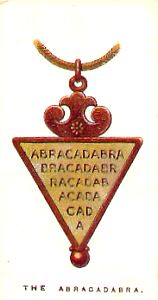
The Daily Charm for March 18th: Abracadabra

Your Charm for Today

Abracadabra

Today’s Meaning:

The most powerful of all talisman indicating you or someone close to you will recover from an infection.

General Description:

One of the most famous of all talismans, and used as a magical formula by the Gnostics in Rome for invoking the aid of beneficent spirits against disease, misfortune and death. Sammonieus, the celebrated Gnostic physician; instructed that the letters of this magical triangle which he used for curing agues and fevers, were to be written on paper, folded into the shape of a cross, worn for nine days suspended from the neck, and, before sunrise, cast behind the patient into a stream running eastward. It was also a most popular charm in the middle ages. During the Great Plague, 1665, great numbers of these amulets were worn as supposed safeguards against infection.

Your Animal Spirit for March 18th: The Owl

Your Animal Spirit for Today

Owl

Many cultures associate Owl with death, while others see Owl as the “night eagle”—the bird that embodies shamanism. Owl has exceptional hearing, and his medicine is one of clairaudience—the ability to hear spirit. If Owl has silently glided into your life today, he is asking you to face your own fears, and listen to the messages spirit is sending you.

Your Ancient Symbol Card for March 18th: The Peacock

Your Ancient Symbol Card for Today

The Peacock

The iridescent emerald plumage and spectacular broad tail of The Peacock make it the ideal symbol of both justified pride and vanity. It denotes the right for one to be proud of themselves for being who they are and for letting others know. In short, its okay to strut a bit. At the same time The Peacock reminds us that while pride and high self esteem are essential components of a healthy psyche, becoming too full of one’s self makes us vain, and vanity is never attractive in anyone.

As a daily card, The Peacock is reminder that you are inherently valuable, and have a right to be proud of who you are as well as let others know you are proud of yourself. It is also a warning to not allow you pride and sense of self worth grow to such grand proportions that you become vain and conceited.

Today’s Tarot for Tuesday, March 18th: The Sun

The Sun

Tuesday, Mar 18th, 2014


What has traditionally been known as the Sun card is about the self — who you are and how you cultivate your personality and character. The earth revolves around the sun to make up one year of a person’s life, a fact we celebrate on our birthday.

The Sun card could also be titled “Back to Eden.” The Sun’s radiance is where one’s original nature or unconditioned Being can be encountered in health and safety. The limitations of time and space are stripped away; the soul is refreshed and temporarily protected from the chaos outside the garden walls.

Under the light of the Sun, Life reclaims its primordial goodness, truth and beauty. If one person is shown on this card, it is usually signifying a human incarnation of the Divine. When two humans are shown, the image is portraying a resolution of the tension between opposites at all levels. It’s as if this card is saying “You can do no wrong — it’s all to the good!”

The Daily Horoscopes for Tuesday, March 18th

Giving peace a chance requires extra effort today as we seek to express our individuality in the context of a relationship. The accommodating Libra Moon brings a genuine concern for others; we want everyone to be happy. Meanwhile, romantic Venus sweetens eclectic Uranus, attracting us to more unusual expressions of love. However, attempts to make nice can be overridden by our drive to redefine ourselves now that the Moon joins assertive Mars.

Aries Horoscope

(Mar 21 – Apr 19)

Although everyone seems to be doing their best to keep you calm now, you’re not interested in placating anyone else. Unfortunately, sharing your hidden desires can be shocking to others, and certainly more complicated than just telling them what they expect to hear. Sometimes being direct is a good idea, but today it may make sense to take a more gentle approach. There are many ways to express your unconventional nature; however, you might have to do it alone.

Taurus Horoscope

(Apr 20 – May 20)

Your nerves are on edge today as electric Uranus cranks up the volume on your key planet Venus. But rather than trying to contain your erratic energy, you can transform an awkward situation into one that brings a smile to your face. This is your chance to make the positive changes you want. Don’t resist the adrenaline rush; ride it for all it’s worth.

Gemini Horoscope

(May 21 – Jun 20)

A sudden bolt of lightning turns your workplace upside down today. Even if the commotion adds unsolicited chaos to your life, it might turn out to be the best thing that could happen. Buried tensions are being released now, unblocking your creativity. No matter what occurs, express your inner artist however you can. An unexpected series of circumstances may just magically morph into an opportunity for personal growth.

Cancer Horoscope

(Jun 21 – Jul 22)

New ideas pop into your head today but no matter how much you like them they might not fit into your long-range plans. Although you usually choose safety and security over the unknown experience of an adventure, you are more than ready to take a risk now. The potential payoff seems to justify any discomfort you might encounter along the way. Don’t bother trying to rationalize your desires; just act on them. Follow your bliss and don’t look back.

Leo Horoscope

(Jul 23 – Aug 22)

If you recently gambled your heart, things might not be working out quite the way you hoped they would. But the energy is shifting and you have reason to believe that your efforts could still pay off. Don’t give up; continue to express your emotions as honestly as possible. You can best take advantage of the current dynamics by exploring your feelings without worrying about where they lead. Happily, you may be pleasantly surprised with where you end up.

Virgo Horoscope

(Aug 23 – Sep 22)

A close friend or romantic partner might catch you off guard today with his or her reckless actions. Or, perhaps you receive an unexpected invitation to participate in something you have never done before. Although you tend to be highly refined in your tastes and cautious in love, this is your opportunity to step beyond your own limitations. You won’t ever know what was possible unless you break the rules, throw away the map and explore uncharted territory.

Libra Horoscope

(Sep 23 – Oct 22)

Your work schedule may be disrupted today and there doesn’t seem to be much you can do other than quickly adapt to the changes as they occur. Remaining flexible now means the difference between experiencing professional satisfaction and facing a temporary setback. If something happens out of the blue, just respond like the resilient willow tree; bend like a branch in the winds of change.

Scorpio Horoscope

(Oct 23 – Nov 21)

Your creative genius surges today, enabling you to express your originality and brilliance — as long as you don’t try too hard. Paradoxically, the more you attempt to force the process, the less likely you are to succeed at making magic. You are being offered an important lesson in spontaneity; connect with your muse and let your inner child out to play.

Sagittarius Horoscope

(Nov 22 – Dec 21)

You are often the one who starts the party or plans the big adventure, but you might try to focus on more serious endeavors in spite of all the distractions today. Even if you can tame the wild energies that are running rampant, your real nemesis could be your own unexpressed desires. Whatever remains hidden now has the potential to create unexpected conflict, so get past your fears and share what’s in your heart.

Capricorn Horoscope

(Dec 22 – Jan 19)

You’re doing your best to keep everything at work on a fairly even keel today, but contradictory thoughts and feelings somehow still slip through your defenses and rattle your professional world. Instead of overcompensating by reverting back to a familiar agenda, find comfort in the current ambiguity. Expand your horizons by exploring options you might otherwise pass by. Even if you don’t like the uncertainty at first, being flexible with your plans now increases your chances for success.

Aquarius Horoscope

(Jan 20 – Feb 18)

The winds of fate are blowing up a major storm now in your 2nd House of Self-Worth, so prepare for a possible windfall. On the other hand, the upcoming shift could leave you wondering what happened, with less money in your bank account than you prefer. Either way, the changes are likely to be swift as they alter your fiscal condition. Shaking up the energy could ultimately work in your favor if you’re ready to settle down and take of business.

Pisces Horoscope

(Feb 19 – Mar 20)

Tell others exactly what you want, even if it’s not what they wish to hear today. In fact, if you blast open the communication channels, you have a better chance of receiving your heart’s true desire. However, you can easily shock someone with your weird ideas. Lay the groundwork carefully while discussing your feelings in order to allow everyone else room to draw their own conclusions. Being true to yourself now encourages others to do the same.

Equinoxes, Solstices and Astrology

Equinoxes, Solstices and Astrology

Learn all about the fresh-start feeling you get with each new season

Maria DeSimone  Maria DeSimone on the topics of solstice, equinox, astrology

Have you ever wondered about the meaning of an equinox or solstice and how they tie into Astrology? Not surprisingly, there’s a major significance to these periods of time and they each have something in common. An equinox or solstice tells us about our relationship here on Earth to the Sun at any given season.

That’s right … the first thing to remember about an equinox or solstice is that they mark the beginning of a new season. There are two equinox points each year (spring and autumn) and two solstice points (summer and winter). They each correspond to one of the four Cardinal signs of the zodiac — also known as the Cardinal axis. This axis is extremely important in Astrology because it is where we find the powerful angles in a birth chart. These angles are points of energy manifestation. They are highly sensitive points in your chart that trigger every major life event. Each of these points on the Cardinal axis will correlate to one of the four cardinal directions (north, south, east, west).

Let’s dig into the astronomy and Astrology behind solstices and equinoxes so that you can understand more about their implication for our life and our planet!

The Summer and Winter Solstices

By definition, a solstice is an astronomical event that happens twice a year — once at the beginning of winter and again at the start of summer. During a solstice, the Sun will reach its highest or lowest point relative to the celestial equator. The celestial equator is a fancy term for the giant imaginary circle that’s on the same plane as our equator. The word solstice literally means “Sun stands still,” and that’s exactly what appears to happen during a solstice point from our perspective here on Earth.

During the Summer Solstice, the Sun will appear to stop and then begin declining in the slightest way each day in a southward direction. The date of the Summer Solstice marks the longest day of the year because at that point the Sun stops right over the Tropic of Cancer which is the northernmost point. After a few days it will backtrack south towards the equator. The Solstice occurs on June 21 and astrologically, it coincides with the start of the Cardinal sign Cancer.

The Winter Solstice, on the other hand, occurs when the Sun appears to stand still at the southernmost point of the equator (the Tropic of Capricorn) and then slowly begins to trek north again. The Winter Solstice occurs on December 21 and marks the shortest day of the year. Astrologically, it coincides with the start of the Cardinal zodiac sign Capricorn. From a soul perspective, the Winter Solstice is about celebrating the rebirth of life in all forms. From here on out, the days will get longer and the Sun will shine brighter. Hope is renewed.

The Spring and Fall Equinoxes

In contrast, an equinox occurs when the tilt of the Earth’s axis is neither away or towards the Sun. At this time, the center of the Sun is in the plane of the Earth’s equator. What happens as a result is that the Sun is at one of two opposite points on the celestial sphere. The word equinox is translated in Latin to mean “equal night” because during an equinox the day and night will be at equal length.

The Spring Equinox begins on March 21 and marks the start of the new astrological year in the tropical zodiac since the Sun will enter Aries — the first sign in the zodiac. This is typically a time of new beginnings and we have come to associate the Spring Equinox with a “fresh start.”

The Fall Equinox occurs when the Sun reaches the opposite balancing point in its path through the tropical zodiac. Once again, the day and night are of about equal length during this time. This occurs on September 21 and correlates to the sign Libra. This time of year has become connected to “harvest” and reaping the fruits of our labor. At the same time, it brings up a certain respect for the fact that now, nights will become longer and it’s time to conserve energy and resources.

Cardinal signs bring life

An important point to note is that the seasonal relationship to solstices and equinoxes specifically apply to the Northern Hemisphere. Seasons in the Southern Hemisphere are reversed.

Either way, it’s no accident that the zodiac signs correlated to equinoxes and solstices are all Cardinal signs. Cardinal signs begin each season and are associated with qualities of initiative. Whether it’s an equinox or solstice, we’re celebrating the start of something new. Each season has a specific and essential job that we rely on for our very existence. The equinox and solstice points are sacred markers in time that help us connect the dots to the mystery behind the Earth’s never ending circle of life.

Daily Cosmic Calendar for Tuesday, March 18th

Monday’s mixed bag of cosmic influences stays intact for another 24 hours. The early hours appear fairly rosy due to Mercury making a harmonious trine of 120-degrees to Ceres in water signs (3:51AM). The message seems fairly clear that it is smart to be eminently productive in key communications, correspondence, literary and educational pursuits. The upbeat Mercury-Ceres rapport is reinforced 8+ hours later during an emotionally-stimulating, supportive, 60-degree liaison between Venus and Uranus (12:01PM). Soar like an eagle in your favorite fine and graphic arts.  Remember that you are still in the time-frame, within 48 hours after a Full Moon, when your capacity for being an ambassador of goodwill should be growing — not diminishing. However, the Moon parallel Neptune (4:56PM) and the monthly lunar conjunction with Mars in Libra (6:08PM) can add fuel to any relationship fires already ignited or out of control. Avoid confusing interactions with associates, friends or dear ones that can quickly become overly contentious. On the other hand, striving for peace and calm with significant others is the higher approach — especially as the Moon-Mars merger at 6:08PM also begins a void lunar uncertainty zone that continues until 2:14AM tomorrow.  Make sure your residence and business environments are safe and secure as the Moon forms its monthly union with Vesta (11:59PM). Despite the presence of a void-of-course Moon lurking around, the Moon with Vesta each month offers an opportunity to hone your investment planning skills. [Note to readers: All times are calculated for Pacific Daylight Time. Be sure to adjust all times according to your own local time so the alignments noted above will be exact for your location.]

Pagan Studies – Liberalia Spell

Pagan Studies – Liberalia Spell

While many people spent yesterday celebrating St. Patrick by getting drunk on green beer, here’s an alternative option from the Roman calendar: Liberalia. Today is sacred to Liber, the Roman god of passion, wild nature, fertility, and wine. On this day, women sold cakes on small altars in honor of freedom. To tap into this energy, bake bread or make a cake today. Think about what exactly freedom and liberty mean to you. Decide what action you can take to promote liberty and tolerance in your life and in the lives of those around you.

Ruminate on what the concept of

freedom means around the world, and how often people struggle to attain it. Once you have thought enough about these concepts, clean up your altar, rearrange it, and take care to rededicate it. Eat the bread or cake you created to symbolize the embodiment of your commitment to freedom and liberty, and to your growing understanding of the responsibility associated with those privileges.

By: Cerridwen Iris Shea

From: GrannyMoon’s Morning Feast Archives

Seasons of the Witch – Legends and Lore, Ancient Holidays

Seasons of the Witch Legends and Lore, Ancient Holidays

And Some Not So Ancient!

Goddess Month of Moura runs from 2/20 – 3/19

Celtic Tree Month Fearn (Alder) – March 18 to April 14

On this day in the year 1877, psychic and “absent-healer” Edgar Cayce (also known as the Sleeping Prophet) was born in Hopkinsville, Kentucky. He was renowned for his psychic visions and miraculous ability to accurately diagnose illnesses and prescribe remedies while in a self-induced trance. He prophesied the Second coming of Christ in the year 1998, followed by cataclysmic changes of the planet. Edgar Cayce died on January 3, 1945.

Sheelah’s Day, an annual festival to honor the fertility Goddess known as Sheela-na-gig was held on this date in ancient Ireland. As

Christianity made inroads, the identity of the Goddess was altered to the consort of mother of St. Patrick. Sheela is a very potent fertility

goddess and is depicted in a squatting birthing position, holding her labia wide to allow her fertility to pass out to any who honour her.

The obviousness of her fertility terrified the Church so they scrambled to find a more chaste version of her.

This day is observed with clovers left over from Saint Patrick’s Day celebrations.

In ancient times, the Pagan fertility-goddess known as Sheela-na-gig was honored annually on this date in Ireland. With the advent of Christianity, the identity of the Goddess was altered from heathen deity with oversized genitalia to the consort or mother of Saint Patrick.

*<<<=-=>>>*<<<=-=>>>*<<<=-=>>>*<<<=-=>>>*<<<=-=>>>*<<<=-=>>>*

NOTE: Because of the large number of ancient calendars, many in simultaneous use, as well as different ways of computing holy days (marked by the annual inundation, the solar year, the lunar month, the rising of key stars, and other celestial and terrestrial events), you may find these holy days celebrated a few days earlier or later at your local temple


Source

GrannyMoons Morning Feast