
-

November Babies
“No spring nor summer’s beauty hath such grace, As I have seen in one Autumnal face.” —John DonneZodiac: Scorpio until November 21 and Sagittarius from November 22 Gemstone: Topaz, Citrine
Meaning love and affection, the topaz comes in many colors: yellow, pink, purple, orange and a variety of blues. It is believed to bring the wearer strength and intellect. The citrine, known as a “healing quartz,” is this month’s other birthstone. It’s believed to bring vitality and health to the wearer, as well as hope, energy and warmth.Flower: Chrysanthemum
A chrysanthemum’s meaning changes depending on its color: red means “I love you,” while white stand for innocence, purity and pure love.Tree: Walnut, Chestnut, Ash
FROM: http://www.whattoexpect.com/pregnancy/photo-gallery/birth-signs-symbols#12
November’s birth flower is the chrysanthemum. A red chrysanthemum means “I love you;” a white chrysanthemum means innocence, purity, and pure love; a yellow chrysanthemum means slighted love.
FROM: http://www.almanac.com/content/birth-month-flowers-and-their-meanings#
November Birthstone – Citrine
The birthstone for November is the Citrine. The warm, fiery colors that exude from this precious stone are off the Van Gogh painting of the sunflowers. The name originates from the French word, “citrin”, meaning lemon. It has been found in the palest of yellows to a dark amber. The dark amber citrine, is referred to as Madeira, because of its resemblance to the wine.
Since the beginning of time, man has dug within the earth to find useful tools for it’s survival. In these earlier times, there was a greater connection with the planet and its gifts and the cosmic world. With each advancement and achievement of the human species, we developed tools to dig deeper within the Earth’s crust. At one point we began to dig for treasures or sometimes they were come upon accidentally. With every unearthing of these treasures and gemstones, they were believed to emit a power to its discoverer. They were thought to offer healing and magical powers, strength or protection. Most of these treasures today represent the birthstones for each month of the year in the calendar we are familiar with today, the Gregorian or Western Calendar. As time went on, each stone was believed to represent a specific time or season of the year.
Citrine is a form of quartz and the sister of Amethyst. It is worn to keep evil thoughts from one’s thinking and ward against venomous snakes. It is also a symbol of strength and hope. It is considered to having medicinal qualities used to remedy kidney and urinary complications. Throughout time it has been extensively utilized to improve the function of ones heart and digestive system. The citrine has the power to remove toxins form the body and treat muscular disorders. The vibrant color and “fire” of the citrine has always been symbolic of healing in general, as fire represents power and strength.
Citrine is very scarce, which could be the reason that it is not mentioned until the first century B.C. The Romans were noted as the first to wear it, where they would fashion the stone into a style that is referred to, cabochon. For this style, the citrine first would be polished to a most brilliant shine and then the pieces of the unfaceted stone would be fashioned into their jewels. During the Romantic Period, artisans would utilize the warmth of the citrine to enhance the color gold jewelry.
The alternate birthstone for the month of November is the Topaz.
Here are some interesting facts for this gemstone:
-In Sanskrit, Topaz also means fire
-In the Middle Ages, it healed mental and physical disorders and warded against death
-Romans used it to improve eyesight
-The Greeks believed Topaz to contain the power to make one invisible and increase their strength.
-The most famous of all Topaz is actually colorless, and originally thought to be a diamond. It measures in at 1,680 carats and is named the “Braganza Diamond” that is set in the Portuguese Crown Jewels
Other Symbols of November:
November Birth Flower:
The Chrysanthemum. It is a symbol for compassion, secret love and friendship. In Asia, the chrysanthemum is recognized as one of the most honored of flowers. In Japan they are traditionally exchanged between friends, symbolizing an invaluable friendship, resembling the virtue shared between the pair.
November Birth Tree:
Chestnut Tree and the Ash Tree
Famous People born in November:
Bruce Lee- November 27, 1940
Ryan Gosling- November 12, 1980
David Schwimmer- November 2, 1966
Richard Burton- November 10, 1925
Charles Bronson- November 3, 1921
Bo Derek- November 20, 1956
Scarlett Johansson- November 22, 1984
Rachel McAdams- November 17, 1978
Neil Young- November 12, 1945
Bjork- November 21, 1965
– See more at: http://birthstonesbymonths.net/november-birthstone-citrine/#sthash.EqwECPFK.dpuf
Tag: Wicca
Moon Water Spell
You will need the following items for this spell:
- Water
- Container for water
- Full moon
This is how you can bless water via full moon
Casting Instructions for ‘Moon Water Spell’
After sunset tonight, when the Moon is up, take a bottle or other container you can close, and fill it full of water, preferably from a well or other natural source. You can use bottled spring water if there is no safe natural source of water nearby.
Put the open container of water outside, and set it where the light of the Moon will shine on it. Ask the Goddess to bless the water with her light. Leave the container there as long as the Moon is up, then close the container carefully. Keep it to use in all rituals and spells that require water. You can do this every month at the Full Moon to have a supply of blessed water on hand.
FROM: http://www.spellsofmagic.com/spells/spiritual_spells/enchantment_spells/5944/page.html
A Little About October Birth Symbols
-

October Babies
“There is no season when such pleasant and sunny spots may be lighted on, and produce so pleasant an effect on the feelings, as now in October.” —Nathaniel Hawthorne Zodiac: Libra until October 22 and Scorpio from October 23
Gemstone: Tourmaline, Opal
Tourmaline is available in many colors — and many stones are bi-color or tri-color, containing multiple hues. It is often referred to as “the gemstone of the rainbow,” and signifies love and friendship. Opal means “precious jewel.” Like the tourmaline, it’s often multi-hued, and it signifies faithfulness and confidence.Flowers: Marigold and Cosmo
The marigold brings a message of undying love. The other October bloom is the cosmo, which symbolizes peace and serenity.Tree: Rowan, Maple, Walnut
FROM: http://www.whattoexpect.com/pregnancy/photo-gallery/birth-signs-symbols#11
October’s birth flower is the pumpkin bloom. Just kidding—it’s actually the marigold. Marigolds are often given as a sign of warm or fierce, undying love, or as a way of saying that you’re content with being with the recipient. The other October flower is cosmo, a symbol of order, peace, and serenity.
FROM: http://www.almanac.com/content/birth-month-flowers-and-their-meanings#
October Birthstone – Opal
The Opal is the birthstone of October. The name, “Opal”, means “to see a change in color” and might make one drift off to daydreaming and envision a rainbow following a summer rain. Ancient monarchs treasured the opal mainly for its protective powers. Thus, they were set in into their crowns and worn in necklaces. The opal dates back to prehistoric times and according to Arabic legend, fell from heaven in a flash of lightening.
The Latin word, “opalus”, means precious jewel, and that it is. It contains up to thirty percent water and must be protected from harsh chemicals and heat. If not, they can cause the opal to dry out and may lead to a loss in its luster and cracking. It can also be broken very easily and must be guarded from any knocks or blows. The opal is made up of a non-crystallized silica, that can be found near the earth’s surface, typically in areas where geothermal springs once existed. Opal is mainly found in Australia, where ninety-five percent of the world’s black and white opals are mined. They are also found in Hungary, Brazil, Mexico, the United States and Canada.
For centuries, before time was even recorded, the discovery of precious gems within the Earth’s crust inspired many. With each discovery, humans believed that there was a cosmic connection and energy emitted from these gemstones. As time went on, they became symbolic of certain times within the year. The calendar we are all familiar with today, the Gregorian Calendar or Western Calendar has a stone symbolic for each month of the year. For those offering these gemstones as gifts to their loved ones, they have been believed to possess magical or healing powers, or sometimes seen as a gift offering protection. Each of these precious stones are unique not only in their compositions, but their energies and strengthening powers.
The gift of an Opal symbolizes confidence and faithfulness and can be used to ward off nightmares. They have even been ground and ingested for healing properties to treat issues relating to the eyes. It has also been gifted to those going into battle for protection and utilized to ease child birth. It symbolizes hope, loyalty, happiness, innocence and purity. It should be stated that the most common of all opals, recognized by its pearly iridescent hues of aqua and baby blues and pinks, should be given as a gift to only those born in October, otherwise they can be a token of bad luck. However, lucky for other lovers of the October birthstone opal, the opal ranges in many colors and shades from all over the world. Another form of opal known as fire opal is transparent of orange and red colors with flicks of yellow, but the most valuable are that of the black or gem opals, which showcase one or more colors against a background of black.
Other Symbols of October:
October Flower:
The Candula. It is usually associated with grief, sorrow and despair.
October Birth Trees:
The Rowan, Maple and Walnut. The Rowan tree will guard against enchantment, and was also used in the art of metal divining. The berries of the Rowan tree feeds birds during long winters and have a pentagram shape. This shape is an ancient symbol of protection. Due to the berries shape, it is no surprise that it has also been referred to as the “Witch Tree”.
Famous People Born in October:
Zac Effron- October 18, 1987
Kate Winslet- October 5, 1975
Suzanne Sommers- October 16, 1946
Susan Surandon- October 4, 1946
Jeff Goldblum- October 22, 1952
Charlton Heston- October 4, 1923
Usher- October 14, 1978
Peter Tosh- October 19, 1944
– See more at: http://birthstonesbymonths.net/october-birthstone-opal/#sthash.V5WcHD17.dpuf
A Little About September Birth Symbols
-

September Babies
“By all these lovely tokens, September days are here, With summer’s best of weather, And autumn’s best of cheer.” —Helen Hunt Jackson Zodiac: Virgo until September 23 and Libra from September 23
Gemstone: Sapphire
The vibrant gemstone is said to protect loved ones from envy and harm. It is associated with heaven — in medieval times, clergy wore the gems to symbolize heaven. Sapphires are generally thought of being various shades of blue, but they occur in hues of purple, green, orange, yellow and even pink.Flower: Aster, Morning Glory
A symbol of powerful love, the aster is joined by September’s other flower, the morning glory, a symbol of affection.Tree: Weeping Willow, Lime, Olive, Hazelnut
FROM: http://www.whattoexpect.com/pregnancy/photo-gallery/birth-signs-symbols#10
September’s birth flower is the aster. Asters are mainly symbols of powerful love. The other September flower is the morning glory. Morning glories are simple symbols of affection.
FROM: http://www.almanac.com/content/birth-month-flowers-and-their-meanings#
September Birthstone – Sapphire
The Sapphire is the birthstone for the month of September. The deep blue color is most associated with this stone and was one of the most popular among Christians in earlier biblical times. This mysterious, abyssal depth of blue symbolizes heavenly grace and ancient Persian civilizations thought of the world set in front of a giant sapphire during the night sky.
The word sapphire is derived from the Greek word, “sapheiros”, “means “precious stone”. It is a reflection of constancy, and blesses its owner with clairvoyance, interpretation and insight. In earlier times it was also used to increase the power from Venus, banishing evil thoughts. Kings and priests favored this gemstone the most and saw in the sapphire a token for wisdom and purity. According to the bible, it is believed that the Ten Commandments were written on tablets of sapphire. There are many healing properties of the sapphire from lowering fevers, and curing hearing problems. It can relieve pain from cancer and also burns.
It can be found in Burma, Australia, Kenya, Tanzania, Kasmir, Cambodia, Thailand, and Sri Lanka(once a part of India), where it was mined for as early as the seventh century BC. There are a variety of colors they can be found in other than blue, but include pink, yellow and white as well. These are referred to as “fancy sapphires”. The blue color is given by very small amounts of oxide, iron and titanium within the stone. India boasts having found the most famous and largest of sapphires, weighing in at 563-carats. Its home resides in the American Museum of Natural History. As it is in the same family of the ruby, like the ruby, it is also second to the diamond in hardness, making it an ideal gemstone for jewelry.
It is a traditional gift for the fifth wedding anniversary, and has been given in place of a diamond for an engagement ring. Princess Diana had an engagement ring given to her by Prince Charles, and is also the engagement ring of Princess Anne. When wearing a sapphire, it is believed that it will give to its owner anything their heart desires; wealth, longevity, happiness and health. It also can restore lost property and wealth, alleviating long-term misfortune.
Each month and its season month throughout the year brings in a new cycle. It does not need to be stated that each of these seasons have a renewed energy, and a new meaning. Specific gemstones throughout many centuries have been designated to symbolize our birth-month. These stones are in accordance with the Gregorian or Western Calendar. Earlier civilizations of India and Babylonia viewed gemstones as magical, mystical symbols. They believed that each one possessed a magical attribute or property that connected their significance aligning with the Zodiac calendar.
Other interesting facts about the September Birthstone Sapphire:
-It is said that it must be set in silver or white metal and worn on the middle finger for any therapeutic purposes.
-Suspicions of ancient India state that the gem should be kept close to one’s skin or under the pillow while sleeping for at least one week before the final purchase is made.
-It is one of the navagraha stones, that represent each of the nine planets. Standing for Saturn it is related to duty and salvation.
Other September symbols:
September Birth Flower:
Aster and Morning Glory. The symbolic meaning of the morning glory is one of affection.
September Birth Tree:
Weeping Willow
Famous People born in September:
Adam Sandler- September 9, 1966
Raquel Welch- September 5, 1940
Charlie Sheen- September 3,1965
Jada Pinkett-Smith- September 18, 1971
– See more at: http://birthstonesbymonths.net/september-birthstone-sapphire/#sthash.tcS9CXwP.dpuf
A Little About August Birth Symbols

August Babies
Zodiac: Leo until August 22 and Virgo from August 23
Gemstone: Peridot
The gemstone is formed deep inside the earth and is brought to the surface by volcanoes. They are believed to contain healing powers that protect against nightmares and bring the wearer power and influence. Colors range from yellowish green to a greenish brown.
Flower: Gladiolus, Poppy
The gladiolus brings remembrance, calm, integrity and infatuation. Poppy is also a popular August flower: red means pleasure, white means consolation, and yellow brings wishes of wealth and success.
Tree: Cypress, Poplar, Cedar, Pine
FROM: http://www.whattoexpect.com/pregnancy/photo-gallery/birth-signs-symbols#09
August’s birth flower is gladiolus, or ‘sword lily.’ Gladiolus represents remembrance, calm, integrity, and infatuation. With gladiolus, the recipient’s heart is being “pierced with love.” The other August flower is the poppy. A red poppy signifies pleasure, a white poppy is given for consolation, and a yellow poppy wishes wealth and success.
FROM: http://www.almanac.com/content/birth-month-flowers-and-their-meanings#
August Birthstone – Peridot
Peridot, a symbol of vitality and is the gemstone for people born in August. The official name for peridot is olivine, and can be found in a wide spectrum of green from light-yellow to dark olive. The Egyptians were known to mine for the peridot on Saint John’s Island around 1500 BC. It was used to ward off night terrors and more specifically, when set in gold, would ward off evil. It has also been ground into a fine powder to treat asthma sufferers and used as a cure for thirst most experience during a fever. It has been said that its owner, when worn would have the power of invisibility, and that if a thief about to be hanged or beheaded might escape if one was held in their mouth. It can bring peace, protection and sleep. It has also been worn to calm anger by soothing ones nerves, expelling negative energy. They also can attract love.
The peridot has many symbolic purposes, one that it promises growth for the future and gives strength to individuals and those in relationships. Peridot is a brilliant young green and were first discovered in the black sands of Hawaii. Hawaiian legend states they were tears shed by the volcanic goddess, Pele. It is a connection to nature and Early Egyptians drank from cups made of peridot, believing they would be drawn closer to the goddess of nature, Isis.
The Egyptians also called it the “gem of the sun”, due to its brilliance that it would showcase in the desert sun. By miners, it is said that even in darkness, the peridot could be seen, and they would mark the location. They would then return in the daytime to retrieve them. Perhaps this is why the peridot is at times referred to as the “evening emerald”. Today, it is mined in Hawaii, the Congo, Arizona, Burma, Norway, Australia and Brazil.
August is a month in which for many is viewed as the end of the summer cycle. A time when some need to make plans and begin preparing for the cooler months of fall. It is a time of harvest and hard work. Our bodies are challenged with physical work and long hours. This is a time when one might need to search for strength from an outside source or symbol. During this month we are once again in touch with the earth and the significant seasonal shifts. The birthstones representing each month are meant to empower their owners with gifts specifically needed for each of these seasonal shifts. When the human condition falls short of spiritual or mental needs, these precious stones have been believed to gift their owners strength and endurance in many forms.
Other interesting facts about the August Birthstone of Peridot:
-They were discovered first in Egypt on a tiny island named Zabargard over four-thousand years ago
-In earlier times, Catholic Bishops would wear a peridot ring as a symbol of their purity
-In Medieval times, churches were obsessively adorned by them
-Considered a gift from Mother Nature
-They are created from the conditions of extreme heat from volcanoes
-The most abundant deposits are found in Burma.
-They have been recommended for gall bladder and liver illness
Other Symbols of August:
August Birth Flower:
The Poppy, more specifically the poppy native to the Mediterranean regions. These yield a source of opium, that in the ancient world would bring on sleep and ease pain when taken in smaller amounts. Poppies were associated with the god of sleep, Hypnos and Morpheus, the god of dreams by the Greeks.
August Birth Tree:
The Pine tree. It represents, immortality and longevity.
Famous People Born in August:
Charlize Theron- August 7, 1975
Robert De Niro- August 17, 1943
Audrey Tautou- August 9, 1976
Martin Sheen- August 3, 1940
Andy Warhol- August 6, 1928
Jack Black- August 28, 1969
– See more at: http://birthstonesbymonths.net/august-birthstone-peridot/#sthash.VeUaoXRo.dpuf
A Thought for Today
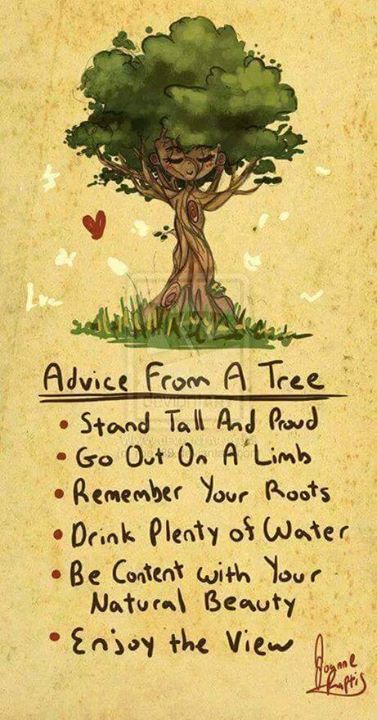
Please remember while you are out and about to pick up trash others so carelessly used Mother Earth as a garbage can for. When my youngest granddaughter was about 3 1/2 years old she suggested we start taking a small plastic bag with us when we walk Cleo to pick up as she called “the yuck on Mom”. I had been picking up garbage along my walks anywhere I might be, even a store parking lot, and depositing it where it should go and never realized she or my children when they were young picked up on it. I am proud to say in my family we have a strong tradition of leaving most anywhere outside we might go in better shape than we found it.
If children can see the need and bend to pick up trash are not we as adults should see the need also and follow through on that need? We only get one Mother we can all help care for, love and cherish.
Blessed be
Magick Oil Recipies

Sweet Dreams Spell
To help you sleep peacefully and have pleasant dreams, create a tranquil and calming environment for your bedroom. The windows should have either curtains or walls that are light coloured or pastel tones and make sure the bed head is well away from the door. Cleanse the atmosphere of your room by holding a sprig of lavender and walking through the room with a peaceful mind and heart. At bedtime turn off everything in the room that could be distracting or disturbing, like television and loud music or radios. Put a lavender sachet under your pillow and before go to sleep say to yourself,
“Feather light on starry night, cosy warm and tired, pleasant dreams and sweetest thoughts as little angels smile.”
FROM: http://www.whitemagic.com.au/fairymagic/freemagicspells.html
A Little About July Birth Symbols

July Babies
Zodiac: Cancer until July 22 and Leo from July 23
Gemstone: Ruby
The gemstone’s vivid red color is a showstopper. Rubies are believed to protect your health and bring wisdom, wealth and success in love (though that last wish is a little premature for your wee one!).
Flower: Larkspur, Water Lily
The larkspur generally stands for strong bonds of love, but different colors have different meanings: Pink means fickleness, white means a happy disposition, and purple is first love. The month’s other flower, the water lily, connotes purity and majesty.
Tree: Apple, Fir, Elm, Cypress
FROM: http://www.whattoexpect.com/pregnancy/photo-gallery/birth-signs-symbols#08
July’s birth flower is larkspur. Each color variation of larkspur has a different meaning: pink means fickleness, white conveys a happy nature, and purple normally represents a first love. Generally, larkspur indicates strong bonds of love. The other July flower is the water lily, which signifies purity and majesty.
FROM: http://www.almanac.com/content/birth-month-flowers-and-their-meanings#
July Birthstone – Ruby
The brilliant Ruby is given to those who are born in July. Next to the diamond, it is the second hardest material on Earth. The wearer will be found in good luck and have strong protection. It stands for courage, integrity, happiness and devotion. Ruby is derived from “ruber” in Latin, meaning red, the traditional more sought after color of this precious stone.
The ruby can be found in a variety of shades form deep strawberry to even violet. The amount of aluminum oxide it contains will dictate its shade. Today, the color of many rubies is caused by man-made heat treatments.
The mining of rubies dates back to over 2,500 years ago. There are ruby mines in Thailand, South Africa, Tanzania, Kenya, Napal, Vietnam and India, where it is believed that if you made an offering of rubies to Lord Krishna, you would be reincarnated as an emperor.
According to the Gregorian calendar, also known as the Western calendar, there are specific gemstones have been designated to symbolize our birth-month. Referred to as birthstones, each one aligns with the energy of its given month and the season of where it falls within a year. According to a Jewish historian, Josephus, he claimed that the breastplate of Aaron was inlaid twelve stones. Each of these stones had a connection with the twelve months of the year. Each precious stone aligns with the season, mental and spiritual energies. They are much sought after for their legends of magical and healing powers.
The Hindus regard the ruby at the “Lord of Gems”. In biblical terms, it is a symbol of fire, passion, love, power and importance. For some owners it may bestow upon them fame, virtue, and a commanding power, however, it is discouraged from women, as regular use will destroy body luster. Red is a powerful color, so the ruby has been used for treating blood illnesses and utilized to increase thought patterns, eliminate depression, cures fevers, and gout. For these uses, it is recommended to be worn on the ring finger. It is given as a gift to bring its owner success and prosperity, and will enable one to live a long life. Ruby is one of the family in navagraha stones, which are stones representing the nine planets and have a cosmic influence on every inhabitant. It represents the sun and is seen as the stone closest related to our souls.
Other Interesting facts about the July Birthstone Ruby:
-Whether ruby is in the same family as the sapphire
-In India, a ruby ring is worn for astrological reasons
-Ruby is often preferred to the diamond as an engagement ring, due to its rich color and symbolism
-Ninety percent of rubies in the market today have been heat treated to enhance their quality
-To bring good fortune, it should be worn on the left hand
-Legend states that only if it is worn by its rightful owner, will it bring about positive powers
Other July Symbols:
July Birth Flower:
Water Lily and the Larkspur. The water lily is given through “purity of heart”, and the larkspur inspires levity and lightness.
July Birth Tree:
The Elm tree, a symbol of strength of will and intuition
Famous People Born in July:
Arnold Schwarzenegger- July 30, 1947
Will Smith- July 4, 1981
Sylvester Stallone- July 6, 1946
Donald Sutherland- July 17, 1935
Hillary Swank- July 30, 1974
O
Blowing in the Wind Spell [Element of Air]
Lovely breezes and windy days can be used to connect with the magical element of Air and this magick charm is one that anyone can easily do for themselves and their friends. On a breezy day, find a piece of blue material or ribbon and tie one end to a fence, a tree branch or a clothesline. Then, as you watch the ribbon fly and wave in the wind, repeat these words out loud,
“Blow laughing winds from North and South, from fairy lands and East to West, I’ll be happy as I say send me magic every day,”
You can leave the ribbon there for as long as you like and add any others to it for a magickal message to family and friends.
FROM: http://www.whitemagic.com.au/fairymagic/freemagicspells.html
A Little About June Birth Symbols

June Babies
Zodiac: Gemini until June 21 and Cancer from June 22
Gemstone: Pearl
The pearl has long been associated with purity. Pearls are the only gems that come from living sea creatures, and they’re also unique in that they require no faceting or polishing to reveal their beauty. Today, most pearls are cultured, grown under controlled conditions by farmers to ensure perfect shape.
Flower: Rose, Honeysuckle
A rose’s color signifies different meanings: red means “I love you,” pink means perfection and white is innocence. Honeysuckle, June’s other flower, stands for the strong bonds of love.
Tree: Ash, Hornbeam, Fig, Birch, Apple
FROM: http://www.whattoexpect.com/pregnancy/photo-gallery/birth-signs-symbols#07
June’s birth flower is the rose, which has more meanings than one can count! A pink rose means perfect happiness, while a red rose means “I love you.” A white rose signifies innocence and purity, while a yellow rose conveys jealousy or a decrease in love. A bouquet of roses means sincere gratitude, whereas a single rose amplifies the meaning of the color (a single red rose means “I REALLY love you”). The other June flower is honeysuckle, which is a strong symbol for the everlasting bonds of love.
FROM: http://www.almanac.com/content/birth-month-flowers-and-their-meanings#
June Birthstone – Pearl
The month of June is represented by the pearl. “Pearl” is derived from the Latin word “pirum”, meaning pear, which is the shape that many pearls take on naturally when they grow. Many ancient civilizations have told a variety of stories and the birth of the pearl. The Greeks believed that they were tears of joy that had been hardened when they were shaken from the eyes of the goddess of love when she was born in the sea. Arabs believe that they were formed when oysters were lured by the light of the moon from the depths of the seas. The moon would leave dewdrops of its light, which would be swallowed by the oysters and taken back with them to their deep oceanic homes. The Chinese in ancient times thought they came from the brain of a dragon.
Specific gemstones are utilized to symbolize our birth-month according to the Gregorian or Western Calendar. Each month of the year brings in a new cycle. For many of you reading this, there needs to be no mention of what one might feel from the energy emitted from each stone representing each month and season. The cycles of each season have their own meaning and energy. Aligning with the changing times, each gemstone can increase our spiritual and mental energies. Many of these yearly shifts compromise our bodies, our immunity, mental health. Many have believed for centuries specific gemstones can counter these affects, granting strength and even cure ailments that might come with each season.
The formation of the pearl is as mystical as its history. For oysters to create a pearl, a small irritant, usually a small fish or parasite would lodged itself in the flesh of the oyster. The presence of the fish or parasite would then cause the oyster create what is called a “nacre”. This nacre grows over the intruder layer after layer and creates a luxurious pearl. As natural pearls are rare, man has created a process in which a small bead or piece of shell is placed inside the mollusk, stimulating the nacre production. This practice makes up about ninety percent of the pearl industry. They are harvested all over the world from the South Pacific, Gulf of California, Gulf of Mexico and its Pacific coast, Gulf of Manmar, the Persian Gulf, Europe, Japan and Australia.
At one time, Royalty were the only ones who were allowed to wear jewelry with pearls. Eventually, they were seen worn by all status’ of culture. Pearls have been obsessed over and been a passion for many. They are the symbol of purity, enhances ones integrity, and are often times given as a gift celebrating the birth of a child or marriage. Pearls are viewed as a sign of refinement and good taste. White pearls are usually given as gifts, however there are a wide variety of spectrum that the pearl grows: white, silver, cream-colored, gold, green, blue and black.
Other interesting facts about the June Birthstone Pearl:
-The pearl has been ground up into fine powders for use in cosmetics, and is effective for health problems of the intestine, stomach, and heals ulcers.
-In earlier times, pearls were seen as more valuable than the diamonds.
-They were sought after by powerful rulers and emperors around the world
-The pearls that have perfect symmetry, sometimes large are viewed as the best ones
Other June Symbols:
June Birth Flower:
The Rose, created by the goddess of flowers, Chloris, according to Greek mythology
June Birth Tree:
Fig
Famous People born in June:
Mark Wahlberg- June 5, 1971
Gene Wilder- June 11, 1933
Liam Neeson- June 7, 1952
– See more at: http://birthstonesbymonths.net/june-birthstone-pearl/#sthash.NwuqI8dx.dpuf
Let’s Talk Witch – Get Ready for The Long-Lost Secrets of Wicca
 Get Ready for The Long-Lost Secrets of Wicca
Get ready for an exciting journey that will take you through the long-lost secrets of Wicca, the inner workings of your magical power, the best ways to cast spells, the history behind the broomstick, the cauldron, and the magic wand, how you can easily start performing spells and rituals of your own…and so much more.
Are you ready?
Because you’re about to access the secrets that the most powerful witches have held for centuries.
And there’s a reason that these things have been kept a secret for so long—they are extremely powerful.
Throughout history, people have tried to suppress this ancient knowledge. The Church and other religions all believe that Wicca and witchcraft are the work of Satan, and that they are evil.
But that is simply not true. They do not understand the true nature of what Wicca is all about.
Let me explain to you the real truth about Wicca and how it works in your life.
The practice of Wicca and witchcraft is very often misunderstood.
Magic is not supernatural. Magic is actually one of the most natural forces out there. But because people don’t understand it, or because they are afraid of it, they call it supernatural, or freaky, or fake.
But magic is real, it’s perfectly natural, and it has very real results–when you do it the right way.
Now let’s define exactly what we mean when we talk about magic. Magic is the projection of natural energies to produce needed effects.
Energy is flowing all around us. Magic spells and rituals, when done with the proper concentration, allow us to harness that energy to attract what we desire.
There are three main sources of energy in the Universe. It’s important to know what kinds of energy we are talking about when we start to practice spells.
The first kind is personal energy. This is our own personal life force. We take in energy from the sun, water, and food, and we release it through exercise, movement, and even as we exhale.
The second type of energy is earth energy. This is the energy found within our planet. Each natural element has its own power which can be used in magic: earth, trees, stones, wind, fire, and crystals are some examples of earth energy.
The third, most powerful type of energy is divine power. This is the energy that makes up the entire Universe. This is higher power energy, life force—whatever you want to call it. It’s the universal power source, and it’s what we tap into when we perform magick.
Wicca Power Spells
Aurora Rede
A Little About May Birth Symbols
-
-
May Babies
“Spring’s last-born darling, clear-eyed, sweet, Pauses a moment, with white twinkling feet, and golden locks in breezy play, Half teasing and half tender, to repeat Her song of ‘May.'” —Susan Coolidge Zodiac: Taurus until May 20 and Gemini from May 21
Gemstone: Emerald
Symbolizing love and success, the deep green stone is thought to bring foresight, good fortune and youth to the wearer. It’s also a symbol of rebirth and new beginnings — an appropriate symbol of spring.Flower: Lily of the Valley
The lily of the valley represents sweetness and humility, purity of heart and honor.Tree: Poplar, Chestnut, Ash
FROM: http://www.almanac.com/content/birth-month-flowers-and-their-meanings#
May’s birth flower is the lily of the valley, which signifies sweetness, humility, and a return to happiness. If you want to show your loved one that your life is complete with them, give them a few lilies of the valley. The other May flower is the hawthorn plant, which represents hope and supreme happiness. Hawthorne signifies that you want only the best for the recipient.
FROM: http://birthstonesbymonths.net/
May Birthstone – Emerald

The gemstone representing May, is the Emerald. As spring in the northern hemisphere occurs in May, the emerald stands for a time of rebirth and growth. The French refer to the emerald’s inclusions and fractures as “jardin’s”, translated as garden, resembling the color of spring foliage.
For each stone of the Gregorian calendar, each month of the year brings in a new cycle. Each cycle represents a new season, has a renewed energy, and a new meaning. The month of May is one of abundance and life in it’s youthful beauty. Following the rainy month of April, the month of May is one that symbolizes fresh, new, green life. The emerald as a precious stone for the month of May. Beautiful, fertile valleys blessed with rain are symbolic of the Emerald in that both offer energy both in a spiritual and physical sense giving sustenance for one who might own an Emerald and for those living within the valleys.
The emerald has been a symbol since the Egyptians engraved the stone with pictures of foliage. It would then be gifted to their deceased loved ones for their burials to represent eternal youth. It is the Egyptians who mined emeralds in the desert to the east over two-thousand years before the birth of Cleopatra. During her reign, this was her favorite stone, and even claimed one of the emerald mines as her own. She would bestow an emerald to a visiting dignitary on their departure. When the Spanish Conquistadors arrived in South America, they noticed that the natives were wearing some of the largest emeralds they had ever seen. They attempted to hide the mines from the Conquistadors, but were unsuccessful. Today, that area is known as Columbia, where some of the most prize emeralds are unearthed. There are sources of emeralds that have been found in Pakistan, Afghanistan, Nigeria, Brazil, Zimbabwe, and Russia.
The Romans regarded the emerald representative to the goddess of love, Venus. They wore the gem to honor Aphrodite, their adopted goddess of love for fertility, beauty and love. Their emperor, Nero had eyeglasses that were made of emerald so that he might watch the gladiators battle and maintain his eyes’ health, and to ease the strain upon his eyes.
These crystals grow slowly within the confines of metamorphic rock, making them rare and thus, very valuable and expensive, sometimes more so than diamonds. It represents wisdom, patience and growth. It often given as an anniversary gift, as these characteristics in a relationship are important. It also represents friendship, faithfulness and loyalty, and they have been utilized for the effective treatment of health issues related to fertility, eyes, spine and for headaches. The Emerald can prevent seizures, reduce fevers and stop bleeding.
Some other interesting facts about the May Birthstone Emerald:
-Mostly all Emeralds have been treated with an epoxy resin or oil to fill in surface cracks making them less visible
-Some of the oils used to treat Emeralds are clear, however, some are tinted green in order to make them appear more vivid
-Mummies were buried with emeralds
-It is often times worn by travelers for luck and has legends of calming stormy seas
Other symbols of May
May Birth Flower:
Lily of the Valley and the Hawthorn. Hawthorns flower in May and symbolizes the return of spring and summer. Maypoles were constructed of hawthorn.
May Birth Tree:
Ash, Popular, and Chestnut
Famous People born in May:
Fred Astaire- May 10, 1899
Mr. T- May 21, 1943
Bing Crosby- May 2, 1903
Tina Fey- May 18, 1970
Audrey Hepburn- May 4, 1929
Candice Bergen- May 9, 1946
Anne Heche- May 25, 1969
Cate Blanchet- May 14, 1969
See more at: http://birthstonesbymonths.net/may-birthstone-emerald/#sthash.VNnsHCVq.dpuf
-
Magic Flower SPell
You will need the following items for this spell:
- Any color flower (picked or grown)
- Sugar
- 1 or half a cup of Water
- Dry ice
- Spoon
- Pink flower petal
- Your DNA (saliva, hair, etc.)
- Freezer
- Window
- Belief in magic
Casting Instructions for ‘Magic Flower Spell
-First, you need a flower. Either picked or grown, both are fine.
-Next, you need to fill the cup with water half way or full.
-Now, get a pink flower petal, and put both flower and petal in water.
-Put in a small amount of sugar and stir it gently with a spoon.
-Put in your DNA in the cup and stir it gently again.
-Put in the dry ice and stir it.
-Put the cup in the freezer for 1, 2, or 3 hours.
-Take the cup out. If the petals are closed and curling up, it’s working.
-Take out the flower, petal, and ice. Throw the ice in the sink, and put in hot water in the cup, dumping out the cold water.
-put in your DNA, petal, flower and the sugar and stir it once more.
-Now, put your flower in the window and chant:
“Magic flower, magic flower, you shall help me. Magic flower, magic flower, you shall grant wishes. Magic flower, magic flower, you shall cast spells. Magic flower, magic flower, you shall help me. So mote it be!”
-Leave the flower in the windowover night, and you have a magic flower!
This article was contributed by User232001
FROM: http://www.spellsofmagic.com/spells/spiritual_spells/dream_spells/14139/page.html
A Little About April Birth Symbols
-
-

April Babies
“April has put a spirit of youth in everything.” —William ShakespeareZodiac: Aries until April 20 and Taurus from April 21 Gemstone: Diamond (lucky baby!)
Meaning invincible (translated from the Greek work “adamas”), the diamond is one of the hardest substances on earth. The “healing powers” attributed to diamonds include balance, clarity and energy.Flower: Daisy
Daisies symbolize innocence, purity and love that conquers all.Tree: Rowan, Maple, Walnut
FROM: http://www.whattoexpect.com/pregnancy/photo-gallery/birth-signs-symbols#05
April’s birth flower is the daisy which conveys innocence, loyal love, and purity. It is also a flower given between friends to keep a secret; the daisy means “I’ll never tell.” The other April flower is the sweet pea. Sweet peas signify blissful pleasure, but are also used to say good-bye.FROM: http://birthstonesbymonths.net/ April Birthstone – Diamond
April’s gemstone is the diamond. Diamonds date back to at least 3,000 years ago in India. The ancient Hindus viewed the strength of the diamond equal to the power in the sparks of lightening, due to the diamond’s ability to throw off light with its invincible strength. For them, the diamond was used as a talisman to provide protection during battle and ward off evil spirits.
The spring season is into full-swing. In many parts of the country, it is a season of much rain, hydrating and lifting life from the earth after a winter’s sleep. If anyone has stared, into a beautiful diamond, it is like that of watching a spring rainstorm, mesmerizing. For many who live in the mountains, the diamond is representative of the water filling and rushing down the streams from the melting snow, bringing life and sustenance to life to all plants and animals downstream. It is strength, and by giving renewed life, it is power. Of the many stones representative of each season on the Gregorian calendar, the diamond could not be more suited for the month of April.
People for centuries have been fascinated by the diamond. The word “diamond” originates from the Greek word “adamas”, to have the meaning of something which is unconquerable.
It was not until the Middle Ages that the diamond was seen as something of monetary value. Mine owners spread rumors that they were poisonous in order to prevent their workers from swallowing them, so they would not be smuggled from the mine. It was not a common practice to even polish a diamond until the 16th century. Until then, doing so was taboo. With more modern technology and tools, the polishing and cutting of the diamond was perfected. It is India that holds the title of being the most foremost diamond polishing industry worldwide. The Koh-I-Noor and the Blue Hope were both unearthed in India, though they are also mined from Borneo, Brazil, Australia and the Orange River in South Africa.
Diamonds have a long history on the earth and were created from the condensation of solid matter, more specifically, carbon. It was compressed into a sphere caused by the power from the core of our planet, then the sphere was subjected to extreme pressures and temperatures. With this pressure and temperature, the carbon began to crystallize. As the planet began to develop more, the surface of the earth began to cool and volcanic activity forced these diamond crystals to the surface. The diamond is known as the hardest substance found on the Earth, synthetically or naturally produced.
Traditionally, the diamond is known to be clear and colorless, however, there are a range of colors: yellow, orange, blue, green, pink, purple, red, black, and brown. The range of colors identify that there are impurities in the stone. For a diamond to be yellow, nitrogen will be present within, blue meaning boron. To gift a diamond will symbolize everlasting love. It has been worn to enhance relationships and give inner strength. As the stone itself possess natural inner strength, it has the properties to aid in the healing of brain diseases and illnesses of the pituitary glands.
April Birth Flower:
The daisy, referred to as “God’s smile”, and the Anglo Saxons called it the “Day’s Eye”, as it would open and close with the rays of the sun. It is associated with the goddess, Venus and are gifted to represent one’s affection.
April Birth Tree:
Maple Tree, symbolizing balance and practicality
Famous People born in April:
Emmylou Harris- April 2, 1947
Marvin Gaye- April 2, 1939
Heath Ledger- April 4, 1979
Billie Holiday- April 7, 1915
Leonardo da Vinci- April 15, 1452
Ashley Judd- April 19, 1968
– See more at: http://birthstonesbymonths.net/april-birthstone-diamond/#sthash.BdYdKR7L.dpuf
-
A Little About March Birth Symbols

March Babies
Zodiac: Pisces until March 21 and Aries from March 21
Gemstone: Aquamarine
The beautiful pale blue stone was believed to protect sailors as well as guarantee a safe voyage. Even its name was sea-worthy, derived from the words aqua (water) and marina (the sea). According to gemstone lore, the stone is also believed to instill a sense of calm in the person who wears it.
Flowers: Daffodil
This daffodil symbolizes forgiveness, honesty, trust and true love.
Tree: Weeping Willow, Lime Tree, Oak, Hazelnut
FROM: http://www.whattoexpect.com/pregnancy/photo-gallery/birth-signs-symbols#04
March’s birth flower is the daffodil, which means unequaled love; the sun is always shining whenever your significant other is around. The other March flower is the jonquil, which signifies desire for affection returned. It also is used to convey sympathy.
FROM: http://www.almanac.com/content/birth-month-flowers-and-their-meanings#
March Birthstone – Aquamarine
For those born in the month of March, the official gemstone is the Aquamarine. It can range in color from a very pale shade, almost colorless, which is also the most valuable, to a most sought-after deep-blue aqua. Some of the ranges in color could be due to its ability to darken permanently with heat due to its amount of iron, which is considered to be an impurity. In knowing this however, it is important to know that the gems do not alter in quality at this point, but only in appearance. These can be heat treated to create a pure blue from a blue-green or teal. Its name originates, quite understandably, from the Latin words meaning water and sea.
The month of March is the time of year in which the world makes a shift renewing life and even creating new life. It is a time when all of us must shed our winter skin, cleanse our bodies of many of the heavy foods we consumed throughout the cold winter months that now slow us down. Many clean their homes, change their home decorations for brighter, fresher colors and textures. It is a time to refresh one’s life and mentality. One who possesses the Aquamarine can draw energy from it’s beautiful, fresh color, opening their hearts and minds for a new season.
During the Middle Ages, aquamarine was believed to gift its owner with a decrease in the effects of an inflicted poison, induce cheerfulness and compose the mind and heart. For older married couples, it gave them the inspiration to reawaken and rekindle their love. But even before, the Egyptians and Hebrews loved and cherished the aquamarine. Its brilliant color represents the sea and the air, identified with the apostle, St.Thomas, who made long journeys by sea to preach salvation. From this, sailors were known to wear this preventing seasickness and guide them safely on their voyages. The Amethyst has been considered the gift from mermaids aiding sailors at sea safety.
The powers of this stone have been known to grant revelations to aid in the search for lost things in one’s life. For those with complications of the liver, stomach, throat and jaws, the wearing of an aquamarine could bring relief. To its bearer, it can quicken your intelligence and intellect, cure laziness, and instill courage. The Romans believed that by wearing this gem one would absorb young love and its aura, and “When blessed and worn, it joins in love, and does great things”. It has also been carved into a crystal ball used in fortune-telling.
Aquamarine has been found in Brazil, also known as the Land of Aquamarine Stone.In 1910, the largest crystal of Aquamarine was mined there, weighing 243 pounds. It has also been found in Siberia, India, and in North Carolina of the United States. However, Madagascar is considered the historical source of the aquamarine, where medium to dark stones were found.
Some other interesting march birthstone facts about the aquamarine:
-Said to give its bearers the ability to overcome phobias and grief, and cure insomnia.
-It originates from the beryl family of minerals, and makes it the sister of the emerald.
-It is the official stone of Colorado.
Other birth symbols of March:
March Birthstone Flower:
Daffodil, signaling a rebirth and a regard for unrequited love. Beware of bringing a single flower of this flower into the home, as it can bring about bad luck.
March Birthstone Tree:
The Hazelnut tree represents hidden wisdom and divine gifts.
Famous People born in March:
Reese Witherspoon- March 22, 1976
Dane Cook- March 18, 1972
Steve McQueen- March 24, 1930
Ewan McGregor- March 31, 1971
Quentin Tarantino- March 27, 1963
Andrew Lloyd Webber- March 22, 1948
Bruce Willis- March 19, 1955
– See more at: http://birthstonesbymonths.net/march-birthstone-aquamarine/#sthash.agBjMbgG.dpuf
Banishment Spell
I personally used this spell once about eight years ago and have not heard anything from the person since. I banishes a person, who lives or at least at the time lived in another state, whom I had been friends with for about 3-4 years because the relationship was toxic for my mental, emotional and spiritual well-being. I first tried the everyday routes refusing her phone calls, returning letters unopen, deleting emails without opening them, etc, after telling her not to contact me again more than once. I do not use dark magic at all or gray magic very often, but this was a time for gray magic to be used if I was to have her out of my life completely. After the ashes cooled I put everything, the metal and stones plus ashes into a plastic bag took it to a woods and buried it all except the plastic bag which I threw away in a garbage can that sits on the main street in town. This way nothing was disposed of near my home.
“This is a fire spell for love gone wrong, for ending personal, family or business relationships that you no longer wish to continue. I wrote it years ago as an anti-stalking spell and have not been troubled by or even laid eyes on the spell’s subject since then. To work the spell you will need:
Herbs of protection
An image of the person (photograph, poppet, etc.); something written in their own hand, a lock of hair, a piece of clothing or personal object will also do. [Their full name, if you know it, written on a piece of paper]
Arrange your altar or working surface in your usual way. Raise power and cast a circle. Put everything into a fire proof container-iron cauldron or marble mortar, for instance- and set fire to it as you perform the spell. Add the photograph or a piece of paper with the person;s name on it if you have trouble getting the fire going. It should make a very saisfactory blaze that reduces everything to ashes. If you have a lot of items from this person to get rid of, you can use a bonfire for the spell and feed them all into it. [I used our fireplace outside when I did it].
By the crimson and the gold
By basilisk and bloodstone
By the garlic in the fields
By the poppies and what they yield
Invisibly I make my shield
To direct thee and deflect thee
And keep harm from me.
By dragon’s blood and salamanders
By horses when the hooves strike sparks
By the dragon breathing flames
From the Book of Life I erase thy names
I cut the cords and unlock the chains
I sever all the ties by which we were bound
And with impenetrable walls myself I surround
Against thy power and its source
Against thy evil and its force
Vesta, Pele, Lillth
KAli KAli KAli
I banish thee forever from me
And any harm from thee to me
Doubles back and tables turned
Thou shalt by thyself be burned
Lillth, Vesta, Pele
KAli MA Kali MA
By the power of three times three
I banish thee, I banish thee, I banish thee
I am set free
So mote it be!
The ashes can be buried or washed down a drain. Flush them down a toilet if very angry. Dispose of all objects that connect you to the person: gifts, letters, photographs, and the like. It is especially important to get rid of jewelry. Move if you have to. [Remember I am quoting from a book I don’t really think or believe you have to move.].
Be careful with this spell. It’s permanent, so don’t use it unless you really mean forever. It’s also powerful. The person I used it against had a pregnant wife, and I learned later their child had heart problems. The last I heard of him, he was having a quadruple bypass operation.”
Copyright 2008 by Eileen Holland in her book The Wicca Handbook Pages 141-142
Gods – OgmaCeltic God c.2015
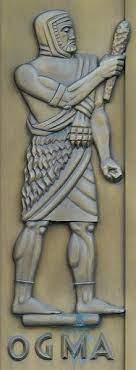
Ogma
Celtic God
In Irish-Celtic myth, Ogma is the god of eloquence and learning. He is the son of the goddess Danu and the god Dagda, and one of the foremost members of the Tuatha Dé Danann. He is the reputed inventor of the ancient Ogham alphabet which is used in the earliest Irish writings.
In the final battle at Mag Tuireadh he managed to take away the sword of the king of the Fomorians, but had to pay with his life for this feat. His Celtic equivalent is Ogmios.
Ogma or Oghma is a character from Irish mythology. A member of the Tuatha Dé Danann, he is often considered a deity and may be related to the Gaulish god Ogmios.
He fights in the first battle of Mag Tuired, when the Tuatha Dé take Ireland from the Fir Bolg. Under the reign of Bres, when the Tuatha Dé are reduced to servitude, Ogma is forced to carry firewood, but nonetheless is the only one of the Tuatha Dé who proves his athletic and martial prowess in contests before the king. When Bres is overthrown and Nuadu restored, Ogma is his champion. His position is threatened by the arrival of Lugh at the court, so Ogma challenges him by lifting and hurling a great flagstone, which normally required eighty oxen to move it, out of Tara, but Lugh answers the challenge by hurling it back. When Nuadu hands command of the Battle of Mag Tuired to Lugh, Ogma becomes Lugh’s champion, and promises to repel the Fomorian king, Indech, and his bodyguard, and to defeat a third of the enemy. During the battle he finds Orna, the sword of the Fomorian king Tethra, which recounts the deeds done with it when unsheathed. During the battle Ogma and Indech fall in single combat, although there is some confusion in the texts as in Cath Maige Tuired Ogma, Lugh and the Dagda pursue the Fomorians after the battle to recover the harp of Uaitne, the Dagda’s harper.
He often appears as a triad with Lugh and the Dagda, who are sometimes collectively known as the trí dée dána or three gods of skill, although that designation is elsewhere applied to other groups of characters. His father is Elatha and his mother is usually given as Ethliu, sometimes as Étaín. His sons include Delbaeth and Tuireann. He is said to have invented the Ogham alphabet, which is named after him.
Scholars of Celtic mythology have proposed that Ogma represents the vestiges of an ancient Celtic god. By virtue of his battle prowess and invention of Ogham, he is compared with Ogmios, a Gaulish deity associated with eloquence and equated with Herakles. J. A. MacCulloch compares Ogma’s epithet grianainech (sun-face) with Lucian’s description of the “smiling face” of Ogmios, and suggests Ogma’s position as champion of the Tuatha Dé Danann may derive “from the primitive custom of rousing the warriors’ emotions by eloquent speeches before a battle”, although this is hardly supported by the texts. Scholars such Rudolf Thurneysen and Anton van Hamel dispute any link between Ogma and Ogmios.
*
A Proto-Indo-European root *og-mo– ‘furrow, track, incised line’ may be the origin of the stem of the name. In addition, Proto-Celtic had a causative verbal suffix *-ej– ~ *-īj-. A hypothetical Proto-Celtic *Ogm-īj-o-sogm-. This agent noun would therefore mean ‘furrow-maker, incisor’ and may have had a metaphorical sense of ‘impresser.’ therefore looks very much like an agent noun derived from a verb formed by the addition of this causative suffix to the stem *
The Irish god of writing, eloquence and poetry. Ogma was credited of being inventor of the Celtic writing systems that the Druids used for their magic. These scripts were known as Ogham.
Ogma was the son of Dagda and the goddess Danu. Some other writers say that Ogma and Dagda were brothers; in this version they were the sons of Eithne. Ogma had also being called the son of Elatha, the king of the Fomorians.
Ogma was one the seven champions in the First Battle of Moytura (Mag Tuired), but when Bres became the king of Tuatha dé Danann, Ogma was degraded into working on humiliating manual job of gathering firewood.
When Lugh went to Nuada, asking for a place to serve the king, Ogma seemed to be Nuada’s foremost fighter. During the second battle of Moytura, Ogma had killed one of the Fomorian leaders, named Indech, the son of Domnu.
Ogma had married Etain, the daughter of Dian Cécht. Ogma had a son named Caipre. Some say that he was the father of MacCuill, MacCecht and MacGrené (MacGrene), the three Danann kings who ruled Ireland, during the Milesian invasion, though other say that Neit was their father.
To the Celtic Gauls he was called Ogmios. According to both Gallic and Irish myths Ogma was a warrior god, depicted as a wrinkled old man, wearing lion’s skin cloak, carrying a bow and club. The Romans considered Ogmios as the Celtic equivalent of Hercules (Greek Heracles). They also depicting Ogimos as holding people chained to his tongue by their ears, to indicate he was the god of eloquence and poetry.
Author: Agaliha
Website: Deity of the Week
Stop Bad Luck Charm Bag
You will need the following items for this spell:
- Small Draw-String Bad (About 1-2 inches deep)
- Angelica root
- African Ginger
- Fennel seed
- Holy thistle
- Clove
- Basil
Angelica root
African Ginger
Fennel seed
Holy thistle
Clove
Basil
Add a small citrine to the pouch and you have a powerful sachet. During the full moon, put the bag together, then consecrate and charge it. Make certain it is tied tightly. Keep it close to your heart.
FROM: http://www.spellsofmagic.com/
The Importance of Your Given Name
It is important not to let other’s that could wish or do you harm to know your whole given name. If the person practices the dark or gray or light side of The Craft the name you were given at birth can be
used against you when a Witch/Pagan performs a spell, hex, curse or anything else that might possibly harm you. The flip of the coin a White Witch can use it for good when performing a spell or
charming an item for a specific reason without your knowledge. For these reasons it is best to only let a Witch/Pagan only know your first name if any of your given name at all unless you know and
trust them fully.
Any Witch/Pagan that truly walks in the light and most that walk in the gray will not perform any type of a spell, healing, incantation, etc. for you without your permission. This is just good manners and common curtsey.
When enchanting/charming an object for yourself you should use your whole name in the spell being used. This will ensure it is for you. Example a black stone to gather negative energy and/or an
entity before it reaches you either by attaching itself to your physical body or your aura or your mind or your spirit or just hover close by and causing mischief in your life. Many of us have negative
things hovering around us for one reason or another…Why give them easy access to you?
This is why many Witches/Pagans chose a name to use when in a coven and/or gathering with other Witches.
Copyright 2011 Lady Beltane


You must be logged in to post a comment.