OSTARA LORE


OSTARA LORE

A traditional Vernal Equinox pastime: go to a field and randomly collect wildflowers [Thank the flowers for their sacrifice before picking them, using a collection formula such as can be found in “An Herbal Grimoire”]. Or buy some from a florist, taking one or two of those that appeal to you. Then bring them home and divine their magickal meanings by the use of books, your own intuition, a pendulum or by other means. The flowers you’ve chosen reveal your inner thoughts and emotions.

It is important at this time of renewed life to plan a walk (or a ride) through gardens, a park, woodlands, forest and other green places. This is not simply exercise, and you should be on no other mission. It isn’t even just an appreciation of nature. Make your walk celebratory, a ritual for nature itself.

Other traditional activities include planting seeds, working on magickal gardens and practicing all forms of herb work – magickal, medicinal, cosmetic, culinary and artistic.

Foods in tune with this day (linking your meals with the seasons is a fine way of attuning with nature) include those made of seeds, such as sunflower, pumpkin and sesame seeds, as well as pine nuts.

Sprouts are equally appropriate, as are leafy, green vegetables. Flower dishes such as stuffed nasturtiums or carnation cupcakes also find their place here. [Find a book of flower cooking or simply make spice cupcakes. Ice with pink frosting and place a fresh carnation petal on each cupcake. Stuff nasturtium blossoms with a mixture made with cream cheese, chopped nuts, chives and watercress.]
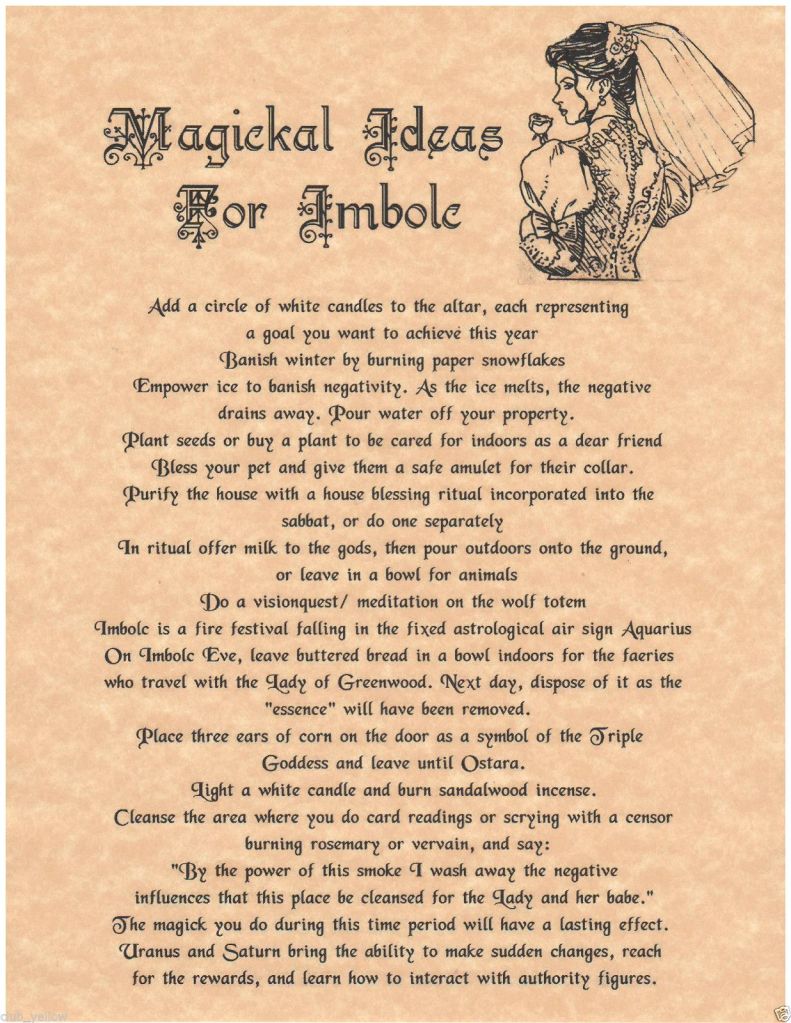
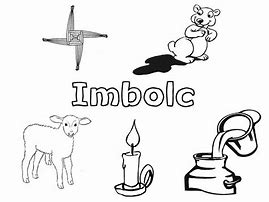
Magickal Ideas for Imbolc

Let’s Have Some Fun – Imbolc


For Your Listening Pleasure – Imbolc

Music for Imbolc – Brigid’s Day Songs (Celtic Festival)

Flashback 2004 Imbolc

 Imbolc

Celebrate this festival by draping the altar in white and silver. Kepp the entire altar white — white candlesticks, white incense bowls, etc. Represent the Goddess with a figure of a horned cow. If you wear robes in ritual, honor Brigid in her guise as the goddess of the dairy by wearing white. With Neptune lending the glamour to your robes to the Sun this time, as glitter to your robes with sliver and “diamonds.” Let your imagination run wild.

Save snow from the last storm, or use crushed ice, and put it out in bowls on the altar. Scrub clean an old milke bottle or cream jar and fill it with fresh milk; freshly made mozzarella cheese will round out your cakes and ale. Nestle all bowls in the snow.

The planetary energies are particularly favorable this sabbat for working magic for world peace. Place all the candles you’ll be using this year on the altar and start this ritual in the dark — this is, without lights. Add your magic to the returning Sun. Dedicate and consecrate all your candles during this festival of lights, and consecrate your agricultural tools for use in the coming cycle of growth. This is the festival of new beginnings.

Copyright By K. D. Spitzer in Llewellyn’s Witches’ Datebook 2004 Page 39

Happy and Blessed Winter Solstice

Winter Solstice Spell

8 Rituals For The Winter Solstice 2021: How To Make Your Own Light

Take a deep breath as we enter this time of the winter solstice on December 21 in the northern hemisphere. Think of it as a sacred gateway: an ending and a new beginning. With all the noise of 2021, it is time for some much-needed quiet and inner nourishment. Mother Nature is asking us to reflect, recalibrate, and strengthen our ability to shine in the world.

The winter solstice is the shortest day of the year and the longest night. At this time, many cultures believe that the archetypal Great Mother gave birth to a sun child (the Egyptian deity Isis gave birth to sun god Horus; the Greek Leto gave birth to a shining Apollo.) This is a moment to hold the light for yourself and others. Here are eight rituals to help you do so.

1. Turn off the lights.

On the night of the solstice, unplug your phone, TV, and tablets. Instead of turning on electric lights, eat dinner by candlelight and…

Click here to read the rest of the article from mindbodygreen.com

Winter solstice 2021: Why it happens and how we celebrate the first day of winter

For the past six months, the days have grown shorter and the nights have grown longer in the Northern Hemisphere. But that’s about to reverse itself.

Winter solstice 2021, the shortest day of year and the official first day of winter, is on Tuesday, December 21. How it all works has fascinated people for thousands of years.

First we’ll look at the science and precise timing behind the solstice. Then we’ll explore some ancient traditions and celebrations around the world.

From msn.com

Printable Winter Solstice Coloring Pages

Winter Solstice Traditions: How to Celebrate This Holiday Season

For those who are spiritual but not so religious, you may choose to celebrate the December holiday season differently. The winter solstice is a wonderful way to honor your ancestors, the earth and its creatures, and the birth of a new sun during this special time of year.

So what exactly is this ancient holiday, and how do you celebrate the winter solstice? Spoonful of Comfort answers these questions and offers some new-to-you winter solstice traditions that you and your loved ones can embrace.

What Is the Winter Solstice Holiday?

Earth experiences the winter solstice when the shortest and darkest day of the year passes and a new, longer day begins. In 2021, for the Northern Hemisphere, the exact time for this change is December 21 at 10:59 a.m. Eastern Standard Time.

Why Is the Winter Solstice Celebrated?…

Click here to read the rest of this article

For Your Viewing Pleasure – Winter Solstice

What happens during the winter solstice?

The Winter Solstice


The Winter Solstice

The darkest day makes way for the return of light

December 21, 2015 marks the Winter Solstice, which is the official beginning of winter, and the shortest day of the year in the Northern Hemisphere. But there’s a light at the end of this tunnel — literally! As the temperatures fall throughout the winter, the light grows, representing new hope during a time of darkness.

Ancient solstice festivals were the last big feasts before food became scarce during the harsh winter months. This magical day was celebrated from ancient Rome to China, and by the builders of Stonehenge to the Mayans. In fact, we all remember the Winter Solstice on December 21, 2012, which was the apparent end of the Mayan calendar, causing many to believe the end of the world is coming. Obviously, we’re still here!

Many modern holiday traditions, such as Christmas, Hanukkah, Kwanzaa and New Year’s, have their roots in the Winter Solstice celebrations of yesterday. Winter festivals continue today, complete with lights, feasts, dancing and singing, and spending quality time with those we love.

Astrologically, the Winter Solstice marks the moment the Sun — the ruler of the zodiac — moves from adventurous Fire sign Sagittarius to the steady Earth sign of Capricorn. This is the dark night of the year, a day when the Sun appears to stand still. It’s a time for light and laughter, but also deep reflection.

The Sun’s move into steady Capricorn urges us to take some time to look back on 2015 before we make those New Year’s resolutions. What did we do right? What do we wish we’d done differently? Don’t fight the seriousness it brings to the festive holiday season — use it to start 2016 on the right foot! Just make sure to keep some of the Goat’s ambitious energy alive when the Sun makes its next move.

Source:
Tarot.com is a Daily Insight Group Site

Let’s Have Some Fun – Northern Hemisphere Yule/Winter Solstice

Winter Solstice Ritual Potpourri

Recipe by Gerina Dunwich

20 drops musk oil

25 drops pine oil

1 cup oak moss

2 cups dried mistletoe

1 cup dried poinsettia flowers

1 cup dried bayberries

1/2 cup dried rosemary

1/2 cup dried holly leaves and berries

3 crushed pinecones

Mix the musk and pine oils with the oak moss, and then add the remaining ingredients. Stir the potpourri well and store in a tightly covered ceramic or glass container.

(The above recipe for “Yule Ritual Potpourri” is quoted directly from Gerina Dunwich’s book “The Wicca Spellbook: A Witch’s Collection of Wiccan Spells, Potions and Recipes”, page 162, A Citadel Press Book, Carol Publishing Group, 1994/1995)


Samhain

From History.com

CONTENTS

  1. Ancient Samhain
  2. Samhain Monsters
  3. Myths of Samhain
  4. Samhain in the Middle Ages
  5. Dumb Supper
  6. Christian Samhain
  7. Samhain Merges With Halloween
  8. Wicca and Samhain
  9. Celtic Reconstructionists
  10. Sources

Samhain is a pagan religious festival originating from an ancient Celtic spiritual tradition. In modern times, Samhain (a Gaelic word pronounced “SAH-win”) is usually celebrated from October 31 to November 1 to welcome in the harvest and usher in “the dark half of the year.” Celebrants believe that the barriers between the physical world and the spirit world break down during Samhain, allowing more interaction between humans and denizens of the Otherworld.

READ MORE: Halloween: Traditions, Rituals, Origins

Ancient Samhain

Ancient Celts marked Samhain as the most significant of the four quarterly fire festivals, taking place at the midpoint between the fall equinox and the winter solstice. During this time of year, hearth fires in family homes were left to burn out while the harvest was gathered.

After the harvest work was complete, celebrants joined with Druid priests…

Samhain Celebration Guide

To read more about celebrating Samhain please click on this link

From Plentiful Earth – Northern and Southern Hemispheres Samhain

MAGICKAL 🍂SAMHAIN

By: Forest🐾Devi✨ (Novice in the Heart’s Spirit Coven)


Voices from the spirit world whisper in the wind.

Tonight two worlds come ever closer the curtain waivers thin.

Hear the crackle of the flames burning in the hearth, while loved ones in the Summerlands 

Return to walk the earth.

We welcome in the new year, a time to shed our skin.

With gratitude for lessons learned the future ushers in.

As entities from other worlds come feast with us again.

All commenced in celebration of MAGICKAL Samhain

Sinister Solar System From NASA

Introduction

Our universe is full of mysterious sights, and spine-tingling sounds. Take a journey to the most frightful corners of the cosmos.

Click here for More interesting and fun information about our “Sinister Solar System”

Beltane of the Southern Hemisphere

Today, in the Pagan calendar, the north celebrate the coming of winter at Samhainn. And all the while the sun is peaking up from behind the lush vernal trees and dancing for us once more in the southern hemisphere, as we welcome Beltane on October 31st. Or as I like to refer to it Beltane of the underworld.

A pagan spiral formation in Faerie Glenn where everything is miniature and enchanted. Copyright Content Catnip 2010

Beltane is  the Gaelic seasonal festival historically held to mark the midpoint between the spring equinox & summer solstice (Là Bealltainn in Scottish Gaelic; Lá Bealtaine in Irish). Fire is the traditional means of marking this spring festival of optimism & return.

A famous Ossianic lament…

Click here to read more about Southern Hemisphere Beltane from ContentCatnip.com

Yule/Winter Solstice Ritual

You will need:

Your tools

Some ice

Lavender incense

A compass

Setup:

Set-up your altar, place the ice in the cauldron and the incense anywhere.

Perform a meditation.

Cast your circle.

Hold your hands up in the air saying:

“GREAT WINTER I WELCOME YOU,GODDESS OF NGHT.”

Place your hands in the cauldron and move them around in the ice while saying:

“I WELCOME YOUR MIGHT,YOUR COLD.”

Light the incense. Take aa sip from the chalice. Take the athame and point it toward the west while saying:

“GREAT WINTER I CALL YOU,COME FORTH,I WELCOME YOU.”

Close your eyes and visualize the winter in all her fury. At this point you may end this ritual,or continue with a spell.

“SO MOTE IT BE”

Close your circle.