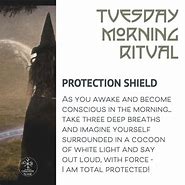
When doing spells for yourself set your intention that it will work just as you want it to. As you are writing the spell envision the outcome you want to happen.
Until we meet again dear sisters, brothers, and honored guests may you blessed be.

When doing spells for yourself set your intention that it will work just as you want it to. As you are writing the spell envision the outcome you want to happen.
Until we meet again dear sisters, brothers, and honored guests may you blessed be.

You can use this link to go forward or backward in time for Moon phase information. If you are curious, you can even find out what phase the Moon was in when you or anyone else was born.
Today and tonight the Moon will be in a Waning Gibbous Phase. This is the first phase after the Full Moon occurs. It lasts roughly 7 days with the Moon’s illumination growing smaller each day until the Moon becomes a Last Quarter Moon with an illumination of 50%. The average Moon rise for this phase is between 9pm and Midnight depending on the age of the phase. The moon rises later and later each night setting after sunrise in the morning. During this phase the Moon can also be seen in the early morning daylight hours on the western horizon.
Visit the May 2022 Moon Phases Calendar to see all the daily moon phase for this month.
The Waning Gibbous on May 17 has an illumination of 97%. This is the percentage of the Moon illuminated by the Sun. The illumination is constantly changing and can vary up to 10% a day. On May 17 the Moon is 16.29 days old. This refers to how many days it has been since the last New Moon. It takes 29.53 days for the Moon to orbit the Earth and go through the lunar cycle of all 8 Moon phases.
There are 8 lunar phases the Moon goes through in its 29.53 days lunar cycle. The 4 major Moon phases are Full Moon, New Moon, First Quarter and Last Quarter. Between these major phases, there are 4 minor ones: the Waxing Crescent, Waxing Gibbous, Waning Gibbous and Waning Crescent. For more info on the Moon Cycle and on each phase check out Wikipedia Lunar Phase page.
Check the weather before a night of Moon gazing at weather.com
For a list of all the current meteor showers visit American Meteor Society
Tuesday (Tiw’s-day)
Planet: Mars
Colors: Red and Autumn Shades
Crystals: Bloodstone, Ruby, Garnet, Flint, Rhodonite, Iron and Steel
Aroma: Basil, Ginger, Black Pepper, Mars Oil, Dragon’s blood and patchouli
Herb: Basil
The day of Mars. This day could only ever symbolize the sheer power of the god of war! The ideal spells to be cast on this day are that of force, power war and protection.
Dedicated to the powers of the planet Mars, personified as Ares, Tiwaz, Tiw, and Tyr.
Magical aspects: controlled power, energy, and endurance, passion, sex, courage, aggression, and protection.
This is the proper day of the week to perform spells and rituals involving courage, physical strength, revenge, military honors, surgery, the breaking of negative spells, dynamic energy, matrimony, war, enemies, prison, hunting, politics, contests, protection, victory, and athletics.

Discover the cosmos! Each day a different image or photograph of our fascinating universe is featured, along with a brief explanation written by a professional astronomer.
2022 May 17

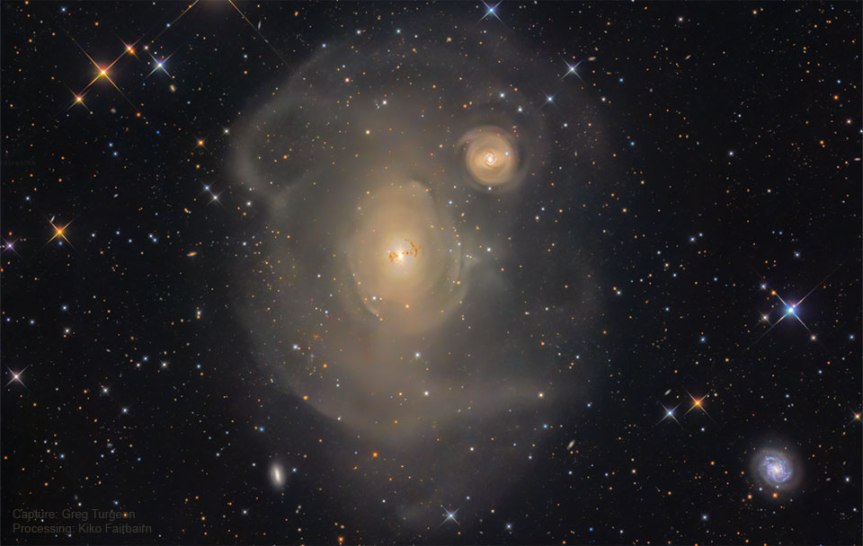
Explanation: Astronomers turn detectives when trying to figure out the cause of startling sights like NGC 1316. Investigations indicate that NGC 1316 is an enormous elliptical galaxy that started, about 100 million years ago, to devour a smaller spiral galaxy neighbor, NGC 1317, just on the upper right. Supporting evidence includes the dark dust lanes characteristic of a spiral galaxy, and faint swirls and shells of stars and gas visible in this wide and deep image. One thing that >remains unexplained is the unusually small globular star clusters, seen as faint dots on the image. Most elliptical galaxies have more and brighter globular clusters than NGC 1316. Yet the observed globulars are too old to have been created by the recent spiral collision. One hypothesis is that these globulars survive from an even earlier galaxy that was subsumed into NGC 1316. Another surprising attribute of NGC 1316, also known as Fornax A, is its giant lobes of gas that glow brightly in radio waves.
There are at least a thousand reasons to visit Sicily, the great island – indeed the largest in the Mediterranean – that forms the triangular football to the boot that is the Italian peninsula. They are all very good reasons, including amazing landscapes, a uniquely complex and delicious cuisine, a history that is diverse and multifaceted beyond belief, excellent wines, a vast array of archaeological sites, an even vaster one of historical towns and villages. But one key reason to visit the island is missing from the list above: Greek temples!
Greek temples are one of the earliest well-defined expressions of what we now recognise as the Western tradition in architecture, and one of the most influential ones by a vast margin to this day. They go back to the 8th or 7th centuries BCE, and, as the name entails, they are indeed a key achievement of the Archaic Greeks. They originated in what is the south of modern Greece, namely the Peloponnese and Central Greece, where Greek temple architecture appears to have its main roots, probably derived from local wooden predecessors.
The Greek mainland’s architectural style is the Doric one, considered to be the most austere and ‘male’ in character. The eastern Aegean and Asia Minor were famous for their own development, the more elegant and ‘female’ Ionic style, conceived about a century after the Doric one. Its most prominent examples at Samos, Ephesus, and Didyma (much better preserved than the other two) are also marked by their …

Wishing you a fantastic Tuesday!

If you need to calculate the planetary positions for a specific use and time, click on this link
To figure out GMT (Greenwich Mean Time) to your local time use this link
The time for these Custom Planetary Positions is from the local time in Sao Paulo, Brazil, South America
18 May 2022
03:00 pm GMT 12:00 PM BRT
Zodiac: Tropical (Standard Western)
True Lunar Node:22 Taurus 31 Rx
Mean Lunar Node:22 Taurus 15 Rx
Lilith (Black Moon):03 Cancer 45
Chiron:14 Aries 53
Ceres:01 Cancer 22
Pallas:08 Taurus 04
Juno:09 Pisces 19
Vesta:28 Aquarius 17
Eris:24 Aries 42

The time for these Custom Planetary Positions is from the local time in Cape Town, South Africa
18 May 2022
10:00 am GMT 12:00 PM SAST
Zodiac: Tropical (Standard Western)
True Lunar Node:22 Taurus 31 Rx
Mean Lunar Node:22 Taurus 15 Rx
Lilith (Black Moon):03 Cancer 44
Chiron:14 Aries 53
Ceres:01 Cancer 17
Pallas:07 Taurus 58
Juno:09 Pisces 15
Vesta:28 Aquarius 13
Eris:24 Aries 42

The time for these Custom Planetary Positions is from the local time in Melbourne, Victoria, Australia
18 May 2022
02:00 am GMT 12:00 PM AEST
Zodiac: Tropical (Standard Western)
True Lunar Node:22 Taurus 31 Rx
Mean Lunar Node:22 Taurus 16 Rx
Lilith (Black Moon):03 Cancer 41
Chiron:14 Aries 52
Ceres:01 Cancer 08
Pallas:07 Taurus 49
Juno:09 Pisces 09
Vesta:28 Aquarius 07
Eris:24 Aries 41


You can use this link to go forward or backward in time for Moon phase information. If you are curious, you can even find out what phase the Moon was in when you or anyone else was born.
Today and tonight the Moon will be in a Full Moon phase. During a Full Moon the moon is 100% illuminated as seen from Earth and is on the opposite side of the Earth from the Sun. The Moon will be visible throughout the night sky rising at sunset in the east and setting with the sunrise the next morning. The point at which a Full Moon occurs can be measured down to a fraction of a second. The time it takes between full moons is known as a Synodic month and is 29.530587981 days long. Keep track of all the Full Moons throughout the year on the Full Moon Calendar >
Visit the May 2022 Moon Phases Calendar to see all the daily moon phase for this month.
The Full Moon on May 16 has an illumination of 100%. This is the percentage of the Moon illuminated by the Sun. The illumination is constantly changing and can vary up to 10% a day. On May 16 the Moon is 15.14 days old. This refers to how many days it has been since the last New Moon. It takes 29.53 days for the Moon to orbit the Earth and go through the lunar cycle of all 8 Moon phases.
There are 8 lunar phases the Moon goes through in its 29.53 days lunar cycle. The 4 major Moon phases are Full Moon, New Moon, First Quarter and Last Quarter. Between these major phases, there are 4 minor ones: the Waxing Crescent, Waxing Gibbous, Waning Gibbous and Waning Crescent. For more info on the Moon Cycle and on each phase check out Wikipedia Lunar Phase page.
Check the weather before a night of Moon gazing at weather.com
For a list of all the current meteor showers visit American Meteor Society
Materials
5 small bells
1 yard each yellow, red, blue, green, and purple ribbon
Thread a bell on each length of ribbon, then tie the first four ribbons to tree branches in the order listed above, saying with each:
To ring these bells,
all breezes blow
Carry their sounds
both high and low
To wake the Muses from
Their rest
Heed ye now this firm request
Then tie the purple ribbon to a branch, saying something like:
From East and South and
West and North
Muses hear me: now come forth
From South and West and
North and East
Inspiration now release
From West and North and
East and South
Creative powers bud and sprout
From North and East
and South and West
Heed my call and this request
As these bells ring in the breeze
Let ideas flow forth with ease
Bring inspiration with the wind—
In constant stream without an end—
Unleash Your creativity
Muses, bring it now to me
Creative blocks will begin to dissipate within twenty-four hours.
Everyday Moon Magic: Spells & Rituals for Abundant Living (Everyday Series)
Dorothy Morrison
Discover the cosmos! Each day a different image or photograph of our fascinating universe is featured, along with a brief explanation written by a professional astronomer.
2022 May 16

Explanation: Real castles aren’t this old. And the background galaxy is even older. Looking a bit like an alien castle, the pictured rock spires are called hoodoos and are likely millions of years old. Rare, but found around the world, hoodoos form when dense rocks slow the erosion of softer rock underneath. The pictured hoodoos survive in the French Alps and are named Demoiselles Coiffées — which translates to English as “Ladies with Hairdos“. The background galaxy is part of the central disk of our own Milky Way galaxy and contains stars that are typically billions of years old. The photogenic Cygnus sky region — rich in dusty dark clouds and red glowing nebulas — appears just above and behind the hoodoos. The featured image was taken in two stages: the foreground was captured during the evening blue hour, while the background was acquired from the same location later that night.


If you need to calculate the planetary positions for a specific use and time, click on this link
To figure out GMT (Greenwich Mean Time) to your local time use this link
The time for these Custom Planetary Positions is from the local time in Sao Paulo, Brazil, South America
17 May 2022
03:00 pm GMT 12:00 PM BRT
Zodiac: Tropical (Standard Western)
True Lunar Node:22 Taurus 31 Rx
Mean Lunar Node:22 Taurus 18 Rx
Lilith (Black Moon):03 Cancer 38
Chiron:14 Aries 50
Ceres:00 Cancer 57
Pallas:07 Taurus 37
Juno:09 Pisces 00
Vesta:27 Aquarius 59
Eris:24 Aries 41

The time for these Custom Planetary Positions is from the local time in Cape Town, South Africa
17 May 2022
10:00 am GMT 12:00 PM SAST
Zodiac: Tropical (Standard Western)
True Lunar Node:22 Taurus 31 Rx
Mean Lunar Node:22 Taurus 18 Rx
Lilith (Black Moon):03 Cancer 37
Chiron:14 Aries 50
Ceres:00 Cancer 52
Pallas:07 Taurus 31
Juno:08 Pisces 56
Vesta:27 Aquarius 55
Eris:24 Aries 41

The time for these Custom Planetary Positions is from the local time in Melbourne, Victoria, Australia
17 May 2022
02:00 am GMT 12:00 PM AEST
Zodiac: Tropical (Standard Western)
True Lunar Node:22 Taurus 31 Rx
Mean Lunar Node:22 Taurus 19 Rx
Lilith (Black Moon):03 Cancer 35
Chiron:14 Aries 49
Ceres:00 Cancer 44
Pallas:07 Taurus 23
Juno:08 Pisces 50
Vesta:27 Aquarius 48
Eris:24 Aries 41


You can use this link to go forward or backward in time for Moon phase information. If you are curious, you can even find out what phase the Moon was in when you or anyone else was born.
The Moon’s current phase for today and tonight is a Waxing Gibbous phase. This phase is when the moon is more than 50% illuminated but not yet a Full Moon. The phase lasts about 7 days with the moon becoming more illuminated each day until the Full Moon. During a Waxing Gibbous the moon rises in the east in mid-afternoon and is high in the eastern sky at sunset. The moon is then visible through most of the night sky setting a few hours before sunrise. The word Gibbous first appeared in the 14th century and has its roots in the Latin word “gibbosus” meaning humpbacked.
Visit the May 2022 Moon Phases Calendar to see all the daily moon phase for this month.
The Waxing Gibbous on May 15 has an illumination of 99%. This is the percentage of the Moon illuminated by the Sun. The illumination is constantly changing and can vary up to 10% a day. On May 15 the Moon is 14 days old. This refers to how many days it has been since the last New Moon. It takes 29.53 days for the Moon to orbit the Earth and go through the lunar cycle of all 8 Moon phases.
There are 8 lunar phases the Moon goes through in its 29.53 days lunar cycle. The 4 major Moon phases are Full Moon, New Moon, First Quarter and Last Quarter. Between these major phases, there are 4 minor ones: the Waxing Crescent, Waxing Gibbous, Waning Gibbous and Waning Crescent. For more info on the Moon Cycle and on each phase check out Wikipedia Lunar Phase page.
Check the weather before a night of Moon gazing at weather.com
For a list of all the current meteor showers visit American Meteor Society

Discover the cosmos! Each day a different image or photograph of our fascinating universe is featured, along with a brief explanation written by a professional astronomer.
2022 May 15

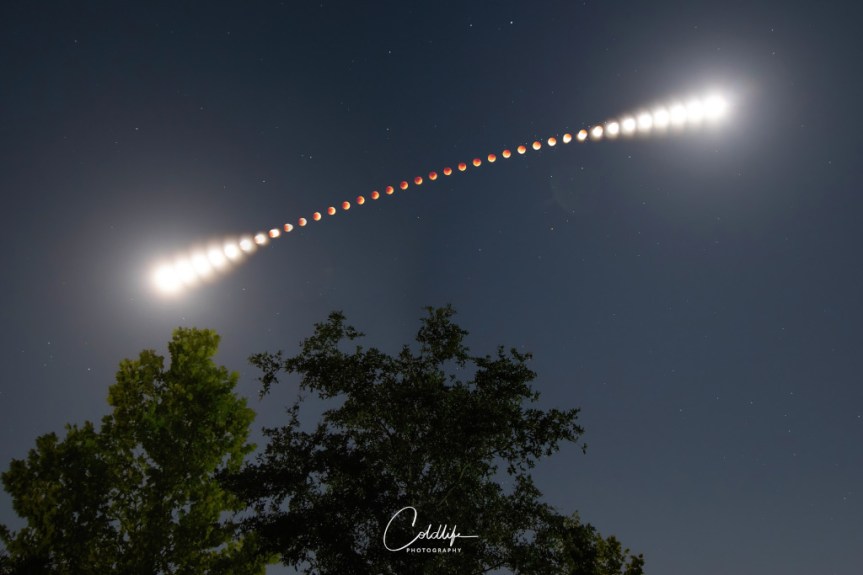
Explanation: What color is the Moon? It depends on the night. Outside of the Earth’s atmosphere, the dark Moon, which shines by reflected sunlight, appears a magnificently brown-tinged gray. Viewed from inside the Earth’s atmosphere, though, the moon can appear quite different. The featured image highlights a collection of apparent colors of the full moon documented by one astrophotographer over 10 years from different locations across Italy. A red or yellow colored moon usually indicates a moon seen near the horizon. There, some of the blue light has been scattered away by a long path through the Earth’s atmosphere, sometimes laden with fine dust. A blue-colored moon is more rare and can indicate a moon seen through an atmosphere carrying larger dust particles. What created the purple moon is unclear — it may be a combination of several effects. The last image captures the total lunar eclipse of 2018 July — where the moon, in Earth’s shadow, appeared a faint red — due to light refracted through air around the Earth. Today there is not only another full moon but a total lunar eclipse visible to observers in North and South America — an occurrence that may lead to some unexpected lunar colorings.
1252 Pope Innocent IV issues the papal bull ad exstirpanda, which authorizes, but also limits, the torture of heretics in the Medieval Inquisition
1618 German astronomer Johannes Kepler discovers the third of his three planetary laws his “harmonics law”
1869 National Woman Suffrage Association forms in New York, founded by Susan B. Anthony and Elizabeth Cady Stanton
1940 Richard and Maurice McDonald open the 1st McDonald’s restaurant in San Bernardino, California
1951 AT&T becomes the 1st US corporation to have a million stockholders after young car salesman Brady Denton purchases 7 shares worth $1,078
1988 USSR begins withdrawing its 115,000 troops from Afghanistan

756 Abd-al-Rahman I becomes emir of Cordova, Spain
884 Marinus I ends his reign as Catholic Pope
1004 Henry II the Saint crowned King of Italy
1213 King John of England names Stephen Langton as Archbishop of Canterbury
1222 Mongolian leader Genghis Khan meets the leader of the Taoist Dragon Gate sect Chang Chun at his camp in Parwan (Afghanistan)
1248 Archbishop Konrad von Hochstaden lays cornerstone for Cologne Cathedral
1252 Pope Innocent IV issues the papal bull ad exstirpanda, which authorizes, but also limits, the torture of heretics in the Medieval Inquisition
1492 Cheese & Bread rebellion: German mercenaries kill 232 residents of Alkmaar, Netherlands

1928 Mickey Mouse makes his 1st ever appearance in silent film “Plane Crazy”
1954 KGLO (now KIMT) TV channel 3 in Mason City, IA (CBS) 1st broadcast
1955 KPUA (now KGMD) TV channel 9 in Hilo, HI (CBS) begins broadcasting
1958 “Gigi” based on the story by Colette, directed by Vincent Minnelli and starring Leslie Caron and Maurice Chevalier premieres in New York (Best Picture 1959)
1959 12th Cannes Film Festival: “Black Orpheus” directed by Marcel Camus wins the Palme d’Or
1960 KHVO TV channel 13 in Hilo, HI (ABC) begins broadcasting
1960 “L’Avventura”, Italian film directed by Michelangelo Antonioni, starring Gabriele Ferzetti, Monica Vitti. premieres at Cannes
1961 “Bonanza” by Al Caiola Orchestra hits #19

1858 Royal Italian Opera opens in Covent Garden, London
1891 Jules Massenet‘s opera “Grisélidis” premieres in Paris
1914 Henri Rabaud’s opera “Marouf, savetier de Caire” premieres in Paris
1941 Nazi occupiers in Netherlands forbid Jewish music
1960 Dmitri Shostakovich‘s 7th String quartet premieres in Leningrad
1967 Paul McCartney meets his future wife Linda Eastman
1971 “70, Girls, 70” closes at Broadhurst Theater, NYC, after 35 performances
1972 “Hard Job Being God” opens at Edison Theater, NYC; runs for 6 performances

1862 First baseball enclosure opens at Union Grounds, Brooklyn
1876 2nd Kentucky Derby: Bobby Swim aboard Vagrant wins in 2:38.25
1894 20th Kentucky Derby: Frank Goodale aboard Chant wins in 2:41
1906 NY Giants’ Hooks Wiltse strikes out 4 batters in 1 inning
1912 37th Preakness: Clarnence Turner on Colonel Holloway wins in 1:56.6
1912 Ty Cobb rushes a heckler at a NY Highlander game & is suspended
1918 43rd Preakness: Johnny Loftus aboard War Cloud wins in 1:53.6
1918 Washington Senator Walter Johnson pitches 1-0, 18 inning game

Majestic / adjective / muh·jeh·stuhk
We use the word “majestic” in the English language to represent people, places, and things that have an elegant or stately quality. “Majestic” is a term that describes otherworldly greatness, grace, style, and outstanding beauty or form. English speakers often use the word “majestic” to describe things related to royalty and regality. Familiar terminology uses the word “majestic” to address royal kings and Queens as his or her “majesty.”
It surprised them to see the “majestic” looking yacht emerge from the ocean.
The King and Queen of the palace always dress in a “majestic” fashion.
The Taj Mahal is one of the most “majestic” buildings in existence.
English-speakers find the first instance of the word “majestic” showing up around the end of the late-15th century. Etymologists say the word “majestic” has Latin origins and first entered language around 1570. The original definition of “majestic” refers to outstanding and out-of-this world characteristics or behavior synonymous with exceptionality, dignity, and grace. “Majestic” still carries the original definition assigned in the 1500s.
Classy, Courtly
Dowdy, Graceless

You must be logged in to post a comment.