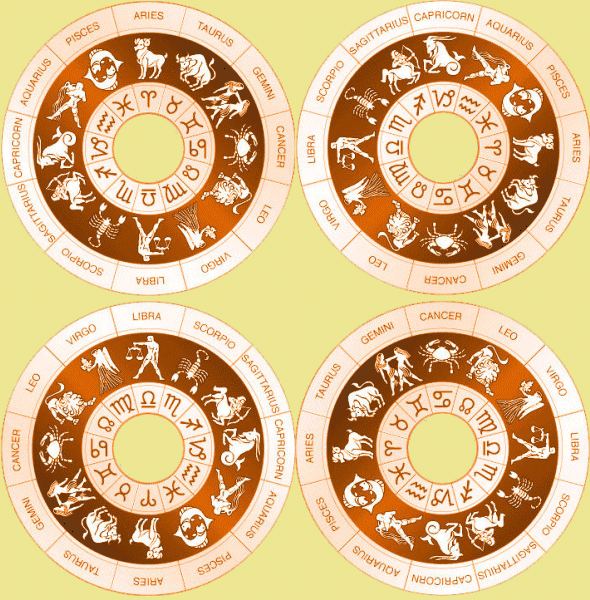
The Witches Sabbats

Northern Hemisphere

Imbolc – Feb 2nd
Ostara – Mar 21st/22nd
Beltane – April 30th/May 1st
Lithia – June 21st/22nd
Lammas – July 31st/Aug 1st
Mabon – Sept 21st/22nd
Samhain – Oct 31st
Yule – Dec 21st/22nd

Southern Hemisphere

Imbolc – August 1st
Ostara – September 21st/22nd
Beltane – Oct 31st/Nov 1st
Lithia – Dec 21st/22nd
Lammas – Feb 1st/2nd
Mabon – March 21st

Samhain – April 30th/May 1st
Yule – June 21st

 Our Next Sabbat is Ostara

Solstices and Equinoxes

Spring Equinox ~ March 20th

Summer Solstice ~ June 20th

Autumn Equinox ~ September 22nd

Winter Solstice ~ December 21st

Deity of the Day for August 17: Brigid

Brigid

by Lisa Spindler
Name Cognates: Breo Saighead, Brid, Brighid [Eriu], Brigindo, Brigandu [Gaul], Brigan, Brigantia, Brigantis [Briton], Bride [Alba].Breo Saighead, or the “Fiery Arrow or Power,” is a Celtic three-fold goddess, the daughter of The Dagda, and the wife of Bres. Known by many names, Brighid’s three aspects are (1) Fire of Inspiration as patroness of poetry, (2) Fire of the Hearth, as patroness of healing and fertility, and (3) Fire of the Forge, as  patroness of smithcraft and martial arts. She is mother to the craftsmen. Sons of Tuireann: Creidhne, Luchtaine and Giobhniu.

Excalibur, King Arthur’s sword, was forged by the Lady of the Lake, a figure sometimes associated with Brighid because of her fire and forgery aspect. Like the Arthurian Avalon, or “Isle of Apples,” Brigid possessed an apple orchard in the Otherworld to which bees traveled to obtain it’s magickal nectar.

Brigid, which means “one who exaults herself,” is Goddess of the Sacred Flame of Kildare (derived from “Cill Dara,” which means “church of the oak”) and often is considered to be the White Maiden aspect of the Triple Goddess. She was Christianized as the “foster-mother” of Jesus Christ, and called St. Brigit, the daughter of the Druid Dougal the Brown. She sometimes also is associated with the Romano-Celtic goddess Aquae-Sulis in Bathe.

Brighid’s festival is Imbolc, celebrated on or around February 1 when she ushers Spring to the land after The Cailleach’s Winter reign. This mid-Winter feast commences as the ewes begin to lactate and is the start of the new agricultural cycle. During this time Brigid personifies a bride, virgin or maiden aspect and is the protectoress of women in childbirth. Imbolc also is known as Oimelc, Brigid, Candlemas, or even in America as Groundhog Day.

As the foundation for the American Groundhog Day, Brigid’s snake comes out of its mound in which it hibernates and its behavior is said to determine the length of the remaining Winter.

Gailleach, or White Lady, drank from the ancient Well of Youth at dawn. In that instant, she was transformed into her Maiden aspect, the young goddess called Brigid. Wells were considered to be sacred because they arose from oimbelc(literally “in the belly”), or womb of Mother Earth.

Because of her Fire of Inspiration and her connection to the apple and oak trees, Brighid often is considered the patroness of the Druids.

When Maiden Becomes Mother

When Maiden Becomes Mother

Lammas Traditions from Nebraska to Wales

by Brighid

Once again, we approach the fall rituals of harvest and riches of the Earth Goddess, thankful for Her bounty She bestows on us. Lammas, August 1 (its celebration typically held the night before, July 31), is the time of the first grain harvest, with objects made of grains (wheat, barley, corn and so on – for example, a bundle of corn stalks) being considered very magickal, for they represent the generosity of the Mother.

Lammas is directly contrasted in the wheel of the year to Imbolc. The two holidays represent opposite aspects of the Goddess. At Imbolc She is the Corn Maiden, fresh and new after her winter rest, and at Lammas She is the Corn Mother, the crone with all development and fruitfulness coming to an end. Lammas also involves the Sun King becoming the Dark Lord, giving of his energy to the crops to ensure life. It is the time of the death of summer and the start of fall, with the days growing shorter and the foliage ending its growth and fruit-bearing cycles. It is the time to share the fruits of the earth, of your own accomplishments with others.

Almost every culture has a celebration in thankfulness for the reaping of the crops in this time of year.

The Celts knew this holiday as Lughnasadn (pronounced loo-na-sa), celebrating the harvest of the grains, marking the last days of the sun god, Lugh. However, races and games that were held in Lugh’s name were more the funeral games for Lugh’s mother, the goddess Tailtiu, in her time of being crone. The Celts believed that the grain held the spirit of the harvest; as each sheaf was cut, the next would absorb the spirit energy of the cut sheaf. Thus, when reapers came to the last sheaf, it contained the whole spirit of the field. A corn doll was made of it in the image and honor of the Mother. In some groups, the person gathering the last grain, often in some special feat of sickle-wielding, was honored by receiving the magick of the grain. Lammas was also a time for Tailltean marriages, informal marriages that lasted a year and a day, similar to handfastings.

In the Bronze Age, there was a Lughnasadn tradition that a High King or God King was chosen then to serve a year and a day, after which his reign ended and so did his life in honor of the Goddess. He was a symbol of the grain, which has to die before its seeds are sown. As by request of Lugh himself, this ritual was put to an end and a great feast was instituted in its place.

The English (Saxons) called this holiday Lammas, “loaf mass,” the mass after the loaves are made from the new grain. At Lammas, couples would run hand-in-hand over bonfires to purify their relationships, a tradition perhaps connected to the Celtic Tailltean marriages.

The Welsh also had a Lammas holiday, and using the muscles gained from the summer work, they held games to test their strength. These games are still held today, alternating between North and South Wales.

The Italian streghe (witches) associated this holiday with the symbol of the cornucopia overflowing with fruit and the harvest grains.

When I was a young girl, we in Nebraska had our own ritual when the big combines would roll into our small farming town. My girlfriends and I would spread out on lawn chairs in my front yard – my house was closest to the road – and watch the hired Texan and Oklahoman farmhands steer those massive machines into our area. Watching the men work, their young muscles bronze and sweaty, over the corn harvest, we would place bets – betting our tip money (very vital since it also was our party money) on which boy we could charm with our wiles and snatch a few intimate moments with. Ah, the harvest we had!

Whatever your celebration ritual may be, let us all remember this is a time for appreciating all that She has given us and for sharing that bounty with others. Enjoy your Lammas!

About Litha: A Guide to the Symbolism of the Wiccan Sabbat

a guide to the symbolism of the Wiccan Sabbat

by Arwynn MacFeylynnd

Date: June 20-23 (usually, the date of the calendar summer solstice).

Alternative names: Summer Solstice, Midsummer, Midsummer’s Eve, Alban Heruin, Alban Hefin, Gathering Day, Vestalia, La Festa dell’Estate (Summer Fest), the Day of the Green Man.

Primary meanings:  This Sabbat celebrates the abundance and beauty of the Earth. From this day on, the days will wane, growing shorter and shorter until Yule. It is a time to absorb the Sun’s warming rays, and to celebrate the ending of the waxing year and beginning of the waning year in preparation for the harvest to come. Midsummer is another fertility Sabbat, not only for humans, but also for crops and animals. This is a time to celebrate work and leisure, to appreciate children and childlike play and to look internally at the seeds you’ve planted that should be at full bloom. Some people believe that at twilight on this day, the portals between worlds open and the faery folk pass into our world; welcome them on this day to receive their blessings.

Symbols: Fire, the Sun, blades, mistletoe, oak trees, balefires, Sun wheels, summertime flowers (especially sunflowers), summer fruits, seashells and faeries. If you made Sun wheels at Imbolc, display them now prominently, hanging from the ceiling or on trees in your yard. You may want to decorate them with yellow and gold ribbons and summer herbs.

Colors: White, red, maize yellow or golden yellow, green, blue and tan.

Gemstones: All green gemstones, especially emerald and jade, and also tiger’s eye, lapis lazuli and diamond.

Herbs: Chamomile, cinquefoil, copal, elder, fennel, fern, frankincense, galangal, heliotrope, hemp, larkspur, laurel, lavender, lemon, mistletoe, mugwort, oak, pine, roses, saffron, St. John’s wort, sandalwood, thyme, verbena, wisteria and ylang-ylang. Herbs gathered on this day are said to be extremely powerful.

Gods and goddesses: All father gods and mother goddesses, pregnant goddesses and Sun deities. Particular emphasis might be placed on the goddesses Aphrodite, Astarte, Freya, Hathor, Ishtar and Venus and other goddesses who preside over love, passion and beauty. Other Litha deities include the goddesses Athena, Artemis, Dana, Kali, Isis and Juno and the gods Apollo, Ares, Dagda, Gwydion, Helios, Llew, Oak/Holly King, Lugh, Ra, Sol, Zeus, Prometheus and Thor.

Customs and myths: One way to express the cycle of the Earth’s fertility that has persisted from early pagan to modern times is the myth of the Oak King and the Holly King, gods respectively of the Waxing and Waning Year. The Oak King rules from Midwinter to Midsummer, the period of fertility, expansion and growth, and the Holly King reigns from Midsummer to Midwinter, the period of harvest, withdrawal and wisdom. They are light and dark twins, each being the other’s alternate self, thus being one. Each represents a necessary phase in the natural rhythm; therefore, both are good. At the two changeover points, they symbolically meet in combat. The incoming twin — the Oak King at Midwinter, the Holly King at Midsummer — “slays” the outgoing one. But the defeated twin is not considered dead — he has merely withdrawn during the six months of his brother’s rule.

On Midsummer Night, it is said that field and forest elves, sprites and faeries abound in great numbers, making this a great time to commune with them. Litha is considered a time of great magickal power, one of the best times to perform magicks of all kinds. Especially effective magick and spells now include those for love, healing and prosperity. Wreaths can be made for your door with yellow feathers for prosperity and red feathers for sexuality, intertwined and tied together with ivy. This is also a very good time to perform blessings and protection spells for pets or other animals.

Nurturing and love are key actions related to Midsummer. Litha is a good time to perform a ceremony of self-dedication or rededication to your spiritual path as a part of your Sabbat celebration. Ritual actions for Litha include placing a flower-ringed cauldron upon your altar, gathering and drying herbs, plunging the sword (or athamé) into the cauldron and leaping the balefire (bonfire) for purification and renewed energy. Considered taboo on this holiday are giving away fire, sleeping away from home and neglecting animals.

About Litha

a guide to the Sabbat’s symbolism

by Arwynn MacFeylynnd

Date: June 20-23 (usually, the date of the calendar Summer Solstice).

Alternative names:                 Summer Solstice, Midsummer, Midsummer’s Eve, Alban Heruin, Alban Hefin, Gathering Day, Vestalia, La Festa dell’Estate (Summer Fest), the Day of the Green Man.

Primary meanings:                  This Sabbat celebrates the abundance and beauty of the Earth. From this day on, the days will wane, growing shorter and shorter until Yule. It is a time to absorb the Sun’s warming rays, and to celebrate the ending of the waxing year and beginning of the waning year in preparation for the harvest to come. Midsummer is another fertility sabbat, not only for humans, but also for crops and animals. This is a time to celebrate work and leisure, to appreciate children and childlike play and to look internally at the seeds you’ve planted that should be at full bloom. Some people believe that at twilight on this day, the portals between worlds open and the faery folk pass into our world. Welcome them to receive their blessings.

Symbols: Fire, the Sun, blades, mistletoe, oak trees, balefires, Sun wheels, summertime flowers (especially sunflowers), summer fruits, seashells and faeries. If you made Sun wheels at Imbolc, display them now prominently, hanging from the ceiling or on trees in your yard. You may want to decorate them with yellow and gold ribbons and summer herbs.

Colors: White, red, maize yellow or golden yellow, green, blue and tan.

Gemstones: All green gemstones, especially emerald and jade, and also tiger’s eye, lapis lazuli and diamond.

Herbs: Chamomile, cinquefoil, copal, elder, fennel, fern, frankincense, galangal, heliotrope, hemp, larkspur, laurel, lavender, lemon, mistletoe, mugwort, oak, pine, roses, saffron, St. John’s wort, sandalwood, thyme, verbena, wisteria and ylang-ylang. Herbs gathered on this day are said to be extremely powerful.

Gods and goddesses: All father gods and mother goddesses, pregnant goddesses and sun deities. Particular emphasis might be placed on the goddesses Aphrodite, Astarte, Freya, Hathor, Ishtar and Venus and other goddesses who preside over love, passion and beauty. Other Litha deities include the goddesses Athena, Artemis, Dana, Kali, Isis and Juno and the gods Apollo, Ares, Dagda, Gwydion, Helios, Llew, Oak/Holly King, Lugh, Ra, Sol, Zeus, Prometheus and Thor.

Customs and myths: One way to express the cycle of the Earth’s fertility that has persisted from early pagan to modern times is the myth of the Oak King and the Holly King, gods respectively of the waxing and waning year. The Oak King rules from Midwinter to Midsummer, the period of fertility, expansion and growth, and the Holly King reigns from Midsummer to Midwinter, the period of harvest, withdrawal and wisdom. They are light and dark twins, each being the other’s alternate self, thus being one. Each represents a necessary phase in the natural rhythm; therefore, both are good. At the two changeover points, they symbolically meet in combat. The incoming twin — the Oak King at Midwinter, the Holly King at Midsummer — “slays” the outgoing one. But the defeated twin is not considered dead — he has merely withdrawn during the six months of his brother’s rule.

On Midsummer Night, it is said that field and forest elves, sprites and faeries abound in great numbers, making this a great time to commune with them. Litha is considered a time of great magickal power, one of the best times to perform magicks of all kinds. Spells and magick for love, healing and prosperity are especially effective now. Wreaths can be made for your door with yellow feathers for prosperity and red feathers for sexuality, intertwined and tied together with ivy. This is also a very good time to perform blessings and protection spells for pets or other animals.

Nurturing and love are key actions related to Midsummer. Litha is a good time to perform a ceremony of self-dedication or rededication to your spiritual path as a part of your sabbat celebration. Ritual actions for Litha include placing a flower-ringed cauldron on your altar, gathering and drying herbs, plunging the sword (or athamé) into the cauldron and leaping the balefire (bonfire) for purification and renewed energy. Giving away fire, sleeping away from home and neglecting animals are considered taboo on this holiday.

WICCA AND WITCHCRAFT – The Spiritual Seeker’s Guide

WICCA AND WITCHCRAFT
————————————
The Spiritual Seeker’s Guide
Steven S. Sadleir

Wicca, or Witchcraft is the old religion of Europe, which apparently evolved
from Druidism. Wiccan is generally a term applied to a “Wise One” or
“Magician”, and Wicca is the practice of “magic”, which is the application and
utilization of natural laws. As Witchcraft competed as a religion with
Christianity (the ‘new’ religion) in the Christianized Western World, witchcraft
became repressed as a form of paganism (i.e., a Primative Teaching) and was
given an evil stigma, and therefore was not practiced openly. However, with the
repeal of the English Witchcraft Act in 1951, many covens, or congregations,
have opened up to teh public and many new groups have formed. There are now
dozens of Wiccan orgnaizations in the United States and Europe, with perhaps,
thousands of active Wiccans and Witches. Most witches practicing the craft
publicly are considered ‘white’ witches, that is, they yse their knowledge for
good ends and practice the Wiccan Creed: “Ye hurt none, do as ye will.” Black
Witches (which has recieved most of the notoriety, but are considered a
minority) are generally not visible to the public and use thier knowledge for
selfish or evil means. Satanism is NOT considered a form of witchcraft, but was
created by people who believe there is a Satan, or Devil.

Wicca/Witchcraft generally involves some form of God or Goddess worship, and
many involve the workings of spiritual guides as well. Wicca/Witchcraft is a
very individualized religion, and each person chooses his or her own deities to
worship. Generally, the supreme being is considered ‘genderless’ and is
comprised of many aspects that may be identified as masculine or feminine in
nature, and thus a God or Goddess. Originally, the horned God of hunting
represented the maculine facet of the deity, whereas the female qualities were
represented in the fertility Goddess. The Gods and Goddesses from the
personalities of the supreme being, and are a reflection of the attributes that
worshippers seek to emulate. Wiccans may draw upon the ancient civilizations of
the Druids, Egyptians, Greeks, Romans, or other polytheistic cultures to
commune with the particular aspect of the deity that they identify with. Some
favorite gods include Osiris, Pan, Cennunnos, and Bacchus. Facotie Goddesses
include Isis, Caridwen, Rhea, Selene, and Diana.

Wiccans generally observe the four greater Sabbaths of Samhain, Imbolc,
Beltane, and Laghnasadh; and the lesser Sabbaths – the Spring and autumn
equinoxes and the summer and winter solstices. There celebrations are typically
free-spirited, and are sometimes held ‘skyclad’ (naked) or in various styles of
robes. Other services include handfasting (marriage), handparting (divorce) and
wiccaning (birth rite). Regular meetings, called Esbats are also held, at which
magic and healing are performed. Wiccans/witches meet in small groups (up to
twelve) called a coven, whcih typically join with other covens to form a
‘Grove’.

Rituals are typically held outside and consist of forma a circle and
erecting the temple (consecrating the circle); invoking, praising, and
soliciting assistance from gods, goddesses, and elementals; observing the change
of season and energies represented by the various seasons; singing; dancaing;
‘cakes and ale’ (sharing of bread and wine); and clearing the temple. Personal
practive includes meditation and prayer, divination, development of personal
will and psychic abilities through spells and various forms of healing. Most
Wiccans/witches have altars where they burn candles and incense and practice
thier rites. To perform thier rites, other tools of the craft are used, such as
an athame, yag-disk or, seaux (a handmade and consecrated knife), a sword, a
wand, and sometimes special jewelry, amulets or talismans (magically empowered
objects). Sometimes these objects are inscribed with magical writings. Joining
a coven or grove typically involves an initiation, which is stylized by each
individual group, but generally involves the confirmation that the initiate
understands the principals and an oath of secrecy.

Calendar of the Sun for March 31

Calendar of the Sun
31 Wolfmonath

Imbolc Eve: Day of the Bean Sidhe

Color: Black
Element: Air
Altar: Upon cloth of black place a cup of blood, kept from the last slaughtering. Before it lay bloodstained rags and a flute, and many small unlit votive candles. Block the windows and shut out all sunlight.
Offering: Give aid to a child who has lost their mother.
Daily Meal: Red meat and milk.

Imbolc Eve Invocation

Go, my children, to the riverbank,
In the dark of the night when the wind is howling,
And you shall hear the wails of one who mourns,
And you shall see her kneeling by the water,
Washing the bloody clothes of those
Who did not survive the giving forth of life.
She weeps for the mothers lost,
She weeps for the children lost,
She weeps for the life cut short,
What should have been a joyous day
Become a night of mourning.
She weeps above all for those
Who have no one else to weep for them.
So we shall light a candle, on this night
Before the morn of Candlemas,
For all those who have no one to weep for them,
And we shall shed the tears
And we shall be the voice,
And we shall do the work
Of the lonely Bean Sidhe.

(The cup of blood is poured as a libation. Each comes forward and lights a small votive candle, and then all wail in a great torrent of sound together, with one playing the flute wildly over the cacophony. Those who can shed tears should do so. This should go on until all are exhausted from wailing, and then all should go quietly to their other tasks in silence until Hesperis.

[Pagan Book of Hours]

Beyond Eggs: Ways to Celebrate Oestara

Beyond Eggs: Ways to Celebrate Oestara

by Melanie Fire Salamander


The wheel of the year turns; the days get longer, dawns earlier. The Spring Equinox, Oestara, approaches. You want to celebrate, but how? The same way you did last year? Nah, boring. Or maybe you’ve never planned an Oestara ritual before. Maybe it’s a holiday you’ve always gotten stuck on: You understand Imbolc, you understand Beltaine, but Spring Equinox — what do you do then? Following are some ideas to get your imagination ticking.

First, as with any Sabbat, consider whether you want only to celebrate the time of year and the goddesses and gods of spring or also to perform magick to accomplish a goal. If you want to perform magick, what goals do you and your co-ritualists have, and how do you work for those goals in magick appropriate to the time of year?

Whether you perform magick or simply celebrate, your Oestara rites begin with understanding the time of year. If Litha, June 21 or thereabouts, is Midsummer, Oestara is Midspring. It’s the second of the three spring holidays, Imbolc marking spring’s first glimmer and Beltaine spring’s height and power. If Imbolc is about inspiration, Beltaine about consummation, Oestara is about growth. At Oestara, the seed that stirred at Imbolc sprouts and pokes its head above ground. At Oestara, you can begin to feel spring: The crocuses and daffodils are out; the cherries blossom. The air smells of wet earth and flowers; earth and air begin to warm. You see the tall spring cumulus, feel the first spring wind, greet kite-flying weather. You can make your Oestara ritual part of this burgeoning spring, celebrating Earth’s fertility and the fertility in your own life.

You can also consider Oestara as a time of balance between light and dark. Night and day equally divide the 24 hours now; the dark half of the year gives way to the light. You can perform rituals to ask for balance in your life, and to honor both dark and light.

You can also work with Oestara as the first quarter of the Sun-year, parallel to the first quarter of the Moon. It’s a time to start new things or to consolidate beginnings. If the first inspiration began at Imbolc, now is the time to pour on nurturance and growth. You can also plant new seeds now. Symbolic associations for Oestara include the element air, the direction east and the time of dawn.

In a related association, this time belongs to the Maiden and her parallel the Young God. Other gods and goddesses concerned with Spring Equinox include the Greek wine-god Dionysos and his Roman counterpart Bacchus; the Greeks held Dionysia at Spring Equinox, when the new wine made the previous harvest was first drunk. The Norse at equinox celebrated the feast of the goddess Iduna, bearer of the magick apples of life, symbol of the light half of the year. We get the name of the holiday from the Germanic goddess Eastre or Oestara, whose symbolism is similar to Aphrodite’s, whose associations include Near-Eastern Astarte and Indian Mother Kali and whose consort is the lusty Moon-Hare.

On the day before the equinox, the Greeks and Romans honored wisdom goddess Athena and her counterpart Minerva. Rhea, mother of Greek Sky-Father Zeus and an aspect of the Great Mother, has her feast day March 15. March as a whole is sacred to the Roman god Mars and his Norse equivalent Tyr, and to the Anglo-Saxon Earth-Mother Hertha.

To celebrate Oestara, you can do any of the following, or use these ideas as a springboard.

Get out in Nature.Take a walk around your neighborhood or favorite park. See which plants are sprouting, which budding, which blooming, which still are in the grips of winter. Feel the air; smell the scents of Oestara.

Clear a space for a garden, or start flowers, herbs or vegetables indoors.It’s too early in this climate to plant fruits and vegetables; frosts can happen as late as April in the Northwest. But you can clear weeds, grass and rubbish from the spot where you plan a garden, or you can start seeds indoors. Check with your favorite garden store what flowers and vegetables might best be started now.

Pick up litter at your favorite park or beach.Help the earth rejuvenate by getting rid of the mess. Even an hour of cleanup can make a big difference.

Ritually color hard-boiled or blown eggs.Eggs, a potent symbol of fertility, figured in pagan spring worship long before their appropriation by the Christian Easter. Ukrainian pysanky, blown eggs with patterns drawn in wax and dyed, are pagan amulets for fertility, prosperity and protection. Pysanky have come to us basically unchanged in form from the hunter-gatherers of Eastern Europe.

For your own rituals, you can draw in crayon or white wax on hard-boiled eggs symbols that represent things you want in the coming sun-year, or write on the eggs these things’ names, or both. You can then use Easter-egg or natural dyes to color the eggs; your wax symbols and writing will stand out against the dye-color. Next, raise energy in ritual for your goals, charge the eggs with that energy, then peel and eat the eggs, taking in the things you want to manifest. Alternatively, you can mark and dye unboiled eggs, then crack tiny holes in both ends with a pin and blow out the matter inside, keeping the eggshell on your altar.

Perform oomancy (divination by eggs).To perform the most common form of egg-divination, separate egg whites and yolks. You then drop the white into hot water and divine from the shapes it assumes.

Perform love or other divination with apples.Apples are a Northern European pagan symbol of spring and of love. You may recall from childhood two forms of love-divination by apple, using the seeds and the stem.

To divine whether someone loves you by apple seeds, choose and eat an apple thinking of your loved one. Next, split the core and count the seeds chanting this rhyme: One I love, two I love, three I love I say, four I love with all my heart, five I cast away; six she loves, seven he loves, eight they both love; nine s/he comes, ten s/he tarries, eleven s/he courts, twelve s/he marries. To divine the first letter of your spouse-to-be’s name, twist an apple’s stem while chanting the letters of the alphabet. The letter at which the stem breaks is his or her initial.

Both these love-divination techniques can be adapted to other uses. To adapt the former, alter the rhyme with words suiting your situation. To adapt the latter, you can simply chant yes and no while twisting till the apple stem breaks; you can also chant “yes, no, maybe” or use words more specific to your situation.

Meditate on the imagery of the seed.Consider a seed and how it relates to the earth, how it falls from its mother plant into a rich loam made from the breakdown of other dead plants. Consider how the seed is influenced by sun and rain, by the energy from sky and earth. Or contemplate as a seed an idea or situation in your life, then imagine the seed breaking open and sending out roots and sprouts. Study what these roots and sprouts look like, where they find barriers and where they grow most strongly.

Perform magick by planting a seed to grow with your spell.A traditional love-spell runs as follows. (Of course, you shouldn’t perform this spell to draw a particular person, but rather to draw the right person toward you.) Just after the New Moon, plant the seed of some sturdy plant in a pot. Water thoroughly, and charge your spell by raising energy and saying over the plant: As this root grows, and this blossom blows, may my true love be inclined toward me. You can adapt this spell to any purpose naturally achieved over time, such as the success of a business.

Meditate on the season’s flowers.Around us now bloom crocuses, daffodils and early tulips. You can find or purchase cut or living flowers and meditate on them. Sitting before the flowers, consider what is growing in your life. Flowers are the sexual organs of plants; consider what this says to you.

Perform magick to give back to the earth.Raise and send energy to return to the Earth, our mother, some of the bounteous energy and fertility She gives to us.

Meditate on the Moon-Hare.Rabbits provide an obvious symbol of animal fecundity. Meditate on the Moon-Hare, the animal the early German tribes and the Aztecs saw on the face of the moon, and see what comes to you about literal or creative fertility in your own life.

Honor the spring or Earth goddess or god of your choice, or a goddess or god of balance.To honor balance, venerate Roman Janus or his female counterpart Jana, or any pair of twin goddesses or gods. You can also honor goddesses and gods of spring or fertility now. Greet Oestara with rites like those of Aphrodite; drink new wine in honor of Dionysos; celebrate warlike Mars, deep and fertile Hertha or ever-young Iduna. Likewise, you can honor the Maiden, either sole and free or ripe for consummation.

Light around your house pairs of white and black candles, symbolizing dark and light.Each time you pass a pair of candles, you can honor the balance of light and dark we find this time of year, and the balance of light and dark within yourself.

Light a bonfire at dawn on the Equinox to honor the light half of the year.Not only did ancient Northern Europeans burn such fires, but also the Mayans.

Meditate or perform ritual at dawn or sunset.These liminal times are particularly significant now when we balance between dark and light.

Meditate or perform ritual for balance in your life and in the earth’s life.Meditate on that ancient Eastern emblem of balance, the Yin-Yang symbol. Consider what is dark and hidden, rightly or wrongly, in your life, and what is daylit. Consider how you best can create balance, honoring both sides of yourself. Likewise, contemplate what you see as dark and light in the world around you. Meditate upon what this year will bring, dark and light, and how best you can take right action in the world. You can also use these symbols actively, raising energy and asking that balance come to your life.

Do a ritual denoting the passing of the year’s dark half.Medieval Bohemians, after honoring the Christian savior on Easter Sunday, performed a ritual for his pagan rival on the following Monday, or Moon-day. Village girls sacrificed an effigy of the Lord of Death in the nearest running water, singing “Death swims in the water, spring comes to visit us, with eggs that are red, with yellow pancakes, we carried Death out of the village, we are carrying Summer into the village.”

As an updated variation, you can create an effigy of the dark half of the year and imbue it with the things of winter you’d like to leave behind. You can then either burn it in a bonfire or drop it in the nearest watercourse. (In the former case, you’ll want to make the effigy’s components flammable, in the latter biodegradable.) To return with the spring, bring back to your home greenery cut with respect or water from the stream.

Use the energy of the time of year as you would the first quarter of the moon.You can use the energy of this time of year to fuel any new project or goal.

Meditate on beginnings, on the East, on air, on dawn. This station of the year reflects these traditional associations. In meditation, note how these symbols connect organically and how you relate personally to them.

About Oestara

About Oestara

a guide to the Sabbat’s symbolism

by Arwynn MacFeylynnd

Date: March 21–23 (usually, the date of the calendar spring equinox).

Alternative names: Spring Equinox, Vernal Equinox, Alban Eiler, Mean Erraigh, Eostre.

Primary meanings: Oestara is light and dark balanced, with light gaining power. It’s the turning point from winter to spring. It is a beginning of the agricultural year, and its rites ensure fertility of crops and flocks; it is a time of planting, nurturing and growth. The God and Goddess begin their courtship now. Oestara was not originally a part of the Celtic year but was named for a Teutonic goddess of spring and new life, Eostre. The holiday was probably brought to prominence in the Celtic world by the Saxons.

Symbols: The hare or rabbit, eggs, seeds, potted plants, the New Moon, butterflies and cocoons.

Colors: Lemon yellow, pale green and pale pink, all pastels, robin’s-egg blue and white.

Gemstones: Aquamarine, rose quartz and moonstone.

Herbs: Crocuses, daffodils, ginger, jasmine, Irish moss and snowdrops.

Gods and goddesses: All youthful and virile gods and goddesses, sun gods, mother goddesses, love goddesses, moon gods and goddesses and all fertility deities. Goddesses include Persephone, Blodeuwedd, Eostre, Aphrodite, Athena, Cybele, Gaia, Hera, Isis, Ishtar, Minerva and Venus. Gods include Robin of the Woods, the Green Man, Cernunnos, the Dagda, Attis, Mithras, Odin, Thoth, Osiris and Pan.

Customs and myths: Spell-work for improving communication and group interaction is recommended, as well as for fertility and abundance. Oestara is a good time to start putting those plans and preparations you made at Imbolc into action. Plan a celebratory walk (or ride) through gardens, a park, woodlands, forest or other green places. A popular Oestara activity is decorating and coloring or dying hard-boiled eggs, or other eggs such as those made of wooden or papier-mâché. Use gold and silver paint pens to draw pagan designs and magickal symbols all over your eggs, or use other color combinations. Try interconnected triangles, symbolizing the Triple Goddess, pentagrams and other God and Goddess symbols, or words written in magickal scripts. Other traditional activities include gardening and practicing all forms of herbal work — magickal, artistic, medicinal, culinary and cosmetic.

AN OESTARA RITUAL

AN OESTARA RITUAL


The main points of this sabbath are those of balance and of spring.

This ritual is best performed outdoors. In advance you will need to collect a small handful of old leaves and write on each something that you would like to be rid of. Also take a small number of seeds or seedlings (if these seedlings come from the seeds you planted at Imbolg, so much the better), one for each new thing that you wish to attain.

Silently ask the elements, the Goddess and the God to be with you, then when you are ready, dig a hole large enough to give space to the seedlings you wish to grow and place the dead leaves into it. Say, ‘Lord and Lady of this time of balance, these are the things I wish to be rid of. As these leaves wither and rot, may I let go of those things that might hold me back’.

Next place one or two seedlings on top of the leaves. Say, ‘Lord and Lady, these are the things which I wish to attain in the coming season. Let them grow strong and true from the remains of the old’.

As before, thank the elements, the Goddess and the God.

Remember that for ritual to work, you should give more thought to your preparations than the time you actually spend performing the ritual. In this case, that preparation includes carefully choosing the things you wish to leave behind and the things you wish to take on. On a more practical level, it will also include selecting plants appropriate to your area and climate outside, as well as a suitable place to plant them. If you cannot perform your ritual outside, then you can either scale down everything and work with a single plant pot or you can dedicate your leaves and plant indoors and go out to plant them at a later date.

Oestara Is Also The Spring Equinox

Oestara Is Also The Spring Equinox

It is no coincidence that the name for this sabbath sounds similar to the word ‘Easter’. Eostre, or Ostara, is an Anglo-Saxon Dawn Goddess whose symbols are the egg and the hare. She, in turn, is the European version of the Goddess Ishtar or Astarte, whose worship dates back thousands of years and is certainly pre-Christian. Eostre also lives on in our medical language in the words ‘oestrous’ (the sexual impulse in female animals) and ‘oestrogen’ (a female hormone). Today, Oestara is celebrated as a spring festival. Although the Goddess put on the robes of Maiden at Imbolg, here she is seen as truly embodying the spirit of spring. By this time we can see all around us the awakened land, the leaves on the trees, the flowers and the first shoots of corn.

Oestara is also the Spring Equinox, a time of balance when day and night are equal. As with the other Equinox and the Solstices, the date of this festival may move slightly from year to year, but many will choose to celebrate it on 21 March. In keeping with the balance of the Equinox, Oestara is a time when we seek balance within ourselves. It is a time for throwing out the old and taking on the new. We rid ourselves of those things which are no longer necessary – old habits, thoughts and feelings – and take on new ideas and thoughts. This does not mean that you use this festival as a time for berating yourself about your ‘bad’ points, but rather that you should seek to find a balance through which you can accept yourself for what you are.

There is some debate as to whether Oestara or Imbolg was the traditional time of spring cleaning, but certainly the casting out of the old would seem to be in sympathy with the spirit of this festival and the increased daylight at this time encourages a good clean out around the home.


Kate West

WICCA AND WITCHCRAFT

WICCA AND WITCHCRAFT
————————————
The Spiritual Seeker’s Guide
Steven S. Sadleir

Wicca, or Witchcraft is the old religion of Europe, which apparently evolved
from Druidism. Wiccan is generally a term applied to a “Wise One” or
“Magician”, and Wicca is the practice of “magic”, which is the application and
utilization of natural laws. As Witchcraft competed as a religion with
Christianity (the ‘new’ religion) in the Christianized Western World, witchcraft
became repressed as a form of paganism (i.e., a Primative Teaching) and was
given an evil stigma, and therefore was not practiced openly. However, with the
repeal of the English Witchcraft Act in 1951, many covens, or congregations,
have opened up to teh public and many new groups have formed. There are now
dozens of Wiccan orgnaizations in the United States and Europe, with perhaps,
thousands of active Wiccans and Witches. Most witches practicing the craft
publicly are considered ‘white’ witches, that is, they yse their knowledge for
good ends and practice the Wiccan Creed: “Ye hurt none, do as ye will.” Black
Witches (which has recieved most of the notoriety, but are considered a
minority) are generally not visible to the public and use thier knowledge for
selfish or evil means. Satanism is NOT considered a form of witchcraft, but was
created by people who believe there is a Satan, or Devil.

Wicca/Witchcraft generally involves some form of God or Goddess worship, and
many involve the workings of spiritual guides as well. Wicca/Witchcraft is a
very individualized religion, and each person chooses his or her own deities to
worship. Generally, the supreme being is considered ‘genderless’ and is
comprised of many aspects that may be identified as masculine or feminine in
nature, and thus a God or Goddess. Originally, the horned God of hunting
represented the maculine facet of the deity, whereas the female qualities were
represented in the fertility Goddess. The Gods and Goddesses from the
personalities of the supreme being, and are a reflection of the attributes that
worshippers seek to emulate. Wiccans may draw upon the ancient civilizations of
the Druids, Egyptians, Greeks, Romans, or other polytheistic cultures to
commune with the particular aspect of the deity that they identify with. Some
favorite gods include Osiris, Pan, Cennunnos, and Bacchus. Facotie Goddesses
include Isis, Caridwen, Rhea, Selene, and Diana.

Wiccans generally observe the four greater Sabbaths of Samhain, Imbolc,
Beltane, and Laghnasadh; and the lesser Sabbaths – the Spring and autumn
equinoxes and the summer and winter solstices. There celebrations are typically
free-spirited, and are sometimes held ‘skyclad’ (naked) or in various styles of
robes. Other services include handfasting (marriage), handparting (divorce) and
wiccaning (birth rite). Regular meetings, called Esbats are also held, at which
magic and healing are performed. Wiccans/witches meet in small groups (up to
twelve) called a coven, whcih typically join with other covens to form a
‘Grove’.

Rituals are typically held outside and consist of forma a circle and
erecting the temple (consecrating the circle); invoking, praising, and
soliciting assistance from gods, goddesses, and elementals; observing the change
of season and energies represented by the various seasons; singing; dancaing;
‘cakes and ale’ (sharing of bread and wine); and clearing the temple. Personal
practive includes meditation and prayer, divination, development of personal
will and psychic abilities through spells and various forms of healing. Most
Wiccans/witches have altars where they burn candles and incense and practice
thier rites. To perform thier rites, other tools of the craft are used, such as
an athame, yag-disk or, seaux (a handmade and consecrated knife), a sword, a
wand, and sometimes special jewelry, amulets or talismans (magically empowered
objects). Sometimes these objects are inscribed with magical writings. Joining
a coven or grove typically involves an initiation, which is stylized by each
individual group, but generally involves the confirmation that the initiate
understands the principals and an oath of secrecy.

How Bad Kitty and Her Family Do Magickal Spring Cleaning

How Bad Kitty and Her Family Do Magickal Spring Cleaning

by L. Lisa Harris

The sun shone in every window making the entire house buzz with energy, newly alive and vibrant. The “warm” spring breeze floated through the open windows and doors, cleansing, purifying, and transforming the mini blinds into a worthy opponent for our self-proclaimed house guardian, Sabrina — also known as “Bad Kitty” — who was intently doing battle with “the enemy.” I felt new life and energy in the air and was ready to take on the world myself. Even the plants looked happy. It was time for Spring Cleaning.

“What are you doing with all the windows open? Are you crazy? It’s 50 degrees outside, It’s freezing in here!” cried my loving, yet obviously distressed spouse when he returned home from running errands.

He was still put out by the fact that we had taken a vacation day off–while the kid was in school–to enjoy a day of skiing, and there had not been enough snow to make it worth the drive. He had resigned himself to Chinese take-out, a video, and cuddling on the couch, only to come home and find his crazy wife dancing around the house like an idiot on an obvious “chai high” to boot.

Noticing that I had included incense, salt, herbs and essential oils with my cleaning arsenal, he said, “You’re doing witch stuff, aren’t you?”

I thought that was a keen observation coming from a man who thinks it’s amusing that he sleeps in the same room with an altar containing, among other things, a seven-inch “dagger.” He resigned himself to grabbing a comforter and curling up on the couch while I started my routine. He would have yet another interesting tale to tell the guys at work about his eccentric, dangerous life filled with daggers and the threat of hypothermia.

I have many seasonal routines, but none as important–or noisy–as spring-cleaning. It has always been important for me to clean magickally as well as physically. As usual, I started out this time with open windows so that all the mold, dust, cooking odors and yucky energy from seasonal depression, colds and other nasty stuff that builds up over the winter can escape.

After another cup of chai, I proceeded to dance around the house beating my drum, made a second trip with my tambourine to stir up all the old, stagnant energy, and to recharge any latent good energy that might have taken the winter off. I have recently added an element of ceremonial magick borrowed from a friend’s tradition, by doing a very cool banishing pentagram. This particular banishing ends with a dramatic “fencers lunge,” athamé at the ready, and the words: “Trouble not the servants of the gods!” I say this forcefully, like I really mean it.

The cat and hubby stopped what they were doing, took a moment to consider those words and then went about their business.

Consecrating and purifying the house with the elements is also part of the ritual. I walked around the house with each element in turn, incense for Air, a candle for Fire, my chalice for Water, and kosher salt for earth, sprinkling or waving it around as needed.

“Why don’t you ever use the chalice I got you for Yule?” came a voice from under the comforter.

“Because, it’s in my porta-witch-kit for public ritual honey.” I answered back.

Satisfied that his gift was appreciated, he returned his attention to his movie.

A simple chant for each element seems to help the process along, something like “I consecrate this house with the element of Air…” This time, I was in the mood to chant for all of them: “Fire, Water, Earth and Air, we call you to this place. Fire, Water, Earth and Air, to help create a sacred space.” This chant stirred up quite a bit of energy, as evidenced by Bad Kitty abandoning her battle with the dreaded mini blinds, then chasing me around the house swatting at me, adding the ringing of her little collar bell to the task at hand.

Next I turned my attention to the houseplants and the nature spirits that inhabit them. I brought each plant down from the shelf, removed dead or damaged leaves and cleaned the remaining leaves. Any plant that needed repotting was taken care of, and they were all fed, watered, and talked to.

My 11 ½-year-old daughter got home from school in time to see the kitchen counters and floor covered in leaves, potting soil and other debris.

“I hope you don’t expect me to clean that up!” she said with a disgusted and indignant look on her face.

“No, but I do expect you to clean your room. It’s spring cleaning day.”

She rolled her eyes as only an adolescent girl can, resigning herself to the fact that when I’m on a roll, there’s no point in trying to argue. She headed off to the wilds of her room, but just before her final, dramatic exit, she tossed her head and said accusingly, “You guys had Chinese food without me.”

The kitty was not brave enough to follow.

Next, it was the standard tasks: mopping, dusting, laundry and vacuuming that most folks consider a “normal” spring-cleaning, with a few modifications. I have an herb mixture, using the “nine time nine protects thee and mine” formula–any nine protection herbs will do–that I use for protection spells. I sprinkled it on the carpet as a sort of “Pagan Carpet Fresh,” prior to vacuuming.

I add cedar and rosemary oil, as well as salt, to all my cleaning solutions to magickally charge them. This is also added to the laundry when I wash all the bed linens and towels.

When cleaning the bathroom, I visualize any negative energy going down the drains when rinsing the sinks and tubs. I save the real “yucky stuff” to power flush down the toilet.

By this time, hubby was happily dusting the bookshelves and doing a little dance of his own. It’s amazing what a cup of chai and some magick will do to lift one’s spirits.

The next thing I knew, the girl emerged from the “Room of No Return” with a triumphant look on her face.

“Mom! Did you know that I have a floor?” She was positively beaming.

After the cleaning was done, I walked through the house reciting the initial house blessing chant I used when we first bought and moved into the place. I thanked the nature spirits that live in the house, and the green man who guards our front door.

Later that night, we all snuggled on the couch in front of the fire feeling well fed after an enormous spaghetti dinner, quite pleased with our efforts. Bad Kitty lay purring in our laps and the whole house had a new, vital energy about it. The entire family agreed that the cleaning ritual was a worthwhile project and made us all feel better. They “got” the magickal spring-cleaning ritual.

Now if I can just get them to understand why I run around the yard barefoot, in my bathrobe in the first big snowfall of the season yelling, “Woo hoo! Snow day, snow day, no work or school day” to thank the gods, or why I paint my toenails red every year at Imbolc, we’ll be on our way to true family understanding.

The Festival of Oestre – March 21

The Festival of Oestre

The festival of Oestre or Spring Equinox, takes place on the day when the hours of light and dark art of equal length. Oestre was the Goddess of Spring, signifying all that was new and fresh. In the past, only fires were extinguished and the grates were cleaned. Only then could new fires be lit. This is where our tradition of “spring cleaning” originates. Today’s use of eggs, rabbits and hot crossed buns are rooted in ancient Pagan customs.

Beliefs and practice Of Wicca

Beliefs and practice Of Wicca

Its is commonly understood that Wiccans worship two deities, the Goddess and the God sometimes known as the Horned God. Some traditions such as the Dianic Wiccans mainly worship the Goddess; the God plays either no role, or a diminished role, in Dianism. Many Gardnerian Wiccans do not claim to be duotheistic, but rather, may practice some form of polytheism, often with particular reference to the Celtic pantheons; they may also be animists, pantheists, agnostics or indeed any of the other spectacular range of possibilities.

Wiccans celebrate eight main holidays (or Sabbats): four cross-quarter days called Samhain, Beltane (or Beltaine), Imbolc (also called Imbolg, Oimelc, or Candlemas) and Lammas (or Lughnasadh), as well as the solstices, Litha and Yule, and equinoxes, Ostara (or Eostar or Eostre) and Mabon (see Wheel of the Year). They also hold Esbats, which are rituals held at the full and new moon.

Generally, the names are of ancient Germanic or Celtic holidays held around the same time, although two do not have any historical precedent. Ritual observations may include mixtures of those holidays as well as others celebrated at the same time in other cultures; there are several ways to celebrate the holidays.

Some Wiccans join groups called covens, though others work alone and are called “solitaries”. Some solitaries do, however, attend “gatherings” and other community events, but reserve their spiritual practices (Sabbats, Esbats, spell-casting, worship, magical work, etc.) for when they are alone. Some Wiccans work with a community without being part of a coven.Many beliefs hold that the ideal number of members for a coven is thirteen. When a coven grows beyond their ideal number of members, they often split into multiple covens, yet remain together as a group. A grouping of multiple covens is known as a grove.Wiccans weddings can be called “bondings”, “joinings”, or “eclipses” but are most commonly called “handfastings”.

Some Wiccans observe an ancient Celtic practice of a trial marriage for a year and a day, which some Traditions hold should be contracted on Lammas (Lughnasadh), although this is far from universal. When someone is being initiated into a coven, it is also traditional to study with the coven for a year and a day before their actual initiation into to the religion, and some Solitary Wicca choose to study for a year and a day before dedicating themselves to the religion.

A much sensationalized aspect of Wicca, particularly in Gardnerian Wicca, is that some Wiccans practice skyclad (naked). Though many Wiccans do this, many others do not. Some Wiccans wear a pure cotton robe, to symbolise bodily purity, and a cord, to symbolise interdependence and which is often used during rituals.

Others wear normal clothes or whatever they think is appropriate. Robes and even Renaissance-Faire-type clothing are not uncommon.In usual rites the Wiccans assemble inside a magic circle, which is drawn out in a ritual manner followed by a cleansing and then blessing of the space. Prayers to the God and Goddess are said, and spells are sometimes worked. Traditionally, the circle is followed by a meal. Before entering the circle, some Traditions fast for the day, and have a thorough wash.

Many Wiccans use a special set of altar tools in their rituals; these can include a broom (besom), cauldron, Chalice (goblet), wand, Book of Shadows, altar cloth, athame (personal knife), altar knife, boline, candles, and/or incense. Representations of the God/Goddess are often also used, which may be direct, representative, or abstract. The tools themselves are just that–tools, and have no innate powers of their own, though they are usually dedicated or charged with a particular purpose, and used only in that context. It is considered rude to touch another’s tools without permission.

There are different thoughts in Wicca regarding the Elements. Some hold to the earlier Greek conception of the classical elements (air, fire, water, earth), while others recognize five elements: earth, air, water, fire, and spirit (akasha). It has been claimed that the points of the frequently worn pentagram symbol, the five pointed star, symbolise five elements.

The pentacle (a pentagram (five-pointed star) inside of a circle) is most often shown with its point facing upward. Alexandrian Wicca believe that the upper point represents spirit, and the four remaining points symbolise earth, air, fire, and water. This symbolism has slowly worked itself into other traditions such as Solitary Wicca and Seax-Wica, but most Gardnarian Wicca will deny that the points of the pentagram or pentacle actually represent anything at all.

Some people believe that the top point of the pentacle was chosen to represent the spirit as it is often recognized as being more important than the four elements. When, in Satanism for example, the pentacle is usually inverted, the point representing spirit faces downward, and it is often taken that this symbolises that it is less important than physical things.

Another much less common view on the symbolism of the pentacle is that the upright pentacle is a protective charm which protects its wearer through passive energies, such as good will or pleasing emotions, and that the inverted pentacle protects its wearer using aggressive energies, such as curses or angry emotions.

In either case, these are the elements of nature that symbolize different places, emotions, objects, and natural energies and forces. For instance, crystals and stones are objects of the element earth, and seashells are objects of the water element. Each of the four cardinal elements, air, fire, water and earth, are commonly assigned a direction and a color. The following list is not true for all traditions, or branches of Wicca:

  • Air: east, yellow
  • Fire: south, red
  • Water: west, blue
  • Earth: north, green

Elemental, directional correspondences, and colors may vary between traditions. It is common in the southern hemisphere, for instance, to associate the element fire with north (the direction of the equator) and earth with south (the direction of the nearest polar area.) Some Wiccan groups also modify the religious calendar to reflect local seasonal changes; for instance, in Australia Samhain might be celebrated on April 30th, and Beltane on October 31st to reflect the southern hemisphere’s autumn and spring seasons.

Walking The Path As A Public Witch

Walking The Path As A Public Witch

Author: Medea

I am a ‘public Witch’. The phrase means different things to different people but generally it means I am one who has come ‘out of the broom closet’. That has come to mean different things to me as the years have gone by.

I never was really in the ‘broom closet’. From the time I was introduced to The Craft by way of The Tarot at age eighteen, I was very open about it. Sometimes the openness was just for ‘shock value’. Sometimes it was just to be ‘different’. More often than not my openness was just a part of my personality. Like a puppy, I gleefully and playfully was just ‘me’ all over the place.

Now, at the age of forty-seven (can I really be that old?) and High Priestess in my tradition, I am still open about it, yet in very different ways. I rarely go for ‘shock value’ anymore (there are, however, those occasions when I cannot seem to help myself) . I have been a professional Nurse for twenty plus years and have learned in some instances the less said, the better. This learned, of course, the hard way. In many, many areas of my life I am much more tolerant and not so quick to take offense. I cannot attribute this to age or wisdom, as in many ways I am very immature and like it that way. It is a by-product of the path in which I have chosen to walk. One of the many, many gifts I receive.

I no longer feel the need to flash a Pentacle ring or necklace every chance I get. Most jewelry associated with the Craft and my religion are worn in private or under my clothes, close to my heart, as they should be. Yet, if I choose to wear such things in public (or forget to take them off) I make no effort to hide them, give no explanations, and make no apologies. My car is no longer adorned with bumper stickers proclaiming me ‘Witch’ or ‘Happy Heathen’. I didn’t take them off, but simply quit feeling the need to replace them each time I had to replace a vehicle. Yet I would not refrain from putting one on my bumper if it caught my fancy.

These days when I find it necessary or appropriate to speak of the Divine in general company I am as apt to say ‘God’ as ‘Goddess’ or ‘The Gods’. I have seen that getting caught up in nomenclature or schematics lessons somehow the sacredness of what one speaks of. If I am asked what Church I go to (a common question here in the South) I tell them. I don’t use flowery or holier- than -thou phrases such as ‘Nature is my Church’.

I say I am Pagan, if need be I say I am ‘Witch’, but more than that, I say I am a person of faith. And in some eyes I see the flash of recognition and in others I see distrust and incomprehension. These things no longer bother me. I am not meant to crusade. Neither am I, or my life, meant to be perfect. I can lapse in my old ways from time to time without being ‘lost’. I can make mistakes.

These days my Pentacle hangs on the lamppost in my yard. It hangs there for protection of my home and property as well as a nod to The Craft. It matters not who sees it and who does not. My home is Pagan and I call it a Temple House. It is where our rituals are mostly held. Where our classes are held. Where I sit and work on my computer on things that are important to the Temple. It is filled with altars which range from very simple to elaborate. Like all things, they change as they should, and I understand one does not need the trappings of religion to walk one’s faith. The house is lived in. It is welcoming to The Gods and Spirits I call, to my blood family and my Temple family and to visitors who come and go. It is meant to be welcoming to visitors of all faith and I believe for the most part it is. It is a work in progress, like the Temple itself. Like all things which grow and change. Like me.

I returned to the place I was born and raised after a twenty-year hiatus. It is a rural area in the Wilds of Tennessee, deep in the Bible Belt. It is a wonderful and beautiful place and the people are wonderful and beautiful too. Yet suspicions and prejudices linger along side traditions that smack of the Old Religion. I am known as a Witch and there is no mistake I am ‘the Real Thing’. At first I was humored, seen as a local girl who went ‘Out West’ and got some very strange ideas. There is often surprise when it is learned I was first introduced to the Craft in good ol’ Nashville, Tennessee. But here in the Wilds, Nashville, too, is a long way and there are many strange ideas to be found there. Maybe not as strange as ‘Out West’, but still strange.

When the realization came that this is not a passing fad for me, and that not only did I practice what I believed but ‘preached’ what I practiced the attitudes began to change. Family members and childhood friends, some I loved dearly and had missed for a long time, began to avoid me. Their attempts to ‘save my soul’ fell on deaf ears, and I took offense to being prayed for in Churches that I would ‘find my way and be saved’. They could not convert me, could not understand when I asked ‘saved from what?’ or said ‘I’m already saved’. And so I became a lost cause and to some a threat. There is no brand of persecution as scorching as that of those we know and love. My invitations to my home were unanswered by some. It became clear there were homes in which I was no longer welcome.

The Goddess does not demand sacrifice though at times it may seem so. I eventually came to understand that in order to have the things I found important in my life there were some things that by nature had to go. There is always grief, but as all things it passes and is, if not understood, accepted.

There were those who came and went. And there are those who stayed. Rituals of one became rituals of two and then three and then as many as fifteen at any given time. Others want card readings or advice or a little magick to ‘help out a situation’. Sometimes they are open about it and do not care who knows or what is thought of their association with me. Sometimes they come on the sly. I have learned to recognize those who come for a reason, such as the Goddess may have, and those who want what I can give and firmly believe me to be going to a Christian hell. There are those who do not care what becomes of me, but care about what it is I can do. Sometimes I still grow angry, usually out of hurt from the fall of one who I may have at some point respected. Mostly I do what I feel to be right and it has become very easy.

Inevitably the question will come from somewhere: ‘How did you get into that?’ that, of course, being Paganism or Witchcraft and sometimes thinly veiled ‘in league with The Devil’. I no longer feel the need to explain how Christianity never ‘felt right’ for me, implying of course I was somehow superior to that particular belief. These days I usually shrug and say ‘Like anyone of faith, I was called to it.’ This leaves little to argue about.

In my tradition today we celebrate Lenaia at the time of Imbolc, yet like so many things, the lines are blurred and the messages are the same. This Imbolc season I find myself taking stock and reflecting on many things about my life and the Path I walk. They, this life and this path, have somewhere along the line become one and the same. Perhaps it is the knowledge of having achieved this very thing, without setting out to do so or even hoping that I could, which is causing me to reflect. Perhaps it is my age, and the realization that, though I am not so old, I have most certainly lived longer in this life than I am going to live. It could be the weathering of so many changes over the last several years, some devastating enough to make me question my faith. Having come to terms with myself I have accepted many things I thought I could not. I can do this; accept these things, because at some point I began to trust that my Gods know what they are doing.

In January of 2001, I performed a solitary ritual outside in the yard at the old house my brother and I shared, divorced siblings clinging together in the changes of life. This was many years after I had picked up my first Tarot deck and felt the power of Otherworlds and the promise of mysteries revealed in them. It was cold and the Full Winter Moon rose high in a dark and starless sky. The moon was the color of ecru and its light brightened and dimmed with my incantation and my song. I had felt and witnessed the Power of the presence of the Divine before. I had seen first hand the workings of magick. Yet this was different. It was as if I were tapped on the shoulder. I had the feeling that Someone had finally gotten my attention. She had been waiting patiently for me to notice She wanted my attention. The voice I heard on the Wind, though the night was Windless, was real even though I could not make out the words. It was as if there was one voice, no, a thousand voices, and though the words were unintelligible I knew they said ‘Follow Me’.

I did not call the God and Goddess by name then, a last holdout of my Pentecost upbringing. They were to me The Lord and Lady. Yet I knew there were names, many names, and I would come to know Them. Although I became a Priestess of Hekate, it was Diana, the Huntress Mother, who called to me that night. I now know Her feel and Her smell and I recognize Her voice. When I hear Her name mentioned I see in my mind’s eye the silver disk floating in the Winter Sky. I often thank Her for calling me.

It wasn’t long after that I held my first private Imbolc ritual, as I have ever since, as I will continue to do. The day was sunny, bright, and cold. The kind of day that often depressed me. With stick incense in hand (patchouli because that is all I had) and the instructions from Scott Cunningham’s ‘Wicca’ in my head I picked my way through the thickets behind our rental house. I found a clearing and sat down, my nose running and the frozen ground pressing against my too thin pants for the weather. I meditated in silence, one thing I was only beginning to get good at. I sat there a long while, sometimes registering the sound of small animals in the thickets. Somehow understanding the sounds of the animals were gifts. I then told the Gods the things I have told them many times since:

I am Your daughter and Your lover. I give myself to You in this life and in any others to come. Set my feet upon the path You wish for me. Teach me the things I need to know. Give me the strength to learn them. I honor You and I love You. So Mote it be.

I meant those words the day I said them. And many times after, even as I wondered how hard this life has to get. I mean them now. The Gods listened and they knew I meant them and they have granted me the very things I asked for.

I love this life. It is at times messy and ugly, often chaotic, and on occasion extremely painful. It is equally interesting, comforting, and fun. And so there is balance. And so I am very, very blessed.

I love being Pagan. It is a wonderful thing to know what one’s path is and to be allowed to walk it. The Buddhist say ‘do the dishes for the sake of doing the dishes’. The clean dishes are only a result of doing the dishes correctly and wholeheartedly. Clean dishes are not the goal, doing the task well is the goal, everything else is, well, gravy. They say the same about the journey we call life. The journey is the point, the destination only the result of taking the journey well and wholeheartedly. Take the journey for the sake of taking the journey, walk the path for the sake of walking the path. Every now and then cast your eyes to the top of the mountain for a moment, but only a moment, focus on your goal, reassess your progress, make the proper adjustments, and get back to the task at hand.

In giving true love for the sake of giving true love, I have been given the truest of love. In giving friendship for the sake of giving friendship, I have received friendship. In being faithful for the sake of being faithful, I am given faithfulness. In giving mercy and kindness and justice for the sake of giving mercy and kindness and justice, I have received mercy and kindness and justice far beyond that I ever expected. In teaching the things I know for the sake of teaching the things I know I have been taught. And such fine teachers I have.

I walk the Pagan Path and the Path of the Priestess (and yes, Witch) for many reasons but mainly because it is my journey, what is put before me to do. It is an awesome task, an honor, and a door to many fleeting moments of happiness, which add up to a joyful life when all is said and done. Sometimes this path of mine is walked on nothing but faith because all else seems to elude me. Yet that which eludes me becomes mine if it is meant to be, and though I question and rail against the way, I am committed.

Along the way I catch the most peaceful sunrises, beautiful sunsets, healing breezes, and mighty storms. I am taught humility; I am reprimanded, led gently back when astray, and kicked hard when I need it. I am loved unconditionally and I know this without a doubt. I neither fear Death nor look for it, waiting for the rewards that I think might be my due. My rewards are many, and they are now. I may at times dread the act of dying and wonder if I will be granted a merciful death or if suffering at the end of this life is part of my lesson and task. Yet I trust that I will have what is needed for me and what is in the end the best. And I will not make that journey alone.

Those who have gone before will welcome me. The Gods will guide me and the Lady Hekate will walk with me as She always has. Cunningham pointed out that there is a difference in believing in something and knowing something. Many of the things I thought I believed I have come to know. To know a thing to be true is to accept it without having to understand it. There are many things I do understand and many things I will someday understand. But knowing, that is something that is not given lightly. It cannot be earned or bought; it can only come from walking the journey and walking it with an open heart and a willing soul.

I am one of many who aid this Phoenix we call Paganism to rise. My voice is among the silent ones who roar their presence into this world in this time. Our books and our Temples were burned and like so many things, though the way could have been easier, it had to be. Our Temples stand in our hearts and in our souls, in our country homes, and our suburban yards, in our small apartments in sprawling cities. This wonderful thing we call the Internet weaves us together across many, many miles. We have new books with words from Powerful hearts. We have remnants from the past which survive and which are important yet unimportant and therefore kept in perspective. We have the new and the old in which to learn and to build from. Balance. As it should be.

I am parched with thirst, and perishing,
But drink of me, the ever-flowing spring on the right (where) there is a fair cypress.
Who are you? Where are you from?
I am a child of Earth and starry Heaven, but my race is of Heaven (alone)
— Orphic Lamella from Thessaly

Historical Roots to Modern Practice of Witchcraft

Historical Roots to Modern Practice of Witchcraft


The roots of the religion called Wicca, or Witchcraft, are very old, coming down to us through a variety of channels worldwide. Although any general statement about our practices will have exceptions, the following will attempt to present a basic foundation for understanding. Some of the old practices were lost when indigenous religions encountered militant Christianity and were forced to go underground for survival. The ancient mystery religions were lost when the practice of the rites was stopped and the old oral traditions were no longer available. Parents transmitted their traditions to their children, with parts being lost and new parts created in succeeding generations. These survivals, along with research into the old ways, provide a rich foundation for modern practice. Other factors contributing to the revival of the Craft are archaeological and anthropological studies of the religious practices of non-Christian cultures, the works of the Golden Dawn and other metaphysical orders, and the liberalization of anti-Witchcraft laws.

Modern Witches hold rituals according to the turning of the seasons, the tides of the moon, and personal needs. Most rituals are performed in a ritual space marked by a circle. We do not build church buildings to create this sacred, ritual space — all Earth is sacred and in touch with the Goddess and so any place, indoors or out, may be consecrated for ritual use. Outdoor spaces tend to be used from Ostara to Lammas, indoor spaces from Samhain to Imbolc.

The Wiccan Book of Days for Feb. 3rd – Februa in Februarius

Wiccan Pictures, Images, Comments, Graphics

Februa in Februarius

The transition from January to February heralded the arrival of a major Sabbat, but now that Imbolc has been celebrated, there is time to reflect on the name of the second month of the solar year. “February” is ultimately derived from the Latin word februum, which means “purification” or “purgation” and is linked with the Februa (or Februalia) festival of purification, expiation, and atonement that was held in Rome on February 15. It is thought that both the Roman month of Februarius an Februa, during which sacrifices were made to he dead were dedicated to Febuus, a god of the underworld.

“Many Happy Returns”

On this day, ponder upon the Wiccan threefold law of return, which holds that any magick that you do unto others will rebound three times as strongly upon yourself. Think hard before casting a spiteful spell lest you later have personal cause to rue its consequences.

Imblc – Brigid’s Well Spell

Imbolc – Brigid’s Well Spell

To Heal Or Bring General Good Health

Purpose:  To ease ill-health or bring well-being in the coming year.

Background:  Imbolc is also known as the Feast of Brigid, a well-beloved Irish Goddess renowned as a patron of healing. Many springs and rivers are sacred to her, bearing features of her name, in Brittany, England, Ireland, Scotland, and Wales, but her strongest association with the healing power of waters is with wells.

In pre-Christian times, people venerated the genii loci, or “spirits of place,” of natural locations that were considered particularly sacred springs and wells, sources of water that came up from the earth, were considered very special, and healing properties, including cures for eye and skin problems, became attributed to many of those associated with Brigid. In this spell, you will be recreating Brigid’s Well in symbol, in the form of a pottery or stone bowl or cup. Since Brigid’s Healing Well is a spiritual symbol, this recreation is just as valid as if you had applied to the spirit of a well in Kildare, in Ireland, or a river in Wales. You may make up to three requests for healing, including one for general good health, as appropriate.

How to cast the Spell

Items You Will Need:

  • Six white candles, 6-8″ in length
  • One stone or pottery cup or bowl
  • Three small beach pebbles
  • One small cup of salt
  • Spring water
  • Matches

Timing:  Cast this spell at Imbolc

Casting the Spell:

  • Place the candles all around the cup.
  • Name each stone as an ailment you wish healed, as appropriate, sprinkling a pinch of salt over each. Breathe onto them, saying:

By my breath.

  • Cover them with your hands, saying:

By my flesh.

  • Place the in the cup, and cover them with water, saying:

By the living waters of Brigid, may health prevail and good reside.

  • Light each candle, saying:

Hail, Lady of Fire.

  • Hold your palms toward the flames and close your eyes, then visualize dark stains on the stones dissolving in the water, rising to the surface to be burned away in the candle flames.
  • Chant the following until you feel the energies in the circle rise:

Earth, water, flame

Work in Her name

Earth, water, fire

Work my desire.

Discharge the energy raised by raising your hands into the air and mentally releasing it.

  • Return the stones to a beach as soon as possible after Imbolc night.
 The Spells Bible
The Definitive Guide to Charms and Enchantments
Ann-Marie Gallagher

Candles and Lights

Candles and Lights

 
Candles (leading to the name, “Candlemas”) are sometimes burned in every window in the house, starting the night of February 1st, until the candles burn themselves out. (If you practice this, be watchful of fire hazards. We use battery-operated candles, and the if the bulbs and batteries are new, the lights remain on all night.)
 
This is yet another time to enjoy outdoor luminaria, as well. That’s when you take bags (lunch bags work fine, and you can cut designs in them), put a couple of inches of sand in the bottom of each bag, and then put a tea candle in each bag. If the bag is on a wooden porch or other flammable surface, make certain to use plenty of sand to insulate. Also check the bags regularly, in
case a stiff wind tilts a bag and the paper goes up in flames.
 
A similar tradition (in older houses where families have lived for generations) is to light a candle, one in the window of each room
where someone has died. One candle for each person who died in that room. Again, the candle is allowed to burn itself out.
 
A related tradition is to make candles the night before the holy day, thentake them to church to be blessed on the feast, and use those candlesthroughout the rest of the year.
 
Snow candles
 
Yet another candle tradition, which we have used with delight, is to collect a bowl of snow. (A white cereal bowl is perfect.) Bring the bowl indoors, place a “floating candle” in the center of the pile of snow and light it. As the snow melts, the candle will remain alight because it floats in the water. This is a very visual symbol for the return of light and heat to the earth, melting the snow.
 
Bride’s Bed
 
There are a variety of traditions related to making a “Bride’s bed” (also called “Brighid’s bed”) with a homemade cradle, an ear of corn, a wand (smaller but related to the coronation wand given to the kings of Ireland), and small tokens of respect and/or adornment. Many books on Celtic traditions give the details of this ritual.
 
St. Brighid’s Cross
 
“St. Brighid’s Cross,” is another tradition. It is a woven cross made from straw, sometimes with a diamond shape woven around the center. (Compare thiswith the Native American “God’s eye” crosses.) In some places, wells and other water sources (such as faucets) are decorated with ivy and early flowers.
 
Blessed clothing
 
Brighid’s healing arts are called upon in yet another delightful tradition.As night falls, place an item of clothing outside, for Brighid to bless as she passes over the earth on Imbolc. In the morning, bring the item indoors, and wear it whenever you need an extra blessing to heal. People with migraines are supposedly helped by this tradition, in particular. (Due to winter winds, it’s
a good idea to tie the item to a tree or fence so it doesn’t blow away during the night.)
 
And, in the morning…
 
In keeping with the milk theme of the holiday, some people pour a small amount of milk onto the soil early on February 2nd morning, as they thank Mother Earth for having fed them for the past year. The dairy theme of the festival also makes it appropriate to enjoy rich dishes and desserts such as cheesecake.
 
As with many holidays, it’s always appropriate to drum or ring in the festival, with a drum, rattle, or bells.
 
This is also a time for housecleaning and preparing for the new growing season. (Some women do a ritual “spring cleaning” of house, or use a cleansing tonic at this time, to mark a fresh start and a new year.)
 
In many ways, New Year’s Eve is somewhat misplaced. We do far better to begin our “resolutions” at Imbolc, which celebrates new beginnings.
 
Written by Fiona Broome http://www.fionabroome.com