14 October Southerner Hemisphere Current Moon Phase and Planetary Positions


Moon’s Current Phase 

You can use this link to go forward or backward in time for Moon phase information. If you are curious you can even find out what phase the Moon was in when you or anyone else, you know was on the date the person was born. 

From Moongiant.com

Today the Moon will be in a Waxing Gibbous phase. This phase is when the moon is more than 50% illuminated but not yet a Full Moon. The phase lasts about 7 days with the moon becoming more illuminated each day until the Full Moon. During a Waxing Gibbous the moon rises in the east in mid-afternoon and is high in the eastern sky at sunset. The moon is then visible through most of the night sky setting a few hours before sunrise. The word Gibbous first appeared in the 14th century and has its roots in the Latin word “gibbosus” meaning humpbacked.

Visit the October 2021 Moon Phases Calendar to see all the daily moon phase for this month.

Today’s Waxing Gibbous Phase

The Waxing Gibbous on October 14 has an illumination of 65%. This is the percentage of the Moon illuminated by the Sun. The illumination is constantly changing and can vary up to 10% a day. On October 14 the Moon is 8.8 days old. This refers to how many days it has been since the last New Moon. It takes 29.53 days for the Moon to orbit the Earth and go through the lunar cycle of all 8 Moon phases.

The 8 Lunar Phases

There are 8 lunar phases the Moon goes through in its 29.53 days lunar cycle. The 4 major Moon phases are Full Moon, New Moon, First Quarter and Last Quarter. Between these major phases, there are 4 minor ones: the Waxing Crescent, Waxing Gibbous, Waning Gibbous and Waning Crescent. For more info on the Moon Cycle and on each phase check out Wikipedia Lunar Phase page.

Phase Details

Phase: Waxing Gibbous
Illumination: 65%
Moon Age: 8.80 days
Moon Angle: 0.53
Moon Distance: 372,822.01 km
Sun Angle: 0.53
Sun Distance: 149,176,203.45 km

Useful Moon Resources

October 13 Northern Hemisphere Moon Phase and Planetary Positions

Moon Phase

Click here to find out the Moon phase for anyone’s birth date.

From Moongiant.com

The Moon’s current phase for today and tonight is a First Quarter phase. This phase occurs roughly 7 days after the New Moon when the moon is one quarter of the way through its orbit around the earth. Exactly half the moon will be illuminated and half dark. On the day of the First Quarter phase the moon is high overhead at sunset and is visible until mid-night when it sets in the west. The First Quarter phase is a one-day event and in the following days enters a Waxing Gibbous phase becoming more illuminated each day until the Full Moon.

Visit the October 2021 Moon Phases Calendar to see all the daily moon phase for this month.

Today’s First Quarter Phase

The First Quarter on October 13 has an illumination of 54%. This is the percentage of the Moon illuminated by the Sun. The illumination is constantly changing and can vary up to 10% a day. On October 13 the Moon is 7.76 days old. This refers to how many days it has been since the last New Moon. It takes 29.53 days for the Moon to orbit the Earth and go through the lunar cycle of all 8 Moon phases.

The 8 Lunar Phases

There are 8 lunar phases the Moon goes through in its 29.53 days lunar cycle. The 4 major Moon phases are Full Moon, New Moon, First Quarter and Last Quarter. Between these major phases, there are 4 minor ones: the Waxing Crescent, Waxing Gibbous, Waning Gibbous and Waning Crescent. For more info on the Moon Cycle and on each phase check out Wikipedia Lunar Phase page.

Phase Details

Phase: First Quarter
Illumination: 54%
Moon Age: 7.76 days
Moon Angle: 0.54
Moon Distance: 369,063.85 km
Sun Angle: 0.53
Sun Distance: 149,218,784.35 km

Useful Moon Resources

Astronomy Picture of the Day

Discover the cosmos! Each day a different image or photograph of our fascinating universe is featured, along with a brief explanation written by a professional astronomer.

Today’s astronomy picture is a video.

Juno Flyby of Ganymede and Jupiter

Video Credit: Images: NASAJPL-CaltechSWRIMSSS;
Animation: Koji KuramuraGerald Eichstädt, Mike Stetson; Music: VangelisExplanation: What would it be like to fly over the largest moon in the Solar System? In June, the robotic Juno spacecraft flew past Jupiter‘s huge moon Ganymede and took images that have been digitally constructed into a detailed flyby. As the featured video begins, Juno swoops over the two-toned surface of the 2,000-km wide moon, revealing an icy alien landscape filled with grooves and craters. The grooves are likely caused by shifting surface plates, while the craters are caused by violent impacts. Continuing on in its orbit, Juno then performed its 34th close pass over Jupiter’s clouds. The digitally-constructed video shows numerous swirling clouds in the north, colorful planet-circling zones and bands across the middle — featuring several white-oval clouds from the String of Pearls, and finally more swirling clouds in the south. Next September, Juno is scheduled to make a close pass over another of Jupiter’s large moons: Europa.

11 October Moon Goddess’ Current Phase and Southern Hemisphere Custom Planetary Positions

You can use this link to go forward or backward in time for Moon phase information. If you are curious you can even find out what phase the Moon was in when you or anyone else, you know was on the date the person was born.

From Moongiant.com 

Today the Moon will be in a Waxing Crescent Phase. A Waxing Crescent is the first Phase after the New Moon and is a great time to see the features of the moon’s surface. During this phase the Moon can be seen in the wester sky after the sun dips below the horizon at sunset. The moon is close to the sun in the sky and mostly dark except for the right edge of the moon which becomes brighter as the days get closer to the next phase which is a First Quarter with a 50% illumination.

Visit the October 2021 Moon Phases Calendar to see all the daily moon phase for this month.

Today’s Waxing Crescent Phase

The Waxing Crescent on October 11 has an illumination of 32%. This is the percentage of the Moon illuminated by the Sun. The illumination is constantly changing and can vary up to 10% a day. On October 11 the Moon is 5.62 days old. This refers to how many days it has been since the last New Moon. It takes 29.53 days for the Moon to orbit the Earth and go through the lunar cycle of all 8 Moon phases.

Useful Moon Resources

Astronomy Picture of the Day

Discover the cosmos! Each day a different image or photograph of our fascinating universe is featured, along with a brief explanation written by a professional astronomer.

[I cannot get the video for today to copy anywhere that I can upload it from so instead here is a link that will take you to view it) From NASA.gov – Full Moon Silhouettes

Full Moon Silhouettes
Video Credit & Copyright: Mark GeeMusic: Tenderness (Dan Phillipson)Explanation: Have you ever watched the Moon rise? The slow rise of a nearly full moon over a clear horizon can be an impressive sight. One impressive moonrise was imaged in early 2013 over Mount Victoria Lookout in WellingtonNew Zealand. With detailed planning, an industrious astrophotographer placed a camera about two kilometers away and pointed it across the lookout to where the Moon would surely soon be making its nightly debut. The featured single shot sequence is unedited and shown in real time — it is not a time lapse. People on Mount Victoria Lookout can be seen in silhouette themselves admiring the dawn of Earth’s largest satellite. Seeing a moonrise yourself is not difficult: it happens every day, although only half the time at night. Each day the Moon rises about fifty minutes later than the previous day, with a full moon always rising at sunset. This Saturday, October 16, is International Observe the Moon Night, where you observe a first-quarter Moon along with other lunar enthusiasts.

October 10 Moon Goddess’ Current Phase and Northern Hemisphere Custom Planetary Positions

You can use this link to go forward or backward in time for Moon phase information. If you are curious you can even find out what phase the Moon was in when you or anyone else, you know was on the date the person was born. 

From Moongiant.com

The Moon’s current phase for today and tonight is a Waxing Crescent Phase. A Waxing Crescent is the first Phase after the New Moon and is a great time to see the features of the moon’s surface. During this phase the Moon can be seen in the wester sky after the sun dips below the horizon at sunset. The moon is close to the sun in the sky and mostly dark except for the right edge of the moon which becomes brighter as the days get closer to the next phase which is a First Quarter with a 50% illumination.

Visit the October 2021 Moon Phases Calendar to see all the daily moon phase for this month.

Today’s Waxing Crescent Phase

The Waxing Crescent on October 10 has an illumination of 21%. This is the percentage of the Moon illuminated by the Sun. The illumination is constantly changing and can vary up to 10% a day. On October 10 the Moon is 4.52 days old. This refers to how many days it has been since the last New Moon. It takes 29.53 days for the Moon to orbit the Earth and go through the lunar cycle of all 8 Moon phases.

The 8 Lunar Phases

There are 8 lunar phases the Moon goes through in its 29.53 days lunar cycle. The 4 major Moon phases are Full Moon, New Moon, First Quarter and Last Quarter. Between these major phases, there are 4 minor ones: the Waxing Crescent, Waxing Gibbous, Waning Gibbous and Waning Crescent. For more info on the Moon Cycle and on each phase check out Wikipedia Lunar Phase page

Phase Details

Phase: Waxing Crescent
Illumination: 21%
Moon Age: 4.52 days
Moon Angle: 0.55
Moon Distance: 363,321.90 km
Sun Angle: 0.53
Sun Distance: 149,347,080.41 km

Useful Moon Resources

If you need to calculate the planetary positions for a specific use and time, click on this link 

Currentplanetarypositions.com

To figure out GMT (Greenwich Mean Time) to your local time use this link

For Your Local Time and Date

Northeastern Hemisphere

The time for the Custom Planetary Positions is from the local time in Frankfurt, Germany, Europe

10 October 2021
02:00 pm GMT 4:00 PM CET
Zodiac: Tropical (Standard Western)

Sun:17 Libra 29
Moon:13 Sagittarius 42
Mercury:15 Libra 32 Rx
Venus:03 Sagittarius 24
Mars:16 Libra 41
Jupiter:22 Aquarius 26 Rx
Saturn:06 Aquarius 53 Rx
Uranus:13 Taurus 47 Rx
Neptune:21 Pisces 06 Rx
Pluto:24 Capricorn 19
True Lunar Node:02 Gemini 33
Mean Lunar Node:03 Gemini 54 Rx
Lilith (Black Moon):09 Gemini 20
Chiron:10 Aries 20 Rx
Ceres:12 Gemini 08 Rx
Pallas:11 Pisces 39 Rx
Juno:19 Sagittarius 02
Vesta:10 Scorpio 17
Eris:24 Aries 18 Rx
Fire:5
Earth:2
Air:9
Water:3
Cardinal:6
Fixed:4
Mutable:9

Northwestern Hemisphere

The time for the Custom Planetary Positions is from the local time in Chicago, Illinois, USA

October 10, 2021
09:00 pm GMT 4:00 PM CT
Zodiac: Tropical (Standard Western)

Sun:17 Libra 46
Moon:17 Sagittarius 55
Mercury:15 Libra 12 Rx
Venus:03 Sagittarius 43
Mars:16 Libra 53
Jupiter:22 Aquarius 25 Rx
Saturn:06 Aquarius 53 Rx
Uranus:13 Taurus 46 Rx
Neptune:21 Pisces 05 Rx
Pluto:24 Capricorn 19
True Lunar Node:02 Gemini 33
Mean Lunar Node:03 Gemini 53 Rx
Lilith (Black Moon):09 Gemini 22
Chiron:10 Aries 20 Rx
Ceres:12 Gemini 08 Rx
Pallas:11 Pisces 36 Rx
Juno:19 Sagittarius 06
Vesta:10 Scorpio 26
Eris:24 Aries 18 Rx
Fire:5
Earth:2
Air:9
Water:3
Cardinal:6
Fixed:4
Mutable:9

Astronomy Picture of the Day

Discover the cosmos! Each day a different image or photograph of our fascinating universe is featured, along with a brief explanation written by a professional astronomer.

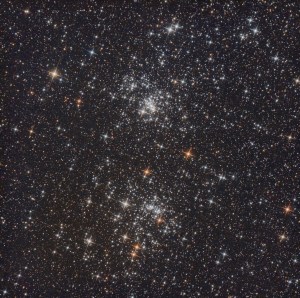
The Double Cluster in Perseus

Image Credit & Copyright: Jack Groves

Explanation: This pretty starfield spans about three full moons (1.5 degrees) across the heroic northern constellation of Perseus. It holds the famous pair of open star clusters, h and Chi Persei. Also cataloged as NGC 869 (top) and NGC 884, both clusters are about 7,000 light-years away and contain stars much younger and hotter than the Sun. Separated by only a few hundred light-years, the clusters are both 13 million years young based on the ages of their individual stars, evidence that they were likely a product of the same star-forming region. Always a rewarding sight in binoculars, the Double Cluster is even visible to the unaided eye from dark locations. But a shroud of guitar strings was used to produce diffraction spikes on the colorful stars imaged in this

International Observe The Moon Night – Global Moon Party

From NASA.gov (USA) National Aeronautics and Space Administration

Plan Your Event and Celebrate with Us

View our recorded Event Planning Webinar, and join the virtual Global Moon Party on October 9, for resources and activities that can take your International Observe the Moon Night to the next level.

Capture the moment like a pro! Check out our Moon photography tips for cell phones, professional cameras, and more.

The Moon is Earth’s constant companion, the first skywatching target pointed out to us as children. We watch its face change as the month progresses, and see patterns and pictures in its geological features.

It’s the object in the night sky that humanity knows best ― and the one that’s easiest to study. Whether your tools are a telescope, a pair of binoculars, or just your eyes, you can find plenty of features on the Moon.

We only ever see one side of the Moon from Earth. That’s because the interplay of gravity between Earth and Moon slows the Moon into a rotation that paces its own. The Moon rotates, but it rotates at the same speed that it orbits around Earth. This keeps the same side always turned toward us. We call this being “tidally locked.

The Moon has no glow of its own, but shines with the reflected light of the Sun. During its crescent phase in the twilight or dawn, you can also sometimes see the dark portion of the Moon glowing faintly in the sunlight that reflects off Earth, an effect called earthshine.

You can look at the Moon during any of its illuminated phases, but for better viewing of craters and mountains, try phases other than the full Moon. The shadows on the surface will be more pronounced, and help distinguish features you might otherwise miss.

Eyeballing the Moon

Looking at the Moon with only your eyes, you see mostly areas of white and gray. These gray patches are solidified volcanic lava flows. In the Moon’s youth, its interior was still molten, and magma would erupt onto its surface. These dark areas formed when massive asteroid or meteorite impacts on the Moon’s surface created basins. Because the impact basins were often the lowest places on the Moon’s surface, they would begin to fill with erupting lava. The lava was similar to the basalt that erupts on Earth and, like on Earth, cooled to form a relatively dark-colored rock. We call these areas the lunar seas, or maria.

The lighter-colored areas are called the highlands, and show the earliest crust on the Moon, dominated by a type of rock called anorthosite, which is primarily made up of the white mineral anorthite or plagioclase.

What you see on the Moon with your eyes only will vary depending on your eyesight. Give yourself plenty of time for your eyes to adjust and look carefully. You may be able to see some of the larger impact craters on the Moon’s surface if your vision is sharp enough, including Copernicus, Kepler, and Aristarchus and Tycho. You may even be able to see some of the bright streaks that are ray systems emanating from the Copernicus or Tycho craters, created when material was thrown outward by the force of the original impacts.

Lunar Sightseeing

Pick up a pair of binoculars, and the Moon transforms.

With binoculars, you’ll still see the entire Moon at once, but now it’ll have terrain. Smooth-looking patterns of gray and white resolve into craters and large mountain ridges. You’ll be able to tell where the Moon is relatively undisturbed and where it’s been pockmarked by impacts. Binoculars introduce texture, especially when you look at the Moon when it’s in any other phase other than full. Focus particularly along the terminator line between light and dark, where features will cast long shadows that make them clearer. Choose binoculars with a magnification of 7 at a minimum. Though a magnification of 10 or 15 will provide more detail, you may need a tripod to steady them.

Under the gaze of a telescope, the Moon becomes too big to take in at once. Now you’ll see real mountains, and not just craters but the crater chains created when impact debris splashes around the main craters. You’ll see valleys, and the cracks in the Moon’s surface called rilles, formed when the lava that once filled a basin cooled and contracted. If this is your first time looking at the Moon through a telescope, you may feel the same wonder Galileo felt seeing that familiar orb in the sky transform into another world. Be sure to examine the Moon at many different phases and on different days. Parts of the Moon near the edge of the disk come into view at some times but not others, a wobbling phenomenon known as libration. Experienced observers can take advantage of favorable librations to see about 59 percent of the lunar surface.

Published: September 20, 2021

Take on a Moon Observing Challenge from the Astronomical League. This activity challenges you to complete each of the following tasks:

  • Do an outreach activity. This could be an International Observe the Moon Night event or any activity that encourages observing the Moon in general.
  • Observe the Moon with just your eyes. No equipment is required.
  • Estimate the Moon’s percent illumination. Not illuminated at all would be 0%, half-illuminated would be 50%, and completely illuminated would be 100%.
  • Make a sketch or capture an image of the Moon that includes at least ten of the features below. Indicate your chosen features on your sketch or image:
    • Mare Crisium
    • Mare Fecunditatis
    • Mare Frigoris
    • Mare Imbrium
    • Mare Nectaris
    • Mare Nubium
    • Mare Serenitatis
    • Mare Tranquillitatis
    • Crater Copernicus
    • Crater Tycho
    • Crater Rays from Crater Copernicus
    • The Woman in the Moon

For more information about this challenge, and to learn how to submit your sketch or image, visit the Astronomical League website.

Note: You may make your observation any time between October 15, 2021 and October 22, 2021. The deadline for submission is November 22, 2021. You do not need to be a member of the Astronomical League to participate in this challenge.

A lot more Activities to do with People and Our Moon Goddess

Astronomy Picture of the Day

Discover the cosmos! Each day a different image or photograph of our fascinating universe is featured, along with a brief explanation written by a professional astronomer.

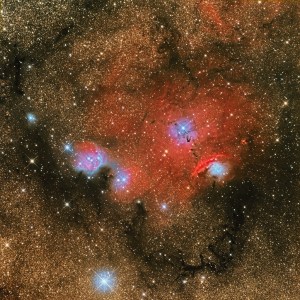
NGC 6559: East of the Lagoon

Image Credit & Copyright: Roberto SartoriExplanation: Slide your telescope just east of the Lagoon Nebula to find this alluring field of view in the rich starfields of the constellation Sagittarius toward the central Milky Way. Of course the Lagoon nebula is also known as M8, the eighth object listed in Charles Messier’s famous catalog of bright nebulae and star clusters. Close on the sky but slightly fainter than M8, this complex of nebulae was left out of Messier’s list though. It contains obscuring dust, striking red emission and blue reflection nebulae of star-forming region NGC 6559 at right. Like M8, NGC 6559 is located about 5,000 light-years away along the edge of a large molecular cloud. At that distance, this telescopic frame nearly 3 full moons wide would span about 130 light-years.

7 October Moon Goddess’ Current Phase, Southwestern and Southeastern Hemisphere Planetary Positions

Moon Goddess’ Current Phase

You can use this link to go forward or backward in time for Moon phase information. If you are curious you can even find out what phase the Moon was in when you or anyone else, you know was on the date the person was born. 

From Moongiant.com 

Today the Moon will be in a Waxing Crescent Phase. A Waxing Crescent is the first Phase after the New Moon and is a great time to see the features of the moon’s surface. During this phase the Moon can be seen in the wester sky after the sun dips below the horizon at sunset. The moon is close to the sun in the sky and mostly dark except for the right edge of the moon which becomes brighter as the days get closer to the next phase which is a First Quarter with a 50% illumination.

Visit the October 2021 Moon Phases Calendar to see all the daily moon phase for this month.

Today’s Waxing Crescent Phase

The Waxing Crescent on October 7 has an illumination of 1%. This is the percentage of the Moon illuminated by the Sun. The illumination is constantly changing and can vary up to 10% a day. On October 7 the Moon is 1.15 days old. This refers to how many days it has been since the last New Moon. It takes 29.53 days for the Moon to orbit the Earth and go through the lunar cycle of all 8 Moon phases.

Phase Details

Phase: Waxing Crescent
Illumination: 1%
Moon Age: 1.15 days
Moon Angle: 0.54
Moon Distance: 367,849.63 km
Sun Angle: 0.53
Sun Distance: 149,475,937.59 km

Useful Moon Resources

Astronomy Picture of the Day

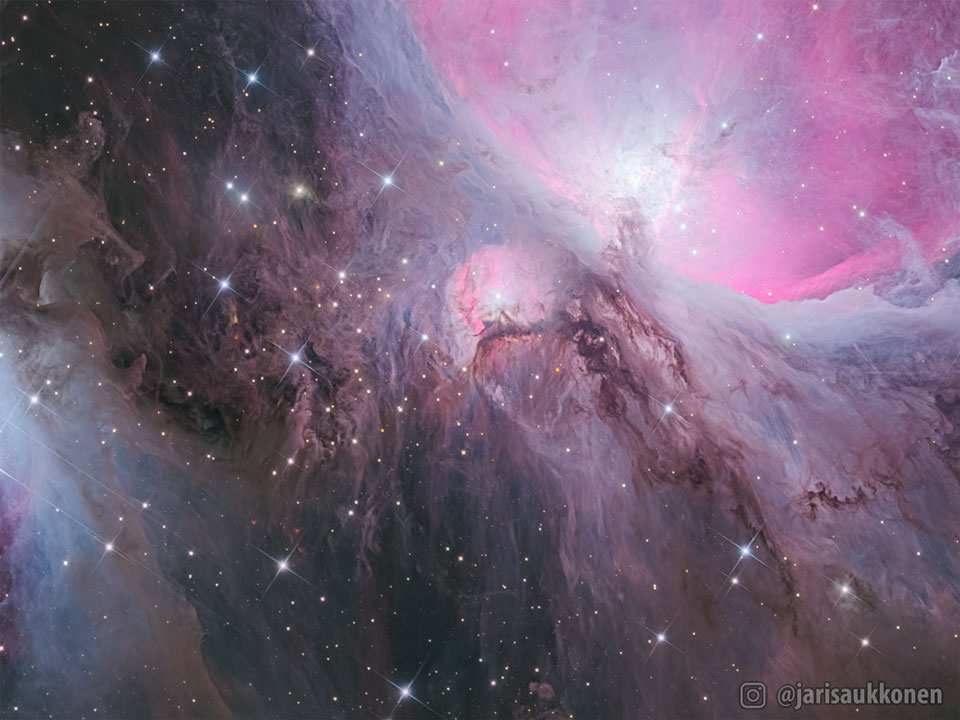
The picture the part of the Orion Nebula known as M43 
in great detail including many find streams of dust.
Please see the explanation for more detailed information.

M43: Streams of Orion

Image Credit & Copyright: Jari SaukkonenExplanation: Where do the dark streams of dust in the Orion Nebula originate? This part of the Orion Molecular Cloud ComplexM43, is the often imaged but rarely mentioned neighbor of the more famous M42. M42, seen in part to the upper right, includes many bright stars from the Trapezium star clusterM43 is itself a star forming region that displays intricately-laced streams of dark dust — although it is really composed mostly of glowing hydrogen gas. The entire Orion field is located about 1600 light years away. Opaque to visible light, the picturesque dark dust is created in the outer atmosphere of massive cool stars and expelled by strong outer winds of protons and electrons.


October 6 Moon Goddess’ Current Phase, Northeastern and Northwestern Hemisphere Planetary Positions

Moon Goddess’ Current Phase

You can use this link to go forward or backward in time for Moon phase information. If you are curious you can even find out what phase the Moon was in when you or anyone else, you know was on the date the person was born. 

From Moongiant.com

The Moon’s current phase for today and tonight is a New Moon phase. During this phase the Moon is too close to the sun in the sky to be visible. The moon rises and sets with the sun and is not present in the night sky. Because of this the night sky is darker and an excellent time to view other celestial objects. Like the Full Moon, a New Moon happens at a very specific time when the sun and moon have the same ecliptic longitude and it can be measured down to the second it occurs.

Visit the October 2021 Moon Phases Calendar to see all the daily moon phase for this month.

Today’s New Moon Phase

The New Moon on October 6 has an illumination of 0%. This is the percentage of the Moon illuminated by the Sun. The illumination is constantly changing and can vary up to 10% a day. On October 6 the Moon is 0.03 days old. This refers to how many days it has been since the last New Moon. It takes 29.53 days for the Moon to orbit the Earth and go through the lunar cycle of all 8 Moon phases.

The 8 Lunar Phases

There are 8 lunar phases the Moon goes through in its 29.53 days lunar cycle. The 4 major Moon phases are Full Moon, New Moon, First Quarter and Last Quarter. Between these major phases, there are 4 minor ones: the Waxing Crescent, Waxing Gibbous, Waning Gibbous and Waning Crescent. For more info on the Moon Cycle and on each phase check out Wikipedia Lunar Phase page.

Phase Details

Phase: New Moon
Illumination: 0%
Moon Age: 0.03 days
Moon Angle: 0.54
Moon Distance: 371,419.45 km
Sun Angle: 0.53
Sun Distance: 149,518,954.95 km

Useful Moon Resources

Custom Planetary Positions

If you need to calculate the planetary positions for a specific use and time, click on this link

Currentplanetarypositions.com

To figure out GMT (Greenwich Mean Time) to your local time use this link

For Your Local Time and Date

Northwestern Hemisphere

The time for the Custom Planetary Positions is from the local time in Chicago, Illinois, USA 

October 06, 2021
09:00 pm GMT 3:00 PM CDT
Zodiac: Tropical (Standard Western)

Sun:13 Libra 49
Moon:19 Libra 25
Mercury:19 Libra 51 Rx
Venus:29 Scorpio 21
Mars:14 Libra 15
Jupiter:22 Aquarius 33 Rx
Saturn:06 Aquarius 54 Rx
Uranus:13 Taurus 55 Rx
Neptune:21 Pisces 11 Rx
Pluto:24 Capricorn 19
True Lunar Node:02 Gemini 41 Rx
Mean Lunar Node:04 Gemini 05 Rx
Lilith (Black Moon):08 Gemini 55
Chiron:10 Aries 30 Rx
Ceres:12 Gemini 07
Pallas:12 Pisces 20 Rx
Juno:18 Sagittarius 02
Vesta:08 Scorpio 21
Eris:24 Aries 20 Rx
Fire:3
Earth:2
Air:10
Water:4
Cardinal:7
Fixed:5
Mutable:7

Northeastern Hemisphere

The time for the Custom Planetary Positions is from the local time in Frankfurt, Germany, Europe

6 October 2021
02:00 pm GMT 4:00 PM CEST
Zodiac: Tropical (Standard Western)

Sun:13 Libra 32
Moon:15 Libra 11
Mercury:20 Libra 10 Rx
Venus:29 Scorpio 01
Mars:14 Libra 03
Jupiter:22 Aquarius 33 Rx
Saturn:06 Aquarius 54 Rx
Uranus:13 Taurus 55 Rx
Neptune:21 Pisces 12 Rx
Pluto:24 Capricorn 19 Rx
True Lunar Node:02 Gemini 43 Rx
Mean Lunar Node:04 Gemini 06 Rx
Lilith (Black Moon):08 Gemini 53
Chiron:10 Aries 31 Rx
Ceres:12 Gemini 07
Pallas:12 Pisces 24 Rx
Juno:17 Sagittarius 57
Vesta:08 Scorpio 12
Eris:24 Aries 20 Rx
Fire:3
Earth:2
Air:10
Water:4
Cardinal:7
Fixed:5
Mutable:7

5 October Moon Goddess’ Current Phase, Southeastern and Southwestern

Moon Goddess’ Current Phase 

You can use this link to go forward or backward in time for Moon phase information. If you are curious you can even find out what phase the Moon was in when you or anyone else, you know was on the date the person was born. 

From Moongiant.com

Today the Moon will be in a New Moon phase. During this phase the Moon is too close to the sun in the sky to be visible. The moon rises and sets with the sun and is not present in the night sky. Because of this the night sky is darker and an excellent time to view other celestial objects. Like the Full Moon, a New Moon happens at a very specific time when the sun and moon have the same ecliptic longitude and it can be measured down to the second it occurs.

Visit the October 2021 Moon Phases Calendar to see all the daily moon phase for this month.

Today’s New Moon Phase

The New Moon on October 6 has an illumination of 0%. This is the percentage of the Moon illuminated by the Sun. The illumination is constantly changing and can vary up to 10% a day. On October 6 the Moon is 0.03 days old. This refers to how many days it has been since the last New Moon. It takes 29.53 days for the Moon to orbit the Earth and go through the lunar cycle of all 8 Moon phases.

Phase Details

Phase: New Moon
Illumination: 0%
Moon Age: 0.03 days
Moon Angle: 0.54
Moon Distance: 371,419.45 km
Sun Angle: 0.53
Sun Distance: 149,518,954.95 km

Useful Moon Resources

I Leave With This Thought for Today…

Blessed Be dear Sisters, Brothers, and Guests

I am sorry a few posts are missing that I started doing daily but with my fibromyalgia flare it hurts to type or even copy and paste. See you again tomorrow.

Menu of Contents

From Tarotx.net – Wildwood Tarot Deck

October 5th Northwestern and Northeastern Hemispheres Moon Phase and Planetary Positions

Moon Goddess’ Current Phase 

You can use this link to go forward or backward in time for Moon phase information. If you are curious you can even find out what phase the Moon was in when you or anyone else, you know was on the date the person was born. 

From Moongiant.com 

The Moon’s current phase for today and tonight is a Waning Crescent phase. In this phase the Moon’s illumination is growing smaller each day until the New Moon. During this part of the Moon cycle, the Moon is getting closer to the Sun as viewed from Earth and the night side of the Moon is facing the Earth with only a small edge of the Moon being illuminated. This phase is best viewed an hour or 2 before the sunrise and can be quite beautiful if you’re willing to get up early. It can also be a great time to see the features of the Moon’s surface. Along the edge where the illuminated portion meets the dark side, the craters and mountains cast long shadows making them easier to observe with a telescope or binoculars.

Visit the October 2021 Moon Phases Calendar to see all the daily moon phase for this month.

Today’s Waning Crescent Phase

The Waning Crescent on October 5 has an illumination of 1%. This is the percentage of the Moon illuminated by the Sun. The illumination is constantly changing and can vary up to 10% a day. On October 5 the Moon is 28.46 days old. This refers to how many days it has been since the last New Moon. It takes 29.53 days for the Moon to orbit the Earth and go through the lunar cycle of all 8 Moon phases.

The 8 Lunar Phases

There are 8 lunar phases the Moon goes through in its 29.53 days lunar cycle. The 4 major Moon phases are Full Moon, New Moon, First Quarter and Last Quarter. Between these major phases, there are 4 minor ones: the Waxing Crescent, Waxing Gibbous, Waning Gibbous and Waning Crescent. For more info on the Moon Cycle and on each phase check out Wikipedia Lunar Phase page.

Phase Details

Phase: Waning Crescent
Illumination: 1%
Moon Age: 28.46 days
Moon Angle: 0.53
Moon Distance: 375,708.54 km
Sun Angle: 0.53
Sun Distance: 149,561,983.50 km

Useful Moon Resources

4 October Southern Hemisphere Custom Planetary Positions  

 
If you need to calculate the planetary positions for a specific use and time, click on this link

Currentplanetarypositions.com

To figure out GMT (Greenwich Mean Time) to your local time use this link

For Your Local Time and Date

The time for the Custom Planetary Positions is from the local time in Sao Pablo, Brazil, South America

4 October 2021
04:00 pm GMT 3:00 PM BRT
Zodiac: Tropical (Standard Western)

Sun:11 Libra 39
Moon:17 Virgo 52
Mercury:22 Libra 05 Rx
Venus:26 Scorpio 55
Mars:12 Libra 48
Jupiter:22 Aquarius 38 Rx
Saturn:06 Aquarius 55 Rx
Uranus:13 Taurus 59 Rx
Neptune:21 Pisces 14 Rx
Pluto:24 Capricorn 19 Rx

True Lunar Node:02 Gemini 59 Rx
Mean Lunar Node:04 Gemini 12 Rx

Lilith (Black Moon):08 Gemini 40

Chiron:10 Aries 36 Rx
Ceres:12 Gemini 05
Pallas:12 Pisces 47 Rx
Juno:17 Sagittarius 27
Vesta:07 Scorpio 12

Eris:24 Aries 22 Rx

Fire:3
Earth:3
Air:9
Water:4
Cardinal:6
Fixed:5
Mutable:8

See You Tomorrow

I have a migraine and fibromyalgia flare and being on the computer is making both worse. I will be back tomorrow with all the daily information posts.

The are some of the things people with fibromyalgia have to deal with on a daily basis…

For me stress, lack of sleep (like getting only 4 broken hours is sleep last night), and rather changes turn pain I can deal with into pain I can hardly tolerate. I use herbal teas of my own combinations along with prescription medication to try to control this. Image fire ants being all over your body and they are all biting you at the same time. This will give you a glimpse of what living with fibromyalgia is like.