Anthropologist Believes Ancient Human Species Could Still Be Alive In The Forests Of Flores Island

In 2003, archaeologists looking for evidence of the migration of modern humans from Asia to Australia stumbled across a small, fairly complete skeleton of an extinct human species on the Indonesian island of Flores, which came to be known as Homo floresiensis. Or, as it became more commonly known, the Hobbit, after the small, breakfast-guzzling creatures from J.R.R. Tolkein’s The Hobbit.

The species was initially thought to have survived until relatively recently, around 12,000 years ago, before further analysis pushed that date back to around 50,000 years. But one retired professor of anthropology at the University of Alberta says that evidence that the species’ continued existence may have been overlooked, and the Hobbit may still be alive today, or at least within living memory.

In an opinion piece for The Scientist promoting his upcoming book Between Ape and Human, Gregory Forth argues that palaeontologists and other scientists have overlooked Indigenous knowledge and accounts of an “ape-man” living in the forests of Flores.

“My aim in writing the book was to find the best explanation — that is, the most rational and empirically best supported — of Lio accounts of the creatures,” Forth wrote in the piece. “These include reports of sightings by more than 30 eyewitnesses, all of whom I spoke with directly. And I conclude that …

Click here to read the rest of this article from newsbreak.com

A Thought for Today

Until we meet again dear sisters, brothers, and honored guests may you blessed be.

May 3 Astronomy Picture of the Day

Discover the cosmos! Each day a different image or photograph of our fascinating universe is featured, along with a brief explanation written by a professional astronomer.

2022 May 3

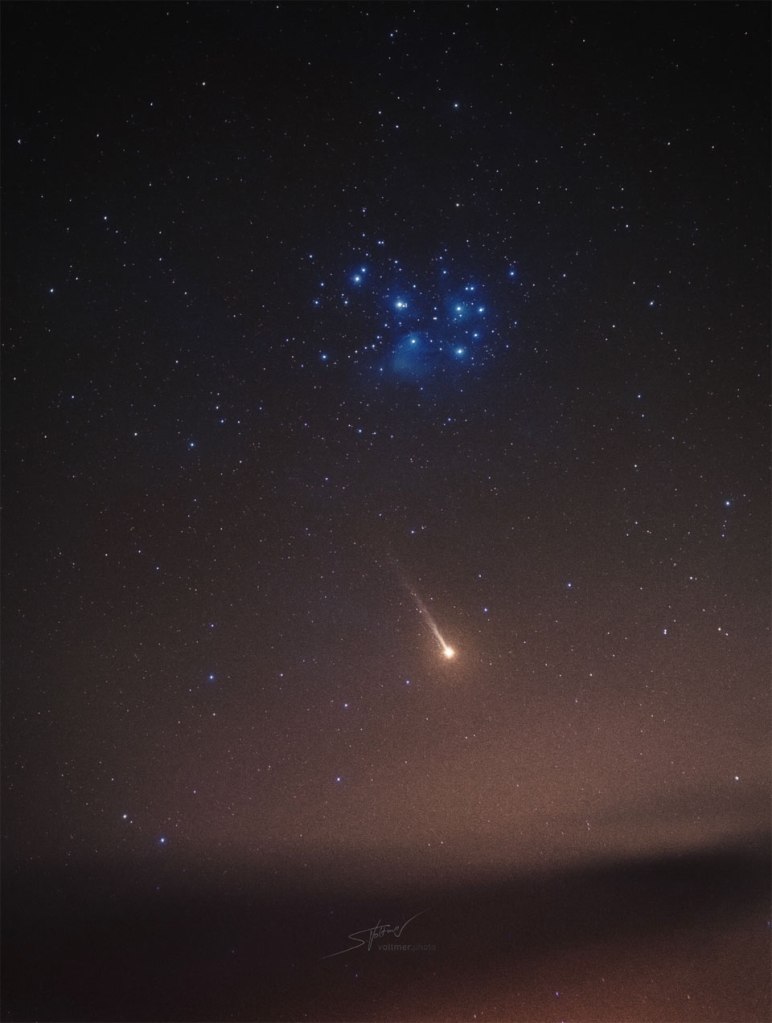
Mercury’s Sodium Tail

Image Credit & Copyright: Sebastian Voltmer

Explanation: That’s no comet. Below the Pleiades star cluster is actually a planet: Mercury. Long exposures of our Solar System’s innermost planet may reveal something unexpected: a tail. Mercury‘s thin atmosphere contains small amounts of sodium that glow when excited by light from the Sun. Sunlight also liberates these molecules from Mercury’s surface and pushes them away. The yellow glow from sodium, in particular, is relatively bright. Pictured, Mercury and its sodium tail are visible in a deep image taken last week from La PalmaSpain through a filter that primarily transmits yellow light emitted by sodium. First predicted in the 1980s, Mercury’s tail was first discovered in 2001. Many tail details were revealed in multiple observations by NASA‘s robotic MESSENGER spacecraft that orbited Mercury between 2011 and 2015. Tails, of course, are usually associated with comets.

PAGAN CALENDAR OF OBSERVANCES

MAY 1: BELTANE SABBAT: Festival of Spring and Fertility. Sidhe Day. Beltaine – Celtic festival marking the arrival of summer in ancient times.


MAY 4: Celtic/British Festival of Cerridwen and Brigit: Corn Goddesses of Fertility

May 4 – Celtic Festival of Cerridwen and Brigit – Corn Goddesses of fertility, healing, and poets.
– St. Monica’s Day (Irish)
– Veneration of the Thorn (Irish)
– Festival of Sheila Na Gig (Irish)

MAY 6: – Shepherd’s Day – Day to meditate on Deity as Lord of Animals: Dumuzi (Old Sumerian), Osiris (Egyptian), Pan (Old Greek), Shiva Pasupati (Hindu).
– Eyvind Kelve (Norse)

MAY 9: – Greek Feast of Artemis

MAY 9-12: Lemuria – Roman festival when the spirits of the dead are thought to revisit their homes.

MAY 13: – Roman Garland Day, Offering garlands to Neptune.
– Month of Hawthorn, Celtic festival of the tree.
– Our Lady of Fatima Day (Portugal)

MAY 14: – Isis Day in ancient Egypt

MAY 14: -16 Feast of Divine Love and Compassion – Source of healing and beneficence, honoring the Goddess as Isis (Old Egyptian), Oshun (Yoruba/Santeria), Lakshmi (Hindu).

MAY 15: – Festival of Vesta (Roman)
– Maia and Mercury’s Day (Roman)
MAY 18: – Celtic Feast of Greek God Pan – Who represents the masculine in Nature and protects men throughout their lives. Men recognized the transitions in their lives and honored male fertility.

MAY 19: Celtic Feast of Brigid – In which sacred healing wells and springs were adorned with flowers in honor of Goddess Brigid, daughter of Mother Goddess Danu and Father God Dagda.

MAY 21: Dark/Bright Mother Goddess Day—honoring Hecate/Demeter; Uma; Kali/Parvati .

MAY 26: – Festival of Diana begins (ends 31st) (ancient Roman holiday)

MAY 28: FEAST OF BENDIDIA—family feast day honoring of the Goddess of the Moon, Dark Moon, Underworld, Secret Wisdom and Witches.

May 30 – Frigg’s Day, Northern Goddess, spouse of Odin (Teutonic “heathen” European pre-Christian holiday)
– Feast of the Queen of the Underworld Begins (Roman)
– Feast of the Queen of Heaven (European)

From WiccanFamilyTemple.org

May 2 Astronomy Picture of the Day

Discover the cosmos! Each day a different image or photograph of our fascinating universe is featured, along with a brief explanation written by a professional astronomer.

2022 May 2

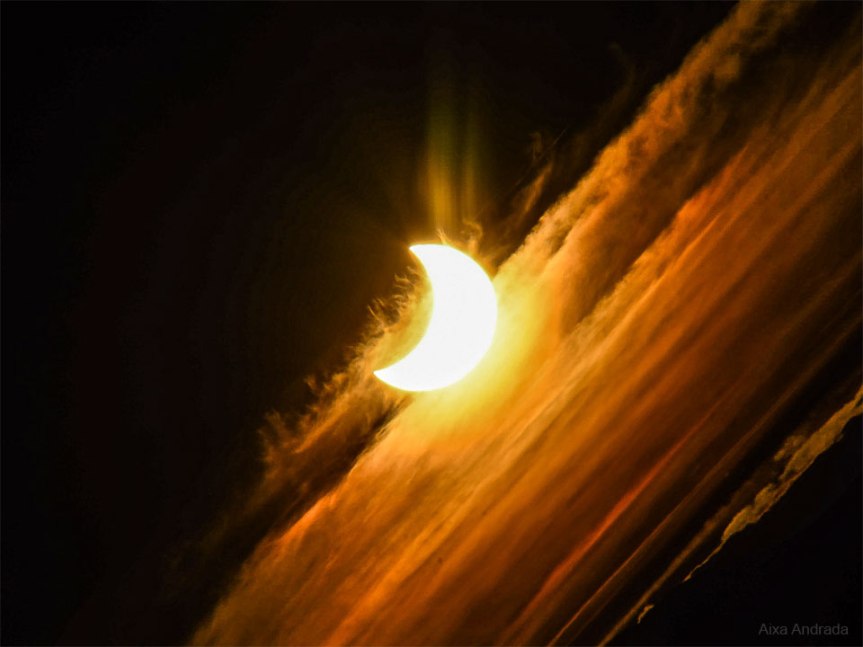
Partial Solar Eclipse over Argentina

Image Credit & Copyright: Aixa Andrada

Explanation: What’s happened to the Sun? Two days ago, parts of South America were treated to a partial solar eclipse — where the Moon blocked out part of the Sun. The featured image shows an image of the partially eclipsed Sun through clouds as it was setting over PatagoniaArgentina. In the tilted image, Earth is toward the right. During the eclipse, the Moon moved partly between Earth and the Sun. Although a visually impressive sight, the slight dimming of surroundings during this partial eclipse was less noticeable than dimming created by a thick cloud. In about two weeks, all of South America and part of North America will experience a total lunar eclipse — where the Earth moves completely between the Moon and the Sun. In about two years, a total solar eclipse will cross North America.

May 1 Astronomy Picture of the Day

Discover the cosmos! Each day a different image or photograph of our fascinating universe is featured, along with a brief explanation written by a professional astronomer.

2022 May 1

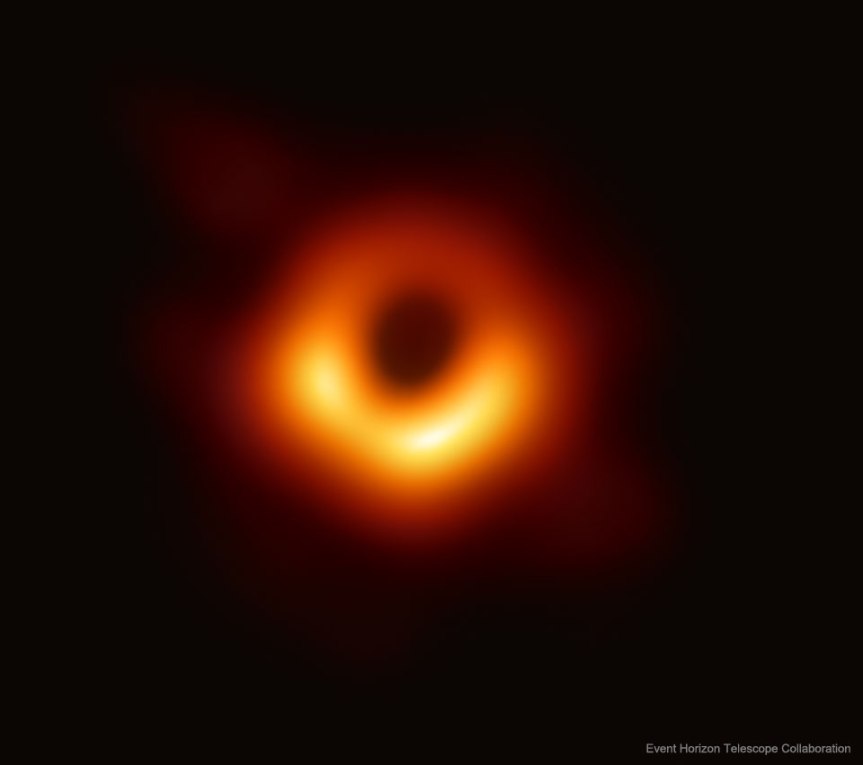
First Horizon-Scale Image of a Black Hole

Image Credit: Event Horizon Telescope Collaboration

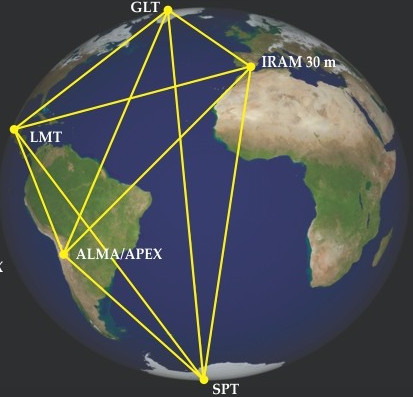
Explanation: What does a black hole look like? To find out, radio telescopes from around the Earth coordinated observations of black holes with the largest known event horizons on the sky. Alone, black holes are just black, but these monster attractors are known to be surrounded by glowing gas. This first image resolves the area around the black hole at the center of galaxy M87 on a scale below that expected for its event horizonPictured, the dark central region is not the event horizon, but rather the black hole’s shadow — the central region of emitting gas darkened by the central black hole’s gravity. The size and shape of the shadow is determined by bright gas near the event horizon, by strong gravitational lensing deflections, and by the black hole’s spin. In resolving this black hole’s shadow, the Event Horizon Telescope (EHT) bolstered evidence that Einstein’s gravity works even in extreme regions, and gave clear evidence that M87 has a central spinning black hole of about 6 billion solar masses. Since releasing this featured image in 2019, the EHT has expanded to include more telescopes, observe more black holes, track polarized light,and is working to observe the immediately vicinity of the black hole in the center of our Milky Way Galaxy.


This week is: Black Hole Week
New EHT Results to be Announced: Next Thursday

Edinburgh’s Beltane Fire Festival celebrates the rebirth of summer with fire, dance and drumming

When it comes to big, wild gatherings, Edinburgh is best known for the Fringe Festival, that month long revel dedicated to art, music and drama. There is a much older, if lesser-known, festival however, that’s an equally spectacular event – the Beltane Fire Festival.

The Beltane Fire Festival marks the dawn of summer and the end of frost with bonfires, feasting and rituals meant to appease the aos si – fairy folk who are significantly more bloodthirsty than the ones you find in most modern fairytales.

Along with holidays like Samhuinn, Imbolc and Lùnastal, Beltane was one of the most important, sacred days of the year. Today, this homage to an ancient Celtic holy day once celebrated throughout Ireland, Scotland and the Isle of Man still takes place annually on the 1st of May, or the next closest weekend night.

The ritual of Beltane

The modern Beltaners, as the members of the Fire Society are affectionately known, have taken these elements and run with them, creating a wild, vivid event that mingles historic Scottish folk practices, reconstructed Celtic ritual and …

Click here to read the rest of this article

Some Witchcraft/Magickal Correspondence Digest for Sundy – Printable

A Thought for Today

Following your intuition especially when writing a spell will help move you in the direction you should be going. To me my intuition is my spirit guides helping me to stay on my true-life path.

Until we meet again dear sisters, brothers, and honored guests may you blessed be.

Some Witchcraft/Magickal Correspondence Digest for Saturday

From Learning Religions

Named for the god Saturn—is a good time to wrap things up.

Colors: black and dark purple,

Metal: lead

This day is connected to: goddess Hecate.

Gemstones: Apache tear, obsidian, and hematite

Plants: such as thyme, mullein, and the cypress tree.

Magical workings: focus on agriculture and creativity, fortune and hope, protection and banishment of negativity. Put up a barrier to keep the unwelcome out, eliminate the things that make you miserable, and wash your hands of anything other than your hopes, dreams, and goals.

April 30 Astronomy Picture of the Day

Discover the cosmos! Each day a different image or photograph of our fascinating universe is featured, along with a brief explanation written by a professional astronomer.

2022 April 30

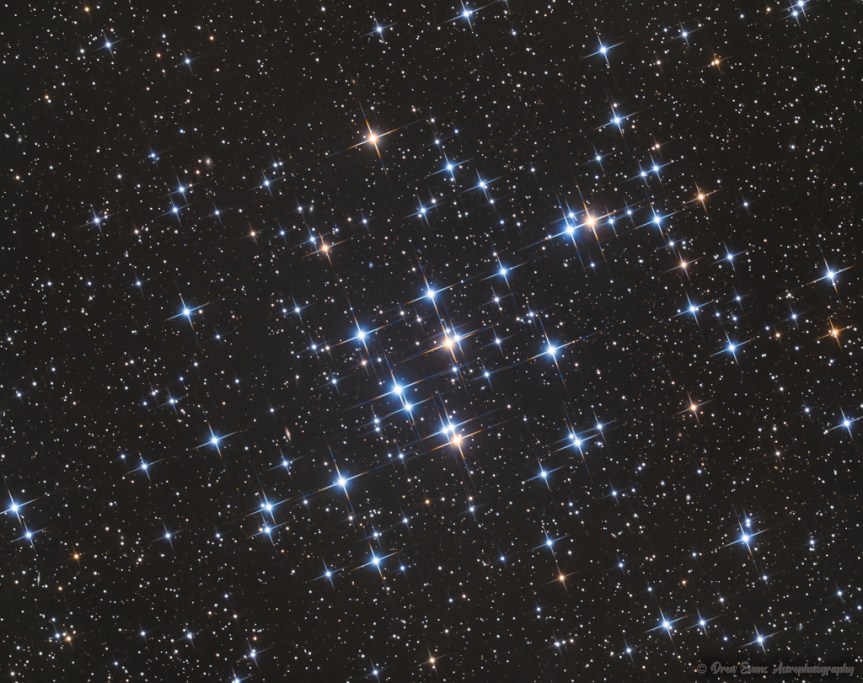
M44: The Beehive Cluster

Image Credit & Copyright: Drew Evans

Explanation: A mere 600 light-years away, M44 is one of the closest star clusters to our solar system. Also known as the Praesepe or the Beehive cluster its stars are young though, about 600 million years old compared to our Sun’s 4.5 billion years. Based on similar ages and motion through space, M44 and the even closer Hyades star cluster in Taurus are thought to have been born together in the same large molecular cloud. An open cluster spanning some 15 light-years, M44 holds 1,000 stars or so and covers about 3 full moons (1.5 degrees) on the sky in the constellation Cancer. Visible to the unaided eye, M44 has been recognized since antiquity. Described as a faint cloud or celestial mist long before being included as the 44th entry in Charles Messier’s 18th century catalog, the cluster was not resolved into its individual stars until telescopes were available. A popular target for modern, binocular-equipped sky gazers, the cluster’s few yellowish tinted, cool, red giants are scattered through the field of its brighter hot blue main sequence stars in this telescopic group snapshot. Dramatic diffraction spikes highlighting the brighter cluster members were created with string crossed in front of the telescope’s objective lens.

For Your Viewing Pleasure – Beltane

Edinburgh’s Beltane Fire Festival celebrates the rebirth of summer with fire, dance and drumming c. 2017

Celtic festival of Beltane heats up in Scotland c. 2018

A Laugh for Today

Wishing you a sizzling Saturday

Printable Some Beltane Information

April 29 Astronomy Picture of the Day

Discover the cosmos! Each day a different image or photograph of our fascinating universe is featured, along with a brief explanation written by a professional astronomer.

2022 April 29

Portrait of NGC 3628

Image Credit & Copyright: Wilhelm Michael Kasakow, Olaf Guillaume

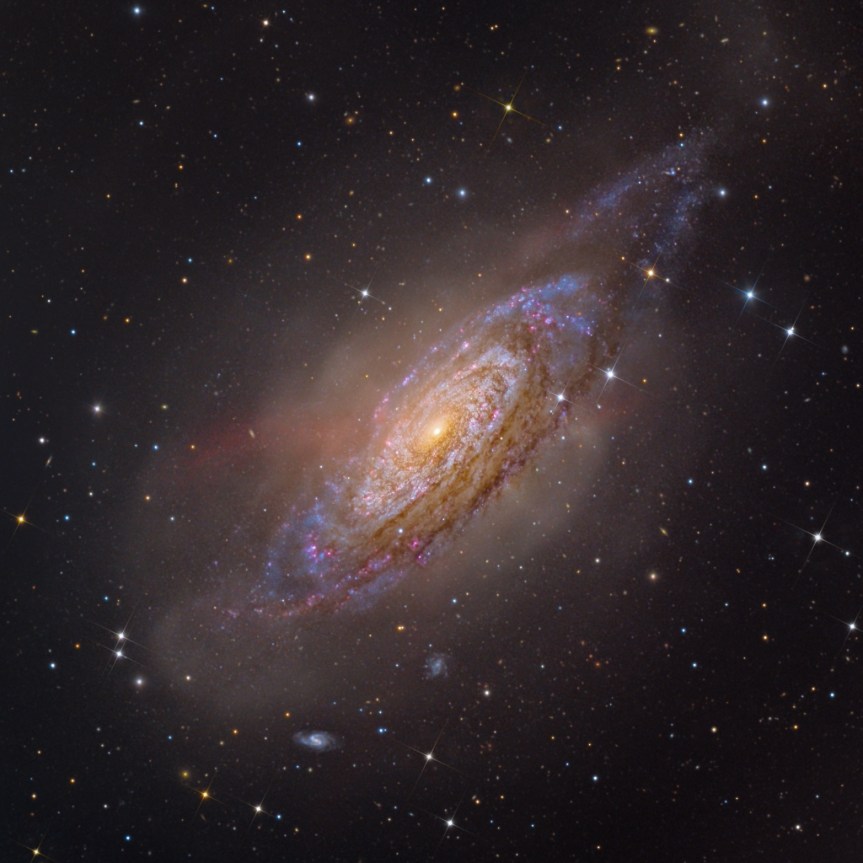
Explanation: Sharp telescopic views of NGC 3628 show a puffy galactic disk divided by dark dust lanes. Of course, this portrait of the magnificent, edge-on spiral galaxy puts some astronomers in mind of its popular moniker, the Hamburger Galaxy. It also reveals a small galaxy nearby (below), likely a satellite of NGC 3628, and a very faint but extensive tidal tail. The drawn out tail stretches for about 300,000 light-years, even beyond the upper left edge of the frame. NGC 3628 shares its neighborhood in the local universe with two other large spirals M65 and M66 in a grouping otherwise known as the Leo Triplet. Gravitational interactions with its cosmic neighbors are likely responsible for creating the tidal tail, as well as the extended flare and warp of this spiral’s disk. The tantalizing island universe itself is about 100,000 light-years across and 35 million light-years away in the northern springtime constellation Leo.

Quick Update

I am home and awaiting a pathology test on a couple of biopsies. I am not concerned about the results even through cancer gallops in my mom’s family. I have told my body for a few decades it’s not allowed to get cancer.

Lord Beltane had delicious homemade soup made for when I got home. So I ate and now going to sleep off the knock out drugs.

I will be back to doing morning and afternoon posts tomorrow.

Until than blessed be.

April 28 Astronomy Picture of the Day

Discover the cosmos! Each day a different image or photograph of our fascinating universe is featured, along with a brief explanation written by a professional astronomer.

2022 April 28

Lyrid of the Lake

Image Credit & Copyright: Jeff Dai (TWAN)

Explanation: In the early hours of April 24 this bright Lyrid meteor flashed along the central Milky Way. For a moment, it cast a bright reflection across Lake Nian, Yunnan province, China. The annual Lyrid meteor shower, one of the oldest known, is active in late April, as our fair planet plows through dust left along the orbit of long-period comet Thatcher. The trail of the bright fireball points back toward the shower’s radiant in the constellation Lyra high in the northern springtime sky and off the top of the frame. Just rising in that starry sky, light from a third quarter moon also cast a glow on the peaceful waters of the lake.