

Category: Daily Posts
A Thought for Today

Until we meet again dear sisters, brothers, and honored guests may your life be filled with all things positive!
June 11 Astronomy Picture of the Day
Discover the cosmos! Each day a different image or photograph of our fascinating universe is featured, along with a brief explanation written by a professional astronomer.
2022 June 11
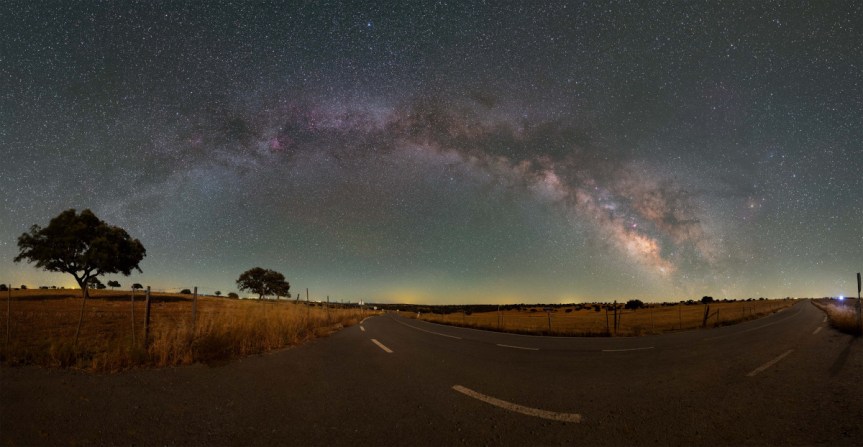
The Road and the Milky Way
Image Credit & Copyright: David Cruz
Explanation: At night you can follow this road as it passes through the Dark Sky Alqueva reserve not too far from Alentejo, Portugal. Or you could stop, look up, and follow the Milky Way through the sky. Both stretch from horizon to horizon in this 180 degree panorama recorded on June 3. Our galaxy’s name, the Milky Way, does refer to its appearance as a milky path in the sky. The word galaxy itself derives from the Greek for milk. From our fair planet the arc of the Milky Way is most easily visible on moonless nights from dark sky areas, though not quite so bright or colorful as in this image. The glowing celestial band is due to the collective light of myriad stars along the galactic plane too faint to be distinguished individually. The diffuse starlight is cut by dark swaths of the galaxy’s obscuring interstellar dust clouds. Standing above the Milky Way arc near the top of this panoramic nightscape is bright star Vega, with the galaxy’s central bulge near the horizon at the right.
A Laugh for Today

Wishing you a relaxed weekend
Some of the Witchcraft/Magickal Correspondence Digest for Friday
From awithintime.weebly.com
Ruled by Venus. Love, sex, marriage, fertility and friendship.
- Day – Friday
Planet – Venus
Sign – Libra, Taurus
Angel – Ariel
Color – Green, Blue, Pink, White
Plants – Pink rose, ivy, birch, heather, clematis, sage, violet, water lily
Stone – Rose Quartz, moonstone, pink tourmaline, peridot, emerald, jade
Intention – Romantic love, friendships, beauty, soul mates, artistic ability, harmony
Element – Earth, air
More Qualities – Love, art, beauty, money, woman, passion, friendship, affection, relationships, partners, alliances, grace, beauty, luxury, social activity, marriage, decorating, cosmetics, gifts, income, growth, gardening, architects, artists, beauticians, chiropractors, dancers, designers, engineers, entertainers, fashion, music, painting, poetry, courtship, dating, decorating homes, household improvements, planning parties, shopping
June 10 Astronomy Picture of the Day
Discover the cosmos! Each day a different image or photograph of our fascinating universe is featured, along with a brief explanation written by a professional astronomer.
2022 June 10
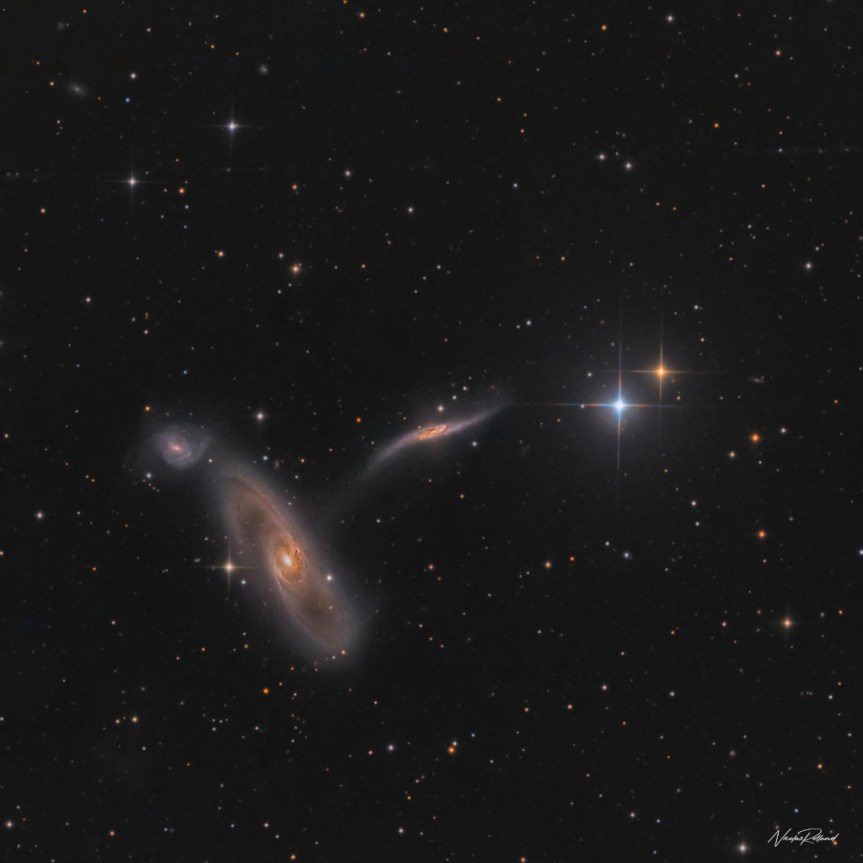
(5.3 hours integration 2022-03)
El Sauce Observatory, Rio Hurtado, Coquimbo, Chile
Planewave 24″ CDK @F/6.5
FLI PL9000
L: 8*600s, R: 8*600s, G: 8*600s , B: 8*600s
Arp 286: Trio in Virgo
Image Credit & Copyright: Nicolas Rolland, Telescope.Live
Explanation: This colorful telescopic field of view features a trio of interacting galaxies almost 90 million light-years away, toward the constellation Virgo. On the right two spiky, foreground Milky Way stars echo the extragalactic hues, a reminder that stars in our own galaxy are like those in distant island universes. With sweeping spiral arms and obscuring dust lanes, the dominant member of the trio, NGC 5566, is enormous, about 150,000 light-years across. Just above it lies smaller, bluish NGC 5569. Near center a third galaxy, NGC 5560, is apparently stretched and distorted by its interaction with massive NGC 5566. The trio is also included in Halton Arp’s 1966 Atlas of Peculiar Galaxies as Arp 286. Of course, such cosmic interactions are now appreciated as part of the evolution of galaxies.
One Way to Make Your Own Besom Using Branches and Sticks
I suggest gathering these under a full or waxing Moon phase as they will hold more helpful energy. Your Besom can also be used to sweep out the negativity in your sacred place and/or wherever you are going to cast a circle. Remember to ask the tree you get your branch and sticks from even if they are laying on the ground no longer attached to the tree. It is always better to take what you need from a tree or shrub off of the ground beneath it rather than cutting pieces off the tree or shrub. Get a branch about 3 to 4 inches little taller then you are. Gather good size bunch of unstift smaller branches, I have found getting the sticks from under a shrub or pine tree make the best sweeping part of the Besom, if possible the size difference in them should be no more the approximately 2 inches in size. After gathering the branch and sticks remember to thank the tree for the parts it has given you and to leave an offering such as some water out of a container you have drank from. You need a ball of natural thin twine or some type of undryed vine. Tie the twine or vine to the branch making sure it is tight and will not slip off (you may want to by an angular cut about 4 to 5 inch up from the bottom of the branch to slip this twine or vine when securing it. (The size you have at the bottom of your Besom made from the twigs is up to you. Usually doing 2 to 4 layers of sticks make a good size Besom. Lay your first stick against the branch pull the twine or vine around the stick as tightly as you can, continue doing this until you have made you first layer of sticks pull the twine or vine in the opposite direction the you have been placing the in a tightly as possible and tie it off but do not cut the twine or vine. For the next layer you will follow the same instruction except lay the sticks in the opposite direction from the first layer. The third layer will go in the same direction as the first layer and the fourth layer goes in the same direction as the second layer. To help ensure you sticks stay secure to the branch at the end of each layer of sticks pour white glue over the sticks and twine or vine and make sure it gets down to the branch. If you want you can even put glue on the branch as you lay each first layer stick. Let each layer of sticks dry for approximately 24 hours before adding the next layer. When you have done the last layer and have used glue to help hold it together let the entire Besom dry a minimum of 72 hours before using it.
A Laugh for Today

Dance your way into a joy filled weekend!
A Thought for Today

Until we meet again dear sisters, brothers, and honored guests may your life be filled with all things positive!
Some of the Witchcraft/Magickal Correspondence Digest for Thursday
From lightwarriorslegion.com
| Use this day to cast spells for wealth, success, business, luck, health, protection, legal matters, male fertility,money, desires and laughter. | Jupiter | Blue. Additionally: Purple | Zeus and Thor. Gods of thunder |
June 9 Astronomy Picture of the Day
Discover the cosmos! Each day a different image or photograph of our fascinating universe is featured, along with a brief explanation written by a professional astronomer.
2022 June 9
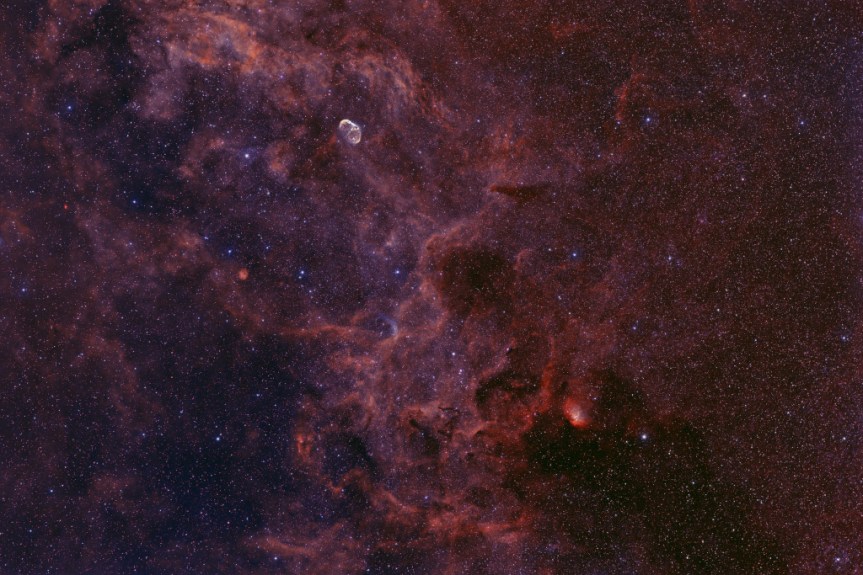
Cosmic Clouds in Cygnus
Image Credit & Copyright: Wolfgang Zimmermann
Explanation: These cosmic clouds of gas and dust drift through rich star fields along the plane of our Milky Way Galaxy toward the high flying constellation Cygnus. They’re too faint to be seen with the unaided eye though, even on a clear, dark night. Image data from a camera and telephoto lens using narrowband filters was used to construct this 10 degree wide field of view. The deep mosaic reveals a region that includes star forming dust clouds seen in silhouette against the characteristic glow of atomic hydrogen and oxygen gas. NGC 6888 is the standout emission nebula near the top. Blown by winds from an massive Wolf-Rayet star it’s about 25 light-years across and known as the Crescent Nebula. A faint bluish curl just below center in the frame is also the signature of a Wolf-Rayet star. Burning fuel at a prodigious rate and near the end of their stellar lives, both stars will ultimately go out with a bang in a spectacular supernova explosion. Toward the right, a massive, young O type star powers the glow of Sh2-101, the Tulip Nebula.
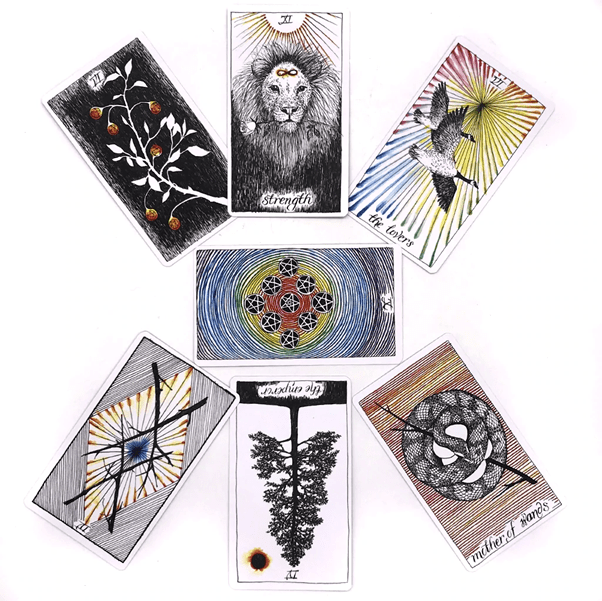
Wild Unknown Tarot Deck
A Laugh for Today

Only problem is I wake up to 2-foot-long hair looking like this…LOL
Have a great untangled Thursday!
June 8 World Oceans Day
Today is: World Oceans Day
JOIN US
This year’s United Nations World Oceans Day, on 8 June 2022, will highlight the theme Revitalization: Collective Action for the Ocean.
This is the first hybrid celebration of the annual event, hosted in-person at the UN Headquarters in New York and broadcast live.
The ocean connects, sustains, and supports us all. Yet its health is at a tipping point and so is the well-being of all that depends on it. As the past years have shown us, we need to work together to create a new balance with the ocean that no longer depletes its bounty but instead restores its vibrancy and brings it new life.
Join us as we shed light on the communities, ideas, and solutions that are working together to protect and revitalize the ocean and everything it sustains.
UN World Oceans Day 2022 is Hosted by the United Nations Division for Ocean Affairs and the Law of the Sea, Office of Legal Affairs, with the generouse contribution of Oceanic Global, which is made possible by La Mer.
A Thought for Today

Until we meet again dear sisters, brothers, and honored guests may your life be filled with all things positive!
June 8 Astronomy Picture of the Day
Discover the cosmos! Each day a different image or photograph of our fascinating universe is featured, along with a brief explanation written by a professional astronomer.
2022 June 8
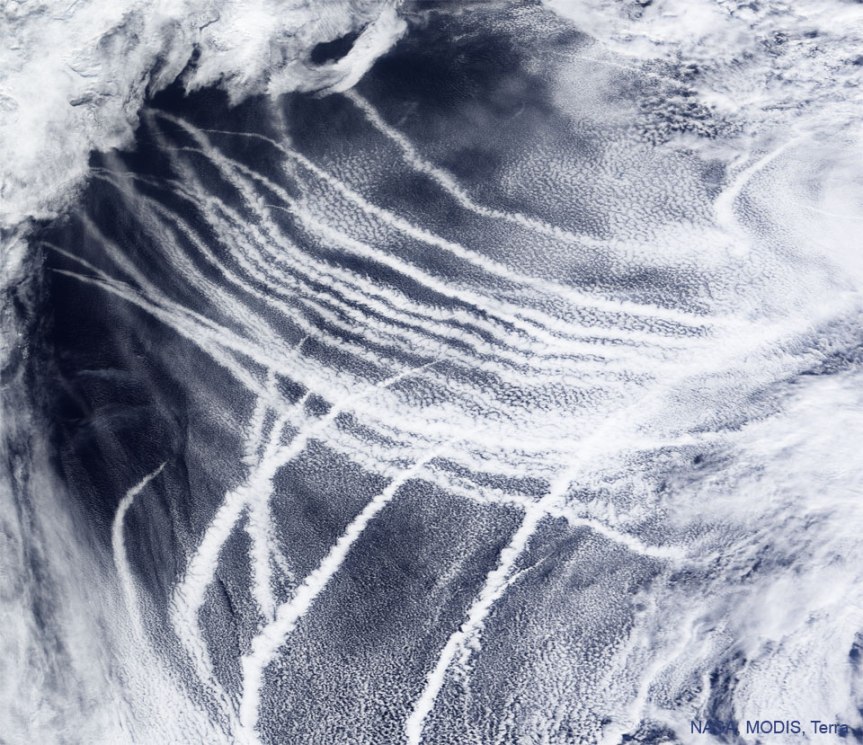
Ship Tracks over the Pacific Ocean
Image Credit: NASA, Terra, MODIS; Text: Raymond Shaw (MTU)
Explanation: What are those unusual streaks? Some images of planet Earth show clear bright streaks that follow the paths of ships. Known as ship tracks, these low and narrow bands are caused by the ship’s engine exhaust. Water vapor condenses around small bits of exhaust known as aerosols, which soon grow into floating water drops that efficiently reflect sunlight. Ship tracks were first discovered in 1965 in Earth images taken by NASA’s TIROS satellites. Multiple ship tracks are visible across the featured image that was captured in 2009 over the Pacific Ocean by the MODIS instrument on NASA’s Terra satellite. Inspired by ship-tracks, some scientists have suggested deploying a network of floating buoys in the worlds’ oceans that spray salt-aerosol containing sea-water into the air so that, with the help of the wind, streams of sunlight-reflecting clouds would also form. Why do this? These human-made clouds could reflect so much sunlight they might help fight global warming.
A Thought for Today

Until we meet again dear sisters, brothers, and honored guests may your life be filled with all things positive!
June 7 Astronomy Picture of the Day
Discover the cosmos! Each day a different image or photograph of our fascinating universe is featured, along with a brief explanation written by a professional astronomer.
2022 June 7
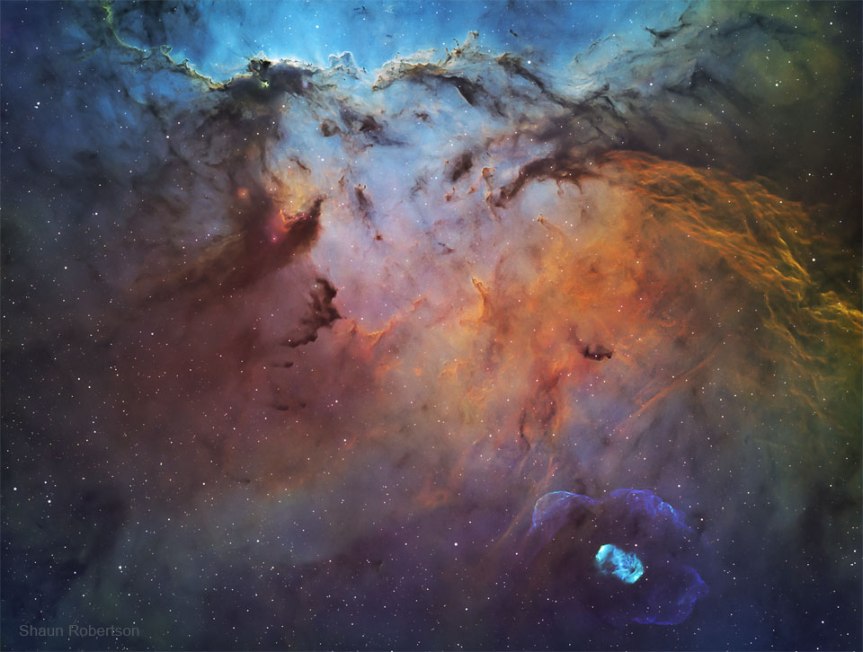
NGC 6188: Dragons of Ara
Image Credit & Copyright: Shaun Robertson
Explanation: Do dragons fight on the altar of the sky? Although it might appear that way, these dragons are illusions made of thin gas and dust. The emission nebula NGC 6188, home to the glowing clouds, is found about 4,000 light years away near the edge of a large molecular cloud unseen at visible wavelengths, in the southern constellation Ara (the Altar). Massive, young stars of the embedded Ara OB1 association were formed in that region only a few million years ago, sculpting the dark shapes and powering the nebular glow with stellar winds and intense ultraviolet radiation. The recent star formation itself was likely triggered by winds and supernova explosions, from previous generations of massive stars, that swept up and compressed the molecular gas. Joining NGC 6188 on this cosmic canvas, visible toward the lower right, is rare emission nebula NGC 6164, also created by one of the region’s massive O-type stars. Similar in appearance to many planetary nebulae, NGC 6164’s striking, symmetric gaseous shroud and faint halo surround its bright central star near the bottom edge. This impressively wide field of view spans over 2 degrees (four full Moons), corresponding to over 150 light years at the estimated distance of NGC 6188.
Interesting facts about the dwarf planet Pluto that will blow your mind

Despite no longer being a planet, Pluto is still loved by millions around the world. And, for a good reason, it is a fascinating object.
With a surface covered with mountains, valleys, plains, craters, and perhaps even glaciers, Pluto would certainly be a fascinating place to visit. First officially discovered in the early-1930s, it has fascinated scientists and the general public ever since.
Let’s take a closer look at this former planet at the edge of our Solar System.
What is unique about the dwarf planet Pluto?
Since it received its new status of a “dwarf planet,” Pluto can console itself with finally being the largest of something in the Solar System. Due to its proximity to the Kuiper Belt, it can claim the title of being the largest body in the belt.
The Kuiper belt, in case you are unaware, is a shadowy zone beyond Neptune that is populated with hundreds of thousands or millions of rocky and icy …
Click here to read the rest of this article
A Laugh for Today

 Witches Of The Craft®


You must be logged in to post a comment.