January 22, 2026 Current Northern Hemisphere Moon Phase

You can find more moon phase details on both of the websites used in this post by clicking on each hyperlink.
Source: nineplanets.org

The Moon phase for today is a Waxing Crescent phase. This is the phase where the moon started to become visible again after the New Moon.

In this part of the moon cycle, the Moon is moving away from the Sun and is becoming more and more illuminated by sunlight. In this phase, the moon will go from 0.1% to 49.9% illuminated before reaching the First Quarter phase.

In the Waxing Crescent phase the moon rises before noon in the east, transits the meridian before sunset, before setting in the west before midnight.

The Waxing Crescent phase, like all moon phases, will last for just over 7 days. The actual length will vary because of the elliptical shaped orbit of the moon. The moon is close to the Sun in the sky and the right edge will become brighter as it approaches 50% illumination and the First Quarter phase

Fun fact:

Phase Details

Phase: Waxing Crescent

Moon age: 3.41 days

Moon illumination: 12.95%

Moon tilt: 107.656°

Moon angle: 0.52

Moon distance: 383,630.87 km

Moon sign: Pisces

Source: MoonGiant.com

You can use this link to go forward or backward in time for Moon phase information. If you are curious, you can even find out what phase the Moon was in when you or anyone else was born.

Visit the January 2026 Moon Phases Calendar to see all the daily moon phase for this month.

Today’s Waxing Crescent Phase

The Waxing Crescent on January 22 has an illumination of 16%. This is the percentage of the Moon illuminated by the Sun. The illumination is constantly changing and can vary up to 10% a day. On January 22 the Moon is 3.82 days old. This refers to how many days it has been since the last New Moon. It takes 29.53 days for the Moon to orbit the Earth and go through the lunar cycle of all 8 Moon phases.

Phase Details

Phase: Waxing Crescent
Illumination: 16%
Moon Age: 3.82 days
Moon Angle: 0.53
Moon Distance: 377,900.43 km
Sun Angle: 0.54
Sun Distance: 147,245,843.15 km

January 21, 2026 Current Southern Hemisphere/Tomorrow’s Northern Hemisphere Moon Phase

You can find more moon phase details on both of the websites used in this post by clicking on each hyperlink.

Source: nineplanets.org

The Moon phase for January 21st, 2026 is a Waxing Crescent phase. This is the phase where the moon started to become visible again after the New Moon.

In this part of the moon cycle, the Moon is moving away from the Sun and is becoming more and more illuminated by sunlight. In this phase, the moon will go from 0.1% to 49.9% illuminated before reaching the First Quarter phase.

In the Waxing Crescent phase the moon rises before noon in the east, transits the meridian before sunset, before setting in the west before midnight.

The Waxing Crescent phase, like all moon phases, will last for just over 7 days. The actual length will vary because of the elliptical shaped orbit of the moon. The moon is close to the Sun in the sky and the right edge will become brighter as it approaches 50% illumination and the First Quarter phase

Fun fact:

Phase Details

Phase: Waxing Crescent

Moon age: 2.38 days

Moon illumination: 6.61%

Moon tilt: 110.822°

Moon angle: 0.51

Moon distance: 387,039.25 km

Moon sign: Pisces

Source: MoonGiant.com

You can use this link to go forward or backward in time for Moon phase information. If you are curious, you can even find out what phase the Moon was in when you or anyone else was born.

Visit the January 2026 Moon Phases Calendar to see all the daily moon phase for this month.

Today’s Waxing Crescent Phase

The Waxing Crescent on January 21 has an illumination of 8%. This is the percentage of the Moon illuminated by the Sun. The illumination is constantly changing and can vary up to 10% a day. On January 21 the Moon is 2.77 days old. This refers to how many days it has been since the last New Moon. It takes 29.53 days for the Moon to orbit the Earth and go through the lunar cycle of all 8 Moon phases.

Phase Details

Phase: Waxing Crescent
Illumination: 8%
Moon Age: 2.77 days
Moon Angle: 0.52
Moon Distance: 382,795.82 km
Sun Angle: 0.54
Sun Distance: 147,230,785.51 km

January 20, 2026 Current Southern Hemisphere/Tomorrow’s Northern Hemisphere Moon Phase

You can find more moon phase details on both of the websites used in this post by clicking on each hyperlink.

Source: nineplanets.org

The Moon phase for January 20th, 2026 is a Waxing Crescent phase. This is the phase where the moon started to become visible again after the New Moon.

In this part of the moon cycle, the Moon is moving away from the Sun and is becoming more and more illuminated by sunlight. In this phase, the moon will go from 0.1% to 49.9% illuminated before reaching the First Quarter phase.

In the Waxing Crescent phase the moon rises before noon in the east, transits the meridian before sunset, before setting in the west before midnight.

The Waxing Crescent phase, like all moon phases, will last for just over 7 days. The actual length will vary because of the elliptical shaped orbit of the moon. The moon is close to the Sun in the sky and the right edge will become brighter as it approaches 50% illumination and the First Quarter phase

Fun fact: 

Phase Details

Phase: Waxing Crescent

Moon age: 1.35 days

Moon illumination: 2.34%

Moon tilt: 117.716°

Moon angle: 0.51

Moon distance: 390,489.56 km

Moon sign: Aquarius

Source: MoonGiant.com

You can use this link to go forward or backward in time for Moon phase information. If you are curious, you can even find out what phase the Moon was in when you or anyone else was born.

Visit the January 2026 Moon Phases Calendar to see all the daily moon phase for this month.

Today’s Waxing Crescent Phase

The Waxing Crescent on January 20 has an illumination of 4%. This is the percentage of the Moon illuminated by the Sun. The illumination is constantly changing and can vary up to 10% a day. On January 20 the Moon is 1.83 days old. This refers to how many days it has been since the last New Moon. It takes 29.53 days for the Moon to orbit the Earth and go through the lunar cycle of all 8 Moon phases.

Phase Details

Phase: Waxing Crescent
Illumination: 4%
Moon Age: 1.83 days
Moon Angle: 0.51
Moon Distance: 387,338.86 km
Sun Angle: 0.54
Sun Distance: 147,217,624.32 km

January 19, 2026 Current Northern Hemisphere Moon Phase

You can find more moon phase details on both of the websites used in this post by clicking on each hyperlink.

Source: nineplanets.org

The Moon phase for today is a Waning Crescent phase. This is the phase where the moon is less than 50% illuminated but has not yet reached 0% illumination (which would be a New Moon).

In this part of the moon cycle, it is getting closer and closer to the Sun as viewed from Earth and the night side of the Moon is facing earth with a decreasingly thin crescent being illuminated.

The waning (shrinking) crescement Moon will rise at around midnight, transit the meridian after sunrise, before setting after noon. This phase is best viewed 1-2 hours before sunrise and is a great time to see the features of the Moon’s surface. Along the illuminated crescent you can see the craters and mountains of the moon casting long shadows.

The Waxing Gibbous phase, like all moon phases, will last for just over 7 days. The actual length will vary because of the elliptical shaped orbit of the moon. During this Waxing Gibbous phase the moon will rise in the east in the mid- to late-afternoon and will be high in the eastern sky at sunset.

Assuming it’s a clear night, the Waxing Gibbous moon will then be visible through most of the night before setting just before sunrise.

Fun fact:

Phase Details

Phase: Waning Crescent

Moon age: 0.31 days

Moon illumination: 0.24%

Moon tilt: 143.829°

Moon angle: 0.51

Moon distance: 393,924.99 km

Moon sign: Aquarius

Source: MoonGiant.com

You can use this link to go forward or backward in time for Moon phase information. If you are curious, you can even find out what phase the Moon was in when you or anyone else was born.

Visit the January 2026 Moon Phases Calendar to see all the daily moon phase for this month.

Today’s Waxing Crescent Phase

The Waxing Crescent on January 19 has an illumination of 1%. This is the percentage of the Moon illuminated by the Sun. The illumination is constantly changing and can vary up to 10% a day. On January 19 the Moon is 0.86 days old. This refers to how many days it has been since the last New Moon. It takes 29.53 days for the Moon to orbit the Earth and go through the lunar cycle of all 8 Moon phases.

Phase Details

Phase: Waxing Crescent
Illumination: 1%
Moon Age: 0.86 days
Moon Angle: 0.51
Moon Distance: 391,884.58 km
Sun Angle: 0.54
Sun Distance: 147,204,602.16 km

January 16, 2026 Current Southern Hemisphere/Tomorrow’s Northern Hemisphere Moon Phase

You can find more moon phase details on both of the websites used in this post by clicking on each hyperlink.

Source: nineplanets.org

The Moon phase for January 16th, 2026 is a Waning Crescent phase. This is the phase where the moon is less than 50% illuminated but has not yet reached 0% illumination (which would be a New Moon).

In this part of the moon cycle, it is getting closer and closer to the Sun as viewed from Earth and the night side of the Moon is facing earth with a decreasingly thin crescent being illuminated.

The waning (shrinking) crescement Moon will rise at around midnight, transit the meridian after sunrise, before setting after noon. This phase is best viewed 1-2 hours before sunrise and is a great time to see the features of the Moon’s surface. Along the illuminated crescent you can see the craters and mountains of the moon casting long shadows.

The Waxing Gibbous phase, like all moon phases, will last for just over 7 days. The actual length will vary because of the elliptical shaped orbit of the moon. During this Waxing Gibbous phase the moon will rise in the east in the mid- to late-afternoon and will be high in the eastern sky at sunset.

Assuming it’s a clear night, the Waxing Gibbous moon will then be visible through most of the night before setting just before sunrise.

Fun fact:

Phase Details

Phase: Waning Crescent

Moon age: 26.88 days

Moon illumination: 6.49%

Moon tilt: -59.549°

Moon angle: 0.49

Moon distance: 402,783.73 km

Moon sign: Sagittarius

Source: MoonGiant.com

You can use this link to go forward or backward in time for Moon phase information. If you are curious, you can even find out what phase the Moon was in when you or anyone else was born.

Visit the January 2026 Moon Phases Calendar to see all the daily moon phase for this month.

Today’s Waning Crescent Phase

The Waning Crescent on January 16 has an illumination of 4%. This is the percentage of the Moon illuminated by the Sun. The illumination is constantly changing and can vary up to 10% a day. On January 16 the Moon is 27.55 days old. This refers to how many days it has been since the last New Moon. It takes 29.53 days for the Moon to orbit the Earth and go through the lunar cycle of all 8 Moon phases.

Phase Details

Phase: Waning Crescent
Illumination: 4%
Moon Age: 27.55 days
Moon Angle: 0.49
Moon Distance: 402,460.08 km
Sun Angle: 0.54
Sun Distance: 147,169,500.11 km

January 14, 2026 Current Southern Hemisphere/Tomorrow’s Northern Hemisphere Moon Phase

You can find more moon phase details on both of the websites used in this post by clicking on each hyperlink.

Source: nineplanets.org

The Moon phase for January 15th, 2026 is a Waning Crescent phase. This is the phase where the moon is less than 50% illuminated but has not yet reached 0% illumination (which would be a New Moon).

In this part of the moon cycle, it is getting closer and closer to the Sun as viewed from Earth and the night side of the Moon is facing earth with a decreasingly thin crescent being illuminated.

The waning (shrinking) crescent Moon will rise at around midnight, transit the meridian after sunrise, before setting after noon. This phase is best viewed 1-2 hours before sunrise and is a great time to see the features of the Moon’s surface. Along the illuminated crescent you can see the craters and mountains of the moon casting long shadows.

The Waxing Gibbous phase, like all moon phases, will last for just over 7 days. The actual length will vary because of the elliptical shaped orbit of the moon. During this Waxing Gibbous phase the moon will rise in the east in the mid- to late-afternoon and will be high in the eastern sky at sunset.

Assuming it’s a clear night, the Waxing Gibbous moon will then be visible through most of the night before setting just before sunrise.

Fun fact:

Phase Details

Phase: Waning Crescent

Moon age: 25.84 days

Moon illumination: 12.21%

Moon tilt: -51.049°

Moon angle: 0.49

Moon distance: 404,570.94 km

Moon sign: Sagittarius

Source: MoonGiant.com

You can use this link to go forward or backward in time for Moon phase information. If you are curious, you can even find out what phase the Moon was in when you or anyone else was born.

Visit the January 2026 Moon Phases Calendar to see all the daily moon phase for this month.

Today’s Waning Crescent Phase

The Waning Crescent on January 15 has an illumination of 9%. This is the percentage of the Moon illuminated by the Sun. The illumination is constantly changing and can vary up to 10% a day. On January 15 the Moon is 26.68 days old. This refers to how many days it has been since the last New Moon. It takes 29.53 days for the Moon to orbit the Earth and go through the lunar cycle of all 8 Moon phases.

Phase Details

Phase: Waning Crescent
Illumination: 9%
Moon Age: 26.68 days
Moon Angle: 0.49
Moon Distance: 404,314.85 km
Sun Angle: 0.54
Sun Distance: 147,159,857.96 km

January 12, 2026 Current Southern Hemisphere/Tomorrow’s Northern Hemisphere Moon Phase

You can find more moon phase details on both of the websites used in this post by clicking on each hyperlink.

Source: nineplanets.org

The Moon phase for January 12th, 2026 is a Waning Gibbous phase. This is the first phase after the Full Moon where the illumination of the moon decreases each day until it reaches 50% (the Last Quarter phase).

The waning (shrinking) gibbous Moon will rise after sunset in the east, transit the meridian after midnight, before setting after sunrise in the west.

Moon phases poster

During this phase, the illumination of the moon will go down from 99.% to 50.1%. Technically, the phase starts as soon as the Full Moon has passed, but it can be difficult to calculate and differentiate the first stage of a Waning Gibbous Moon from a Full Moon when 98-99% of the Moon’s surface is illuminated.

Fun fact:

Phase Details

Phase: Waning Gibbous

Moon age: 22.74 days

Moon illumination: 36.7%

Moon tilt: -31.784°

Moon angle: 0.49

Moon distance: 403,439.81 km

Moon sign: Scorpio

Source: MoonGiant.com

You can use this link to go forward or backward in time for Moon phase information. If you are curious, you can even find out what phase the Moon was in when you or anyone else was born.

Visit the January 2026 Moon Phases Calendar to see all the daily moon phase for this month.

Today’s Waning Crescent Phase

The Waning Crescent on January 12 has an illumination of 31%. This is the percentage of the Moon illuminated by the Sun. The illumination is constantly changing and can vary up to 10% a day. On January 12 the Moon is 23.97 days old. This refers to how many days it has been since the last New Moon. It takes 29.53 days for the Moon to orbit the Earth and go through the lunar cycle of all 8 Moon phases.

Phase Details

Phase: Waning Crescent
Illumination: 31%
Moon Age: 23.97 days
Moon Angle: 0.49
Moon Distance: 404,444.64 km
Sun Angle: 0.54
Sun Distance: 147,133,800.13 km

January 11, 2026 Current Southern Hemisphere/Tomorrow’s Northern Hemisphere Moon Phase

You can find more moon phase details on both of the websites used in this post by clicking on each hyperlink.

Source: nineplanets.org

The Moon phase for January 11th, 2026 is a Waning Gibbous phase. This is the first phase after the Full Moon where the illumination of the moon decreases each day until it reaches 50% (the Last Quarter phase).

The waning (shrinking) gibbous Moon will rise after sunset in the east, transit the meridian after midnight, before setting after sunrise in the west.

During this phase, the illumination of the moon will go down from 99.% to 50.1%. Technically, the phase starts as soon as the Full Moon has passed, but it can be difficult to calculate and differentiate the first stage of a Waning Gibbous Moon from a Full Moon when 98-99% of the Moon’s surface is illuminated.

Fun fact:


Source: MoonGiant.com

You can use this link to go forward or backward in time for Moon phase information. If you are curious, you can even find out what phase the Moon was in when you or anyone else was born.

Visit the January 2026 Moon Phases Calendar to see all the daily moon phase for this month.

Today’s Waning Crescent Phase

The Waning Crescent on January 11 has an illumination of 40%. This is the percentage of the Moon illuminated by the Sun. The illumination is constantly changing and can vary up to 10% a day. On January 11 the Moon is 23.12 days old. This refers to how many days it has been since the last New Moon. It takes 29.53 days for the Moon to orbit the Earth and go through the lunar cycle of all 8 Moon phases.

Phase Details

Phase: Waning Crescent
Illumination: 40%
Moon Age: 23.12 days
Moon Angle: 0.49
Moon Distance: 402,635.41 km
Sun Angle: 0.54
Sun Distance: 147,127,031.14 km

January 9, 2026 Current Southern Hemisphere/Tomorrow’s Northern Hemisphere Moon Phase

You can find more moon phase details on both of the websites used in this post by clicking on each hyperlink.

Source: nineplanets.org

The Moon phase for January 9th, 2026 is a Waning Gibbous phase. This is the first phase after the Full Moon where the illumination of the moon decreases each day until it reaches 50% (the Last Quarter phase).

The waning (shrinking) gibbous Moon will rise after sunset in the east, transit the meridian after midnight, before setting after sunrise in the west.

During this phase, the illumination of the moon will go down from 99.% to 50.1%. Technically, the phase starts as soon as the Full Moon has passed, but it can be difficult to calculate and differentiate the first stage of a Waning Gibbous Moon from a Full Moon when 98-99% of the Moon’s surface is illuminated.

Fun fact:

Phase Details

Phase: Waning Gibbous

Moon age: 19.65 days

Moon illumination: 66.54%

Moon tilt: -24.931°

Moon angle: 0.51

Moon distance: 391,093.33 km

Moon sign: Virgo

Source: MoonGiant.com

You can use this link to go forward or backward in time for Moon phase information. If you are curious, you can even find out what phase the Moon was in when you or anyone else was born.

Visit the January 2026 Moon Phases Calendar to see all the daily moon phase for this month.

Today’s Waning Gibbous Phase

The Waning Gibbous on January 9 has an illumination of 59%. This is the percentage of the Moon illuminated by the Sun. The illumination is constantly changing and can vary up to 10% a day. On January 9 the Moon is 21.26 days old. This refers to how many days it has been since the last New Moon. It takes 29.53 days for the Moon to orbit the Earth and go through the lunar cycle of all 8 Moon phases.

Phase Details

Phase: Waning Gibbous
Illumination: 59%
Moon Age: 21.26 days
Moon Angle: 0.50
Moon Distance: 396,124.65 km
Sun Angle: 0.54
Sun Distance: 147,114,927.32 km

January 7, 2026 Current Southern Hemisphere/Tomorrow’s Northern Hemisphere Moon Phase

You can find more moon phase details on both of the websites used in this post by clicking on each hyperlink.

Source: nineplanets.org

The Moon phase for January 7th, 2026 is a Waning Gibbous phase. This is the first phase after the Full Moon where the illumination of the moon decreases each day until it reaches 50% (the Last Quarter phase).

The waning (shrinking) gibbous Moon will rise after sunset in the east, transit the meridian after midnight, before setting after sunrise in the west.

During this phase, the illumination of the moon will go down from 99.% to 50.1%. Technically, the phase starts as soon as the Full Moon has passed, but it can be difficult to calculate and differentiate the first stage of a Waning Gibbous Moon from a Full Moon when 98-99% of the Moon’s surface is illuminated.

Fun fact:

Phase Details

Phase: Waning Gibbous

Moon age: 17.59 days

Moon illumination: 84.95%

Moon tilt: -29.338°

Moon angle: 0.53

Moon distance: 378,835.76 km

Moon sign: Virgo

Source: MoonGiant.com

You can use this link to go forward or backward in time for Moon phase information. If you are curious, you can even find out what phase the Moon was in when you or anyone else was born.

Visit the January 2026 Moon Phases Calendar to see all the daily moon phase for this month.

Today’s Waning Gibbous Phase

The Waning Gibbous on January 7 has an illumination of 78%. This is the percentage of the Moon illuminated by the Sun. The illumination is constantly changing and can vary up to 10% a day. On January 7 the Moon is 19.35 days old. This refers to how many days it has been since the last New Moon. It takes 29.53 days for the Moon to orbit the Earth and go through the lunar cycle of all 8 Moon phases.

Phase Details

Phase: Waning Gibbous
Illumination: 78%
Moon Age: 19.35 days
Moon Angle: 0.51
Moon Distance: 387,155.74 km
Sun Angle: 0.54
Sun Distance: 147,106,141.03 km

January 7, 2026 Current Southern Hemisphere/Tomorrow’s Northern Hemisphere Moon Phase

You can find more moon phase details on both of the websites used in this post by clicking on each hyperlink.

Source: nineplanets.org

The Moon phase for January 6th, 2026 is a Waning Gibbous phase. This is the first phase after the Full Moon where the illumination of the moon decreases each day until it reaches 50% (the Last Quarter phase).

The waning (shrinking) gibbous Moon will rise after sunset in the east, transit the meridian after midnight, before setting after sunrise in the west.

During this phase, the illumination of the moon will go down from 99.% to 50.1%. Technically, the phase starts as soon as the Full Moon has passed, but it can be difficult to calculate and differentiate the first stage of a Waning Gibbous Moon from a Full Moon when 98-99% of the Moon’s surface is illuminated.

Fun fact:

Phase Details

Phase: Waning Gibbous

Moon age: 16.56 days

Moon illumination: 92.21%

Moon tilt: -35.386°

Moon angle: 0.53

Moon distance: 372,750.31 km

Moon sign: Leo

Source: MoonGiant.com

You can use this link to go forward or backward in time for Moon phase information. If you are curious, you can even find out what phase the Moon was in when you or anyone else was born.

Visit the January 2026 Moon Phases Calendar to see all the daily moon phase for this month.

Today’s Waning Gibbous Phase

The Waning Gibbous on January 6 has an illumination of 86%. This is the percentage of the Moon illuminated by the Sun. The illumination is constantly changing and can vary up to 10% a day. On January 6 the Moon is 18.38 days old. This refers to how many days it has been since the last New Moon. It takes 29.53 days for the Moon to orbit the Earth and go through the lunar cycle of all 8 Moon phases.

Phase Details

Phase: Waning Gibbous
Illumination: 86%
Moon Age: 18.38 days
Moon Angle: 0.52
Moon Distance: 382,439.79 km
Sun Angle: 0.54
Sun Distance: 147,103,011.40 km

January 5, 2026 Current Southern Hemisphere/Tomorrow’s Northern Hemisphere Moon Phase

You can find more moon phase details on both of the websites used in this post by clicking on each hyperlink.

Source: nineplanets.org

The Moon phase for January 5th, 2026 is a Waning Gibbous phase. This is the first phase after the Full Moon where the illumination of the moon decreases each day until it reaches 50% (the Last Quarter phase).

The waning (shrinking) gibbous Moon will rise after sunset in the east, transit the meridian after midnight, before setting after sunrise in the west.

During this phase, the illumination of the moon will go down from 99.% to 50.1%. Technically, the phase starts as soon as the Full Moon has passed, but it can be difficult to calculate and differentiate the first stage of a Waning Gibbous Moon from a Full Moon when 98-99% of the Moon’s surface is illuminated.

Fun fact:

Phase Details

Phase: Waning Gibbous

Moon age: 15.52 days

Moon illumination: 97.36%

Moon tilt: -46.341°

Moon angle: 0.54

Moon distance: 367,417.36 km

Moon sign: Leo

Source: MoonGiant.com

You can use this link to go forward or backward in time for Moon phase information. If you are curious, you can even find out what phase the Moon was in when you or anyone else was born.

Visit the January 2026 Moon Phases Calendar to see all the daily moon phase for this month.

Today’s Waning Gibbous Phase

The Waning Gibbous on January 5 has an illumination of 94%. This is the percentage of the Moon illuminated by the Sun. The illumination is constantly changing and can vary up to 10% a day. On January 5 the Moon is 17.06 days old. This refers to how many days it has been since the last New Moon. It takes 29.53 days for the Moon to orbit the Earth and go through the lunar cycle of all 8 Moon phases.

Phase Details

Phase: Waning Gibbous
Illumination: 94%
Moon Age: 17.06 days
Moon Angle: 0.53
Moon Distance: 376,400.48 km
Sun Angle: 0.54
Sun Distance: 147,099,983.46 km

January 4, 2026 Current Southern Hemisphere/Tomorrow’s Northern Hemisphere Moon Phase

You can find more moon phase details on both of the websites used in this post by clicking on each hyperlink.

Source: nineplanets.org

The Moon phase for January 4th, 2026 is a Waxing Gibbous phase. This is the phase where the moon is more than 50% illuminated but has not yet reached 100% illumination (which would be a Full Moon).

In the Northern Hemisphere, the right side will be illuminated, and in the Southern hemisphere it’ll be the left side that is illuminated.

The Waxing Gibbous phase, like all moon phases, will last for just over 7 days. The actual length will vary because of the elliptical shaped orbit of the moon. During this Waxing Gibbous phase the moon will rise in the east in the mid- to late-afternoon and will be high in the eastern sky at sunset.

Assuming it’s a clear night, the Waxing Gibbous moon will then be visible through most of the night before setting just before sunrise.

Fun fact:

Phase Details

Phase: Waxing Gibbous

Moon age: 14.48 days

Moon illumination: 99.84%

Moon tilt: -82.876°

Moon angle: 0.55

Moon distance: 363,353.79 km

Moon sign: Cancer

Source: MoonGiant.com

You can use this link to go forward or backward in time for Moon phase information. If you are curious, you can even find out what phase the Moon was in when you or anyone else was born.

Visit the January 2026 Moon Phases Calendar to see all the daily moon phase for this month.

Today’s Waning Gibbous Phase

The Waning Gibbous on January 4 has an illumination of 98%. This is the percentage of the Moon illuminated by the Sun. The illumination is constantly changing and can vary up to 10% a day. On January 4 the Moon is 16.25 days old. This refers to how many days it has been since the last New Moon. It takes 29.53 days for the Moon to orbit the Earth and go through the lunar cycle of all 8 Moon phases.

Phase Details

Phase: Waning Gibbous
Illumination: 98%
Moon Age: 16.25 days
Moon Angle: 0.53
Moon Distance: 373,051.02 km
Sun Angle: 0.54
Sun Distance: 147,098,740.13 km

January 3, 2026 Current Southern Hemisphere/Tomorrow’s Northern Hemisphere Moon Phase

You can find more moon phase details on both of the websites used in this post by clicking on each hyperlink.

Source: nineplanets.org

The Moon phase for January 3rd, 2026 is the Full Moon phase. In this phase, the moon is 100% illuminated when seen from Earth (hence the name Full Moon).

The Full Moon happens when the moon is on the opposite side of the Earth from the Sun. The sunlight fully illuminated the moon, and this is what we call being “full”. The moon will be visible throughout the night sky as it rises at sunset in the east, transits the meridian at midnight, before setting at sunrise in the west.

The specific point at which the Full Moon occurs can be measured down to a fraction of a second. The time that passes between full moons is called the Synodic month and is 29.530587981 days long.

Fun fact:

 Phase Details

Phase: Full Moon

Moon age: 13.45 days

Moon illumination: 99.29%

Moon tilt: 157.237°

Moon angle: 0.55

Moon distance: 360,973.80 km

Moon sign: Cancer

Source: MoonGiant.com

You can use this link to go forward or backward in time for Moon phase information. If you are curious, you can even find out what phase the Moon was in when you or anyone else was born.

Visit the January 2026 Moon Phases Calendar to see all the daily moon phase for this month.

Today’s Full Moon Phase

The Full Moon on January 3 has an illumination of 100%. This is the percentage of the Moon illuminated by the Sun. The illumination is constantly changing and can vary up to 10% a day. On January 3 the Moon is 15.13 days old. This refers to how many days it has been since the last New Moon. It takes 29.53 days for the Moon to orbit the Earth and go through the lunar cycle of all 8 Moon phases.

Phase Details

Phase: Full Moon
Illumination: 100%
Moon Age: 15.13 days
Moon Angle: 0.54
Moon Distance: 369,147.58 km
Sun Angle: 0.54
Sun Distance: 147,097,751.84 km

Current Northern Hemisphere Moon Phase

You can find more moon phase details on both of the websites used in this post by clicking on each hyperlink.

Source: nineplanets.org

The Moon phase for today is a Waxing Gibbous phase. This is the phase where the moon is more than 50% illuminated but has not yet reached 100% illumination (which would be a Full Moon).

In the Northern Hemisphere, the right side will be illuminated, and in the Southern hemisphere it’ll be the left side that is illuminated.

The Waxing Gibbous phase, like all moon phases, will last for just over 7 days. The actual length will vary because of the elliptical

Fun fact:

Phase Details

Phase: Waxing Gibbous

Moon age: 13.44 days

Moon illumination: 99.26%

Moon tilt: 155.17°

Moon angle: 0.55

Moon distance: 360,953.84 km

Moon sign: Cancer

Source: MoonGiant.com

You can use this link to go forward or backward in time for Moon phase information. If you are curious, you can even find out what phase the Moon was in when you or anyone else was born.

Visit the January 2026 Moon Phases Calendar to see all the daily moon phase for this month.

Today’s Waxing Gibbous Phase

The Waxing Gibbous on January 2 has an illumination of 99%. This is the percentage of the Moon illuminated by the Sun. The illumination is constantly changing and can vary up to 10% a day. On January 2 the Moon is 14 days old. This refers to how many days it has been since the last New Moon. It takes 29.53 days for the Moon to orbit the Earth and go through the lunar cycle of all 8 Moon phases.

Phase Details

Phase: Waxing Gibbous
Illumination: 99%
Moon Age: 14.00 days
Moon Angle: 0.54
Moon Distance: 366,109.01 km
Sun Angle: 0.54
Sun Distance: 147,097,528.97 km

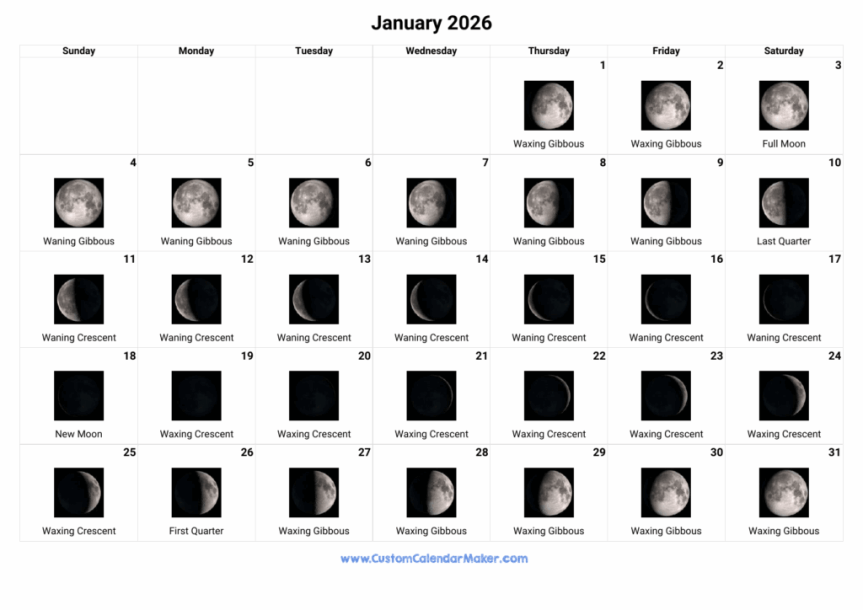
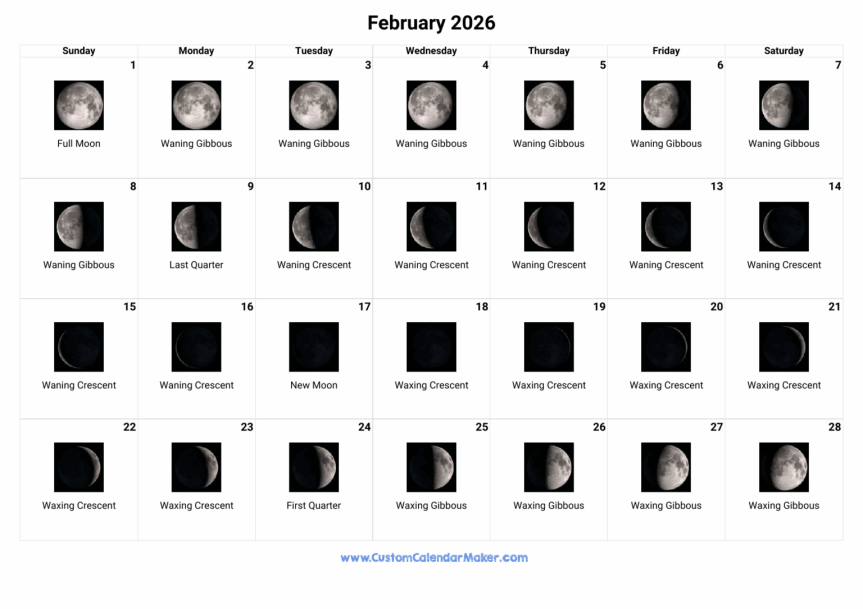
2026 Moon Phase Calendar

Please save and/or print this calendar if you want to.

December 31, 2025 Current Southern Hemisphere/Tomorrow’s Northern Hemisphere Moon Phase

You can find more moon phase details on both of the websites used in this post by clicking on each hyperlink.

Source: nineplanets.org

The Moon phase for December 31st, 2025 is a Waxing Gibbous phase. This is the phase where the moon is more than 50% illuminated but has not yet reached 100% illumination (which would be a Full Moon).

In the Northern Hemisphere, the right side will be illuminated, and in the Southern hemisphere it’ll be the left side that is illuminated.

The Waxing Gibbous phase, like all moon phases, will last for just over 7 days. The actual length will vary because of the elliptical shaped orbit of the moon. During this Waxing Gibbous phase the moon will rise in the east in the mid- to late-afternoon and will be high in the eastern sky at sunset.

Assuming it’s a clear night, the Waxing Gibbous moon will then be visible through most of the night before setting just before sunrise.

Fun fact:

Phase Details

Phase: Waxing Gibbous

Moon age: 11.35 days

Moon illumination: 88.93%

Moon tilt: 123.014°

Moon angle: 0.55

Moon distance: 361,650.56 km

Moon sign: Gemini

Source: MoonGiant.com

You can use this link to go forward or backward in time for Moon phase information. If you are curious, you can even find out what phase the Moon was in when you or anyone else was born.

Visit the December 2025 Moon Phases Calendar to see all the daily moon phase for this month.

Today’s Waxing Gibbous Phase

The Waxing Gibbous on December 31 has an illumination of 90%. This is the percentage of the Moon illuminated by the Sun. The illumination is constantly changing and can vary up to 10% a day. On December 31 the Moon is 11.71 days old. This refers to how many days it has been since the last New Moon. It takes 29.53 days for the Moon to orbit the Earth and go through the lunar cycle of all 8 Moon phases.

Phase Details

Phase: Waxing Gibbous
Illumination: 90%
Moon Age: 11.71 days
Moon Angle: 0.55
Moon Distance: 363,314.35 km
Sun Angle: 0.54
Sun Distance: 147,099,379.52 km

December 29, 2025 Current Southern Hemisphere/Tomorrow’s Northern Hemisphere Moon Phase

You can find more moon phase details on both of the websites used in this post by clicking on each hyperlink.

Source: nineplanets.org

The Moon phase for December 30th, 2025 is a Waxing Gibbous phase. This is the phase where the moon is more than 50% illuminated but has not yet reached 100% illumination (which would be a Full Moon).

In the Northern Hemisphere, the right side will be illuminated, and in the Southern hemisphere it’ll be the left side that is illuminated.

The Waxing Gibbous phase, like all moon phases, will last for just…

Fun fact:

Phase Details

Phase: Waxing Gibbous

Moon age: 10.31 days

Moon illumination: 79.97%

Moon tilt: 115.906°

Moon angle: 0.55

Moon distance: 364,426.50 km

Moon sign: Taurus

Source: MoonGiant.com

You can use this link to go forward or backward in time for Moon phase information. If you are curious, you can even find out what phase the Moon was in when you or anyone else was born.

Visit the December 2025 Moon Phases Calendar to see all the daily moon phase for this month.

Today’s Waxing Gibbous Phase

The Waxing Gibbous on December 30 has an illumination of 81%. This is the percentage of the Moon illuminated by the Sun. The illumination is constantly changing and can vary up to 10% a day. On December 30 the Moon is 10.53 days old. This refers to how many days it has been since the last New Moon. It takes 29.53 days for the Moon to orbit the Earth and go through the lunar cycle of all 8 Moon phases.

Phase Details

Illumination: 81%
Moon Age: 10.53 days
Moon Angle: 0.55
Moon Distance: 363,760.80 km
Sun Angle: 0.54
Sun Distance: 147,101,555.29 km

December 29, 2025 Current Southern Hemisphere/Tomorrow’s Northern Hemisphere Moon Phase

You can find more moon phase details on both of the websites used in this post by clicking on each hyperlink.

Source: nineplanets.org

The Moon phase for December 29th, 2025 is a Waxing Gibbous phase. This is the phase where the moon is more than 50% illuminated but has not yet reached 100% illumination (which would be a Full Moon).

In the Northern Hemisphere, the right side will be illuminated, and in the Southern hemisphere it’ll be the left side that is illuminated.

The Waxing Gibbous phase, like all moon phases, will last for just over 7 days. The actual length will vary because of the 

Fun fact:

Phase Details

Phase: Waxing Gibbous

Moon age: 9.27 days

Moon illumination: 69.42%

Moon tilt: 111.254°

Moon angle: 0.54

Moon distance: 368,321.56 km

Moon sign: Taurus

Source: MoonGiant.com

You can use this link to go forward or backward in time for Moon phase information. If you are curious, you can even find out what phase the Moon was in when you or anyone else was born.

Visit the December 2025 Moon Phases Calendar to see all the daily moon phase for this month.

Today’s Waxing Gibbous Phase

The Waxing Gibbous on December 29 has an illumination of 71%. This is the percentage of the Moon illuminated by the Sun. The illumination is constantly changing and can vary up to 10% a day. On December 29 the Moon is 9.43 days old. This refers to how many days it has been since the last New Moon. It takes 29.53 days for the Moon to orbit the Earth and go through the lunar cycle of all 8 Moon phases.

Phase Details

Phase: Waxing Gibbous
Illumination: 71%
Moon Age: 9.43 days
Moon Angle: 0.55
Moon Distance: 365,386.43 km
Sun Angle: 0.54
Sun Distance: 147,104,424.13 km

December 27, 2025 Current Southern Hemisphere/Tomorrow’s Northern Hemisphere Moon Phase

You can find more moon phase details on both of the websites used in this post by clicking on each hyperlink.

Source: nineplanets.org

The Moon phase for December 27th, 2025 is the First Quarter phase. In this phase, exactly half of the moon is illuminated and half is in darkness.

The First Quarter phase comes roughly 7 days after the New Moon and this is when the moon has completed one quarter of its orbit around the Earth (hence the name, First Quarter). The moon will be high overhead at sunset in this phase and will be visible until mid-night, when it sets in the west.

The First Quarter of the moon phase cycle happens on one day. It’s followed by the intermediate phase, Waxing Gibbous, and will become more illuminated every day until it reaches the Full Moon phase.

Assuming it’s a clear night, the Waxing Gibbous moon will then be visible through most of the night before setting just before sunrise.

Fun fact:

 Phase Details

Phase: First Quarter

Moon age: 7.2 days

Moon illumination: 46.61%

Moon tilt: 107.445°

Moon angle: 0.53

Moon distance: 377,718.93 km

Moon sign: Aries

Source: MoonGiant.com

You can use this link to go forward or backward in time for Moon phase information. If you are curious, you can even find out what phase the Moon was in when you or anyone else was born.

Visit the December 2025 Moon Phases Calendar to see all the daily moon phase for this month.

Today’s First Quarter Phase

The First Quarter on December 27 has an illumination of 49%. This is the percentage of the Moon illuminated by the Sun. The illumination is constantly changing and can vary up to 10% a day. On December 27 the Moon is 7.31 days old. This refers to how many days it has been since the last New Moon. It takes 29.53 days for the Moon to orbit the Earth and go through the lunar cycle of all 8 Moon phases.