August 19, 2026 Current Southern Hemisphere/Tomorrow’s Northern Hemisphere Moon Phase 

You can find more moon phase details on both of the websites used in this post by clicking on each hyperlink.
Source: nineplanets.org

…

The Moon phase for August 19th, 2026 is a Waning Crescent phase. This is the phase where the moon is less than 50% illuminated but has not yet reached 0% illumination (which would be a New Moon).

In this part of the moon cycle, it is getting closer and closer to the Sun as viewed from Earth and the night side of the Moon is facing earth with a decreasingly thin crescent being illuminated.

The waning (shrinking) crescement Moon will rise at around midnight, transit the meridian after sunrise, before setting after noon. This phase is best viewed 1-2 hours before sunrise and is a great time to see the features of the Moon’s surface. Along the illuminated crescent you can see the craters and mountains of the moon casting long shadows.

The Waxing Gibbous phase, like all moon phases, will last for just over 7 days. The actual length will vary because of the elliptical shaped orbit of the moon. During this Waxing Gibbous phase the moon will rise in the east in the mid- to late-afternoon and will be high in the eastern sky at sunset.

Assuming it’s a clear night, the Waxing Gibbous moon will then be visible through most of the night before setting just before sunrise.

Fun fact:

Phase Details:

Phase: Waning Crescent

Moon age: 6.94 days

Moon illumination: 44.96%

Moon tilt: 142.721°

Moon angle: 0.5

Moon distance: 399,825.14 km

Moon sign: Scorpio

Source: MoonGiant.com 

You can use this link to go forward or backward in time for Moon phase information. If you are curious, you can even find out what phase the Moon was in when you or anyone else was born.

…

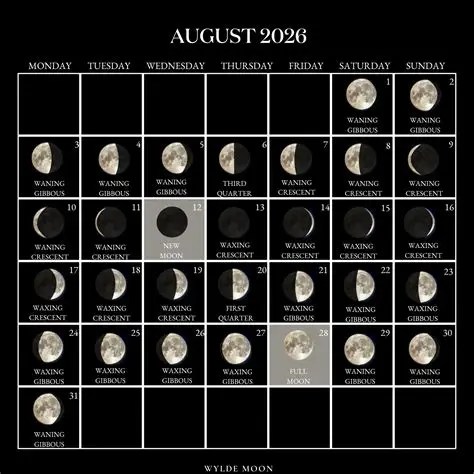
Visit the August 2026 Moon Phases Calendar to see all the daily moon phase for this month.

Today’s Waxing Crescent Phase

The Waxing Crescent on August 19 has an illumination of 46%. This is the percentage of the Moon illuminated by the Sun. The illumination is constantly changing and can vary up to 10% a day. On August 19 the Moon is 7.02 days old. This refers to how many days it has been since the last New Moon. It takes 29.53 days for the Moon to orbit the Earth and go through the lunar cycle of all 8 Moon phases.

Phase Details:

Phase: Waxing Crescent
Illumination: 46%
Moon Age: 7.02 days
Moon Angle: 0.50°
Moon Distance: 401,431.37 km
Sun Angle: 0.53°
Sun Distance: 151,373,390.22 km
August 18, 2026 Current Southern Hemisphere/Tomorrow’s Northern Hemisphere Moon Phase 

You can find more moon phase details on both of the websites used in this post by clicking on each hyperlink.


Source: nineplanets.org

…

The Moon phase for August 18th, 2026 is a Waxing Crescent phase. This is the phase where the moon started to become visible again after the New Moon.

In this part of the moon cycle, the Moon is moving away from the Sun and is becoming more and more illuminated by sunlight. In this phase, the moon will go from 0.1% to 49.9% illuminated before reaching the First Quarter phase.

In the Waxing Crescent phase the moon rises before noon in the east, transits the meridian before sunset, before setting in the west before midnight.

The Waxing Crescent phase, like all moon phases, will last for just over 7 days. The actual length will vary because of the elliptical shaped orbit of the moon. The moon is close to the Sun in the sky and the right edge will become brighter as it approaches 50% illumination and the First Quarter phase

Fun fact:

Phase Details:

Phase: Waxing Crescent

Moon age: 5.91 days

Moon illumination: 34.93%

Moon tilt: 148.655°

Moon angle: 0.5

Moon distance: 395,734.86 km

Moon sign: Scorpio


Source: MoonGiant.com 

You can use this link to go forward or backward in time for Moon phase information. If you are curious, you can even find out what phase the Moon was in when you or anyone else was born.

…

Visit the August 2026 Moon Phases Calendar to see all the daily moon phase for this month.

Today’s Waxing Crescent Phase

The Waxing Crescent on August 18 has an illumination of 37%. This is the percentage of the Moon illuminated by the Sun. The illumination is constantly changing and can vary up to 10% a day. On August 18 the Moon is 6.1 days old. This refers to how many days it has been since the last New Moon. It takes 29.53 days for the Moon to orbit the Earth and go through the lunar cycle of all 8 Moon phases.

Phase Details:

Phase: Waxing Crescent
Illumination: 37%
Moon Age: 6.10 days
Moon Angle: 0.50°
Moon Distance: 398,247.85 km
Sun Angle: 0.53°
Sun Distance: 151,403,085.59 km

August 17, 2026 Current Southern Hemisphere/Tomorrow’s Northern Hemisphere Moon Phase 

You can find more moon phase details on both of the websites used in this post by clicking on each hyperlink.


Source: nineplanets.org

…

The Moon phase for August 17th, 2026 is a Waxing Crescent phase. This is the phase where the moon started to become visible again after the New Moon.

In this part of the moon cycle, the Moon is moving away from the Sun and is becoming more and more illuminated by sunlight. In this phase, the moon will go from 0.1% to 49.9% illuminated before reaching the First Quarter phase.

In the Waxing Crescent phase the moon rises before noon in the east, transits the meridian before sunset, before setting in the west before midnight.

The Waxing Crescent phase, like all moon phases, will last for just over 7 days. The actual length will vary because of the elliptical shaped orbit of the moon. The moon is close to the Sun in the sky and the right edge will become brighter as it approaches 50% illumination and the First Quarter phase

Fun fact:

Phase Details:

Phase: Waxing Crescent

Moon age: 4.88 days

Moon illumination: 25.29%

Moon tilt: 153.426°

Moon angle: 0.51

Moon distance: 390,712.65 km

Moon sign: Libra

Source: MoonGiant.com 

You can use this link to go forward or backward in time for Moon phase information. If you are curious, you can even find out what phase the Moon was in when you or anyone else was born. 

…

Visit the August 2026 Moon Phases Calendar to see all the daily moon phase for this month.

Today’s Waxing Crescent Phase

The Waxing Crescent on August 17 has an illumination of 27%. This is the percentage of the Moon illuminated by the Sun. The illumination is constantly changing and can vary up to 10% a day. On August 17 the Moon is 5.16 days old. This refers to how many days it has been since the last New Moon. It takes 29.53 days for the Moon to orbit the Earth and go through the lunar cycle of all 8 Moon phases.

Phase Details:

Phase: Waxing Crescent
Illumination: 27%
Moon Age: 5.16 days
Moon Angle: 0.51°
Moon Distance: 394,321.88 km
Sun Angle: 0.53°
Sun Distance: 151,432,253.85 km

August 16, 2026 Current Northern Hemisphere Moon Phase 

You can find more moon phase details on both of the websites used in this post by clicking on each hyperlink.


Source: nineplanets.org

…

The Moon phase for today is a Waxing Crescent phase. This is the phase where the moon started to become visible again after the New Moon.

In this part of the moon cycle, the Moon is moving away from the Sun and is becoming more and more illuminated by sunlight. In this phase, the moon will go from 0.1% to 49.9% illuminated before reaching the First Quarter phase.

In the Waxing Crescent phase the moon rises before noon in the east, transits the meridian before sunset, before setting in the west before midnight.

The Waxing Crescent phase, like all moon phases, will last for just over 7 days. The actual length will vary because of the elliptical shaped orbit of the moon. The moon is close to the Sun in the sky and the right edge will become brighter as it approaches 50% illumination and the First Quarter phase

Fun fact:

 Phase Details:

Phase: Waxing Crescent

Moon age: 3.84 days

Moon illumination: 16.48%

Moon tilt: 156.802°

Moon angle: 0.52

Moon distance: 385,095.70 km

Moon sign: Libra

Source: MoonGiant.com 

You can use this link to go forward or backward in time for Moon phase information. If you are curious, you can even find out what phase the Moon was in when you or anyone else was born.

…

Visit the August 2026 Moon Phases Calendar to see all the daily moon phase for this month.

Today’s Waxing Crescent Phase

The Waxing Crescent on August 16 has an illumination of 19%. This is the percentage of the Moon illuminated by the Sun. The illumination is constantly changing and can vary up to 10% a day. On August 16 the Moon is 4.27 days old. This refers to how many days it has been since the last New Moon. It takes 29.53 days for the Moon to orbit the Earth and go through the lunar cycle of all 8 Moon phases.

Phase Details:

Phase: Waxing Crescent
Illumination: 19%
Moon Age: 4.27 days
Moon Angle: 0.51°
Moon Distance: 390,219.24 km
Sun Angle: 0.53°
Sun Distance: 151,458,521.54 km

August 15, 2026 Current Southern Hemisphere/Tomorrow’s Northern Hemisphere Moon Phase

You can find more moon phase details on both of the websites used in this post by clicking on each hyperlink.


Source: nineplanets.org

…

The Moon phase for August 15th, 2026 is a Waxing Crescent phase. This is the phase where the moon started to become visible again after the New Moon.

In this part of the moon cycle, the Moon is moving away from the Sun and is becoming more and more illuminated by sunlight. In this phase, the moon will go from 0.1% to 49.9% illuminated before reaching the First Quarter phase.

In the Waxing Crescent phase the moon rises before noon in the east, transits the meridian before sunset, before setting in the west before midnight.

The Waxing Crescent phase, like all moon phases, will last for just over 7 days. The actual length will vary because of the elliptical shaped orbit of the moon. The moon is close to the Sun in the sky and the right edge will become brighter as it approaches 50% illumination and the First Quarter phase

Fun fact:

 Phase Details:

Phase: Waxing Crescent

Moon age: 2.81 days

Moon illumination: 9.04%

Moon tilt: 158.446°

Moon angle: 0.53

Moon distance: 379,324.88 km

Moon sign: Virgo

Source: MoonGiant.com 

You can use this link to go forward or backward in time for Moon phase information. If you are curious, you can even find out what phase the Moon was in when you or anyone else was born.

…

Visit the August 2026 Moon Phases Calendar to see all the daily moon phase for this month.

Today’s Waxing Crescent Phase

The Waxing Crescent on August 15 has an illumination of 11%. This is the percentage of the Moon illuminated by the Sun. The illumination is constantly changing and can vary up to 10% a day. On August 15 the Moon is 3.19 days old. This refers to how many days it has been since the last New Moon. It takes 29.53 days for the Moon to orbit the Earth and go through the lunar cycle of all 8 Moon phases.

Phase Details:

Phase: Waxing Crescent
Illumination: 11%
Moon Age: 3.19 days
Moon Angle: 0.52°
Moon Distance: 384,989.13 km
Sun Angle: 0.53°
Sun Distance: 151,488,977.19 km

August 14, 2026 Current Northern Hemisphere Moon Phase 

You can find more moon phase details on both of the websites used in this post by clicking on each hyperlink.


Source: nineplanets.org

…

The Moon phase for today is a Waxing Crescent phase. This is the phase where the moon started to become visible again after the New Moon.

In this part of the moon cycle, the Moon is moving away from the Sun and is becoming more and more illuminated by sunlight. In this phase, the moon will go from 0.1% to 49.9% illuminated before reaching the First Quarter phase.

In the Waxing Crescent phase the moon rises before noon in the east, transits the meridian before sunset, before setting in the west before midnight.

The Waxing Crescent phase, like all moon phases, will last for just over 7 days. The actual length will vary because of the elliptical shaped orbit of the moon. The moon is close to the Sun in the sky and the right edge will become brighter as it approaches 50% illumination and the First Quarter phase

Fun fact:

 Phase Details:

Phase: Waxing Crescent

Moon age: 1.78 days

Moon illumination: 3.53%

Moon tilt: 157.852°

Moon angle: 0.53

Moon distance: 373,876.15 km

Moon sign: Virgo

Source: MoonGiant.com 

You can use this link to go forward or backward in time for Moon phase information. If you are curious, you can even find out what phase the Moon was in when you or anyone else was born.

…

Visit the August 2026 Moon Phases Calendar to see all the daily moon phase for this month.

Today’s Waxing Crescent Phase

The Waxing Crescent on August 14 has an illumination of 5%. This is the percentage of the Moon illuminated by the Sun. The illumination is constantly changing and can vary up to 10% a day. On August 14 the Moon is 2.15 days old. This refers to how many days it has been since the last New Moon. It takes 29.53 days for the Moon to orbit the  Earth and go through the lunar cycle of all 8 Moon phases.

Phase Details:

Phase: Waxing Crescent
Illumination: 5%
Moon Age: 2.15 days
Moon Angle: 0.52°
Moon Distance: 380,065.28 km
Sun Angle: 0.53°
Sun Distance: 151,516,516.69 km

August 11, 2026 Current Southern Hemisphere/Tomorrow’s Northern Hemisphere Moon Phase

You can find more moon phase details on both of the websites used in this post by clicking on each hyperlink.


Source: nineplanets.org

…

The Moon phase for August 11th, 2026 is a Waning Crescent phase. This is the phase where the moon is less than 50% illuminated but has not yet reached 0% illumination (which would be a New Moon).

In this part of the moon cycle, it is getting closer and closer to the Sun as viewed from Earth and the night side of the Moon is facing earth with a decreasingly thin crescent being illuminated.

The waning (shrinking) crescement Moon will rise at around midnight, transit the meridian after sunrise, before setting after noon. This phase is best viewed 1-2 hours before sunrise and is a great time to see the features of the Moon’s surface. Along the illuminated crescent you can see the craters and mountains of the moon casting long shadows.

The Waxing Gibbous phase, like all moon phases, will last for just over 7 days. The actual length will vary because of the elliptical shaped orbit of the moon. During this Waxing Gibbous phase the moon will rise in the east in the mid- to late-afternoon and will be high in the eastern sky at sunset.

Assuming it’s a clear night, the Waxing Gibbous moon will then be visible through most of the night before setting just before sunrise.

Fun fact:

 Phase Details:

Phase: Waning Crescent

Moon age: 28.08 days

Moon illumination: 3.13%

Moon tilt: -27.945°

Moon angle: 0.55

Moon distance: 363,772.03 km

Moon sign: Cancer


Source: MoonGiant.com 

You can use this link to go forward or backward in time for Moon phase information. If you are curious, you can even find out what phase the Moon was in when you or anyone else was born.

…

Visit the August 2026 Moon Phases Calendar to see all the daily moon phase for this month.

Today’s Waning Crescent Phase

The Waning Crescent on August 11 has an illumination of 2%. This is the percentage of the Moon illuminated by the Sun. The illumination is constantly changing and can vary up to 10% a day. On August 11 the Moon is 28.33 days old. This refers to how many days it has been since the last New Moon. It takes 29.53 days for the Moon to orbit the Earth and go through the lunar cycle of all 8 Moon phases.

Phase Details:

Phase: Waning Crescent
Illumination: 2%
Moon Age: 28.33 days
Moon Angle: 0.54°
Moon Distance: 367,463.78 km
Sun Angle: 0.53°
Sun Distance: 151,596,820.74 km

August 10, 2026 Current  Northern Hemisphere Moon Phase 

You can find more moon phase details on both of the websites used in this post by clicking on each hyperlink.


Source: nineplanets.org

…

The Moon phase for today is a Waning Crescent phase. This is the phase where the moon is less than 50% illuminated but has not yet reached 0% illumination (which would be a New Moon).

In this part of the moon cycle, it is getting closer and closer to the Sun as viewed from Earth and the night side of the Moon is facing  earth with a decreasingly thin crescent being illuminated.

The waning (shrinking) crescement Moon will rise at around midnight, transit the meridian after sunrise, before setting after noon. This phase is best viewed 1-2 hours before sunrise and is a great time to see the features of the Moon’s surface. Along the illuminated crescent you can see the craters and mountains of the moon casting long shadows.

The Waxing Gibbous phase, like all moon phases, will last for just over 7 days. The actual length will vary because of the elliptical shaped orbit of the moon. During this Waxing Gibbous phase the moon will rise in the east in the mid- to late-afternoon and will be high in the eastern sky at sunset.

Assuming it’s a clear night, the Waxing Gibbous moon will then be visible through most of the night before setting just before sunrise.

Fun fact:

Phase Details:

Phase: Waning Crescent

Moon age: 27.04 days

Moon illumination: 8.92%

Moon tilt: -35.914°

Moon angle: 0.55

Moon distance: 363,334.42 km

Moon sign: Cancer

Source: MoonGiant.com 

You can use this link to go forward or backward in time for Moon phase information. If you are curious, you can even find out what phase the Moon was in when you or anyone else was born.

…

Visit the August 2026 Moon Phases Calendar to see all the daily moon phase for this month.

Today’s Waning Crescent Phase

The Waning Crescent on August 10 has an illumination of 5%. This is the percentage of the Moon illuminated by the Sun. The illumination is constantly changing and can vary up to 10% a day. On August 10 the Moon is 27.33 days old. This refers to how many days it has been since the last New Moon. It takes 29.53 days for the Moon to orbit the Earth and go through the lunar cycle of all 8 Moon phases.

Phase Details:

Phase: Waning Crescent
Illumination: 5%
Moon Age: 27.33 days
Moon Angle: 0.55°
Moon Distance: 365,213.39 km
Sun Angle: 0.53°
Sun Distance: 151,618,936.53 km

August 9, 2026 Current Southern Hemisphere/Tomorrow’s Northern Hemisphere Moon Phase 

You can find more moon phase details on both of the websites used in this post by clicking on each hyperlink.

Source: nineplanets.org

…

The Moon phase for August 9th, 2026 is a Waning Crescent phase. This is the phase where the moon is less than 50% illuminated but has not yet reached 0% illumination (which would be a New Moon).

In this part of the moon cycle, it is getting closer and closer to the Sun as viewed from Earth and the night side of the Moon is facing earth with a decreasingly thin crescent being illuminated.

The waning (shrinking) crescement Moon will rise at around midnight, transit the meridian after sunrise, before setting after noon. This phase is best viewed 1-2 hours before sunrise and is a great time to see the features of the Moon’s surface. Along the illuminated crescent you can see the craters and mountains of the moon casting long shadows.

The Waxing Gibbous phase, like all moon phases, will last for just over 7 days. The actual length will vary because of the elliptical shaped orbit of the moon. During this Waxing Gibbous phase the moon will rise in the east in the mid- to late-afternoon and will be high in the eastern sky at sunset.

Assuming it’s a clear night, the Waxing Gibbous moon will then be visible through most of the night before setting just before sunrise.

Fun fact:

 Phase Details:

Phase: Waning Crescent

Moon age: 26 days

Moon illumination: 17.25%

Moon tilt: -44.018°

Moon angle: 0.55

Moon distance: 364,359.15 km

Moon sign: Gemini

Source: MoonGiant.com 

You can use this link to go forward or backward in time for Moon phase information. If you are curious, you can even find out what phase the Moon was in when you or anyone else was born.

…

Visit the August 2026 Moon Phases Calendar to see all the daily moon phase for this month.

Today’s Waning Crescent Phase

The Waning Crescent on August 9 has an illumination of 13%. This is the percentage of the Moon illuminated by the Sun. The illumination is constantly changing and can vary up to 10% a day. On August 9 the Moon is 26.06 days old. This refers to how many days it has been since the last New Moon. It takes 29.53 days for the Moon to orbit the Earth and go through the lunar cycle of all 8 Moon phases.

Phase Details:

Phase: Waning Crescent
Illumination: 13%
Moon Age: 26.06 days
Moon Angle: 0.55°
Moon Distance: 363,566.44 km
Sun Angle: 0.53°
Sun Distance: 151,646,710.99 km

August 8, 2026 Current Southern Hemisphere/Tomorrow’s Northern Hemisphere Moon Phase 

You can find more moon phase details on both of the websites used in this post by clicking on each hyperlink.

Source: nineplanets.org

…

The Moon phase for August 8th, 2026 is a Waning Crescent phase. This is the phase where the moon is less than 50% illuminated but has not yet reached 0% illumination (which would be a New Moon).

In this part of the moon cycle, it is getting closer and closer to the Sun as viewed from Earth and the night side of the Moon is facing earth with a decreasingly thin crescent being illuminated.

The waning (shrinking) crescement Moon will rise at around midnight, transit the meridian after sunrise, before setting after noon. This phase is best viewed 1-2 hours before sunrise and is a great time to see the features of the Moon’s surface. Along the illuminated crescent you can see the craters and mountains of the moon casting long shadows.

The Waxing Gibbous phase, like all moon phases, will last for just over 7 days. The actual length will vary because of the elliptical shaped orbit of the moon. During this Waxing Gibbous phase the moon will rise in the east in the mid- to late-afternoon and will be high in the eastern sky at sunset.

Assuming it’s a clear night, the Waxing Gibbous moon will then be visible through most of the night before setting just before sunrise.

Fun fact:

 Phase Details:

Phase: Waning Crescent

Moon age: 24.96 days

Moon illumination: 27.48%

Moon tilt: -51.851°

Moon angle: 0.54

Moon distance: 366,603.34 km

Moon sign: Gemini

Source: MoonGiant.com

You can use this link to go forward or backward in time for Moon phase information. If you are curious, you can even find out what phase the Moon was in when you or anyone else was born. 

…

Visit the August 2026 Moon Phases Calendar to see all the daily moon phase for this month.

Today’s Waning Crescent Phase

The Waning Crescent on August 8 has an illumination of 22%. This is the percentage of the Moon illuminated by the Sun. The illumination is constantly changing and can vary up to 10% a day. On August 8 the Moon is 24.94 days old. This refers to how many days it has been since the last New Moon. It takes 29.53 days for the Moon to orbit the Earth and go through the lunar cycle of all 8 Moon phases.

Phase Details:

Phase: Waning Crescent
Illumination: 22%
Moon Age: 24.94 days
Moon Angle: 0.55°
Moon Distance: 363,363.40 km
Sun Angle: 0.53°
Sun Distance: 151,670,768.81 km

August 3, 2026 Current Southern Hemisphere/Tomorrow’s Northern Hemisphere Moon Phase

You can find more moon phase details on both of the websites used in this post by clicking on each hyperlink.

Source: nineplanets.org

…

The Moon phase for August 3rd, 2026 is a Waning Gibbous phase. This is the first phase after the Full Moon where the illumination of the moon decreases each day until it reaches 50% (the Last Quarter phase).

The waning (shrinking) gibbous Moon will rise after sunset in the east, transit the meridian after midnight, before setting after sunrise in the west.

During this phase, the illumination of the moon will go down from 99.% to 50.1%. Technically, the phase starts as soon as the Full Moon has passed, but it can be difficult to calculate and differentiate the first stage of a Waning Gibbous Moon from a Full Moon when 98-99% of the Moon’s surface is illuminated.

Fun fact:

Phase Details:

Phase: Waning Gibbous

Moon age: 19.77 days

Moon illumination: 81.58%

Moon tilt: -73.299°

Moon angle: 0.52

Moon distance: 385,306.49 km

Moon sign: Aries

Source: MoonGiant.com

You can use this link to go forward or backward in time for Moon phase information. If you are curious, you can even find out what phase the Moon was in when you or anyone else was born.

…

Visit the August 2026 Moon Phases Calendar to see all the daily moon phase for this month.

Today’s Waning Gibbous Phase

The Waning Gibbous on August 3 has an illumination of 75%. This is the percentage of the Moon illuminated by the Sun. The illumination is constantly changing and can vary up to 10% a day. On August 3 the Moon is 19.68 days old. This refers to how many days it has been since the last New Moon. It takes 29.53 days for the Moon to orbit the Earth and go through the lunar cycle of all 8 Moon phases.

Phase Details:

Phase: Waning Gibbous
Illumination: 75%
Moon Age: 19.68 days
Moon Angle: 0.53°
Moon Distance: 377,588.04 km
Sun Angle: 0.53°
Sun Distance: 151,781,065.85 km

August 2, 2026 Current Northern Hemisphere Moon Phase

You can find more moon phase details on both of the websites used in this post by clicking on each hyperlink.

Source: nineplanets.org

…

The Moon phase for today is a Waning Gibbous phase. This is the first phase after the Full Moon where the illumination of the moon decreases each day until it reaches 50% (the Last Quarter phase).

The waning (shrinking) gibbous Moon will rise after sunset in the east, transit the meridian after midnight, before setting after sunrise in the west.

During this phase, the illumination of the moon will go down from 99.% to 50.1%. Technically, the phase starts as soon as the Full Moon has passed, but it can be difficult to calculate and differentiate the first stage of a Waning Gibbous Moon from a Full Moon when 98-99% of the Moon’s surface is illuminated.

Fun fact:

Phase Details:

Phase: Waning Gibbous

Moon age: 18.74 days

Moon illumination: 89.07%

Moon tilt: -73.575°

Moon angle: 0.51

Moon distance: 389,065.07 km

Moon sign: Pisces

Source: MoonGiant.com

You can use this link to go forward or backward in time for Moon phase information. If you are curious, you can even find out what phase the Moon was in when you or anyone else was born.

…

Visit the August 2026 Moon Phases Calendar to see all the daily moon phase for this month.

Today’s Waning Gibbous Phase

The Waning Gibbous on August 2 has an illumination of 84%. This is the percentage of the Moon illuminated by the Sun. The illumination is constantly changing and can vary up to 10% a day. On August 2 the Moon is 18.64 days old. This refers to how many days it has been since the last New Moon. It takes 29.53 days for the Moon to orbit the  Earth and go through the lunar cycle of all 8 Moon phases.

Phase Details:

Phase: Waning Gibbous
Illumination: 84%
Moon Age: 18.64 days
Moon Angle: 0.52°
Moon Distance: 382,477.36 km
Sun Angle: 0.53°
Sun Distance: 151,802,291.68 km

August 1, 2026 Current Southern Hemisphere/Tomorrow’s Northern Hemisphere Moon Phase

You can find more moon phase details on both of the websites used in this post by clicking on each hyperlink.

Source: nineplanets.org

…

The Moon phase for August 1st, 2026 is a Waning Gibbous phase. This is the first phase after the Full Moon where the illumination of the moon decreases each day until it reaches 50% (the Last Quarter phase).

The waning (shrinking) gibbous Moon will rise after sunset in the east, transit the meridian after midnight, before setting after sunrise in the west.

During this phase, the illumination of the moon will go down from 99.% to 50.1%. Technically, the phase starts as soon as the Full Moon has passed, but it can be difficult to calculate and differentiate the first stage of a Waning Gibbous Moon from a Full Moon when 98-99% of the Moon’s surface is illuminated.

Fun fact:

Phase Details:

Phase: Waning Gibbous

Moon age: 17.71 days

Moon illumination: 94.71%

Moon tilt: -72.208°

Moon angle: 0.51

Moon distance: 392,621.29 km

Moon sign: Pisces

Source: MoonGiant.com

You can use this link to go forward or backward in time for Moon phase information. If you are curious, you can even find out what phase the Moon was in when you or anyone else was born.

…

Visit the August 2026 Moon Phases Calendar to see all the daily moon phase for this month.

Today’s Waning Gibbous Phase

The Waning Gibbous on August 1 has an illumination of 91%. This is the percentage of the Moon illuminated by the Sun. The illumination is constantly changing and can vary up to 10% a day. On August 1 the Moon is 17.7 days old. This refers to how many days it has been since the last New Moon. It takes 29.53 days for the Moon to orbit the Earth and go through the lunar cycle of all 8 Moon phases.

Phase Details:

Phase: Waning Gibbous
Illumination: 91%
Moon Age: 17.70 days
Moon Angle: 0.51°
Moon Distance: 387,023.20 km
Sun Angle: 0.53°
Sun Distance: 151,821,210.07 km

July 31, 2026 Current Southern Hemisphere/Tomorrow’s Northern Hemisphere Moon Phase

You can find more moon phase details on both of the websites used in this post by clicking on each hyperlink.

Source: nineplanets.org

…

The Moon phase for July 31st, 2026 is a Waning Gibbous phase. This is the first phase after the Full Moon where the illumination of the moon decreases each day until it reaches 50% (the Last Quarter phase).

The waning (shrinking) gibbous Moon will rise after sunset in the east, transit the meridian after midnight, before setting after sunrise in the west.

During this phase, the illumination of the moon will go down from 99.% to 50.1%. Technically, the phase starts as soon as the Full Moon has passed, but it can be difficult to calculate and differentiate the first stage of a Waning Gibbous Moon from a Full Moon when 98-99% of the Moon’s surface is illuminated.

Fun fact:

Phase Details:

Phase: Waning Gibbous

Moon age: 16.68 days

Moon illumination: 98.35%

Moon tilt: -67.553°

Moon angle: 0.5

Moon distance: 395,933.82 km

Moon sign: Aquarius

Source: MoonGiant.com

You can use this link to go forward or backward in time for Moon phase information. If you are curious, you can even find out what phase the Moon was in when you or anyone else was born.

…

Visit the July 2026 Moon Phases Calendar to see all the daily moon phase for this month.

Today’s Waning Gibbous Phase

The Waning Gibbous on July 31 has an illumination of 96%. This is the percentage of the Moon illuminated by the Sun. The illumination is constantly changing and can vary up to 10% a day. On July 31 the Moon is 16.7 days old. This refers to how many days it has been since the last New Moon. It takes 29.53 days for the Moon to orbit the Earth and go through the lunar cycle of all 8 Moon phases.

Phase Details:

Phase: Waning Gibbous
Illumination: 96%
Moon Age: 16.70 days
Moon Angle: 0.51°
Moon Distance: 391,762.77 km
Sun Angle: 0.53°
Sun Distance: 151,841,105.54 km

July 30, 2026 Current Southern Hemisphere/Tomorrow’s Northern Hemisphere Moon Phase

You can find more moon phase details on both of the websites used in this post by clicking on each hyperlink.

Source: nineplanets.org

…

The Moon phase for July 30th, 2026 is a Waning Gibbous phase. This is the first phase after the Full Moon where the illumination of the moon decreases each day until it reaches 50% (the Last Quarter phase).

The waning (shrinking) gibbous Moon will rise after sunset in the east, transit the meridian after midnight, before setting after sunrise in the west.

During this phase, the illumination of the moon will go down from 99.% to 50.1%. Technically, the phase starts as soon as the Full Moon has passed, but it can be difficult to calculate and differentiate the first stage of a Waning Gibbous Moon from a Full Moon when 98-99% of the Moon’s surface is illuminated.

Fun fact:

Phase Details:

Phase: Waning Gibbous

Moon age: 15.65 days

Moon illumination: 99.93%

Moon tilt: -35.007°

Moon angle: 0.5

Moon distance: 398,944.63 km

Moon sign: Aquarius

Source: MoonGiant.com

You can use this link to go forward or backward in time for Moon phase information. If you are curious, you can even find out what phase the Moon was in when you or anyone else was born.

…

Visit the July 2026 Moon Phases Calendar to see all the daily moon phase for this month.

Today’s Waning Gibbous Phase

The Waning Gibbous on July 30 has an illumination of 99%. This is the percentage of the Moon illuminated by the Sun. The illumination is constantly changing and can vary up to 10% a day. On July 30 the Moon is 15.75 days old. This refers to how many days it has been since the last New Moon. It takes 29.53 days for the Moon to orbit the Earth and go through the lunar cycle of all 8 Moon phases.

Phase Details:

Phase: Waning Gibbous
Illumination: 99%
Moon Age: 15.75 days
Moon Angle: 0.50°
Moon Distance: 395,897.48 km
Sun Angle: 0.53°
Sun Distance: 151,859,545.28 km

Full Moon July 2025 – Buck Moon And Alternative Names

The full Moon July 2025 comes when nature is in full-growth. Crops are either ripening or beginning to be harvested. The annual rite of you-pick strawberries wraps up in the beginning of the month and folks in the Midwest check to see if the corn is “knee high by the Fourth of July.” But why is the July full Moon traditionally known as the “Buck Moon” and what other names does this summer Moon go by in different cultures?

July 2025 Full Moon: Tuesday, July 10
Peak Illumination: 4:37 p.m. Eastern Time

Why Is The July Full Moon The “Buck” Moon?

Male deer antlers begin to grow in late spring. Antlers grow as fast as ¼ inch per day or one and one half inches per week during this period making them the fastest growing bones in the world. Antlers grow from the pedicel in the buck’s skull. The lengthening daylight in spring triggers the hormones that start the growth each spring. Buck antlers can easily be spotted in full velvet come July. Unlike horns, antlers are bones made mostly of calcium and phosphorus that the deer shed after mating season. Buck antlers lose their velvety coating, usually within a 24-hour period, closer to mating season in fall.

The “Salmon” Moon – An Alternative July Full Moon Name

American Indians in Alaska, including the Haida and Tlingit dubbed the July full moon the “Salmon Moon” for its timing with salmon runs. The Wishrams in the Pacific Northwest translates to “Salmon Go Up Rivers In A Group.” (Salmon migrate up rivers to spawn from spring through fall.) The sockeye salmon run typically begins in July and can last through October.

July is also a month when the summer runs of chinook and steelhead take place. Salmon spend anywhere from 1 to 6 years in the oceans before returning to their home rivers to spawn.

Gardening And Growth-Related July Full Moon Names

July’s moon is dubbed the “Time Of Much Ripening” by Mohawk in the Eastern Woodlands. There’s plenty of ripening happening across the United States. For the Shawnee in the Midwestern region, it is the Blackberry moon. (See our June Full Moon article for more berry-related names.) In the Northern Plains the Assiniboine noted the red berries while the Lakota named it “When The Chokecherries Are Black.” For the Algonquin from the Northeast to Great Lakes this is the moon when the “Squash Are Ripe.”

More broadly, the Zuni in New Mexico called it the “Limbs Are Broken By Fruit” Moon. Among Ojibwe it’s the “Blueberry Moon.” To the Oneida it is the “String Bean Moon.”

While the berries and fruits ripen, corn is various stages of readiness. The translation of the Cherokee Nation in the Carolinas is “Ripe Corn Moon.” Though corn in the Great Lakes region has a bit of time to go. The Potawatomi name this the “Moon Of The Young Corn.”

In Celtic culture the July moon names included “Wyrt,” “Herb” and/or “Mead Moon.” Wyrt is derived from an Old English word. A herbal garden in Old English language was a Wyrtyard. Wort is the modernized spelling of the word. Those familiar with the beer brewing process recognize wort as the sugary liquid drained from mash used during the fermentation process.

Gardeners and herbalists spot wort used in plant names like St. John’s wort, bishop’s wort and lousewort. Harvesting herbs should be done once the plants have enough foliage to maintain growth after cuttings. By July, most herbs can withstand harvesting.

In addition to medicinal and cooking applications of herbs, they can be used in the mead making process. Of course, one needs honey to ferment into the alcoholic drink. Come July, there’s plenty of nectar giving flowers in bloom for honeybees to make plenty of honey for mead making.

Hay bales are a staple of fall decorations, but July’s moon was known as the “Hay Moon” among Anglo Saxon culture.

Whatever it is called, the July full Moon is a time to appreciate the glory of summer ripeness!

Source: farmersalmanac.com

(One Person’s Viewpoint) Celebrating the Full Buck Moon: Spiritual Meaning, Rituals and More

The Full Buck Moon, which graces the skies every July, brings a unique energy perfect for spiritual reflection and celebration. While the exact timing of its peak may vary, the Full Moon’s powerful energy can be harnessed throughout the entire week. This guide will help you explore the spiritual meaning of the Buck Moon, its rich history and folklore, and various ways to celebrate this magical time.

When is the Buck Moon in 2024?

In 2024, the Buck Moon will reach its peak on Sunday, July 21, at around 3:17 AM PDT. While the exact timing may differ slightly depending on your location, the Full Moon’s energy can be harnessed throughout the entire week. This gives you plenty of time to engage in rituals, meditation, and other spiritual practices to fully benefit from its powerful influence.

History & Folklore of the Buck Moon

The Full Moon is named the Buck Moon in July, drawing inspiration from the animal kingdom. During this time, male deer, or bucks, are in the peak of their antler growth. This phenomenon, observed by Native American tribes, led to the naming of this Full Moon. Bucks grow their antlers in preparation for the mating season, symbolizing strength, dominance, and growth.

The Buck Moon is a time of abundant vitality in the natural world. With plenty of plant life, deer and other wildlife thrive, providing essential resources for the months ahead. The preservation techniques of smoking and drying meat were crucial for survival, making the Buck Moon a vital marker for the seasonal cycle.

Buck Moon Spiritual Meaning

The Buck Moon’s energy is imbued with themes of authority, ambition, and change. As we bask in the warmth of summer days, this Full Moon encourages us to harness

Click here to read the rest of this article source thelocalmystic.com

July 29, 2026 Current Southern Hemisphere/Tomorrow’s Northern Hemisphere Moon Phase

You can find more moon phase details on both of the websites used in this post by clicking on each hyperlink.

Source: nineplanets.org

…

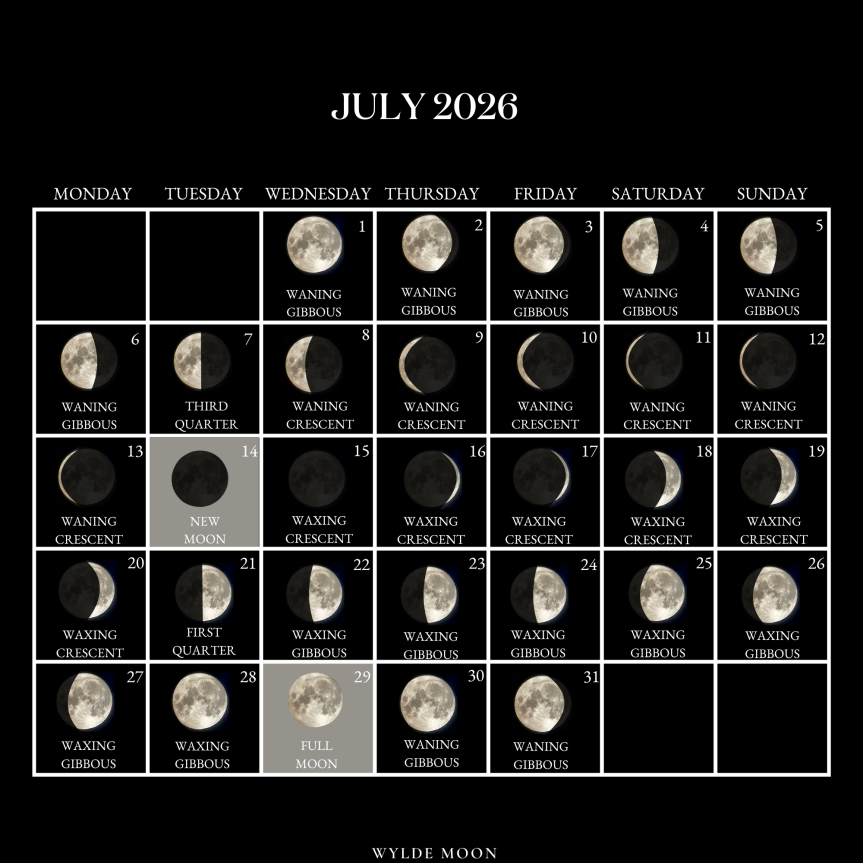
The Moon phase for July 29th, 2026 is the Full Moon phase. In this phase, the moon is 100% illuminated when seen from Earth (hence the name Full Moon).

The Full Moon happens when the moon is on the opposite side of the Earth from the Sun. The sunlight fully illuminated the moon, and this is what we call being “full”. The moon will be visible throughout the night sky as it rises at sunset in the east, transits the meridian at midnight, before setting at sunrise in the west.

The specific point at which the Full Moon occurs can be measured down to a fraction of a second. The time that passes between full moons is called the Synodic month and is 29.530587981 days long.

Fun fact:

Phase Details:

Phase: Full Moon

Moon age: 14.62 days

Moon illumination: 99.46%

Moon tilt: 96.601°

Moon angle: 0.5

Moon distance: 401,556.44 km

Moon sign: Capricorn

Source: MoonGiant.com

You can use this link to go forward or backward in time for Moon phase information. If you are curious, you can even find out what phase the Moon was in when you or anyone else was born.

…

Visit the July 2026 Moon Phases Calendar to see all the daily moon phase for this month.

Today’s Full Moon Phase

The Full Moon on July 29 has an illumination of 100%. This is the percentage of the Moon illuminated by the Sun. The illumination is constantly changing and can vary up to 10% a day. On July 29 the Moon is 14.85 days old. This refers to how many days it has been since the last New Moon. It takes 29.53 days for the Moon to orbit the Earth and go through the lunar cycle of all 8 Moon phases.

Phase Details:

Phase: Full Moon
Illumination: 100%
Moon Age: 14.85 days
Moon Angle: 0.50°
Moon Distance: 399,309.75 km
Sun Angle: 0.53°
Sun Distance: 151,876,605.42 km

July 28, 2026 Current Southern Hemisphere/Tomorrow’s Northern Hemisphere Moon Phase

You can find more moon phase details on both of the websites used in this post by clicking on each hyperlink.

Source: nineplanets.org

…

The Moon phase for July 28th, 2026 is a Waxing Gibbous phase. This is the phase where the moon is more than 50% illuminated but has not yet reached 100% illumination (which would be a Full Moon).

In the Northern Hemisphere, the right side will be illuminated, and in the Southern hemisphere it’ll be the left side that is illuminated.

The Waxing Gibbous phase, like all moon phases, will last for just over 7 days. The actual length will vary because of the elliptical shaped orbit of the moon. During this Waxing Gibbous phase the moon will rise in the east in the mid- to late-afternoon and will be high in the eastern sky at sunset.

Assuming it’s a clear night, the Waxing Gibbous moon will then be visible through most of the night before setting just before sunrise.

Fun fact:

Phase Details:

Phase: Waxing Gibbous

Moon age: 13.59 days

Moon illumination: 97.04%

Moon tilt: 107.881°

Moon angle: 0.49

Moon distance: 403,629.91 km

Moon sign: Capricorn

Source: MoonGiant.com

You can use this link to go forward or backward in time for Moon phase information. If you are curious, you can even find out what phase the Moon was in when you or anyone else was born.

…

Visit the July 2026 Moon Phases Calendar to see all the daily moon phase for this month.

Today’s Waxing Gibbous Phase

The Waxing Gibbous on July 28 has an illumination of 99%. This is the percentage of the Moon illuminated by the Sun. The illumination is constantly changing and can vary up to 10% a day. On July 28 the Moon is 13.93 days old. This refers to how many days it has been since the last New Moon. It takes 29.53 days for the Moon to orbit the Earth and go through the lunar cycle of all 8 Moon phases.

Phase Details:

Phase: Waxing Gibbous
Illumination: 99%
Moon Age: 13.93 days
Moon Angle: 0.50°
Moon Distance: 402,158.87 km
Sun Angle: 0.53°
Sun Distance: 151,893,764.81 km

July 27, 2026 Current Southern Hemisphere/Tomorrow’s Northern Hemisphere Moon Phase

You can find more moon phase details on both of the websites used in this post by clicking on each hyperlink.

Source: nineplanets.org

…

The Moon phase for July 27th, 2026 is a Waxing Gibbous phase. This is the phase where the moon is more than 50% illuminated but has not yet reached 100% illumination (which would be a Full Moon).

In the Northern Hemisphere, the right side will be illuminated, and in the Southern hemisphere it’ll be the left side that is illuminated.

The Waxing Gibbous phase, like all moon phases, will last for just over 7 days. The actual length will vary because of the elliptical shaped orbit of the moon. During this Waxing Gibbous phase the moon will rise in the east in the mid- to late-afternoon and will be high in the eastern sky at sunset.

Assuming it’s a clear night, the Waxing Gibbous moon will then be visible through most of the night before setting just before sunrise.

Fun fact:

Phase Details:

Phase: Waxing Gibbous

Moon age: 13.58 days

Moon illumination: 97.03%

Moon tilt: 108.188°

Moon angle: 0.49

Moon distance: 403,637.62 km

Moon sign: Capricorn

Source: MoonGiant.com

You can use this link to go forward or backward in time for Moon phase information. If you are curious, you can even find out what phase the Moon was in when you or anyone else was born.

…

Visit the July 2026 Moon Phases Calendar to see all the daily moon phase for this month.

Today’s Waxing Gibbous Phase

The Waxing Gibbous on July 27 has an illumination of 96%. This is the percentage of the Moon illuminated by the Sun. The illumination is constantly changing and can vary up to 10% a day. On July 27 the Moon is 12.98 days old. This refers to how many days it has been since the last New Moon. It takes 29.53 days for the Moon to orbit the Earth and go through the lunar cycle of all 8 Moon phases.

Phase Details:

Phase: Waxing Gibbous
Illumination: 96%
Moon Age: 12.98 days
Moon Angle: 0.49°
Moon Distance: 404,241.23 km
Sun Angle: 0.53°
Sun Distance: 151,910,936.52 km