

Day: January 10, 2024
Athena – Greek Goddess of Wisdom and War
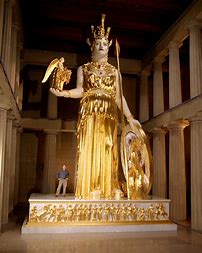
Athena – Greek Goddess of Wisdom and War Source: greekmythology.com
Athena is the Olympian goddess of wisdom and war and the adored patroness of the city of Athens. A virgin deity, she was also – somewhat paradoxically – associated with peace and handicrafts, especially spinning and weaving. Majestic and stern, Athena surpassed everybody in both of her main domains. In fact, even Ares feared her; and all Greek heroes asked her for help and advice.
Atena’s Roll
Athena’s Name
Athena’s name is closely linked with the name of the city of Athens. The Ancient Greeks debated whether she got her name after the city or the other way around. Modern scholars usually agree that the former was the case.
Athena’s Portrayal and Symbolism
In art and literature, Athena is usually depicted as a majestic lady, with a beautiful, but stern face, unsmiling full lips, grey eyes and a graceful build, emanating power and authority. She is always regally clad in either a chiton or a full armor. In the former case, she is sometimes represented with a spindle. In the latter case, she wears an elaborately crested Corinthian helmet and holds a long spear in one hand and an aegis in the other.
At the center of her aegis there’s oftentimes an image of a Gorgon’s head (Gorgoneion), symbolizing the gift she got from Perseus: the head of Medusa. Just like Medusa’s eyes, Athena’s shield can also turn her enemies to stone. As a symbol of her wisdom, there’s sometimes an owl flying in Athena’s vicinity or sitting on her shoulder; from time to time there may also be a snake or an olive branch.
Athena’s Epithets
Athena was one of the most important Olympian gods and she had many functions. Unsurprisingly, she was known under many different epithets. Some of the most famous were “Virgin,” “Pallas,” “The Unwearying One,” “The One of the City,” “The One with gleaming eyes” and “The One who fights in front.”
Athena’s Early Life
The Birth of Athena
Athena was born in most miraculous circumstances. On learning that Metis’ next child may overthrow him, Zeus swallowed his first wife who was already pregnant with Athens. When the time came, Zeus started feeling tremendous headaches. As even he couldn’t bear them, Hephaestus struck him with his axe and – lo and behold! – Athena leapt out of Zeus’ head, fully armed and with a cry so mighty and fearsome that Uranus and Gaea were shaken to their bones with terror. Zeus was delighted and full of pride.
Athena’s Childhood Friend Pallas
As a child, Athena had a friend she loved above all. Her name was Pallas and she was all but her equal in the art of war. However, one day, as they were practicing some martial exercises, Athena accidentally killed her friend. Grief-stricken and in an attempt to preserve her memory, she added her friend’s name to her own. That’s why many people know Athena as Athena Pallas.
Athena, Goddess of Wisdom
Athena, The Virgin Goddess
Just like Artemis and Hestia, Athena was never swayed by love or passion. Consequently, she never had any children. Some say that Erichthonius was an exception, but, in fact, Athena was only his foster-mother. True, Hephaestus did try to violate her, but she fought him off, so he spilled his seed over the Earth, after which Gaea was impregnated. When Erichthonius was born, Athena took him under her wing, just like she would do afterward with another cult hero, Heracles.
Athena, the Patron of Athens
Poseidon and Athena had a much-publicized quarrel over who deserves to be the patron of the most prosperous Ancient Greek city, Athens. Poseidon claimed that the city would benefit more from him than Athena and to prove this, he struck his trident into a rock, creating a seawater stream which welled up in the Temple of Erechtheion on the north side of the Acropolis. Smart as she was, Athena did nothing spectacular: she merely planted an olive tree. However, the first king of Athens, Cecrops – who was the judge of the contest – realized that the olive tree was much more beneficial, since it gave the Athenians fruit, oil and wood.
Athena, the Patroness of Handicrafts
Athena was a master artisan. As much as she was the women counterpart of Ares as a war goddess, she was also the female equivalent of Hephaestus when it came to arts and crafts. Homer says that Athena fashioned ornate and luxuriously embroidered robes for Hera and herself. Some even say that she combined her two main interests to invent the war chariot and even the warship.
Athena and the Myth of Arachne
However, the most famous myth which connects Athena with handicrafts is the story of Arachne, a mortal craftswoman who boasted that she was more skillful than Athena herself. Athena offered her a chance to repent, but after Arachne refused, she challenged her to a weaving duel. The goddess fashioned a beautiful tapestry which illustrated the gruesome fate of the mortals who had the hubris of challenging the gods. Arachne, on the other hand, chose for a subject the stories of the mortals unjustly victimized by the gods. She didn’t even have a chance to finish it: enraged and offended, Athena tore Arachne’s fabric to pieces and turned her into a spider. As such, Arachne is doomed to weave ever since.
Athena, the Helper of Heroes
As a war goddess associated with wisdom – unlike Ares who was associated with mere violence – Athena was often the main helper of Ancient Greece’s greatest heroes. Most famously, she guided Odysseus during his ten-year-long journey back to Ithaca. But, she also helped many others, such as Heracles, Perseus, Bellerophon, Jason, Diomedes, Argus, and Cadmus.
Athena: Myths and Hidden Truths
Contrary to popular belief, Athena is not a war goddess in the same sense as Ares. While both deities are associated with war, their roles are fundamentally different. Athena is revered for her strategic thinking, wisdom, and diplomacy, whereas Ares embodies the violent and chaotic aspects of war. This misconception often overshadows Athena’s connection to peace, as she sought to resolve conflicts through wisdom and negotiation rather than brute force.
Athena and musical instruments
Although more commonly associated with the arts of war and weaving, Athena was also credited with the creation of the flute and the trumpet. This demonstrates her influence on the arts and highlights her multifaceted nature as a goddess of both wisdom and creativity.
Athena and snakes
Athena’s relationship with animals is another little-known aspect of her mythology. In addition to her iconic association with the owl, symbolizing wisdom and knowledge, Athena was also linked with the serpent. The snake represents transformation, rebirth, and the ability to navigate complex challenges, reflecting Athena’s own attributes as a wise and resourceful goddess.
Athena: Wisdom, War, and the Power of the Goddess
Throughout our journey into the world of Athena, we have been deeply moved by the many facets of this fascinating goddess. Her wisdom, prowess in war, and dedication to the arts have not only inspired us but also served as a reminder of the importance of balance and harmony in life. As we delved into her stories, we felt a profound connection with the heroes who sought her guidance and the city of Athens, which revered her as their patroness. We were particularly touched by her unwavering devotion to her friend Pallas, which highlights the significance of loyalty and remembrance.
Athena’s enduring influence on both the ancient world and our modern lives has been truly captivating, and we hope that our exploration of her mythos has resonated with you, bringing a newfound appreciation for the wisdom and strength of this remarkable goddess.
Athena Sources
Homer’s “Odyssey” is an invaluable source for Athena and her deeds. If you want something briefer, read “The Homeric Hymns to Athena” (11 and 28). In Hesiod’s “Theogony” you can find the story of her birth.
Source: https://www.greekmythology.com/Olympians/Athena/athena.html
January 10 and 11, 2024 Current Moon Phase for the Northern and Southern Hemispheres

You can use this link to go forward or backward in time for Moon phase information. If you are curious, you can even find out what phase the Moon was in when you or anyone else was born.
Source: MoonGiant.com
Northern Hemisphere
January 11, 2024
The Moon’s current phase for today and tonight is a Waning Crescent phase. This phase is best viewed just before the sunrise in the western sky. In this phase the Moon’s illumination is growing smaller each day until the New Moon. During this part of the Moon cycle, the Moon is getting closer to the Sun as viewed from Earth and the night side of the Moon is facing the Earth with only a small edge of the Moon being illuminated. It can also be a great time to see the features of the Moon’s surface. Along the edge where the illuminated portion meets the dark side, the craters and mountains cast long shadows making them easier to observe with a telescope or binoculars.
Visit the January 2024 Moon Phases Calendar to see all the daily moon phase for this month.
Today’s Waning Crescent Phase
The Waning Crescent on January 10 has an illumination of 1%. This is the percentage of the Moon illuminated by the Sun. The illumination is constantly changing and can vary up to 10% a day. On January 10 the Moon is 28.42 days old. This refers to how many days it has been since the last New Moon. It takes 29.53 days for the Moon to orbit the Earth and go through the lunar cycle of all 8 Moon phases.
Phase Details
Phase: Waning Crescent
Illumination: 1%
Moon Age: 28.42 days
Moon Angle: 0.53
Moon Distance: 374,337.34 km
Sun Angle: 0.54
Sun Distance: 147,116,379.12 km
Illumination: 1%
Moon Age: 28.42 days
Moon Angle: 0.53
Moon Distance: 374,337.34 km
Sun Angle: 0.54
Sun Distance: 147,116,379.12 km
Useful Moon Resources
Check the weather before a night of Moon gazing at weather.com
For a list of all the current meteor showers visit American Meteor Society
The 8 Lunar Phases
There are 8 lunar phases the Moon goes through in its 29.53 days lunar cycle. The 4 major Moon phases are Full Moon, New Moon, First Quarter and Last Quarter. Between these major phases, there are 4 minor ones: the Waxing Crescent, Waxing Gibbous, Waning Gibbous and Waning Crescent. For more info on the Moon Cycle and on each phase check out Wikipedia Lunar Phase page.

Southern Hemisphere
11 January 2024
The Moon’s current phase for today and tonight is a New Moon phase. During this phase the Moon is too close to the sun in the sky to be visible. The moon rises and sets with the sun and is not present in the night sky. Because of this the night sky is darker and an excellent time to view other celestial objects. Like the Full Moon, a New Moon happens at a very specific time when the sun and moon have the same ecliptic longitude and it can be measured down to the second it occurs.
Visit the January 2024 Moon Phases Calendar to see all the daily moon phase for this month.
Today’s New Moon Phase
The New Moon on January 11 has an illumination of 0%. This is the percentage of the Moon illuminated by the Sun. The illumination is constantly changing and can vary up to 10% a day. On January 11 the Moon is 29.52 days old. This refers to how many days it has been since the last New Moon. It takes 29.53 days for the Moon to orbit the Earth and go through the lunar cycle of all 8 Moon phases.
Phase Details
Phase: New Moon
Illumination: 0%
Moon Age: 29.52 days
Moon Angle: 0.54
Moon Distance: 370,235.71 km
Sun Angle: 0.54
Sun Distance: 147,122,122.19 km
Illumination: 0%
Moon Age: 29.52 days
Moon Angle: 0.54
Moon Distance: 370,235.71 km
Sun Angle: 0.54
Sun Distance: 147,122,122.19 km
Useful Moon Resources
Check the weather before a night of Moon gazing at weather.com
For a list of all the current meteor showers visit American Meteor Society
The 8 Lunar Phases
There are 8 lunar phases the Moon goes through in its 29.53 days lunar cycle. The 4 major Moon phases are Full Moon, New Moon, First Quarter and Last Quarter. Between these major phases, there are 4 minor ones: the Waxing Crescent, Waxing Gibbous, Waning Gibbous and Waning Crescent. For more info on the Moon Cycle and on each phase check out Wikipedia Lunar Phase page.
 Witches Of The Craft®
You must be logged in to post a comment.