International Observe The Moon Night – Global Moon Party

From NASA.gov (USA) National Aeronautics and Space Administration

Plan Your Event and Celebrate with Us

View our recorded Event Planning Webinar, and join the virtual Global Moon Party on October 9, for resources and activities that can take your International Observe the Moon Night to the next level.

Capture the moment like a pro! Check out our Moon photography tips for cell phones, professional cameras, and more.

The Moon is Earth’s constant companion, the first skywatching target pointed out to us as children. We watch its face change as the month progresses, and see patterns and pictures in its geological features.

It’s the object in the night sky that humanity knows best ― and the one that’s easiest to study. Whether your tools are a telescope, a pair of binoculars, or just your eyes, you can find plenty of features on the Moon.

We only ever see one side of the Moon from Earth. That’s because the interplay of gravity between Earth and Moon slows the Moon into a rotation that paces its own. The Moon rotates, but it rotates at the same speed that it orbits around Earth. This keeps the same side always turned toward us. We call this being “tidally locked.

The Moon has no glow of its own, but shines with the reflected light of the Sun. During its crescent phase in the twilight or dawn, you can also sometimes see the dark portion of the Moon glowing faintly in the sunlight that reflects off Earth, an effect called earthshine.

You can look at the Moon during any of its illuminated phases, but for better viewing of craters and mountains, try phases other than the full Moon. The shadows on the surface will be more pronounced, and help distinguish features you might otherwise miss.

Eyeballing the Moon

Looking at the Moon with only your eyes, you see mostly areas of white and gray. These gray patches are solidified volcanic lava flows. In the Moon’s youth, its interior was still molten, and magma would erupt onto its surface. These dark areas formed when massive asteroid or meteorite impacts on the Moon’s surface created basins. Because the impact basins were often the lowest places on the Moon’s surface, they would begin to fill with erupting lava. The lava was similar to the basalt that erupts on Earth and, like on Earth, cooled to form a relatively dark-colored rock. We call these areas the lunar seas, or maria.

The lighter-colored areas are called the highlands, and show the earliest crust on the Moon, dominated by a type of rock called anorthosite, which is primarily made up of the white mineral anorthite or plagioclase.

What you see on the Moon with your eyes only will vary depending on your eyesight. Give yourself plenty of time for your eyes to adjust and look carefully. You may be able to see some of the larger impact craters on the Moon’s surface if your vision is sharp enough, including Copernicus, Kepler, and Aristarchus and Tycho. You may even be able to see some of the bright streaks that are ray systems emanating from the Copernicus or Tycho craters, created when material was thrown outward by the force of the original impacts.

Lunar Sightseeing

Pick up a pair of binoculars, and the Moon transforms.

With binoculars, you’ll still see the entire Moon at once, but now it’ll have terrain. Smooth-looking patterns of gray and white resolve into craters and large mountain ridges. You’ll be able to tell where the Moon is relatively undisturbed and where it’s been pockmarked by impacts. Binoculars introduce texture, especially when you look at the Moon when it’s in any other phase other than full. Focus particularly along the terminator line between light and dark, where features will cast long shadows that make them clearer. Choose binoculars with a magnification of 7 at a minimum. Though a magnification of 10 or 15 will provide more detail, you may need a tripod to steady them.

Under the gaze of a telescope, the Moon becomes too big to take in at once. Now you’ll see real mountains, and not just craters but the crater chains created when impact debris splashes around the main craters. You’ll see valleys, and the cracks in the Moon’s surface called rilles, formed when the lava that once filled a basin cooled and contracted. If this is your first time looking at the Moon through a telescope, you may feel the same wonder Galileo felt seeing that familiar orb in the sky transform into another world. Be sure to examine the Moon at many different phases and on different days. Parts of the Moon near the edge of the disk come into view at some times but not others, a wobbling phenomenon known as libration. Experienced observers can take advantage of favorable librations to see about 59 percent of the lunar surface.

Published: September 20, 2021

Take on a Moon Observing Challenge from the Astronomical League. This activity challenges you to complete each of the following tasks:

  • Do an outreach activity. This could be an International Observe the Moon Night event or any activity that encourages observing the Moon in general.
  • Observe the Moon with just your eyes. No equipment is required.
  • Estimate the Moon’s percent illumination. Not illuminated at all would be 0%, half-illuminated would be 50%, and completely illuminated would be 100%.
  • Make a sketch or capture an image of the Moon that includes at least ten of the features below. Indicate your chosen features on your sketch or image:
    • Mare Crisium
    • Mare Fecunditatis
    • Mare Frigoris
    • Mare Imbrium
    • Mare Nectaris
    • Mare Nubium
    • Mare Serenitatis
    • Mare Tranquillitatis
    • Crater Copernicus
    • Crater Tycho
    • Crater Rays from Crater Copernicus
    • The Woman in the Moon

For more information about this challenge, and to learn how to submit your sketch or image, visit the Astronomical League website.

Note: You may make your observation any time between October 15, 2021 and October 22, 2021. The deadline for submission is November 22, 2021. You do not need to be a member of the Astronomical League to participate in this challenge.

A lot more Activities to do with People and Our Moon Goddess

Astronomy Picture of the Day

Discover the cosmos! Each day a different image or photograph of our fascinating universe is featured, along with a brief explanation written by a professional astronomer.

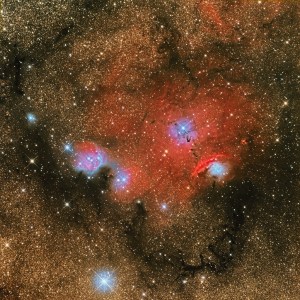
NGC 6559: East of the Lagoon

Image Credit & Copyright: Roberto SartoriExplanation: Slide your telescope just east of the Lagoon Nebula to find this alluring field of view in the rich starfields of the constellation Sagittarius toward the central Milky Way. Of course the Lagoon nebula is also known as M8, the eighth object listed in Charles Messier’s famous catalog of bright nebulae and star clusters. Close on the sky but slightly fainter than M8, this complex of nebulae was left out of Messier’s list though. It contains obscuring dust, striking red emission and blue reflection nebulae of star-forming region NGC 6559 at right. Like M8, NGC 6559 is located about 5,000 light-years away along the edge of a large molecular cloud. At that distance, this telescopic frame nearly 3 full moons wide would span about 130 light-years.

October 7th Moon Goddess’ Current Phase Northeastern and Northwestern Hemispheres Planetary Positions

Moon Goddess’ Current Phase

You can use this link to go forward or backward in time for Moon phase information. If you are curious you can even find out what phase the Moon was in when you or anyone else, you know was on the date the person was born. 

From Moongiant.com 

The Moon’s current phase for today and tonight is a Waxing Crescent Phase. A Waxing Crescent is the first Phase after the New Moon and is a great time to see the features of the moon’s surface. During this phase the Moon can be seen in the wester sky after the sun dips below the horizon at sunset. The moon is close to the sun in the sky and mostly dark except for the right edge of the moon which becomes brighter as the days get closer to the next phase which is a First Quarter with a 50% illumination.

Visit the October 2021 Moon Phases Calendar to see all the daily moon phase for this month.

Today’s Waxing Crescent Phase

The Waxing Crescent on October 7 has an illumination of 1%. This is the percentage of the Moon illuminated by the Sun. The illumination is constantly changing and can vary up to 10% a day. On October 7 the Moon is 1.15 days old. This refers to how many days it has been since the last New Moon. It takes 29.53 days for the Moon to orbit the Earth and go through the lunar cycle of all 8 Moon phases.

The 8 Lunar Phases

There are 8 lunar phases the Moon goes through in its 29.53 days lunar cycle. The 4 major Moon phases are Full Moon, New Moon, First Quarter and Last Quarter. Between these major phases, there are 4 minor ones: the Waxing Crescent, Waxing Gibbous, Waning Gibbous and Waning Crescent. For more info on the Moon Cycle and on each phase check out Wikipedia Lunar Phase page.

Phase Details

Phase: Waxing Crescent
Illumination: 1%
Moon Age: 1.15 days
Moon Angle: 0.54
Moon Distance: 367,849.63 km
Sun Angle: 0.53
Sun Distance: 149,475,937.59 km

Useful Moon Resources

7 October Moon Goddess’ Current Phase, Southwestern and Southeastern Hemisphere Planetary Positions

Moon Goddess’ Current Phase

You can use this link to go forward or backward in time for Moon phase information. If you are curious you can even find out what phase the Moon was in when you or anyone else, you know was on the date the person was born. 

From Moongiant.com 

Today the Moon will be in a Waxing Crescent Phase. A Waxing Crescent is the first Phase after the New Moon and is a great time to see the features of the moon’s surface. During this phase the Moon can be seen in the wester sky after the sun dips below the horizon at sunset. The moon is close to the sun in the sky and mostly dark except for the right edge of the moon which becomes brighter as the days get closer to the next phase which is a First Quarter with a 50% illumination.

Visit the October 2021 Moon Phases Calendar to see all the daily moon phase for this month.

Today’s Waxing Crescent Phase

The Waxing Crescent on October 7 has an illumination of 1%. This is the percentage of the Moon illuminated by the Sun. The illumination is constantly changing and can vary up to 10% a day. On October 7 the Moon is 1.15 days old. This refers to how many days it has been since the last New Moon. It takes 29.53 days for the Moon to orbit the Earth and go through the lunar cycle of all 8 Moon phases.

Phase Details

Phase: Waxing Crescent
Illumination: 1%
Moon Age: 1.15 days
Moon Angle: 0.54
Moon Distance: 367,849.63 km
Sun Angle: 0.53
Sun Distance: 149,475,937.59 km

Useful Moon Resources