
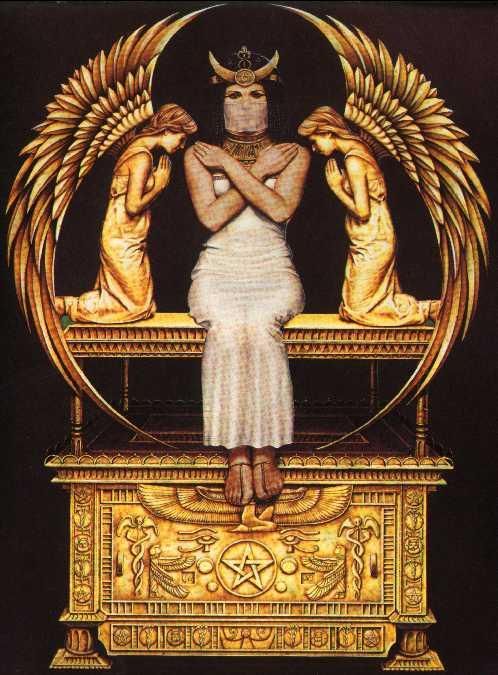
Isis, Mother Goddess
Isis (called “Aset” by the Egyptians), a daughter of Nut and Geb, is known in Ancient Egyptian mythology as a goddess of magic. Wife and sister of Osiris, Isis was originally considered a funerary goddess. After her resurrection via magic of Osiris, who had been killed by his brother Set, Isis was considered “more powerful than a thousand soldiers” and “the clever-tongued one whose speech never fails.” She is sometimes invoked as an assistant in magical rituals in some traditions of contemporary Paganism.
Her worship is also a focus of some Kemetic reconstructionist groups.
The Love of Isis and Osiris
Isis and her brother, Osiris, were recognized as husband and wife. Isis loved Osiris, but their brother Set (or Seth) was jealous of Osiris, and planned to kill him. Set tricked Osiris and murdered him, and Isis was highly distraught. She found Osiris’ body within a great tree, which was used by the Pharaoh in his palace. She brought Osiris back to life, and the two of them concieved Horus.
Depiction of Isis in Art and Literature
Because Isis’ name means, literally, “throne” in the Ancient Egyptian language, she is usually represented with a throne as a depiction of her power. She is often shown holding a lotus as well. After Isis was assimilated with Hathor, she was sometimes depicted with the twin horns of a cow on her head, with a solar disc between them.
Beyond Egypt’s Borders
Isis was at the center of a cult that spread far beyond Egypt’s boundaries.
The Romans were aware of the cult’s existence, but it was frowned upon by many of the ruling class. The emporer Augustus (Octavian) decreed that worship of Isis was forbidden as part of his attempt to return Rome to Roman gods. For some Roman worshipers, Isis was absorbed into the cult of Cybele, which held bloody rites in honor of their mother goddess.
The cult of Isis moved as far afield as ancient Greece, and was known as a mystery tradition among the Hellenes until it was banned by Christianity around the sixth century c.e.
Goddess of Fertility, Rebirth, and Magic
In addition to being the fertile wife of Osiris, Isis is honored for her role as the mother of Horus, one of Egypt’s most powerful gods. She was also the divine mother of every pharaoh of Egypt, and ultimately of Egypt itself. She assimilated with Hathor, another goddess of fertility, and is often depicted nursing her son Horus. There is a wide belief that this image served as inspiration for the classic Christian portrait of the Madonna and Child.
After Ra created all things, Isis tricked him by creating a serpent which ambushed Ra on his daily journey across the heavens. The serpent bit Ra, who was powerless to undo the poison. Isis announced that she could heal Ra from the poison and destroy the serpent, but would only do so if Ra revealed his True Name as payment. By learning his True Name, Isis was able to gain power over Ra.
After Set murdered and dismembered Osiris, Isis used her magic and power to bring her husband back to life. The realms of life and death are often associated with both Isis and her faithful sister Nephthys, who are depicted together on coffins and funerary texts.
They are usually shown in their human form, with the addition of the wings that they used to shelter and protect Osiris.
Isis for a Modern Age
A number of contemporary Pagan traditions have adopted Isis as their patron Goddess and she is often found at the heart of Dianic Wiccan groups and other female-centered covens. Although modern Wiccan worship does not follow the same structure as the ancient Egyptian ceremonies that were once used to honor Isis, today’s Isiac covens incorporate Egyptian lore and mythology into a Wiccan framework, bringing the knowledge and worship of Isis into a contemporary setting.
The Order of the Golden Dawn, founded by William Robert Woodman, William Wynn Westcott, and Samuel Liddell MacGregor Mathers, recognized Isis as a powerful triple goddess. Later, she was passed down to modern Wicca when it was founded by Gerald Gardner.
Kemetic Wicca is a variation of Gardnerian Wicca that follows an Egyptian pantheon. Some Kemetic groups focus on the trinity of Isis, Orsiris and Horus and utilize prayers and spells found the ancient Egyptian Book of the Dead.
In addition to these widely recognized traditions, there are countless eclectic Wiccan groups throughout the world that have selected Isis as their deity. Because of the strength and power displayed by Isis, spiritual paths that honor her are popular among many Pagans who are seeking alternatives to traditional patriarchal religious structures. Worship of Isis has seen a resurgence as part of the “Goddess-oriented” spirituality that has become a notable part of the New Age movement.
A Prayer to Isis
Mighty mother, daughter of the Nile,
we rejoice as you join us with the rays of the sun.
Sacred sister, mother of magic,
we honor you, Lover of Osiris,
she who is mother of the universe itself.
Isis, who was and is and shall ever be
daughter of the earth and sky,
I honor you and sing your praises.
Glorious goddess of magic and light,
I open my heart to your mysteries.
___________________________
Isis
The Goddess of Fertility
Isis was the ancient Egyptian goddess of marriage, fertility, motherhood, magic and medicine. Many myths and legends exist about Isis in Egypt and Egyptian literature uses several names and titles for this goddess. Worship of Isis, her temples and her cult spread through Egypt and parts of Europe.
Names, Titles & Roles
Isis is the “Goddess with Ten Thousand Names”
Although this statement is an exaggeration, she does have many names Some of these are Aset, Aust, Eenohebis, Eset, Esu, Hesat, Iahu, Unt, Urethekau, and Werethekau. Isis was also associated with the other Egyptian goddesses, Sekhmet and Hathor. The Greeks worshiped Isis and they associated her with their goddesses; Persephone, Tethys and Athena.
Isis is also known under many different titles, such as:
The Divine One
The Queen of all Gods
Queen of Heaven
The Maker of Sunrise
Mother of God
Isis’ most important roles were:
Her positions as the wife of Osiris and the mother of Horus.
Isis’ role as a fertility goddess was also important and caused many women to worship her.
Her position as a goddess of magic: people would look to her and her cult for spells to solve problems. It is told that she managed to trick Ra into revealing his secret name to her and in doing so, Isis obtained many magical powers.
In some of her other roles, Isis had names associated with each role:
Khut: giver of light at the beginning of a new year
Usert: goddess of the earth
Thenenet: goddess of the Tuat (the underworld)
Satis: the Nile flood’s power
Ankhet: providing fertility from the waters and embracer of the land
Kekhet: goddess of the fields and the cultivated areas
Renenet: goddess of the harvest
Tcheft: goddess of the food offered to the gods by humans
Ament: lady of the underworld who restored the bodies of the dead so they could live with Osiris in his kingdom.
How Was Isis Honored?
Isis had a cult that spread throughout Egypt and parts of Europe. People worshiped Isis as the ideal, fertile mother. Women worshiped in her cult and, at times, were her primary worshipers. Another way Egyptians honored Isis was through the images and statues placed in her temples. She was part of a triad of deities along with Osiris and Horus.
Isis is often shown nursing Horus or the pharaoh. Some aspects of her as a mother might have influenced early Christian ideas about the Virgin Mary. People believed her priests could cure illness and they celebrated festivals for her and her four siblings. These took place on five successive days at the end of the year.
Temples
Two of the primary temples dedicated to Isis (in Egypt), were at Behbeit el-Hagar and Philae. Behbeit el Hagar’s construction began during the Late Period and it was in use through the Ptolemaic Period. The builders of this temple were the kings of the Thirtieth Dynasty, who worshiped Isis with devotion. Behbeit el Hagar served as a match to Isis’ temple at Philae, in Upper Egypt.
Construction of the temple on the island of Philae began during the Twenty-fifth Dynasty. But it was not a prominent temple until the Greco-Roman period. Scholars moved Isis’ temple at Philae during the 1960s to save it from flooding after the building of the Aswan Dam. This temple is intact because people did not remove its stones to construct other buildings.
Family Tree
Father: Geb, god of the earth
Mother: Nut, god of the sky
Brother/Husband: Osiris, god of the dead and resurrection
Brother: Set, god of evil and darkness
Sister: Nepthys, goddess of darkness, decay and death
Brother/Son: Horus, sky god, god of kingship
Nephew/Son: Anubis, god of embalming. Anubis was the son of Nepthys by either Osiris or Set. His mother abandoned him as a baby but Isis found him and raised him as her son.
Nephew/Son: Mesthi, guarded the liver of the dead in a Canopic jar, guardian of the South
Nephew/Son: Hapi, guarded the lungs of the dead in a Canopic jar, guardian of the North
Nephew/Son: Qeph-Sennuf, guarded the intestines of the dead in a Canopic jar, guardian of the West
Nephew/Son: Tuamutef, guarded the stomach of the dead in a Canopic jar, guardian of the East
Symbols
Several symbols are associated with Isis:
Sept: a star that marked the beginning of a new year and the start of the Niles’s flooding.
Thet: the buckle or knot of Isis. The thet might represent a stylized uterus with its ligatures and a vagina. It was usually made of a red substance and represents blood and life.
Sacred Animals: cow, scorpion and snake.
Sacred Birds: dove, hawk, swallow and vulture.
Depictions
Depictions of Isis show her as a goddess and a human woman. As a goddess, she wears the vulture headdress. This resembled a bird laying on its stomach on top of Isis’ head, with its head over her forehead and wings hanging down on each side of her head. Isis wears a jeweled collar and a floor-length gown. She holds a papyrus scepter and an ankh in her hands and is often portrayed with long wings.
Sometimes Isis wears a crown instead of the headdress. One crown has horns surrounding a sun disc. Another crown has the horns of a ram, under the double crown, to associate Isis with Osiris. The depictions showing Isis as a human woman show her wearing plainer clothes but her headdress has an uraeus symbol.
Birth of Horus and Scorpion Myth
One of the most important legends told about Isis concerns the birth of Horus and the scorpion myth. This story begins with Set sealing Osiris in a coffin and throwing it into the Nile. This devastated Isis, so she searched for him and found the coffin inside a cedar column in another land. She brought Osiris back to Egypt and mourned him. Set found the coffin, removed Osiris’ body and tore it into fourteen pieces.
Isis wept as she searched for the pieces and Nepthys heard her. Nepthys helped Isis find thirteen of the pieces but a Nile creature ate the final piece. Thoth taught Isis a spell that allowed her to reassemble Osiris and she used wax to replace the missing piece. The spell also restored Osiris to life for one night, he and Isis had intercourse and she conceived Horus.
The next morning, Osiris went to the Tuat. Set imprisoned Isis but Thoth helped her escape. Isis traveled surrounded by her seven scorpion goddesses; Tefen, Befen, Mestet, Mestetef, Petet, Thetet and Maatet. They traveled until they came to a village near a papyrus swamp. Isis knocked on the door of a rich woman, seeking aid, but the woman sent her away. Then she came to the home of a peasant woman who took Isis into her home.
The seven scorpion goddesses were angry so Tefen returned to the rich woman’s house, stung her son and set the house on fire. Isis heard the woman’s grief and restored her son’s life. She gave birth to Horus in a papyrus bed and hid him from Set. One day, Set sent a scorpion to sting Horus but Isis was able to save him.
Taking Ra’s Power
Another legend tells how Isis took Ra’s power for Horus. Ra was an old man and spittle trailed from his mouth. Isis took some spittle and mixed it with earth to create a serpent which bit Ra. She promised to heal Ra in exchange for his secret name, which she could use to control him. Ra told her his name then Isis healed him, forced him to abdicated and made Horus king of the gods.
Important Facts
Isis was the wife of Osiris and the mother of Horus.
In her role as an excellent mother, ancient women revered her.
Isis tricked Ra and took his position for Horus.
Her cult spread throughout the Roman and Greek Empires.
Isis tried hard to find Osiris and restore him to life regardless of obstacles.
———————–
Reference
Patti Wigington
Ancient Egypt Online
12 Days To Go
Please Make A Purchase
Magickal Necessities
Or
If Possible A Donation, Either is Greatly Appreciated!
Thank you!


You must be logged in to post a comment.