Glory to The Newborn King

Yule Comments & Graphics

Glory to The Newborn King

(Tune: Hark the Herald Angels Sing)

Brothers, sisters, come and sing
Glory to the new-born king!
Gardens peaceful, forests wild
Celebrate the Winter Child!
Now the time of glowing starts!
Joyful hands and joyful hearts!
Cheer the Yule log as it burns!
For once again, the Sun returns!
Brothers, sisters, come and sing!
Glory to the new-born King!

Brothers, sisters, singing come
Glory to the new-born Sun
Through the wind and dark of night
Celebrate the coming light.
Suns glad rays through fear’s cold burns
Life through death the Wheels now turns
Gather round Yule log and tree
Celebrate Life’s mystery
Brothers, sisters, singing come
Glory to the new-born Sun.

Rejoice Dear Brothers & Sisters, The Sun Has Returned To Us!

Sunrise Over Western Kentucky

Sunrise over Western Kentucky

Good Afternoon dear brothers and sisters! This is my Yule gift’s to Lady A, doing the postings after our Yule Celebration. We had a wonderful celebration and I hope you do too. The guys were ready to celebrate as soon as Lady A close up shop here. She told them they could get some chairs and benches out and we would be back in a little bit. The joke was on the guys, Lady A told us she wasn’t planning on coming back to at least 6:30. She told us we could come when ever we got ready. I showed up at 7:00 to see if there was any help needed. There always is. The food was out on the tables (buffet style). I was in charge of the drinks. Everything when smoothly. We all ate supper, then everyone helped clean up. We went to the gathering room and all had a seat. It was time to light the fire in the fireplace and tell stories to the children. We read a few stories then the kids got anxious. It was time to exchange gifts. We have a rule that we never purchase gifts. Everything is handmade which makes it nice.

After the gifts were opened, we started caroling. We sang tons of Pagan carols. While we sang, Lady A and the others that would be in the ritual quietly disappeared. Lady A doesn’t like take the part of High Priestess especially since she is a Solitary. She has more knowledge than any of us, so she got voted in years ago. Lady A’s husband is a Druid, he takes the position of High Priest. Slowly and quietly the music starts to fade.  The group parts way and in the huge doorway, stays Lady A looking so beautiful and radiant. Then her husband, so handsome and gleaming with joy of the ritual to come. The procession starts through the cabin, out the door and down to the cleared wooded area. Next comes the ritual, which I won’t give you a play by play of it. We did all manage to stay up and see the Sun rise this morning. It was a grand sight to see.

I hope everyone of you were able to have a very merry Yule celebration. Below I have posted a photo of our bonfire.

2012 Bonfire

A Poem for Yule

Yule Comments & Graphics
A Poem for Yule

by Elspeth Sapphire

I hear the wind howling
The ice has entered my soul
The cold seems endless
The darkness black as coal.

Yet a spark of something
Shines bright through the night
Could it be the dawning
Of approaching light?

For it’s always coldest
In the hours before dawn
Darkness is its deepest,
Facing fears we’ve drawn

How can loneliness dwell
With loved ones nearby?
Why the tiny doubts
Filling me with their cries?

So I turn my face away
Forget the winter’s chill
Celebrate Sun’s return
As my spirit thrills.

~Magickal Graphics~

Midwinter Night’s Eve: Yule by Mike Nichols

To be it wouldn’t be a Sabbat without an article from Mike Nichols. He is absolutely, fabulous Pagan writer. I hope you enjoy this article as much as I do.


Midwinter Night’s Eve: Yule
by Mike Nichols

Our Christian friends are often quite surprised at how enthusiastically we Pagans  celebrate the ‘Christmas’ season.  Even though we prefer to use the word ‘Yule’, and our  celebrations may peak a few days before the 25th, we nonetheless follow many of the  traditional customs of the season: decorated trees, carolling, presents, Yule logs, and  mistletoe.  We might even go so far as putting up a ‘Nativity set’, though for us the three  central characters are likely to be interpreted as Mother Nature, Father Time, and the Baby  Sun-God.  None of this will come as a surprise to anyone who knows the true history of the  holiday, of course.

In fact, if truth be known, the holiday of Christmas has always been more Pagan than  Christian, with it’s associations of Nordic divination, Celtic fertility rites, and Roman  Mithraism.  That is why both Martin Luther and John Calvin abhorred it, why the Puritans  refused to acknowledge it, much less celebrate it (to them, no day of the year could be  more holy than the Sabbath), and why it was even made illegal in Boston!  The holiday  was  already too closely associated with the birth of older Pagan gods and heroes.  And many of  them (like Oedipus, Theseus, Hercules, Perseus, Jason, Dionysus, Apollo, Mithra, Horus and  even Arthur) possessed a narrative of birth, death, and resurrection that was uncomfortably  close to that of Jesus. And to make matters worse, many of them pre-dated the Christian  Savior.

Ultimately, of course, the holiday is rooted deeply in the cycle of the year.  It is the  Winter Solstice that is being celebrated, seed-time of the year, the longest night and  shortest day.  It is the birthday of the new Sun King, the Son of God — by whatever name  you choose to call him.  On this darkest of nights, the Goddess becomes the Great Mother  and once again gives birth.  And it makes perfect poetic sense that on the longest night of  the winter, ‘the dark night of our souls’, there springs the new spark of hope, the Sacred  Fire, the Light of the World, the Coel Coeth.

That is why Pagans have as much right to claim this holiday as Christians.  Perhaps even  more so, as the Christians were rather late in laying claim to it, and tried more than once  to reject it.  There had been a tradition in the West that Mary bore the child Jesus on the  twenty-fifth day, but no one could seem to decide on the month. Finally, in 320 C.E., the  Catholic Fathers in Rome decided to make it December, in an effort to co-opt the Mithraic  celebration of the Romans and the Yule celebrations of the Celts and Saxons.

There was never much pretense that the date they finally chose was historically  accurate.  Shepherds just don’t ‘tend their flocks by night’ in the high pastures in the  dead of winter!  But if one wishes to use the New Testament as historical evidence, this  reference may point to sometime in the spring as the time of Jesus’s birth.  This is  because the lambing season occurs in the spring and that is the only time when shepherds  are likely to ‘watch their flocks by night’ — to make sure the lambing goes well.  Knowing  this, the Eastern half of the Church continued to reject December 25, preferring a ‘movable  date’ fixed by their astrologers according to the moon.

Thus, despite its shaky start (for over three centuries, no one knew when Jesus was  supposed to have been born!), December 25 finally began to catch on.  By 529, it was a  civic holiday, and all work or public business (except that of cooks, bakers, or any that  contributed to the delight of the holiday) was prohibited by the Emperor Justinian.  In  563, the Council of Braga forbade fasting on Christmas Day, and four years later the  Council of Tours proclaimed the twelve days from December 25 to Epiphany as a sacred,  festive season.  This last point is perhaps the hardest to impress upon the modern reader,  who is lucky to get a single day off work.  Christmas, in the Middle Ages, was not a  single day, but rather a period of twelve days, from December 25 to January 6.  The Twelve  Days of  Christmas, in fact.  It is certainly lamentable that the modern world has abandoned this  approach, along with the popular Twelfth Night celebrations.

Of course, the Christian version of the holiday spread to many countries no faster than  Christianity itself, which means that ‘Christmas’ wasn’t celebrated in Ireland until the  late fifth century; in England, Switzerland, and Austria until the seventh; in Germany  until the eighth; and in the Slavic lands until the ninth and tenth. Not that these  countries lacked their own mid-winter celebrations of Yuletide.  Long before the world had  heard of Jesus, Pagans had been observing the season by bringing in the Yule log, wishing  on it, and lighting it from the remains of last year’s log.  Riddles were posed and  answered, magic and rituals were practiced, wild boars were sacrificed and consumed along  with large quantities of liquor, corn dollies were carried from house to house while  carolling, fertility rites were practiced (girls standing under a sprig of mistletoe were  subject to a bit more than a kiss), and divinations were cast for the coming Spring.  Many  of these Pagan customs, in an appropriately watered-down form, have entered the mainstream  of Christian celebration, though most celebrants do not realize (or do not mention it, if  they do) their origins.

For modern Witches, Yule (from the Anglo-Saxon ‘Yula’, meaning ‘wheel’ of the year) is  usually celebrated on the actual Winter Solstice, which may vary by a few days, though it  usually occurs on or around December 21st.  It is a Lesser Sabbat or Lower Holiday in the  modern Pagan calendar, one of the four quarter-days of the year, but a very important one.   This year (1988) it occurs on December 21st at 9:28 am CST.  Pagan customs are still  enthusiastically followed. Once, the Yule log had been the center of the celebration.  It  was lighted on the eve of the solstice (it should light on the first try) and must be kept  burning for twelve hours, for good luck.  It should be made of ash.  Later, the Yule log  was replaced by the Yule tree but, instead of burning it, burning candles were placed on  it.  In Christianity, Protestants might claim that Martin Luther invented the custom, and  Catholics might grant St. Boniface the honor, but the custom can demonstrably be traced  back through the Roman Saturnalia all the way to ancient Egypt.  Needless to say, such a  tree should be cut down rather than purchased, and should be disposed of by burning, the  proper way to dispatch any sacred object.

Along with the evergreen, the holly and the ivy and the mistletoe were important plants  of the season, all symbolizing fertility and everlasting life.  Mistletoe was especially  venerated by the Celtic Druids, who cut it with a golden sickle on the sixth night of the  moon, and believed it to be an aphrodisiac.  (Magically — not medicinally!  It’s highly  toxic!)  But aphrodisiacs must have been the smallest part of the Yuletide menu in ancient  times, as contemporary reports indicate that the tables fairly creaked under the strain of  every type of good food.  And drink!  The most popular of which was the ‘wassail cup’  deriving its name from the Anglo-Saxon term ‘waes hael’ (be whole or hale).

Medieval Christmas folklore seems endless: that animals will all kneel down as the Holy  Night arrives, that bees hum the ‘100th psalm’ on Christmas Eve, that a windy Christmas  will bring good luck, that a person born on Christmas Day can see the Little People, that a  cricket on the hearth brings good luck, that if one opens all the doors of the house at  midnight all the evil spirits will depart, that you will have one lucky month for each  Christmas pudding you sample, that the tree must be taken down by Twelfth Night or bad luck  is sure to follow, that ‘if Christmas on a Sunday be, a windy winter we shall see’, that  ‘hours of sun on Christmas Day, so many frosts in the month of May’, that one can use the  Twelve Days of Christmas to predict the weather for each of the twelve months of the coming  year, and so on.

Remembering that most Christmas customs are ultimately based upon older Pagan customs,  it only remains for modern Pagans to reclaim their lost traditions.  In doing so, we can  share many common customs with our Christian friends, albeit with a slightly different  interpretation.  And thus we all share in the beauty of this most magical of seasons, when  the Mother Goddess once again gives birth to the baby Sun-God and sets the wheel in motion  again.  To conclude with a long-overdue paraphrase, ‘Goddess bless us, every one!’

A Must Read To The Children For Winter Solstice

BRAN THE BLESSED, A FAERY KING MYTH

The Yuletide season provides us with an ideal opportunity to reflect on the ancient Welsh myth of Bran the Blessed, a vivid and compassionate tale that embodies the Wiccan values of giving, light, and rebirth. Bran’s story is one of personal sacrifice, conciliation, and a king’s love for his people and land. If he does not meet his obligations to the Goddess, Earth Mother, and the land itself turns against him. Bran’s myth is about how to become a good king.

Bran’s sister, Branwen, is Goddess of the Land, and as such, she is Bran’s reason for being. As Faery King and Guardian of the Cauldron of Rebirth, Bran is committed to his role as champion of Her cause. The Cauldron of Rebirth, originally from Ireland, has the power to bring dead warriors back to life and is a special symbol of the law and power of the land.

In the story, Branwen marries Matholwch, the King of Ireland, in order to form a bond between Britain and Ireland. Branwen’s brother however, is upset by the marriage and kills all of Matholwch’s horses. Bran replaces the horses, but Matholwch is not satisfied. In order to heal the breach, Bran must also give Matholwch the Cauldron of Rebirth. Despite so generous a gift, Matholwch is still not appeased. He mistreats Bran’s sister so badly, Bran must march into Ireland to save her. To prevent his arrival, Matholwch burns the bridge leading across the Shannon River. But Bran shapeshifts into a giant and acts as his own bridge, carrying his men on his enormous shoulders through the sea. Thus we find in Bran’s story the important line, which serves as a lesson to future leaders, “He who would be chief, let him make himself a bridge.”

Without the Cauldron of Rebirth, Bran’s forces are defeated and Bran is wounded. He orders his own beheading and while his men transport his head to be buried in the White Tower of London, Bran teaches everything he has learned from the Goddess’ Cauldron of Rebirth, passing on his wisdom to all future generations. This image of Bran’s head is one of many examples found in Celtic mythology and witchcraft of the skull as a symbol of power and wisdom. The skull is not something to be feared. Modern witches wear skull jewelry, symbolizing the house of the brain.

Yule is a good time of year to think about what we learn of Bran’s myth. This is a magickal moment of the ever-turning wheel: like Bran’s story, it is full of heart and passion, lightness and gravity, hope and realism. This is a time when we reflect on the unconquerable human spirit that the story of Branwen and Bran represents. (Laurie Cabot, Celebrate the Earth)

Cabot goes on to say she believes Yule, more than any other moment on the Wheel of the Year, is indicative of the unity of the Wiccan tradition. At Yule, we desire to cherish the best of all we have, and to seek out and acknowledge what is of great value in others.Yule is an awakening and a thankfulness for our knowledge of and our connection to the Wheel of the Year.


Earth Witchery

The Yule Tree (Lore, Decorating/Consecrating & Correspondences)

Yule Comments & Graphics
THE YULE TREEThe Celtic Druids venerated evergreen trees as manifestations of deity and as symbols of the universe. To the Celts, these trees were sacred because they did not die from year to year like deciduous trees. Therefore they represented the eternal aspect of the Goddess who also never dies. Their greenery was symbolic of the hope for the sun’s return.

The Druids decorated the evergreen trees at Yule with all the images of the things they wished the waxing year to bring. Fruits for a successful harvest, love charms for happiness, nuts for fertility, and coins for wealth adorned the trees. These were forerunners to many of the images on today’s Christmas trees. Candles were the forerunners of today’s electric tree lights.

In Scandinavia, Yule trees were brought inside to provide a warm and festive place for tree elementals who inhabited the woodland. This was also a good way to coax the native faery folk to participate in Solstice rituals. Some believed the Saxons were the first to place candles in the tree.

Gradually sacred tree imagery was absorbed and minimalized by the Christian church–but it was never able to destroy trees’ resonance within our collective unconscious completely. We realize when we plant a tree we are encouraging the Earth to breathe. And when we decorate our evergreen trees at Yule, we are making a symbol of our dream world with the objects we hang upon it. Perhaps a chain or garland, reflecting the linking of all together on Earth. Lights–for the light of human consciousness, animal figures who serve as our totems, fruits and colors that nourish and give beauty to our world, gold and silver for prosperity, treats and nuts that blend sweet and bitter–just as in real life. The trees we decorate now with symbols of our perfect worlds actually animate what we esteem and what we hope for in the coming year; as from this night, the light returns, reborn.

Decorating the Tree

It’s best to use a live tree, but if you can’t, you can perform an outdoor ritual thanking a tree, making sure to leave it a gift when you’re finished (either some herbs or food for the animals and birds). Start a seedling for a new tree to be planted at Beltane.

If apartment rules or other conditions prevent you from using a live tree indoors, be sure to bring live evergreen garlands or wreaths into the house as decorations.

* String popcorn and cranberries and hang them on the Yule tree or an outdoor tree for birds.

* Decorate pine cones with glue and glitter as symbols of the faeries and place them in the Yule tree.

* Glue the caps onto acorns and attach with a red string to hang on the Yule tree.

* Hang little bells on the Yule tree to call the spirits and faeries.

* Hang robin and wren ornaments on the tree. The robin is the animal equivalent of the Oak King, the wren of the Holly King. Each Yule and Midsummer they play out the same battle as the two kings.

* Hang 6-spoked snowflakes on the branches of the tree. The Witches Rune, or Hagalaz, has 6 spokes.

* Hang sun, moon, star, Holly King, faery, or fruit decorations.

* String electric lights on your tree to encourage the return of the Sun.

Consecrating the Tree

Consecrate the Yule tree by sprinkling it with salted water, passing the smoke of incense (bayberry, pine, spruce, pine, spice, cedar, or cinnamon)through the branches, and walking around the tree with a lighted candle saying:

By fire and water, air and earth,   I consecrate this tree of rebirth.

Correspondences

EVERGREENS

Symbolizing: Continuity of Life, Protection, Prosperity
Types: Pine, Fir, Cedar, Juniper, other evergreens
Forms: boughs, wreaths, garlands, trees
Divinities: Green Goddesses & Gods; Hertha; Cybele, Attis, Dionysius (Pine); Woodland Spirits
Traditions: Roman, Celtic, Teutonic, Christian

OAK

Symbolizing: New Solar Year; Waxing Sun; Endurance, Strength, Triumph, Protection, Good Luck
Forms: Yule log, acorns, wood for sacred fires
Divinities: Oak King; Oak Spirit; Sky Gods including Thor, Jupiter, Zeus
Traditions: Teutonic, Celtic, Christian

SACRED TREES OF WINTER SOLSTICE from the Celtic Tree Calendar

Yew: Last Day of Solar Year; Death.
Silver Fir: Winter Solstice Day; Birth.
Birch: Month following Winter Solstice; Beginnings.

written by Selena Fox

Glory to The Newborn King


Yule Comments & Graphics

Glory to The Newborn King

(Tune: Hark the Herald Angels Sing)

Brothers, sisters, come and sing
Glory to the new-born king!
Gardens peaceful, forests wild
Celebrate the Winter Child!
Now the time of glowing starts!
Joyful hands and joyful hearts!
Cheer the Yule log as it burns!
For once again, the Sun returns!
Brothers, sisters, come and sing!
Glory to the new-born King!

Brothers, sisters, singing come
Glory to the new-born Sun
Through the wind and dark of night
Celebrate the coming light.
Suns glad rays through fear’s cold burns
Life through death the Wheels now turns
Gather round Yule log and tree
Celebrate Life’s mystery
Brothers, sisters, singing come
Glory to the new-born Sun.

Yule – Winter Solstice

Yule Comments & Graphics

Yule – Winter Solstice

After Samhain and Beltane, Yule is the most important feast. Elaborate rites are performed to insure the rebirth of the Sun. It is the greatest crisis of the year, and before the commercial value of sentimentality was discovered, popular customs reflected a wide contrast of the dark and eerie against joyful music and glittering lights.

Samhain to Yule is a season of preparation. A fast is not exactly enjoined, but it is as good a time as any to lose a little weight, because you’ll surely gain it back during Yule. It is a time for serious introspection and spiritual discipline. Perform your devotions and meditations regularly. Just before Yule, thoroughly clean your home.

The celebration begins on Yule Eve with religious rites. Yule Day is for family observances of a cheerful, social nature, with a feast, perhaps in the evening, unless there is a ball or theater event. The next day is a peculiar time. It is the day left over in the old Pagan calendar of thirteen 28-day months. It belongs to no month and no year; truly a “time that is not time”. (On a leap year there are two of these intercalary days.) what is done on the third day, then, hasn’t really happened, or doesn’t count. It gives us a perfect opportunity to step outside our usual roles and experiment, even if we look foolish. No one is allowed to hold it against us. No commitments can be made of this day; they will not be binding.

The next day is the New Year from a solar point of view.

The season of Yule runs till the Eve of Oimelc, so for Pagans there is no post- Xmas letdown. You can have Yule parties every weekend till February. When your evergreen decorations dry up, you can renew them. But by Oimelc, every trace of the Yule greens must be out of the house. It is pleasant to burn them in your fireplace.

Good Blessed Solstice Morning To You, My Brothers & Sisters Of The Craft

Good Blessed Solstice Morning To You, My Brothers & Sisters Of The Craft,

What a glorious event awaits us on the longest night of the year. We will gather with loved ones, family and friends alike. We will sing carols, play games, talk and fellowship. Have a huge traditional Yule supper. I can almost smell it now. After we are through eating, we will exchange presents with each other. Then I am sure for the children stories will read. Preparation for the burning of the Yule log begins. You can either burn it in your fireplace or go outside and build a bonfire.

Each of our traditions vary on how we do things. But the men here go and prepare a huge stack of wood to be burned. Then on top, the yule log is placed. We are central time remember. Around 3:30, we light the fire. We start by singing carols and praying to the Goddess. Then it is time for our ritual. I have included it here so perhaps in some way we can all be together this year.

It has always been a dream of mine, that one day we could all meet and have a ritual together. This year would have been exceptionally nice. With all the horrors and tragedies that have occurred it is comforting to have a kindred spirit with you. You can hold each other and give comfort, cry, let all you feelings that have been bottled up out. Let your sadness go, turn it over to the Goddess. Now is the time to start anew. We have a fresh start with the rebirth of our Sun. The promise of life, love and hope.

With this fresh new season upon us, let us pray. Pray that mankind becomes kind and gentler. Pray that we learn how to show compassion and love to all. Pray for an end to all the senseless killings of our children, our future. Pray that the Goddess continues to watch over us, keep us in her love and light.

Now join us in ritual, my dear brothers and sisters!

Our Yule Ritual We Would Like To Share With You

Our Altar has:

Presence candle
Goddess and God candles
salt
water
small cauldron with sand for incense stick
bell
chalice, four decanters and juice
plates with bread

Corner candles are set out and lit.

HP:    Let it be known that the circle is about to be cast, let none
be here but of their own free will.

Priestess:      “I cleanse and purify this space with sound.”

Rings bell three times, circling deosil.

HPS  lights Presence candle.

I light this Candle (light
Presence Lamp)
in the name of that ancient presence,
which is, was, and ever shall be
male, female, all-knowing, all-powerful
and present everywhere.

And in the names of the four Mighty Ones,
the rulers of the elements,
may power and blessing descend
in this hour upon this place
and those gathered here.”

HPS:  Salt and water blessings, fire and air blessings

Priestess:      “With water and earth I cleanse and purify this space.”

Sprinkles consecrated salt and water.

Priestess:      “With fire and air, I cleanse and consecrate this
space.”

Circles deosil with incense.

HPS:

Take up athame, face north and say:

I conjure thee, O Circle of Power, as a boundary between the worlds. A
meeting of love and joy and truth; a shield against all wickedness and
evil; a Rampart and Protection that shall preserve and contain the
power which we shall raise within thee.  I do bless and consecrate
thee.

Cast circle to the east.  See it glow.  Salute the East, then draw an
invoking pentagram and say:

Spirit of the East!  Spirits of Air!
Oh Lords of the great icy towers of the North,
I, Lady of the Abyss, do summon, stir and call you up
To guard our circle and Witness our rites!
We ask you to come to us now on the cold winter wind
and breathe into us the spirit of the pure joy of life.
So mote it be!

Cast circle to the south.  See it glow.  Salute the south, then draw
an invoking pentagram and say:

Spirit of the South!  Spirits of Fire!
O lords of the firey towers of the South,
I, Lady Of The Abyss, do summon, stir and call you up
To guard our circle and Witness our rites!
We ask you to come forth from the fires that
warm the planets heart, from the fires that
protect us on this winters night. Kindle
within us the warmth of spiritual awakening.
So mote it be!

Cast circle to the west.  See it glow.  Salute the west, then draw an
invoking pentagram and say:

Spirit of the West!  Spirits of Water!
I, Lady Of The Abyss, do summon, stir and call you up
To guard our circle and Witness our rites!
We ask you to come forth from the streams,
the lakes, from the vast expanse of your watery realm.
Bring to us the water of life to wash away our fears and resentments
that we may find peace of mind.
So mote it be!

Cast circle to the north.  See it glow.  Salute the north, then draw
an invoking pentagram and say:

Spirit of the North!  Spirits of Earth!
I, Lady Of The Abyss, do summon, stir and call you up
To guard our circle and Witness our rites!
We ask you to come forth from the fertile bosom of our Blessed
Mother Earth, and nourish us so that our wisdom may grow in strength.
So mote it be!

Close the circle, then turn to the altar and say:

HPS:
The circle is cast.  We are between the worlds.

Tonight we celebrate the Solstice, the night that the darkness is
triumphant over light,  and yet on the morrow, the dark begins to give
way and the light will return.

The spirit of nature is suspended, all living things wait the
transformation of the Dark Lord of Shadow into the newborn Child of
Light.   We watch for the coming of Dawn, when the Holy Mother will
again give birth to the Divine Child, the Sun God who is the bringer
of the life of Spring and the promise of Summer.  We call the Sun from
the womb of night, and so, turn the Wheel.

Blessed be!

All:    Blessed Be!

HPS:    Antlered God, Winter God, Father of the Sun, with frost upon your
beard and the blazing of Yule fires in your eyes, you bless us with
your presence. We invoke and greet you!

All:    So mote it be.

HP:     Blessed Lady, Maiden, Mother and Crone, Mother heavy with unborn
child, we greet you and ask your blessings upon your people gathered
here.  We invoke and adore thee!

HPS:
The light was born, and the light has died.

All:     Everything passes, all fades away.

The God enters in the west,  HPS goes to him and  raises him up.  He
begins  to  dance and chant , deosil around the circle:

At Yule I’m born and at Yule I’ll die,
round and round the wheel,
forever flying thru the sky,
ever mindful of what must be.

All:    So turns the wheel.

At spring I nourish the seed and hide therein growing with the light!
Round and round the wheel,
forever flying thru the sky,
ever mindful of what must be.

All:    So turns the wheel.

In summer the young stag am I in love and lust I seek the Goddess, our
union and bliss sustains the world.
Round and round the wheel,
forever flying thru the sky,
ever mindful what must be.

All:    So turns the wheel.

In fall as I weaken with the sun, the grain is cut
for Harvest, that all may carry on.
Round and round the wheel,
forever flying thru the sky,
ever mindful of what must be.

All:    So turns the wheel!

In winter old and tired am I, dying with the light.
Round and round the wheel,
forever flying thru thr sky,
ever mindful of what must be.

All:    So turns the wheel!

God falls into crouch, dies, is covered by black cloth, behind the
birthing  mother.

All light is extinguished and the Mother wails for the loss of the
God.

All:     Start chanting “It is Winter, It is night chant”

It is winter, it is night,
We await the sun,
We await the light.
In the darkness
In this night,
We await the warmth,
We await the light.

The Mother, kneeling in the east moans in labor., Make ’em fit the
breaks in the sentences of HPS/narrator.

HPS:  I am the great Mother.  I exist beyond time and space.  I bring
forth all of creation.

Moan.

HPS:  My voice rides upon the wind.  Stars pour from my soul.  I am
the silence of the sea, and the secret of the standing stones.

Moan.

I am the Mother of all things, and the soul of nature, who gives life
to the universe.

Moan.

I am the Giver of light.  Tonight I give light back to the world as I
mourn the death of the God and rejoice in his birth.

Moans come to crescendo.

HP exits from beneath Mother’s legs, then lights fireplace match.

All chant:

Mother who has birthed this light
In the darkness of this night
Infant child of glowing light
We celebrate you both tonight!

Light cauldron, all other candles.
Repeat, with drumming, dancing and singing, then send off the power.
When everyone has calmed down a bit, have them gather again into a
circle.

HPS:    Blessings of the Goddess and God upon this bread and the fruit of
the vine!

Pours out juice into decanters, holds hands over them.

May you never thirst!

Holds hands over bread plates.

May you never hunger!

Juice and Bread are passed among gathered folk.
When everyone has partaken, ground the energy (two hands on the
floor).

Then dismiss the elementals, and open the circle.

The Yule Log

The Yule Log
by Lila

The tradition of the Yule logs dates back millennia. The origin of the word Yule seems to originate from the Anglo Saxon word for sun and light. People used to burn a yule log on the Winter Solstice in December. The Winter Solstice is the day of the year with the shortest amount of daylight. Yule is celebrated by fire, which provides a dual role of warmth and keeping evil spirits away. Many people thought that evil spirits were more likely to wander the earth on the longest night of the year. All night bonfires and hearth fires kept evil at bay and provided gathering places for folks to share feasts and stories.

Winter Solstice marks the sun’s victory over darkness; the days would now grow longer. The cinders from the burnt log were thought to protect homes from lightning and the evil powers of the devil. The ashes were also sprinkled on the surrounding fields to ensure good luck for the coming year’s harvest. The largest remaining part of the log was kept safe to kindle next year’s fire.

The Yule log has waned in popularity with the advent of electric heaters and wood stoves. With no access to a hearth, fireplace or fire pit, modern folks are losing a sacred tradition. Today, we may still partake of the Yule Log tradition by creating a smaller version as a table ornament, embellished with greenery and candles, or the popular Yule log cake. As we eat a slice, we can imagine taking in the protective properties of the log.

Many enjoy the practice of lighting the Yule Log. If you choose to burn one, select a log and carve or chalk upon it a figure of the Sun (a rayed disc) or the Horned God (a horned circle). Set it alight in the fireplace at dusk, on Yule. This is a graphic representation of the rebirth of the God within the sacred fire of the Mother Goddess. As the log burns, visualize the Sun shining within it and think of the coming warmer days. Traditionally, a portion of the Yule Log is saved to be used in lighting next year’s log. This piece is kept throughout the year to protect the home.

Whether you are burning a log or creating a centrepiece, different woods may be used to produce different effects:
Aspen: invokes understanding of the grand design
Birch: signifies new beginnings
Holly: inspires visions and reveals past lives
Oak: brings healing, strength, and wisdom, symbol of the Oak king, the New year
Pine: signifies prosperity and growth
Willow: invokes the Goddess to achieve desires
Decorate your log with the any of the following items:
bright green needles of fir represents the birth of the new year
dark green needles of yew represent death of the waning year
vines of ivy or birch branches represent the Goddess
sprigs of holly with red berries represent the Holly king of the dying year
As you light the Yule log chant the following:

As the yule log is kindled
so is the new year begun
as it has been down through the ages
an unending cycle of birth, death, and rebirth
every ending is a new beginning
May the Yule log burn
May all good enter here
May there be wheat for bread
and vats full of wine
(or may we never hunger may we never thirst)

When the log has almost completely burned, collect a small piece of the Yule log (dip in a bucket of water to ensure it is completely out) wrap carefully and keep somewhere in the home for safety and protection.

collect some of the cold ashes and store in a glass bottle. The ash can be used for spells of protection and amulets. The remainder of the Yule ash can be scattered over fields or gardens to ensure fertility in the spring.

Pauline Campanelli; Wheel of the Year

Lila is an initiate in The Sacred Three Goddess school. She lives on a mountain in beautiful British Columbia with her husband, four cats, two ferrets and other varied critters of nature. She spends her time communing with the Faerie folk and long walks by the river.

Invoking the Holly King

Greenman Comments & Graphics=

Today we do bid Hail to our beloved Holly King
With these ancient carols, we do again sing
He who is called Father Christmas is returning yet again
As the Solstice’s longest night has finally begun
We await you, Santa Claus, Lord of Winter
To honor you on this day that you always were
Saint Nicholas, patron of children on Gaia’s sphere
This invocation, we pray you do hear
Come bless us, upon this season of the Yuletide
Great Holly King as you fly upon your sleigh ride
Whether your gifts to us be physical or spiritual
We know that they will always be most magical
Grateful, because we know your blessings’ great worth
We offer a blessing of our own — Peace on Earth!

by Ginger Strivelli

Gypsy Magic

‘Twas the night before Yule


‘Twas the night before Yule, and all through the Coven,
The cookies were baked and removed from the oven.
The bayberry candles were lit on the table,
The altar was wrapped in a new cloth of sable.

The children were nestled, all snug in their beds,
While visions of Yuletime danced in their heads.
Their stockings were hung by the chimney with care,
In hopes that some presents soon would be there!

With Rocker in his new robe, and I in mine,
We were asking our Goddess her blessing divine.
When out on the lawn there arose such a clatter,
We sprang from our Circle to see what was the matter.

Away to the window, tripping over my sash,
My eyes were a-glamoured with a bright silver flash.
The moon on the breasts of the Goddess and God
Drew my eyes to behold the blessed Circle they trod.

When, what to my wondering eyes should appear,
But the manifestations of all those we hold Dear.
The physical forms of those whom we pray to,
Even Saint Nick, and his miniature sleigh, too!

Jehovah, Mohammed, Shiva, Hera and Thor.
Zeus, Freya, Brahma, and many, many more.
All the Spiritual Entities who’d ever been mentioned.
Even some, like dear Loki, who sowed seeds of dissension.

They greeted each other with smile, warm and sweet.
Then, forming a Circle, they all took a seat.
With multiple Voices all joined as One,
The Corners were Called. And, when that was done.

The Chalice was passed from Hand to Hand.
Then, a blanket of silence enfolded the land.
A crystal clear Voice began to hold sway.
Which Deity spoke? I could not say.

But, clearly, I heard all the love in that Voice.
It caused my tired heart to take flight and rejoice.
“Our Children, it seems, have missed the whole point.
“We now join together, their hearts to anoint.

“Pour all of Our love O’er their hearts of stone.
“Let them see that together they’re never alone!
“Show them it matters not which of Us that they choose.
“Their sad hate and mistrust cause each of Us to lose!”

As I stood there transfixed, I could suddenly see
If we all stand as one, what a world this could be!
Put ALL of our differences well behind us.
Let the love of the Gods enfold and remind us.

We ARE all the same, though varied our skins.
We all dream the same dreams, we all sin the same sins.
With a look of enlightenment etched on my face,
I beheld all the Gods in Their glory and grace!

They all bowed Their heads then said “So mote it be!”
They all smiled at each Other bestowing winks on me.
One by One they disappeared from my sight.
Just the Goddess and God were left in the light.

As slowly They twinkled, fading by degree,
“Happy Yuletide to all!!
Blessed be times three!”

~Written by Mary, a.k.a. Wandering Poet, a.k.a.littlebit~

Permission to reprint granted to all who keep keep this credit line by the author

Quick Yule Project – Love & Protection Sachet


Witchy Comments & Graphics

Love & Protection Sachet

Fill a green or gold sachet with cinnamon to draw money and success or to use as a healing charm. Use a purple sachet with Cinnamon can help increase your magickal or psychic powers. Use a pink or red sachet w/cinnamon to draw love or white to insure protection.

Glorious Thursday Morning To All My Dear Friends & Family!

Yule Comments & Graphics Glorious Thursday Morning, my loves! I hope you are having a fairly good day today. Grab yourself a cup of hot cocoa, curl up on the couch, make yourself at home. Want to sing a few Yule carols with me? Don’t know any I can certain

White Solstice
(Tune: White Christmas)
by Lady Bridget

I used to dream of a white Solstice
Just like the ones I knew up North.
But in sunny south Florida
It ain’t gonna happen
Unless dreaming brings it forth.

Now I dream about a green Solstice
Ripe fruit is on my citrus trees.
May your Holidays be healthy and wealthy,
And may all your Solstices be green.

 
SHARE THE LIGHT
(The First Noel)

CHORUS:
Share the light, share the light!
Share the light, share the Light!
All paths are one on this holy night!

On this Winter holiday, let us stop and recall
That this season is holy to one and to all.
Unto some a Son is born, unto us comes a Sun,
And we know, if they don’t, that all paths are one.

Be it Chanukah or Yule,
Christmas time or Solstice night,
All celebrate the eternal light.
Lighted tree or burning log,
Or eight candle flames.
All gods are one god, whatever their names

.

OH HOLY NIGHT
filled by Lady Bridget

Oh Holy Night, the stars are brightly shining
It is the night of the Sun King’s rebirth.
Long lay the world in winter’s darkness pining
‘Till he appeared to bring warmth to the earth.

A thrill of hope, the weary world rejoices
For yonder breaks a new and glorious morn!<
Call out your needs, Oh hear the Goddess singing
Oh night divine, oh night the sun’s reborn.
Oh night divine, Oh night, Oh Holy Night


A Little Holiday Cheer for You This Wonderful Wednesday!


See now you have something to do at work. You can just full screen the videos, turn up the speaker and party down. Hmm, partying to Yule music, Oh, what the hay, we do it every year, lol!

Have a great day, my friends!

Oh, one more little thing, please remember we are accepting donations to help pay our server bill (which just happens to be due this month like everything else)!

Grab Bag for the Holiday Season Or, Survival Tips for the Homeward Bound

Grab Bag for the Holiday Season

Or, Survival Tips for the Homeward Bound

by Erika Ginnis


I thought that for this article I would  touch on a couple of ideas and techniques that I have found useful during  the holiday season. This is the time of  year when the light seems like a  memory (even as it begins to change  and return), and the dark is ever around  us. It is a powerful time for inner  searching and deep magick. It is a time  of cycles both within us and outside  of us. In some ways, this is the time of  year when it seems like everyone, pagan or not, is bound up in the cyclic  sweep of the turning of the year and  the seasons.

Whatever your own personal opinions about the many traditions that  are celebrated during this time of year  (I personally love the holidays regardless of the name they go by — but  then again I have also been told I am  rather strange!) it is hard to dismiss  all that it brings up in us. All our childhood experiences good or bad are  there with us. All the hopes and  dreams, realized or not, come crowding back on us at this time of year. We  get together with family members  (many of which have little understanding of our particular spirituality), and  sometimes it seems like we become  someone we once were, or never were  but thought we were supposed to be.  It can also be that we love the festivities at this time of year, but those  around us are glum and depressed.  Perhaps we ourselves like this dark  time of inner reflection and long for  its quiet wisdom, but are annoyed by  all the revelers around us and feel the  need to go hibernate under a rock till  spring.

Anything sound familiar yet? Well,  you are not alone. I have personally  found that this period of time right  around Yule to be a great opportunity  for growth and change. The way I look  at it, “If my stuff is going to be up and  strewn all around me anyway, I might  as well take this opportunity to work  on some of it!”

One of the things that I become  increasingly aware of in relation to all  of this, is something that I call a “growth  period.” To define this very simply: “A  growth period is the time it takes the  body to adjust and process the  changes that we make as spirit.” The  holiday season is a time ripe for periods of accelerated growth. We are  confronted with our pasts, with family  issues, with the cyclic and therefore  mortal aspects of ourselves. Adding  this to the fact that it is already a time  of darkness and cold (at least in this  part of the world) can inspire some  pretty intense stuff.

Have you ever taken a class in  some kind of personal development  or spiritual work, and felt like you were  riding an amazing high, only to find  yourself a week or two later getting  sick, or wanting to hide from the world?  This is an example of a growth period. First of all, you make some kind  of change or work on something as  spirit. This happens very quickly, since  spirit isn’t bound by time and space.  Great, no problem, you can make all  these changes and wheeeee! Right?  Well, only partially; you are spirit, you  can change in an instant; however, you  have a body, and that body has to  operate in time and space. So what  happens is that your body needs to  integrate what you have changed. It  needs time to process the new energy.

While you are in this process, it  can feel a little odd. I think of it sometimes like a plant getting a new leaf.  When the leaf is just beginning to unfold, it is a lighter green and is a lot  more tender, more easily bruised. It  hasn’t developed the more waxy finish that the other leaves have.

This is analogous to how we can  feel when we are in a state of flux.  Over time, the leaf grows out and unfolds and becomes just like the others, and the plant is that much larger.  It is the process by which growth occurs. We are not so very different from  the plants. We don’t normally sprout  leaves, but our changes are just as  real and every bit as observable if you  know how to look.

Growth periods can be experienced in a number of ways. You may  want to sleep much more than usual  or not need as much sleep as you are  used to. You may want to have a lot  of sex or want to go out dancing a lot,  or maybe want to hibernate at home  all of a sudden. Maybe you want to  eat a lot of chocolate, or you may  catch a cold, or just feel generally unsettled. It may also be that you feel  better than you ever have and you feel  like the whole world is opening up to  you. These are all growth periods. A  growth period does not have to be  uncomfortable! It is simply the time it  takes the body to process the  changes that you make as spirit.

What is important, especially when  it feels more challenging, is to remember “This is a normal, natural and necessary part of learning and growing.”  Many of us like to try and skip this  part, or try and ignore it. We may feel  more fragile at this time and want to  protect ourselves by denying our  changes. Unfortunately, one of the  things that denial can do is to prolong  the process. If you acknowledge your  growth period, you can then begin to  communicate with your body about  what’s happening and what your body  needs. This will make it all go more  smoothly.

Sometimes all it takes is that conscious recognition that you are indeed  in a growth period. It can make it all  make more sense. Another thing to  remember is that  growth periods are  cyclic…. they have a  beginning, a middle  and an end! They  don’t go on forever; you  will adjust to the changes,  and you will have grown. A  former teacher of mine  used to use the adage: “When  you are up to your ass in alligators,  it’s hard to remember that you set out  to drain the swamp!”

As long as you are in a body, you  will have growth periods; it’s part of  the package. If you are into growing  spiritually, well, guess what, you will go  out of your way to have growth periods! I find that meditation really helps  to keep everything flowing. It may be  that the time that you want to meditate the least is when you need it the  most.

So this brings me back to this particular season. This would be a fabulous time to commit to meditating  daily. This is one of the times of the  year when we all are aware of the cyclic nature of our lives. It is coming up  on the New Year, we are running headlong into our childhood memories, we  are seeing people we might not have  seen since last year. We become very  aware of our own changes or lack  thereof, and it can be pretty intense.  It will very likely put us into a growth  period.

One of the techniques that I suggest people use for getting a handle  on where they are, in their growth, is  as follows: Find a quiet place where  you won’t be disturbed for a few minutes. (Sure, you say, with all my relatives in my house, how will this happen? If all else fails, go into the bathroom, lock the door and say you’re  taking a bath.) Take a few minutes to  ground and center.

Let yourself become aware of what  your current growth period is; let the  information flow to you from your stillness. Ask yourself the question: “What  are the spiritual changes I have recently made, and how am I responding to them?” Let the answers flow.  Maybe you have been feeling odd and  unsettled and not wanted to look at  it, so have been on the run as much  as possible to avoid it all. Take this  opportunity to stop running and simply look at what’s happening and why,  and give yourself permission to not  take it all so seriously. Laugh a little at  the huge growth period you are in (if  this is the case) and realize that it will  pass and you will have grown. Even if  the issue that you are working on is  serious, treating it with just a little  amusement can help the energy move  and change more easily.

The next exercise can give you  more insight into what you are working on and can also be a wonderful  way to get in touch with your own  changes.

Take two sheets of paper and a  pen. On the first sheet, start the heading of a letter that  says “Dear  Spirit…”  and at the  end of the  sheet of  paper write  “… love, Body.”  Next, take  the other  sheet of  paper and at the top write “Dear  Body….” and at the end of the paper  write “…love, Spirit.”

If you haven’t already guessed,  you are going to write two letters. Let  your mind relax and let your body have  a voice; let it talk to you and let you  know what’s up, what it feels, what it  needs. Write it down in the first letter.  This is your body communicating to  you, the spiritual being. Don’t judge  what you write, just write. It may say  things like, “Dear Spirit, you haven’t  been paying any attention to me, I need  more exercise, I need more sleep,  please buy me some flowers.” Or perhaps, “I am trying as best as I can, but  I don’t know what we are doing or  where we are going, so I am afraid;  please let me know what’s going on.”  Or even, “I am starting to get a cold,  please  drink a lot  of water so  I won’t be  sick for the  holidays.”

Whatever the  communication, it is  a valuable  tool for staying in touch with the wisdom of the body and for knowing how  your body actually feels in this sometimes hectic season. Now realize you  don’t have to do everything the body  asks for. It may say, “I want to go escape to Hawaii until February,” but  what you as Spirit may decide to do is  go spend 10 minutes tanning and take  a walk in a conservatory of tropical  plants. What you may find is that the  very act of being listened to is enough  to totally change how your body feels.

Next up is the second letter. This  is a letter from you as Spirit to your  body. Take a minute and breathe and  relax. Get in touch with yourself and  you own inner voice. I highly recommend meditating as part of writing  both these letters if it is at all possible. This is the letter that begins  “Dear Body….” You may be surprised  at what you write. Let go of your expectations as you write and let it flow.  It may sound like, “Dear Body, I love  you, but I am not always good at communicating, but I am working on changing that. I want to work on prosperity  for the holidays, and so I have stimulated all the memories from our childhood so I can put them to rest. Sorry  I didn’t mention this to you before I  started….” Or, “I am really proud of  the way you didn’t get enough sleep  for a few days so that I could create  that wonderful holiday dinner. I am  going to make sure there is time now  to relax and enjoy the next week.”

It may also sound totally different than these examples, which is the  point. It is your own voice as spirit  communicating into this physical reality to your body so that you can begin  to work in harmony with each other. It  is all part of the same thing, but it has  different aspects and different voices,  which are each valid and valuable. I  often say that one of our most important relationships, one that colors all  our others, is the one we have as spirit  with our body. If we can begin to harmonize that one, the others are much  more likely to be successful.

Hopefully now that you have some  tools to use during this time of change  and renewal, you can let yourself enjoy what comes to you and be able to  learn from it. If nothing else, you can  know  what  is going on  when  you want nothing  better than  to  stay in  bed and eat chocolate until Spring  Equinox. It is just a growth period! Next  week, most likely, you’ll be planning  what new plants you want to add to  your garden when it thaws out, or beginning that new class you wanted to  take.

I will end with another saying I  heard a lot when I was a student. “Running your energy will get you into a  growth period, and running your energy will get you out!” Meditate, meditate, meditate, and I’ll see you next  year.

Blessed be.

Review of Grounding and Centering

Close your eyes, and turn within.

Take three nice, deep breaths,  breathe down into your belly and  soften it  as you  breathe.  Notice  how you  feel, how  your body  feels.

Be  aware of  your first  chakra. This is simply an energy center (vortex) that is located in the general area near the base of the spine.  For women, the center (vortex) that is  located in the general area near the  base of the spine. For women the center is usually near the area between  the ovaries (note: the chakra positioning doesn’t change if you have had to  have your ovaries removed for any reason). For men the location is slightly  lower in the body because the chakra  placement is associated with the testicles.

Be aware of this area, and allow a  cord of energy to flow downward  from your body…

through the chair you are sitting  in…

through the floor and  down through  the building you  are in…

through the  foundation and  into the deep  earth beneath.

Allow your grounding to flow down  into the earth past all the rocks and  layers of the planet, past the water,  deep into the earth into the heart of  the Mother. Until it reaches the center  of the earth.

Allow your grounding cord to connect securely into the center of  the planet.

Be aware of your grounding  cord being securely connected  also to your first chakra. Allow this  connection, breathe and release energy and tension down your grounding.

Now that you are grounded you  can take the next step and center yourself. Take a nice deep breath and bring  your awareness into the center of your  head. That safe neutral place behind  your eyes and back a bit.

Notice how you body responds. It  might have a reaction to you being centered. Let that reaction simply be, notice it. If you experience any discomfort, release it down your grounding.

Be aware of what the center of  your head is like right now. Is it light?  Is it dark? Is it crowded, or empty?  Cold or warm, big or small? Are you  aware of sensations, sounds, images,  scents? Relax and breathe yourself  into the center of your head. Get comfortable and begin to own this safe  neutral place.

Continue to use your grounding to  release energy from this space so that  you can make more room for you to  focus there in the present moment.

The Holly King Presents Christmas’s Pagan Origins

The Holly King Presents Christmas’s Pagan Origins

Early Solstice Celebration

The original reason for the season is the Winter Solstice. Solstice is a word from the Latin that meaning “stands still”. For six days at this time, the sun appears to stand still on the horizon. This was a time of uncertainty and mystery as people wondered if indeed the sun would return. When it did year and year again, festivals grew up in just about every place and culture. Even today in our modern indoor society the Solstice continues to be a time of celebration across the world. The theme of light emerging from darkness is universal at this time of year.

In primitive societies the priests and shamans were most certainly the astronomers. Knowledge of the mathematical calculations needed to calculate the time of the Solstices would be seen as high magic in these cultures. From New Grange in Ireland to Chaco Canyon in New Mexico, to the great solar temples of Egypt, peoples developed elaborate sacred sites to track the movement of the Sun across the sky and to note the times of the Solstices. Stonehenge is the most famous of the solar calculators and its construction is one of the great unsolved mysteries.

The celebration of Horus or Ra the Sun in ancient Egypt involved decorating with greenery especially palm branches with twelve fronds and directly linked the Sun God to the natural rhythms of the Sun in the sky.

The Solstice time in Babylon was Zagmuk. The Babylonians incorporated their Sun god Marduk who defeated the Monsters of Chaos during this dark and shadowy time. This holiday introduced the idea of the struggle between good and bad; continued today in the magical persona of a Santa Claus who uses the granting of presents or coal and switches to judge children.

The festival of Sacaea continued this theme. The Persians and later the Greeks celebrated the reversal of order that was stirred up by Kallikantzaroi, mischievous imps who roamed about during the twelve days of Sacaea. These imps had a darker side than the elves Santa associates with today.

In Rome the major festival for this time of year was Saturnalia, the birthday of the Roman God Saturn. This festival was celebrated from December 17-24. This holiday included pig sacrifice and gift exchange and was followed by the Kalends an early January celebration of the New Year where houses were decorated with greenery and lights. Both of which are usually still up on New Year’s Day in modern America.

The Norse, largely independently arrived at a similar holiday that bears the closest resemblance to the modern celebrations and unlike the Celts and many others, made this a major holiday. We can thank them for the word Yule that still is used interchangeably with Christmas by many contemporary persons. We can also thank them for the traditions of caroling, the Yule log and the first custom of bringing an entire evergreen into the house. It is fitting that this would be a major holiday for those who lived so far north that the winter nights literally swallowed the days in the time directly before Solstice.

Modern Solstice Celebrations

Christmas: The earliest record of a Christmas celebration was in Rome in 336 CE. Pope Liberus in 354 CE placed the holiday on December 25. The Armenian Church still celebrates on Jan 6. The holiday remains an almost universal celebration around the World. Many people participant in the cultural elements of Christmas to a much greater extent than the religious. Unfortunately Christmas has come to represent consumerism in our society with many stores and businesses dependent on large sales this time of year. Many Christians are trying to reestablish the religious aspects of the season by moving away from large scale elaborate gifting and returning to homemade and personal services gifting. Many see this as an environmental imperative as well as a religious one. There is also a movement towards joint celebrations with many other spiritual seasonal celebrations to allow us all to experience the diversity of spiritual experience as well as the Christian teachings of peace and good will towards all.

But even as Christmas seems to be everywhere it is important to remember that other solar festivals remain and new ones have been established.

Pagan Yule: The word Yule is from the Scandinavian word Jul meaning ‘wheel’. Many pagans honor the turning wheel at this time. Many Wiccans honor the theme from the Celts: they see Yule as the time of battle between the aging Holly King and the young Oak King. Others may use the Greek myth of Persephone and the Underworld to enact the theme of dark giving way to light. Still others see the waning God passing to the waxing Goddess.

For many Wiccans Yule is a lesser Sabot: with Beltane and Samhain being more significant. Common celebrations involve all night bon fires, Yule log rituals, and rituals celebrating the return of the light with large numbers of candles. Drumming, chanting and ecstatic dancing are often a part of these rituals as they tend to be in all Wiccan and Neo-Pagan rituals. Many Norse Pagans or the other hand see Yule as the major festival, a time for swearing oaths, toasting and boasting.

Solstice/ Midwinter Night: Celebrated by many neo-Pagans, New Agers, and even by some atheists we see new traditions are arising out of the old. They may borrow liberally from many older traditions and add to them with new traditions. It may be elaborate ritual or a simple bonfire to celebrate the returning sun. It may have religious or spiritual connotations or it may just be a cultural celebration. People are finding old and new ways to celebrate with friends and family.

Hanukkah (Chanukah) : This eight day festival of lights celebrates a victory by a small Jewish army, led by Judah Maccabee over the Assyrian Greeks in the second century BC. After regaining their right to worship in the temple they had only enough sacred oil to last a short time. Myth has it that the oil miraculously burned for eight days straight. The festival is celebrated by lighting the menorah candles each night until all are lit. Gifts are exchanged and seasonal food shared. Gelt, which is chocolate or real money, is often given. A dreidel or four-sided top is also a popular gift and game to be played. Latkes or potato pancakes are often served.

Kwanzaa. This modern holiday was created in 1966 by Dr. Maulana Karenga, an American academic to celebrate the African roots of Afro-Americans. The word is from Swahili and translated to ‘first fruits’. Seven candles, one black and three each of red and green are lit each night for the seven principles of Kwanzaa. These principles are Unity, Self-determination, Collective work and Responsibility, Cooperative Economics, Purpose, Creativity and Faith. Other symbols are the colors of red (struggle) black (unity) and green (future) from flag created by Marcus Garvey at the beginning of the century, the unity cup, the candleholder for the candles, which is called the Kinara

Common Elements of Solstice Celebrations

Child of Wonder, Child of Light

A great many of the winter solstice festivals celebrate the birth of a wonder child. The child, especially a magical child represents hope and rebirth embodied.

The child is almost always a male and is often the result of a non-ordinary birth. The divine feminine is usually embodied in the birth and the Madonna/goddess image of fertility is often a part of the symbology.

Osiris, the Egyptian Sun god underwent death, dismemberment and resurrection yearly with the travels of the Sun and the rise and fall of the Nile River and thus the fertility of the area. In his guise as Horus he was the sun as well as the son. Pictured sitting on the lap of his mother Isis, his portrait is very reminiscent of the Christian Madonna with child images and is one of the earliest children of promise.

In ancient Greek myth the son god Attis was born in a cave around the time of Solstice and was the son of the Goddess Cybel or Isis. Attis grew to full strength with the sun and was yearly cut down to be reborn.

While Saturn was the sun god for whom Saturnalia, the great Roman solar festival was celebrated for, another god Mithras who was worshiped well (6th Century BC) before but then contemporarily (second century BC to fifth century CE) with Jesus. Mithras was also born in a cave of a virgin and later went through death and resurrection. Because Mithras was worshiped by Emperor Constantine before his conversation to Christianity he may be a more direct influence on the Christian story as well as the date since Mithras’ birthday was celebrated on December 25.

Even in North American among the Huron along the northern shore of Lake Ontario, a child of wonder named Deganawidah was born of a virgin. This child was sent by the Great Spirit as a messenger to bring peace to humankind. He traveled among the tribes and is credited with founding the Iroquois Confederacy. It is believed that he too will return to Earth at the time of greatest need. This is a clear parallel to the return of King Arthur and the Second Coming of Chris and would indicate that the story is an archetypal myth shared by humans all around the world.

Santa and other Father Winters

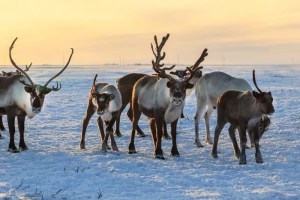
Is Santa a Shamanic concept? Many pictures of northern Shaman are very similar to woodland Santas — both ancient and modern. He appears in long fur robes, often with Bells and is often an older man. The Shaman works both in the spiritual realm and in the material sphere. The Shaman climbed the world tree to bring back gifts of spiritual knowledge as well as calling the herds to supply food and materials for the material lives of his people. Often he went up the smoke hole, the early chimney at night probably in trance, possibly with the herd of reindeer that supported his clan.

Like the Shaman, Santa embodies magic and mystery, the spirit of nature as well as universal human values of caring and generosity. The word Shaman is a Siberian word and this is the land of the reindeer. In his Primitive Mythology, Joseph Campbell describes a legendary Shaman who received his enlightenment in the nest of a winged reindeer in a tree, which was thought to reach the heavens.

There were also Goddesses who rode sleighs and delivered gifts. The Norse goddess Freya rode a chariot pulled by stags.

The life and legends of the Christian St. Nickolas continues the magic of the Shaman. As a young man St. Nickolas traveled to the holy land and on his way back was blown around in a storm and ended upon the coast of Lyca near Myra. He went to pray at the nearest church where the bishop was retiring. One member of the convocation (committee) to choose a new Bishop had had a vision that the new Bishop would be coming to the church and his name would be Nickolas. Arriving as he did the boy was made Bishop of Myra. After serving a prison term under the Romans, young St. Nickolas participated in the decision of Pope Liberus to make Dec 25 the official date of the birth of Christ and the celebration of Christmas. He was a generous man who gave much to the poor of Myca through out the year but especially around Christmas. He was also a Christian Shaman whose miracles that lead to his sainthood was bring back to life and form three boys who had been chopped up and boiled in a pot for stealing.

Modern Santas: Our modern image of Santa in a red suit can be traced to Thomas Nast, an amazing commercial artist of the 19th century. He developed Santa for President Lincoln as well as the Donkey and Elephant of the Democrats and Republicans. His illustration was used in New Yorker publication of Clement Moore’s famous poem, T’was the Night Before Christmas.

Coca Cola: Haddon Sunblom popularized most common image of the modern global culture in 1931.

Contemporary Santas: Even today the image of Santa grows and expands to fill hopes and dreams of all children. Modern Santas of all races and nationalities join woodland and other artist Santas to adorn homes and businesses. Woodland Santas stand on store shelves beside Santas who play golf, surf, and just about any activity you can imagine. Some even have electronic movement and sound.

Evergreens: The obvious symbol of eternal life, green when all else is barren and brown. Evergreens were probably held sacred very early in human prehistory. Again the palm fronds in Egypt and the greening during the Kalends are recorded examples.

The Christmas tree: In the sixth century it is said that the Christian St. Boniface cut down a sacred oak to spite local druids. As the tree fell, it crushed everything in its path except one cedar. He declared it a miracle and that the tree belonged to the Christ child. This is often cited as an example of cultural assimilation of Pagan religious symbology for political purposes.

Hanging of the greens: Decorating with evergreens was first noted in Egypt. It was also popular during the roman Saturnalia and Kalends. The Norse also brought in evergreens for decoration during the long snowy winters. Where Christmas is celebrated, the evergreens are often used to mark the start of the season, which is longer than any of the preceding cultures, now beginning shortly after Halloween and withering out sometime in middle January, marked mainly by clearance sales.

Holly: A symbol from the Celts, the male symbol of rebirth is again an evergreen, this time with red berries. A plant of protection, holly is the symbol of the god of the dark year.

Mistletoe: Mistletoe may have first been used in the Greek winter ceremonies. The Norse legend said it was blessed with luck and fertility by the goddess Frigga after Balder, her son, was shot by Loki, the dark and mischievous imp god, with an arrow of mistletoe. Her tears restored him to life and fell also on the mistletoe giving it magical properties. Mistletoe was also sacred to the Druids. As it dried, it became the golden bough, symbolic of both sun and moon, of the male and female mysteries.

Winged Goddesses, Angels and Elves: These range from representations of the Goddess Iris to the Catholic Holy Spirits. From the many spirits of the holy host to Santa’s magical elves these winged fairies bring another element of the mischievous imps to our Solstice season.

Madonna: The female remains firmly in the season, firmly eternal throughout the turning of the wheel, the force of nature herself. Her consort, son, partner going through continual birth and rebirth is the wonder child.

Yule log: This harks back to the importance of fire during the darkness of winter. A whole tree was burned during the Greek festival of Sacaea to scar away the Kallikantzuroi (mischievous imps) . The familiar Yule log was a Norse tradition adopted by the Christians. In early America there was a custom “freedom of the Yule, ” a week off for slaves and savants while the Yule log burned. “Firewood as wet as a Yule log” was a saying that this custom generated.

These are many of the ancient legends of the Solstice, which have been important in the development of our modern holiday celebration. As modern spiritual seekers we are borrowing from and saving the old ways while we create new ways. We take what is significant to us and add to it, creating personal, family and community traditions. There are kids, stories, and magick as the Sun and Son once again returns!

Sunrise in the Snow

Sunrise in the Snow

An Evocation of Yule

by Levana Lindentree

A field of snow lies, shadows blue, in the gray before dawn. The air is so cold it pinches your nose shut; it smells crisp, like ice. Your breath around you is steam. You crunch forward in the snow, leaving footprints, one by one, in blank snow, like the first person on earth. Into silence, echoing silence.

At the edge of the field sits a wooden fence, wood of its ties gone silver-gray with age. You climb over, drop to the other side. You see that from the fence’s top tie you have peeled a splinter, and in the wound the wood shows warm tan-brown, the old wood still young beneath its skin. You brush yourself off, wondering where the splinter has gone, but you are bundled against the cold and you do not find it.

You stand still a moment on the snowy hill. The sky has lightened to a shining yellow-white, and along the blue mountains on the horizon flames a rim of coral. The sun is about to rise.

Ahead of you is a small wood. You crunch down to it through the cold. Oaks tower there, still holding their last brown leaves; dark firs stand, snow on their shoulders; low and merry holly-trees glisten, berries bright; ivy twines in the shadows.

At the wood’s edge, you greet a sentinel holly, touch one glossy leaf, feel its needle-spiked edge. Then you enter the darkness of the wood. Here the ground is barely snowy, just a few shakings on the path. The earth is deep in decaying leaves, turning to muck, in brown needles that muffle your steps. The air is hushed. Here, the night remains.

The wood’s darkness envelops you like a coat, protective, secret: secrets of earth. You breathe in. The air is warmer here; you smell fir and decaying leaves. You breathe in darkness, secrets, protection.

Now you walk forward, to the edge of the wood, and out again; you look back once, say farewell to the trees. The air is brighter, and ahead you see the red sun-disk poised on the horizon. The sun is rising, liquid fire, and as you watch, bit by bit it surfaces, the whole flaming round, the sun reborn at solstice. The light warms your face, and you reach out your hands.

Red light falls, colors the snow. All around you is silence. You breathe in cold fresh air, new light.

After a few moments, you turn your steps uphill to the small stone house where you are going. You tread fresh snow. Quickly you kneel, pull off a glove and take a handful of snow, bring it to your tongue. It tastes cold, empty. You rise and walk forward, reach the house’s doorstep. You feel nearly frozen; your ears are burning. The door is unlocked. You push inside.

Shutting the door behind you, you take off coat, gloves and boots. To the right is a stone fireplace, where someone has laid a fire. You find matches on the mantel and strike one, set it to the tinder, which blazes up. In a few moments, the fire is flaring, crackling, eating its wood, beginning to warm the house. You hold out your hands to it.

The house is decorated for Yule. Fir branches and holly drape the doorway, and in an arch hangs mistletoe, deep green, white berries, the semen of the God. On the fire is a large log, twined in ivy and fir, runes cut into its skin. You know this is the Yule log, beginning to burn.

There is only one thing missing. Then you hear stamping feet at the door, and it opens: a rush of cold air. There in the doorway stand the people you love best, come to celebrate Yule. You come forward and are enveloped in embraces.

Calendar of the Sun for December 18th

Calendar of the Sun

18 Yulmonath

Saturnalia Day 2: Saturn’s Release

Colors: Black and Gold
Element: Earth
Altar: Upon cloth of black place eight gold candles, each surrounded by gold coins, a bottle of good wine and many cups, and the figure of a seated man, wrapped in a chain.
Offerings: Throw over routines and take joy.
Daily Meal: Anything that the folk of the House want, correct or otherwise.

Invocation of Saturn’s Release

Hail to the Lord of Discipline,
Saturn bound in chains.
Hail to the Old Man of Time
With your fearsome sickle,
Lord of the Hourglass, the Sundial,
All that places restrictions on the bright,
The beautiful, the free and easy.
You live an existence bound in chains,
But at this time of the year, dark and cold,
We release you from your bonds!
We acknowledge that order cannot be held
Without respecting that which is chaos,
And so we pay for the blessed order of our lives,
The gift of Saturn, and Eunomia, and many others,
By these days of release from that Order.
We release you, O Lord of Limitations,
And pray that you, and we, shall be glad
Once more to place these chains about you
And about ourselves. Hail Saturn!

(All cry out “Hail Saturn!” The chain is unwound from about the seated statue of Saturn, and the wine is poured. All toast to the Gods and to many other things, and go off to do what they will. From this point until Arktos of the night of Yule, rules are loosened if not entirely done away with. There is no work today during Akte and Elete, and folk may do what they will until Hesperis. All work done, and all hours attended to, will be by choosing and not by rule. Waking and sleeping will come as they will. For many folks, this will be a time to leave the House and visit family.)

Song: Any that the House chooses.


[Pagan Book of Hours]

Dancing in a Wiccan Wonderland!

Yule Comments & Graphics

Dancing in a Wiccan Wonderland!

by Alexander and Aarcher

Pagans sing, are you listenin’
Alters set, candles glisten,
Its a magical night, we’re having tonight
Dancing in a Wiccan Wonderland

Blades held high, censor smoking,
God and Goddess, we’re invoking,
Through Elements Five, we celebrate life,
Dancing in a Wiccan Wonderland,

Queen of Heaven, is in her place,
Triple Goddess, now the Crone face
Above and below, She’s the Goddess we know,
Dancing in a Wiccan wonderland.

Now the God, is the provider
Supplying game for our fire,
Above and below, He’s the Horned one we know,
Dancing in a Wiccan Wonderland

In a circle we can burn a Yule fire,
And await the rising of the Sun, It’s the great wheel turning for the new year,
Loaded with abundance and great fun

Later on, by the fire,
Cone of Power, gettin’ higher
Its a Magickal Night, we’re having tonight,
Dancing in a Wiccan Wonderland!

~Magickal Graphics~