Today’s Word is
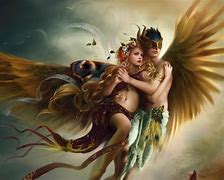
Faeries
From moonlitpriestess.com
Some refer to them as The Wee Folk; the word “fairy” is a synonym for “brownie.” Many Earth elementals are called faeries or the fey. A deeper study is required for better understanding.

1678 Venetian Elena Cornaro Piscopia is awarded a doctorate of philosophy from the University of Padua, 1st woman to receive a university doctoral degree or PhD
1876 Battle of the Little Bighorn: US 7th Cavalry under Brevet Major General George Armstrong Custer wiped out by Sioux and Cheyenne warriors led by Chiefs Crazy Horse and Sitting Bull in what has become famously known as “Custer’s Last Stand”
1929 US President Herbert Hoover authorizes building of Boulder Dam (Hoover Dam)
1950 north korea invades South Korea, beginning the Korean War
2021 WHO head Tedros Adhanom Ghebreyesus confirms the COVID-19 Delta variant is the most transmissible to date, now present in 85 countries and spreading rapidly [1]

253 St Lucius I begins his reign as Catholic Pope
524 Battle of Vézeronce, the Franks defeat the Burgundians
841 Battle at Fontenay: Louis & Charles beat their brother Lotharius I
1080 Wibbert of Ravenna chosen as anti-pope Clemens III
1096 1st Crusade slaughter Jews of Werelinghofen Germany
1139 Battle of Ourique: Afonso Henriques (later Afonso I of Portugal) defeats Moors
1183 Peace of Konstanz signed between Hohenstaufen Emperor Frederick Barbarossa and Italian Lombard League
1243 Sinibaldo dei Fieschi elected as Pope Innocentius IV
1949 “Long-Haired Hare”, animated short starring Bugs Bunny, is released in theaters
1951 1st color TV broadcast, CBS’ Arthur Godfrey from NYC to 4 cities
1955 “Imogene Coca Show” last airs on NBC-TV
1956 WKNO TV channel 10 in Memphis, Tennessee (PBS) begins broadcasting
1957 “Jonathan Winters Show” last airs on NBC-TV
1960 Lorraine Hansberry’s stage drama “A Raisin in the Sun”, 1st Broadway play by a black woman, starring Ruby Dee and Sidney Poitier, closes at the Belasco Theatre, NYC, after 530 performances
1965 15th Berlin International Film Festival: “Alphaville” wins the Golden Bear
1967 KPBS TV channel 15 in San Diego, CA (PBS) begins broadcasting
1821 Carl Maria von Weber‘s “Konzertstück in f, for Piano and Orchestra” premieres
1910 Igor Stravinsky‘s ballet “The Firebird” for the Ballets Russes premieres at the Opéra de Paris, Paris
1938 “A Tisket A Tasket” by Ella Fitzgerald with Chick Webb hits #1
1950 Johnny Pramesa (Reds) and Hank Thompson (Giants) hit inside the park HRs
1955 “Can Can” closes at Shubert Theater NYC after 892 performances
1964 WMCA (NYC) plays Beatles’ Hard Days Night Album (10 days prior to its scheduled release date), they decide to release it June 26th
1966 Beatles’ “Paperback Writer” single goes #1 & stays #1 for 2 weeks
1966 Dmitri Shostakovich‘s 13th Symphony, premieres in Leningrad
1892 US National Championship Women’s Tennis, Philadelphia Cricket Club: Defending champion Mabel Cahill beats Elisabeth Moore 5-7, 6-3, 6-4, 4-6, 6-2
1903 NY Yanks & Chicago White Sox end deadlocked game at 6-6 in 18
1903 Boston Beaneater Wiley Piatt is only 20th-century pitcher to lose 2 complete games in one day, falling to Pittsburgh 1-0 & 5-3
1904 US National Championship Women’s Tennis, Philadelphia CC: May Sutton beats defending champion Elisabeth Moore 6-1, 6-2 for her first of 3 major titles
1909 US Open Men’s Golf, Englewood GC: Englishman George Sargent sets a new Open scoring record to win his only major title, 4 strokes ahead of runner-up Tom McNamara
1912 British Open Men’s Golf, Muirfield: Ted Ray wins wire-to-wire by 4 shots from defending champion Harry Vardon
1921 British Open Men’s Golf, St Andrews: former local Jock Hutchison (resident in US) wins his only Open Championship by 9 strokes in a 36-hole playoff over amateur Roger Wethered
1926 British Open Men’s Golf, Royal Lytham & St Annes GC: American amateur Bobby Jones wins the first of his 3 Claret Jugs, 2 strokes clear of runner-up Al Watrous; 5th victory by an American in 6 years
Discover the cosmos! Each day a different image or photograph of our fascinating universe is featured, along with a brief explanation written by a professional astronomer.
2022 June 25
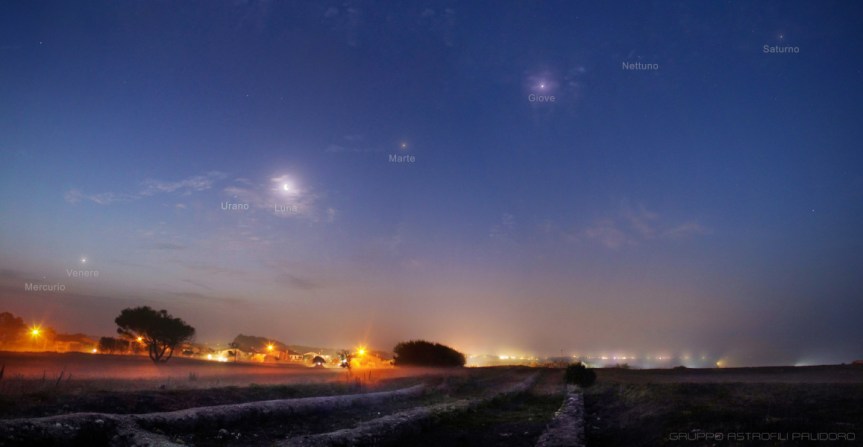
Explanation: Simultaneous images from four cameras were combined to construct this atmospheric predawn skyscape. The cooperative astro-panorama captures all the planets of the Solar System, just before sunrise on June 24. That foggy morning found innermost planet Mercury close to the horizon but just visible against the twilight, below and left of brilliant Venus. Along with the waning crescent Moon, the other bright naked-eye planets, Mars, Jupiter, and Saturn lie near the ecliptic, arcing up and to the right across the wide field of view. Binoculars would have been required to spot the much fainter planets Uranus and Neptune, though they also were along the ecliptic in the sky. In the foreground are excavations at an ancient Roman villa near Marina di San Nicola, Italy, planet Earth.
Venus/Water/East/West/South/Dawn/Female/Libra/Taurus
Magickal Intentions: Love, Romance, Marriage, Sexual Matters, Physical Beauty, Friendship and Partnerships, Strangers, Heart
Color: aqua, blue, light blue, brown, green, pale green, magenta, peach, pink, rose, white, all pastels
Number: 5, 6
Metal: copper
Charm: green or white garments, scepter
Stone: alexandrite, amethyst, coral, diamond, emerald, jade, jet, black moonstone, peridot, smoky quartz, tiger’s-eye, pink tourmaline
Animal: camel, dove, elephant, goat, horse, pigeon, sparrow
Plant: apple, birch, cherry, clematis, clove, coriander, heather, hemlock, hibiscus, ivy, lotus, moss, myrtle, oats, pepperwort, peppermint, pinecone, quince, raspberry, rose, pink rose, red rose, rose hips, saffron, sage, savin, stephanotis, strawberry, thyme, vanilla, verbena, violet, water lily, yarrow, and all flowers
Incense: ambergris, camphor, mace, musk, myrrh, rose, saffron, sage, sandalwood, sweetgrass, vanilla, violet, all floral scents
Goddess: Aphrodite, Asherah, Baalith, Brigid, Erzulie, Freya (Passionate Queen), Frigg, Gefion, Harbor (Beautiful One), Hestia, Inanna, Ishtar (Lady of Passion and Desire), Lakshmi, Lilith, Mokosh, Nehalennia, Nerthus, Ostara, Pombagira, Sarasvati, Shakti, Shekinah, Sirtur, Al Uzza, Venus (Queen of Pleasure), Vesta
God: Allah, Bacchus, Bes, Cupid, the Dagda, Dionysus, El, Eros (God of Love), Freyr, Frit Ailek, Shukra
Evocation: Agrat Bat Mahalat, Anael, Hagiel, Mokosba, Rasbid, Sachiel, Uriel, Velas
Discover the cosmos! Each day a different image or photograph of our fascinating universe is featured, along with a brief explanation written by a professional astronomer.
2022 June 23

Explanation: Beautiful spiral galaxy NGC 6744 is nearly 175,000 light-years across, larger than our own Milky Way. It lies some 30 million light-years distant in the southern constellation Pavo but appears as only a faint, extended object in small telescopes. We see the disk of the nearby island universe tilted towards our line of sight in this remarkably detailed galaxy portrait, a telescopic view that spans an area about the angular size of a full moon. In it, the giant galaxy’s elongated yellowish core is dominated by the light from old, cool stars. Beyond the core, grand spiral arms are filled with young blue star clusters and speckled with pinkish star forming regions. An extended arm sweeps past smaller satellite galaxy NGC 6744A at the lower right. NGC 6744’s galactic companion is reminiscent of the Milky Way’s satellite galaxy the Large Magellanic Cloud.
Discover the cosmos! Each day a different image or photograph of our fascinating universe is featured, along with a brief explanation written by a professional astronomer.
2022 June 24
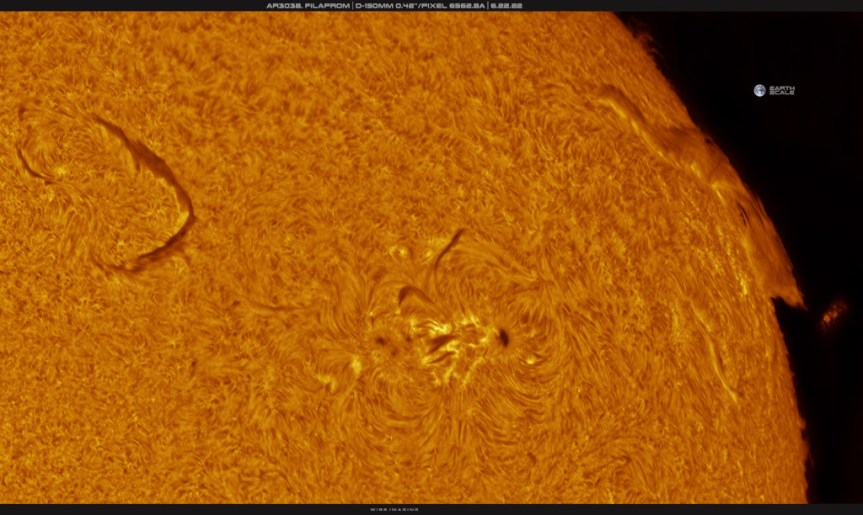
Explanation: A solar filament is an enormous stream of incandescent plasma suspended above the active surface of the Sun by looping magnetic fields. Seen against the solar disk it looks dark only because it’s a little cooler, and so slightly dimmer, than the solar photosphere. Suspended above the solar limb the same structure looks bright when viewed against the blackness of space and is called a solar prominence. A filaprom would be both of course, a stream of magnetized plasma that crosses in front of the solar disk and extends beyond the Sun’s edge. In this hydrogen-alpha close-up of the Sun captured on June 22, active region AR3038 is near the center of the frame. Active region AR3032 is seen at the far right, close to the Sun’s western limb. As AR3032 is carried by rotation toward the Sun’s visible edge, what was once a giant filament above it is now partly seen as a prominence, How big is AR3032’s filaprom? For scale planet Earth is shown near the top right corner.

| Magickal Intentions: Luck, Happiness, Health, Legal Matters, Male Fertility, Treasure and Wealth, Honor, Riches, Clothing Desires, Leadership, Public Activity, Power, Success |
Incense: Cinnamon Musk Nutmeg Sage |
|
| Planet: Jupiter |
Sign: Sagittarius Pisces |
Angel: Sachiel |
| Colors: Purple Royal Blue Indigo |
Herbs/Plants: Cinnamon Beech Buttercup Coltsfoot Oak |
Stones: Sugilite Amethyst Turquoise Lapis Lazuli Sapphire |
1633 Galileo Galilei forced to recant his Copernican views that the Earth orbits the Sun by the Pope (Vatican only admits it was wrong on Oct 31, 1992!)
1675 Royal Greenwich Observatory established in England by Charles II
1772 Somerset v Stewart court case finds slavery unsupported by English common law, encouraging the abolitionist movement
1848 Beginning of the June Days uprising in Paris by French workers
1865 The CSS Shenandoah fires the last shot of the American Civil War in the Bering Strait to indicate surrender

217 BC Battle of Raphia: Ptolemy IV of Egypt defeats Antiochus III the Great of the Seleucid kingdom
168 BC Battle of Pydna: Romans under Lucius Aemilius Paullus defeat and capture Macedonian King Perseus, ending the Third Macedonian War
431 Council of Ephesus (3rd ecumenical council) opens
816 Pope Stephen IV, [V] elected to succeed Leo III
1377 10-year-old Richard of Bordeaux succeeds his grandfather Edward III as Richard II, king of England
1476 Battle at Morat/Murten: Charles the Stout invades Switzerland
1497 Antitax insurrection in Cornwall suppressed at Blackheath
1533 Ferdinand of Austria and Ottoman Sultan Suleiman the Magnificent sign peace treaty
1342 Fictional character of “The Hobbit” Bilbo Baggins returns to his home at Bag End, Shire Reckoning
1951 Gene Rayburn & Dee Finch show premieres on NBC radio
1955 Walt Disney‘s animated film “Lady & the Tramp” released
1956 6th Berlin International Film Festival: “Invitation to the Dance” wins Golden Bear
1962 12th Berlin International Film Festival: “A Kind of Loving” wins the Golden Bear
1970 WSWO TV channel 26 in Springfield, OH (ABC) suspends broadcasting
1973 23rd Berlin International Film Festival: “Distant Thunder” wins the Golden Bear
1977 Walt Disney’s “Rescuers” released, first Disney film to get a sequel
1849 Stephen C Massett opens concert at San Francisco courthouse using only piano in California
1942 European broadcast première of Dmitri Shostakovich‘s 7th Symphony in London conducted by Sir Henry J. Wood and the London Philharmonic Orchestra
1959 “Along Came Jones” by The Coasters peaks at #9
1959 “Class” the first hit by Chubby Checker peaks at #38 in the US
1961 Beatles record “Ain’t She Sweet”, “Cry for a Shadow”, “When the Saints Go Marching In”, “Why”, “Nobody’s Child” & “My Bonnie”, in Hamburg, Germany
1963 “Little” Stevie Wonder aged 13 releases his first single “Fingertips” (first live non-studio recording to go to No. 1 on Billboard)
1968 “Here Come Da Judge” by The Buena Vistas peaks at #88
1969 Aretha Franklin arrested in Detroit for creating a disturbance
1865 Acknowledged as 1st Class Cricket debut of Dr W. G. Grace; as a 16 year old he is dismissed for 0 playing for Gentlemen of South v Players of South at Kennington Oval, London
1874 Game of lawn tennis introduced
1889 Louisville Colonels set ML baseball record with 26th consecutive loss
1918 US National Championship Women’s Tennis, Forest Hills, NY: Molla Bjurstedt beats Eleanor Goss 6-4, 6-3 for her 4th consecutive US singles title
1921 Paavo Nurmi runs world record 10,000m (30:40.2)
1926 Cardinals pick up 39-year-old Grover Alexander on waivers from Cubs
1929 Mel Ott (Giants) homers off Leo Sweetland (Phillies) in doubleheader
1930 New York Yankees first baseman Lou Gehrig smashes 3 HRs in 20-13 win over Philadelphia A’s at Shibe Park
Discover the cosmos! Each day a different image or photograph of our fascinating universe is featured, along with a brief explanation written by a professional astronomer.
2022 June 22
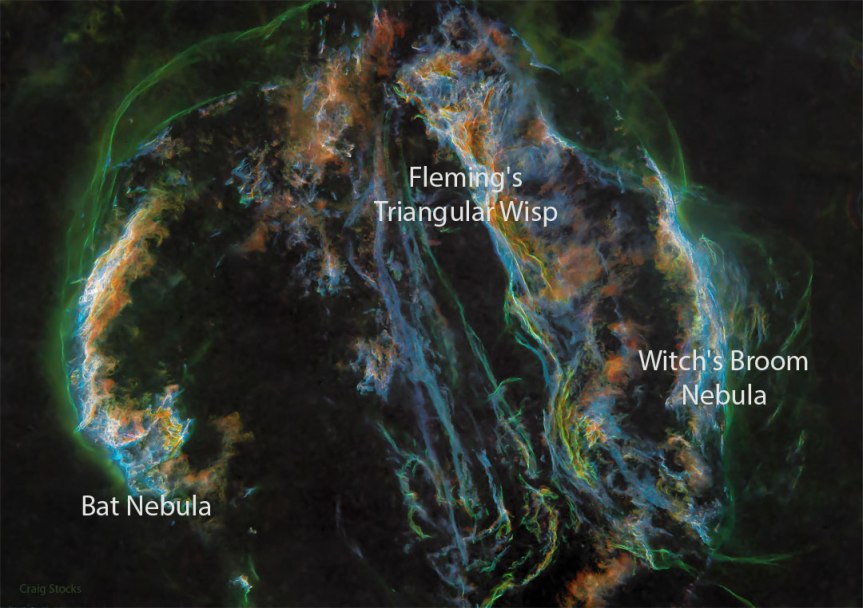
Explanation: Ten thousand years ago, before the dawn of recorded human history, a new light would have suddenly have appeared in the night sky and faded after a few weeks. Today we know this light was from a supernova, or exploding star, and record the expanding debris cloud as the Veil Nebula, a supernova remnant. Imaged with color filters featuring light emitted by sulfur (red), hydrogen (green), and oxygen (blue), this deep wide-angle view was processed to remove the stars and so better capture the impressive glowing filaments of the Veil. Also known as the Cygnus Loop, the Veil Nebula is roughly circular in shape and covers nearly 3 degrees on the sky toward the constellation of the Swan (Cygnus). Famous nebular sections include the Bat Nebula, the Witch’s Broom Nebula, and Fleming’s Triangular Wisp. The complete supernova remnant lies about 1,400 light-years away.

Symbolism: life, fire, rebirth, transformation, power, purity
Symbols: sun flowers, leaves, sword, spear, sun, God’s eye, sun wheels, bonfire, balefires, fire, sun dials, bird feathers, seashells,
Colors: red, gold, orange, yellow, white, green, blue
Food and Drink: mead, ale, summer fruits and vegetables, strawberries, honey cakes, whipped cream, oranges, lemons, summer squash, honey
Herbs: Saint John’s Wort, lavender, rose, peony, vervain, mugwort, chamomile, chickweed, chicory, sun flower, lily, thyme, hemp, fennel, nettle, wisteria, rue, fern, heather, oak, yarrow, holly
Deities: Ra, Bast, Helios, Oak King, Fotuna, Arinna, and other sun god.
Crystals and Gemstones: Lapis, diamond, tiger’s eye, emerald, jade, and other green stones
Animals: butterflies, wren, horse, stag, robin, cattle, phoenix, dragon, faeries, satyrs
Magic: Litha is the time to celebrate the Sun and all that he provides for us. Protection spells and fire magic are great to perform on this night. Make protective amulets to be empowered in the balefire lit on Midsummer’s eve. Looking to promote a transformation, a new career, or create a new or strengthen an old relationship? Litha is a great night to perform such magic. Collect herbs, especially St. John’s Wort, on the eve of this sabbat to bring luck and enhance the herbs’ power. Renew your wedding vows or just enjoy the time with your friends and family. This is also a great time to communicate with faeries and seek their help if you so wish. Be careful though. Faeries can be tricky.
Please note this is not a complete list but a brief overview of symbols, colors, herbs, deities, and the like. If I have missed something that you feel should make the list, please feel free to contact me via the comments or through email. Willow
To be recited on Midsummer’s Day, thrice before and thrice after gathering herbs for magickal workings:

1788 US Constitution comes into effect when New Hampshire is the 9th state to ratify it
1854 First Victoria Cross won during bombardment of Bomarsund in the Aland Islands (Crimean War)
1948 Lord Mountbatten resigns as Governor General of India (formerly the last Viceroy)
1990 7.7 Manjil-Rudbar Earthquake with hundreds of aftershocks hits Iran; killing about 50,000
1993 English mathematician Andrew Wiles proves last theorem of Fermat

68 Roman General Vespasian conquers Jericho during the Great Jewish Revolt
524 Godomar, King of the Burgundians, defeats the Franks at the Battle of Vézeronce
1128 Battle of Akspoele: earl Willem of Normandy beats Diederik
1307 Külüg Khan is enthroned as Emperor of China and seventh Great Khan after defeating rival factions and succeeding his uncle Temür Khan
1498 Jews are expelled from Nurenberg Bavaria by Emperor Maximillian
1529 Queen Catherine Of England [Catherine of Aragon] speaks against her marriage’s annulment at the Blackfriars Legatine Court
1529 Battle of Landriano: Imperial-Spanish forces under Don Antonio de Leyva, Duke of Terranova, beat a French army under Francis de Bourbon, Comte de St. Pol
1547 Great fire in Moscow, a third of the largely wooden city destroyed and 2-3,000 killed
1948 WNAC (now WHDH) TV channel 7 in Boston, MA (CBS) begins broadcasting
1957 7th Berlin International Film Festival: “12 Angry Men” wins Golden Bear
1963 13th Berlin International Film Festival: “The Devil” and “Bushido: The Cruel Code of the Samurai” win the Golden Bear (tie)
1966 “Who’s Afraid of Virginia Woolf?”, directed by Mike Nichols and based on the 1962 play of the same name, starring Elizabeth Taylor and Richard Burton, is released (Academy Awards Best Actress 1967)
1968 18th Berlin International Film Festival: “Who Saw Him Die?” wins the Golden Bear
1974 24th Berlin International Film Festival: “The Apprenticeship of Duddy Kravitz” wins the Golden Bear
1990 Little Richard [Penniman] gets a star on Hollywood’s Walk Of Fame
1993 Revival of Lerner and Loewe’ musical “Camelot”, with Robert Goulet as King Arthur, opens at Gershwin Theater, NYC; runs for 56 performances
1868 Wagner’s opera “Meistersinger von Nuernberg” premieres in Munich
1948 Columbia Records unveil the 33-1/3 rpm LP phonograph record invented by Peter Carl Goldmark, allowing up to 20 minutes per side (available in 10 and 12 inch diameters), at the Waldorf-Astoria Hotel, NYC; over the next decade the popularity and profitability of the LP pushed the 78 rpm out of production [1]
1951 “17” opens at Broadhurst Theater NYC for 180 performances
1955 Johnny Cash debuts Top 10 country song “Cry! Cry! Cry!”
1969 Dmitri Shostakovich‘s 14th Symphony premieres in Moscow
1969 Zager & Evans release “In the Year 2525”
1971 50,000 attend Celebration of Life, rock concert in McCrea, Louisiana; performers included Chuck Berry; Stephen Stills; WAR; John Sebastian; and Delaney and Bonnie
1975 Elton John, The Eagles and The Beach Boys play to 72,000 fans at Wembley Stadium, London
1858 Louisiana chess prodigy Paul Morphy arrives in Europe
1879 Infielder William White plays one game for the Providence Grays with conjecture was the first African-American to play MLB even though he appeared Caucasian
1900 Dodgers score 7 in top of 11th to go ahead of Phillies, 20-13, In bottom of 11th Phillies stalls so umpire forfeits game to Dodgers
1904 Boston Herald tells of Red Sox trade “Dougherty as a Yankee,” 1st known reference to NY club as Yankees (became Yankees in 1913)
1907 US Open Men’s Golf, Philadelphia Cricket Club: Alec Ross of Scotland posts 4 sub-80 rounds to win his only major title, 2 strokes ahead of runner-up Gilbert Nicholls
1907 British Open Men’s Golf, Royal Liverpool GC: Frenchman Arnaud Massy wins by 2 strokes from J.H. Taylor; first non-Briton to win Open Championship
1916 Boston Red Sox pitcher Rube Foster no-hits New York Yankees, 2-0 at Fenway Park
1932 German champion Max Schmeling loses NYSAC, NBA and lineal heavyweight boxing titles in controversial split points decision to American Jack Sharkey in NYC, New York
Discover the cosmos! Each day a different image or photograph of our fascinating universe is featured, along with a brief explanation written by a professional astronomer.
2022 June 21
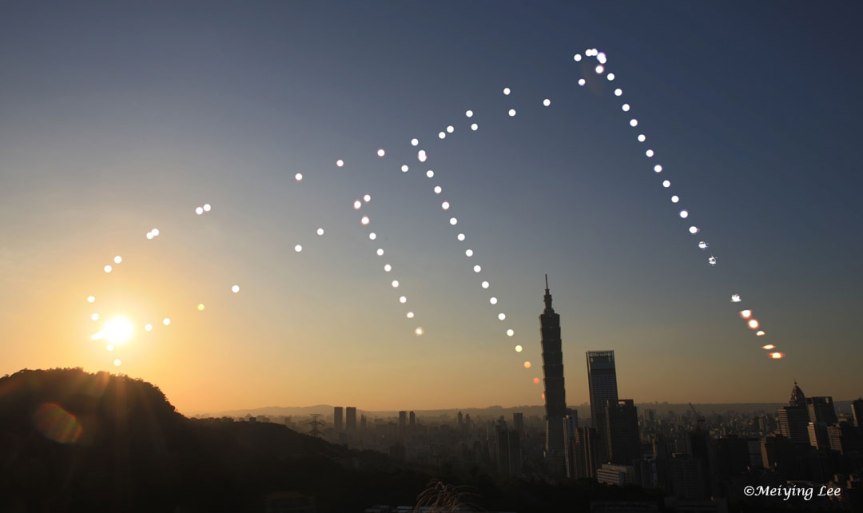
Explanation: Does the Sun return to the same spot on the sky every day? No. A better and more visual answer to that question is an analemma, a composite of images taken at the same time and from the same place over the course of a year. The featured analemma was compiled at 4:30 pm many afternoons from Taiwan during 2021, with the city skyline of Taipei in the foreground, including tall Taipei 101. The Sun‘s location in December — at the December solstice — is shown on the far left, while its location at the June solstice is captured on the far right. Also shown are the positions of the Sun throughout the rest of the day on the solstices and equinoxes. Today is the June solstice of 2022, the day in Earth‘s northern hemisphere when the Sun spends the longest time in the sky. In many countries, today marks the official beginning of a new season, for example winter in Earth’s southern hemisphere.

Discover the cosmos! Each day a different image or photograph of our fascinating universe is featured, along with a brief explanation written by a professional astronomer.
2022 June 20

Explanation: There, just right of center, what is that? The surface of Mars keeps revealing new surprises with the recent discovery of finger-like rock spires. The small nearly-vertical rock outcrops were imaged last month by the robotic Curiosity rover on Mars. Although similar in size and shape to small snakes, the leading explanation for their origin is as conglomerations of small minerals left by water flowing through rock crevices. After these relatively dense minerals filled the crevices, they were left behind when the surrounding rock eroded away. Famous rock outcrops on Earth with a similar origin are called hoodoos. NASA’s Curiosity Rover continues to search for new signs of ancient water in Gale Crater on Mars, while also providing a geologic background important for future human exploration.






You must be logged in to post a comment.