Flashback 2000 Lammas

At Lammas, the Sun is at the very peak of Leo, the sign this planet loves above all others. Our star’s warmth is at its most powerful now in the Northern Hemisphere, as it appears directly overhead. At this time, life too, ia at its peak—as are the crops. The ancients celebrated this festival by giving thanks for their first harvest, most especially the grain harvest, even as they accepted the beginning of the God’s descent into the underworld. The myth of the asteroid-Goddess Ceres (Demeter), giver of the grain, also relates to this season. It was now when she would bid her daughter Farwell, since Persephone was obligated to return to the Underworld to rejoin Hades (Pluto). So bereaved was Ceres to see her daughter leave her, she refused to all the Earth to produce grain until her return. At this time,nothing, modern practitioners should be remind of both astrological principles: the fullness of life the Sun brings, and the necessity for rest, as signified by the coming fall.

©️ By Kim Rogers-Gallagher Llewellyn’s Witches’ Datebook 2000 Page 95

Summer Solstice Printable Coloring Pages

For Your Viewing Pleasure – Winter Solstice

What happens during the winter solstice?

For Your Listening PLeasure

SONG OF SUMMER SOLSTICE | Kulning & Nyckelharpa

This song is short but sweet.

Category Samhain/Deep Autumn

WE ARE THE ANCESTORS: MAY WE BE INTERESTING FOOD

May 9, 2020 · by Glenys D. Livingstone · in Samhain/Deep Autumn · Leave a comment Our present lives are formed by all who came before us. We are in-formed by them, whether conscious or not. In PaGaian Samhain ceremony as it has been done traditionally, participants are invited to remember the ancestors in this way: Let us remember our ancestors, those who have gone before, whose lives have been harvested, […]

THREADS OF GOLD IN THE COMPOST

April 20, 2020 · by Glenys D. Livingstone · in Samhain/Deep Autumn · 2 Comments There are threads of gold in the compost, if one has the vision for it. And we may take the golden thread, exclaim the strongest natural fibre known – our creative selves, our imaginations – for the building of a new world made sacred, of our conceiving: yet beyond our knowings, across the vast Darkness between […] For more interesting article about Southern Hemisphere Samhain click here  

Lammas/Lughnasadh Blessings Sisters, Brothers, and Guests

May your harvest be plentiful growing from what you sowed on Imbolc.

Blessed be dear ones.

Imbolc Blessing

Celtic Tree Month – Coll – Hazel Moon August 5 – September 1


About the Celtic Tree Month – Coll (Hazel Moon): August 5 – September 1

“The lunar tree calendar of the Celts has long been a source of controversy among Celtic scholars. Some even claim it was never a part of the old Celtic world, but was an invention of author/researcher Robert Graves. The Druids are generally given credit by other researchers for creating this system. There seems to be no scholarly evidence to prove otherwise, yet many Celtic Pagans feel that the system pre-dates the time of Druidic influence over Celtic religious matters. It is probably reasonable to believe that the truth lies somewhere in between these three extremes. It is most likely that the tree system was in place, with minor regional variations before the time of the Druids who experimented with it, discovered the magical properties of each tree, and codified all the information into the system we have today.”

—-Joelles Sacred Grove

The Hazel Moon was known to the Celts as Coll, which translates to “the life force inside you.” This is the time of year when Hazelnuts are appearing on the trees, and are an early part of the harvest. Hazelnuts are also associated with wisdom and protection. Hazel is often associated in Celtic lore with sacred wells and magical springs containing the salmon of knowledge. This is a good month to do workings related to wisdom and knowledge, dowsing and divination, and dream journeys. If you’re a creative type, such as an artist, writer, or musician, this is a good month to get your muse back, and find inspiration for your talents. Even if you normally don’t do so, write a poem or song this month.

Source

Patti Wigington, Author
Published on ThoughtCo

As Imbolc Approaches

Imbolc/Candlemas Comments
As Imbolc Approaches

a guide to the Sabbat’s symbolism

by Arwynn MacFeylynnd

Date: February 1 or 2.

Alternative names: Imbolg, Candlemas, Oimelc, Brighid’s Day, Lupercus, the Feast of Lights, Groundhog’s Day

Primary meanings: The name “Imbolc” derives from the word “oimelc,” meaning sheep’s milk. It is considered a time of purification, preparation and celebration for new life stirring, anticipating spring. The holiday is also known as Candlemas; the custom of blessing candles at this time signifies awakening of life and honors the Celtic goddess Brighid, to whom fire is sacred. This Sabbat also celebrates banishing winter.

Symbols: Candle wheels, grain dollies and Sun wheels, a besom (witch’s broom), a sprig of evergreen, a bowl of snow and small Goddess statues representing her in the maiden aspect.

Colors: White, yellow, pink, light blue, light green; also, red and brown.

Gemstones: Amethyst, aquamarine, turquoise, garnet and onyx.

Herbs: Angelica, basil, bay, benzoin, clover, dill, evergreens, heather, myrrh, rosemary, willows and all yellow flowers.

Gods and goddesses: Brighid, the Celtic goddess of healing, poetry and smithcraft; all virgin and maiden goddesses; all fire and flame gods, connected with the newborn Sun.

Customs and myths: In Irish legends of the Tuatha De Danaan, Brighid is the name of three daughters of Dagda who over time were combined into one goddess. She was venerated in Scotland, Wales, on the Isle of Man and in the Hebrides. When celebrating Candlemas or Imbolc, spellwork for fertility, inspiration and protection are appropriate, defining and focusing on spiritual and physical desires for the future. Imbolc is a good time to get your life in order — physically, mentally, spiritually and emotionally. Make plans, organize, clean out drawers and closets to bring in the new and clearing out the old. Make and bless candles; light one in each room in honor of the Sun’s rebirth. Carry out rites of self-purification. Burn mistletoe, holly and ivy decorations from Yule to signify the end of harsh weather and old ways.

Gods – OgmaCeltic God c.2015


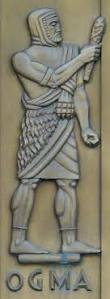
Ogma

Celtic God


In Irish-Celtic myth, Ogma is the god of eloquence and learning. He is the son of the goddess Danu and the god Dagda, and one of the foremost members of the Tuatha Dé Danann. He is the reputed inventor of the ancient Ogham alphabet which is used in the earliest Irish writings.

In the final battle at Mag Tuireadh he managed to take away the sword of the king of the Fomorians, but had to pay with his life for this feat. His Celtic equivalent is Ogmios.

Ogma or Oghma is a character from Irish mythology. A member of the Tuatha Dé Danann, he is often considered a deity and may be related to the Gaulish god Ogmios.

He fights in the first battle of Mag Tuired, when the Tuatha Dé take Ireland from the Fir Bolg. Under the reign of Bres, when the Tuatha Dé are reduced to servitude, Ogma is forced to carry firewood, but nonetheless is the only one of the Tuatha Dé who proves his athletic and martial prowess in contests before the king. When Bres is overthrown and Nuadu restored, Ogma is his champion. His position is threatened by the arrival of Lugh at the court, so Ogma challenges him by lifting and hurling a great flagstone, which normally required eighty oxen to move it, out of Tara, but Lugh answers the challenge by hurling it back. When Nuadu hands command of the Battle of Mag Tuired to Lugh, Ogma becomes Lugh’s champion, and promises to repel the Fomorian king, Indech, and his bodyguard, and to defeat a third of the enemy. During the battle he finds Orna, the sword of the Fomorian king Tethra, which recounts the deeds done with it when unsheathed. During the battle Ogma and Indech fall in single combat, although there is some confusion in the texts as in Cath Maige Tuired Ogma, Lugh and the Dagda pursue the Fomorians after the battle to recover the harp of Uaitne, the Dagda’s harper.

He often appears as a triad with Lugh and the Dagda, who are sometimes collectively known as the trí dée dána or three gods of skill, although that designation is elsewhere applied to other groups of characters. His father is Elatha and his mother is usually given as Ethliu, sometimes as Étaín. His sons include Delbaeth and Tuireann. He is said to have invented the Ogham alphabet, which is named after him.

Scholars of Celtic mythology have proposed that Ogma represents the vestiges of an ancient Celtic god. By virtue of his battle prowess and invention of Ogham, he is compared with Ogmios, a Gaulish deity associated with eloquence and equated with Herakles. J. A. MacCulloch compares Ogma’s epithet grianainech (sun-face) with Lucian’s description of the “smiling face” of Ogmios, and suggests Ogma’s position as champion of the Tuatha Dé Danann may derive “from the primitive custom of rousing the warriors’ emotions by eloquent speeches before a battle”, although this is hardly supported by the texts. Scholars such Rudolf Thurneysen and Anton van Hamel dispute any link between Ogma and Ogmios.

*
A Proto-Indo-European root *og-mo– ‘furrow, track, incised line’ may be the origin of the stem of the name. In addition, Proto-Celtic had a causative verbal suffix *-ej– ~ *-īj-. A hypothetical Proto-Celtic *Ogm-īj-o-sogm-. This agent noun would therefore mean ‘furrow-maker, incisor’ and may have had a metaphorical sense of ‘impresser.’ therefore looks very much like an agent noun derived from a verb formed by the addition of this causative suffix to the stem *

The Irish god of writing, eloquence and poetry. Ogma was credited of being inventor of the Celtic writing systems that the Druids used for their magic. These scripts were known as Ogham.

Ogma was the son of Dagda and the goddess Danu. Some other writers say that Ogma and Dagda were brothers; in this version they were the sons of Eithne. Ogma had also being called the son of Elatha, the king of the Fomorians.

Ogma was one the seven champions in the First Battle of Moytura (Mag Tuired), but when Bres became the king of Tuatha dé Danann, Ogma was degraded into working on humiliating manual job of gathering firewood.
When Lugh went to Nuada, asking for a place to serve the king, Ogma seemed to be Nuada’s foremost fighter. During the second battle of Moytura, Ogma had killed one of the Fomorian leaders, named Indech, the son of Domnu.

Ogma had married Etain, the daughter of Dian Cécht. Ogma had a son named Caipre. Some say that he was the father of MacCuill, MacCecht and MacGrené (MacGrene), the three Danann kings who ruled Ireland, during the Milesian invasion, though other say that Neit was their father.
To the Celtic Gauls he was called Ogmios. According to both Gallic and Irish myths Ogma was a warrior god, depicted as a wrinkled old man, wearing lion’s skin cloak, carrying a bow and club. The Romans considered Ogmios as the Celtic equivalent of Hercules (Greek Heracles). They also depicting Ogimos as holding people chained to his tongue by their ears, to indicate he was the god of eloquence and poetry.

Author: Agaliha

May The Goddess Continue To Bless All These Great Men Who Have Led Our Country!

Click here
Happy President’s Day Everyone!

I hope you are having a wonderful day off from work. I wanted to let you know that we have a sales rep (those never take a day off, lol), coming out shortly. She has already called for direction and will be here shortly. I am going to try to get some info done before she get here. But when she arrives I will have to stop and when she leaves continue.

Just wanted to let you know real quick what was going on. Again I wish you a very Happy & Blessed Presidents’ Day!

Luv & Hugs,

Lady A

Enhanced by Zemanta

Calendar of the Sun for February 13th

Calendar of the Sun

13 Solmonath

Parentalia

Color: Blood-red
Element: Fire
Altar: Set with a red cloth, and unlit red candles, and symbols of Mother and Father.
Offerings: Written words of thanks for one’s childhood. Be a parental mentor to someone young.
Daily Meal: Soups or stews, and bread.

Parentalia Invocation

Perhaps you gave us life,
Sowed our seed, gifted us with
Your chromosomes and genes.
Perhaps you birthed us
Or were there to greet us
As we entered the world.
Perhaps you fed us, cleaned us,
Held us when we cried,
Sang us to sleep, taught us
Many skills, or perhaps
You merely led by example.
Perhaps you were tied to us by blood
Or by marriage, or simply came
Into our lives when it was needed.
Perhaps you were a parent to our bodies,
Or to our minds, or to our hearts,
Or to our souls.
However it was, you were there,
And we are grateful,
For the flame you kindled
Has warmed us ever since,
And we will pass it on.

(Each steps forward, lights a candle, and speaks the name of a parent, or one who has parented them, and everyone else calls it back to them, as in “I honor Maria, my stepmother who taught me to read!” “We honor Maria!” The next person lights their candle from the last one, until the ritual is over. At the end, all chant in two-part harmony the names they have spoken.)

[Pagan Book of Hours]

Enhanced by Zemanta

Dressing A Candle

Dressing A Candle

Candles have been used for many many years in rituals, to set an atmosphere and help to focus on a desired result of a the ritual.  Here are steps to to take
when dressing a candle for a ritual or for requesting a desired result.When
working with candles, you will see that no two candles are alike, they each
have their own character. (drip, flame, sound )

* Choose the candle to be used : type and color ( green for money, black/
white for cleansing).

* Cleanse the candle from prior energies. Here are some suggestions for
cleansing:
A: Holy water
B: Sea salt
C: Pure soap
D: Baby oil

* Bless / Consecrate your oil to be used.

* State and engrave (if desired) what the candle is to represent (money,
love, job, taking away unwanted habits, etc.)

* Anoint the candle with the oil you have chosen (it is important to focus on
your desire when doing this).
A: — To achieve : start on the top to the middle in a downward
motion(stop) then go the bottom to the middle in an upward motion(stop).
B: — To banish : start in the middle to top (stop) then go from the middle
to the bottom (stop).
Do not use a back and forth motion, it defeats the purpose.

* Bless / Consecrate the candle.

Your candle is now ready to use. Light your candle with an incense of your
desire or deity. Do not use matches, a lighter or incense should be used.
honestly I know not why, just that the sulfur is the problem. But every
book  I have read states this, and I have read many.)

Meditate as long as possible (many don’t have a lot of time past 15min.) on
your desired outcome while your candle is burning. Let the candle burn till the
end.

If and when you need to extinguish your candle, snuff it out or swipe your
hand enough to let the air blow it out. Do not blow or pinch it out. As blowing
it out blows your desires away from you and pinching it out also pinches out
your desires.

Enhanced by Zemanta

She’s Been Waiting

Witchy Comments & Graphics

She’s been waiting
She’s been waiting, waiting.
She’s been waiting so long.
She’s been waiting for her children
To remember, to return.
 
Blessed be, and blessed are,
The lovers of the lady.
Blessed be, and blessed are,
The mother, maiden, crone.
Blessed be, and blessed are,
The ones who dance together.
Blessed be, and blessed are,
The ones who dance alone.
She’s been waiting, waiting.
She’s been waiting so long.
She’s been waiting for her children
To remember, to return.
 
Blessed be, and blessed are,
The ones who work in silence.
Blessed be, and blessed are,
The ones who shout and scream.
Blessed be, and blessed are,
The movers and the changes.
Blessed be, and blessed are,
The dreamers and the dream.
She’s been waiting, waiting.
She’s been waiting so long.
She’s been waiting for her children
To remember, to return.
 

– Paula Walowitz

Source:

Blessed Be
Online Wiccan Resource Center
Enhanced by Zemanta

A Little Humor for Your Day – How Not To Get Invited Back To A Circle

How Not To Get Invited Back To A Circle

1.   Take the ritual sword from the altar and make sounds like Darth Vader — “Luke, I am your father!” — and start making light saber noises.

2.   Start skat-singing when chanting.

3.   Take the ritual athame from the altar and start cleaning your nails with it.

4.   When taking a sip of the ritual wine, act like a wine snob and comment on it.

5.   When doing the spiral dance, make it a Conga line.

6.   Call down the Goddess with “Get your ass down here, Big Momma!”

7.   Call down the God with “Our father, who art in heaven …”

8.   When chanting the names of the Goddess, randomly include Pokemon names.

9.   When being smudged, complain vehemently about second-hand smoke.

10.  In a drumming circle, laugh insanely and start drumming the beat to Wipe Out!

11.  Ask the people in the circle “When are we all gonna git nekked?”

12.  When in a skyclad circle, randomly point and laugh.

13.  When the ritual wine goblet is passed to you, chug it and ask for more.

14.  Invoke Satan.

15.  Take out a Bible and start evangelizing.

16.  Light-up a cigar.

17.  Bring a cute furry creature and offer it as a blood sacrifice.

18.  Talk a lot about casting spells for revenge against people who have offended you.

19.  At a handfasting say “Thank God! Maybe now i’ll get some grandchildren!”

20.  When in circle, answer your cell phone.

21.  Respond to “So Mote it Be!” with “Amen!”

22.  Invite people to “Come to the dark side.”

23.  Bring you kids and ask the group to invoke the baby sitting Goddess.

Turok’s Cabana

Enhanced by Zemanta

February 4th – King of Frost Day

Witchy Comments & Graphics
February 4th – King of Frost Day

Prior to World War I, a fair was held on this day in London to honor the King of Frost. All the townspeople would gather on the Thames River, normally frozen over at this time, and petition the King of Frost to bring forth Spring. The festival died out during the war.

Along the Welsh border people continue to celebrate this day by gathering snowdrops, sometimes called Candlemas Bells. These bright flowers are tied into bundles and used to purify the hearth and home.

In Honor Of King Frost

Spring House Blessing

To encourage the return of Spring, tie a bunch of snowdrops with green ribbon and hang over the main entrance of your home as you repeat:

Candlemas Bells, snowdrops so white,
Cast away shadows, bring forth the light.
Enhanced by Zemanta

Hold An Imbolc House Cleansing Ceremony

Hold An Imbolc House Cleansing Ceremony

By , About.com

Give your whole house a thorough cleaning at the end of winter.

A clean physical space feels good spiritually.

Be sure to clean your windows so they’re free of winter’s grime.

No one really likes to clean, but we all know we feel better when our physical space is tidy. It’s one of life’s necessary chores. Start your spring off with a good thorough cleaning, and then follow that up with a spiritual cleansing. This is a great ritual to perform at Imbolc — remember that for many of our ancestors, washing came only a few times a year, so by February, a house was probably smelling pretty ripe. Pick a bright sunny day to do a clean sweep, and then invite friends and family to join you in a blessing of your home.

First, do a complete physical cleaning of your house. Put on some music and thoroughly clean every room. Strip sheets off the beds, turn the mattresses, dust every surface, and vacuum every floor. Sort through those piles of paper on your desk, and get rid of things you don’t need to keep; file everything else. Gather up the kids’ toys and put them in baskets for easy storage. If you need to get rid of things, do it now — set aside a box for charity and put gently used items in it. Set aside another box for trash, and see if you can fill it up!

Once your house is clean — and this assumes you did the kitchen as well — it’s time to have some fun. Call up some friends and invite them over for a potluck. Cook up some Imbolc-themed comfort foods, such as Braided Bread or Beer Battered Fish & Chips, and have a small potluck celebration. Ask each guest to bring a small token to bless your house — pebbles, shells, interesting bits of wood, beads, etc.

You’ll also need the following:

  • A bowl of water
  • Some sea salt
  • A smudging bundle of sage or sweetgrass
  • A blue candle
  • Some Blessing Oil
  • A bowl or bag

Begin at the front door — it is, after all, where you welcome guests into your home — and go through the house in a sunwise direction (clockwise). Ask your guests to help you by smudging the perimeter of each room with the salt, sage, candle flame and water. You may wish to say some sort of incantation as they do this, something like:

With the purifying power of water, with the clean breath of air, with the passionate heat of fire, with the grounding energy of earth we cleanse this space.

As you pass from room to room, anoint each door and windowsill with the Blessing Oil by tracing the shape of a pentagram or other symbol of your tradition. This prevents anything negative from crossing into the home. If you like, you can offer a small incantation as you do this, something like:

May the goddess bless this home, making it sacred and pure, so that nothing but love and joy shall enter through this door.

Finally, once you’ve gone through the house, ask each of your guests to deposit their blessing token in your bowl or bag. Keep it in a place of honor in your home — on the mantel or in your kitchen is a good idea. Gather around the dinner table, break out the goodies, and enjoy a feast with your friends and family!

Tips:

* If you don’t have Blessing Oil, you can use rosemary oil instead. Make your own by infusing fresh rosemary in grapeseed or flaxseed oil.

Enhanced by Zemanta

How To Hold an Imbolc Candle Ritual (for Solitaries)

How To Hold an Imbolc Candle Ritual (for Solitaries)

By Patti Wigington, About.com

Imbolc is a festival of light — celebrate it with candles and flames!

Hundreds of years ago, when our ancestors relied upon the sun as their only source of light, the end of winter was met with much celebration. Although it is still cold in February, often the sun shines brightly above us, and the skies are often crisp and clear. As a festival of light, Imbolc came to be called Candlemas. On this evening, when the sun has set once more, call it back by lighting the seven candles of this ritual.

** Note: although this ceremony is written for one, it can easily be adapted for a small group.

Difficulty: Average
Time Required: Varied

Here’s How:

  1. First, set up your altar in a way that makes you happy, and brings to mind the themes of Imbolc. You’ll also want to have on hand the following:
    • Seven candles, in red and white (tealights are perfect for this)
    • Something to light your candles with
    • A large bowl or cauldron big enough to hold the candles
    • Sand or salt to fill the bottom of the bowl/cauldron

    Prior to beginning your ritual, take a warm, cleansing bath. While soaking, meditate on the concept of purification. Once you’re done, dress in your ritual attire, and begin the rite.

  2. If your tradition requires you to cast a circle, do so now.

    Pour the sand or salt into the bowl or cauldron. Place the seven candles into the sand so they won’t slide around. Light the first candle. As you do so, say:

    Although it is now dark, I come seeking light. In the chill of winter, I come seeking life.

    Light the second candle, saying:

    I call upon fire, that melts the snow and warms the hearth. I call upon fire, that brings the light and makes new life. I call upon fire to purify me with your flames.

  3. Light the third candle. Say:

    This light is a boundary, between positive and negative. That which is outside, shall stay without. That which is inside, shall stay within.

    Light the fourth candle. Say:

    I call upon fire, that melts the snow and warms the hearth. I call upon fire, that brings the light and makes new life. I call upon fire to purify me with your flames.

  4. Light the fifth candle, saying:

    Like fire, light and love will always grow. Like fire, wisdom and inspiration will always grow.

    Light the sixth candle, and say:

    I call upon fire, that melts the snow and warms the hearth. I call upon fire, that brings the light and makes new life. I call upon fire to purify me with your flames.

    Finally, light the last candle. As you do so, visualize the seven flames coming together as one. As the light builds, see the energy growing in a purifying glow.

    Fire of the hearth, blaze of the sun, cover me in your shining light. I am awash in your glow, and tonight I am made pure.

  5. Take a few momemnts and meditate on the light of your candles. Think about this Sabbat, a time of healing and inspiration and purification. Do you have something damaged that needs to be healed? Are you feeling stagnant, for lack of inspiration? Is there some part of your life that feels toxic or tainted? Visualize the light as a warm, enveloping energy that wraps itself around you, healing your ailments, igniting the spark of creativity, and purifying that which is damanged.

    When you are ready, end the ritual. You may choose to follow up with healing magic, or with a Cakes and Ale ceremony.

What You Need

  • Seven candles, white and red, and something to light them with
  • A bowl or cauldron with sand in the bottom
Enhanced by Zemanta

Setting Up Your Imbolc Altar

Setting Up Your Imbolc Altar

By , About.com

It’s Imbolc, and that’s the Sabbat where many Wiccans and Pagans choose to honor the Celtic goddess Brighid, in her many aspects. However, other than having a giant statue of Brighid on your altar, there are a number of ways you can set up for the season. Depending on how much space you have, you can try some or even all of these ideas — obviously, someone using a bookshelf as an altar will have less flexibility than someone using a table, but use what calls to you most.

Colors

Traditionally, the colors of red and white are associated with Brighid. The white is the color of the blanket of snow, and the red symbolizes the rising sun. In some traditions, the red is connected with the blood of life. Brighid is also tied to the color green, both for the green mantle she wears and for the life growing beneath the earth. Decorate your altar with a white cloth, and drape a swath of red across it. Add green candles in candleholders.

The Beginnings of New Life

Altar decor should reflect the theme of the Sabbat. Because Imbolc is a harbinger of spring, any plants that symbolize the new growth are appropriate. Add potted bulbs — don’t worry if they’re blooming yet — and spring flowers such as forsythia, crocus, daffodils, and snowdrops. If you don’t have much luck planting bulbs, think about making a Brighid’s crown as a centerpiece — it combines flowers and candles together.

Celtic Designs

Brighid is, after all, a goddess of the Celtic peoples, so it’s always appropriate to add some sort of Celtic design to your altar. Consider adding a Brighid’s cross6 or any other item incoporating Celtic knotwork. If you happen to have a Celtic cross, don’t worry about the fact that it’s also a Christian symbol — if it feels right on your altar, go ahead and add it.

Other Symbols of Brighid

  • Cauldrons or chalices — she’s often connected to sacred wells and springs
  • A small anvil or hammer — Brighid is the goddess of smithcraft
  • A Brighid corn doll and Priapic wand
  • Sacred animals such as cows, sheep or swans
  • A goddess statue
  • A book of poetry, or a poem you’ve written — Brighid is the patroness of poets
  • Faeries — in some traditions, Brighid is the sister of the Fae
  • Healing herbs — she’s often connected to healing rites
  • Lots of candles, or a cauldron with a small fire in it
Enhanced by Zemanta

Giving Thanks to Brighid – Meal Blessing

Giving Thanks to Brighid – Meal Blessing

By , About.com


Giving Thanks to Brighid – Meal Blessing
 
This is the season of Brighid,
She who protects our hearth and home.
We honor her and thank her, for keeping us warm as we eat this meal.
Great Lady, bless us and this food,
and protect us in your name.


Enhanced by Zemanta