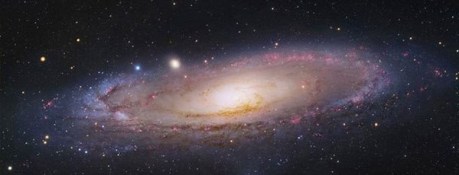
The most distant object that most folks can see with the unaided eye is also the closest major galaxy to our own Milky Way. Although the Andromeda Galaxy lies a mind-bending 2.5 million light-years from Earth, its trillion stars are enough to emit a strong glow across the vast reaches of space. Despite the wide gap, the Milky Way and Andromeda are on a collision course and predicted to begin merging in roughly 4.5 billion years. (You’ve been warned.)
The Andromeda Galaxy was once thought to be a nebula. Early in the development of modern astronomy, any diffuse, undefined celestial body was called a ‘nebula,’ including what we now know to be a neighboring galaxy. Our modern definition of nebula refers to galaxies-in-training that will coalesce over cosmic time into something less…nebulous.
Discover the cosmos! Each day a different image or photograph of our fascinating universe is featured, along with a brief explanation written by a professional astronomer.
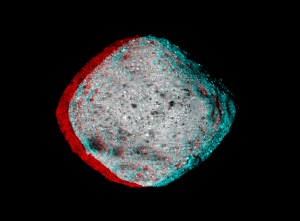
Explanation: Put on your red/blue glasses and float next to asteroid 101955 Bennu. Shaped like a spinning toy top with boulders littering its rough surface, the tiny Solar System world is about one Empire State Building (less than 500 meters) across. Frames used to construct this 3D anaglyph were taken by PolyCam on the OSIRIS_REx spacecraft on December 3, 2018 from a distance of about 80 kilometers. With a sample from the asteroid’s rocky surface on board, OSIRIS_REx departed Bennu’s vicinity this May and is now enroute to planet Earth. The robotic spacecraft is scheduled to return the sample to Earth in September 2023.
Discover the cosmos! Each day a different image or photograph of our fascinating universe is featured, along with a brief explanation written by a professional astronomer.
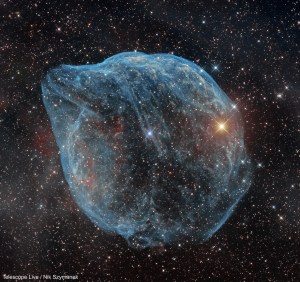
Explanation: Blown by fast winds from a hot, massive star, this cosmic bubble is huge. Cataloged as Sharpless 2-308 it lies some 5,000 light-years away toward the constellation of the Big Dog (Canis Major) and covers slightly more of the sky than a Full Moon. That corresponds to a diameter of 60 light-years at its estimated distance. The massive star that created the bubble, a Wolf-Rayet star, is the bright one near the center of the nebula. Wolf-Rayet stars have over 20 times the mass of the Sun and are thought to be in a brief, pre-supernova phase of massive star evolution. Fast winds from this Wolf-Rayet star create the bubble-shaped nebula as they sweep up slower moving material from an earlier phase of evolution. The windblown nebula has an age of about 70,000 years. Relatively faint emission captured by narrowband filters in the deep image is dominated by the glow of ionized oxygen atoms mapped to a blue hue. Presenting a mostly harmless outline, SH2-308 is also known as The Dolphin-head Nebula.
Discover the cosmos! Each day a different image or photograph of our fascinating universe is featured, along with a brief explanation written by a professional astronomer.
2021 October 17
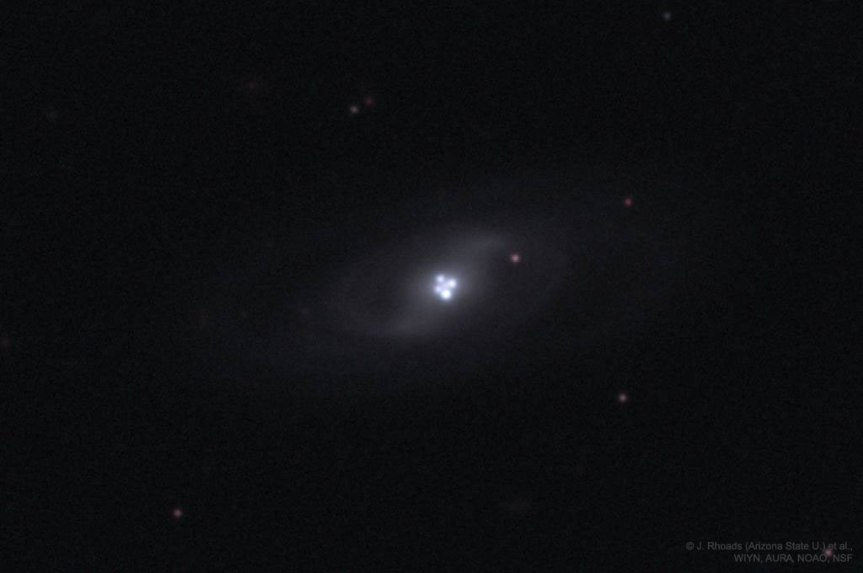
The Einstein Cross Gravitational Lens
Image Credit & License: J. Rhoads (Arizona State U.) et al., WIYN, AURA, NOIRLab, NSFExplanation: Most galaxies have a single nucleus — does this galaxy have four? The strange answer leads astronomers to conclude that the nucleus of the surrounding galaxy is not even visible in this image. The central cloverleaf is rather light emitted from a background quasar. The gravitational field of the visible foreground galaxy breaks light from this distant quasar into four distinct images. The quasar must be properly aligned behind the center of a massive galaxy for a mirage like this to be evident. The general effect is known as gravitational lensing, and this specific case is known as the Einstein Cross. Stranger still, the images of the Einstein Cross vary in relative brightness, enhanced occasionally by the additional gravitational microlensing effect of specific stars in the foreground galaxy.
Discover the cosmos! Each day a different image or photograph of our fascinating universe is featured, along with a brief explanation written by a professional astronomer.
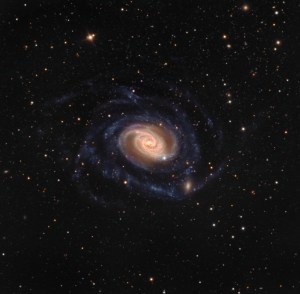
NGC 289: Swirl in the Southern Sky
Image Credit & Copyright:Mike SelbyExplanation: About 70 million light-years distant, gorgeous spiral galaxy NGC 289 is larger than our own Milky Way. Seen nearly face-on, its bright core and colorful central disk give way to remarkably faint, bluish spiral arms. The extensive arms sweep well over 100 thousand light-years from the galaxy’s center. At the lower right in this sharp, telescopic galaxy portrait the main spiral arm seems to encounter a small, fuzzy elliptical companion galaxy interacting with enormous NGC 289. Of course spiky stars are in the foreground of the scene. They lie within the Milky Way toward the southern constellation Sculptor.
Discover the cosmos! Each day a different image or photograph of our fascinating universe is featured, along with a brief explanation written by a professional astronomer.
NGC 7293: The Helix Nebula
Image Credit & Copyright:Ignacio Diaz BobilloExplanation: A mere seven hundred light years from Earth, toward the constellation Aquarius, a sun-like star is dying. Its last few thousand years have produced the Helix Nebula (NGC 7293), a well studied and nearby example of a Planetary Nebula, typical of this final phase of stellar evolution. A total of 90 hours of exposure time have gone in to creating this expansive view of the nebula. Combining narrow band image data from emission lines of hydrogen atoms in red and oxygen atoms in blue-green hues, it shows remarkable details of the Helix’s brighter inner region about 3 light-years across. The white dot at the Helix’s center is this Planetary Nebula’s hot, central star. A simple looking nebula at first glance, the Helix is now understood to have a surprisingly complex geometry.
Discover the cosmos! Each day a different image or photograph of our fascinating universe is featured, along with a brief explanation written by a professional astronomer.
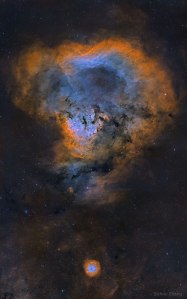
NGC 7822: Cosmic Question Mark
Image Credit & Copyright: Yizhou ZhangExplanation: It may look like a huge cosmic question mark, but the big question really is how does the bright gas and dark dust tell this nebula’s history of star formation. At the edge of a giant molecular cloud toward the northern constellation Cepheus, the glowing star forming region NGC 7822 lies about 3,000 light-years away. Within the nebula, bright edges and dark shapes stand out in this colorful and detailed skyscape. The 9-panel mosaic, taken over 28 nights with a small telescope in Texas, includes data from narrowband filters, mapping emission from atomic oxygen, hydrogen, and sulfur into blue, green, and red hues. The emission line and color combination has become well-known as the Hubble palette. The atomic emission is powered by energetic radiation from the central hot stars. Their powerful winds and radiation sculpt and erode the denser pillar shapes and clear out a characteristic cavity light-years across the center of the natal cloud. Stars could still be forming inside the pillars by gravitational collapse but as the pillars are eroded away, any forming stars will ultimately be cut off from their reservoir of star stuff. This field of view spans over 40 light-years across at the estimated distance of NGC 7822.
Discover the cosmos! Each day a different image or photograph of our fascinating universe is featured, along with a brief explanation written by a professional astronomer.
[I cannot get the video for today to copy anywhere that I can upload it from so instead here is a link that will take you to view it) From NASA.gov – Full Moon Silhouettes
Discover the cosmos! Each day a different image or photograph of our fascinating universe is featured, along with a brief explanation written by a professional astronomer.
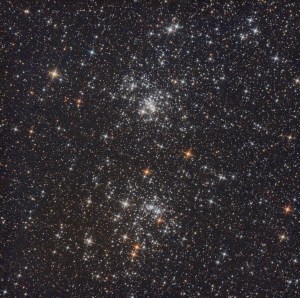
Explanation: This pretty starfield spans about three full moons (1.5 degrees) across the heroic northern constellation of Perseus. It holds the famous pair of open star clusters, h and Chi Persei. Also cataloged as NGC 869 (top) and NGC 884, both clusters are about 7,000 light-years away and contain stars much younger and hotter than the Sun. Separated by only a few hundred light-years, the clusters are both 13 million years young based on the ages of their individual stars, evidence that they were likely a product of the same star-forming region. Always a rewarding sight in binoculars, the Double Cluster is even visible to the unaided eye from dark locations. But a shroud of guitar strings was used to produce diffraction spikes on the colorful stars imaged in this
View our recorded Event Planning Webinar, and join the virtual Global Moon Party on October 9, for resources and activities that can take your International Observe the Moon Night to the next level.
Discover the cosmos! Each day a different image or photograph of our fascinating universe is featured, along with a brief explanation written by a professional astronomer.
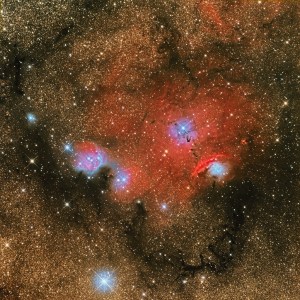
NGC 6559: East of the Lagoon
Image Credit & Copyright:Roberto SartoriExplanation: Slide your telescope just east of the Lagoon Nebula to find this alluring field of view in the rich starfields of the constellation Sagittarius toward the central Milky Way. Of course the Lagoon nebula is also known as M8, the eighth object listed in Charles Messier’s famous catalog of bright nebulae and star clusters. Close on the sky but slightly fainter than M8, this complex of nebulae was left out of Messier’s list though. It contains obscuring dust, striking red emission and blue reflection nebulae of star-forming region NGC 6559 at right. Like M8, NGC 6559 is located about 5,000 light-years away along the edge of a large molecular cloud. At that distance, this telescopic frame nearly 3 full moons wide would span about 130 light-years.
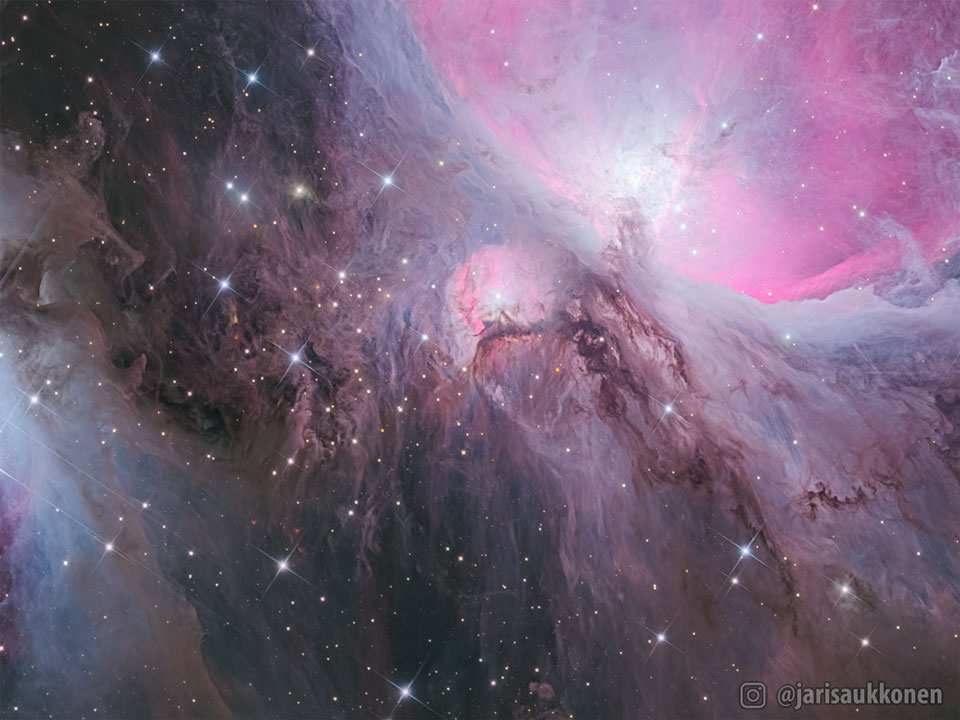
Image Credit & Copyright: Jari SaukkonenExplanation: Where do the dark streams of dust in the Orion Nebula originate? This part of the Orion Molecular CloudComplex, M43, is the often imaged but rarely mentioned neighbor of the more famous M42. M42, seen in part to the upper right, includes many bright stars from the Trapezium star cluster. M43 is itself a star forming region that displays intricately-laced streams of dark dust — although it is really composed mostly of glowing hydrogen gas. The entire Orion field is located about 1600 light years away. Opaque to visible light, the picturesque dark dust is created in the outer atmosphere of massive cool stars and expelled by strong outer winds of protons and electrons.
Discover the cosmos! Each day a different image or photograph of our fascinating universe is featured, along with a brief explanation written by a professional astronomer.
2021 October 3
The Holographic Principle and a Teapot
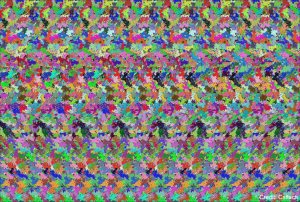
Image Credit: CaltechExplanation: Sure, you can see the 2D rectangle of colors, but can you see deeper? Counting color patches in the featured image, you might estimate that the most information that this 2D digital image can hold is about 60 (horizontal) x 50(vertical) x 256 (possible colors) = 768,000 bits. However, the yet-unproven Holographic Principle states that, counter-intuitively, the information in a 2D panel can include all of the information in a 3D room that can be enclosed by the panel. The principle derives from the idea that the Planck length, the length scale where quantum mechanics begins to dominate classical gravity, is one side of an area that can hold only about one bit of information. The limit was first postulated by physicist Gerard ‘t Hooft in 1993. It can arise from generalizations from seemingly distant speculation that the information held by a black hole is determined not by its enclosed volume but by the surface area of its event horizon. The term “holographic” arises from a hologram analogy where three-dimension images are created by projecting light through a flat screen. Beware, some people staring at the featured image may not think it encodes just 768,000 bits — nor even 2563,000 bit permutations — rather they might claim it encodes a three-dimensional teapot.
Discover the cosmos! Each day a different image or photograph of our fascinating universe is featured, along with a brief explanation written by a professional astronomer.
2021 October 2
A Light and Dusty Night
Image Credit & Copyright:Rodrigo GuerraExplanation: Posing as a brilliant evening star, Venus lies near the western horizon in this southern hemisphere, early spring, night skyscape. To create the composite view exposures tracking the sky and fixed for the foreground were taken on September 25 from Cascavel in southern Brazil. In view after sunset, Venus appears immersed in a cone of zodiacal light, sunlight scattered from dust along the Solar System’s ecliptic plane. In fact from either hemisphere of planet Earth, zodiacal light is most visible after sunset near a spring equinox, (or before sunrise near an autumn equinox) when its luminous arc lies at steep angles to the horizon. Extending above the sunset on this night, the zodiacal light reaches toward rich starfields and immense interstellar dust clouds in the bulge of the central Milky Way. Follow along the Milky Way from the central bulge back toward the horizon and you’ll spot the closest star system to the Sun, Alpha Centauri, a mere 4.37 light-years away.
Discover the cosmos! Each day a different image or photograph of our fascinating universe is featured, along with a brief explanation written by a professional astronomer.
Explanation: Gorgeous spiral galaxy M33 seems to have more than its fair share of glowing hydrogen gas. A prominent member of the local group of galaxies, M33 is also known as the Triangulum Galaxy and lies a mere 3 million light-years away. Sprawling along loose spiral arms that wind toward the core, M33’s giant HII regions are some of the largest known stellar nurseries, sites of the formation of short-lived but very massive stars. Intense ultraviolet radiation from the luminous massive stars ionizes the surrounding hydrogen gas and ultimately produces the characteristic red glow. To highlight the HII regions in this telescopic image, broadband data used to produce a color view of the galaxy were combined with narrowband data recorded through a hydrogen-alpha filter, transmitting the light of the strongest hydrogen emission line. Close-ups of cataloged HII regions appear in the sidebar insets. Use the individual reference number to find their location within the Triangulum Galaxy. For example, giant HII region NGC604 is identified in an inset on the right and appears at position number 15. That’s about 4 o’clock from galaxy center in this portrait of M33.
Gigantic Jet Lightning from Puerto Rico Video Credit & Copyright: Frankie LucenaExplanation: Have you ever seen a gigantic jet? They are extremely rare but tremendously powerful. Gigantic jets are a type of lightning discharge documented only this century that occur between some thunderstorms and the Earth’s ionosphere high above them. Pictured above is the middle and top of one such jet caught last week by a lightning and meteor camera from PuertoRico, USA. The jet traversed perhaps 70 kilometers in just under one second. Gigantic jets are much different from regular cloud-to-cloud and cloud-to-ground lightning. The bottoms of gigantic jets appear similar in appearance to another type cloud-to-above strike called blue jets, while the tops appear similar to upper-atmospherered sprites. Although the mechanism and trigger that causes gigantic jets is a topic of research, it is clear that the jets reduce charge imbalance between different parts of Earth’s atmosphere. A good way to look for gigantic jets is to watch a powerful but distant thunderstorm from a clear location.
Discover the cosmos! Each day a different image or photograph of our fascinating universe is featured, along with a brief explanation written by a professional astronomer.
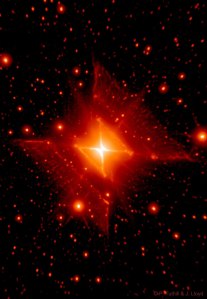
Explanation: How did a round star create this square nebula? No one is quite sure. The round star, known as MWC 922 and possibly part of a multiple star system, appears at the center of the Red Square Nebula. The featured image combines infrared exposures from the Hale Telescope on Mt. Palomar in California, and the Keck-2 Telescope on Mauna Kea in Hawaii. A leading progenitor hypothesis for the square nebula is that the central star or stars somehow expelled cones of gas during a late developmental stage. For MWC 922, these cones happen to incorporate nearly right angles and be visible from the sides. Supporting evidence for the cone hypothesis includes radial spokes in the image that might run along the cone walls. Researchers speculate that the cones viewed from another angle would appear similar to the gigantic rings of supernova 1987A, possibly indicating that a star in MWC 922 might one day itself explode in a similar supernova.
Discover the cosmos! Each day a different image or photograph of our fascinating universe is featured, along with a brief explanation written by a professional astronomer.
Explanation: Stars are forming in dark, dusty molecular cloud LDN 988. Seen near picture center some 2,000 light-years distant, LDN 988 and other nearby dark nebulae were cataloged by Beverly T. Lynds in 1962 using Palomar Observatory Sky Survey plates. Narrowband and near-infrared explorations of the dark nebula reveal energetic shocks and outflows light-years across associated with dozens of newborn stars. But in this sharp optical telescopic view, the irregular outlines of LDN 988 and friends look like dancing stick figures eclipsing the rich starfields of the constellation Cygnus. From dark sites the region can be identified by eye alone. It’s part of the Great Rift of dark clouds along the plane of the Milky Way galaxy known as the Northern Coalsack.









You must be logged in to post a comment.