

Category: Daily Posts
A Thought for Today
Until we meet again dear sisters, brothers, and honored guests may your life be filled with all things positive!
June 29 Astronomy Picture of the Day
Discover the cosmos! Each day a different image or photograph of our fascinating universe is featured, along with a brief explanation written by a professional astronomer.
2022 June 29
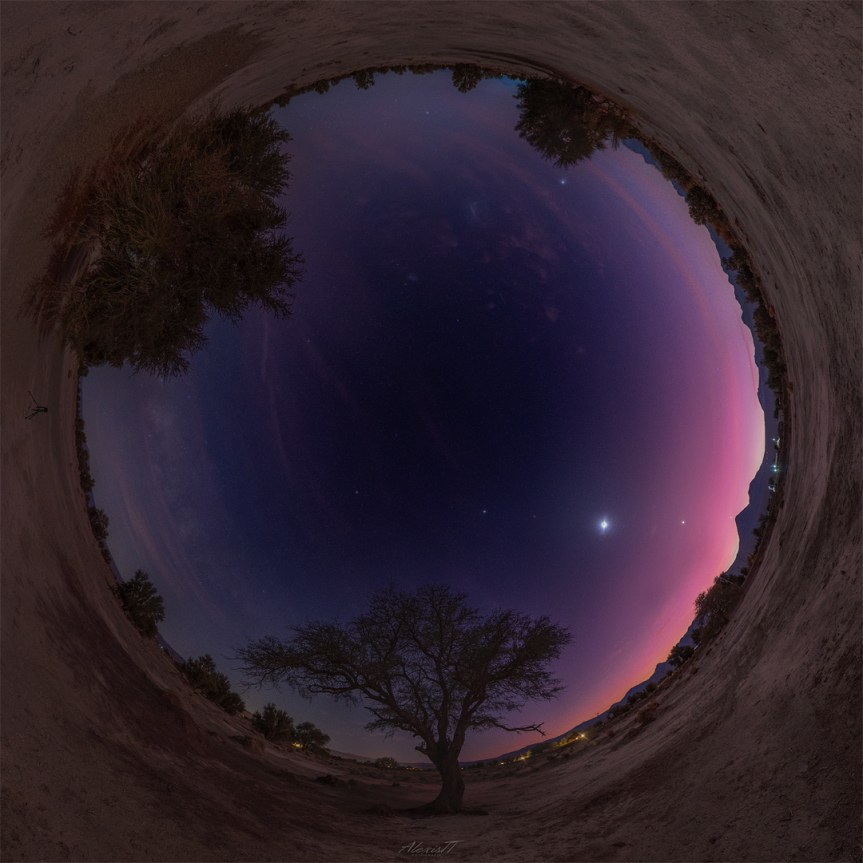
Solar System Family Portrait
Image Credit & Copyright: Alexis Trigo
Explanation: Yes, but have you ever seen all of the planets at once? A rare roll-call of planets has been occurring in the morning sky for much of June. The featured fisheye all-sky image, taken a few mornings ago near the town of San Pedro de Atacama in Chile, caught not only the entire planet parade, but the Moon between Mars and Venus. In order, left to right along the ecliptic plane, members of this Solar System family portrait are Earth, Saturn, Neptune, Jupiter, Mars, Uranus, Venus, Mercury, and Earth. To emphasize their locations, Neptune and Uranus have been artificially enhanced. The volcano just below Mercury is Licancabur. In July, Mercury will move into the Sun’s glare but reappear a few days later on the evening side. Then, in August, Saturn will drift past the direction opposite the Sun and so become visible at dusk instead of dawn. The next time that all eight planets will be simultaneously visible in a morning sky will be in 2122.
Notable Submissions to APOD: Morning Planet Parade 2022 June
A Laugh for Today

You guys too!
We can all fly by the dark of the Moon and wonder at the stars and planet all around us in our vast universe. Just have to be careful of all the sky rise buildings or splat we will go.
A Thought for Today

Until we meet again dear sisters, brothers, and honored guests may your life be filled with all things positive!
June 28 Astronomy Picture of the Day
Discover the cosmos! Each day a different image or photograph of our fascinating universe is featured, along with a brief explanation written by a professional astronomer.
2022 June 28
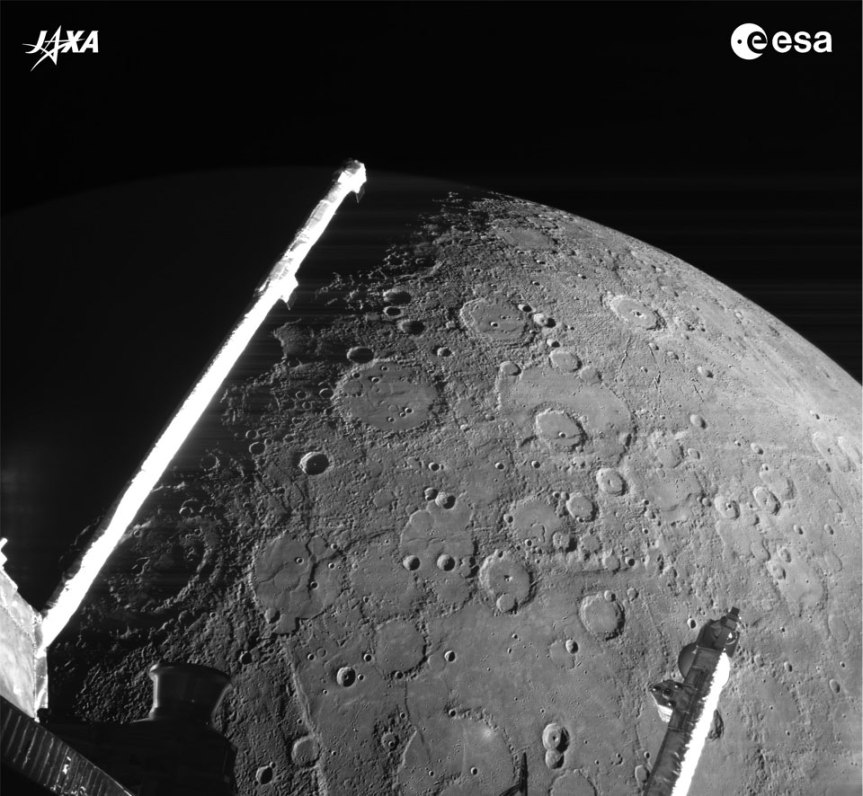
Mercury from Passing BepiColombo
Image Credit & License: ESA, JAXA, BepiColombo, MTM
Explanation: Which part of the Moon is this? No part — because this is the planet Mercury. Mercury’s old surface is heavily cratered like that of Earth’s Moon. Mercury, while only slightly larger than Luna, is much denser and more massive than any Solar System moon because it is made mostly of iron. In fact, our Earth is the only planet more dense. Because Mercury rotates exactly three times for every two orbits around the Sun, and because Mercury’s orbit is so elliptical, visitors on Mercury could see the Sun rise, stop in the sky, go back toward the rising horizon, stop again, and then set quickly over the other horizon. From Earth, Mercury’s proximity to the Sun causes it to be visible only for a short time just after sunset or just before sunrise. The featured image was captured last week by ESA and JAXA‘s passing BepiColombo spacecraft as it sheds energy and prepares to orbit the innermost planet starting in 2025.
A Laugh for Today

If I had only remembered to get creamer 😥
A Thought for Today

Until we meet again dear sisters, brothers, and honored guests may your life be filled with all things positive!
June 27 Astronomy Picture of the Day
Discover the cosmos! Each day a different image or photograph of our fascinating universe is featured, along with a brief explanation written by a professional astronomer.
2022 June 27

The Gum Nebula over Snowy Mountains
Image Credit & Copyright: Wang Jin
Explanation: The Gum Nebula is so large and close it is actually hard to see. This interstellar expanse of glowing hydrogen gas frequently evades notice because it spans 35 degrees — over 70 full Moons — while much of it is quite dim. This featured spectacular 90-degree wide mosaic, however, was designed to be both wide and deep enough to bring up the Gum — visible in red on the right. The image was acquired late last year with both the foreground — including Haba Snow Mountain — and the background — including the Milky Way’s central band — captured by the same camera and from the same location in Shangri-La, Yunnan, China. The Gum Nebula is so close that we are only about 450 light-years from the front edge, while about 1,500 light-years from the back edge. Named for a cosmic cloud hunter, Australian astronomer Colin Stanley Gum (1924-1960), the origin of this complex nebula is still being debated. A leading theory for the origin of the Gum Nebula is that it is the remnant of a million year-old supernova explosion, while a competing theory holds that the Gum is a molecular cloud shaped over eons by multiple supernovas and the outflowing winds of several massive stars.
A Laugh for Today

Time to start the countdown for next weekend
Please Say a Prayer or Light a Candle
My middle son’s father is going through a very rough time physically because of a few different medical problems he has. He is in the emergency room right now with kidney problems and an erratic heartbeat. He can use all the healing energy and spiritual support we are willing to give him.
A Thought for Today

Until we meet again dear sisters, brothers, and honored guests may your life be filled with all things positive!
June 26 Astronomy Picture of the Day
Discover the cosmos! Each day a different image or photograph of our fascinating universe is featured, along with a brief explanation written by a professional astronomer.
2022 June 26
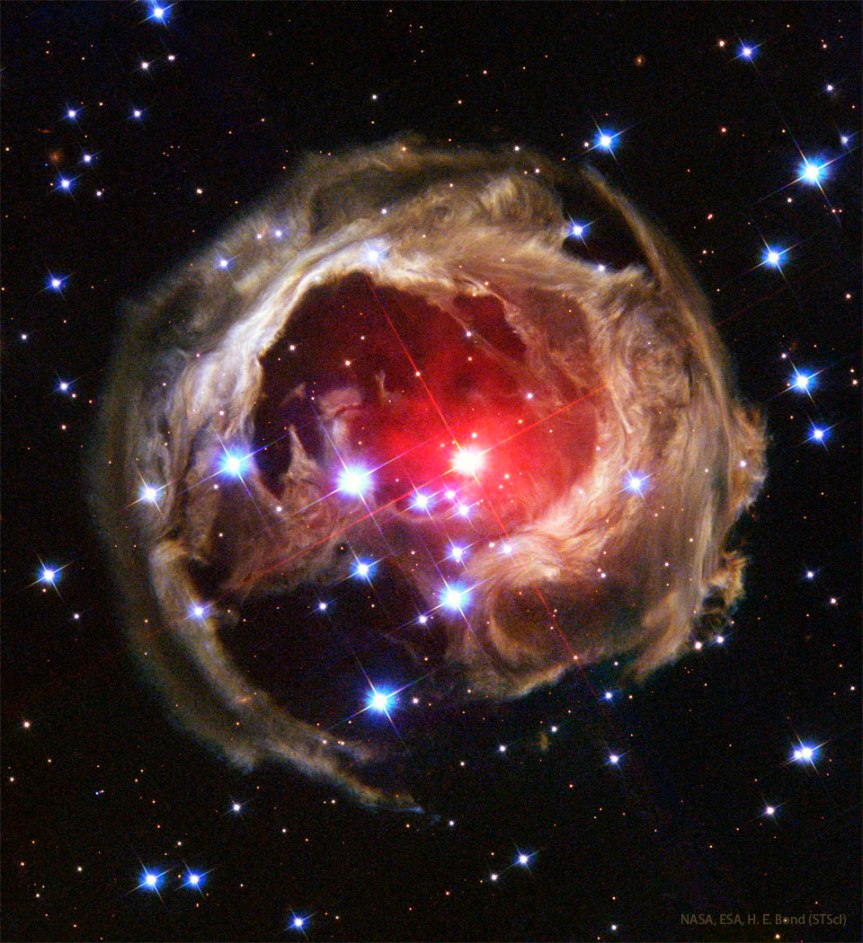
Light Echoes from V838 Mon
Image Credit: NASA, ESA, H. E. Bond (STScI)
Explanation: What caused this outburst of V838 Mon? For reasons unknown, star V838 Mon‘s outer surface suddenly greatly expanded with the result that it became one of the brighter stars in the Milky Way Galaxy in early 2002. Then, just as suddenly, it shrunk and faded. A stellar flash like this had never been seen before — supernovas and novas expel matter out into space. Although the V838 Mon flash appears to expel material into space, what is seen in the featured image from the Hubble Space Telescope is actually an outwardly expanding light echo of the original flash. In a light echo, light from the flash is reflected by successively more distant surfaces in the complex array of ambient interstellar dust that already surrounded the star. V838 Mon lies about 20,000 light years away toward the constellation of the unicorn (Monoceros), while the light echo above spans about six light years in diameter.
A Laugh for Today

Marble head of Hercules pulled up from Roman shipwreck site in Greece
For archaeologists, it’s the underwater find that keeps on giving. A Roman-era cargo ship, discovered by chance off the Greek island of Antikythera more than 120 years ago and regarded as the world’s richest ancient shipwreck, has yielded yet more treasures in the most recent explorations of it, including the missing head of a statue of the demigod Hercules.
“In 1900, [sponge divers] pulled out the statue of Hercules [from the sea] and now in all probably we’ve found its head,” said Prof Lorenz Baumer, the classical archaeologist who is overseeing the underwater mission with the University of Geneva.
“It’s a most impressive marble piece,” he said, describing characteristics that bore all the hallmarks of one of the great heroic figures of Greek and …
Click here to read the rest of this article
A Thought for Today

Until we meet again dear sisters, brothers, and honored guests may your life be filled with all things positive!
Some of the Witchcraft/Magickal Correspondence Digest for Saturday
Magickal Intentions: Spirit Communications, Meditation, Psychic Attack or Defense, Locating Lost Things and Missing Persons, Building, Life, Doctrine, Protection, Knowledge, Authority, Limitations, Boundaries, Time and Death
Incense: Black Poppy Seed and Myrrh
Planet: Saturn
Sign: Capricorn and Aquarius
Angel: Cassel
Colors: Black, Grey and Indigo
Herbs/Plants: Myrrh, Moss, Hemlock, Wolfsbane, Coltsfoot, Nightshade and Fir
Stones: Jet, Smokey Quartz, Amethyst, Black Onyx, Snowflake Obsidian, Lava, Pumice
Oil: (Saturn) Cypress, Mimosa, Myrrh, Patchouli
Saturn lends its energies to the last day of the week. Because Saturn is the planet of karma, this day is an excellent time for spellwork involving reincarnation, karmic lessons, the Mysteries, wisdom, and long-term projects.
It is also a good time to being efforts that deal with the elderly, death, or the eradication of pests and disease.
June 25 Astronomy Picture of the Day
Discover the cosmos! Each day a different image or photograph of our fascinating universe is featured, along with a brief explanation written by a professional astronomer.
2022 June 25

Planets of the Solar System
Image Credit & Copyright: Antonio Canaveras, Chiara Tronci, Giovanni Esposito, Giuseppe Conzo, Luciana Guariglia, (Gruppo Astrofili Palidoro)
Explanation: Simultaneous images from four cameras were combined to construct this atmospheric predawn skyscape. The cooperative astro-panorama captures all the planets of the Solar System, just before sunrise on June 24. That foggy morning found innermost planet Mercury close to the horizon but just visible against the twilight, below and left of brilliant Venus. Along with the waning crescent Moon, the other bright naked-eye planets, Mars, Jupiter, and Saturn lie near the ecliptic, arcing up and to the right across the wide field of view. Binoculars would have been required to spot the much fainter planets Uranus and Neptune, though they also were along the ecliptic in the sky. In the foreground are excavations at an ancient Roman villa near Marina di San Nicola, Italy, planet Earth.
A Laugh for Today

Have a spectacular Saturday!
Some of the Witchcraft/Magickal Correspondence Digest for Friday
Venus/Water/East/West/South/Dawn/Female/Libra/Taurus
Magickal Intentions: Love, Romance, Marriage, Sexual Matters, Physical Beauty, Friendship and Partnerships, Strangers, Heart
Color: aqua, blue, light blue, brown, green, pale green, magenta, peach, pink, rose, white, all pastels
Number: 5, 6
Metal: copper
Charm: green or white garments, scepter
Stone: alexandrite, amethyst, coral, diamond, emerald, jade, jet, black moonstone, peridot, smoky quartz, tiger’s-eye, pink tourmaline
Animal: camel, dove, elephant, goat, horse, pigeon, sparrow
Plant: apple, birch, cherry, clematis, clove, coriander, heather, hemlock, hibiscus, ivy, lotus, moss, myrtle, oats, pepperwort, peppermint, pinecone, quince, raspberry, rose, pink rose, red rose, rose hips, saffron, sage, savin, stephanotis, strawberry, thyme, vanilla, verbena, violet, water lily, yarrow, and all flowers
Incense: ambergris, camphor, mace, musk, myrrh, rose, saffron, sage, sandalwood, sweetgrass, vanilla, violet, all floral scents
Goddess: Aphrodite, Asherah, Baalith, Brigid, Erzulie, Freya (Passionate Queen), Frigg, Gefion, Harbor (Beautiful One), Hestia, Inanna, Ishtar (Lady of Passion and Desire), Lakshmi, Lilith, Mokosh, Nehalennia, Nerthus, Ostara, Pombagira, Sarasvati, Shakti, Shekinah, Sirtur, Al Uzza, Venus (Queen of Pleasure), Vesta
God: Allah, Bacchus, Bes, Cupid, the Dagda, Dionysus, El, Eros (God of Love), Freyr, Frit Ailek, Shukra
Evocation: Agrat Bat Mahalat, Anael, Hagiel, Mokosba, Rasbid, Sachiel, Uriel, Velas



You must be logged in to post a comment.