Elder’s Meditation of the Day – November 1

Elder’s Meditation of the Day – November 1

“Times change but principles don’t. Times change but lands do not. Times change but our culture and our language remain the same. And that’s what you have to keep intact. It’s not what you wear – it’s what’s in your heart.”

–Oren Lyons, ONONDAGA

Going back to the old ways doesn’t mean giving up electricity, homes and cars. It means living by the same principles, laws and values that our ancestors lived by. This will allow us to live successfully in today’s world. The spirituality our ancestors lived is the same spirituality we need in these modern times. There are too many influences from TV, radio, newspapers, magazines and negative role models that are guiding our lives in a bad way. Our stability is in the laws, principles and values that our ancestors were given and that our Elders teach us.

Great Spirit, let me live my life in a spiritual way.

*<<<=-=>>>*<<<=-=>>>*<<<=-=>>>*<<<=-=>>>*

November 1 – Daily Feast

November 1 – Daily Feast


ELEVEN
Du

BIG TRADING MONTH
Nu Da Na ‘Egwa

Great Spirit, the council here assembled, the aged men and women, the strong warriors, the women and children, unite their voice of thanksgiving to Thee. Na-Ho!

IROQUOIS THANKSGIVING FESTIVAL

November 1 – Daily Feast

The danger point comes after a victory when we think there are no more battles. How many wars have been fought thinking this is the war that will end all wars? Even in our own private battles we cannot lie back and think we have won the right to peace. We do need to know and remember that we are more than conquerors. It is a life promise, but we have to claim it. Other claims have taken precedence – weariness, lack, sickness – but we are conquerors, even more than conquerors. We are winners and overcomers. Believe it, because it is true, and the more we claim it, the stronger it is.

~ Where is our strength? In the old times we were strong. ~

CHIPAROPAI – YUMA

‘A Cherokee Feast of Days, Volume II’ by Joyce Sequichie Hifler

*<<<=-=>>>*<<<=-=>>>*<<<=-=>>>*<<<=-=>>>*

Earth Science Pic of the Day

Fiery Sunrise

Fierysunrise


Photographer: Mitch Englebrecht
Summary Author: Mitch Englebrecht; Jim Foster


The photo above showing a fiery sunup was captured near Colorado Springs, Colorado in late winter of 2008. Neither telephone poles nor wires could detract from this glowing dawn. The increased path-length of sunlight when the Sun is near the horizon, in the presence of mid and high altitude clouds, accounts for the vivid coloration of many sunrises and sunsets, including this one.

Astronomy Picture of the Day

Astronomy Picture of the Day

Discover the cosmos!Each day a different image or photograph of our fascinating universe is featured, along with a brief explanation written by a professional astronomer.

2011 November 1
See Explanation.  Clicking on the picture will downloadthe highest resolution version available.

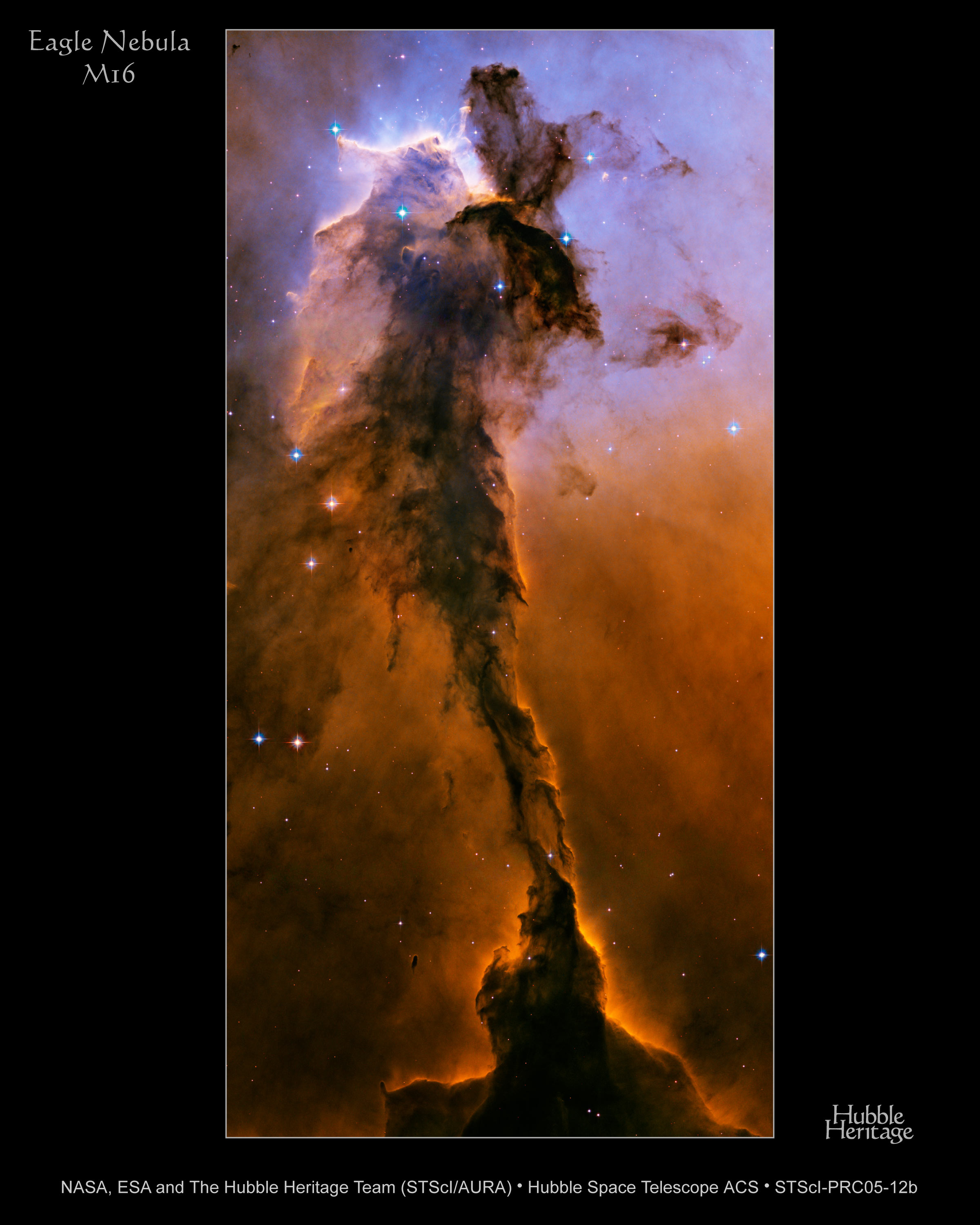
The Fairy of Eagle Nebula
Image Credit: The Hubble Heritage Team, (STScI/AURA), ESA, NASA 

Explanation: The dust sculptures of the Eagle Nebula are evaporating. As powerful starlight whittles away these cool cosmic mountains, the statuesque pillars that remain might be imagined as mythical beasts. Pictured above is one of several striking dust pillars of the Eagle Nebula that might be described as a gigantic alien fairy. This fairy, however, is ten light years tall and spews radiation much hotter than common fire. The greater Eagle Nebula, M16, is actually a giant evaporating shell of gas and dust inside of which is a growing cavity filled with a spectacular stellar nursery currently forming an open cluster of stars. The above image in scientifically re-assigned colors was released in 2005 as part of the fifteenth anniversary celebration of the launch of the Hubble Space Telescope.

Your Daily Number for November 1: 1

Exercise leadership today, and don’t hesitate to push your ideas and agenda forward. Others will look to you for direction. You’re also likely to meet someone new. Today is a day of progress if you don’t let fear get in the way.

Fast Facts

About the Number 1

Theme: Masculine, Creative, Independent, Aggressive
Astro Association: Mercury
Tarot Association: Magician

Today’s I Ching Hexagram for November 1 is 44:Liaison

44: Liaison

Hexagram 44

General Meaning: The attraction is strong, but the relationship is not destined to last. So, be careful — the magnetism of polarized forces may not be what it seems. An apparently harmless, but potentially dangerous, energy has attracted attention to itself and is pulling on a stronger one. The ancient image is of a bold but immature girl who uses her charms to gain influence with a stable, powerful man. The man dallies with her, thinking that it can do him no harm. Ha, famous last thoughts! When power shifts into the hands of those unprepared for it, harm comes to all parties.

Still, you need not fear meetings with those whose positions are widely different from your own, as long as you can remain free of ulterior motives.

Be especially wary of temptations that arise because of your connections to important people. Generally, it is best to combat such temptations by snipping them in the bud before they can flower. Just as soon as a dangerous liaison presents itself is the time to take note and speak up. On the other hand, there are times when the meeting of the yielding and the strong turn out to be opportunities for truly positive and constructive relationships. The difference between careless connection and a relationship of depth lies in the motives of the heart. How sincere are you?

Today’s Runes for November 1 is Eoh

Today’s Runes

Ice Runes are most commonly used for questions about struggle, conflict, and achievement. Eoh refers to the Yew tree. The Yew does not go dormant and therefore represents endurance. Even the wood of the tree is strong, resilient, and pliable – the Yew bends, but does not break. The evergreen nature of the Yew is present even in the rune itself, as it cannot be changed even by reversal. This rune is historically symbolic of death, but, as in the Tarot and as suggested by the nature of the Yew tree itself, death is seen only as a transmutation of something eternal and unchanging – the spirit.

Today’s Tarot Card for November 1 is The Emperor

The Emperor

This Tarot Deck: Tarot of the Witches

General Meaning: In the most practical terms, what has traditionally been called the Emperor card represents the highest leadership, a head of state or the most exemplary and powerful person in the realm. This archetypal ruler is responsible for the positive working out of affairs of a society or community, which are directly proportional to his well being and happiness.

The more enlightenment and cosmic perspective this energy brings, the better life is for all. The Emperor archetype masters the world of matter and physical manifestation. When you apply this card to your situation, acknowledge your potentials for mastery. Reinforce a sense of sovereignty within yourself, despite any self-limiting beliefs, habits or appearances to the contrary.

Your Daily Horoscopes for Monday, Nov. 1

We are reminded of the differences between logic and imagination today as rational Mercury squares intuitive Neptune. This creative yet oftentimes confusing aspect comes on the heels of yesterday’s Venus-Neptune square, so our unrealistic desires are mixed with dreamy thoughts. However, the sensible Capricorn Moon helps us turn our fantasies into reality. The air begins to clear when the Moon shifts into intellectual Aquarius at 6:07 pm EDT.


Aries Horoscope
Aries Horoscope (Mar 21 – Apr 19)

You may not know what to do with the brilliant ideas that pop into your head today. Ironically, friends and coworkers become less convinced that your approach will work the more you try to explain it. They may agree with your position, but they’re not sure that you can transform your clever strategy into a practical plan. It won’t help to ramble on about what you will do. Save your long speeches for another time; for now, lead with actions rather than words.

Taurus Horoscope
Taurus Horoscope (Apr 20 – May 20)

You believe that you’re being very realistic, but you probably won’t have such a firm grip on reality today. At first you may persuade others that you’re in control, but you are more likely to confuse them as you contradict yourself later on. Although you’re able to explain a complicated concept now, it’s more challenging to just give simple directions. Be smart and let someone else temporarily hold the reins of control.

Gemini Horoscope
Gemini Horoscope (May 21 – Jun 20)

Your key planet Mercury is in its trickster mode today as it squares irrational Neptune. You may try to think clearly, but it’s challenging to finish sentences when your ideas float off into the mists of illusion and fantasy. Remember your analytical process is muddled now, so don’t be overly certain about what you know. Wait a couple of days before reconsidering your options.

Cancer Horoscope
Cancer Horoscope (June 21 – Jul 22)

You may be better off today by remaining as silent as possible. If you avoid saying too much, you can come out of a tangled emotional web appearing as if you are a real hero. Although it could be difficult to see both sides of a conflict now, you still realize that there’s no single straightforward solution. Pretending to have the answer will probably just create disappointment; your wisest strategy is to wait it out. If you have something crucial to add to the discussion, it will be even more relevant in a day or two.

Leo Horoscope
Leo Horoscope (Jul 23 – Aug 22)

It’s very reassuring when your personal goals are consistent with your actual duties at work. However, it can be quite disconcerting now if they’re not. Your current situation may be complicated by a friend or business partner who isn’t communicating clearly. If you’re trying to finalize a decision, it would be better to have the support of those around you. Be patient; others will begin to cooperate more in the days ahead.

Virgo Horoscope
Virgo Horoscope (Aug 23 – Sep 22)

This can be an unusual but exciting day when you’re more inclined to tell a story or write a poem than act in a fully rational manner. You want everyone to acknowledge how clever you are, but it isn’t easy to concentrate on details today. Don’t set yourself up for failure by trying to deliver something beyond your current capability. Give yourself permission to lose yourself in a daydream; you can always return to your work tomorrow.

Libra Horoscope
Libra Horoscope (Sep 23 – Oct 22)

Your sign of The Scales symbolizes your commitment to seeking balance, even when it’s elusive. You might end up spinning your wheels today if you think you can use logic to find the calm center of the storm. But you won’t re-establish your center of gravity by keeping still; instead of sitting in a yoga pose, imagine that you are a figure skater in motion. Your easy grace arises from being one with the flow rather than trying to cling to the status quo.

Scorpio Horoscope
Scorpio Horoscope (Oct 23 – Nov 21)

You aren’t in the mood to argue with anyone who seems to know all the answers since you don’t feel the need to prove anything. However, it won’t help if you just walk away from a discussion simply because you’re afraid that a disagreement will ensue. Remember that it always takes two to create conflict. Demonstrate your wisdom by remaining clear about your facts and beliefs without having to compete with others.

Sagittarius Horoscope
Sagittarius Horoscope (Nov 22 – Dec 21)

You can turn a rather mundane day into an exciting one as long as you don’t attempt to resolve the dualistic way you approach life today. On one hand, you’re thinking like an analytical scientist, carefully observing your current situation in a cool and detached manner. But on the other hand, you’re like an artist, directly engaging your experiences by responding with a wide spectrum of emotions. Each method has something of value to offer, so tune in to your head and your heart at the same time without closing down either one.

Capricorn Horoscope
Capricorn Horoscope (Dec 22 – Jan 19)

You want to believe that your instincts won’t steer you wrong because the Moon is back in your pragmatic sign. However, you may have temporarily lost your ability to separate threads that are spun in your imagination from those that are woven with reality. Normally you are a champ at keeping fact and fiction distinct, yet now the fabric of life contains both. Don’t overanalyze what’s happening; just appreciate the magic of what you can create.

Aquarius Horoscope
Aquarius Horoscope (Jan 20 – Feb 18)

You are motivated to communicate the recent vague visions you’ve been having, but the more you try to describe them, the less others understand. Your thoughts are elusive and cannot easily fit into words, unless you have a particular spiritual discipline that helps you to frame your experience. Awakening your inner artist, poet or mystic, however, can help you explain the subtleties of your current perspective.

Pisces Horoscope
Pisces Horoscope (Feb 19 – Mar 20)

Logical Mercury is forming a creative square with your ruling planet Neptune, opening your imagination to realities that exist beyond the realm of language. This can be very confusing if you want to be specific in your communication today. Unfortunately, even the most basic ideas are slippery now. Instead of increasing your frustration by trying to manage too many details, put this kind of work off until tomorrow when your concentration returns.

the daily humorscopes for tuesday, november 1st

the daily humorscope

Tuesday, November 01, 2011


Aries (March 21 – April 19)
You will be harassed by cats today. Hungry, irritable cats.
Taurus (April 20 – May 20)
Beware of celery.
Gemini (May 21 – June 20)
Beware of giant squids today. Other than that, a good day for a nice walk along the beach.
Cancer (June 21 – July 22)
Unleash the power you have chained inside you! Just don’t let it make those annoying “yip yip yip” sounds or pee on the lawn, this time.
Leo (July 23 – August 22)
Everyone you work with will start spending a lot of time balancing things on their nose. This could be bad. You may have a renegade seal trainer lurking in your midst!
Virgo (August 23 – September 22)
Noodle day #2! “The Revenge Of The Noodle”. Today you will learn to make a really killer recipe for Szechwan noodles, which will contain both chili-garlic paste and whole peanuts.
Libra (September 23 – October 22)
You will develop a sudden bizarre craving for a bologna sandwich on white bread with mayonnaise and iceberg lettuce. Fight it!
Scorpio (October 23 – November 21)
Today you will turn over a new leaf. Good for you! We were all getting a little tired of you, you know, as you were.
Sagittarius (November 22 – December 21)
You will have an odd dream in which a stadium filled with dogs looks on while a group of wiry runners chases a bunny around a track. The bunny will be Miss April, I believe.
Capricorn (December 22 – January 20)
Try to avoid nibbling on things today. Despite recent developments, you don’t actually know your friend that well yet.
Aquarius (January 21 – February 18)
Good time to institute “show and tell” at the office. Why should kids have all the fun? You could break the ice by bringing in your stamp collection, no?
Pisces (February 19 – March 20)
Someone will ask you if you like Swing music. That’s when you’ll have to be a bit creative, if you don’t want to look ignorant. I generally shrug and say “I don’t know – I don’t really spend that much time on the porch.”

It’s November, Can You Believe It? It is also….

Day Of The Dead Comments

Day of the Dead

 Day of the Dead (Spanish: Día de los Muertos) is a holiday celebrated in Mexico and around the world in many cultures. The holiday focuses on gatherings of family and friends to pray for and remember friends and family members who have died. It is particularly celebrated in Mexico, where it attains the quality of a National Holiday. The celebration takes place on November 1–2, in connection with the Catholic holidays of All Saints’ Day (November 1) and All Souls’ Day (November 2). Traditions connected with the holiday include building private altars honoring the deceased using sugar skulls, marigolds, and the favorite foods and beverages of the departed and visiting graves with these as gifts.

Scholars trace the origins of the modern Mexican holiday to indigenous observances dating back hundreds of years and to an Aztec festival dedicated to a goddess called Mictecacihuatl. In Brazil, Dia de Finados is a public holiday that many Brazilians celebrate by visiting cemeteries and churches. In Spain, there are festivals and parades, and, at the end of the day, people gather at cemeteries and pray for their dead loved ones. Similar observances occur elsewhere in Europe, and similarly themed celebrations appear in many Asian and African cultures.

Origin of The Day of the Dead


 The Day of the Dead celebrations in Mexico can be traced back to the indigenous cultures. Rituals celebrating the deaths of ancestors have been observed by these civilizations perhaps for as long as 2,500–3,000 years. In the pre-Hispanic era, it was common to keep skulls as trophies and display them during the rituals to symbolize death and rebirth.

The festival that became the modern Day of the Dead fell in the ninth month of the Aztec calendar, about the beginning of August, and was celebrated for an entire month. The festivities were dedicated to the god known as the “Lady of the Dead”, corresponding to the modern Catrina.

In most regions of Mexico, November 1 honors children and infants, whereas deceased adults are honored on November 2. This is indicated by generally referring to November 1 mainly as Día de los Inocentes (“Day of the Innocents”) but also as Día de los Angelitos (“Day of the Little Angels”) and November 2 as Día de los Muertos or Día de los Difuntos (“Day of the Dead”).

Beliefs and Traditions


People go to cemeteries to be with the souls of the departed and build private altars containing the favorite foods and beverages as well as photos and memorabilia of the departed. The intent is to encourage visits by the souls, so that the souls will hear the prayers and the comments of the living directed to them. Celebrations can take a humorous tone, as celebrants remember funny events and anecdotes about the departed.

Plans for the day are made throughout the year, including gathering the goods to be offered to the dead. During the three-day period, families usually clean and decorate graves; most visit the cemeteries where their loved ones are buried and decorate their graves with ofrendas (“offerings”), which often include orange mexican marigolds (Tagetes erecta) called cempasúchitl (originally named cempoalxochitl, Nahuatl for “twenty flowers”).

In modern Mexico, this name is sometimes replaced with the term Flor de Muerto (“Flower of the Dead”). These flowers are thought to attract souls of the dead to the offerings.


Toys are brought for dead children (los angelitos, or “the little angels”), and bottles of tequila, mezcal or pulque or jars of atole for adults. Families will also offer trinkets or the deceased’s favorite candies on the grave. Ofrendas are also put in homes, usually with foods such as candied pumpkin, pan de muerto (“bread of the dead”), and sugar skulls and beverages such as atole. The ofrendas are left out in the homes as a welcoming gesture for the deceased. Some people believe the spirits of the dead eat the “spiritual essence” of the ofrendas food, so even though the celebrators eat the food after the festivities, they believe it lacks nutritional value. Pillows and blankets are left out so that the deceased can rest after their long journey. In some parts of Mexico, such as the towns of Mixquic, Pátzcuaro and Janitzio, people spend all night beside the graves of their relatives. In many places, people have picnics at the grave site as well.

Some families build altars or small shrines in their homes; these usually have the Christian cross, statues or pictures of the Blessed Virgin Mary, pictures of deceased relatives and other persons, scores of candles and an ofrenda. Traditionally, families spend some time around the altar, praying and telling anecdotes about the deceased. In some locations, celebrants wear shells on their clothing, so that when they dance, the noise will wake up the dead; some will also dress up as the deceased.

Public schools at all levels build altars with ofrendas, usually omitting the religious symbols. Government offices usually have at least a small altar, as this holiday is seen as important to the Mexican heritage.

Those with a distinctive talent for writing sometimes create short poems, called calaveras (“skulls”), mocking epitaphs of friends, describing interesting habits and attitudes or funny anecdotes. This custom originated in the 18th or 19th century, after a newspaper published a poem narrating a dream of a cemetery in the future, “and all of us were dead”, proceeding to “read” the tombstones. Newspapers dedicate calaveras to public figures, with cartoons of skeletons in the style of the famous calaveras of José Guadalupe Posada, a Mexican illustrator. Theatrical presentations of Don Juan Tenorio by José Zorrilla (1817–1893) are also traditional on this day.

A common symbol of the holiday is the skull (colloquially called calavera), which celebrants represent in masks, called calacas (colloquial term for “skeleton”), and foods such as sugar or chocolate skulls, which are inscribed with the name of the recipient on the forehead. Sugar skulls are gifts that can be given to both the living and the dead. Other holiday foods include pan de muerto, a sweet egg bread made in various shapes from plain rounds to skulls and rabbits, often decorated with white frosting to look like twisted bones.

José Guadalupe Posada created a famous print of a figure that he called La Calavera de la Catrina (“calavera of the female dandy”) as a parody of a Mexican upper-class female. Posada’s striking image of a costumed female with a skeleton face has become associated with the Day of the Dead, and Catrina figures often are a prominent part of modern Day of the Dead observances.


The traditions and activities that take place in celebration of the Day of the Dead are not universal and often vary from town to town. For example, in the town of Pátzcuaro on the Lago de Pátzcuaro in Michoacán, the tradition is very different if the deceased is a child rather than an adult. On November 1 of the year after a child’s death, the godparents set a table in the parents’ home with sweets, fruits, pan de muerto, a cross, a rosary (used to ask the Virgin Mary to pray for them) and candles. This is meant to celebrate the child’s life, in respect and appreciation for the parents. There is also dancing with colorful costumes, often with skull-shaped masks and devil masks in the plaza or garden of the town. At midnight on November 2, the people light candles and ride winged boats called mariposas (Spanish for “butterflies”) to Janitzio, an island in the middle of the lake where there is a cemetery, to honor and celebrate the lives of the dead there.


In contrast, the town of Ocotepec, north of Cuernavaca in the State of Morelos, opens its doors to visitors in exchange for veladoras (small wax candles) to show respect for the recently deceased. In return, the visitors receive tamales and atole. This is only done by the owners of the house where somebody in the household has died in the previous year. Many people of the surrounding areas arrive early to eat for free and enjoy the elaborate altars set up to receive the visitors from Mictlán.

In some parts of the country (especially the cities, where in recent years there are displaced other customs), children in costumes roam the streets, knocking on people’s doors for a calaverita, a small gift of candies or money; they also ask passersby for it. This custom is similar to that of Halloween’s trick-or-treating and is relatively recent.

Some people believe that possessing Day of the Dead items can bring good luck. Many people get tattoos or have dolls of the dead to carry with them. They also clean their houses and prepare the favorite dishes of their deceased loved ones to place upon their altar or ofrenda.

 Observances in the United States

In many American communities with Mexican residents, Day of the Dead celebrations are held that are very similar to those held in Mexico. In some of these communities, such as in Texas and Arizona, the celebrations tend to be mostly traditional. For example, the All Souls Procession has been an annual Tucson event since 1990. The event combines elements of traditional Day of the Dead celebrations with those of pagan harvest festivals. People wearing masks carry signs honoring the dead and an urn in which people can place slips of paper with prayers on them to be burned.

In other communities, interactions between Mexican traditions and American culture are resulting in celebrations in which Mexican traditions are being extended to make artistic or sometimes political statements. For example, in Los Angeles, California, the Self Help Graphics & Art Mexican-American cultural center presents an annual Day of the Dead celebration that includes both traditional and political elements, such as altars to honor the victims of the Iraq War highlighting the high casualty rate among Latino soldiers. An updated, inter-cultural version of the Day of the Dead is also evolving at Hollywood Forever Cemetery. There, in a mixture of Mexican traditions and Hollywood hip, conventional altars are set up side-by-side with altars to Jayne Mansfield and Johnny Ramone. Colorful native dancers and music intermix with performance artists, while sly pranksters play on traditional themes.

Similar traditional and inter-cultural updating of Mexican celebrations is occurring in San Francisco, for example, through the Galería de la Raza, SomArts Cultural Center, Mission Cultural Center, de Young Museum and altars at Garfield Square by the Marigold Project. Oakland is home to Corazon Del Pueblo in the Fruitvale district. Corazon Del Pueblo has a shop offering handcrafted Mexican gifts and a museum devoted to Day of the Dead artifacts. In Missoula, Montana, skeletal celebrants on stilts, novelty bicycles, and skis parade through town. It also occurs annually at historic Forest Hills Cemetery in Boston’s Jamaica Plain neighborhood. Sponsored by Forest Hills Educational Trust and the folkloric performance group La Piñata, the Day of the Dead celebration celebrates the cycle of life and death. People bring offerings of flowers, photos, mementos, and food for their departed loved ones, which they place at an elaborately and colorfully decorated altar. A program of traditional music and dance also accompanies the community event.

~Magickal Graphics~

Welcome, Darkest Night

Welcome, Darkest Night

by Janice Van Cleve

I love this season of growing dark. The night starts earlier to cast its blanket of quiet and peace upon the land and calls me to wrap up what I am doing. Early darkness coaxes me to sit down to supper at six o’clock instead of nine, so I can digest properly before I go to sleep. Longer nights delay the prodding light of morning, so I can grab a few more winks. It encourages me to work more efficiently with the daylight that I do have. The dark time of the year is a healthy time for me.

It is a healthy time for plants and animals as well. Perennials focus on building up their root systems during the dark time, and annuals spread their seeds. Leaves fall to the ground to be leached and composted into next year ‘s soil. Animals feast on the yield of crops and orchards and store up surplus to see them through the winter and spring. In the dark time, all nature refocuses on renewing itself, sloughing off that which is no longer necessary and nurturing the best for the new year.

For northern tribes who lived where night falls longest and deepest, the dark time of the year was a time of great creativity. Bards honed their songs and added new verses for the entertainment and education of their audiences. Farmers turned to woodworking to fashion furniture or to decorate the interiors of their homes. Tradespeople made cloth, tools, jewelry, clothes and other goods to sell the merchants when they returned in the spring. Cooks became more and more inventive as the darkness lingered and the variety in the larder grew more limited. Even today, most school and university classes are scheduled for the winter months. In the business world, new product releases from software to movies to automobiles are debuted during this time.

In short, the dark time of the year is a busy, industrious and very creative time for nature and for human activity. So why in modern society does it get such a bad rap? The ancients certainly figured out that spring followed winter every year, and they used their skills to create solstice calculators like Stonehenge to predict how much more winter they had left. Were they really immobilized in fear of the dark, waiting for solstice to give them hope of spring? Or, on the other hand, did they grumble at solstice that they only had a few more months to play, eat, sing and finish their carvings before they had to get back out and work the farm again? Ancient peoples, after all, did not create surpluses for profit or a year-round global economy. They simply raised enough to sustain themselves so they could devote their time to crafts and play.

Perhaps it was the new religion of Christianity that tried to separate light from dark, exalting the former and disparaging the latter. Perhaps it was Christians’ idea to create fear of the dark so they could make light seem like a sort of salvation. However, nature doesn’t seem to need saving from anything, except from human greed. Nature goes on, year after year, with summer and winter alternating appropriate to the latitude. Nature values the dark time as much as the light and uses both to its advantage. The dark time is healthy and wholesome. It is as necessary for life as rain and sun, decay and bacteria.

And so it is appropriate that our pagan new year starts with Samhain, the beginning of the darkest time of the year. We rest before we work. We focus inwardly before we focus on the wider world. We sleep, we feast, we meditate, and we renew ourselves so that when spring’s light returns and calls us to next year’s work we can respond with new health and strength. These are gifts of the dark time. We are fortunate to have them!

To Brew a Cauldron of Roots and Bones

To Brew a Cauldron of Roots and Bones

by Catherine Harper

When the year turns, the earth is less gentle, and the outdoors is no longer safe. The soft green woods of summer are now stripped bare and home to winds and rain. For light and warmth, we must retreat inside, even in the gentle clime of Puget Sound, where we are sheltered by the mountains and the extremities of season are kept at bay by the vast thermal mass of the ocean.

All at once, it seems, it is autumn, and past the drawn-out golden harvest and into the dark days and rain. There may be a few peppers and tomatoes left to us, but the season has turned from fruit to fallow. For the gardener, there are a few hardy greens, the squash lying amidst their shriveling vines and the late apples. For the forager, there are a few roots and the cool-weather fruiting of mushrooms. But the focus has changed from the fields and orchards to the kitchens, pantries and root cellars, from what is fresh to what can be saved for later use.

After the extravagance of the autumn harvest, it is a good time to contemplate the dark season. All that is left of the corn are the stalks in the field; in the orchard, the branches are bare. The supermarkets bring us strange and often illusory delights from far distant lands (yes, one can have hothouse strawberries in winter, or bland and mealy fruits picked too early and ripened far from their trees, but do the limp imitations you may purchase feed your body any better than they do your soul?). But you still may take a step back and look at the land around you, and recall both to the mind and table the humble foods that are still with us.

Consider, then, the onion.

The origins of onions are hidden back in the misty recesses of antiquity. There are wild onions known and enjoyed throughout the world, and by the time the pyramids were built the onion was widely cultivated. Herodotus records indeed that the builders of the pyramids sustained their strength on a diet of “radishes, onions and leeks,” and onions and bread were the staple diet of workers throughout the greater region. The Egyptians honored their onions, and were well-known in the ancient world for the quality of their leeks. But by the Roman period, while the leeks were considered a fit item for the tables of emperors, the onions, though grown in vast quantities, were confirmed in their place on the poor man’s table.

In the garden, it is easy to see why the onion has been so embraced by those lacking in both time and money. It is a hardy plant, resistant to disease and pests, and needing little in the way of cultivation. A bit of rich soil, perhaps a quick weeding once or twice during the year, and the tiny shoots you planted that looked like nothing more than frail blades of grass send up a tower of sturdy, pungent greenery, and then below ground swell into plump bulbs.

In our own kitchens, onions are ever present, and yet little regarded. They are so often used as a flavoring agent that I suspect few people realize how much they contribute to the bulk of a dish, and so ubiquitous that it’s easy to forget how much flavor they add, while their cousins garlic and shallot get most of the press. Few vegetables have ever carried so much weight with so little notice. In the store, there are always onions, vast piles of onions, cheap and long-lasting. Red onions and white, yellow onions in their darker skins, pearl onions and boiling onions, green onions, dried onions and french-fried onions.

I think too little thought often goes into the selection of onions. Red onions and white onions are sold, usually at a jacked-up price, peeled and trimmed, a form in which they must be kept refrigerated. This allows you to get a good look at the onions and is undoubtedly more convenient, if one is willing to pay twice the price and use the onion swiftly. The yellow onions, our local most common staple, are sold only untrimmed and often poorly sorted. And yet a good yellow onion will sit like a bronze pearl, filling its skin smoothly with no trace of bruising or of the black powdery mold that likely infests many of its neighbors. I have been laughed at by produce clerks for my careful selection of onions, but I have never regretted looking closely. (Onions in bags, while cheap and convenient, I have often regretted, in part because the bag often prevents close inspection, and onions only last a long time if they are intact.)

When I was first on my own, at 15 finding myself abruptly responsible for my own sustenance, I kept my ears always open as I made my way through the produce aisle. One day, I overheard a woman talking of the labor of feeding a family after a long day at work herself. “When I get home, sometimes I don’t know what I’m going to make, and no one else wants to wait at all. But my mother told me a trick — chop up and fry an onion in a pan, and you’ll buy yourself some time. When they smell that onion coming out of the kitchen, they’ll sit back and wait, because they know it’s going to be good.”

Or consider the venerable soup bone.

It is a curious reversal that the thrifty old art of boiling meaty bones for soup, and the great equalizer of the soup pot where the taste of the ingredients is shared by all even if the best pieces might not be, has become something of a mark of culinary distinction. True cooks now build their stock with love, patience, time and often fairly expensive ingredients. Indeed, it is common now for a stock to be made for soup, after which the meat the stock was drawn from is thrown away and replaced by fresh pieces for the finished product.

I can’t quite see that. From a technique point, yes, this is a fine way to build a soup, but to rob meat of its flavor and yet little of its nutrients and then to throw the meat away… perhaps there is a time and a place for such extravagance, but not in my kitchen, as late autumn mutters of the coming of winter. There are generations enough of hungry dead.

Soup bones are almost an anachronism to most home cooks. They come from a time when people were more comfortable with the animal origins of their meat, when larger roasts were more common and yet also more dear, and when people took care to extract all the nutrients they could from their food. Today, one is more likely to see beef “stew meat” for sale, though this ignores that the purpose of a soup bone isn’t only meat, but tendon, cartilage, connective tissue and even marrow. (A dear friend of mine, retired lawyer and accomplished Jewish mother, informs me that the curative powers of matzoh ball soup reside in the gelatin leached out of the chicken. I hesitate at such a reductionist explanation, but the theory is the same. A good rich homemade broth will thicken and even solidify when cold.)

Onion Lemon Soup with Mushrooms

This soup has Greek avgolemono in its ancestry, but it has become vegetarian and shifted its focus to include the onions and mushrooms that form the base of the stock. The onions must be thoroughly caramelized.

The dried mushrooms in this recipe can be six or so good-sized shiitake mushrooms, reconstituted in warm water and then sliced, or a slightly smaller quantity of dried porcini, matsutake or other strong-tasting wild mushroom — chantrelles, delicately flavored as they are, would be lost. One could also substitute a cup or fresh shiitake or porcini for both the dried and fresh mushrooms, or use some combination thereof. I’m afraid this really only qualifies as poverty food if you hunt your own mushrooms, considering the prices wild mushrooms command, though during my impoverished years I sometimes found dried mushrooms in the marked-down bin.

  • 1 or 2 large onions (yellow or white) chopped
  • Olive oil
  • 3 to 6 cloves garlic, crushed and chopped
  • 1 cup button mushrooms, sliced
  • Dried mushrooms
  • 2 cups cooked rice
  • 1 bay leaf
  • Salt, pepper
  • Juice of two lemons
  • 2 egg yolks
  • 2 quarts water, plus an additional &fraq14; cup

In a thick-bottomed pot, caramelize the onions in olive oil over medium heat until they are thoroughly brown. (If they begin to stick to the bottom of the pan too badly, you may deglaze the pan by pouring in a few tablespoons of water and stirring vigorously, until the water boils off and you resume caramelizing.) Add the garlic and mushrooms and continue to cook, stirring gently, until the mushrooms are tender.

Add two quarts of water, the rice and the bay leaf, bring soup to a simmer, and let it simmer for 20 minutes or so. Add salt and pepper, taste the broth and correct the seasoning if needed. (Add more salt, more mushrooms or perhaps a teaspoon or so of molasses.)

Remove pot from heat while you juice the lemons and separate the eggs.

Add lemon juice. Beat the egg yolks. Beat in about a quarter cup of lukewarm water. Then beat in a half-cup of broth from your soup. (The idea here is for the egg yolks to blend smoothly with the broth and not to cook too quickly.) Finally, whisk the egg and broth mixture into your soup, and return the soup to the burner, over medium low heat. Return to the barest simmer, gently, then remove from heat and serve

Beef Bone Barley

This soup is based on a savory, layered broth that still uses all of its edible parts. The bones and raw and roasted meat add richness and complexity to the broth.

  • 1 soup bone
  • 1 small package beef stew meat
  • 1 cup barley
  • 1 onion, chopped
  • 3 or 4 cloves garlic, crushed
  • 2 or 3 carrots (optional)
  • 2 or 3 stalks celery (optional)
  • 1 bay leaf
  • 5 to 10 peppercorns
  • 1 glug of red wine, if available
  • Salt

For the soup bone, if you do not have easy access to a neighborhood butcher, nose around in your grocery’s meat department. Often bones for soup are hidden in the frozen section. I’d recommend a nice joint, if possible, and don’t worry too much about whether it has meat on it, as you’ll be adding meat later. Ox tails are never a bad thing, either, though they make for a very rich soup.

Cover your soup bone in cold water in a thick-bottomed pot, and then slowly heat the pot over a low burner. Seek a stable temperature just at the edge of simmering, cover and allow to stew overnight.

A few hours before dinnertime, remove the soup bone and discard. Add half your stew meat to the pot, and roast the other for some 20 minutes in a 350-degree oven. Add the roasted meat as well to the pot. Add the cup of barley, cover and continue simmering.

Forty minutes or so before dinner, add the onion, garlic, carrots, celery, bay leaf and peppercorns. Add your glug of wine, and quickly cover and return to simmering.

In the last few minutes before serving, add salt, remove the bay leaf and taste the broth. Add more salt, wine or fresh ground pepper if needed.

About Samhain: A Guide to the Sabbat’s Symbolism

About Samhain: A Guide to the Sabbat’s Symbolism

by Arwynn MacFeylynnd

Editor’s note: Readers have asked for Widdershins to run a short piece in each paper to give a guide to the symbolism of the current Sabbat for new pagans and witches. Following is the first of these.

Date: October 31.

Alternative names: All Hallow’s Eve, Halloween, the Witches’ New Year, Third Festival of Harvest.

Primary meaning: Samhain, pronounced “sow-en” — not “sam hain” — marks the beginning of the cold months or winter; it is the Day Between the Years. Primary elements to contemplate are endings and beginnings, change, reflection and reincarnation. Celebrations honor the dead, ancestors, the wisdom of the Crone and the death of the God.

Symbols: Cauldrons, jack o’ lanterns, masks, balefires, besoms (brooms), bats, owls, ravens and the ever-present witch and black cat.

Colors: Orange, black, brown, golden yellow and red.

Gemstones: Carnelian, jet, obsidian and onyx.

Herbs: Aborvitae (yellow cedar), acorn, allspice, apple, autumn flowers, catnip, corn, chrysanthemums, dittany of Crete, fall leaves (especially oak), ferns, flax, fumitory, gourds, grains, hazel, heather, mandrake, mugwort, mullein, nightshade, pear, pumpkin, sage, straw, thistle, turnip, wormwood.

Gods and goddesses: Crone goddesses, the Father or dying gods, gods of the underworld or death including Arawn, Cerridwen, Cernunnos, the Dagdha, Dis Pater, Hades, Hecate, Hel, Inanna, Ishtar, Kali, Lilith, Macha, Mari, the Morrigan, Osiris, Pomona, Psyche, Rhiannon, Samana, Sekhmet, Teutates and Taranis.

Customs and myths: In England, it formerly was the custom to go “a-souling” on this night, asking for little “soul cakes” and offering prayers for the dead in return.

In the British Isles, lanterns carved out of turnips (in the New World pumpkins) were at one time used to provide light on a night when bale fires were lit, and all households let their fires go out so they could be rekindled from the new fire.

Another custom was the Dumb Supper, in which an extra plate was laid for the dead and the meal was eaten in silence. Bobbing for apples, roasting nuts in the fire and baking cakes that contained tokens of luck are ancient methods of telling the future now. Ducking for apples was a divination for marriage. The first person to bite an apple would be the first to marry in the coming year. Apple peeling was a divination to see how long your life would be. The longer the unbroken apple peel, the longer your life was destined to be.

In Scotland, people would place stones in the ashes of the hearth before retiring for the night. Anyone whose stone had been disturbed during the night was said to be destined to die during the coming year.

Communicating with the Spirits of the Departed

While it is true that Samhain is the time when the veil between the worlds is at its thinnest, you can converse with spirits of the departed at any time of the year. Prepare your altar as you normally do, but place several fresh apples upon it to represent the other-world. Also, use juniper and wormwood as your incense. Speak the name of the person you are trying to contact. State what you need to tell them or that you need to ask. Don’t expect a physical manifestation, but you will very soon find your response in your dreams.


By: Nuala Drago

Halloween Spell

For many witches throughout the world, Halloween is an ideal time to magically do away with weaknesses. The Celts of old, for instance, on Samhain slaughtered all livestock that were too weak to live through the coming winter. Using a quill pen and dragon’s blood ink, write upon a piece of parchment the weaknesses you wish to be rid of. As you concentrate on your intent, crumple up the paper in your “power hand” and toss it into a fire or set it ablaze by holding it above the flame of a black candle. Place it into a fireproof container such as a cast iron cauldron, and as the parchment burns away into ashes, so too shall your weaknesses be consumed by the flames of magic.


By: Gerina Dunwich

Inviting in your Ancestors

A good time to pay homage to you ancestors is just before Samhain. For this spell, gather at your altar or sacred space some black cloth, a black candle, a bowl of water, a feather, a citrine, amethyst or lapis lazuli crystal, and photos and mementos from your loved ones who have passed beyond. Place the black cloth on your altar or on the floor. Position the feather in the east, the candle in the south, the bowl of water in the west, and the crystal in the north. Arrange the photos and other objects in the middle as you chant or whisper: “May my loved ones touch me again—in the kiss of a breeze, in the light of candle flame, in the laughter of the rain, in the ground beneath my feet. Spirits of air, fire, water, earth, bring my loved ones close again.” You may want to hold a photo or object and take time to feel the spirit of your loved one.


By: Sedwin

Honoring Ancestors

Autumn is the season when the dark of the year arrives. It is a time to turn inward and reflect on our ancestors and on those we love who have crossed to the other side of the veil. Begin building energy to welcome your loved ones on Samhain by placing photos or mementos of them on a table, bookshelf, or windowsill in the east area of a room. (East is the direction associated with ancestors and family.) Along with ancestral photos, you may want to include goddess images of Hecate, Cerridwen, Kali, Inanna, or Cybele. Samhain is when the goddess enters her crone aspect as Dark Mother and Wise One. She takes away what she has created, but in her dark womb is the seed of the next New Year. All that is old is new again.
 
By: Sedwin

Samhain Prosperity Spell

Pass a skull (plastic or wax), some pumpkin spice and some dried pumpkin seed, a large white plate, a small bowl, a black bag, and a gold cord through incense smoke. Mix the seeds and spice in a bowl and stir counterclockwise to banish negativity, clockwise for the blessings of your ancestors. Place a list of your ancestors on the plate, and set the skull on top, sprinkling it with the seed and spice mixture. Hold your hands over the skull asking that your ancestors bring harmony and prosperity into your life, and cover the skull with the bag for seven days. On the seventh day, place the spice, seeds, and skull in the bag, and tie it all securely with the gold cord. Place it in the west part of your attic or basement. 

By: Silver RavenWolf