Discover the cosmos! Each day a different image or photograph of our fascinating universe is featured, along with a brief explanation written by a professional astronomer.
Discover the cosmos! Each day a different image or photograph of our fascinating universe is featured, along with a brief explanation written by a professional astronomer.
2022 December 2
A merging galaxy pair cavort in this image captured by the NASA/ESA/CSA James Webb Space Telescope. This pair of galaxies, known to astronomers as II ZW 96, is roughly 500 million light-years from Earth and lies in the constellation Delphinus, close to the celestial equator. As well as the wild swirl of the merging galaxies, a menagerie of background galaxies are dotted throughout the image.The two galaxies are in the process of merging and as a result have a chaotic, disturbed shape. The bright cores of the two galaxies are connected by bright tendrils of star-forming regions, and the spiral arms of the lower galaxy have been twisted out of shape by the gravitational perturbation of the galaxy merger. It is these star-forming regions that made II ZW 96 such a tempting target for Webb; the galaxy pair is particularly bright at infrared wavelengths thanks to the presence of the star formation. This observation is from a collection of Webb measurements delving into the details of galactic evolution, in particular in nearby Luminous Infrared Galaxies such as II ZW 96. These galaxies, as the name suggests, are particularly bright at infrared wavelengths, with luminosities more than 100 billion times that of the Sun. An international team of astronomers proposed a study of complex galactic ecosystems — including the merging galaxies in II ZW 96 — to put Webb through its paces soon after the telescope was commissioned. Their chosen targets have already been observed with ground-based telescopes and the NASA/ESA Hubble Space Telescope, which will provide astronomers with insights into Webb’s ability to unravel the details of complex galactic environments. Webb captured this merging galaxy pair with a pair of its cutting-edge instruments; NIRCam — the Near-InfraRed Camera — and MIRI, the Mid-InfraRed Instrument. If you are interested in exploring the differences between Hubble and Webb’s observations of II ZW 96, you can do so here.MIRI was contributed by ESA an
Merging Galaxy Pair IIZw096
Image Credit:ESA/Webb, NASA & CSA, L. Armus, A. Evans
Explanation: Bright at infrared wavelengths, this merging galaxy pair is some 500 million light-years away toward the constellation Delphinus. The cosmic mashup is seen against a background of even more distant galaxies, and occasional spiky foreground stars. But the galaxy merger itself spans about 100,000 light-years in this deep James Webb Space Telescope image. The image data is from Webb’s Near-InfraRed Camera (NIRCam) and Mid-InfraRed Instrument (MIRI). Their combined, sharp infrared view follows galactic scale restructuring in the dusty merger’s wild jumble of intense star forming regions and distorted spiral arms
Discover the cosmos! Each day a different image or photograph of our fascinating universe is featured, along with a brief explanation written by a professional astronomer.
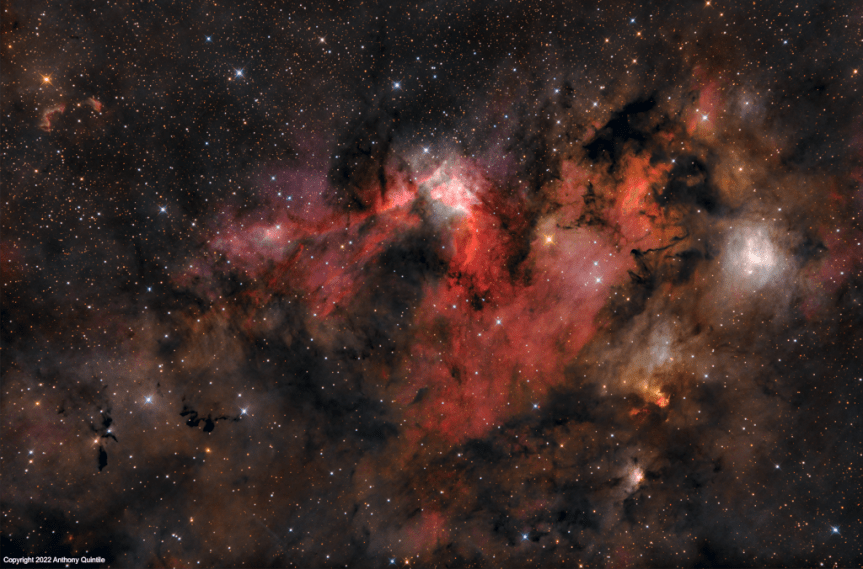
Explanation: This colorful skyscape spans about four full moons across nebula rich starfields along the plane of our Milky Way Galaxy in the royal northern constellation Cepheus. Near the edge of the region’s massive molecular cloud some 2,400 light-years away, bright reddish emission region Sharpless (Sh) 155 is at the center of the frame, also known as the Cave Nebula. About 10 light-years across the cosmic cave’s bright walls of gas are ionized by ultraviolet light from the hot young stars around it. Dusty reflection nebulae, like vdB 155 to the right, and dense obscuring clouds of dust also abound on the interstellar canvas. Astronomical explorations have revealed other dramatic signs of star formation, including the bright reddish fleck of Herbig-Haro (HH) 168. Below and right of center, the Herbig-Haro object emission is generated by energetic jets from a newborn star.
Discover the cosmos! Each day a different image or photograph of our fascinating universe is featured, along with a brief explanation written by a professional astronomer.
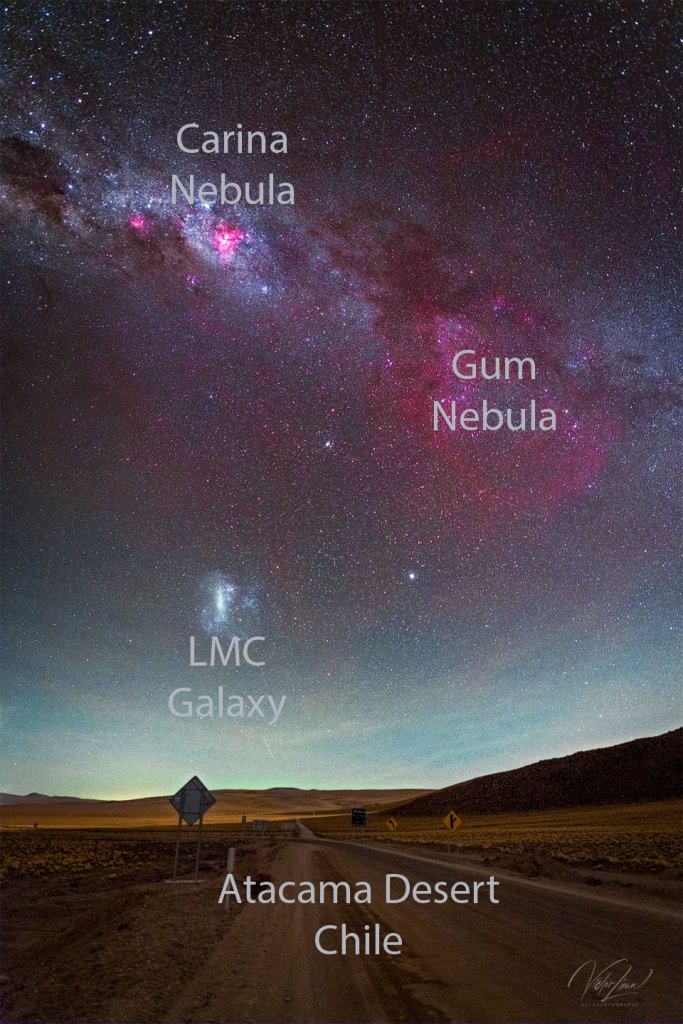
Explanation: Because the Gum Nebula is the closest supernova remnant, it is actually hard to see. Spanning 40 degrees across the sky, the nebula appears so large and faint that it is easily lost in the din of a bright and complex background. The Gum Nebula is highlighted nicely in red emission toward the right of the featured wide-angle, single-image photograph taken in late May. Also visible in the frame are the Atacama Desert in Chile in the foreground, the Carina Nebula in the plane of our Milky Way galaxy running diagonally down from the upper left, and the neighboring Large Magellanic Cloud (LMC) galaxy. The Gum Nebula is so close that we are much nearer the front edge than the back edge, each measuring 450 and 1500 light years respectively. The complicated nebula lies in the direction of the constellations of Puppis and Vela. Oddly, much remains unknown about the Gum Nebula, including the timing and even number of supernova explosions that formed it.
Discover the cosmos! Each day a different image or photograph of our fascinating universe is featured, along with a brief explanation written by a professional astronomer.
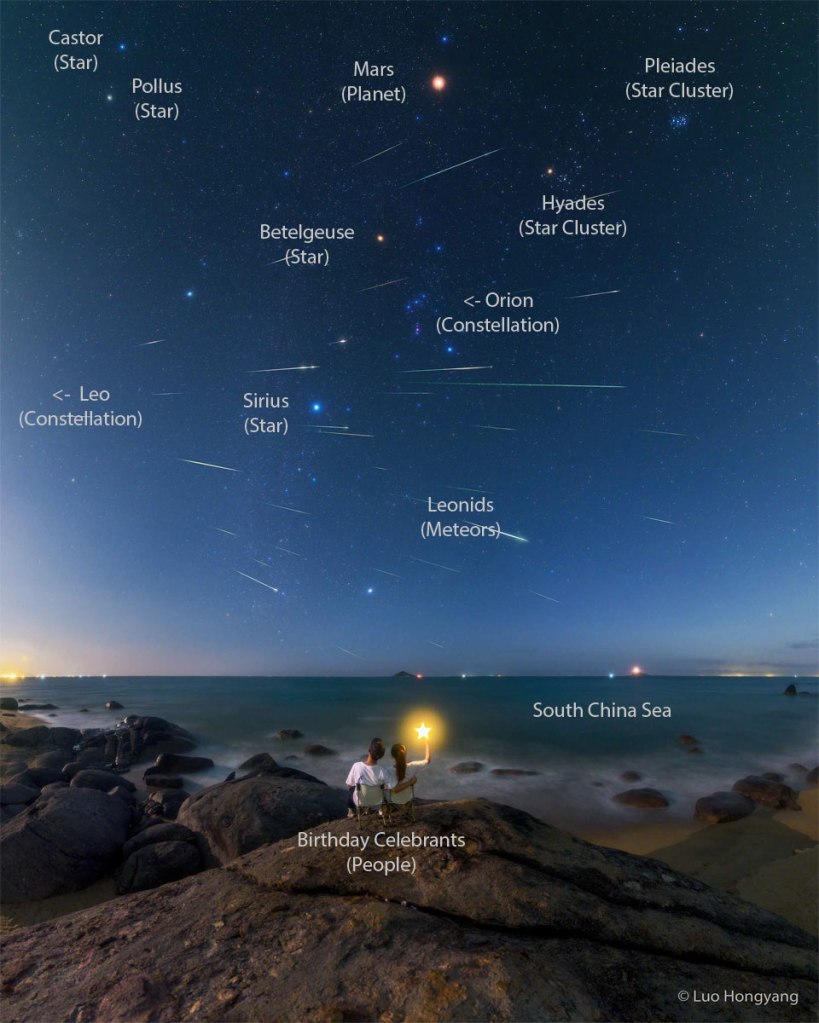
Explanation: Where will the next meteor appear? Even during a meteor shower, it is practically impossible to know. Therefore, a good way to enjoy a meteor shower is to find a place where you can sit comfortably and monitor a great expanse of dark sky. And it may be satisfying to share this experience with a friend. The meteor shower depicted was the 2022 Leonids which peaked earlier this month, and the view is from Hainan, China looking out over the South China Sea. Meteor streaks captured over a few hours were isolated and added to a foreground image recorded earlier. From this place and time, Leonid meteors that trace back to the constellation of Leo were seen streaking across other constellations including Orion. The bright red planet Mars appears near the top of the image. Bonding over their love of astronomy, the two pictured meteor enthusiasts, shown celebrating their common birthday this month, are now married.
Discover the cosmos! Each day a different image or photograph of our fascinating universe is featured, along with a brief explanation written by a professional astronomer.
Discover the cosmos! Each day a different image or photograph of our fascinating universe is featured, along with a brief explanation written by a professional astronomer.
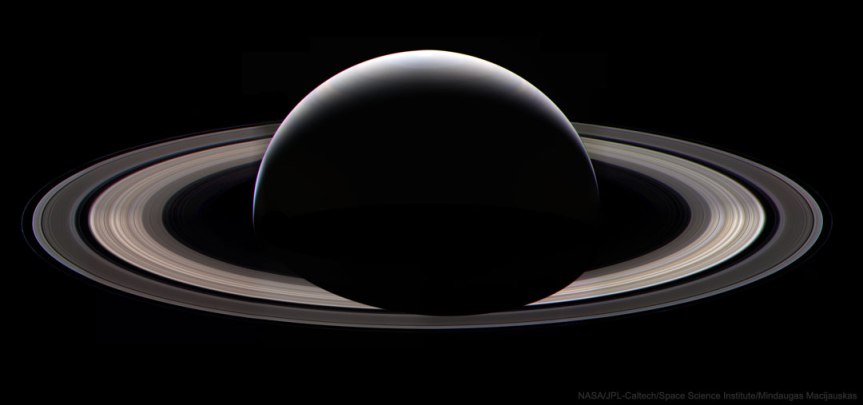
Explanation: Saturn is still bright in planet Earth’s night skies. Telescopic views of the distant gas giant and its beautiful rings often make it a star at star parties. But this stunning view of Saturn’s rings and night side just isn’t possible from telescopes closer to the Sun than the outer planet. They can only bring Saturn’s day into view. In fact, this image of Saturn’s slender sunlit crescent with night’s shadow cast across its broad and complex ring system was captured by the Cassini spacecraft. A robot spacecraft from planet Earth, Cassini called Saturn orbit home for 13 years before it was directed to dive into the atmosphere of the gas giant on September 15, 2017. This magnificent mosaic is composed of frames recorded by Cassini’s wide-angle camera only two days before its grand final plunge. Saturn’s night will not be seen again until another spaceship from Earth calls.
Discover the cosmos! Each day a different image or photograph of our fascinating universe is featured, along with a brief explanation written by a professional astronomer.
Explanation: Few star clusters this close to each other. Visible to the unaided eye from dark sky areas, it was cataloged in 130 BC by Greek astronomer Hipparchus. Some 7,000 light-years away, this pair of open star clusters is also an easy binocular target, a striking starfield in the northern constellation of the mythical Greek hero Perseus. Now known as h and chi Persei, or NGC 869 (above right) and NGC 884, the clusters themselves are separated by only a few hundred light-years and contain stars much younger and hotter than the Sun. In addition to being physically close together, the clusters‘ ages based on their individual stars are similar – evidence that both clusters were likely a product of the same star-forming region.
Discover the cosmos! Each day a different image or photograph of our fascinating universe is featured, along with a brief explanation written by a professional astronomer.
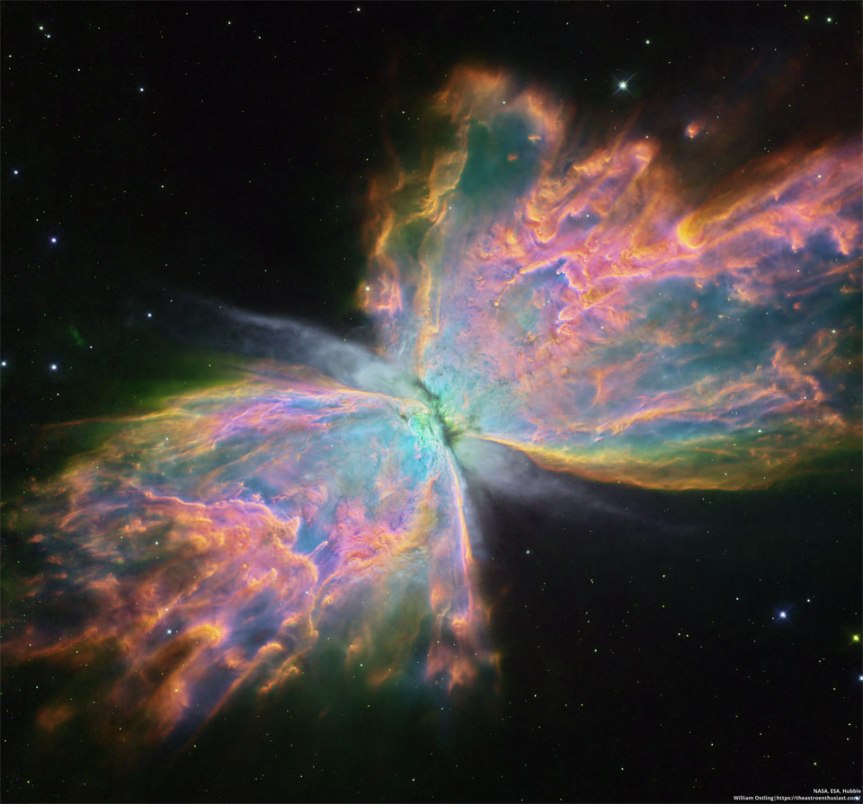
Explanation: Stars can make beautiful patterns as they age — sometimes similar to flowers or insects. NGC 6302, the Butterfly Nebula, is a notable example. Though its gaseous wingspan covers over 3 light-years and its estimated surface temperature exceeds 200,000 degrees C, the aging central star of NGC 6302, the featured planetary nebula, has become exceptionally hot, shining brightly in visible and ultraviolet light but hidden from direct view by a dense torus of dust. This sharp close-up was recorded by the Hubble Space Telescope and is processed here to show off remarkable details of the complex planetary nebula, highlighting in particular light emitted by oxygen (shown as blue), hydrogen (green), and nitrogen (red). NGC 6302 lies about 3,500 light-years away in the arachnologically correct constellation of the Scorpion (Scorpius). Planetary nebulas evolve from outer atmospheres of stars like our Sun, but usually fade in about 20,000 years.
Discover the cosmos! Each day a different image or photograph of our fascinating universe is featured, along with a brief explanation written by a professional astronomer.
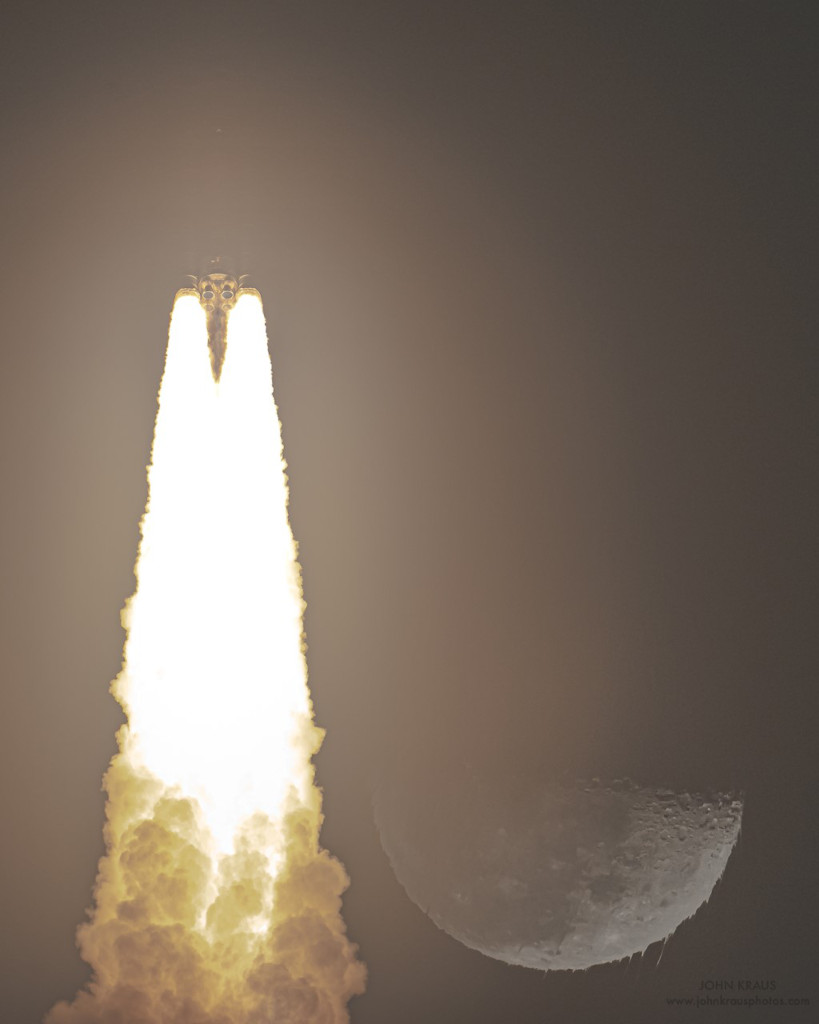
Explanation: When the Artemis 1 mission’s Orion spacecraft makes its November 21 powered flyby of the Moon, denizens of planet Earth will see the Moon in a waning crescent phase. The spacecraft will approach to within about 130 kilometers of the lunar surface on its way to a distant retrograde orbit some 70,000 kilometers beyond the Moon. But the Moon was at last quarter for the November 16 launch and near the horizon in the dark early hours after midnight. It’s captured here in skies over Kennedy Space Center along with the SLS rocket engines and solid rocket boosters lofting the uncrewed Orion to space. Ragged fringes appearing along the bright edge of the sunlit lunar nearside are caused as pressure waves generated by the rocket’s passage change the index of refraction along the camera’s line of sight.
Discover the cosmos! Each day a different image or photograph of our fascinating universe is featured, along with a brief explanation written by a professional astronomer.
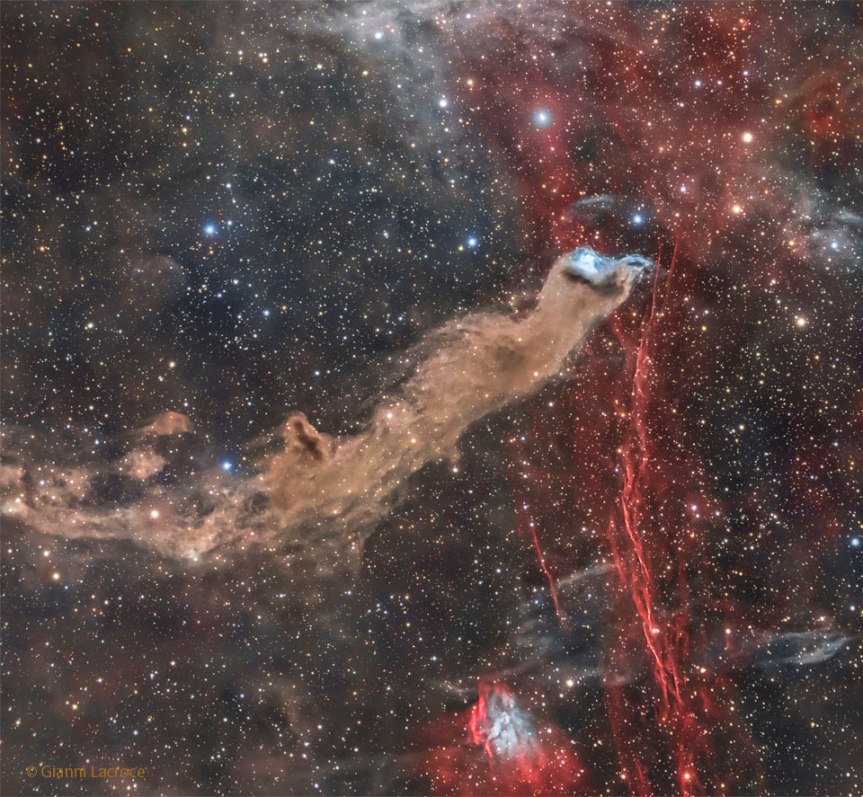
Explanation: The mysterious blue reflection nebula found in catalogs as VdB 152 or Ced 201 really is very faint. It lies at the tip of the long dark nebula Barnard 175 in a dusty complex that has also been called Wolf’s Cave. At the center of this deep telescopic view, the cosmic apparitions are nearly 1,400 light-years away along the northern Milky Way in the royal constellation Cepheus. Interstellar dust in the region blocks light from background stars and scatters light from the embedded bright star, giving the end nebula its characteristic blue color. Though stars do form in molecular clouds, this star seems to have only accidentally wandered into the area, as its measured velocity through space is very different from the cloud’s velocity. At the image bottom is the planetary nebula Dengel-Hartl 5, while red glowing gas from an ancient supernova remnant is also visible along the image’s right side.
Discover the cosmos! Each day a different image or photograph of our fascinating universe is featured, along with a brief explanation written by a professional astronomer.
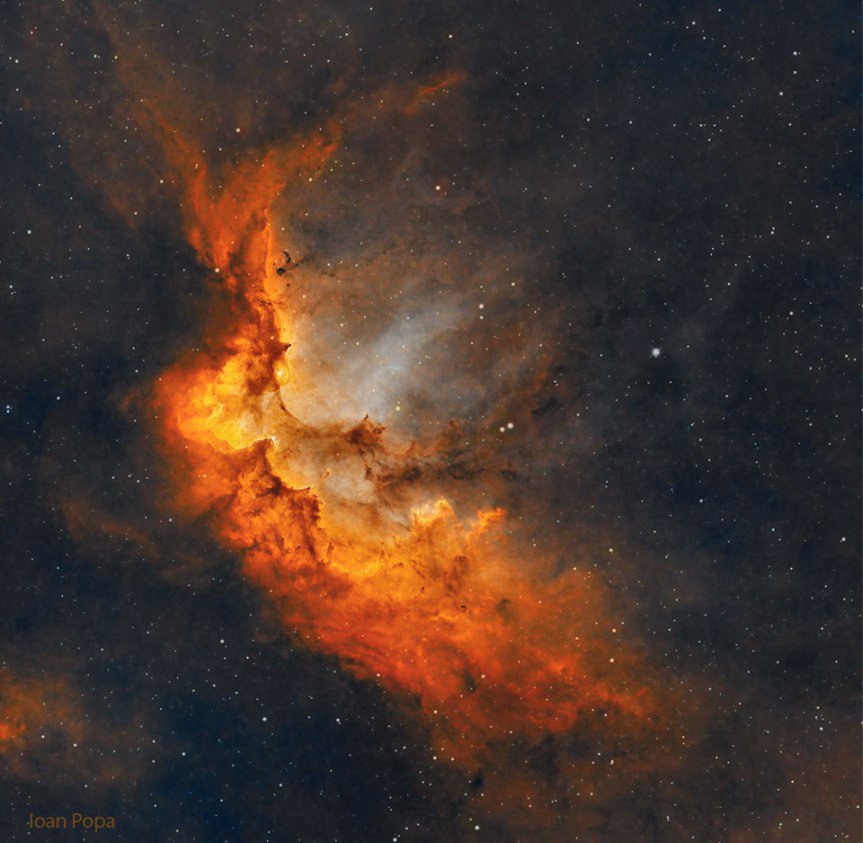
Explanation: What powers are being wielded in the Wizard Nebula? Gravitation strong enough to form stars, and stellar winds and radiations powerful enough to create and dissolve towers of gas. Located only 8,000 light years away, the Wizard nebula, featured here, surrounds developing open star cluster NGC 7380. Visually, the interplay of stars, gas, and dust has created a shape that appears to some like a fictional medieval sorcerer. The active star forming region spans 100 about light years, making it appear larger than the angular extent of the Moon. The Wizard Nebula can be located with a small telescope toward the constellation of the King of Aethiopia (Cepheus). Although the nebula may last only a few million years, some of the stars being formed may outlive our Sun.
Discover the cosmos! Each day a different image or photograph of our fascinating universe is featured, along with a brief explanation written by a professional astronomer.
Explanation: A flying saucer from outer space crash-landed in the Utah desert after being tracked by radar and chased by helicopters. The year was 2004, and no space aliens were involved. The saucer, pictured here, was the Genesis sample return capsule, part of a human-made robot Genesis spaceship launched in 2001 by NASA itself to study the Sun. The unexpectedly hard landing at over 300 kilometers per hour occurred because the parachutes did not open as planned. The Genesis mission had been orbiting the Sun collecting solar wind particles that are usually deflected away by Earth’s magnetic field. Despite the crash landing, many return samples remained in good enough condition to analyze. So far, Genesis-related discoveries include new details about the composition of the Sun and how the abundance of some types of elements differ across the Solar System. These results have provided intriguing clues into details of how the Sun and planets formed billions of years
Discover the cosmos! Each day a different image or photograph of our fascinating universe is featured, along with a brief explanation written by a professional astronomer.
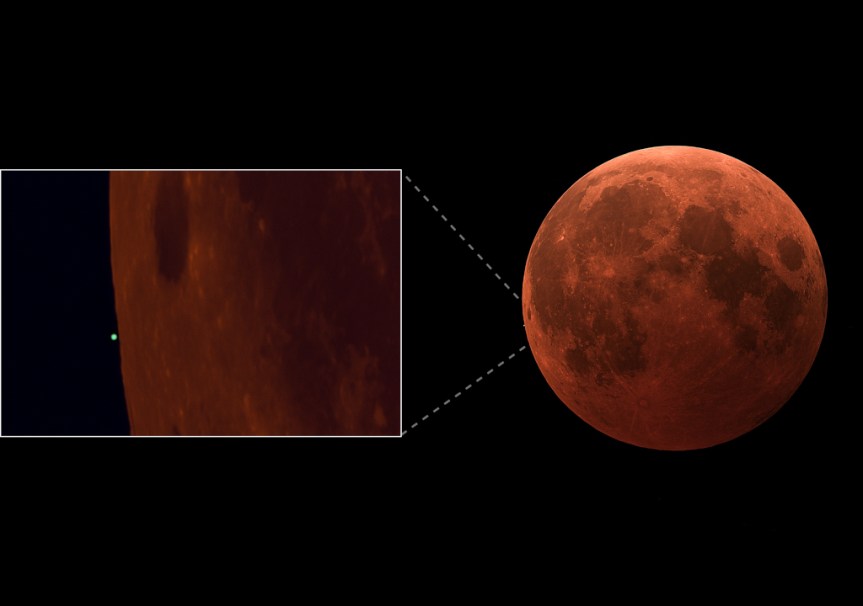
Explanation: On November 8 the Full Moon turned blood red as it slid through Earth’s shadow in a beautiful total lunar eclipse. During totality it also passed in front of, or occulted, outer planet Uranus for eclipse viewers located in parts of northern America and Asia. For a close-up and wider view these two images were taken just before the occultation began, captured with different telescopes and cameras from the same roof top in Shanghai, China. Normally very faint compared to a Full Moon, the tiny, pale, greenish disk of the distant ice giant is just to the left of the Moon’s edge and about to disappear behind the darkened, red lunar limb. Though only visible from certain locations across planet Earth, lunar occultations of planets are fairly common. But for this rare “lunar eclipse occultation” to take place, at the time of the total eclipse the outer planet had to be both at opposition and very near the ecliptic plane to fall in line with Sun, Earth, and Moon.
Discover the cosmos! Each day a different image or photograph of our fascinating universe is featured, along with a brief explanation written by a professional astronomer.
2022 November 8
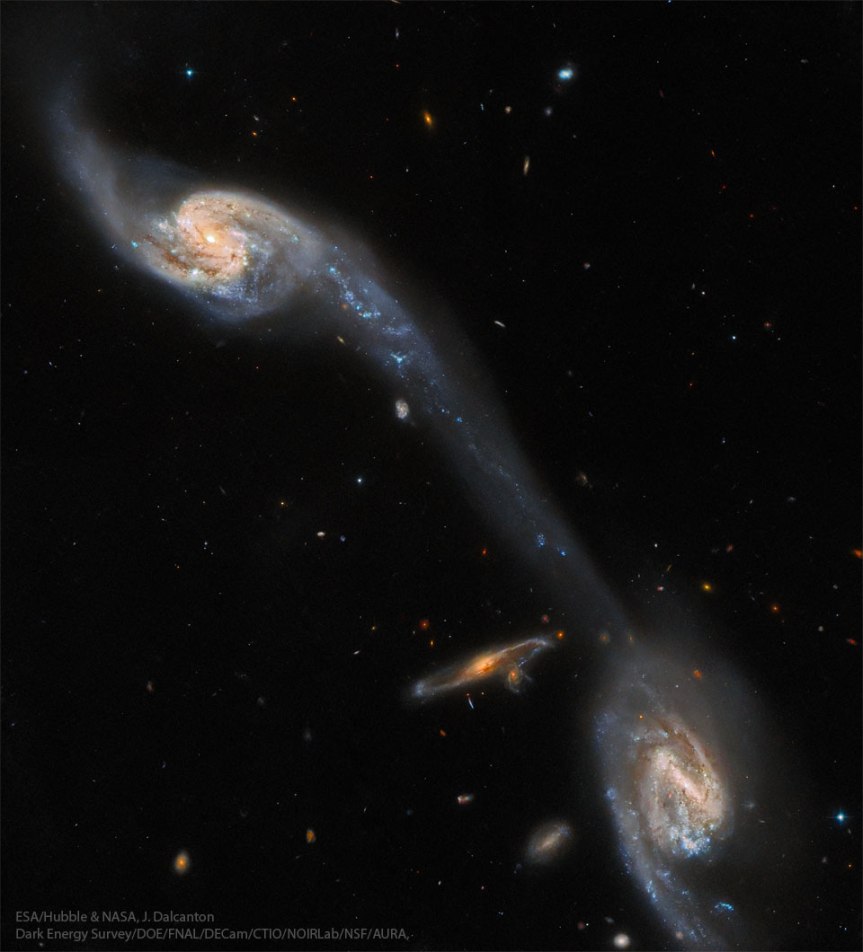
This image from the NASA/ESA Hubble Space Telescope shows two of the galaxies in the galactic triplet Arp 248 — also known as Wild’s Triplet — which lies around 200 million light-years from Earth in the constellation Virgo. The two large spiral galaxies visible in this image — which flank a smaller, unrelated background spiral galaxy — seem to be connected by a luminous bridge. This elongated stream of stars and interstellar dust is known as a tidal tail, and it was formed by the mutual gravitational attraction of the two foreground galaxies. This observation comes from a project which delves into two rogues’ galleries of weird and wonderful galaxies: A Catalogue Of Southern Peculiar Galaxies And Associations, compiled by astronomers Halton Arp and Barry Madore, and the Atlas of Peculiar Galaxies, compiled by Halton Arp. Each collection contains a menagerie of spectacularly peculiar galaxies, including interacting galaxies such as Arp 248, as well as one- or three-armed spiral galaxies, galaxies with shell-like structures, and a variety of other space oddities. Hubble used its Advanced Camera for Surveys to scour this menagerie of eccentric galaxies in search of promising candidates for future observations with the NASA/ESA/CSA James Webb Space Telescope, the Atacama Large Millimeter/submillimeter Array, and Hubble itself. With such a wealth of astronomical objects to study in the night sky, projects such as this, which guide future observations, are a valuable investment of observing time. As well as the scientific merits of observing these weird and wonderful galaxies, they were also — very unusually — selected as Hubble targets because of their visual appeal to the general public! [Image description: Two spiral galaxies are viewed almost face-on; they are a mix of pale blue and yellow in colour, crossed by strands of dark red dust. They lie in the upper-left and lower-right corners. A long, faint streak of pale blue joins them, extending from an arm of one galaxy and crossing the field diagonally. A small spiral galaxy, orange in colour, is visible edge-on, left of the lower galaxy.]
Explanation: How many galaxies are interacting here? This grouping of galaxies is called the Wild Triplet, not only for the discoverer, but for the number of bright galaxies that appear. It had been assumed that all three galaxies, collectively cataloged as Arp 248, are interacting, but more recent investigations reveal that only the brightest two galaxies are sparring gravitationally: the big galaxies at the top and bottom. The spiral galaxy in the middle of the featured image by the Hubble Space Telescope is actually far in the distance, as is the galaxy just below it and all of the other numerous galaxies in the field. A striking result of these giants jousting is a tremendous bridge of stars, gas, and dust that stretches between them — a bridge almost 200,000 light-years long. Light we see today from Wild’s Triplet left about 200 million years ago, when dinosaurs roamed the Earth. In perhaps a billion years or so, the two interacting galaxies will merge to form a single large spiral galaxy.
Discover the cosmos! Each day a different image or photograph of our fascinating universe is featured, along with a brief explanation written by a professional astronomer.
Explanation: If the full Moon suddenly faded, what would you see? The answer was recorded in a dramatic time lapse video taken during the total lunar eclipse in 2011 from Tajikistan. During a total lunar eclipse, the Earth moves between the Moon and the Sun, causing the moon to fade dramatically. The Moon never gets completely dark, though, since the Earth’s atmosphere refracts some light. As the featured video begins, the scene may appear to be daytime and sunlit, but actually it is a nighttime and lit by the glow of the full Moon. As the Moon becomes eclipsed and fades, background stars become visible and here can be seen reflected in a lake. Most spectacularly, the sky surrounding the eclipsed moon suddenly appears to be full of stars and highlighted by the busy plane of our Milky Way Galaxy. The sequence repeats with a closer view, and the final image shows the placement of the eclipsed Moon near the Eagle, Swan, Trifid, and Lagoon nebulas. Nearly two hours after the eclipse started, the moon emerged from the Earth’s shadow and its bright full glare again dominated the sky. Later today or tomorrow, depending on your location relative to the International Date Line, a new total lunar eclipse will take place — with totality being primarily visible over northeastern Asia and northwestern North America.
Discover the cosmos! Each day a different image or photograph of our fascinating universe is featured, along with a brief explanation written by a professional astronomer.
2022 November 6
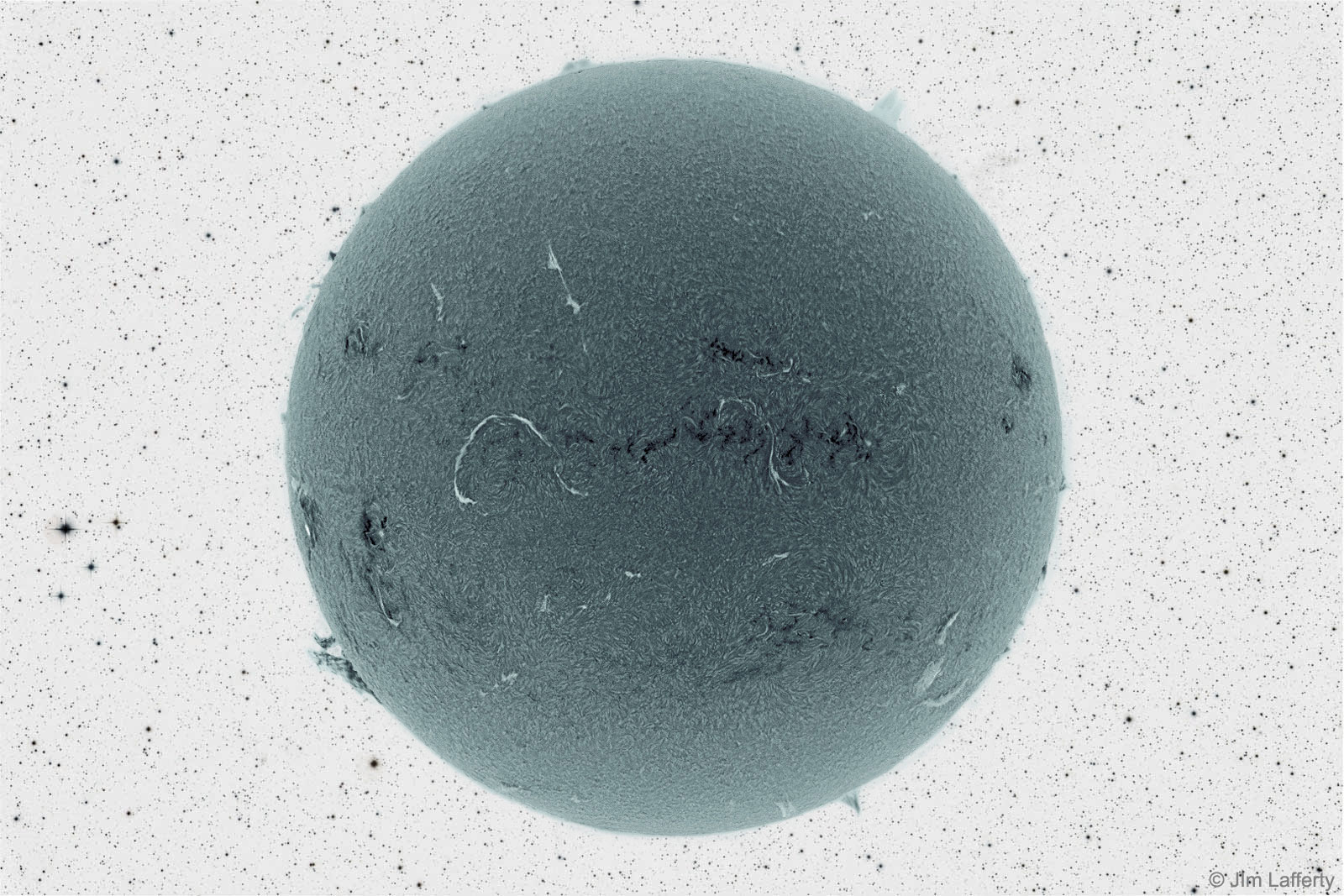
Dark Ball in Inverted Starfield
Image Credit: Jim Lafferty
Explanation: Does this strange dark ball look somehow familiar? If so, that might be because it is our Sun. In the featured image from 2012, a detailed solar view was captured originally in a very specific color of red light, then rendered in black and white, and then color inverted. Once complete, the resulting image was added to a starfield, then also color inverted. Visible in the image of the Sun are long light filaments, dark active regions, prominences peeking around the edge, and a moving carpet of hot gas. The surface of our Sun can be a busy place, in particular during Solar Maximum, the time when its surface magnetic field is wound up the most. Besides an active Sun being so picturesque, the plasma expelled can also become picturesque when it impacts the Earth’s magnetosphere and creates auroras.
Discover the cosmos! Each day a different image or photograph of our fascinating universe is featured, along with a brief explanation written by a professional astronomer.
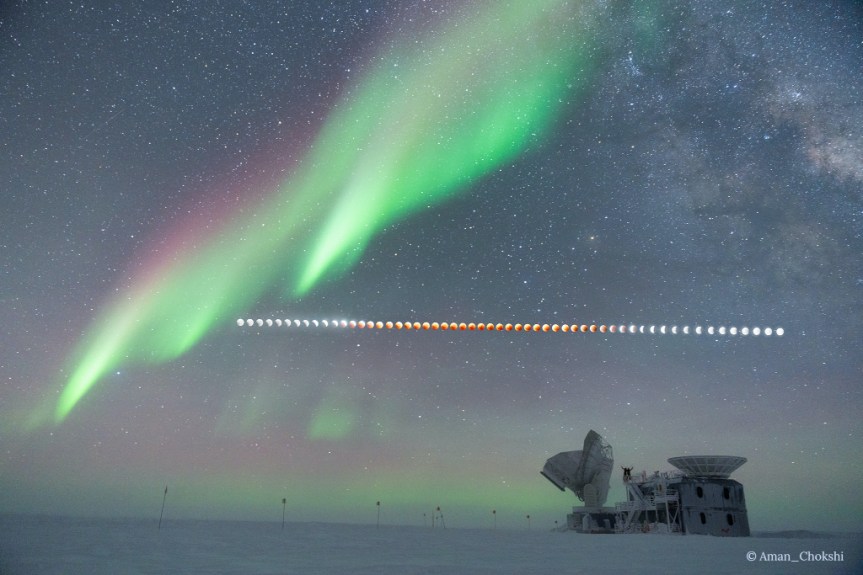
Explanation: Last May 16 the Moon slid through Earth’s shadow, completely immersed in the planet’s dark umbra for about 1 hour and 25 minutes during a total lunar eclipse. In this composited timelapse view, the partial and total phases of the eclipse were captured as the Moon tracked above the horizon from Amundsen-Scott South Pole Station. There it shared a cold and starry south polar night with a surging display of the aurora australis and central Milky Way. In the foreground are the BICEP (right) and South Pole telescopes at the southernmost station’s Dark Sector Laboratory. But while polar skies can be spectacular, you won’t want to go to the South Pole to view the total lunar eclipse coming up on November 8. Instead, that eclipse can be seen from locations in Asia, Australia, the Pacific, the Americas and Northern Europe. It will be your last chance to watch a total lunar eclipse until 2025.
Discover the cosmos! Each day a different image or photograph of our fascinating universe is featured, along with a brief explanation written by a professional astronomer.
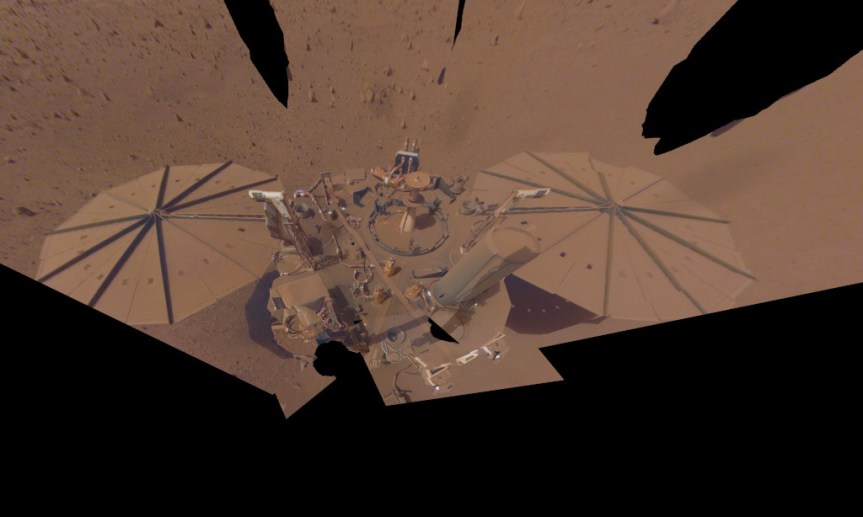
Explanation: The Mars InSight lander returned its first image from the Red Planet’s flat, equatorial Elysium Planitia after a successful touchdown on November 26, 2018. The history making mission to explore the martian Interior using Seismic investigations, geodesy, and heat transport has been operating for over 1,400 martian days or sols. In that time the InSight mission has detected more than 1,300 marsquakes and recorded data from Mars-shaking meteoroid impacts, observing how the seismic waves travel to provide a glimpse inside Mars. Analyzing the archive of data collected is expected to yield discoveries for decades. But InSight’s final operational sol is likely not far off. The reason is evident in this selfie recorded earlier this year showing its deck and large, 2-meter-wide solar panels covered with dust. Kicked up by martian winds the dust continues to accumulate and drastically reduce the power that can be generated by InSight’s solar panels.





 Witches Of The Craft®








#/media/File:Saluzzo-Castello_della_Manta-mago.jpg)


You must be logged in to post a comment.