November 22 Astronomy Picture of the Day

Discover the cosmos! Each day a different image or photograph of our fascinating universe is featured, along with a brief explanation written by a professional astronomer.

2022 November 22

A Double Star Cluster in Perseus

Image Credit & Copyright: Tommy Lease

Explanation: Few star clusters this close to each other. Visible to the unaided eye from dark sky areas, it was cataloged in 130 BC by Greek astronomer Hipparchus. Some 7,000 light-years away, this pair of open star clusters is also an easy binocular target, a striking starfield in the northern constellation of the mythical Greek hero Perseus. Now known as h and chi Persei, or NGC 869 (above right) and NGC 884, the clusters themselves are separated by only a few hundred light-years and contain stars much younger and hotter than the Sun. In addition to being physically close together, the clusters‘ ages based on their individual stars are similar – evidence that both clusters were likely a product of the same star-forming region.

November 21 Astronomy Picture of the Day

Discover the cosmos! Each day a different image or photograph of our fascinating universe is featured, along with a brief explanation written by a professional astronomer.

2022 November 21

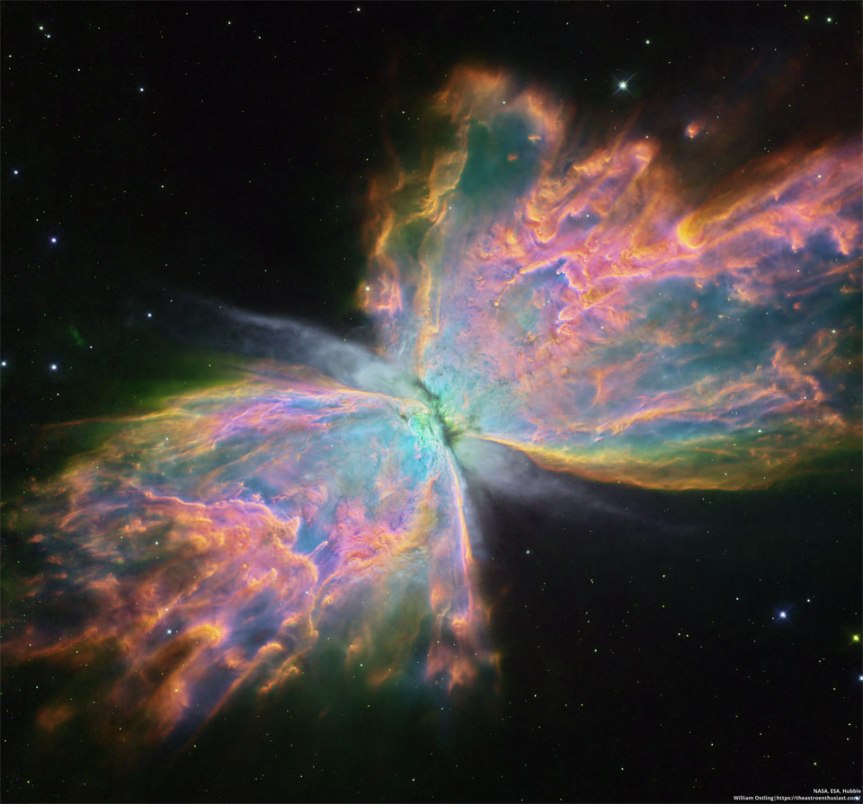
The Butterfly Nebula from Hubble

Image Credit: NASAESAHubble; Processing: William Ostling

Explanation: Stars can make beautiful patterns as they age — sometimes similar to flowers or insects. NGC 6302, the Butterfly Nebula, is a notable example. Though its gaseous wingspan covers over 3 light-years and its estimated surface temperature exceeds 200,000 degrees C, the aging central star of NGC 6302, the featured planetary nebula, has become exceptionally hot, shining brightly in visible and ultraviolet light but hidden from direct view by a dense torus of dust. This sharp close-up was recorded by the Hubble Space Telescope and is processed here to show off remarkable details of the complex planetary nebula, highlighting in particular light emitted by oxygen (shown as blue), hydrogen (green), and nitrogen (red). NGC 6302 lies about 3,500 light-years away in the arachnologically correct constellation of the Scorpion (Scorpius). Planetary nebulas evolve from outer atmospheres of stars like our Sun, but usually fade in about 20,000 years.

November 20 Astronomy Picture of the Day

Discover the cosmos! Each day a different image or photograph of our fascinating universe is featured, along with a brief explanation written by a professional astronomer.

2022 November 20

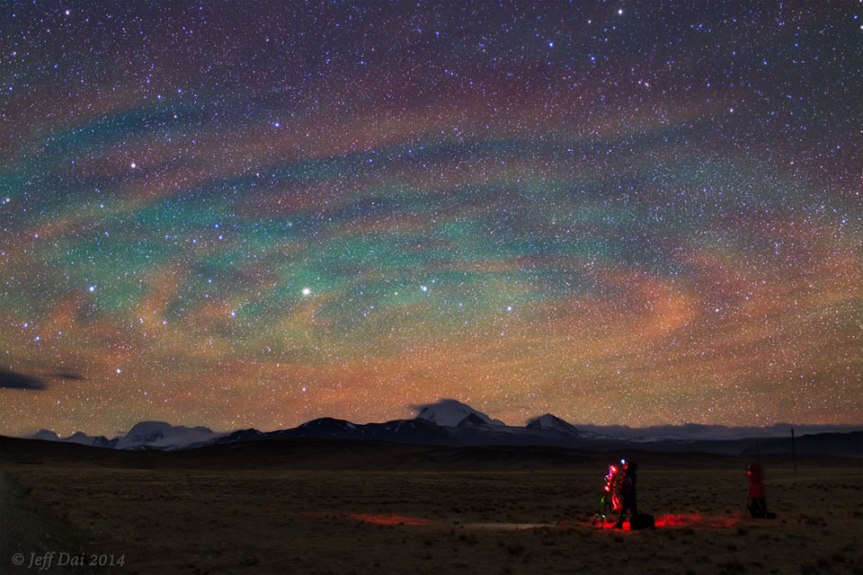
Airglow Ripples over Tibet

Image Credit & Copyright: Jeff Dai

Explanation: Why would the sky look like a giant target? Airglow. Following a giant thunderstorm over Bangladesh in late April, giant circular ripples of glowing air appeared over TibetChina, as pictured here. The unusual pattern is created by atmospheric gravity waves, waves of alternating air pressure that can grow with height as the air thins, in this case about 90-kilometers up. Unlike auroras powered by collisions with energetic charged particles and seen at high latitudes, airglow is due to chemiluminescence, the production of light in a chemical reaction. More typically seen near the horizon, airglow keeps the night sky from ever being completely dark.

November 19 Astronomy Picture of the Day

Discover the cosmos! Each day a different image or photograph of our fascinating universe is featured, along with a brief explanation written by a professional astronomer.

2022 November 19

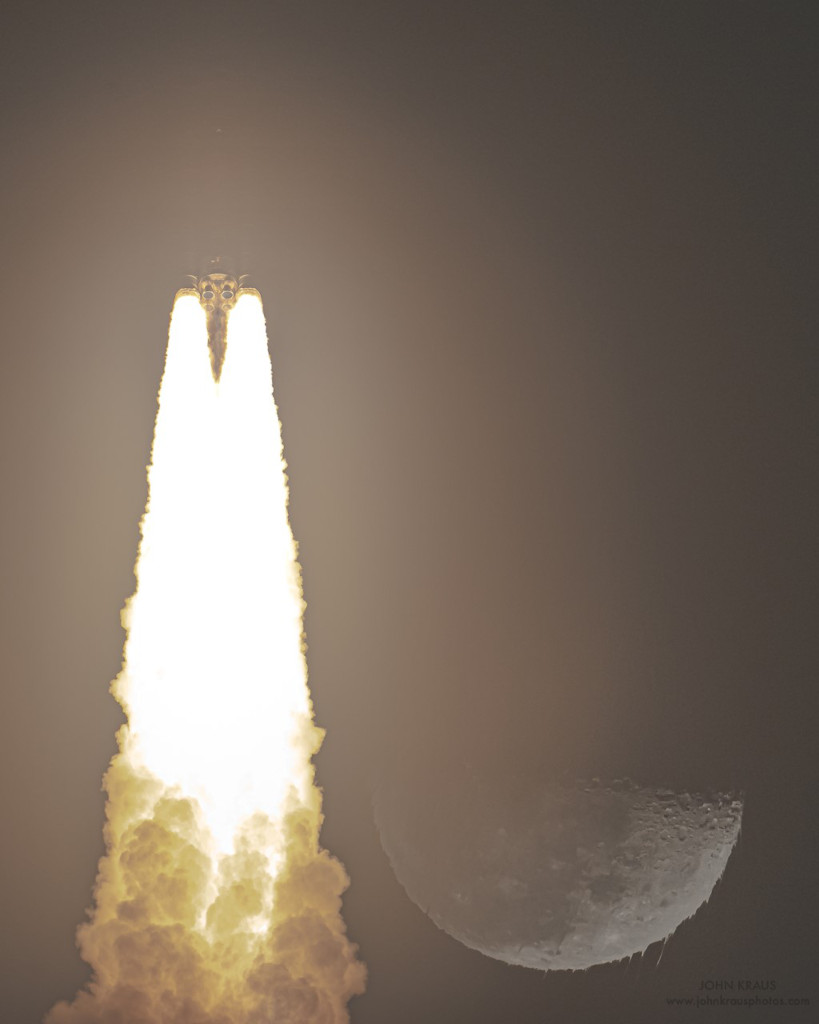
Artemis 1 Moonshot

Image Credit & CopyrightJohn Kraus

Explanation: When the Artemis 1 mission’s Orion spacecraft makes its November 21 powered flyby of the Moon, denizens of planet Earth will see the Moon in a waning crescent phase. The spacecraft will approach to within about 130 kilometers of the lunar surface on its way to a distant retrograde orbit some 70,000 kilometers beyond the Moon. But the Moon was at last quarter for the November 16 launch and near the horizon in the dark early hours after midnight. It’s captured here in skies over Kennedy Space Center along with the SLS rocket engines and solid rocket boosters lofting the uncrewed Orion to space. Ragged fringes appearing along the bright edge of the sunlit lunar nearside are caused as pressure waves generated by the rocket’s passage change the index of refraction along the camera’s line of sight.

November 18 Astronomy Picture of the Day

Discover the cosmos! Each day a different image or photograph of our fascinating universe is featured, along with a brief explanation written by a professional astronomer.

2022 November 18

The protostar L1527, shown in this image from the NASA/ESA/CSA James Webb Space Telescope, is embedded within a cloud of material that is feeding its growth. Material ejected from the star has cleared out cavities above and below it, whose boundaries glow orange and blue in this infrared view. The upper central region displays bubble-like shapes due to stellar ‘burps,’ or sporadic ejections. Webb also detects filaments made of molecular hydrogen that has been shocked by past stellar ejections. Intriguingly, the edges of the cavities at upper left and lower right appear straight, while the boundaries at upper right and lower left are curved. The region at lower right appears blue, as there’s less dust between it and Webb than the orange regions above it.

The Protostar within L1527

Image Credit: Science – NASAESACSASTScINIRCam
Processing – Joseph DePasquale (STScI), Anton M. Koekemoer (STScI), Alyssa Pagan (STScI)

Explanation: The protostar within dark cloud L1527 is a mere 100,000 years old, still embedded in the cloud of gas and dust that feeds its growth. In this NIRCam image from the James Webb Space Telescope, the dark band at the neck of the infrared nebula is a thick disk that surrounds the young stellar object. Viewed nearly edge-on and a little larger than our Solar System, the disk ultimately supplies material to the protostar while hiding it from Webb’s direct infrared view. The nebula itself is seen in stunning detail though. Illuminated by infrared light from the protostar, the hourglass-shaped nebula’s cavities are created as material ejected in the star-forming process plows through the surrounding medium. As the protostar gains mass it will eventually become a full-fledged star, collapsing and igniting nuclear fusion in its core. A likely analog to our own Sun and Solar System in their early infancy, the protostar within dark cloud L1527 lies some 460 light-years distant in the Taurus star-forming region. Webb’s NIRCam image spans about 0.3 light-years.

November 17 Astronomy Picture of the Day

Discover the cosmos! Each day a different image or photograph of our fascinating universe is featured, along with a brief explanation written by a professional astronomer.

2022 November 17

Planet Earth from Orion

Image Credit: NASAArtemis 1

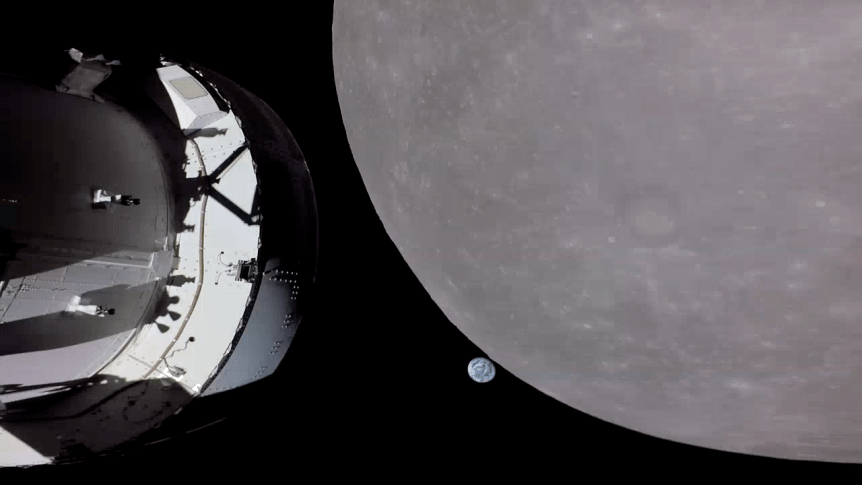
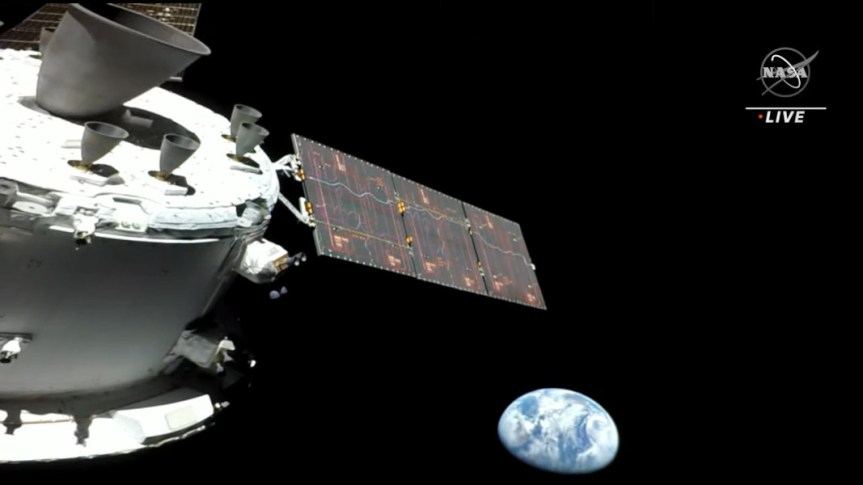
Explanation: A Space Launch System rocket left planet Earth on Wednesday, November 16 at 1:47am EST carrying the Orion spacecraft on the Artemis 1 mission, the first integrated test of NASA’s deep space exploration systems. Over an hour after liftoff from Kennedy Space Center’s historic Launch Complex 39B, one of Orion’s external video cameras captured this view of its new perspective from space. In the foreground are Orion’s Orbital Maneuvering System engine and auxillary engines, at the bottom of the European Service Module. Beyond one of the module’s 7-meter long extended solar array wings lies the spacecraft’s beautiful home world. The Artemis 1 mission will last almost four weeks, testing capabilities to enable human exploration of the Moon and Mars. The uncrewed Orion spacecraft is expected to fly by the Moon on November 21, performing a close approach to the lunar surface on its way to a retrograde orbit 70,000 kilometers beyond the Moon.

November 17 Today in History

Today’s Important Historical Events

1558 Elizabeth I aged 25, ascends the English throne upon death of her half sister, Queen “Bloody” Mary (SIND NOTE: Queen Elizabeth II ascended the throne at age 25 years old also in 1952)

1800 Congress holds its 1st session in Washington, D.C. in an incomplete Capitol Building

1831 Ecuador and Venezuela separated from Greater Colombia

1855 David Livingstone becomes the first European to see Victoria Falls, in what is now Zambia and Zimbabwe

1869 Suez Canal in Egypt opens, linking Mediterranean and Red seas

1922 The last sultan of the Ottoman Empire, Mehmed VI, is expelled to Malta on a British warship

1970 Douglas Engelbart receives the patent for the first computer mouse

November 16 Astronomy Picture of the Day

Discover the cosmos! Each day a different image or photograph of our fascinating universe is featured, along with a brief explanation written by a professional astronomer.

2022 November 16

In the Arms of NGC 1097

Image Credit & CopyrightMike SelbyMark Hanson

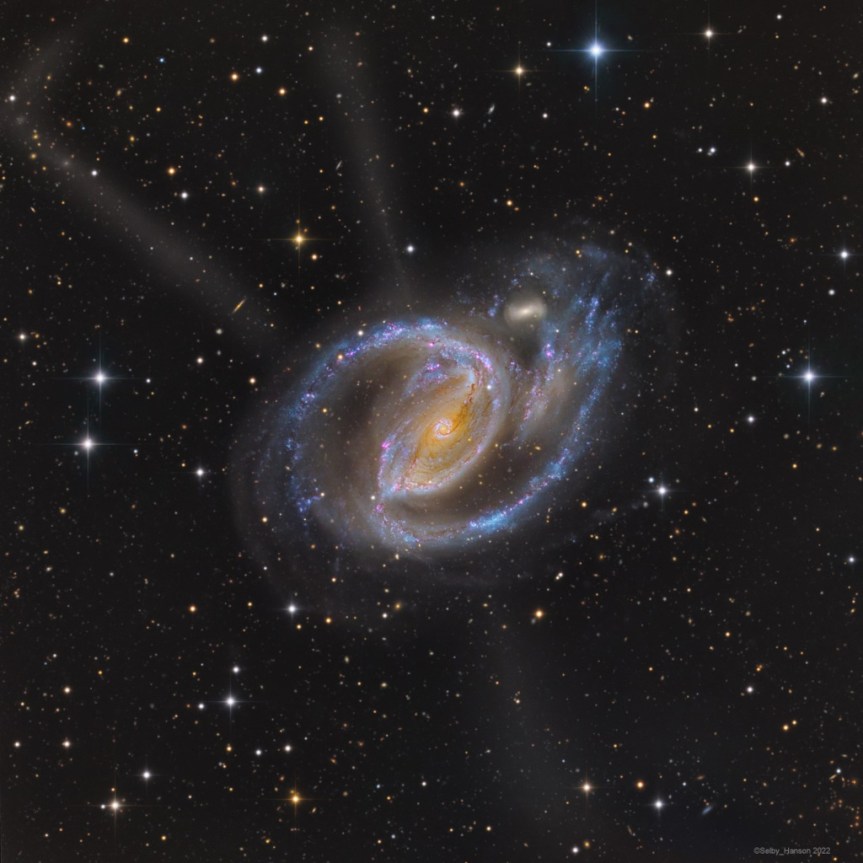
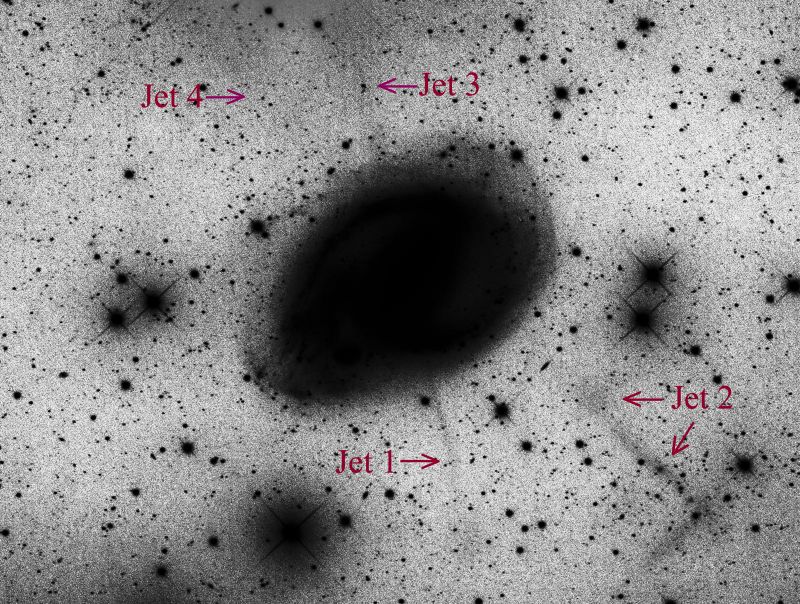
Explanation: Spiral galaxy NGC 1097 shines in southern skies, about 45 million light-years away in the heated constellation Fornax. Its blue spiral arms are mottled with pinkish star forming regions in this colorful galaxy portrait. They seem to have wrapped around a small companion galaxy above and right of center, about 40,000 light-years from the spiral’s luminous core. That’s not NGC 1097’s only peculiar feature, though. This very deep exposure hints of faint, mysterious jets, seen to extend well beyond the bluish arms. In fact, four faint jets are ultimately recognized in optical images of NGC 1097. The jets trace an X centered on the galaxy’s nucleus, but probably don’t originate there. Instead, they could be fossil star streams, trails left over from the capture and disruption of a much smaller galaxy in the large spiral’s ancient past. A Seyfert galaxy, NGC 1097’s nucleus also harbors a supermassive black hole.