On Friday, May 5th, We Honor The Muses

defi spring dominance jaune et vertOn Friday, May 5th, We Honor……

The Muses

INVOKED BY POETS, ARTISTS, and musicians, these nine goddesses presided over the arts and sciences in ancient Greece. The Muses offered their supplicants the purest form of inspiration—infusing spirit into creative works to animate them.

The Muses were often worshiped with libations of milk, honey, or wine, which were poured upon the earth. They were especially honored in Boeotia, where the oldest city in Greece originated. Parnassus, a mountain that towered over the sacred site of Delphi, was considered the birthplace of the Muses; Apollo, the god of music and other arts, was also associated with Parnassus. Poets from Roman times believed that a sacred spring ran from Parnassus, bringing the gifts of the Muses to those fortunate to drink of it.

EXPANDING INSPIRATION

Though their parentage is uncertain, most stories hold that the Muses were the daughters of Mnemosyne, the goddess of memory, and Zeus. As such, the goddesses held a special place next to their divine father’s throne, where they often sang songs in praise of the ruling god.

Originally there was only one Muse. Over time, they grew to number nine goddesses, suggesting the expansion of their powers. Each of the nine Muses concerned herself with an area of art.

Calliope, the mother of Orpheus, was the most eloquent; she inspired epic poetry. Clio ruled over history, while Erato was usually depicted with a lyre. Other Muses included Euterpe (flute playing), Melpomene (tragedy), Polyhymnia (sacred music), Terpsichore (dance), Urania (astronomy), and Thalia (comedy).

The power of the Muses still exists today, though mainly within words in our language. When we are amused, we are reminded of the charms wielded by these graceful goddesses. Our ears are soothed by transforming music which bring harmony and peace into our lives. Museums, latter-day shrines to the Muses, offer us inspiration and education


The Book of Goddesses: Expanded Anniversary Edition
Kris Waldherr

The Wicca Book of Days for Friday, May 5th

Spring Dreams Fairy
The Wicca Book of Days for Friday, May 5th

Pentacles and Diamonds

This day’s element, earth, corresponds to the pentacles suit in the Tarot. Pentacles’ alternative names of coins and deniers help to clarify this suit’s primary meaning, which relates to money and material possessions, and thus to financial security. And when translated into one of the four conventional playing card suits, pentacles become diamonds, again, resonant of riches, but also symbolizing earthly health. Whatever you call these suits, they send the same messages when used for divination, instructing you to look to monetary matters.

 
The Wicca Book of Days
Selena Eilidth Ash

Friday, May 5

Spring Blossom Fairy Friday, May 5


Friday is the day of Venus. It takes it name from Frigg, the Goddess of love and transformation. She rules the spiritual side of a person that manifests in the physical. Because of this, Friday is often thought of as dangerously unpredictable. This is expressed in an old East Anglian adage:

Friday’s day will have its trick
The fairest or foulest day of the week.


Deity: Frigg

Zodiac Sign: Taurus/Libra

Planet: Venus

Tree: Apple

Herb: Vervain

Stone: Sapphire/Chrsolite

Animal: Bull/Serpent

Element: Earth

Color: Yellow/Violet

Number: 7

Rune: Peorth(P)


Celtic Tree Month of Huath (Hawthorne) (April 14 – May 12 )

The Runic Half Month of Lgy (flowing water) (April 29 – May 13)

Goddess of the Month of Maia(April 17 – May 15)


Source

The Pagan Book of Days
Nigel Pennick


The Sky This Week for May 5 to May 7

Fairy Garden The Sky This Week for May 5 to May 7

The Summer Triangle, Jupiter at opposition, and other beautiful things to look for in the sky this week.
By Richard Talcott


Friday, May 5

Although the calendar says May, the sky’s Summer Triangle returns to prominence this month. The asterism’s three bright stars — Vega in Lyra, Deneb in Cygnus, and Altair in Aquila — all clear the horizon by midnight local daylight time. An hour later, they rule the eastern sky. Vega shines brightest and appears at the apex of the triangular asterism. Look for Deneb to Vega’s lower left and Altair to the lower right of the other two. The Summer Triangle will grace the Northern Hemisphere’s evening sky from now through the end of the year.

Saturday, May 6

The Eta Aquariid meteor shower reaches its peak before dawn. Although this is typically one of the year’s most prolific showers, a waxing gibbous Moon interferes with the 2017 show. The Moon sets around 4 a.m. local daylight time, just before morning twilight starts to paint the sky. For the best views, head outside an hour or two before then and find a spot where trees or buildings block the Moon’s glow low in the west. Eta Aquariid meteors derive from bits of debris ejected by Comet 1P/Halley during its many trips around the Sun. When Earth crosses this debris stream, our planet’s atmosphere incinerates the tiny dust particles and we see the streaks of light called meteors, or “shooting stars.”

Sunday, May 7

Although Jupiter reached opposition and peak visibility exactly one month ago, it remains a stunning sight nearly all night. It appears about 40° above the southeastern horizon an hour after sunset and climbs highest in the south around 11 p.m. local daylight time. As a bonus this evening, a waxing gibbous Moon appears just a few degrees away. The pair lies among the background stars of Leo, though only 1st-magnitude Spica some 10° below appears conspicuous thanks to the bright Moon nearby. When viewed through a telescope, Jupiter’s disk spans 43″ and shows a wealth of detail in its atmosphere.

Mars passes 6° due north (to the upper right) of Aldebaran today. Use binoculars to pick them out of the evening twilight. Although Aldebaran shines a half-magnitude brighter than the planet, Mars’ greater altitude should make it just as easy to see.


Source

The Astronomy Magazine


The Sun & Moon Almanac for Friday, May 5th

~ Spring Melody ~

The Sun & Moon Almanac for Friday, May 5th

The Sun
Sun Direction: ↑ 105.91° ESE
Sun Altitude: 46.10°
Sun Distance: 93.761 million mi
Next Solstice: Jun 20, 2017 11:24 pm (Summer)
Sunrise Today: 5:55 am↑ 69° East
Sunset Today: 7:47 pm↑ 292° Northwest
Lenght of Daylight: 13 hours, 52 minutes


The Moon
Moon Direction: ↑ 16.83° NNE
Moon Altitude: -45.29°
Moon Distance: 242384 mi
Next Full Moon: May 10, 20174:42 pm
Next New Moon: May 25, 20172:44 pm
Next Moonrise: Today 3:00 pm
Current Moon Phase: Waxing Gibbous
Illumination: 75.4%


Source

timeanddate.com

Mother, Maiden, Crone

Fantasie LandschaftMother, Maiden, Crone


Mother Maiden, Crone
I am just a Witch alone,
honoring your many phases
as my own….
Changes come and go,
tides rise and flow
as your light continues to grow,
peeking through the window as I sleep,
my dreams you safely keep,
Goddess of the Moon,
your magick fills my room,
with blessings of the womb,
moonbeams dance upon these walls,
like golden threads, spun on a loom,
Stars circle round,
like a silvery crown,
as I draw your energy down..
Many Blessings you continuously bestow
with your magickal glow,
as above… so below….
Mother, Maiden, Crone
I am just a Witch Alone….

– by Mor`inanna~EagleSon


It’s Friday, May 5th, Happy Cinco De Mayo, Everyone! May The Goddess Bless You & Yours On This Glorious Friday Morn’!


Cinco De Mayo Comments

Cinco de Mayo in the United States

Cinco de Mayo is annually observed on May 5. It celebrates the defeat of the French army during the Battle of Puebla (Batalla de Puebla) in Mexico on May 5, 1862. It is not to be confused with Mexico’s Independence Day.


What Do People Do?

Cinco de Mayo is seen as a day to celebrate the culture, achievements and experiences of people with a Mexican background, who live in the United States. There is a large commercial element to the day, with businesses promoting Mexican services and goods, particularly food, drinks and music. Other aspects of the day center around traditional symbols of Mexican life, such as the Virgin de Guadalupe, and Mexican-Americans who have achieved fame, fortune and influence in the United States.

One of the largest Cinco de Mayo celebrations are in cities such as Los Angeles, San Jose, San Francisco, San Antonio, Sacramento, Phoenix, Albuquerque, Denver and El Paso in the USA’s south-western regions. In these cities, a large proportion of the population has Mexican origins. Many people hang up banners and school districts organize lessons and special events to educate their pupils about the culture of Americans of Mexican descent. In some areas, particularly in Pubelo de Los Angeles, celebrations of regional Mexican music and dancing are held.

Public Life

Cinco de Mayo is not a federal holiday in the United States. Organizations, businesses and schools are open as usual. Public transit systems run on their usual schedule. In some areas of some cities, especially those in the Southwest, local parades and street events may cause some local congestion to traffic.

Background

Cinco de Mayo officially commemorates the anniversary of an early victory by Mexican forces over French forces in the Battle of Puebla on May 5, 1862. It is not the anniversary of the defeat and expulsion of the French forces by the Mexicans, which occurred in 1867. It is also not, as is often assumed, the day of Mexico’s celebrations of independence, which are actually held on September 16. It is believed that the origins of Cinco de Mayo celebrations lie in the responses of Mexicans living in California in the 1860s to French rule in Mexico at that time.


Source

timeanddate.com

Good Thursday Morning To All Our Dear Family & Friends, Ready for Your Astronomy for the Day

What a beautiful Thursday morning it is. Well, not really it is pouring down rain and we are getting ready to build an ark. Shouldn’t complain, we watched the News this morning and saw people’s houses getting washed down the flooded rivers. I can’t imagine that, my heart and prayers go out to each of your effected by the floods. May the Goddess bless you & give you courage and strength to survive this horrible period in your life.


We Are Witches All

We sing and dance and hold our rites,
We live and love together.
We go sky-clad or wear our outer robes
If it is chilling weather.
About the altar we do dance;
We praise The Gods
We love and ever do, we give
Our thanks to the sun.
And moon above, We are The Craft;
Love The Craft; We are Witches All.

Join us.. In Our Circle For We Are Witches All.

Walk into our Circle and feel the love Bound,
And Meet The Lord and Lady who guide us in our Rounds;
” An’ Harm None, Do What Thou Wilt.”
It is The Wiccan Rede.
We fear no foe for love we show,
In thought and also Deed.
Our words of thanks, our songs of praise,
We offer them in pray’r.
We sing their praise, we ask their help;
We know that they are there.

—-Author Unknown

This episode also includes:

Your First Look At The Planets Today

Your Current Moon Phase

Moon in Virgo

Next up…

Your Horoscopes

THE WOTC PODCAST

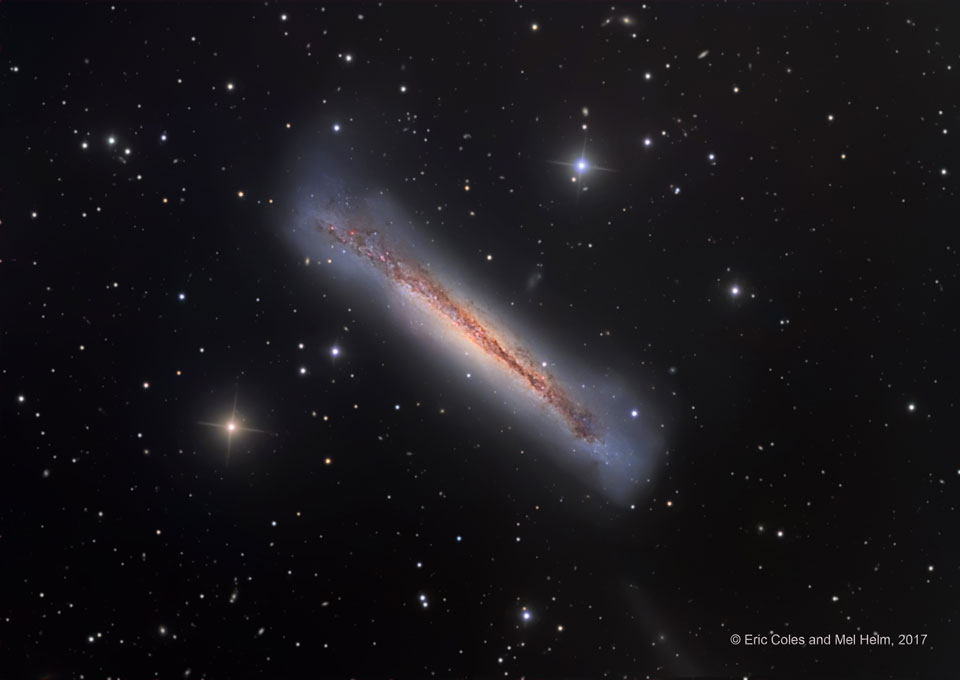
Astronomy Picture of the Day – The Hamburger Galaxy

Astronomy Picture of the Day

Discover the cosmos! Each day a different image or photograph of our fascinating universe is featured, along with a brief explanation written by a professional astronomer.

2017 May 3

NGC 3628: The Hamburger Galaxy
Image Credit & Copyright: Eric Coles and Mel Helm


Explanation: No, hamburgers are not this big. What is pictured is a sharp telescopic view of a magnificent edge-on spiral galaxy NGC 3628, a puffy galactic disk divided by dark dust lanes. Of course, this deep galactic portrait puts some astronomers in mind of its popular moniker, The Hamburger Galaxy. The tantalizing island universe is about 100,000 light-years across and 35 million light-years away in the northern springtime constellation Leo. NGC 3628 shares its neighborhood in the local Universe with two other large spirals M65 and M66 in a grouping otherwise known as the Leo Triplet. Gravitational interactions with its cosmic neighbors are likely responsible for the extended flare and warp of this spiral’s disk.

Save

Earth Sky News For May 3rd: Comet Halley’s 2 meteor showers

Comet Halley’s 2 meteor showers

It’s because comets like Halley are so crumbly that we see annual meteor showers. One shower spawned by this comet is going on now. Another is visible in October.

Our annual fund-raiser ends May 5. EarthSky needs your help to keep going! Please donate!

Want to donate via PayPal or send a check to EarthSky? Click here.

Comet Halley, proud parent of two meteor showers, swings into the inner solar system about every 76 years. At such times, the sun’s heat causes the comet to loosen its icy grip over its mountain-sized conglomeration of ice, dust and gas. At each pass near the sun, the crumbly comet sheds a fresh trail of debris into its orbital stream. It lost about 1/1,000th of its mass during its last flyby in 1986. It’s because comets like Halley are so crumbly that we see annual meteor showers, like the Eta Aquarid meteor shower that’s going on now. Follow the links below to learn more about Comet Halley, the meteor showers it spawns, and about how astronomers calculate the velocities of meteors streaking across our sky.

Comet Halley’s 2 meteor showers

Where is Comet Halley now?

Parent bodies of other major meteor showers

How fast do meteors from Comet Halley travel?


Comet Halley’s 2 meteor showers. Because Comet Halley has circled the sun innumerable times over countless millennia, cometary fragments litter its orbit. That’s why the comet doesn’t need to be anywhere near the Earth or the sun in order to produce a meteor shower. Instead, whenever our Earth in its orbit intersects Comet Halley’s orbit, cometary bits and pieces – oftentimes no larger than grains of sand or granules of gravel – smash into Earth’s upper atmosphere, to vaporize as fiery streaks across our sky: meteors.

It so happens we intersect Comet Halley’s orbit not once, but twice each year. In early May, we see bits of this comet as the annual Eta Aquariid meteor shower.

Then some six months later, in October, Earth in its orbit again intersects the orbital path of Comet Halley. This time around, these broken-up chunks from Halley’s Comet burn up in Earth’s atmosphere as the annual Orionid meteor shower.

By the way, these small fragments are called meteoroids when in outer space, and meteors when they vaporize in the Earth’s atmosphere.

Meteors in annual showers – made from the icy debris of comets – don’t hit the ground. They vaporize high in Earth’s atmosphere. The more rocky or metallic asteroids are what sometimes hit the ground, and then they are called meteorites.

Where is Comet Halley now? Often, astronomers like to give distances of solar system objects in terms of astronomical units (AU), which is the sun-Earth distance. Comet Halley lodges 0.587 AU from the sun at its closest point to sun (perihelion) and 35.3 AU at its farthest point (aphelion).

In other words, Halley’s Comet resides about 60 times farther from the sun at its closest than it does at its farthest.

It was last at perihelion in 1986, and will again return to perihelion in 2061.

At present, Comet Halley lies outside the orbit of Neptune, and not far from its aphelion point. See the image at the top of this post – for May, 2017 – via Fourmilab.

Even so, meteroids swim throughout Comet Halley’s orbital stream, so each time Earth crosses the orbit of Halley’s Comet, in May and October, these meteoroids turn into incandescent meteors once they plunge into the Earth’s upper atmosphere.

Of course, Comet Halley isn’t the only comet that produces a major meteor shower …

Parent bodies of other major meteor showers

Meteor Shower Parent Body Semi-major axis Orbital Period Perihelion Aphelion
Quadrantids 2003 EH1 (asteroid) 3.12 AU 5.52 years 1.19 AU 5.06 AU
Lyrids Comet Thatcher 55.68 AU 415 years 0.92 AU 110 AU
Eta Aquarids Comet 1/P Halley 17.8 AU 75.3 years 0.59 AU 35.3 AU
Delta Aquarids Comet 96P/Machholz 3.03 AU 5.28 years 0.12 AU 5.94 AU
Perseids Comet 109P/Swift-Tuttle 26.09 AU 133 years 0.96 AU 51.23 AU
Draconids Comet 21P/Giacobini–Zinner 3.52 AU 6.62 years 1.04 AU 6.01 AU
Orionids Comet 1/P Halley 17.8 AU 75.3 years 0.59 AU 35.3 AU
Taurids Comet 2P/Encke 2.22 AU 3.30 years 0.33 AU 4.11 AU
Leonids Comet 55P/Tempel-Tuttle 10.33 AU 33.22 years 0.98 AU 19.69 AU
Geminids 3200 Phaethon (asteroid) 1.27 AU 1.43 years 0.14 AU 2.40 AU

How fast do meteors from Comet Halley travel? If we can figure how fast Comet Halley travels at the Earth’s distance from the sun, we should also be able to figure out how fast these meteors fly in our sky.

Some of you may know that a solar system body, such as a planet or comet, goes faster in its orbit as it nears the sun and more slowly in its orbit as it gets farther away. Halley’s Comet swings inside the orbit of Venus at perihelion – the comet’s nearest point to the sun. At aphelion – its most distant point – Halley’s Comet goes all the way beyond the orbit of Neptune, the solar system’s outermost (known) planet.

Diagram via SurveyMonkey. We’re looking down upon the north side of the solar system plane. The planets revolve around the sun counterclockwise, and Halley’s Comet revolves around the sun clockwise.

When the meteoroids from the orbital stream of Halley’s Comet streak across the sky as Eta Aquarid or Orionid meteors, we know these meteoroids/meteors have to be one astronomical unit (Earth’s distance) from the sun. It might be tempting to assume that these meteoroids at one astronomical unit from the sun travel through space at the same speed Earth does: 108,000 kilometers or 67,000 miles per hour.

However, the velocity of these meteoroids through space does not equal that of Earth at the Earth’s distance from the sun. For that to happen, Earth and Halley’s Comet would have to orbit the sun in the same period of time. But the orbital periods of Earth and Halley’s Comet are vastly different. Earth takes one year to orbit the sun whereas Halley’s Comet takes about 76 years.

However, thanks to the great genius, Isaac Newton, we can easily compute the velocity of these meteoroids/meteors at the Earth’s distance from the sun by using Isaac Newton’s Vis-viva equation, his poetic rendition of instantaneous motion.

The answer, giving the velocity of these meteoroids through space at the Earth’s distance from the sun, is virtually at our fingertips. All we need to know is Comet Halley’s semi-major axis (mean distance from the sun) in astronomical units. Here you have it:

Comet Halley’s semi-major axis = 17.8 astronomical units.

Once we know is a comet’s semi-major axis in astronomical units, we can compute its velocity at any distance from the sun with the easy-to-use Vis-viva equation. The sun resides at one of the two foci of the comet’s elliptical orbit.

In the easy-to-use Vis-viva equation below, r = distance from sun in astronomical units, and a = semi-major axis of Comet Halley’s orbit in astronomical units. In other words, r = 1 AU and a = 17.8 AU.

Vis-viva equation (r = distance from sun = 1 AU; and a = semi-major axis = 17.8 AU):

Velocity = 67,000 x the square root of (2/r – 1/a)
Velocity = 67,000 x the square root of (2/1 – 1/17.8)
Velocity = 67,000 x the square root of (2 – 0.056)
Velocity = 67,000 x the square root of 1.944
Velocity = 67,000 x 1.39
Velocity = 93,130 miles per hour or 25.87 miles per second

The above answer gives the velocity of these meteoroids through space at the Earth’s distance from the sun. However, if these meteoroids were to hit Earth’s atmosphere head-on, that would push the velocity up to an incredible 160,130 miles per hour (93,130 + 67,000 = 160,130). NASA gives the velocity for the Eta Aquarid meteors and Orionid meteors at 148,000 miles per hour, which suggests the collision of these meteoroids/meteors with Earth is not all that far from head-on.

We can also use the Vis-viva equation to find out the velocity of Halley’s Comet (or its meteoroids) at the perihelion distance of 0.59 AU and aphelion distance of 35.3 AU.

Perihelion velocity = 122,331 miles per hour

Aphelion velocity = 1,464 miles per hour

Comets develop gas and dust tails as they approach the sun. Depending on the comet, the comet can orbit the sun counter-clockwise (as above) or clockwise (as Comet Halley does). Read more: Why do comets develop tails?

Bottom line: Halley’s Comet spawned two annual meteor showers, the Eta Aquarids in May and the Orionids in October. Plus … where the comet is now, parent bodies of other meteor showers … and Isaac Newton’s Vis-viva equation, his poetic rendition of instantaneous motion.

Published On Earth Sky News

The Wisdom of Buddha

The Wisdom of Buddha

There is nothing more dreadful than the habit of doubt. Doubt separates people. It is a poison that disintegrates friendships and breaks up pleasant relations. It is a thorn that irritates and hurts; it is a sword that kills.