

Secret Words
“I have given you words of vision and wisdom more secret than hidden mysteries. Ponder them in the silence of your soul, and then in freedom do your will.”
Bhagavad Gita (1st or 2nd Century)
“I have given you words of vision and wisdom more secret than hidden mysteries. Ponder them in the silence of your soul, and then in freedom do your will.”
Bhagavad Gita (1st or 2nd Century)
“I am lighthouse rather than lifeboat. I do not rescue, but instead help others to find their own way to shore, guiding them by my example.”
DOMINATING POWDER
Dominating Compound X 163
Orris Root 1/2 Ounce
Sandalwood 1/2 Ounce
Talcum P]ain 2 Ounce
Color to suit — Yellow
CROSSING POWDER
Cross Powder Compound X 113 1/2 Ounce
Orris Root 1/2 Ounce
CONFUSION POWDER
Confusion Compound X 181 1/2 Ounce
Orris Root 1/2 Ounce
Sandalwood 1/2 Ounce
Talcum Plain 2 Ounce
Color to suit — Yellow — Brown
CONCENTRATION POWDER
Concentration Powder Compound X 118 1/2 Ounce
Orris Root 1/2 Ounce
Sandalwood 1/2 Ounce
Talcum Plain 2 Ounce
Color to suit — Brown
Compelling Powder Compound X 120 1/2 Ounce
Orris Root 1/2 Ounce
Sandalwood 1/2 Ounce
Talcum Plain 2 Ounce
Color to suit — Green
POTION FOR INDUCING SLUMBER
EASY WRATH POWDER 2
Ashes
Red Pepper
Rose
Jasmine
Sandalwood
color: Blue
Toss on any person who is angry over something you have
done. Eliminates all feelings of animosity. Also good for
overcoming hatred.
from “The Magickal Formulary” by Herman Slater
© 1999 Herman Slater
Money Drawing Powder (1)
[If you dont have a tool for this, Mix in a bowl, jar, Etc]
Money Powder
Love Powder
Health Powder
Happiness Powder
Astral Travel Powder
Materials: A bright red or orange candle, a spicy incense, a glass of clear pure cold water, and a bowl of sea salt. If is sunny out you may want to start the spell by going outside for a few minutes and breathing in some fresh air.
Sit in front of the candle and say:
“Give me energy to happily complete the task I have been given to do.
I will feel better for having done it. The completion of the task will be my reward.
”
Sprinkle the sea salt around the candle and say,
“Give me strength, O sacred Earth.
”
Pass your hand near the candle and say
“Give me strength O sacred Fire.
”
Pass your hand through the smoke of the incense and say,
“Give me strength, O sacred Air.
”
Drink the water down and say
“Give me strength O sacred water.
”
Now immediately get up and go do your task.

Colours: Blue
Source: America, Brazil, France, Greenland, Russia, Romania
Energy: Receptive
Planet: Venus
Element: Water
Chakra: Throat and Third Eye
Spiritual Uses: Deepens meditation. Excellent for group work as it stimulates, trust and harmony between members.
Emotional Uses: Brings about emotional balance and calms panic attacks.
Physical Uses: Balances the metabolism and boosts the immune system.
Folklore: Said to be the ‘stone of teachers’
Magickal Properties: Healing, Peace, Meditation, Wisdom
Herb Of The Day for Jan. 29th – Grains of Paradise

Latin Name:Aframomum melegueta
Common Names: Guinea Grains, Alligator Pepper, Melegueta Pepper
Gender: Masculine
Planet: Mars
Element: Fire
Folklore: In African lore the seeds of Grains of Paradises are also regarded as a spice possessing magical properties, and are frequently spoken of as being of great value for spells of divination as well as rituals intended to determine guilt.
Magickal Uses:Good Luck, House Protection, Employment, Wishes, Power, Love, Lust

In Egyptian mythology, Nekhbet (also spelt Nechbet, and Nekhebit) was an early predynastic local goddess who was the patron of the city of Nekheb, her name meaning of Nekheb. Ultimately, she became the patron of Upper Egypt and one of the two patron deities for all of Ancient Egypt when it was unified.
She was seen as a goddess who had chosen to adopt the city, and consequently depicted as the Egyptian white vulture, a creature that the Egyptians thought only existed as females (not knowing that, lacking sexual dimorphism, the males are identical). They were presumed to be reproducing via parthenogenesis.
Egypt’s oldest oracle was the shrine of Nekhbet at Nekheb, the original necropolis or city of the dead. It was the companion city to Nekhen, the religious and political capital of Upper Egypt at the end of the Predynastic period (c. 3200–3100 BC) and probably, also during the Early Dynastic Period (c. 3100–2686 BC). The original settlement on the Nekhen site dates from Naqada I or the late Badarian cultures. At its height, from about 3400 BC, Nekhen had at least 5,000 and possibly as many as 10,000 inhabitants.
The priestesses of Nekhbet were called muu (mothers) and wore robes of Egyptian vulture feathers.
Later, as with Wadjet, Nekhbet’s sister, became patron of the pharaohs, in her case becoming the personification of Upper Egypt. The images of these two primal goddesses became the protecting deities for all of Egypt, also known as the “two ladies” and one of the titles of each ruler was the Nebty name, which was associated with these goddesses and beginning as [s/he] of the Two Ladies… with the remainder of that title.
In art, Nekhbet was depicted as the white vulture (representing purification), always seen on the front of pharaoh’s double crown along with Wadjet. Nekhbet usually was depicted hovering, with her wings spread above the royal image, clutching a shen symbol (representing infinity, all, or everything), frequently in both of her claws. As patron of the pharaoh, she was sometimes seen to be the mother of the divine aspect of the pharaoh, and it was in this capacity that she was Mother of Mothers, and the Great White Cow of Nekheb.
The vulture hieroglyph was the uniliteral sign used for the glottal sound (3) including words such as mother, prosperous, grandmother, and ruler. In some late texts of the Book of the Dead, Nekhbet is referred to as Father of Fathers, Mother of Mothers, who hath existed from the Beginning, and is Creatrix of this World.
When pairing began to occur in the Egyptian pantheon, giving most of the goddesses a husband, Nekhbet was said to become the wife of Hapy, a deity of the inundation of the Nile. Given the early and constant association of Nekhbet with being a good mother, in later myths she was said to have adopted children.
Discover the cosmos!Each day a different image or photograph of our fascinating universe is featured, along with a brief explanation written by a professional astronomer.
2012 January 29
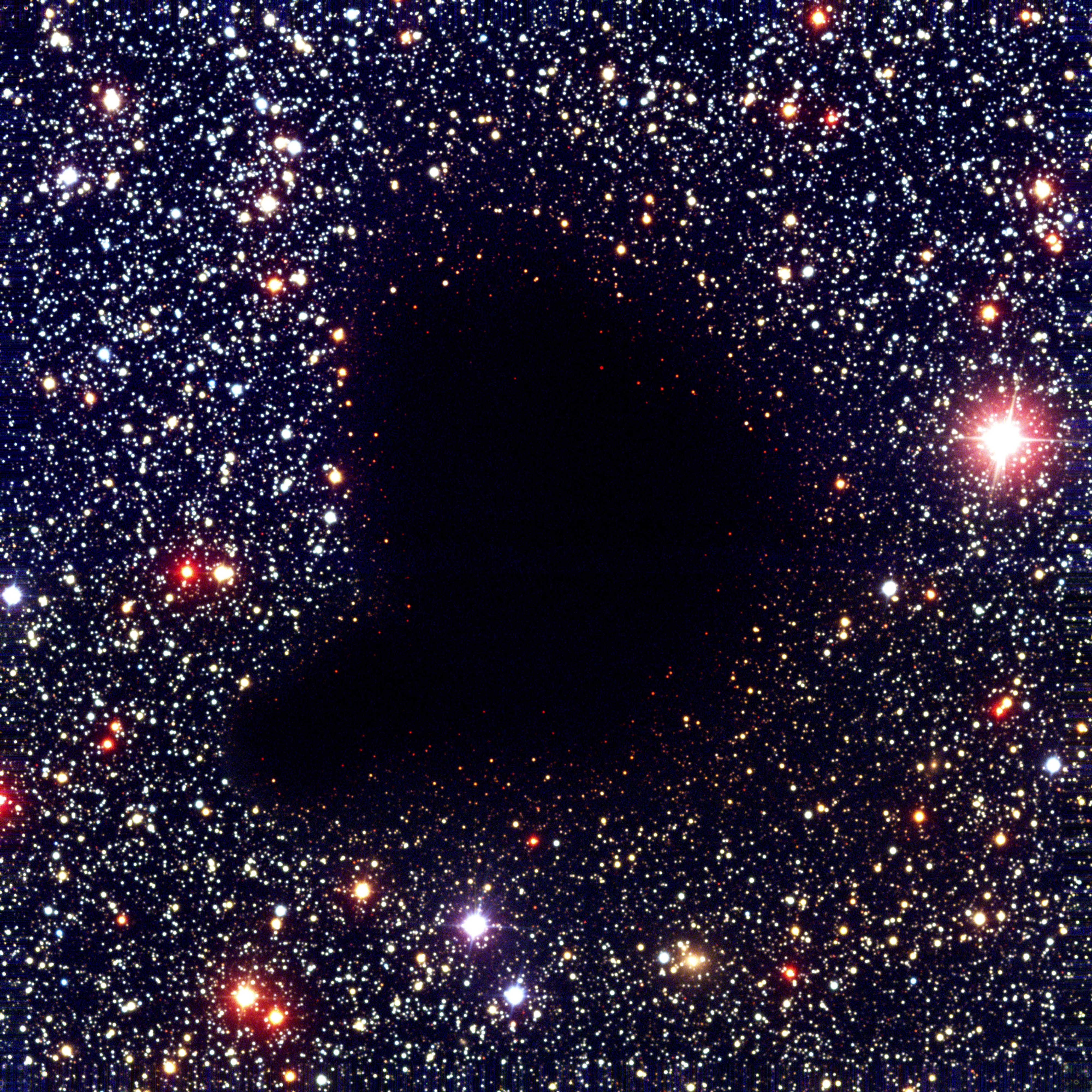
Molecular Cloud Barnard 68
Image Credit: FORS Team, 8.2-meter VLT Antu, ESO
Explanation: Where did all the stars go? What used to be considered a hole in the sky is now known to astronomers as a dark molecular cloud. Here, a high concentration of dust and molecular gas absorb practically all the visible light emitted from background stars. The eerily dark surroundings help make the interiors of molecular clouds some of the coldest and most isolated places in the universe. One of the most notable of these dark absorption nebulae is a cloud toward the constellation Ophiuchus known as Barnard 68, pictured above. That no stars are visible in the center indicates that Barnard 68 is relatively nearby, with measurements placing it about 500 light-years away and half a light-year across. It is not known exactly how molecular clouds like Barnard 68 form, but it is known that these clouds are themselves likely places for new stars to form. In fact, Barnard 68 itself has been found likely to collapse and form a new star system. It is possible to look right through the cloud in infrared light.


You must be logged in to post a comment.