

Category: Daily Posts
June 22 Astronomy Picture of the Day
Discover the cosmos! Each day a different image or photograph of our fascinating universe is featured, along with a brief explanation written by a professional astronomer.
2022 June 22
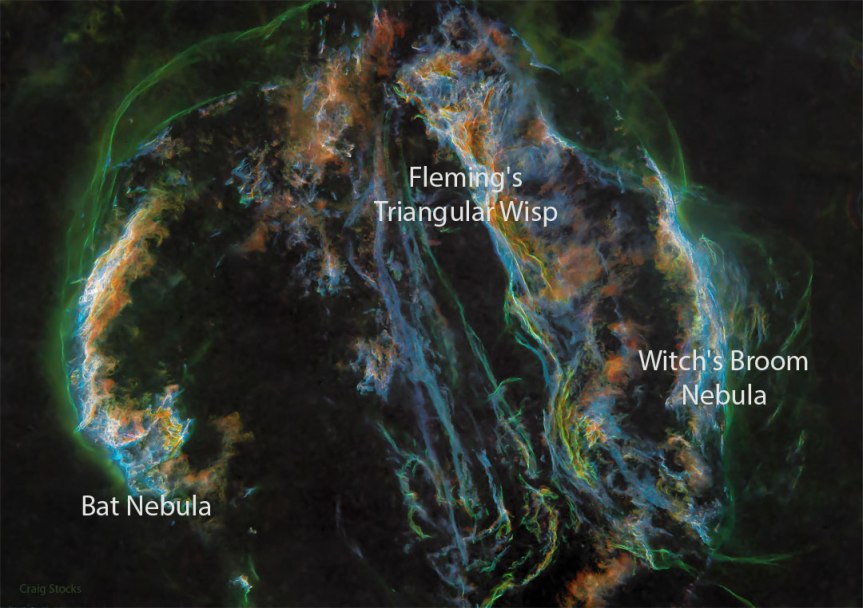
Supernova Remnant: The Veil Nebula
Image Credit & Copyright: Craig Stocks (Utah Desert Remote Observatories)
Explanation: Ten thousand years ago, before the dawn of recorded human history, a new light would have suddenly have appeared in the night sky and faded after a few weeks. Today we know this light was from a supernova, or exploding star, and record the expanding debris cloud as the Veil Nebula, a supernova remnant. Imaged with color filters featuring light emitted by sulfur (red), hydrogen (green), and oxygen (blue), this deep wide-angle view was processed to remove the stars and so better capture the impressive glowing filaments of the Veil. Also known as the Cygnus Loop, the Veil Nebula is roughly circular in shape and covers nearly 3 degrees on the sky toward the constellation of the Swan (Cygnus). Famous nebular sections include the Bat Nebula, the Witch’s Broom Nebula, and Fleming’s Triangular Wisp. The complete supernova remnant lies about 1,400 light-years away.
The Beauty of the Mother Moon

I gaze in awe at the beautiful light from our Mother Moon,
With her I take time to commune.
I speak from my heart about love and life.
This is time to vent my strife.
She fills me thoughts of sliver linings and shinny gold.
I ask her to share her sliver and gold for all my needs be met and my purse can hold.
I give her thanks for her unconditional love, protection, and guidance as I walk my path.
I ask that the heat and rain be not too bad in case I have done something to earn her wrath.
– Lady Beltane
Copyright 2022
I Can Hardly Type
My fibromyalgia is still rearing its ugly head and has caused another flare along with a migraine. Thanks to temperature changes and me mowing our lawn this morning before it got hot and possible rain tonight. Right now, when I type it feels like hot needles sticking in my fingertips whenever they touch a key. I am going to rest for a while than try to get the southern hemispheres tomorrow posts up on time but no guarantees.
Litha/Summer Solstice Correspondences
From FlyingTheHedge.com – Litha Correspondences
Symbolism: life, fire, rebirth, transformation, power, purity
Symbols: sun flowers, leaves, sword, spear, sun, God’s eye, sun wheels, bonfire, balefires, fire, sun dials, bird feathers, seashells,
Colors: red, gold, orange, yellow, white, green, blue
Food and Drink: mead, ale, summer fruits and vegetables, strawberries, honey cakes, whipped cream, oranges, lemons, summer squash, honey
Herbs: Saint John’s Wort, lavender, rose, peony, vervain, mugwort, chamomile, chickweed, chicory, sun flower, lily, thyme, hemp, fennel, nettle, wisteria, rue, fern, heather, oak, yarrow, holly
Deities: Ra, Bast, Helios, Oak King, Fotuna, Arinna, and other sun god.
Crystals and Gemstones: Lapis, diamond, tiger’s eye, emerald, jade, and other green stones
Animals: butterflies, wren, horse, stag, robin, cattle, phoenix, dragon, faeries, satyrs
Magic: Litha is the time to celebrate the Sun and all that he provides for us. Protection spells and fire magic are great to perform on this night. Make protective amulets to be empowered in the balefire lit on Midsummer’s eve. Looking to promote a transformation, a new career, or create a new or strengthen an old relationship? Litha is a great night to perform such magic. Collect herbs, especially St. John’s Wort, on the eve of this sabbat to bring luck and enhance the herbs’ power. Renew your wedding vows or just enjoy the time with your friends and family. This is also a great time to communicate with faeries and seek their help if you so wish. Be careful though. Faeries can be tricky.
Please note this is not a complete list but a brief overview of symbols, colors, herbs, deities, and the like. If I have missed something that you feel should make the list, please feel free to contact me via the comments or through email. Willow
June 21 Astronomy Picture of the Day
Discover the cosmos! Each day a different image or photograph of our fascinating universe is featured, along with a brief explanation written by a professional astronomer.
2022 June 21
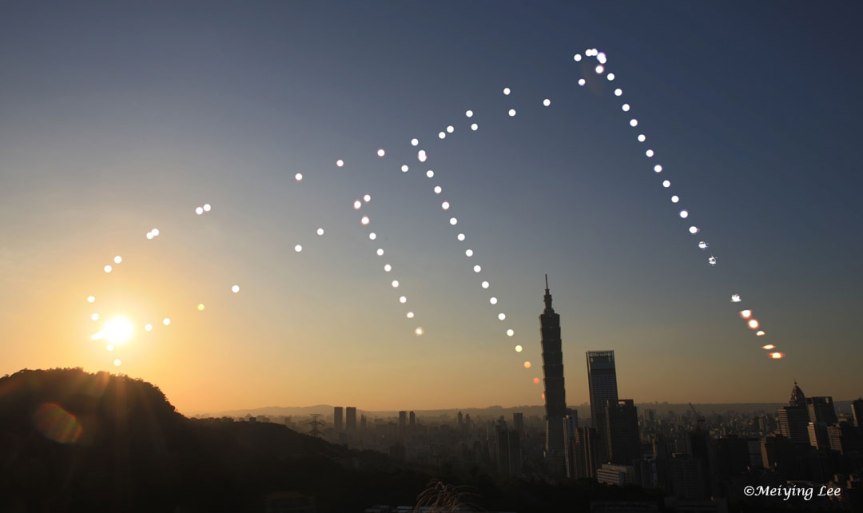
Analemma over Taipei
Image Credit & Copyright: Meiying Lee
Explanation: Does the Sun return to the same spot on the sky every day? No. A better and more visual answer to that question is an analemma, a composite of images taken at the same time and from the same place over the course of a year. The featured analemma was compiled at 4:30 pm many afternoons from Taiwan during 2021, with the city skyline of Taipei in the foreground, including tall Taipei 101. The Sun‘s location in December — at the December solstice — is shown on the far left, while its location at the June solstice is captured on the far right. Also shown are the positions of the Sun throughout the rest of the day on the solstices and equinoxes. Today is the June solstice of 2022, the day in Earth‘s northern hemisphere when the Sun spends the longest time in the sky. In many countries, today marks the official beginning of a new season, for example winter in Earth’s southern hemisphere.
A Laugh for Today

I hope your Tuesday is not terrible!
A Thought for Today

Until we meet again dear sisters, brothers, and honored guests may your life be filled with all things positive!
June 20 Astronomy Picture of the Day
Discover the cosmos! Each day a different image or photograph of our fascinating universe is featured, along with a brief explanation written by a professional astronomer.
2022 June 20

Rock Fingers on Mars
Image Credit: NASA, JPL-Caltech, MSSS
Explanation: There, just right of center, what is that? The surface of Mars keeps revealing new surprises with the recent discovery of finger-like rock spires. The small nearly-vertical rock outcrops were imaged last month by the robotic Curiosity rover on Mars. Although similar in size and shape to small snakes, the leading explanation for their origin is as conglomerations of small minerals left by water flowing through rock crevices. After these relatively dense minerals filled the crevices, they were left behind when the surrounding rock eroded away. Famous rock outcrops on Earth with a similar origin are called hoodoos. NASA’s Curiosity Rover continues to search for new signs of ancient water in Gale Crater on Mars, while also providing a geologic background important for future human exploration.
A Laugh for Today

I hope your Monday is not a manic one!
Belated HAPPY MOTHER’S DAY

HAPPY FATHER’S DAY
Ok ladies please do not get upset that I am posting a thing for Father’s Day but did not for Mother’s Day. The reason I did not for Mother’s Day is it happens on different days worldwide and I did not want to pick one date over another, but you will have a Happy Mother’s Day post today!

June 19 Astronomy Picture of the Day is a Game
Discover the cosmos! Each day a different image or photograph of our fascinating universe is featured, along with a brief explanation written by a professional astronomer.
2022 June 19
Use this link to see Game: Super Planet Crash
Game Credit & License: Stefano Meschiari (U. Texas at Austin) & the SAVE/Point Team
Explanation: Can you create a planetary system that lasts for 1000 years? Super Planet Crash, the featured game, allows you to try. To create up to ten planets, just click anywhere near the central star. Planet types can be selected on the left in order of increasing mass: Earth, Super-Earth, Ice giant, Giant planet, Brown dwarf, or Dwarf star. Each planet is gravitationally attracted not only to the central Sun-like star, but to other planets. Points are awarded, with bonus factors applied for increasingly crowded and habitable systems. The game ends after 1000 years or when a planet is gravitationally expelled. Many exoplanetary systems are being discovered in recent years, and Super Planet Crash demonstrates why some remain stable. As you might suspect after playing Super Planet Crash a few times, there is reason to believe that our own Solar System has lost planets during its formation.
Prehistoric Swiss Army knife indicates early humans communicated
Archaeologists have found that a tool, dubbed the “stone Swiss Army knife” of prehistory, was made to look the same in enormous numbers across great distances and multiple biomes in southern Africa. This indicates early humans were sharing information and communicating with one another.
In a world first, a team of international scientists, led by University of Sydney archaeologist, Dr. Amy Way and Australian Museum, has revealed that early humans across southern Africa made a particular type of stone tool—a blade used for many purposes including hunting technology (such as barbs in hand thrown spears and possibly bow and arrows), for cutting wood, plants, bone, skin, feathers and flesh—in the same shape. The researchers reported this means populations must have been in contact with each other.
Known as the “stone Swiss Army knife” of prehistory, the Howiesons Poort blades were made to a similar template across great distances and multiple biomes. The study published in Scientific Reports, found the artifacts produced in enormous numbers across southern Africa roughly 65 thousand years ago were made to a similar shape.
Lead author Dr. Way, from the Department of Archaeology at the University of Sydney and the Australian Museum, explained…
Click here to read the rest of this article
A Laugh for Today

As a witch many of us get label as a black sheep or an outcast in our families. But you what? It only matters what you think of yourself and the spiritual path that is right for you.
Have a super Sunday!
A Thought for Today

Until we meet again dear sisters, brothers, and honored guests may your life be filled with all things positive!
Some of the Witchcraft/Magickal Correspondence Digest for Saturday
Magickal Intentions: Spirit Communications, Meditation, Psychic Attack or Defense, Locating Lost Things and Missing Persons, Building, Life, Doctrine, Protection, Knowledge, Authority, Limitations, Boundaries, Time and Death
Incense: Black Poppy Seed and Myrrh
Planet: Saturn
Sign: Capricorn and Aquarius
Angel: Cassel
Colors: Black, Grey and Indigo
Herbs/Plants: Myrrh, Moss, Hemlock, Wolfsbane, Coltsfoot, Nightshade and Fir
Stones: Jet, Smokey Quartz, Amethyst, Black Onyx, Snowflake Obsidian, Lava, Pumice
Oil: (Saturn) Cypress, Mimosa, Myrrh, Patchouli
Saturn lends its energies to the last day of the week. Because Saturn is the planet of karma, this day is an excellent time for spellwork involving reincarnation, karmic lessons, the Mysteries, wisdom, and long-term projects.
It is also a good time to being efforts that deal with the elderly, death, or the eradication of pests and disease.
June 18 Astronomy Picture of the Day
Discover the cosmos! Each day a different image or photograph of our fascinating universe is featured, along with a brief explanation written by a professional astronomer.
2022 June 18
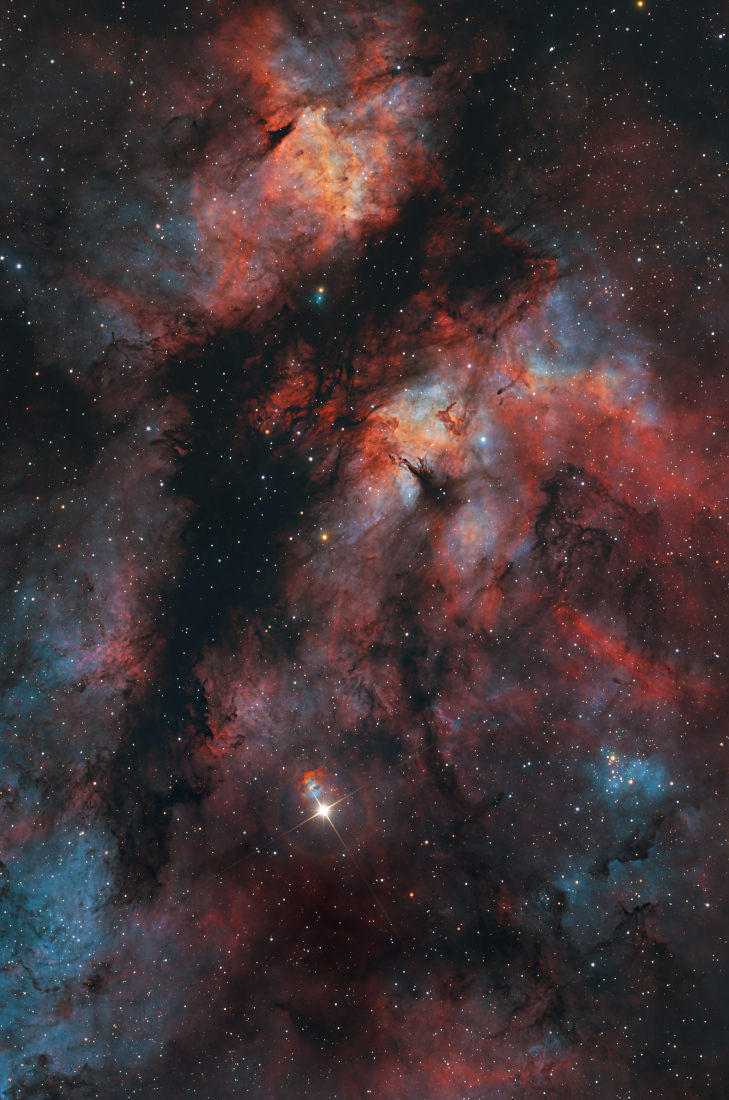
The Gamma Cygni Nebula
Image Credit & Copyright: Min Xie, Chen Wu, Yizhou Zhang, and Benchu Tang
Explanation: Supergiant star Gamma Cygni is at the center of the Northern Cross. Near the plane of our Milky Way galaxy, that famous asterism flies high in northern summer night skies in the constellation Cygnus the Swan. Known by the proper name Sadr, Gamma Cygni also lies just below center in this telescopic skyscape, with colors mapped from both broadband and narrowband image data. The field of view spans about 3 degrees (six Full Moons) on the sky and includes emission nebula IC 1318 and open star cluster NGC 6910. Filling the upper part of the frame and shaped like two glowing cosmic wings divided by a long dark dust lane, IC 1318’s popular name is understandably the Butterfly Nebula. Right of Gamma Cygni, are the young, still tightly grouped stars of NGC 6910. The distance to Gamma Cygni is around 560 parsecs or 1,800 light-years. Estimates for IC 1318 and NGC 6910 range from 2,000 to 5,000 light-years.
A Laugh for Today

Rest, relax, and enjoy a magical Saturday!
A Thought for Today

Until we meet again dear sisters, brothers, and honored guests may your life be filled with all things positive!
 Witches Of The Craft®





You must be logged in to post a comment.