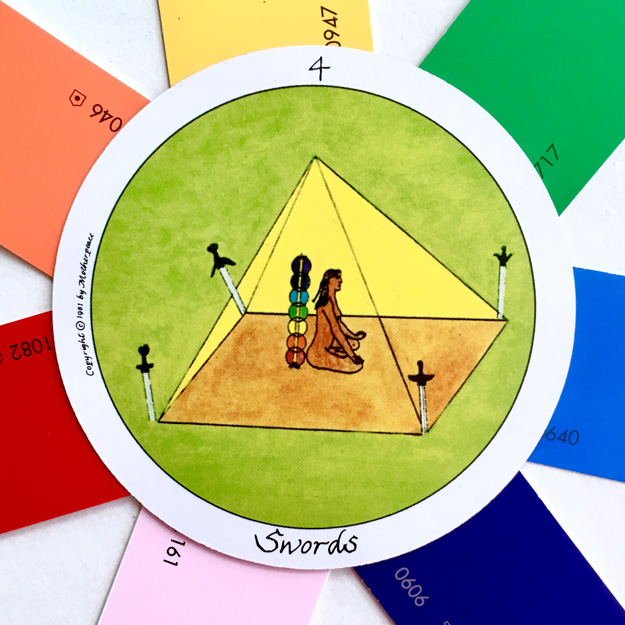
Your Tarot Card for the Week of April 16 – 22 is Four of Swords

Weekly Tarot Card for April 16-22:
Four of Swords

4

This week the Four of Swords confirms it’s time to rest and reflect as the dust settles on recent changes we have implemented. Any time big shifts occur in life, it’s necessary to take stock, checking in with the self to confirm aspects of identity and renew personal truths. In the discussions of the previous weeks’ cards, I’ve been using the example of moving homes to illustrate our theme of dealing with change. I actually did move homes recently, so these examples aren’t arbitrary! It was a huge change after spending five and a half years in one place (and came as a full-on Tower moment that I had been resisting). After the hard work of moving, I was tempted to reassemble my life as closely as possible to the old one, putting up the same pictures, recreating old furniture arrangements, but instead I took some time to get to know myself in the new situation. What still suited me, and what needed to be altered to fit these surroundings?

Exertion transforms us. We learn we are capable of a lot more than we thought, and it’s important to incorporate this new perspective into our identities. We also owe it to our minds and bodies to honor those efforts with recuperation. In the Motherpeace deck’s imagery, the Four of Swords shows a figure self-isolated inside a meditation pyramid designed for healing and chakra activation. Obviously, it’s not realistic for most of us to enjoy a fully sequestered retreat any time we need rest and recuperation. We have jobs, families, and other responsibilities than can’t be extensively put on hold. But even with those responsibilities, it is possible to find time for healing and reflection, often in connection with self-care activities that are already part of our regular routines. It’s just a matter of adding some extra awareness into these actions.

Exercise for this week: Realigning the self

How might you create mini-retreats inside of your busy life? Take a walk around the neighborhood, sit in silence in a favorite place, or enjoy a cup of tea at the local café while you write down your thoughts about recent experiences. If it’s too tough to carve out this extra time, turn one of the times you already spend alone taking care of your basic needs into a personal ritual. For example, use bath or shower time as a mini-retreat by increasing awareness of the activity as yours and yours alone. Be present with yourself instead of just going through the motions as a means to an end. Select a special scented soap or add salts and herbs to your bath. Play your favorite relaxing music. Be aware of each part of your body and how it feels as you honor it through cleansing. If you have trouble finding time alone, don’t be ashamed to ask for help; perhaps you can trade breaks with a co-parent or a friend who is also in need of a little self-care.

You might also take a suggestion from this illustration in the Motherpeace Tarot and give some attention to each of the chakras as a way to reconnect with the self. You can do this through meditation, if that is your practice. (Peacock Ore is said to be a great stone for realigning all the chakras, so consider incorporating a piece of it into your session.) If you prefer to engage with these concepts in a more cerebral way, try a journaling exercise exploring how each of the following are represented in your life. Give extra attention to any that seem underrepresented:


Tarot.com is Part of the Daily Insight Group ©2018


Tarot Card of the Day for April 16 is The Moon

Tarot Card of the Day

The Moon


18
The Moon card refers to a deep state of sensitivity and imaginative impressionability, developed within a womb of deep relaxation. Here we dream and go into trance, have visions and receive insights, wash in and out with the psychic tides, and experience deep mystical and/or terrifying realities beyond our ordinary senses. In a state of expanded consciousness, we cannot always control what happens. The Moon card represents the ultimate test of a soul’s integrity, where the membrane between the self and the unknown is removed, and the drop of individuality re-enters the ocean of being. What transpires next is between a soul and its maker.
Tarot.com is Part of the Daily Insight Group ©2018

If You Were Born Today, April 16

Happy Birthday

If You Were Born Today, April 16

While you yearn for security and stability, you are easily bored with routines and can get antsy if you don’t have freedom of movement. This can make you somewhat difficult to please at times! You can be quite indecisive in love, and in long-term setups, you’ll need to vary the routine frequently in order to keep your interest levels high. Dynamic and spirited, you have a kooky sense of humor and your interests (as well as talents) are many. Famous people born today: Kareem Abdul-Jabbar, Peter Ustinov, Ellen Barkin, Charlie Chaplin.

Your Birthday Year Forecast

With the Sun and Moon in harmony in your Solar Return chart, the year ahead should be satisfying and balanced overall. You are in comfortable demand and personally popular, and you are able to achieve a decent balance between work and play; personal and professional life. For the most part, you are on top of your game this year, and positive connections with others can be made fairly easily. With the ability to handle your emotions successfully, there is less stress on both your mind and body. Your self-confidence and positive attitude will reward you!

With Uranus electrifying your Sun this year, you can expect a rather liberated and interesting period ahead. Changes are in store for you, and they’re likely to be very positive if you recognize and honor your need for newness in your life. This influence brings about big changes, sudden events, unanticipated disruptions, and surprising situations into your life. These happenings are likely to have a major impact on your character, vitality, and individuality. You may feel the urge to break out and embrace new and exciting things. Life will be exciting–and the changes positive–if you go with the flow. If you deny your urge for change, feelings of restlessness and rebelliousness will unexpectedly erupt, prompting sudden lunges for freedom that can have surprising results and reactions. This influence stimulates your creativity, excitability, self-will, and originality. Sudden flashes of insight increase your spiritual awareness. You may become more outspoken, even rebellious. Career breaks or changes are possible. Alternatively, you might change the direction of your life path to suit the “new you”. Unexpected events may cause you to rethink some of your goals and ambitions. In the area of relationships, there could be sudden attachments and equally sudden breakups. Ongoing connections with others may also undergo abrupt fluctuations.

Transiting Saturn harmonizes with your Sun until November, however, and this is a steadying, helpful influence. You are practical in your choices (for the most part), keeping your feet on the ground and paying attention to, and honoring, tradition as well as tried-and-true methods. You have the power of practicality, realism, and caution on your side in the year ahead. Work you have done in the past begins to pay off this year–not necessarily in dramatic ways, but in small, measurable ways. You may be recognized or rewarded in some way for the efforts you put forth. Because you project a more responsible and credible “you”, people in authority are more inclined to appreciate you and recognize your work.

Considering both of the above influences are in force at the same time, this can be an excellent period for blending the progressive and traditional and for finding new ways of doing things without sacrificing security and stability. You may be making experimental situations work for you now.

You are likely to form new relationships or connections that further your spiritual growth or to enhance existing relationships with a spirit of camaraderie. People in authority regard you favorably. Events take place in which you feel like you are moving forward and growing into a new phase of your life.

This is a time when you feel confident and supported enough to pursue your desires. You rather readily direct your energies into meaningful activities. It’s a good time to take steps towards making yourself feel more secure and safe, as well as for family or domestic activities.

It is easier than ever to express your individuality in a manner that is true to you this year. You are attracted to mind-body healing activities and can benefit greatly from them.

With Venus in a tense aspect to Saturn in your Solar Return, getting serious about love or money (or both) will be a theme this year. Money may be tight, or the need to buckle down with your finances may be necessary. This does not necessarily signify financial losses or hardship, but you are likely to have an increased awareness of your limits. The responsibilities of partnership are magnified this year. You are likely to be more earnest on a romantic level. An existing relationship may become more serious, or you may form a new partnership with a serious or older person. You are likely to work hard this year, and this could interfere with pleasure time.

Even so, you have distinct opportunities in the relationship department at other points in the year. As well, your personal magnetism is excellent. You are playfully competitive and might win a major competition, if applicable. This is a good period for creative projects and joining with others in pursuing a common goal.

Personal appeal in the period ahead is strong, although there can be some ups and downs in relationships from time to time. The year ahead is excellent for teaching, guiding, sharing, and learning. This can be a time of career advances and is a strong period for focusing on priorities. You may be pouring a lot of your energy into particular projects. You are practical in your decision making, and you’re able to bring both enthusiasm and practicality to your endeavors this year. When you are motivated, you can accomplish great things, bringing new life to old goals. 


2017 is a Number Three year for you. Ruled by Jupiter. This is a year of sociability. It is a friendly time when it is easy to enjoy life and other people. Focus is on personal freedom, reaching out to others, making new friends, and exploration. You are more enthusiastic and ready for adventure. It is likely to be a rather lighthearted year when opportunities for “play” time are greater than usual. It’s also a good year for expressing your creativity. Advice – reach out, but avoid scattering your energies.

2018 will be a Number Four year for you. Ruled by Uranus. This is a year of work and development. It’s “nose to the grindstone” time. It’s a time to deal with practical matters, and it’s not a time to be lazy or especially gregarious. Sometimes, it can be a year that feels hard, monotonous and routine, and/or lonely. Positive new relationships are generally not formed in a Four personal year. Advice – get yourself organized, work to build your resources, keep busy.


Courtesy of Cafe Astrology


Weekly Karma Forecast for April 15 – 21, 2018

Weekly Forecast: April 15 – 21, 2018

The Karmic Tools Weekly Forecast covers the current planetary transits which affect people in different ways and to various degrees of intensity. Take notice when it is a Personal planet (Sun / Moon / Mercury / Venus / Mars) interacting with a Social (Jupiter/Saturn) or Collective planet (Uranus / Neptune/Pluto). And pay extremely close attention when it is a Social planet interacting with a Collective planet because that means something *big* is brewing that will move large groups of people along their evolutionary paths. Tuning in to the energy and rhythm of the planets can serve as a useful *guide* as you move along your Individual Path. It also helps to understand your place within the context of the larger Social & Collective Story. Below, you will find out how these energies tend to manifest, as well as guidance and direction.

*NOTE*  There are some days when there are NO CONTACTS (besides the Moon), please note that there are no missing entries, we just list the actual Activations of each week + the day they happen. 

Weekly Forecast:  April 15 – 21, 2018

4/15 ~ Mercury Direct @4* ARIES:

Hopefully, the review period has yielded new information and you’re ready to truly initiate the new year.

4/17 ~ Venus (love, art & beauty) ~oppose~ Jupiter (expansion):

This is a great energy for enjoying nature, really good food & drink, fun company and lots of laughter! This is a celebration type of energy, to be enjoyed but not to excess or to the neglect of your health or well-being. It’s very creative and activates the true Inner Artist within all of us. It’s also good to consider that you are at a MidPoint in a relationship or creative project that you started about 6-months ago; is it still viable? is the Story you’re telling still true? where’s the value? is it worth it? So whether you are an artist or not, this activation can facilitate an infinitely creative mood, and expand your work immensely. Activate your imagination, think big, have fun & laugh today, but tomorrow, plan to start moving in a new direction that is more authentic for you personally.

4/17 ~ Venus (values, relationships & resources) ~trine~ Pluto (purification & transformation):

Anytime Pluto’s involved the intensity levels go up and you are able to hear/feel your SoulSelf more clearly than usual. Venus brings up that which is most important to you personally, your individual values & priorities, where your relationships & resources are concerned. This is an easy angle, making purification & transformation smoother than usual too. So, what are you ready to change? How have your values & priorities changed completely in the last year or so? Use this activation to deepen your connection with those you love most and allow the relationship to evolve to a totally new level. If you’re working on your relationship with money or self-worth specifically, this activation is a good time for prayer or ritual that supports positive change and your vision for the future. Pour any intense emotions or revelations into art of any medium or do a vision board, but give expression to the depths you recognize as coming to the surface of your consciousness.

4/17 ~ Saturn Retrograde @9* CAPRICORN:

This is Saturn’s first time in Capricorn since 1988-1990 and today brings its first retro in its home sign. This is a tremendous amount of stabilizing energy that you can direct consciously on your own behalf. In general, you can look to any area of your life that requires you to upgrade & fortify because it has essentially run its natural course and is more/less worn out. But you can also look to your Capricorn House, and see if the Areas of Life it represents, also may require some much-needed focus & dedication. Saturn often gets our attention by creating blockages & delays, pointing out weaknesses & oversights, and during its retrograde, there are reports of folks feeling like they are being ‘held back by the elbows’. But it doesn’t necessarily have to be that way. A better use of Saturn’s amazing energy is to slow down and check in with your personal base. How organized are you in general? Are you naturally focused and self-directed or do you succeed more often when you have a structure? This is a time to develop your Inner Authority to make choices & decisions on your own behalf, with courage & confidence. Take time to organize your thoughts or create a plan or strategy for adjusting to the changes being forced on you at this time. Start with small, manageable goals because accomplishing them will also give you the momentum & fortitude to go after the bigger goals. It’s time to release fear & doubt and redefine your reality on some level, if nothing else, for the new year alone.

4/18 ~ Sun (essential self & core drives) ~conjunct~ Uranus (disruption & liberation):

This energy serves to provoke a radical shift within you, catalyzing the desire to breathe fresh, clean, new vital energy into your idea of who you are and what you came to contribute. It may not be comfortable, but it is necessary and even more so for those of you who are rigid in your habits & thinking, or depend on others to validate who you are and what you contribute. Sometimes a little disruption serves to get you focused on what is really important to you. And at this time, change is in the air. It is far better to use the intensity of collective change to shift on personal levels, rather than try to go it alone or worse, play the martyr or victim. It’s time for your most unique Self to contribute the piece only you can. This activation may bring the sudden clarity you need and a refreshed attitude toward life, which can help tremendously as you fortify the connection to what makes you feel truly free & independent. If you resist the shift, you will manifest other disruptions that are far less productive, much more frustrating and significantly more costly.


The Study of Pagan Gods and Goddesses- Lugh, Master of Skills

00e7db143cbfa2a0ff5ae7eec468a6e0

Lugh

Master of Skills

Similar to the Roman god Mercury, Lugh was known as a god of both skill and the distribution of talent. There are countless inscriptions and statues dedicated to Lugh, and Julius Caesar himself commented on this god’s importance to the Celtic people. Although he was not a war god in the same sense as the Roman Mars, Lugh was considered a warrior because to the Celts, skill on the battlefield was a highly valued ability.

In Ireland, which was never invaded by Roman troops, Lugh is called sam ildanach, meaning he was skilled in many arts simultaneously.

Lugh Enters the Hall of Tara
In one famous legend, Lugh arrives at Tara, the hall of the high kings of Ireland. The guard at the door tells him that only one person will be admitted with a particular skill–one blacksmith, one wheelwright, one bard, etc. Lugh enumerates all the great things he can do, and each time the guard says, “Sorry, we’ve already got someone here who can do that.” Finally Lugh asks, “Ah, but do you have anyone here who can do them ALL?” At last, Lugh was allowed entrance to Tara.

The Book of Invasions
Much of the early history of Ireland is recorded in the Book of Invasions, which recounts the many times Ireland was conquered by foreign enemies. According to this chronicle, Lugh was the grandson of one of the Fomorians, a monstrous race that were the enemy of the Tuatha De Danann.

Lugh’s grandfather, Balor of the Evil Eye, had been told he would be murdered by a grandson, so he imprisoned his only daughter in a cave. One of the Tuatha seduced her, and she gave birth to triplets. Balor drowned two of them, but Lugh survived and was raised by a smith. He later led the Tuatha in battle, and indeed killed Balor.

Roman Influence
Julius Caesar believed that most cultures worshipped the same gods and simply called them by different names. In his Gallic War essays, he enumerates the popular deities of the Gauls and refers to them by what he saw as a corresponding Roman name. Thus, references made to Mercury actually are attributed to a god Caesar also calls Lugus, who was Lugh. This god’s cult was centered in Lugundum, which later became Lyon, France. His festival on August 1 was selected as the day of the Feast of Augustus, by Caesar’s successor, Octavian Augustus Caesar, and it was the most important holiday in all of Gaul.

Weapons and War
Although not specifically a war god, Lugh was known as a skilled warrior. His weapons included a mighty magic spear, which was so bloodthirsty that it often tried to fight without its owner. According to Irish myth, in battle, the spear flashed fire and tore through the enemy ranks unchecked. In parts of Ireland, when a thunderstorm rolls in, the locals say that Lugh and Balor are sparring–thus giving Lugh one more role, as a god of storms.

The Many Aspects of Lugh
According to Peter Beresford Ellis, the Celts held smithcraft in high regard. War was a way of life, and smiths were considered to have magical gifts.

After all, they were able to master the element of Fire, and mold the metals of the earth using their strength and skill. Yet in Caesar’s writings, there are no references to a Celtic equivalent of Vulcan, the Roman smith god.

In early Irish mythology, the smith is called Goibhniu, and is accompanied by two brothers to create a triple god-form. The three craftsmen make weaponry and carry out repairs on Lugh’s behalf as the entire host of the Tuatha De Danann prepares for war. In a later Irish tradition, the smith god is seen as a master mason or a great builder. In some legends, Goibhniu is Lugh’s uncle who saves him from Balor and the monstrous Formorians.

One God, Many Names
The Celts had many gods and goddesses, due in part to the fact that each tribe had its own patron deities, and within a region there might be gods associated with particular locations or landmarks.

For example, a god who watched over a particular river or mountain might only be recognized by the tribes who lived in that area. Lugh was fairly versatile, and was honored nearly universally by the Celts. The Gaulish Lugos is connected to the Irish Lugh, who in turn is connected to the Welsh Llew Llaw Gyffes.

Celebrating the Harvest of Grain
The Book of Invasions tells us that Lugh came to be associated with grain in Celtic mythology after he held an harvest fair in honor of his foster mother, Tailtiu. This day became August 1, and that date ties in with the first grain harvest in agricultural societies in the Northern Hemisphere. In fact, in Irish Gaelic, the word for August is lunasa. Lugh is honored with corn, grains, bread, and other symbols of the harvest. This holiday was called Lughnasadh (pronounced Loo-NA-sah). Later, in Christian England the date was called Lammas, after the Saxon phrase hlaf maesse, or “loaf mass.”

An Ancient God for Modern Times
For many Pagans and Wiccans, Lugh is honored as the champion of artistry and skills. Many artisans, musicians, bards, and crafters invoke Lugh when they need assistance with creativity. Today Lugh is still honored at the time of harvest, not only as a god of grain but also as a god of late summer storms.

Even today, in Ireland many people celebrate Lughnasadh with dancing, song, and bonfires. The Catholic church also has set this date aside for a ritual blessing of farmers’ fields.

_________________________

Lugh

Birth
Lugh’s father is Cian of the Tuatha Dé Danann, and his mother is Ethniu, daughter of Balor, of the Fomorians. In Cath Maige Tuired their union is a dynastic marriage following an alliance between the Tuatha Dé and the Fomorians. In the Lebor Gabála Érenn Cian gives the boy to Tailtiu, queen of the Fir Bolg, in fosterage. In the Dindsenchas Lugh, the foster-son of Tailtiu, is described as the “son of the Dumb Champion”.

A folktale told to John O’Donovan by Shane O’Dugan of Tory Island in 1835 recounts the birth of a grandson of Balor who grows up to kill his grandfather. The grandson is unnamed, his father is called Mac Cinnfhaelaidh and the manner of his killing of Balor is different, but it has been taken as a version of the birth of Lugh, and was adapted as such by Lady Gregory. In this tale, Balor hears a druid’s prophecy that he will be killed by his own grandson. To prevent this he imprisons his only daughter in the Tór Mór (great tower) of Tory Island, cared for by twelve women, who are to prevent her ever meeting or even learning of the existence of men. On the mainland, Mac Cinnfhaelaidh owns a magic cow who gives such abundant milk that everyone, including Balor, wants to possess her. While the cow is in the care of Mac Cinnfhaelaidh’s brother Mac Samthainn, Balor appears in the form of a little red-haired boy and tricks him into giving him the cow. Looking for revenge, Mac Cinnfhaelaidh calls on a leanan sídhe (fairy woman) called Biróg, who transports him by magic to the top of Balor’s tower, where he seduces Eithne. In time she gives birth to triplets, which Balor gathers up in a sheet and sends to be drowned in a whirlpool. The messenger drowns two of the babies, but unwittingly drops one child into the harbour, where he is rescued by Biróg. She takes him to his father, who gives him to his brother, Gavida the smith, in fosterage.

There may be further triplism associated with his birth. His father in the folktale is one of a triad of brothers, Mac Cinnfhaelaidh, Gavida and Mac Samthainn, and his father in the medieval texts, Cian, is often mentioned together with his brothers Cú and Cethen. Lebor Gabála Érenn Two characters called Lugaid, a popular medieval Irish name thought to derive from Lugh, have three fathers: Lugaid Riab nDerg (Lugaid of the Red Stripes) was the son of the three Findemna or fair triplets, and Lugaid mac Con Roí was also known as mac Trí Con, “son of three hounds”. In Ireland’s other great “sequestered maiden” story, the tragedy of Deirdre, the king’s intended is carried off by three brothers, who are hunters with hounds. The canine imagery continues with Cian’s brother Cú (“hound”), another Lugaid, Lugaid Mac Con (son of a hound), and Lugh’s son Cúchulainn (“Culann’s Hound”).[18] A fourth Lugaid was Lugaid Loígde, a legendary King of Tara and ancestor of (or inspiration for) Lugaid Mac Con.

Lugh joins the Tuatha Dé Danann
As a young man Lugh travels to Tara to join the court of king Nuada of the Tuatha Dé Danann. The doorkeeper will not let him in unless he has a skill with which to serve the king. He offers his services as a wright, a smith, a champion, a swordsman, a harpist, a hero, a poet and historian, a sorcerer, and a craftsman, but each time is rejected as the Tuatha Dé Danann already have someone with that skill. But when Lugh asks if they have anyone with all those skills simultaneously, the doorkeeper has to admit defeat, and Lugh joins the court and is appointed Chief Ollam of Ireland. He wins a flagstone-throwing contest against Ogma, the champion, and entertains the court with his harp. The Tuatha Dé Danann are at that time oppressed by the Fomorians, and Lugh is amazed how meekly they accept this. Nuada wonders if this young man could lead them to freedom. Lugh is given command over the Tuatha Dé Danann, and he begins making preparations for war.

The sons of Tuireann
Tuireann and Cian, Lugh’s father, are old enemies, and one day his sons, Brian, Iuchar and Iucharba spot Cian in the distance and decide to kill him. They find him hiding in the form of a pig, but Cian tricked the brothers into allowing him to transform back to a man before they killed him, giving Lugh the legal right to claim compensation for a father rather than just a pig. When they try to bury him, the ground spits his body back twice before keeping him down, and eventually confesses that it is a grave to Lugh. Lugh holds a feast and invites the brothers, and during it he asks them what they would demand as compensation for the murder of their father. They reply that death is the only just demand, and Lugh agrees. He accuses them of the murder of his father, Cian, and sets them a series of seemingly impossible quests. The brothers go on an adventure and achieve them all except the last one, which will surely kill them. Despite Tuireann’s pleas, Lugh demands that they proceed and, when they are all fatally wounded, he denies them the use of one of the items they have retrieved, a magic pigskin which heals all wounds. They die of their wounds and Tuireann dies of grief over their bodies.

The Battle of Magh Tuireadh
Using the magic artifacts the sons of Tuireann have gathered, Lugh leads the Tuatha Dé Danann in the Second Battle of Mag Tuireadh against the Fomorians. Nuada is killed in the battle by Balor. Lugh faces Balor, who opens his terrible, poisonous eye that kills all it looks upon, but Lugh shoots a sling-stone that drives his eye out the back of his head, wreaking havoc on the Fomorian army behind. After the victory Lugh finds Bres, the half-Fomorian former king of the Tuatha Dé Danann, alone and unprotected on the battlefield, and Bres begs for his life. If he is spared, he promises, he will ensure that the cows of Ireland always give milk. The Tuatha Dé Danann refuse the offer. He then promises four harvests a year, but the Tuatha Dé Danann say one harvest a year suits them. But Lugh spares his life on the condition that he teach the Tuatha Dé Danann how and when to plough, sow and reap.

Later life and death
Lugh instituted an event similar to the Olympic games called the Assembly of Talti which finished on Lughnasadh (1 August) in memory of his foster-mother, Tailtiu, at the town that bears her name (now Teltown, County Meath). He likewise instituted Lughnasadh fairs in the areas of Carman and Naas in honour of Carman and Nás, the eponymous tutelary goddess of these two regions. Horse races and displays of martial arts were important activities at all three fairs. However, Lughnasadh itself is a celebration of Lugh’s triumph over the spirits of the Otherworld who had tried to keep the harvest for themselves. It survived long into Christian times and is still celebrated under a variety of names. Lúnasa is now the Irish name for the month of August.

According to a poem of the dindsenchas, Lugh was responsible for the death of Bres. He made 300 wooden cows, and filled them with a bitter, poisonous red liquid which was then “milked” into pails and offered to Bres to drink. Bres, who was under an obligation not to refuse hospitality, drank it down without flinching, and it killed him.

Lugh is said to have invented the board game fidchell.

He had several wives, including Buí and Nás, daughters of Ruadri, king of Britain. Buí lived and was buried at Knowth. Nás was buried at Naas, County Kildare, which is named after her. Lugh had a son, Ibic, by Nás. His daughter or sister was Ebliu, who married Fintan. By the mortal Deichtine, he had another son, the hero Cú Chulainn.

One of his wives, Buach, had an affair with Cermait, son of the Dagda. Lugh killed him in revenge, but Cermait’s sons, Mac Cuill, Mac Cecht and Mac Gréine, killed Lugh in return, drowning him in Loch Lugborta. He had ruled for forty years. Cermait was later revived by his father the Dagda, who used the smooth or healing end of his staff to bring Cermait back to life.
In other cycles and traditions
In the Ulster Cycle he fathered Cúchulainn with the mortal maiden Deichtine. When Cúchulainn lay wounded after a gruelling series of combats during the Táin Bó Cuailnge (Cattle Raid of Cooley), Lugh appeared and healed his wounds over a period of three days.
In Baile in Scáil (The Phantom’s Trance), a story of the Historical Cycle, Lugh appeared in a vision to Conn of the Hundred Battles. Enthroned on a daïs, he directed a beautiful woman called the Sovereignty of Ireland to serve Conn a portion of meat and a cup of red ale, ritually confirming his right to rule and the dynasty that would follow him.
In the Fenian Cycle the dwarf harper Cnú Deireóil claimed to be Lugh’s son.
The Luigne, a people who inhabited Counties Meath and Sligo, claimed descent from him.
Ainle is listed as the son of Lug Longhand and is killed by Curnan the Blacklegged in the Rennes Dinsenchas. Ainle, whose name means “champion” is described as being renowned and glorious, but in the same poetic verse is also described as being a weakling with no grip in battle.
In the Dindsenchas, Luat the son of Scal Balb (another name of Cian) is mentioned as the husband of Bairend.
Possessions
Lug possessed a number of magical items, retrieved by the sons of Tuirill Piccreo in Middle Irish redactions of the Lebor Gabála. Not all the items are listed here. The late narrative Fate of the Children of Tuireann not only gives a list of items gathered for Lugh, but also endows him with such gifts from the sea god Manannán as the sword Fragarach, the horse Enbarr (Aonbarr), the boat Scuabtuinne / Sguaba Tuinne (“Wave-Sweeper”), his armour and helmet.

Lugh’s Spear
The lore around Lugh’s Spear is traced as follows:

Four Treasures Spear of Lugh
Lugh’s spear (sleg), according to the text of The Four Jewels of the Tuatha Dé Danann, was said to be impossible to overcome, taken to Ireland from Gorias (or Findias).

Gae Assail
Lugh obtained the Spear of Assal (Irish: Gae Assail) as fine (éric) imposed on the children of Tuirill Piccreo (or Biccreo), according to the short account in Lebor Gabála Érenn (Poem LXV, 319), which adds that the incantation “Ibar (Yew)” made the cast always hit its mark, and “Athibar (Re-Yew)” caused the spear to return.

Areadbhar
In a full narrative version called [A]oidhe Chloinne Tuireann (The Fate of the Children of Tuireann), from copies no earlier than the 18th century, Lugh demands the spear named Ar-éadbair or Areadbhair (Early Modern Irish: Aꞃéadḃaiꞃ) which belonged to Pisear, king of Persia, that its tip had to be kept immersed in a pot of water to keep it from igniting, a property similar to the Lúin of Celtchar. This spear is also called “Slaughterer” in translation.

Finest Yew of the Wood
There is yet another name that Lugh’s spear goes by: “A [yew] tree, the finest of the wood” (Early Modern Irish: eó bo háille d’ḟíoḋḃaiḃ),[34]:204-5 occurring in an inserted verse within The Fate of the Children of Tuireann. “The famous yew of the wood” (ibar alai fhidbaidha) is also the name that Lugh’s spear is given in a tract which alleges that it, the Lúin of Celtchar and the spear Crimall that blinded Cormac Mac Airt were one and the same weapon (tract in TCD MS 1336 (olim H 3. 17), col. 723, discussed in the Lúin page).

Sling-stone
Lugh used the “sling-stone” (cloich tabaill) to slay his grandfather, Balor the Strong-Smiter in the Battle of Magh Tuired according to the brief accounts in the Lebor Gabála Érenn. The narrative Cath Maige Tured, preserved in a unique 16th century copy, words it slightly different saying that Lugh used the sling-stone (here liic talma § 133, i.e. lía “stone” of the ‘tailm “sling”) to destroy the evil eye of Balor of the Piercing Eye (Bolur Birugderc).

Tathlum
A certain poem recorded by O’Curry in English translation says that the missile fired by Lugh was a tathlum (táthluib “(slingstone made of) cement”).

Nature Myth Items
Lugh’s projectile weapon, whether a dart or missile, was envisioned by symbolic of lightning-weapon. Lugh’s sling rod, named “Lugh’s Chain”, was the rainbow and the Milky Way. Unlike the rod-sling, Lugh had no need to wield the spear himself. It was alive and thirsted so for blood that only by steeping its head in a sleeping-draught of pounded fresh poppy seeds could it be kept at rest. When battle was near, it was drawn out; then it roared and struggled against its thongs, fire flashed from it, and it tore through the ranks of the enemy once slipped from the leash, never tired of slaying.

Fragarach
Lugh is also seen girt with the Freagarthach (better known as Fragarach), the sword of Manannán, in the assembly of the Tuatha Dé Danann in the Fate of the Children of Tuireann.

Lugh’s horse(s) and magic boat
Lugh had a horse named Aenbharr which could fare over both land and sea. Like much of his equipment, it was furnished to him by the sea god Manannán mac Lir. When the Children of Tuireann asked to borrow this horse, Lugh begrudged them, saying it would not be proper to make a loan of a loan. Consequently, Lugh was unable to refuse their request to use Lugh’s currach (coracle) or boat, the “Wave-Sweeper” (Irish: Sguaba Tuinne).

In the Lebor Gabála, Gainne and Rea were the names of the pair of horses belonging to the king of the isle of Sicily [on the (Tyrrhene sea)], which Lug demanded as éric from the sons of Tuirill Briccreo.

Failinis
Failinis was the name of the whelp of the King of Ioruaidhe that Lugh demanded as éiric (a forfeit) in the Oidhead Chloinne Tuireann. This concurs with the name of the hound mentioned in an “Ossianic Ballad”, sometimes referred to by its opening line “Dám Thrír Táncatair Ille (They came here as a band of three)”. In the ballad the hound is called Ṡalinnis (Shalinnis) or Failinis (in the Lismore text), and belonged to a threesome from Iruaide whom the Fianna encounter. It is described as “the ancient grayhound… that had been with Lugh of the Mantles, / Given him by the sons of Tuireann Bicreann;…”

That hound of mightiest deeds,
Which was irresistible in hardness of combat,
Was better than wealth ever known,
A ball of fire every night.
Other virtues had that beautiful hound
(Better this property than any other property),
Mead or wine would grow of it,
Should it bathe in spring water.
O’Curry’s excerpt ends here, but the subsequent verse runs “The three full-fledged heroes are called Sél, Donait and Domhnán. The dog of the fairest figure, Failinis was brought to Finn”. These threesome also appear in Acallamh na Sénorach though in that work the wonder-dog is called Fer Mac.

Name and nature

This article may require cleanup to meet Wikipedia’s quality standards. The specific problem is: Lots of unsourced material, possibly original research and synthesis Please help improve this article if you can. (February 2014)

Lugh’s name has been interpreted as deriving from the Proto-Indo-European root *leuk-, “flashing light”, and he is often surrounded by solar imagery, so from Victorian times he has often been considered a sun god, similar to the Greco-Roman Apollo though historically he is only ever equated with Mercury.[citation needed] He appears in folklore as a trickster, and in County Mayo thunderstorms were referred to as battles between Lugh and Balor, so he is sometimes considered a storm god: Alexei Kondratiev notes his epithet lonnbeimnech (“fierce striker”) and concludes that “if his name has any relation to ‘light’ it more properly means ‘lightning-flash’ (as in Breton luc’h and Cornish lughes)”. However, Breton and Cornish are Brythonic languages in which Proto-Celtic *k did undergo systematic sound changes into -gh- and -ch-.

Lugh’s mastery of all arts has led many to link him with the unnamed Gaulish god Julius Caesar identifies with Mercury, whom he describes as the “inventor of all the arts”. Caesar describes the Gaulish Mercury as the most revered deity in Gaul, overseeing journeys and business transactions. Juliette Wood interprets Lugh’s name as deriving from the Celtic root *lugios, “oath”, and the Irish word lugh connotes ideas of “blasphemy, cussing, lies, bond, joint, binding oath”, which strengthens the identification with Mercury, who was, among other attributes, a god of contracts.

It is also worth noting that parallels exist between the Irish Lugh, British Lleu, Gaulish Lugus, German Wotan, the English Woden, and Norse Odin. Odin was worshipped by the Norse as a god of war among other things, including poetry and the arts. Odin may have replaced Tyr as god of war among north Germanic peoples. As such, it may be that Lugh was also worshipped as a god of war by the Irish. On that note it is worth noting that the ultimate Irish warrior hero Cu Chulainn is cited as the son of Lugh.

Locations named after Lugh
The County of Louth in Ireland is named after the village of Louth, which in turn is named after the God Lugh. Historically, the place name has had various spellings; “Lugmad”, “Lughmhaigh”, and “Lughmhadh”. Lú is the modern simplified spelling.


Reference
Patti Wigington, Published on ThoughtCo 
Wikipedia

The Witches Magickal Journal for Monday, April 16th

witches of the craft banner box

The Witches Magickal Journal for Monday, April 16th

OakTree_Pentagram_Tattoo_by_Ralwor

I think that there is incredible prejudice about witches while there is no prejudice about wizards. Words are very important, and I’m really into destroying myths.

–Yoko Ono

Brainy Quotes

OakTree_Pentagram_Tattoo_by_Ralwor

Today is Monday, April 16

Monday is the sacred day of the moon, personified as the goddesses Selene, Luna, and Mani. The moon is ruler of flow, affecting the changeable and impressionable aspects of people. If a full moon falls on a Monday, then the powers of the moon are at their most potent.

Deity: Mani

Zodiac Sign: Cancer

Planet: Moon

Tree: Willow

Herb: Chickweed

Stone: Agate

Animal: Crab

Element: Water

Color: Green

Rune: Lagu (L)


The Celtic Tree Month Saille (Willow) (April 14 – May 12)


Runic Half Month of Man(human being) (April 14 – April 28)


Goddess of the Month of Columbina (March 20 – April 17)


Source
The Pagan Book of Days
Nigel Pennick

OakTree_Pentagram_Tattoo_by_Ralwor

The Pagan Book of Days for Monday, April 16

the Norse festival of Sommarsblot is celebrated to welcome the summer. The runic half-month of Man is a time when the archetypal reality of the human condition should be meditated upon.

Source
The Pagan Book of Days
Nigel Pennick

OakTree_Pentagram_Tattoo_by_Ralwor

The Wicca Book of Days for Monday, April 16th

A Sacred Supplication

Some say that it was on this day that the Greek hero Theseus approached the God Apollo in supplication at Delphi for help in slaying the half-man, half-bull known as the Minotaur that roamed the Labyrinth on Crete. Theseus was advised, through the Delphic Oracle, to make a sacrifice to the Goddess Aphrodite (known as Venus in Rome) before setting sail. According to Greek tradition, supplicants like Theseus carried a ritual olive branch wound with white wool called the hiketeria, for it was said that this ensured that their please would not go unanswered.


The Seed Moon

Many Wiccans dedicate the April esbat to the “growing moon” or the “seed moon” (referring to the burgeoning natural growth at this time of year). Place some seeds on your altar, ask the Goddess to bless them, and then plant them in the earth by moonlight.
Source
The Wicca Book of Days
Observances, Traditions and Lore for Every Day of the Year
Selene Eilidh Ash

OakTree_Pentagram_Tattoo_by_Ralwor

The Goddess Book of Days for Monday, April 16

Bernadette sees the Goddess at Lourdes (France), Church calendar. A place of Persephone in pre- Christian times. Also: Isis, Mary, Yemaya, Kwan Yin, Tonantzin, Coatlique, Chalchiuhtlique, Erzulie, and Aphrodite. The sixteenth day of the Moon belongs to Goddesses Levanah, Selene and Luna.

Source

The Goddess Book of Days
Diane Stein

OakTree_Pentagram_Tattoo_by_Ralwor

Goddesses Associated with Mondays

Luna, Selene, Diana, Re, Gealach, Ida, Artemis, the Witches, Yemaya, Erzulie Tuesday Soorejnaree, Pinga1la, Anna, Aine, Danu, Yngona.
Source
The Goddess Book of Days
Diane Stein

OakTree_Pentagram_Tattoo_by_Ralwor

On Monday, April 16th, We Celebrate…..

Ludi (Rome)

POMONA


Themes: Rest, Pleasure; Nature

Symbols: All Flowers; Gardens

About Pomona: A Roman Goddess of orchards and gardens, Pomona is symbolized by al gardening implements. Pomans’s consort was Vertumnus, who likewise presided over gardens. Together, they embody the fruitful earth from which we gather physical and spiritual sustenance. First fruits are traditionally offered to them in gratitude.

To Do Today: Public games in Ancient Rome were dedicated to taking a much-needed rest fromo toil and war. this particular segment of the festival celebrated the beauty of flowers before people returned to the fields and their labors. So, wear a floral- or leafy-print outfit today and visit a greenhouse or an arboretum. Take time out to literally smell the flowers and thank Pomona for the simple pleasure this provides.

Make yourself a Pomona oil to dab on anytime you want to better appreciate nature or cultivate some diversion from your normal routine. Prepare this from the petals of as many different flowers as you can find, gathered early in the day. Steep the petals in warm oil until they turn translucent, then strain. Repeat and add essential oils (fruits ones for Pomona are ideal) to accentuate the aroma and energy you’ve created.

Source

365 Goddess, A Daily Guide to the magic and inspiration to the Goddess
Patricia Telesco

OakTree_Pentagram_Tattoo_by_Ralwor

Spellcrafting for Monday

 Spirituality
 Astral work
 Dreams
 Psychic talents
 Lunar energy
 Family
 Emotions
 Children
 Pets
 Fertility
 Female Energy
 Purification
Source
A Spell Crafter’s Compendium
Terri Paajanen

OakTree_Pentagram_Tattoo_by_Ralwor

The Magickal Day of Mondays

Monday is the day of the moon itself, and it’s a day that’s connected to lunar colors like silver, white, or even a pale blue. Metals and gemstones like silver, pearl, opal and moonstone all come into play today.

There are plenty of deities associated with the moon – Thoth and Diana for instance – and herbal correspondences include many members of the mint family. Utilize wintergreen or peppermint, as well as catnip, comfrey, sage and chamomile in your workings.

When it comes to Monday magic, because of that lunar connection, it’s a good time to focus on workings related to childbearing and family life, purity and virginity, healing, wisdom, and intuition. Do a little bit of self exploration and work on developing your intuition – learn to trust your gut. Celebrate birth and life, and make some magic to fix what is broken.

Author
Patti Wigington, Paganism/Wicca Expert
Article published on & owned by ThoughtCo

OakTree_Pentagram_Tattoo_by_Ralwor

Your Magickal Guide to Mondays


In the word Monday, we can see part of the word Moon. In the romance languages such as Italian or Spanish, this day of the week is called Lunes and clearly relates to the word lunar.On Mondays, a variety of magick may be worked. Because Monday centers on the energies of the Moon, things like psychism, dreams, feminine energy, health, success in spiritual pursuits, domestic matters, and things of family origin are especially important this day.

Mondays are best for love magick and anything concerning home or family, thus old saying, Mondays child is fair of face, which seems clearly to relate to the themes of love and health.

Angels of Monday are Gabriel, Arcan, Missabu, and Abuzaha. Arcan is known as the king of the angels of air and the “ruler” of Monday. Abuzaha (Abuzohar) serves Monday, and is very responsive to invocations and ritual magick. Missabu is a ministering angel of Arcan.

Check whether the moon is waning or waxing to determine what your spell will be. During waning moons, do spells to rid yourself of obstacles or for wisdom and protection. During waxing moons do magic for increase of any kind or to draw something into your life.

On Mondays, the best hour to work is moonrise. Get this information from your local newspaper, astrological calendar, or almanac.

Source
Gypsy Magic

OakTree_Pentagram_Tattoo_by_Ralwor

Monday’s Witchery

Think for a moment on all of the witchery, magick and enchantments that you have discovered. Don’t be afraid to adjust spells to suit your own specific needs. Any gentle, illusory, and dreamy charms and spells can be enhanced when you work on the day of the week that is dedicated to the moon. Mondays are a fantastic day to boost your psychic abilities and to tune in to your intuition and empathy. It also gives you the opportunity to work with a different lunar phase each and every Monday, which means in one month you could work four different types of moon magicks on Mondays. How’s that for adding to your repertoire? You are going to have mad skills in no time at all.

So light up those lunar scented candles and add a little mystique to your outfit by wearing an enchanting lunar color. Wear your sparkling silver jewelry and maybe add a pair of dangling silver earrings or a pendant shaped like a crescent moon. Create lunar potions and philters; make a dream catcher and give it as a gift to someone you love. Burn some sandalwood or jasmine-scented incense today to inspire the glamour and magick of the moon. Slice up a favorite variety of fruit that is in season for a snack or share it with your love and enjoy his or her lunar and romantic qualities. Brew up a cup of chamomile tea, enchant it with a little moon magick, and relax and get a good night’s sleep.

Most importantly, get outside tonight and watch the moon for a while. What phase is she in? What color was the moon as she rose? Why not start a journal and write down at what location the moon rises and sets for a few seasons? This is a great way to teach you to tune in and to become more aware of the moon and the influence that she pulls into our lives. Try calling on Selene for her magickal assistance, and call Thoth for wisdom and strength. Get to know the Norse Mani and the Latvian Meness. These gods of the moon have plenty to teach, and if you allow their influence to cycle through your life, you’ll receive many blessings. Be imaginative, and create your own personal lunar magick and witchery. Go on….the moonlight becomes you.

Source
Book of Witchery: Spells, Charms & Correspondences for Every Day of the Week
Ellen Dugan

OakTree_Pentagram_Tattoo_by_Ralwor

The Witches Almanac for Monday, April 16

Sechseläuten (Swiss)

Waxing Moon

 
Moon phase: First Quarter

 
Moon Sign: Aries

 
Moon enters Taurus 4: 51 pm

 
Incense: Narcissus

 
Color: White


OakTree_Pentagram_Tattoo_by_Ralwor

The Witches Correspondences for Monday, April 16

Day: Monday ( Moon-day)

Planet: Moon

Colors: Silver and White and Grey

Crystals: Moonstone, Pearl, Aquamarine, Silver, Selenite

Aroma: Jasmine, Lemon, Sandalwood, Moon Oil, African violet, Honeysuckle, Myrtle, Willow, and Wormwood

Herb: Moonwart

The sacred day of the Moon, personified by such goddesses as Selene, Luna, Diana, and Artemis. The Moon is ruler of flow affecting the changeable aspects of people. If a full moon falls on a Monday, its powers are at theirmmost potent. Magical aspects: peace, sleep, healing, compassion, friendships, psychic awareness, purification, and fertility

Monday is ruled by the moon – an ancient symbol of mystery and peace. Monday is a special day for mothers as the cycle of the moon has long been associated with the female menstrual cycle. Those wishing to conceive a baby would be wise to try on a Monday as the magic of motherhood is strong and pregnancy is in the air.

This is the proper day of the week to perform spells and rituals involving agriculture, animals, female fertility, messages, reconciliation’s, theft, voyages, dreams, emotions, clairvoyance, home, family, medicine, cooking, personality, merchandising, psychic work, Faerie magic, and Goddess rituals.

OakTree_Pentagram_Tattoo_by_Ralwor

Monday Is Ruled By the Moon

This day of the week is dedicated to the moon and all of her magic and mystery. Mondays are for women’s mysteries, illusion, prophetic dreaming, emotions, travel, and fertility.

Some suggestions for Monday enchantments would include:

*Getting outside and looking for the moon in the heavens. Sit under her light and absorb a little glamour. Call on the moon goddess Selene for practical help in magical issues.

*Invoking the god Thoth for wisdom and insight

*Empowering your silver jewelry under the light of the moon. Wear moonstone or pearl jewelry today to add a lunar and magical shimmer to your outfit. Be mysterious and subtle and wear moon-associated colors such as white, silver, and blue.

*Working spells for safe travel with a simple moonstone

*Gathering bluebells, jasmine, gardenias, or white roses to create a little garden witchery with the flowers that are associated with the moon

*Setting up a lunar Tarot spell today to increase your psychic powers

*Eating a lunar fruit such as a melon to be healthy, serene, and at peace

*Brewing up a cup of chamomile or mint tea and enchanting it for sweet dreams and restful sleep


OakTree_Pentagram_Tattoo_by_Ralwor

DAILY MAGICKAL APPLICATIONS FOR MONDAY

Monday is named after the moon. The Latin term for Monday is Dies Lunae (“moon’s day”); in the Old English language, this day was Monandaeg; in Greek, it was Hermera Selenes. All of these different names and languages translate to the same thing: the “day of the moon.”

Working with the different phases of the moon is an important skill that takes a bit of time for Witches to learn. So why not cut to the chase and experiment with the day of the week that is dedicated to the moon in all of its magickal energies and aspects?

Magickally, Monday encourages the lunar energies of inspiration, illusion, prophetic dreams, emotions, psychic abilities, travel, women’s mysteries, and fertility.

Source
Book of Witchery: Spells, Charms & Correspondences for Every Day of the Week
Ellen Dugan

OakTree_Pentagram_Tattoo_by_Ralwor

The Witches Magick for Monday, April 16th – Psychic Power Philter


You will need:
• One clear or blue glass bottle with a stopper or lid
• A clean dropper
• 6 inches silver ribbon
• A small moon-shaped charm
• A label and a pen (to list the ingredients and to decorate and mark the bottle)
• 8 cup almond base oil (almond is associated with the moon)
• 13 drops sandalwood oil (a lunar oil that is both spiritual and protective)
• 3 white rose petals
• 3 willow leaves or a pinch of dried willow bark
• A tiny moonstone chipPour the base oil into the bottle until the bottle is three quarters of the way full. Then add the moonstone chip, the rose petals, willow, and finally the essential sandalwood wood oil.
Close up the bottle with the lid, place your fingers over the lid, and carefully shake up the mixture.

Hold up the mixture to the moonlight and allow the moonbeams to illuminate the philter within. On the label, list the ingredients and the use for this potion. Decorate the label by drawing moons or whatever else you think would add to the moon magick. Attach the label to the glass bottle (wipe off the outside of the bottle first). Finish up by threading the moon charm onto the ribbon and then tying the silver ribbon around the neck of the bottle. As you finish tying on the bow, hold the bottle in your hands and repeat the charm below (Notice there is a place for you to insert which phase of the moon you happen to be currently in. This way, you can customize the philter for specific psychic abilities.)

This philter holds the powers of the moon
May it increase my psychic power soon
The stone adds lunar power and empathy
The herbs and oil increase the power times three
During this quarter’s enchanting moon phase
I’ll work easily with my powers through the day
This potion is enhanced by the moon’s magick so bright
My psychic talents will now blossom and come to light.

Store the philter bottle in a safe, dry place out of direct sunlight. Make sure that you keep all potion and philter bottles well out of reach of children. Now, if you want to get really creative, you can adapt the charm for the philter to work in any of the following lunar energies(which means you could literally create four different philters, one for each phase and psychic influence of the moon).


Source

—Ellen Dugan, Book of Witchery: Spells, Charms & Correspondences for Every Day of the Week

OakTree_Pentagram_Tattoo_by_Ralwor

Home & Hearth Magick for Monday, April 16


On Monday, casts for matters concerning the home, emotions and nurturing.

Planetary Influence: The Moon

Household Symbols: Silver platters and bowls, moon shapes

Color: White and Silver

Kitchen Spices: Lemon rind and wintergreen.


Source

Cottage Witchery
Natural Magick for Hearth and Home
Ellen Dugan

OakTree_Pentagram_Tattoo_by_Ralwor

Did You Know

It was in April of 1974 that the Council of American Witches released The Principles of Wiccan Belief. The council was a temporary alliance of 73 Wiccans from a variety of traditions.
It was spearheaded by Carl Weschcke (president of Llewellyn Publications) and they attempted to come up with a common set of principles to dispel misconceptions about Witchcraft. Many still hold to these principles, and they have been included in several editions of the handbook for chaplains in the U.S. Army.

Source

The Practical Witch’s Almanac 2018: Thirteen Months of Magic
Gladheart, Friday; Jensen, R..


blessed are the witches

Your Ancient Symbol Card for Today

Your Ancient Symbol Card for Today

lotuscardmed

The Lotus


The Lotus represents the spiritual self in its purest form. It reminds us that for most achieving a well developed spirituality is a journey which can be long and arduous. The spirit of the Lotus is not of our secular world, and the presence of The Lotus suggests that what is needed can be found by exploring your relationship with the Universe not as a physical entity pursuing material gain, but as a divine soul in need of celestial sustenance.

As a daily card, The Lotus is indicative of a period in which your energies should be focused on your spiritual self. This doesn’t mean you should forsake your possessions or place in our secular world. It simply implies you might be well served by reaffirming or further developing your spiritual self at this time.

Your Weekend Influences for April 13 – 15

Your Weekend Influences

Tarot Influence

12

The Hanged Man Reversed

The reversed Hanged Man represents a preoccupation with the worldly and wasted energy. This is the card of false prophecy and time wasted.


Astrological Influence

27

Aries

The Ram is energetic, courageous, optimistic and obstinate. The Ram is not a quitter! He will get his way!


Element Influence

23

Air

Air denotes freedom and the ability to transcent the mundane. You may be, or may soon experience a spiritual or secular liberation.

Your Crowley Thoth Tarot Card for Today

Your Crowley Thoth Tarot Card for Today

trumpsdeath

Death


First and foremost Death does not specifically pertain to our physical death. The Death card marks ends and beginnings. Although most illustrations of the Death card tend to be morbid, the forces behind the Death card are actually quite exciting. Yes Death does mark the end of something. But ends are often brought about by completion and not loss. Most endings are actually good, and make room for us to begin new adventures.

Your Daily Tarot Card for April 14th is Father of Water

Tarot Card of the Day

Father of Water


49
Traditionally, representing the energy of a King, this card usually portrays a watery background, with a man seated on a throne, holding the Cup of Mystery in his hand. Occasionally, his cup is fulminating like the mouth of a volcano, emanating light, but never boiling over.

The man in this card doesn’t need to speak to communicate strength, passion and commitment. Sometimes he is robed like a priest or shaman. Intense and intuitive, he is a force to be reckoned with.

Tarot.com is Part of the Daily Insight Group ©2018

If You Were Born Today, April 14

HAPPY BIRTHDAY LOLI...FROM NANI

If You Were Born Today, April 14


You are spunky and vivacious, with a personal presence that is powerful indeed. Although you are assertive, you are also very gracious and poised. There is a restlessness to your nature that keeps you on the move. There is also a distinct spiritual side. Your love nature is playful, and you are capable of making big sacrifices for those you love. Famous people born today: Pete Rose, Loretta Lynn, Anthony Michael Hall, Sarah Michelle Gellar, Robert Carlyle.

Your Birthday Year Forecast:

The New Moon in your Solar Return chart suggests that you will instinctively begin a new phase of your life this year. A decisively new direction has come about in your life. This can be an emotionally stimulating time in which you feel the urge to initiate and project, even if you are not quite clear about what you are projecting. Much of the energy in your life can have a magical quality to it as things are just automatically going in a certain direction. It is important to be intuitive at this time and allow the natural course to show you the way to the next step. Surprises (mostly very pleasant) pepper your year. New beginnings are in order, and you are bound to feel some level of excitement as the year unfolds.

This can be a year in which you experience important turning points, or you could begin new projects or goals that have a long-term impact on your life.

You are likely to idealize and expand a relationship this year. Benefits come from paying attention to your dreams and intuitions as well as a more creative approach. In fact, your creative impulses are potent. This can be a particularly good time for such pursuits as dancing, swimming, photography, arts, and entertainment. If you are an artist, this could be an especially inspired, imaginative, and productive year. Finding outlets for tension can be a strong focus and very rewarding. You are likely to idealize and expand a relationship through sensitive interactions and a more giving approach. Benefits come from paying attention to your dreams and intuitions, as well as through creative approaches to your life and relationships. Even so, you may be reevaluating certain relationships in terms of whether or not they are contributing to your personal growth this year if a friendship seems to be stifling you or clashing with important goals.

The year ahead can be an ambitious time and a supportive period for reaching your goals. You might solve a long-standing problem, or capitalize upon a resource that was previously hidden.

You might experience some difficulties and delays in communications in the period ahead. It’s a strong year for recognizing flaws and errors. As long as you don’t forget the “big picture”, you could find you are motivated to channel your mental energy into tasks that require structured and organized thought, tackling projects that you may have found too mundane or downright boring in other years. It’s a strong year for polishing your skills and formal learning.

Jupiter forms a trine to your Sun from March 2019 forward, and you have a stronger than usual desire to improve, grow, and learn. This is a fortunate aspect that helps boost optimism and confidence, and you are able to attract fortunate circumstances into your life as a result. Problems are easier to resolve. Matters related to universities, higher education, religion, publishing, legal affairs, and/or foreign interests can be especially strong. It’s an excellent time to further your education. You are likely to enjoy a larger perspective on matters that keeps you from getting lost in details or overly frustrated by everyday stresses during the course of the month.

There can be a sense that you’re beginning a new chapter of your life in the year ahead. The period ahead is one for both satisfying work and play. While there can be some ups and downs, it’s a time for getting your life into order in key ways, but at the same time, your creativity and personal appeal blossom. This can be a wonderful year for meeting new people or more thoroughly enjoying your current friendships. Cooperation with others comes easily.

2018 is a Number Two year for you. Ruled by the Moon. This is a year of potential companionship. It is a quiet, gentle, and mostly harmonious year that is generally not as active than other years. Instead, you are more responsive to the needs of others. If you are patient and open yourself up in a gentle manner, you will attract what–and who–you want into your life now. This is an excellent year in which to build and develop for the future. Advice – be patient, be receptive, enjoy the peace, collect, develop, build, and attract.

2019 will be a Number Three year for you. Ruled by Jupiter. This is a year of sociability. It is a friendly time when you find it natural and easy to enjoy life and other people. The focus is on personal freedom, reaching out to others, making new friends, and exploration. You are more enthusiastic and ready for adventure than you are in other years. It’s likely to be a rather lighthearted year when opportunities for “play” time are greater than usual. It’s also a favorable year for expressing your creativity. Advice – reach out and connect but avoid scattering your energies.


Source:

Cafe Astrology


Mercury Is Going Direct!

Mercury Is Going Direct!

Kiss retrograde goodbye! Planet Mercury is turning direct!


If you’ve spent the last three weeks or so feeling mentally scrambled, misunderstood or just plain indecisive, relief is near. That’s because Mercury, the planet that rules the mind, is turning direct on April 15, 2018, after having gone through another one of its retrograde phases.

When Mercury is not operating smoothly there can be plenty of mishaps related to anything ruled by Mercury — whether its transportation, commerce or communication. Now that Mercury has stationed direct, it will need a few days to regulate its orbit and then you’ll be good to go. Any delay, frustration or confusion surrounding Mercury-ruled matters will soon find resolution.

So, what does it mean when Mercury goes direct?

A planet changing motion is a potent phenomenon. Remember, Mercury has been out of its usual forward orbit for three weeks, so turning direct again will not be as easy as declaring “On your mark, get set, go!” and watching Mercury zoom out. Ahhh, if only it were that simple.

What really happens when a planet moves from retrograde to direct motion is more akin to waking up from a deep slumber. Mercury will need time to drink some cosmic coffee and fully regain consciousness.

Full speed ahead

It won’t be until Mercury reaches the degree where it originally turned retrograde and then passes it that you’ll know Mercury truly has its full strength back. That tends to take a couple of weeks. But don’t stress — this time frame is nothing at all like the Mercury Retrograde cycle.

In fact, now you’ll be ready to apply whatever it is you’ve learned during the retrograde period into your current reality. It only takes a few days of Mercury being back on track for you to notice the difference. From here on out the planet will get stronger every day!

What’s interesting is that while Mercury will need time to regulate its orbit, the very day of its stationing direct can be a potent time. It’s like Merc will be jolted awake for a short time (remember Mom screaming at you to wake up or you’ll be late for school?). During this day or even the next, it’s likely you’ll experience incredible clarity about whatever issues you’ve been grappling with during Mercury Retrograde.

Be patient, though … it will take just a little more time before you’re ready to execute your newfound lucidity with success.

In the meantime, now that Mercury is direct, over the next few days you are free to sign contracts, schedule vital meetings, have a significant conversation and make important decisions or purchases. Remain confident as you push ahead with anything that requires cerebral muscle.

Mercury finally has its mojo back!


Tarot.com is Part of the Daily Insight Group ©2018


The Study of Pagan Gods & Goddesses: Hades, Lord of the Underworld

00e7db143cbfa2a0ff5ae7eec468a6e0

 Hades

Lord of the Underworld

The Greeks called him the Unseen One, the Wealthy One, Pluoton, and Dis. But few considered the god Hades lightly enough to call him by his name. While he is not the god of death (that’s the implacable Thanatos), Hades welcomed any new subjects to his kingdom, the Underworld, which also takes his name. The ancient Greeks thought it best not to invite his attention.


The Birth of Hades
Hades was the son of the titan Cronos and brother to the Olympian gods Zeus and Poseidon.


Cronos, fearful of a son who would overthrow him as he vanquished his own father Ouranos, swallowed each of his children as they were born. Like his brother Poseidon, he grew up in the bowels of Cronos, until the day when Zeus tricked the titan into vomiting up his siblings. Emerging victorious after the ensuing battle, Poseidon, Zeus, and Hades drew lots to divide up the world they had gained. Hades drew the dark, melancholy Underworld, and ruled there surrounded by the shades of the dead, various monsters, and the glittering wealth of the earth.


Life in the Underworld
For the Greek god Hades, the inevitability of death ensures a vast kingdom. Eager for souls to cross the river Styx and join fief, Hades is also the god of proper burial. (This would include souls left with money to pay the boatman Charon for the crossing to Hades.) As such, Hades complained about Apollo’s son, the healer Asclepius, because he restored people to life, thereby reducing Hades’ dominions, and he inflicted the city of Thebes with plague probably because they weren’t burying the slain correctly.


Myths of Hades
The fearsome god of the dead figures in few tales (it was best not to talk about him too much). But Hesiod relates the most famous story of the Greek god, which is about how he stole his queen Persephone.


The daughter of Demeter, the goddess of agriculture, Persephone caught the eye of the Wealthy One on one of his infrequent trips to the surface world.


He abducted her in his chariot, driving her far below the earth and keeping her in secret. As her mother mourned, the world of humans withered: Fields grew barren, trees toppled and shriveled. When Demeter found out that the kidnapping was Zeus’ idea, she complained loudly to her brother, who urged Hades to free the maiden. But before she rejoined the world of light, Persephone partook of a few pomegranate seeds.


Having eaten the food of the dead, she was compelled to return to the Underworld. The deal made with Hades allowed Persephone to spend one-third (later myths say one-half) of the year with her mother, and the rest in the company of her shades. Thus, to the ancient Greeks, was the cycle of seasons and the yearly birth and death of crops.


Hades Fact Sheet
Occupation: God, Lord of the Dead


Family of Hades: Hades was a son of the Titans Cronos and Rhea. His brothers are Zeus and Poseidon. Hestia, Hera, and Demeter are Hades’ sisters.


Children of Hades: These include the Erinyes (the Furies), Zagreus (Dionysus), and Makaria (goddess of a blessed death)


Other Names: Haides, Aides, Aidoneus, Zeus Katachthonios (Zeus under the earth). The Romans also knew him as Orcus.


Attributes: Hades is depicted as a dark-bearded man with a crown, scepter, and key.


Cerberus, a three-headed dog, is often in his company. He owns a helmet of invisibility and a chariot.


____________________________________________

Hades
God of the Underworld

The origin of Hades’ name is uncertain, but has generally been seen as meaning “The Unseen One” since antiquity. An extensive section of Plato’s dialogue Cratylus is devoted to the etymology of the god’s name, in which Socrates is arguing for a folk etymology not from “unseen” but from “his knowledge (eidenai) of all noble things”. Modern linguists have proposed the Proto-Greek form *Awides (“unseen”). The earliest attested form is Aḯdēs (Ἀΐδης), which lacks the proposed digamma. West argues instead for an original meaning of “the one who presides over meeting up” from the universality of death.


In Homeric and Ionic Greek, he was known as Áïdēs. Other poetic variations of the name include Aïdōneús (Ἀϊδωνεύς) and the inflected forms Áïdos (Ἄϊδος, gen.), Áïdi (Ἄϊδι, dat.), and Áïda (Ἄϊδα, acc.), whose reconstructed nominative case *Áïs (*Ἄϊς) is, however, not attested.The name as it came to be known in classical times was Háidēs (Ἅιδης). Later the iota became silent, then a subscript marking (Άͅδης), and finally omitted entirely (Άδης).


Hades, Hierapolis
Perhaps from fear of pronouncing his name, around the 5th century BC, the Greeks started referring to Hades as Pluto (Πλούτων, Ploútōn), with a root meaning “wealthy”, considering that from the abode below (i.e., the soil) come riches (e.g., fertile crops, metals and so on).Plouton became the Roman god who both rules the underworld and distributed riches from below. This deity was a mixture of the Greek god Hades and the Eleusinian icon Ploutos, and from this he also received a priestess, which was not previously practiced in Greece. More elaborate names of the same genre were Ploutodótēs (Πλουτοδότης) or Ploutodotḗr (Πλουτοδοτήρ) meaning “giver of wealth”.


Epithets of Hades include Agesander (Ἀγήσανδρος) and Agesilaos (Ἀγεσίλαος),[12] both from ágō (ἄγω, “lead”, “carry” or “fetch”) and anḗr (ἀνήρ, “man”) or laos (λαός, “men” or “people”), describing Hades as the god who carries away all. Nicander uses the form Hegesilaus (Ἡγεσίλαος). He was also referred to as Zeus Katachthonios (Ζευς καταχθονιος), meaning “the Zeus of the Underworld”, by those avoiding his actual name, as he had complete control over the Underworld.


Greek god of the underworld

Greek underworld
In Greek mythology, Hades, the god of the underworld, was a son of the Titans Cronus and Rhea. He had three sisters, Demeter, Hestia, and Hera, as well as two brothers, Zeus, the youngest of the three, and Poseidon. Upon reaching adulthood, Zeus managed to force his father to disgorge his siblings. After their release, the six younger gods, along with allies they managed to gather, challenged the elder gods for power in the Titanomachy, a divine war. The war lasted for ten years and ended with the victory of the younger gods. Following their victory, according to a single famous passage in the Iliad (xv.187–93), Hades and his two brothers, Poseidon and Zeus, drew lots for realms to rule. Zeus received the sky, Poseidon received the seas, and Hades received the underworld, the unseen realm to which the souls of the dead go upon leaving the world as well as any and all things beneath the earth. Some myths suggest that Hades was dissatisfied with his turnout, but had no choice and moved to his new realm.


Hades obtained his wife and queen, Persephone, through abduction at the behest of Zeus. This myth is the most important one Hades takes part in; it also connected the Eleusinian Mysteries with the Olympian pantheon, particularly as represented in the Homeric Hymn to Demeter, which is the oldest story of the abduction, most likely dating back to the beginning of the 6th Century BC. Helios told the grieving Demeter that Hades was not unworthy as a consort for Persephone:


Aidoneus, the Ruler of Many, is no unfitting husband among the deathless gods for your child, being your own brother and born of the same stock: also, for honor, he has that third share which he received when division was made at the first, and is appointed lord of those among whom he dwells.

— Homeric Hymn to Demeter

Despite modern connotations of death as evil, Hades was actually more altruistically inclined in mythology. Hades was often portrayed as passive rather than evil; his role was often maintaining relative balance. That said, he was also depicted as cold and stern, and he held all of his subjects equally accountable to his laws. Any other individual aspects of his personality are not given, as Greeks refrained from giving him much thought to avoid attracting his attention.
Hades ruled the dead, assisted by others over whom he had complete authority. The House of Hades was described as full of “guests,” though he rarely left the Underworld. He cared little about what happened in the Upperworld, as his primary attention was ensuring none of his subjects ever left.
He strictly forbade his subjects to leave his domain and would become quite enraged when anyone tried to leave, or if someone tried to steal the souls from his realm. His wrath was equally terrible for anyone who tried to cheat death or otherwise crossed him, as Sisyphus and Pirithous found out to their sorrow. While usually indifferent to his subjects, Hades was very focused on the punishment of these two people; particularly Pirithous, as he entered the underworld in an attempt to steal Persephone for himself, and consequently was forced onto the “Chair of Forgetfulness”. Another myth is about the Roman god Asclepius who was originally a demigod, fathered by Apollo and birthed by Coronis, a Thessalian princess. During his lifetime, he became a famous and talented physician, who eventually was able to bring the dead back to life. Feeling cheated, Plouton persuaded Zeus to kill him with a thunderbolt. After his death, he was brought to Olympus where he became a god.Hades was only depicted outside of the Underworld once in myth, and even that is believed to have been an instance where he had just left the gates of the Underworld, which was when Heracles shot him with an arrow as Hades was attempting to defend the city of Plyus.After he was shot, however, he traveled to Olympus to heal. Besides Heracles, the only other living people who ventured to the Underworld were also heroes: Odysseus, Aeneas (accompanied by the Sibyl), Orpheus, who Hades showed uncharacteristic mercy towards at Persephone’s persuasion, who was moved by Orpheus’ music, Theseus with Pirithous, and, in a late romance, Psyche. None of them were pleased with what they witnessed in the realm of the dead. In particular, the Greek war hero Achilles, whom Odysseus conjured with a blood libation, said:


O shining Odysseus, never try to console me for dying.
I would rather follow the plow as thrall to another
man, one with no land allotted to him and not much to live on,
than be a king over all the perished dead.

— Achilles’ soul to Odysseus. Homer, Odyssey 11.488-491 (Lattimore translation)


Cult
Hades, as the god of the dead, was a fearsome figure to those still living; in no hurry to meet him, they were reluctant to swear oaths in his name, and averted their faces when sacrificing to him. Since to many, simply to say the word “Hades” was frightening, euphemisms were pressed into use. Since precious minerals come from under the earth (i.e., the “underworld” ruled by Hades), he was considered to have control of these as well, and was referred to as Πλούτων (Plouton, related to the word for “wealth”), Latinized as Pluto. Sophocles explained the notion of referring to Hades as “the rich one” with these words: “the gloomy Hades enriches himself with our sighs and our tears.” In addition, he was called Clymenus (“notorious”), Polydegmon (“who receives many”), and perhaps Eubuleus (“good counsel” or “well-intentioned”), all of them euphemisms for a name that was unsafe to pronounce, which evolved into epithets.


He spent most of the time in his dark realm. Formidable in battle, he proved his ferocity in the famous Titanomachy, the battle of the Olympians versus the Titans, which established the rule of Zeus.


Feared and loathed, Hades embodied the inexorable finality of death: “Why do we loathe Hades more than any god, if not because he is so adamantine and unyielding?” The rhetorical question is Agamemnon’s. He was not, however, an evil god, for although he was stern, cruel, and unpitying, he was still just. Hades ruled the Underworld and was therefore most often associated with death and feared by men, but he was not Death itself — the actual embodiment of Death was Thanatos, although Euripides’ play “Alkestis” states fairly clearly that Thanatos and Hades were one and the same deity, and gives an interesting description of him as dark-cloaked and winged; moreover, Hades was also referred to as “Hesperos Theos” (“God of Death and Darkness”)


When the Greeks propitiated Hades, they banged their hands on the ground to be sure he would hear them.[33] Black animals, such as sheep, were sacrificed to him, and the very vehemence of the rejection of human sacrifice expressed in myth suggests an unspoken memory of some distant past.[citation needed] The blood from all chthonic sacrifices including those to propitiate Hades dripped into a pit or cleft in the ground. The person who offered the sacrifice had to avert his face.


One ancient source says that he possessed the Cap of invisibility. His chariot, drawn by four black horses, made for a fearsome and impressive sight. His other ordinary attributes were the narcissus and cypress plants, the Key of Hades and Cerberus, the three-headed dog.In certain portraits, snakes also appeared to be attributed to Hades as he was occasionally portrayed to be either holding them or accompanied by them. This is believed to hold significance as in certain classical sources Hades ravished Kore in the guise of a snake, who went on to give birth to Zagreus-Dionysus. While bearing the name ‘Zeus’, Zeus Olympios, the great king of the gods, noticeably differs from the Zeus Meilichios, a decidedly Chthonian character, often portrayed as a snake, and as seen beforehand, they cannot be different manifestations of the same god, in fact whenever ‘another Zeus’ is mentioned, this always refers to Hades. Zeus Meilichios and Zeus Eubouleus are often referred to being alternate names for Hades.


The philosopher Heraclitus, unifying opposites, declared that Hades and Dionysus, the very essence of indestructible life (zoë), are the same god. Among other evidence Kerényi notes that the grieving goddess Demeter refused to drink wine, which is the gift of Dionysus, after Persephone’s abduction, because of this association, and suggests that Hades may in fact have been a “cover name” for the underworld Dionysus. He suggests that this dual identity may have been familiar to those who came into contact with the Mysteries. One of the epithets of Dionysus was “Chthonios”, meaning “the subterranean”. The role of unifying Hades, Zeus and Dionysus as a single tripartite god was used to represent the birth, death and resurrection of a deity and to unify the ‘shining’ realm of Zeus and the dark underworld realm of Hades


Artistic representations
Hades was depicted so infrequently in artwork, as well as mythology, because the Greeks were so afraid of him. His artistic representations, which are generally found in Archaic pottery, are not even concretely thought of as the deity; however at this point in time it is heavily believed that the figures illustrated are indeed Hades. He was later presented in the classical arts in the depictions of the Rape of Persephone. Within these illustrations, Hades was often young, yet he was also shown as varying ages in other works.Due to this lack of depictions, there weren’t very strict guidelines when representing the deity.On pottery, he has a dark beard and is presented as a stately figure on an “ebony throne.” His attributes in art include a scepter, cornucopia, rooster, and a key, which both represented his control over the underworld and acted as a reminder that the gates of the Underworld were always locked so that souls could not leave. Even if the doors were open, Cerberus, the three-headed guard dog of the Underworld, ensured that while all souls were allowed to enter into The Underworld freely, none could ever escape. The dog is often portrayed next to the god as a means of easy identification, since no other deity relates to it so directly. Sometimes, artists painted Hades as looking away from the other gods, as he was disliked by them as well as humans.


As Plouton, he was regarded in a more positive light. He holds a cornucopia, representing the gifts he bestows upon people as well as fertility, which he becomes connected to.


Persephone

Persephone and Hades: tondo of an Attic red-figured kylix, ca. 440–430 BC
The consort of Hades was Persephone, represented by the Greeks as the beautiful daughter of Demeter.


Persephone did not submit to Hades willingly, but was abducted by him while picking flowers in the fields of Nysa. In protest of his act, Demeter cast a curse on the land and there was a great famine; though, one by one, the gods came to request she lift it, lest mankind perish, she asserted that the earth would remain barren until she saw her daughter again. Finally, Zeus intervened; via Hermes, he requested that Hades return Persephone. Hades complied,


But he on his part secretly gave her sweet pomegranate seed to eat, taking care for himself that she might not remain continually with grave, dark-robed Demeter.— Homeric Hymn to Demeter


Demeter questioned Persephone on her return to light and air:

…but if you have tasted food, you must go back again beneath the secret places of the earth, there to dwell a third part of the seasons every year: yet for the two parts you shall be with me and the other deathless gods.

— Homeric Hymn to Demeter


This bound her to Hades and the Underworld, much to the dismay of Demeter. It is not clear whether Persephone was accomplice to the ploy. Zeus proposed a compromise, to which all parties agreed: of the year, Persephone would spend one third with her husband.


It is during this time that winter casts on the earth “an aspect of sadness and mourning.”


Theseus and Pirithous
Theseus and Pirithous pledged to kidnap and marry daughters of Zeus. Theseus chose Helen and together they kidnapped her and decided to hold onto her until she was old enough to marry. Pirithous chose Persephone. They left Helen with Theseus’ mother, Aethra, and traveled to the Underworld. Hades knew of their plan to capture his wife, so he pretended to offer them hospitality and set a feast; as soon as the pair sat down, snakes coiled around their feet and held them there. Theseus was eventually rescued by Heracles but Pirithous remain

ed trapped as punishment for daring to seek the wife of a god for his own.


Heracles
Hades abducting Persephone, fresco in the small Macedonian royal tomb at Vergina, Macedonia, Greece, c. 340 BC
Heracles’ final labour was to capture Cerberus. First, Heracles went to Eleusis to be initiated into the Eleusinian Mysteries. He did this to absolve himself of guilt for killing the centaurs and to learn how to enter and exit the underworld alive. He found the entrance to the underworld at Taenarum. Athena and Hermes helped him through and back from Hades. Heracles asked Hades for permission to take Cerberus. Hades agreed as long as Heracles didn’t harm Cerberus. When Heracles dragged the dog out of Hades, he passed through the cavern Acherusia.


Minthe
The nymph Minthe, associated with the river Cocytus, loved by Hades, was turned into the mint plant, by a jealous Persephone.


Realm of Hades
In older Greek myths, the realm of Hades is the misty and gloomy abode of the dead (also called Erebus) where all mortals go when they die. Very few mortals could leave Hades once they entered. The exceptions, Heracles and Theseus, are heroic. Even Odysseus in his Nekyia (Odyssey, xi) calls up the spirits of the departed, rather than descend to them. Later Greek philosophy introduced the idea that all mortals are judged after death and are either rewarded or cursed.


There were several sections of the realm of Hades, including Elysium, the Asphodel Meadows, and Tartarus. Greek mythographers were not perfectly consistent about the geography of the afterlife. A contrasting myth of the afterlife concerns the Garden of the Hesperides, often identified with the Isles of the Blessed, where the blessed heroes may dwell.


In Roman mythology, the entrance to the Underworld located at Avernus, a crater near Cumae, was the route Aeneas used to descend to the realm of the dead. By synecdoche, “Avernus” could be substituted for the underworld as a whole. The di inferi were a collective of underworld divinities.


For Hellenes, the deceased entered the underworld by crossing the Styx, ferried across by Charon kair’-on), who charged an obolus, a small coin for passage placed in the mouth of the deceased by pious relatives. Paupers and the friendless gathered for a hundred years on the near shore according to Book VI of Vergil’s Aeneid. Greeks offered propitiatory libations to prevent the deceased from returning to the upper world to “haunt” those who had not given them a proper burial. The far side of the river was guarded by Cerberus, the three-headed dog defeated by Heracles (Roman Hercules). Passing beyond Cerberus, the shades of the departed entered the land of the dead to be judged.


The five rivers of the realm of Hades, and their symbolic meanings, are Acheron (the river of sorrow, or woe), Cocytus (lamentation), Phlegethon (fire), Lethe (oblivion), and Styx (hate), the river upon which even the gods swore and in which Achilles was dipped to render him invincible. The Styx forms the boundary between the upper and lower worlds. See also Eridanos.


The first region of Hades comprises the Fields of Asphodel, described in Odyssey xi, where the shades of heroes wander despondently among lesser spirits, who twitter around them like bats. Only libations of blood offered to them in the world of the living can reawaken in them for a time the sensations of humanity.


Beyond lay Erebus, which could be taken for a euphonym of Hades, whose own name was dread. There were two pools, that of Lethe, where the common souls flocked to erase all memory, and the pool of Mnemosyne (“memory”), where the initiates of the Mysteries drank instead. In the forecourt of the palace of Hades and Persephone sit the three judges of the Underworld: Minos, Rhadamanthus, and Aeacus. There at the trivium sacred to Hecate, where three roads meet, souls are judged, returned to the Fields of Asphodel if they are neither virtuous nor evil, sent by the road to Tartarus if they are impious or evil, or sent to Elysium (Islands of the Blessed) with the “blameless” heroes.


In the Sibylline oracles, a curious hodgepodge of Greco-Roman and Judaeo-Christian elements, Hades again appears as the abode of the dead, and by way of folk etymology, it even derives Hades from the name Adam (the first man), saying it is because he was the first to enter there. Owing to its appearance in the New Testament of the Bible, Hades also has a distinct meaning in Christianity.


Sources:
N.S. Gill Published On ThoughtCo

Ancient sources for Hades include Apollodorus, Cicero, Hesiod, Homer, Hyginus, Ovid, Pausanias, Statius, and Strabo.
Wikipedia