
Tag: Winter solstice
November 30, 2022 Daily Horoscopes
Click here to read Georgi Nicols Daily Horoscopes
Moon Alert
There are no restrictions to shopping or important decisions today. The Moon is in Pisces.
Aries (March 21-April 19)
Make no promises to anyone today because at a deeper level, you are unsure of where your commitment lies, even if you are not consciously aware of this. Nevertheless, you might be physically attracted to someone today. (This attraction might be temporary and unreliable.)
Taurus (April 20-May 20)
Impulse shopping is likely today. (Of course, you love beautiful things, quality items and antiques.) Today you might buy something because you can’t resist it. Meanwhile, a competition or challenge with a friend or a member of a group might arise. Stay cool.
Gemini (May 21-June 20)
Flirtations and physical attractions to others might occur today. (Fun to have a thrill.) Nevertheless, this planetary influence is not sufficient to guarantee a sustained relationship. This is more of a flash-in-the pan thing. Meanwhile, back in the boardroom, conflict with bosses, parents and authority figures are likely. Stay chill.
Cancer (June 21-July 22)
Don’t get worked up about political arguments or issues related to travel, higher education, medicine and the law because this will exhaust you, and probably lead nowhere. Meanwhile, a surprise flirtation might be exciting. (Ah, the thrill of secret passions!)
Leo (July 23-Aug. 22)
Parents must be patient with their kids today because they might have different ideas about what they want to do as opposed to your ideas. (This goes with the territory.) Likewise, a dispute with a friend about where to lunch or what to do might occur. Be cooperative.
Virgo (Aug. 23-Sept. 22)
You might find yourself irresistibly attracted to someone in a uniform today or someone in a position of power. Meanwhile, you might have a power struggle with a friend, spouse or partner. Possibly this quarrel might be triggered by jealous feelings? (Just saying.)
Libra (Sept. 23-Oct. 22)
You are an excellent debater. (One of the reasons so many Librans are in the legal profession.) Today you feel passionately about something. Admittedly, you might also be attracted to someone you meet. (Be still my beating heart.) Avoid work disputes, which might occur.
Scorpio (Oct. 23-Nov. 21)
If financial disputes arise today, be patient. Also guard against a fast, passionate response to how you handle your money (or spend it) today. Act in such a way that you will have no regrets tomorrow. Something might lead to a romantic quarrel. Competition or jealousy might be a factor.
Sagittarius (Nov. 22-Dec. 21)
This is the classic day for a passionate attraction to someone. (Eyes across a crowded room and all that.) This could be an exciting encounter, but very likely, a temporary one. Meanwhile, do your best to keep the peace at home because that makes life easier.
Capricorn (Dec. 22-Jan. 19)
A hidden romance or a secret attraction might trigger an argument with someone today. Perhaps a jealous response by someone else? This could involve a work-related flirtation. Capricorns tend to compartmentalize their lives. Work colleagues rarely meet your family.
Aquarius (Jan. 20-Feb. 18)
Today a friend might become a lover. Certainly, many of you will feel a physical attraction to a friend, a new encounter, or a member of a group. Meanwhile, avoid money disputes or power struggles about cash flow or something that you own. Don’t do anything you will regret later.
Pisces (Feb. 19-March 20)
Intense feelings with bosses and authority figures will exist today, and for many of you, these feelings will be a physical attraction or an exciting flirtation. Nevertheless, at the same time, you might feel competitive or even jealous of someone in power or someone famous. Remember: At the end of the game, the king and the pawn go back in the same box.
If Your Birthday Is Today
Actor Ben Stiller (1965) shares your birthday today. You are clever, humorous and able to entertain others with wit and originality. You are diligent, polite and cooperative once you know what is expected of you. This year is slower paced. Take time to rejuvenate yourself. Focus on the relationships that are most important to you. Accept help from others.
November 30, 2022 Moon Goddess Current Phase

You can use this link to go forward or backward in time for Moon phase information. If you are curious, you can even find out what phase the Moon was in when you or anyone else was born.
From MoonGiant.com
The Moon’s current phase for today and tonight is a Waxing Crescent Phase. Best seen in the west after the sun dips below the horizon at sunset. This is the first Phase after the New Moon and is a great time to see the features of the moon’s surface. The moon is close to the sun in the sky and mostly dark except for the right edge of the moon which becomes brighter as the days get closer to the next phase which is a First Quarter with a 50% illumination.
Visit the November 2022 Moon Phases Calendar to see all the daily moon phase for this month.
Today’s Waxing Crescent Phase
The Waxing Crescent on November 30 has an illumination of 49%. This is the percentage of the Moon illuminated by the Sun. The illumination is constantly changing and can vary up to 10% a day. On November 30 the Moon is 7.25 days old. This refers to how many days it has been since the last New Moon. It takes 29.53 days for the Moon to orbit the Earth and go through the lunar cycle of all 8 Moon phases.
Phase Details
Phase: Waxing Crescent
Illumination: 49%
Moon Age: 7.25 days
Moon Angle: 0.54
Moon Distance: 367,984.08 km
Sun Angle: 0.54
Sun Distance: 147,519,749.51 km
Illumination: 49%
Moon Age: 7.25 days
Moon Angle: 0.54
Moon Distance: 367,984.08 km
Sun Angle: 0.54
Sun Distance: 147,519,749.51 km
The 8 Lunar Phases
There are 8 lunar phases the Moon goes through in its 29.53 days lunar cycle. The 4 major Moon phases are Full Moon, New Moon, First Quarter and Last Quarter. Between these major phases, there are 4 minor ones: the Waxing Crescent, Waxing Gibbous, Waning Gibbous and Waning Crescent. For more info on the Moon Cycle and on each phase check out Wikipedia Lunar Phase page.
Useful Moon Resources
Check the weather before a night of Moon gazing at weather.com
For a list of all the current meteor showers visit American Meteor Society
November 30, 2022 Northern Hemisphere’s Planetary Positions

If you want to calculate the planetary positions for a specific use and time, click on this link
Currentplanetarypositions.com
To figure out GMT (Greenwich Mean Time) for your local time use this link
For Your Local Time and Date
Northwestern Hemisphere
The time for these Custom Planetary Positions is from the local time in Los Angeles, California, USA
November 30, 2022
08:00 pm GMT 12:00 PM PST
Zodiac: Tropical (Standard Western)
Sun:08 Sagittarius 35
Moon:11 Pisces 28
Mercury:20 Sagittarius 48
Venus:18 Sagittarius 18
Mars:18 Gemini 56 Rx
Jupiter:28 Pisces 53
Saturn:19 Aquarius 50
Uranus:16 Taurus 03 Rx
Neptune:22 Pisces 39 Rx
Pluto:26 Capricorn 47
Moon:11 Pisces 28
Mercury:20 Sagittarius 48
Venus:18 Sagittarius 18
Mars:18 Gemini 56 Rx
Jupiter:28 Pisces 53
Saturn:19 Aquarius 50
Uranus:16 Taurus 03 Rx
Neptune:22 Pisces 39 Rx
Pluto:26 Capricorn 47
True Lunar Node:13 Taurus 09
Mean Lunar Node:11 Taurus 51 Rx
Lilith (Black Moon):25 Cancer 40
Chiron:12 Aries 10 Rx
Ceres:24 Virgo 30
Pallas:26 Cancer 33 Rx
Juno:13 Pisces 26
Vesta:02 Pisces 56
Eris:24 Aries 04 Rx
Fire:5
Earth:5
Air:2
Water:7
Earth:5
Air:2
Water:7
Cardinal:5
Fixed:4
Mutable:10
Fixed:4
Mutable:10
Northern Hemisphere
The time for these Custom Planetary Positions is from the local time in Chicago, Illinois, USA
November 30, 2022
06:00 pm GMT 12:00 PM CST
Zodiac: Tropical (Standard Western)
Sun:08 Sagittarius 30
Moon:10 Pisces 19
Mercury:20 Sagittarius 40
Venus:18 Sagittarius 11
Mars:18 Gemini 58 Rx
Jupiter:28 Pisces 53
Saturn:19 Aquarius 50
Uranus:16 Taurus 03 Rx
Neptune:22 Pisces 39 Rx
Pluto:26 Capricorn 47
Moon:10 Pisces 19
Mercury:20 Sagittarius 40
Venus:18 Sagittarius 11
Mars:18 Gemini 58 Rx
Jupiter:28 Pisces 53
Saturn:19 Aquarius 50
Uranus:16 Taurus 03 Rx
Neptune:22 Pisces 39 Rx
Pluto:26 Capricorn 47
True Lunar Node:13 Taurus 09
Mean Lunar Node:11 Taurus 51 Rx
Lilith (Black Moon):25 Cancer 39
Chiron:12 Aries 10 Rx
Ceres:24 Virgo 29
Pallas:26 Cancer 33 Rx
Juno:13 Pisces 24
Vesta:02 Pisces 54
Eris:24 Aries 04 Rx
Fire:5
Earth:5
Air:2
Water:7
Earth:5
Air:2
Water:7
Cardinal:5
Fixed:4
Mutable:10
Fixed:4
Mutable:10
Northeastern Hemisphere
The time for these Custom Planetary Positions is from the local time in Frankfurt, Germany, Europe
30 November 2022
11:00 am GMT 12:00 PM CET
Zodiac: Tropical (Standard Western)
Sun:08 Sagittarius 12
Moon:06 Pisces 16
Mercury:20 Sagittarius 14
Venus:17 Sagittarius 49
Mars:19 Gemini 05 Rx
Jupiter:28 Pisces 52
Saturn:19 Aquarius 49
Uranus:16 Taurus 04 Rx
Neptune:22 Pisces 39 Rx
Pluto:26 Capricorn 46
Moon:06 Pisces 16
Mercury:20 Sagittarius 14
Venus:17 Sagittarius 49
Mars:19 Gemini 05 Rx
Jupiter:28 Pisces 52
Saturn:19 Aquarius 49
Uranus:16 Taurus 04 Rx
Neptune:22 Pisces 39 Rx
Pluto:26 Capricorn 46
True Lunar Node:13 Taurus 09 Rx
Mean Lunar Node:11 Taurus 52 Rx
Lilith (Black Moon):25 Cancer 37
Chiron:12 Aries 10 Rx
Ceres:24 Virgo 23
Pallas:26 Cancer 33 Rx
Juno:13 Pisces 20
Vesta:02 Pisces 49
Eris:24 Aries 05 Rx
Fire:5
Earth:5
Air:2
Water:7
Earth:5
Air:2
Water:7
Cardinal:5
Fixed:4
Mutable:10
Fixed:4
Mutable:10
Spell for Today – Clear as a Bell
From freewitchspells.com
This is a clarity spell to get rid of misunderstandings and to help make yourself better understood when dealing with certain people.
- A silver bell
- Long yellow ribbon
- Strip of paper
Write the name of the person you are dealing with on the paper. If it’s not really a certain person, you could write “my family” or “the people at work” to help gain some clarity with a certain group in your life.
Fold the paper in half once, and then in half again. Draw a pentacle on the top of the folded paper.
Wrap the yellow ribbon around the handle of the bell as many times as it will go. Ring the bell over the folded paper 7 times. Wait for a few minutes, then ring it again for another 7. After a few days, the person (or people) in your spell will start to listen to what you have to say.
November 30 Astronomy Picture of the Day
Discover the cosmos! Each day a different image or photograph of our fascinating universe is featured, along with a brief explanation written by a professional astronomer.
2022 November 30
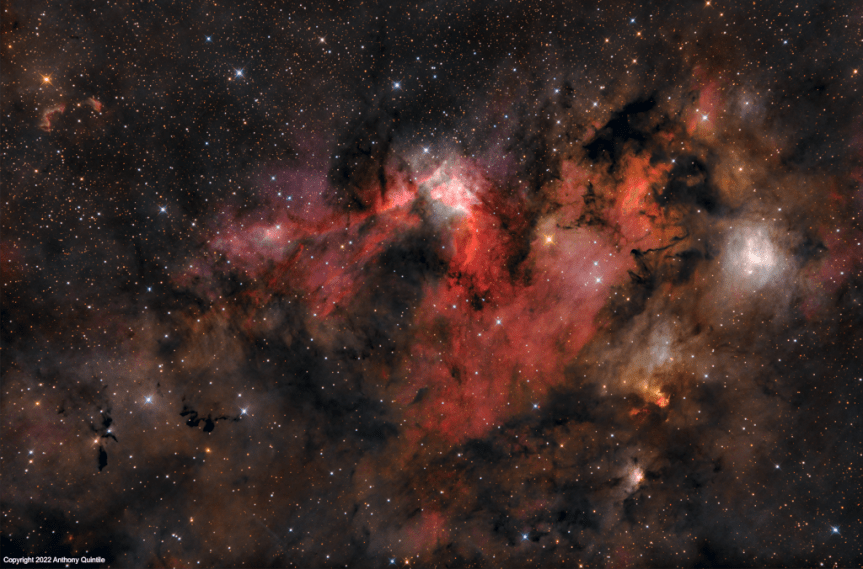
The Light, the Dark, and the Dusty
Image Credit & Copyright: Anthony Quintile
Explanation: This colorful skyscape spans about four full moons across nebula rich starfields along the plane of our Milky Way Galaxy in the royal northern constellation Cepheus. Near the edge of the region’s massive molecular cloud some 2,400 light-years away, bright reddish emission region Sharpless (Sh) 155 is at the center of the frame, also known as the Cave Nebula. About 10 light-years across the cosmic cave’s bright walls of gas are ionized by ultraviolet light from the hot young stars around it. Dusty reflection nebulae, like vdB 155 to the right, and dense obscuring clouds of dust also abound on the interstellar canvas. Astronomical explorations have revealed other dramatic signs of star formation, including the bright reddish fleck of Herbig-Haro (HH) 168. Below and right of center, the Herbig-Haro object emission is generated by energetic jets from a newborn star.
November 30 Today in History
Today’s Important Historical Events
1016 Cnut the Great [Canute], King of Denmark, claims the English throne after the death of Edmund ‘Ironside’
1487 The first German Beer Purity Law (Reinheitsgebot), is promulgated in Munich by Albert IV, Duke of Bavaria stating beer should be brewed from only three ingredients – water, malt and hops
1648 English Parliamentary army captures King Charles I
1786 Grand Duke of Tuscany Leopold II promulgates a penal reform, making his the 1st state to abolish the death penalty. November 30 commemorated as Cities for Life Day.
1876 Archaeologist Heinrich Schliemann finds the gold Mask of Agamemnon at Mycenae (modern Greece) “the Mona Lisa of prehistory” [1]

Today’s Historical Events
306 St Marcellus I begins his reign as Catholic Pope
722 Pope Gregory II names Boniface as missionary bishop
1016 Cnut the Great [Canute], King of Denmark, claims the English throne after the death of Edmund ‘Ironside’
1215 Pope Innocent III closes 4th council of Lateranen
1406 Angelo Correr elected Pope Gregory XII
1487 The first German Beer Purity Law (Reinheitsgebot), is promulgated in Munich by Albert IV, Duke of Bavaria stating beer should be brewed from only three ingredients – water, malt and hops
1523 Amsterdam bans assembly of heretics
1554 England reconciles with Pope Julius III
Today’s Historical Events in Film and TV
1949 KOTV TV channel 6 in Tulsa, Oklahoma (CBS) begins broadcasting
1952 Jackie Robinson accuses the NY Yankees of racial bias on national television
1958 WKBW TV channel 7 in Buffalo, NY (ABC) begins broadcasting
1969 American singer-songwriter Neil Diamond makes his only appearance on “The Ed Sullivan Show”, singing “Sweet Caroline” and “Holly, Holy”
1971 Emmy and Peabody Award-winning TV movie “Brian’s Song”, about the friendship of Chicago Bears football teammates Brian Piccolo and Gale Sayers (based on Sayers’ autobiography) premieres on ABC, starring James Caan and Billie Dee Williams
1972 BBC bans Wings’ “Hi, Hi, Hi”
1979 Ted Koppel becomes anchor of late nightly news on Iran “America Held Hostage” (ABC)
1980 “West Side Story” closes at Minskoff Theater NYC after 341 performances
Today’s Historical Events in Music
1885 Opera “El Cid” premieres (Paris)
1955 “Pipe Dream” opens at Shubert Theater, NYC; runs for 245 performances
1957 “Happy Hunting” closes at Majestic Theater NYC after 413 performances
1973 Paul McCartney & Wings release album “Band on the Run” in the UK
1974 “Good Evening” closes at Plymouth Theater NYC after 438 performances
1974 “Mack & Mabel” closes at Majestic Theater NYC after 66 performances
1979 Pink Floyd‘s “The Wall” released, sells 6 million copies in 2 weeks
1980 “Banjo Dancing” closes at Century Theater NYC after 38 performances
Today’s Historical Events in Sports
1872 First international soccer game, Scotland draws with England (0-0) in Glasgow
1893 2nd Iron Bowl: Auburn beats Alabama 40-16 in Montgomery
1908 International Lawn Tennis Challenge, Melbourne, Australia: Anthony Wilding representing Australasia beats American Fred Alexander 6-3, 6-4, 6-1 to give defending champions a 3-2 victory
1912 CFL Grey Cup, AAA Grounds, Hamilton: Hamilton Alerts win their only title; beat Toronto Argonauts, 11-4
1912 International Lawn Tennis Challenge, Melbourne, Australia: James Cecil Parke beats Rodney Heaths 6-3, 6-4, 6-4 to give British Isles 3-2 victory over defending champions Australasia
1924 National Football League Championship: Cleveland Bulldogs (7-1-1) [formerly Canton] win first past the post title
1928 Australian cricket legend Don Bradman makes an inauspicious Test debut; scores 18 & 1 vs England in 1st Test in Brisbane; dropped to 12th man for 2nd Test
1929 CFL Grey Cup, AAA Grounds, Hamilton: Hamilton Tigers take their 4th title; beat Regina Roughriders, 14-3
30 November 2022 Southern Hemisphere’s Planetary Positions
If you need to calculate the planetary positions for a specific use and time, click on this link
Currentplanetarypositions.com
To figure out GMT (Greenwich Mean Time) to your local time use this link
For Your Local Time and Date
Southeastern Hemisphere
The time for these Custom Planetary Positions is from the local time in Sao Paulo, Brazil, South America
30 November 2022
03:00 pm GMT 12:00 PM BRT
Zodiac: Tropical (Standard Western)
Sun:08 Sagittarius 23
Moon:08 Pisces 35
Mercury:20 Sagittarius 29
Venus:18 Sagittarius 02
Mars:19 Gemini 01 Rx
Jupiter:28 Pisces 53
Saturn:19 Aquarius 50
Uranus:16 Taurus 03 Rx
Neptune:22 Pisces 39 Rx
Pluto:26 Capricorn 46
Moon:08 Pisces 35
Mercury:20 Sagittarius 29
Venus:18 Sagittarius 02
Mars:19 Gemini 01 Rx
Jupiter:28 Pisces 53
Saturn:19 Aquarius 50
Uranus:16 Taurus 03 Rx
Neptune:22 Pisces 39 Rx
Pluto:26 Capricorn 46
True Lunar Node:13 Taurus 09
Mean Lunar Node:11 Taurus 52 Rx
Lilith (Black Moon):25 Cancer 38
Chiron:12 Aries 10 Rx
Ceres:24 Virgo 26
Pallas:26 Cancer 33 Rx
Juno:13 Pisces 22
Vesta:02 Pisces 52
Eris:24 Aries 04 Rx
Fire:5
Earth:5
Air:2
Water:7
Earth:5
Air:2
Water:7
Cardinal:5
Fixed:4
Mutable:10
Fixed:4
Mutable:10
Southern Hemisphere
The time for these Custom Planetary Positions is from the local time in Cape Town, South Africa
30 November 2022
10:00 am GMT 12:00 PM SAST
Zodiac: Tropical (Standard Western)
Sun:08 Sagittarius 10
Moon:05 Pisces 41
Mercury:20 Sagittarius 10
Venus:17 Sagittarius 46
Mars:19 Gemini 06 Rx
Jupiter:28 Pisces 52
Saturn:19 Aquarius 49
Uranus:16 Taurus 04 Rx
Neptune:22 Pisces 39 Rx
Pluto:26 Capricorn 46
Moon:05 Pisces 41
Mercury:20 Sagittarius 10
Venus:17 Sagittarius 46
Mars:19 Gemini 06 Rx
Jupiter:28 Pisces 52
Saturn:19 Aquarius 49
Uranus:16 Taurus 04 Rx
Neptune:22 Pisces 39 Rx
Pluto:26 Capricorn 46
True Lunar Node:13 Taurus 09 Rx
Mean Lunar Node:11 Taurus 53 Rx
Lilith (Black Moon):25 Cancer 37
Chiron:12 Aries 11 Rx
Ceres:24 Virgo 22
Pallas:26 Cancer 33 Rx
Juno:13 Pisces 19
Vesta:02 Pisces 48
Eris:24 Aries 05 Rx
Fire:5
Earth:5
Air:2
Water:7
Earth:5
Air:2
Water:7
Cardinal:5
Fixed:4
Mutable:10
Fixed:4
Mutable:10
Southwestern Hemisphere
The time for these Custom Planetary Positions is from the local time in Melbourne, Victoria, Australia
30 November 2022
01:00 am GMT 12:00 PM AEDT
Zodiac: Tropical (Standard Western)
Sun:07 Sagittarius 47
Moon:00 Pisces 26
Mercury:19 Sagittarius 35
Venus:17 Sagittarius 18
Mars:19 Gemini 14 Rx
Jupiter:28 Pisces 52
Saturn:19 Aquarius 47
Uranus:16 Taurus 05 Rx
Neptune:22 Pisces 39 Rx
Pluto:26 Capricorn 46
Moon:00 Pisces 26
Mercury:19 Sagittarius 35
Venus:17 Sagittarius 18
Mars:19 Gemini 14 Rx
Jupiter:28 Pisces 52
Saturn:19 Aquarius 47
Uranus:16 Taurus 05 Rx
Neptune:22 Pisces 39 Rx
Pluto:26 Capricorn 46
True Lunar Node:13 Taurus 10 Rx
Mean Lunar Node:11 Taurus 54 Rx
Lilith (Black Moon):25 Cancer 34
Chiron:12 Aries 11 Rx
Ceres:24 Virgo 14
Pallas:26 Cancer 33
Juno:13 Pisces 13
Vesta:02 Pisces 41
Eris:24 Aries 05 Rx
Fire:5
Earth:5
Air:2
Water:7
Earth:5
Air:2
Water:7
Cardinal:5
Fixed:4
Mutable:10
Fixed:4
Mutable:10
The 13 Witches Runes
The Witches Runes are different from the Elder Futhark Runes in that the Witches Runes are not an alphabet. The Witches Runes are instead a series of symbols that can be used in divination. There are different versions of the Witches Runes, one uses 8 symbols, another uses 10 symbols and the one discussed here uses 13 symbols. Cast the Witches Runes the same way your would the Runes.
The 13 witches Runes in divination
You can cast the Witches runes on a cloth, or on the table and read the meaning of the runes that are facing upwards only. If the eye is amongst the runes look at where the eye is looking. If there is a rune in front of the eye then this is the rune you must pay extra attention to.
You can also read the Witches runes by picking on rune at a time while you ask the runes a question.
Click here to read the rest of this article and see the common 13 witches runes
November 29, 2022 Daily Horoscopes
Click here to read Georgi Nicols Daily Horoscopes
Moon Alert
caution: Avoid shopping or making important decisions all day until 7:30 PM EST (4:30 PM PST). After that, the Moon moves from Aquarius into Pisces.
Aries (March 21-April 19)
Let’s face it, issues are hot topics today, making it tough to avoid an argument. For starters, steer clear of controversial subjects, which will press everyone’s buttons. (Religion, politics, racial issues.) Today you don’t have to go looking for trouble because it will find you. Stay mellow.
Taurus (April 20-May 20)
Hold on to your hat and avoid squabbles and power struggles about money, shared assets, taxes, debt and inheritances – and possibly, insurance issues. (It’s the whole nine yards.) If you stay levelheaded, some of these issues will subside. Either way, anger serves no purpose.
Gemini (May 21-June 20)
This is a difficult day for dealing with spouses, partners and dear friends. Mars is retrograde in your sign; and today, it opposes Mercury opposite your sign. This could trigger arguments with others. You might feel upset about travel plans, or something to do with education or politics. Just cope as best you can today. Don’t let this issue own you.
Cancer (June 21-July 22)
Today, your ruler the Moon, is lined up with Saturn, which makes you feel lonely or cut off from others. You might encounter domestic problems. Hey, this is a temporary dark cloud on your horizon. Things look worse than they really are. Your future is better than this. “Candygram for Mongo!”
Leo (July 23-Aug. 22)
This is a tough day. Relations with partners and close friends are dicey. Issues with your kids and romantic partners are contentious. You might be at odds with a friend. Relax. In a few days, all is well. (Now is the time to send out for dark chocolate.)
Virgo (Aug. 23-Sept. 22)
Be patient with family today to avoid arguments and differing opinions over home repairs or redecorating projects. Or perhaps, you feel overwhelmed or world-weary at work or with the duties and obligations you face? Things look better later in the week.
Libra (Sept. 23-Oct. 22)
You like harmony in your surroundings. Today difficult encounters with others will bring you down. Romance and issues with sports or social outings or possibly your kids might also depress you. Don’t react. Stay cool. In a few days, this is history.
Scorpio (Oct. 23-Nov. 21)
Financial matters are a concern today, especially debt, other people’s wealth and your responsibilities for others. Combined with this, a conversation with a parent or someone older at home might be a bummer. Just tread water for now. This is temporary.
Sagittarius (Nov. 22-Dec. 21)
Discussions with others are challenging today. You might feel you have to defend yourself. If so, this will be hard to do because you’re worried. You feel cut off from others and their support. In 48 hours, things are different. Keep the faith.
Capricorn (Dec. 22-Jan. 19)
Financial matters might get you down today. Try to put things in perspective. It’s important to know that the planetary pressures of today make things look worse than they really are. In 48 hours, you will see things differently – and be laughing. Trust me.
Aquarius (Jan. 20-Feb. 18)
Today the Moon and Saturn are lined up in your sign, which makes you feel inadequate and self-critical. (Yikes!) This is temporary. Trust that things will look different by Thursday. Avoid arguments with kids and romantic partners. Be smart.
Pisces (Feb. 19-March 20)
Because you feel lonely and cut off today, you might argue with a family member or a parent. This won’t help anything. Remember: Lucky Jupiter is in your sign right now, and in the near future, you will get richer! Think about that.
If Your Birthday Is Today
Comedic actress Anna Faris (1976) shares your birthday today. You are warm, friendly and charismatic. You know how to deal with people. You are a future oriented and often concerned with your security. This year is the first year of a new, nine-year cycle for you, which means to be brave, be flexible and have the courage to walk new paths and open new doors.
November 29, 2022 Moon Goddess Current Phase
You can use this link to go forward or backward in time for Moon phase information. If you are curious, you can even find out what phase the Moon was in when you or anyone else was born.
From MoonGiant.com
The Moon’s current phase for today and tonight is a Waxing Crescent Phase. Best seen in the west after the sun dips below the horizon at sunset. This is the first Phase after the New Moon and is a great time to see the features of the moon’s surface. The moon is close to the sun in the sky and mostly dark except for the right edge of the moon which becomes brighter as the days get closer to the next phase which is a First Quarter with a 50% illumination.
Visit the November 2022 Moon Phases Calendar to see all the daily moon phase for this month.
Today’s Waxing Crescent Phase
The Waxing Crescent on November 29 has an illumination of 37%. This is the percentage of the Moon illuminated by the Sun. The illumination is constantly changing and can vary up to 10% a day. On November 29 the Moon is 6.19 days old. This refers to how many days it has been since the last New Moon. It takes 29.53 days for the Moon to orbit the Earth and go through the lunar cycle of all 8 Moon phases.
Phase Details
Phase: Waxing Crescent
Illumination: 37%
Moon Age: 6.19 days
Moon Angle: 0.55
Moon Distance: 365,342.84 km
Sun Angle: 0.54
Sun Distance: 147,544,321.62 km
Illumination: 37%
Moon Age: 6.19 days
Moon Angle: 0.55
Moon Distance: 365,342.84 km
Sun Angle: 0.54
Sun Distance: 147,544,321.62 km
The 8 Lunar Phases
There are 8 lunar phases the Moon goes through in its 29.53 days lunar cycle. The 4 major Moon phases are Full Moon, New Moon, First Quarter and Last Quarter. Between these major phases, there are 4 minor ones: the Waxing Crescent, Waxing Gibbous, Waning Gibbous and Waning Crescent. For more info on the Moon Cycle and on each phase check out Wikipedia Lunar Phase page.
Useful Moon Resources
Check the weather before a night of Moon gazing at weather.com
For a list of all the current meteor showers visit American Meteor Society
November 29, 2022 Northern Hemisphere’s Planetary Positions

If you want to calculate the planetary positions for a specific use and time, click on this link
Currentplanetarypositions.com
To figure out GMT (Greenwich Mean Time) for your local time use this link
For Your Local Time and Date
Northwestern Hemisphere
The time for these Custom Planetary Positions is from the local time in Los Angeles, California, USA
November 29, 2022
08:00 pm GMT 12:00 PM PST
Zodiac: Tropical (Standard Western)
Sun:07 Sagittarius 34
Moon:27 Aquarius 30
Mercury:19 Sagittarius 16
Venus:17 Sagittarius 02
Mars:19 Gemini 19 Rx
Jupiter:28 Pisces 52
Saturn:19 Aquarius 47
Uranus:16 Taurus 05 Rx
Neptune:22 Pisces 39 Rx
Pluto:26 Capricorn 45
Moon:27 Aquarius 30
Mercury:19 Sagittarius 16
Venus:17 Sagittarius 02
Mars:19 Gemini 19 Rx
Jupiter:28 Pisces 52
Saturn:19 Aquarius 47
Uranus:16 Taurus 05 Rx
Neptune:22 Pisces 39 Rx
Pluto:26 Capricorn 45
True Lunar Node:13 Taurus 10 Rx
Mean Lunar Node:11 Taurus 54 Rx
Lilith (Black Moon):25 Cancer 33
Chiron:12 Aries 11 Rx
Ceres:24 Virgo 10
Pallas:26 Cancer 33
Juno:13 Pisces 09
Vesta:02 Pisces 37
Eris:24 Aries 05 Rx
Fire:5
Earth:5
Air:3
Water:6
Earth:5
Air:3
Water:6
Cardinal:5
Fixed:5
Mutable:9
Fixed:5
Mutable:9
Northern Hemisphere
The time for these Custom Planetary Positions is from the local time in Chicago, Illinois, USA
November 29, 2022
06:00 pm GMT 12:00 PM CST
Zodiac: Tropical (Standard Western)
Sun:07 Sagittarius 29
Moon:26 Aquarius 20
Mercury:19 Sagittarius 09
Venus:16 Sagittarius 56
Mars:19 Gemini 21 Rx
Jupiter:28 Pisces 51
Saturn:19 Aquarius 46
Uranus:16 Taurus 05 Rx
Neptune:22 Pisces 39 Rx
Pluto:26 Capricorn 45
Moon:26 Aquarius 20
Mercury:19 Sagittarius 09
Venus:16 Sagittarius 56
Mars:19 Gemini 21 Rx
Jupiter:28 Pisces 51
Saturn:19 Aquarius 46
Uranus:16 Taurus 05 Rx
Neptune:22 Pisces 39 Rx
Pluto:26 Capricorn 45
True Lunar Node:13 Taurus 10 Rx
Mean Lunar Node:11 Taurus 55 Rx
Lilith (Black Moon):25 Cancer 32
Chiron:12 Aries 11 Rx
Ceres:24 Virgo 09
Pallas:26 Cancer 33
Juno:13 Pisces 08
Vesta:02 Pisces 36
Eris:24 Aries 05 Rx
Fire:5
Earth:5
Air:3
Water:6
Earth:5
Air:3
Water:6
Cardinal:5
Fixed:5
Mutable:9
Fixed:5
Mutable:9
Northeastern Hemisphere
The time for these Custom Planetary Positions is from the local time in Frankfurt, Germany, Europe
29 November 2022
11:00 am GMT 12:00 PM CET
Zodiac: Tropical (Standard Western)
Sun:07 Sagittarius 12
Moon:22 Aquarius 11
Mercury:18 Sagittarius 42
Venus:16 Sagittarius 34
Mars:19 Gemini 27 Rx
Jupiter:28 Pisces 51
Saturn:19 Aquarius 45
Uranus:16 Taurus 06 Rx
Neptune:22 Pisces 39 Rx
Pluto:26 Capricorn 45
Moon:22 Aquarius 11
Mercury:18 Sagittarius 42
Venus:16 Sagittarius 34
Mars:19 Gemini 27 Rx
Jupiter:28 Pisces 51
Saturn:19 Aquarius 45
Uranus:16 Taurus 06 Rx
Neptune:22 Pisces 39 Rx
Pluto:26 Capricorn 45
True Lunar Node:13 Taurus 10 Rx
Mean Lunar Node:11 Taurus 56 Rx
Lilith (Black Moon):25 Cancer 30
Chiron:12 Aries 12 Rx
Ceres:24 Virgo 03
Pallas:26 Cancer 33
Juno:13 Pisces 03
Vesta:02 Pisces 30
Eris:24 Aries 05 Rx
Fire:5
Earth:5
Air:3
Water:6
Earth:5
Air:3
Water:6
Cardinal:5
Fixed:5
Mutable:9
Fixed:5
Mutable:9
Spell for Today – Herbal Protection Bath
From freewitchspells.com
This spell is intended to add extra protection to you personally, not your home like the two spells above. The exact amounts of the herbs are up to you.
You need:
- Rosemary
- Rue
- Lavender
- Basil (fresh if possible)
- Mint
- A handful of coarse salt
Run a hot bath, and toss in all your herbs and the salt. Let the bath steep for a few minutes before getting in. Sit and soak for a while, visualizing that your body is picking up protective energy from all the herbs in the water.
When you’re done, save a bit of the water and herbs in a bowl and toss it outside.
(SIDE NOTE: Unless you want to get out of your bath with herbs sticking all over you, put each herb in its own bag or put all of them in one bag. Then swish the bags around in the water for a while before you get in it. This will infuse the water with the herbs,)
November 29 Astronomy Picture of the Day
Discover the cosmos! Each day a different image or photograph of our fascinating universe is featured, along with a brief explanation written by a professional astronomer.
2022 November 29
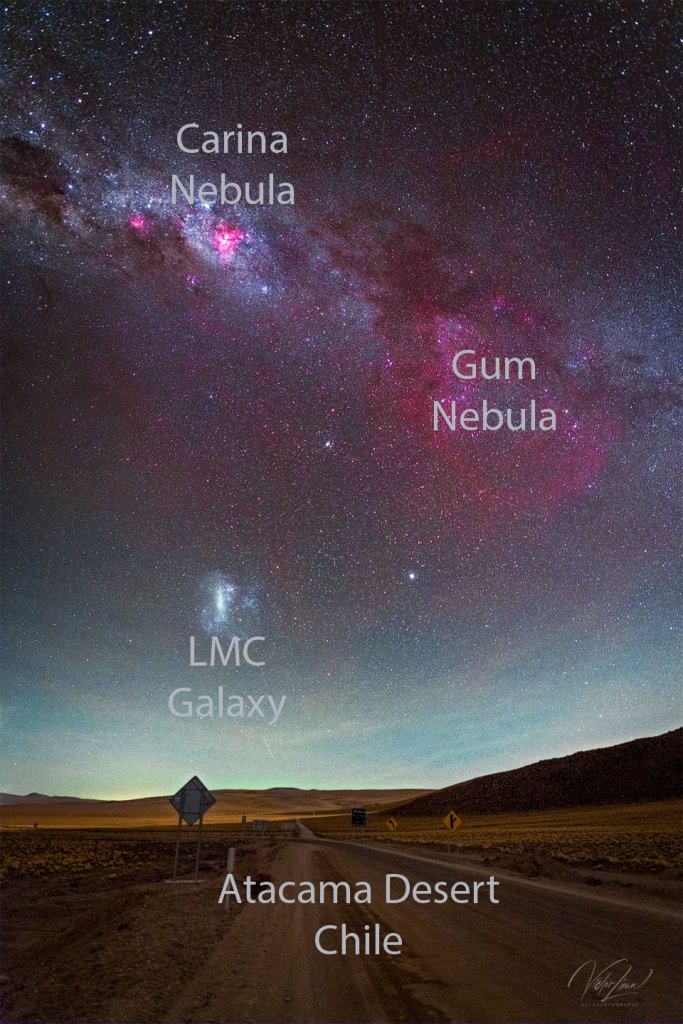
The Gum Nebula Supernova Remnant
Image Credit & Copyright: Victor Lima
Explanation: Because the Gum Nebula is the closest supernova remnant, it is actually hard to see. Spanning 40 degrees across the sky, the nebula appears so large and faint that it is easily lost in the din of a bright and complex background. The Gum Nebula is highlighted nicely in red emission toward the right of the featured wide-angle, single-image photograph taken in late May. Also visible in the frame are the Atacama Desert in Chile in the foreground, the Carina Nebula in the plane of our Milky Way galaxy running diagonally down from the upper left, and the neighboring Large Magellanic Cloud (LMC) galaxy. The Gum Nebula is so close that we are much nearer the front edge than the back edge, each measuring 450 and 1500 light years respectively. The complicated nebula lies in the direction of the constellations of Puppis and Vela. Oddly, much remains unknown about the Gum Nebula, including the timing and even number of supernova explosions that formed it.
November 29 Today in History
Today’s Important Historical Events
526 A possible date for the Antioch earthquake in present-day Syria (then the Byzantine Empire) which killed 200,000 people
1745 Bonnie Prince Charlie‘s army moves into Manchester and occupies Carlisle
1877 US inventor Thomas Edison demonstrates his hand-cranked phonograph for the first time
1935 Physicist Erwin Schrödinger publishes his famous thought experiment “Schrödinger’s cat”, a paradox that illustrates the problem of the Copenhagen interpretation of quantum mechanics
1951 1st underground atomic explosion at Frenchman Flat in Nevada

Today’s Historical Events
526 A possible date for the Antioch earthquake in present-day Syria (then the Byzantine Empire) which killed 200,000 people
799 Pope Leo III, aided by Charles the Great, returns to Rome
1349 Jews of Augsburg, Germany massacred
1516 Treaty of Freiburg: French/Swiss “eternal” peace treaty
1561 Lofland subjects himself on Sigismund August II of Poland
1573 Don Luis de Requesensy Zuniga succeeds duke of Alva as land guardian of Netherlands
1581 Doornik (Tournai) surrenders to Duke of Parma
1596 King Philip II devalues Spanish currency
Today’s Historical Events in Film and TV
1932 Cole Porter‘s musical “Gay Divorcee” opens at the Ethel Barrymore Theatre, NYC, later transferred to the Schubert Theater; runs for 248 performances
1945 “The Lost Weekend”, based on Charles R. Jackson’s novel, directed by Billy Wilder and starring Ray Milland and Jane Wyman premieres in Los Angeles (Academy Awards Best Picture 1946)
1948 1st opera to be televised, “Othello”, broadcast from the Met (NYC)
1948 KOB TV channel 4 in Albuquerque, NM (NBC) begins broadcasting
1948 Puppet TV show”Kukla, Fran, & Ollie” starring Fran Allison debuts on NBC
1953 WSIX TV channel 8 in Nashville, TN (ABC) begins broadcasting
1971 1st pro golf championship at Walt Disney World
1989 8th Largest wrestling crowd UFW U-Cosmos (60,000-Tokyo Dome)
Today’s Historical Events in Music
1825 Gioachino Rossini’s comic opera “Il barbiere di Siviglia” (The Barber of Seville) become 1st opera performed in Italian in US, staged at New York City’s Park Theater
1921 Z Parenteau & Schuyler Green’s musical “Kiki” premieres in NYC
1956 Jule Styne, Betty Comden and Adolph Green‘s musical “Bells Are Ringing”, starring Judy Holiday, opens at Shubert Theater, NYC; runs for 924 performances, wins 2 Tony Awards
1959 2nd Grammy Awards: “Mack The Knife”, Bobby Darin win
1963 “I Want to Hold Your Hand” single released by the Beatles in the United Kingdom
1965 “Anya” opens at Ziegfeld Theater NYC for 16 performances
1968 John Lennon and Yoko Ono release their 1st album “Two Virgins” in UK
1969 The Beatles’ single “Something / Come Together” reaches #1
Today’s Historical Events in Sports
1894 3rd Iron Bowl: Alabama beats Auburn 18-0 in Montgomery
1909 International Lawn Tennis Challenge, Sydney, Australia: Norman Brookes & Anthony Wilding beat Americans Melville Long & Maurice McLoughlin 12-10, 9-7, 6-3; Australasia unassailable 3-0 lead; win 5-0
1913 CFL Grey Cup, AAA Grounds, Hamilton: Hamilton Tigers beat Toronto Parkdale, 44-2; second-largest margin of victory in a Grey Cup final
1924 CFL Grey Cup, Varsity Stadium, Toronto: Queen’s University wins 3rd straight Championship; defeat Toronto Balmy Beach, 11-3
1924 NHL’s Montreal Forum opens
1926 Tris Speaker resigns as Indians manager
1934 Chicago Bears beat Detroit (19-16) in 1st NFL game broadcast nationally
1938 Mayor Oud of Rotterdam forbids soccer match between Netherlands and Germany
A Laugh for Today

Wishing you a terrific Tuesday!
28 November 2022 Southern Hemisphere’s Planetary Positions
If you want to calculate the planetary positions for a specific use and time, click on this link
Currentplanetarypositions.com
To figure out GMT (Greenwich Mean Time) for your local time use this link
For Your Local Time and Date
Southeastern Hemisphere
The time for these Custom Planetary Positions is from the local time in Sao Paulo, Brazil, South America
29 November 2022
03:00 pm GMT 12:00 PM BRT
Zodiac: Tropical (Standard Western)
Sun:07 Sagittarius 22
Moon:24 Aquarius 33
Mercury:18 Sagittarius 57
Venus:16 Sagittarius 47
Mars:19 Gemini 23 Rx
Jupiter:28 Pisces 51
Saturn:19 Aquarius 46
Uranus:16 Taurus 06 Rx
Neptune:22 Pisces 39 Rx
Pluto:26 Capricorn 45
Moon:24 Aquarius 33
Mercury:18 Sagittarius 57
Venus:16 Sagittarius 47
Mars:19 Gemini 23 Rx
Jupiter:28 Pisces 51
Saturn:19 Aquarius 46
Uranus:16 Taurus 06 Rx
Neptune:22 Pisces 39 Rx
Pluto:26 Capricorn 45
True Lunar Node:13 Taurus 10 Rx
Mean Lunar Node:11 Taurus 55 Rx
Lilith (Black Moon):25 Cancer 32
Chiron:12 Aries 12 Rx
Ceres:24 Virgo 06
Pallas:26 Cancer 33
Juno:13 Pisces 06
Vesta:02 Pisces 33
Eris:24 Aries 05 Rx
Fire:5
Earth:5
Air:3
Water:6
Earth:5
Air:3
Water:6
Cardinal:5
Fixed:5
Mutable:9
Fixed:5
Mutable:9
Southern Hemisphere
The time for these Custom Planetary Positions is from the local time in Cape Town, South Africa
29 November 2022
10:00 am GMT 12:00 PM SAST
Zodiac: Tropical (Standard Western)
Sun:07 Sagittarius 09
Moon:21 Aquarius 36
Mercury:18 Sagittarius 38
Venus:16 Sagittarius 31
Mars:19 Gemini 28 Rx
Jupiter:28 Pisces 51
Saturn:19 Aquarius 45
Uranus:16 Taurus 06 Rx
Neptune:22 Pisces 39 Rx
Pluto:26 Capricorn 45
Moon:21 Aquarius 36
Mercury:18 Sagittarius 38
Venus:16 Sagittarius 31
Mars:19 Gemini 28 Rx
Jupiter:28 Pisces 51
Saturn:19 Aquarius 45
Uranus:16 Taurus 06 Rx
Neptune:22 Pisces 39 Rx
Pluto:26 Capricorn 45
True Lunar Node:13 Taurus 10 Rx
Mean Lunar Node:11 Taurus 56 Rx
Lilith (Black Moon):25 Cancer 30
Chiron:12 Aries 12 Rx
Ceres:24 Virgo 02
Pallas:26 Cancer 33
Juno:13 Pisces 02
Vesta:02 Pisces 29
Eris:24 Aries 05 Rx
Fire:5
Earth:5
Air:3
Water:6
Earth:5
Air:3
Water:6
Cardinal:5
Fixed:5
Mutable:9
Fixed:5
Mutable:9
Southwestern Hemisphere
The time for these Custom Planetary Positions is from the local time in Melbourne, Victoria, Australia
29 November 2022
01:00 am GMT 12:00 PM AEDT
Zodiac: Tropical (Standard Western)
Sun:06 Sagittarius 46
Moon:16 Aquarius 14
Mercury:18 Sagittarius 04
Venus:16 Sagittarius 03
Mars:19 Gemini 36 Rx
Jupiter:28 Pisces 51
Saturn:19 Aquarius 44
Uranus:16 Taurus 07 Rx
Neptune:22 Pisces 39 Rx
Pluto:26 Capricorn 44
Moon:16 Aquarius 14
Mercury:18 Sagittarius 04
Venus:16 Sagittarius 03
Mars:19 Gemini 36 Rx
Jupiter:28 Pisces 51
Saturn:19 Aquarius 44
Uranus:16 Taurus 07 Rx
Neptune:22 Pisces 39 Rx
Pluto:26 Capricorn 44
True Lunar Node:13 Taurus 11 Rx
Mean Lunar Node:11 Taurus 57 Rx
Lilith (Black Moon):25 Cancer 28
Chiron:12 Aries 12 Rx
Ceres:23 Virgo 54
Pallas:26 Cancer 33
Juno:12 Pisces 56
Vesta:02 Pisces 23
Eris:24 Aries 05 Rx
Fire:5
Earth:5
Air:3
Water:6
Earth:5
Air:3
Water:6
Cardinal:5
Fixed:5
Mutable:9
Fixed:5
Mutable:9
A Thought for Today
Dear sisters, brothers, and honored guests may your life be blessed with all things positive!
Spanish Stonehenge’ emerges from drought-hit reservoir
A Spanish “stonehenge” has reemerged amid the country’s devastating drought, officials said.
The historic marvel, officially called the Dolmen of Guadalperal, has only been visible four times, according to officials.
Experts believe the striking circle of dozens of megalithic stones has existed since 5000 BC. However, it was first discovered by German archaeologist Hugo Obermaier in 1926 before it became flooded in 1963 due to a rural development project under Francisco Franco’s dictatorship.
Now, the structure sits in a corner of the Valdecanas reservoir located in the country’s central province of Caceres.
As Spain faces its worst drought in 60 years, officials say the water level in the reservoir has dropped to 28% capacity.
“It’s a surprise, it’s a rare opportunity to be able to access it,” archaeologist Enrique Cedillo from Madrid’s Complutense University told Reuters.
The structure itself has an unknown creator, experts say.
Dolmens are vertically arranged stones that usually support a flat boulder or capstone, according to…
Click here to read the rest of this article
November 28, 2022 Daily Horoscopes

Click here to read Georgi Nicols Daily Horoscopes
Moon Alert
Avoid shopping or making important decisions after 10:30 PM PST today. The Moon is in Aquarius.
Aries (March 21-April 19)
As this week begins, you are determined to make some headway. And you will. In fact, whatever you do, you will do very carefully and you will give it much thought. If you have to convince someone to agree with you, you will do so carefully and logically.
Taurus (April 20-May 20)
Today you will be very careful with your money. (For the most part, you usually are because you are the financial wizard of the zodiac.) If you are pondering investments, you will be cautious and conservative. If shopping, you will likewise be thrifty. Nothing foolish.
Gemini (May 21-June 20)
Mars is still in your sign (as it will remain so for the rest of the year), but now it is retrograde. This means that whatever you do today, you will do with careful planning and a cautious approach. Nothing wild eyed and crazy. You want to be sure about what you’re doing, which is why you’re taking baby steps.
Cancer (June 21-July 22)
Today you might feel hesitant because you’re not sure of the outcome of something. However, you’re prepared to work in a very hands-on way, which is why you will roll up your sleeves and get involved. Coworkers are supportive. Nevertheless, you are cautious.
Leo (July 23-Aug. 22)
Today you might be an excellent role model to a friend or a member of a group. Someone sees that you have done your homework. You have worked carefully, perhaps even practising or honing a technique, to be as productive as you are. Excellent example!
Virgo (Aug. 23-Sept. 22)
Although your ambitions are still aroused, with Mars retrograde at the top of your chart, you will be careful about going after what you want. You will check things out first. You will get your facts. You will make sure that you don’t overreach or stick your neck out too far.
Libra (Sept. 23-Oct. 22)
This is a solid day to make future travel plans. Likewise, it’s a good day to make detailed plans about further education or training. You’re in the right frame of mind to proof written material, as well as to discuss serious topics regarding politics or religion.
Scorpio (Oct. 23-Nov. 21)
You will be diligent and careful dealing with financial matters, especially anything to do with shared property, taxes, debt, inheritances and insurance issues. You will leave no stone unturned because you want to get on top of things. You want to feel in control of your security.
Sagittarius (Nov. 22-Dec. 21)
This is an excellent day to discuss practical matters with a friend, partner or spouse. It might concern how money is handled, or the division of labour, or future travel plans. It could be anything but whatever it is, it’s important to you.
Capricorn (Dec. 22-Jan. 19)
Today you will work diligently to achieve your objectives. You will work carefully, slowly and with steady perseverance. You will be like the tortoise who won the race because you won’t stop. Actually, this is your style, which is why you earn the respect of others.
Aquarius (Jan. 20-Feb. 18)
Children might be an increased responsibility for you today. Whatever the case, you will be serious in your approach. You might outline duties and responsibilities involved, especially if you share these with someone else. You might also train or teach someone younger.
Pisces (Feb. 19-March 20)
You feel a bit out of touch with things at home lately, which is why today you want to work slowly and carefully to restore some order to where you live. You know that when you feel things are “pulled together,” you have greater peace of mind.
If Your Birthday Is Today
Actress Karen Gillan (1987) shares your birthday today You are friendly, confident and generous. Many of you are animal lovers and fight for animal rights. This year is the final year of a nine-year cycle for you, which means it’s time to let go of anyone or anything that is holding you back. Time to take inventory.


You must be logged in to post a comment.