Today’s Tarot Card for July 19th is The Fool

The Fool

This Tarot Deck: Aquarian


General Meaning:  Pamela Coleman-Smith’s artful rendition of an “innocent Fool” archetype (Rider-Waite deck) is often used to represent Tarot in general. Early classical versions of the Fool card, however, portray quite a different character — a person driven by base needs and urges, who has fallen into a state of poverty and deprivation.

In some instances, he is made out to be a carnival entertainer or a huckster. In others, he is portrayed as decrepit and vulnerable — as the cumulative result of his delusions and failures. Not until the 20th century do you see the popular Rider-Waite image of the Fool arise — that of an innocent Soul before its Fall into Matter, as yet untainted by contact with society and all its ills.

Modern decks usually borrow from the Rider-Waite imagery. Most Fool cards copy the bucolic mountainside scene, the butterfly, the potential misplaced step that will send the Fool tumbling into the unknown. Don’t forget, however, that the earlier versions of this card represented already-fallen humanity, over-identified with the material plane of existence, and beginning a pilgrimage towards self-knowledge, and eventually, wisdom. The Fool reminds us to recognize the path of personal development within ourselves — and the stage upon that path where we find ourselves — in order to energize our movement toward deeper self-realization.

Today’s Tarot Card for July 1 is The High Priestess

Today’s Tarot Card

The High Priestess

This Tarot Deck: Fantastical Tarot

General Meaning:    Traditionally called the High Priestess, this major arcana, or trump, card represents human wisdom. She can be viewed as a kind of female Pope, the ancient Egyptian Priestess of Isis, the even older snake and bird Goddesses, the Greek Goddess Persephone, or the Eve of Genesis before the Fall.
For the accused heretics who were burnt at the stake for revering her in the 14th and 15th century, she symbolized the prophecy of the return of the Holy Spirit, which was perceived as the female aspect of the Holy Trinity.
In the sequence of cards in the major arcana, the High Priestess appears as soon as the Fool decides he wants to develop his innate powers, making a move toward becoming a Magus. The High Priestess is his first teacher, representing the Inner Life and the method for contacting it, as well as the contemplative study of Nature and the Holy Mysteries.

Today’s Tarot Card for June 20 is Justice

Justice


This Tarot Deck: Morgan-Greer

General Meaning:

Traditionally, what has been known as the Justice card has to do with moral sensitivity and that which gives rise to empathy, compassion and a sense of fairness. Since the time of Solomon, this image has represented a standard for the humane and fair-minded treatment of other beings.

Often including the image of a fulcrum which helps to balance competing needs against the greater good, and a two-edged sword to symbolize the precision needed to make clear judgments, this card reminds us to be careful to attend to important details. It’s a mistake to overlook or minimize anything where this card is concerned. The law of Karma is represented here — what goes around comes around.

Today’s Tarot Card for June 12 is The Empress

The Empress


This Tarot Deck: Crowley

General Meaning:

Traditionally entitled “Empress,” this major arcana or “trump” card portrays the energy of the Great Mother. She is Nature, around us but also within us, the ever-unfolding Source of life-giving power. She is often pictured as a pre-Christian Goddess, as the one whom the High Priestess is channeling down to earth for the rest of us.

In medieval Europe, the Empress card was painted to represent whatever Queen currently ruled the land, probably to satisfy the Inquisitors. But the scholars of the Renaissance and beyond had no doubt of her true identity, although she could not be fully revealed on Tarot cards as the “woman clothed with the sun” until after the French Revolution.

This supreme archetype of femininity also symbolizes fertility. It is She who provides us nourishment and security. She is also sometimes seen as delighting us with flowers and fruit. A potentially terrifying aspect of this archetype manifests itself whenever karmic mood swings wipe out our plans, like a storm that has come upon us. Whatever happens, the Empress is the Source of our Embodiment and of Natural Law. She might even be called “the Great Recycler.”

Your Daily Number for June 11: 3

Your creativity continues to manifest in every area of your life today. A sense of excitement permeates your daily routine, and at times you may lack focus. Clear communication is important today.

Fast Facts

About the Number 3

Theme: Expansive, Sociable, Dramatic, Diversified, Creative
Astro Association: Venus
Tarot Association: Empress

Today’s Tarot Card for June 11th is The High Priestess

The High Priestess

This Tarot Deck: Cosmic

General Meaning:

Traditionally called the High Priestess, this major arcana, or trump, card represents human wisdom. She can be viewed as a kind of female Pope, the ancient Egyptian Priestess of Isis, the even older snake and bird Goddesses, the Greek Goddess Persephone, or the Eve of Genesis before the Fall.

For the accused heretics who were burnt at the stake for revering her in the 14th and 15th century, she symbolized the prophecy of the return of the Holy Spirit, which was perceived as the female aspect of the Holy Trinity.

In the sequence of cards in the major arcana, the High Priestess appears as soon as the Fool decides he wants to develop his innate powers, making a move toward becoming a Magus. The High Priestess is his first teacher, representing the Inner Life and the method for contacting it, as well as the contemplative study of Nature and the Holy Mysteries.

Today’s Tarot Card for June 9th is The Fool

The Fool

This Tarot Deck: Aquarian

General Meaning:    Pamela Coleman-Smith’s artful rendition of an “innocent Fool” archetype (Rider-Waite deck) is often used to represent Tarot in general. Early classical versions of the Fool card, however, portray quite a different character — a person driven by base needs and urges, who has fallen into a state of poverty and deprivation.
In some instances, he is made out to be a carnival entertainer or a huckster. In others, he is portrayed as decrepit and vulnerable — as the cumulative result of his delusions and failures. Not until the 20th century do you see the popular Rider-Waite image of the Fool arise — that of an innocent Soul before its Fall into Matter, as yet untainted by contact with society and all its ills.
Modern decks usually borrow from the Rider-Waite imagery. Most Fool cards copy the bucolic mountainside scene, the butterfly, the potential misplaced step that will send the Fool tumbling into the unknown. Don’t forget, however, that the earlier versions of this card represented already-fallen humanity, over-identified with the material plane of existence, and beginning a pilgrimage towards self-knowledge, and eventually, wisdom. The Fool reminds us to recognize the path of personal development within ourselves — and the stage upon that path where we find ourselves — in order to energize our movement toward deeper self-realization.

Today’s Tarot Card for June 7th is Judgment

Judgment


This Tarot Deck: Medieval Cat

General Meaning: What has traditionally been known as the Judgement card, sometimes entitled Resurrection, represents the great reunion that the ancients believed would happen once in every age. This was the time when souls are harvested and taken Home to their place of origin, outside the solar system. Then the World is seeded with a batch of new souls and the process starts over.

From a modern point of view, this great reunion — which includes every personality that you have ever been and every soul that you have done deep work with — reunites to consciously complete the process. In a way, we symbolically celebrate this returning to center every year on our birthday.

In personal terms, the Judgment cards points to freedom from inner conflicts, and so clear a channel, that the buried talents and gifts of past incarnations can come through an individual in this lifetime. This card counsels you to trust the process of opening yourself, because what emerges is of consistently high quality. You can effortlessly manifest as a multi-dimensional being, and assist in evoking that response from others.

Today’s Tarot Card for June 6th is The Moon

The Moon


This Tarot Deck: Royal Thai

General Meaning:    What has traditionally been known as the Moon card refers to a deep state of sensitivity and imaginative impressionability, developed within a womb of deep relaxation. Here we dream and go into trance, have visions and receive insights, wash in and out with the psychic tides, and experience deep mystical and/or terrifying realities beyond our ordinary senses. The full moon and/or eclipse cycle charted by the Magi (as in some of the earliest Moon card images) exemplify this as a mechanism that Nature uses to expand consciousness.
The variants of the courtly lovers (representing skillful use of the sex force) or the man sleeping it off under the tree (use of drugs to alter consciousness) are also traditional avenues for tapping this primal force. Human interest in higher states propels us to the frontiers of consciousness, where we cannot always control what happens. The Moon card represents the ultimate test of a soul’s integrity, where the membrane between self and the Unknown is removed, and the drop of individuality reenters the Ocean of Being. What transpires next is between a soul and its Maker.

Today’s Tarot Card for June 5 is The Sun

The Sun

This Tarot Deck: Gummy Bear Tarot

General Meaning: What has traditionally been known as the Sun card is about the self — who you are and how you cultivate your personality and character. The earth revolves around the sun to make up one year of a person’s life, a fact we celebrate on our birthday.

The Sun card could also be titled “Back to Eden.” The Sun’s radiance is where one’s original nature or unconditioned Being can be encountered in health and safety. The limitations of time and space are stripped away; the soul is refreshed and temporarily protected from the chaos outside the garden walls.

Under the light of the Sun, Life reclaims its primordial goodness, truth and beauty. If one person is shown on this card, it is usually signifying a human incarnation of the Divine. When two humans are shown, the image is portraying a resolution of the tension between opposites at all levels. It’s as if this card is saying “You can do no wrong — it’s all to the good!”

Today’s Tarot Card for June 4th is The Star

The Star

This Tarot Deck: Celestial

General Meaning: What has traditionally been known as the Star card is about reconnecting one’s Soul with the Divine — the transcending of personality, family, community and reputation. It has to do ultimately with the freedom to be one’s Self. The Soul is responding to celestial influences — forces that can provide the personality with a stronger sense of purpose. The Star card helps us to remember our exalted origins and our attraction to a Higher Union.

This card could also be called the “Celestial Mandate” — that which refers us back to our reason for being, our mission in this lifetime. The Star reminds us that, in a sense, we are agents of Divine Will in our day-to-day lives. If we let go of the idea that we are supposed to be in control, we can more easily notice and appreciate the synchronicities that are nudging us along. In this way, we become more conscious of the invisible Helping Hand, and we better understand our place within — and value to — the larger Cosmos.

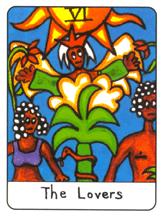
Today’s Tarot Card for May 26th is The Lovers

The Lovers

This Tarot Deck: African Tarot

General Meaning: Although it has taken on a strictly romantic revision of meaning in some modern decks, traditionally the Lovers card of Tarot reflected the challenges of choosing a partner. At a crossroads, one cannot take both paths. The images on this card in different decks have varied more than most, because we have had so many ways of looking at sex and relationships across cultures and centuries.

Classically, the energy of this card reminded us of the real challenges posed by romantic relationships, with the protagonist often shown in the act of making an either-or choice. To partake of a higher ideal often requires sacrificing the lesser option. The path of pleasure eventually leads to distraction from spiritual growth. The gratification of the personality eventually gives way to a call from spirit as the soul matures.

Modern decks tend to portray the feeling of romantic love with this card, showing Adam and Eve at the gates of Eden when everything was still perfect. This interpretation portrays humanity before the Fall, and can be thought to imply a different sort of choice — the choice of evolution over perfection, or the choice of personal growth through relationship — instead of a fantasy where everything falls into place perfectly and is taken care of without effort.

Today’s Tarot Card for May 22nd is The High Priestess

The High Priestess

This Tarot Deck: Fantastical Tarot

General Meaning: Traditionally called the High Priestess, this major arcana, or trump, card represents human wisdom. She can be viewed as a kind of female Pope, the ancient Egyptian Priestess of Isis, the even older snake and bird Goddesses, the Greek Goddess Persephone, or the Eve of Genesis before the Fall.

For the accused heretics who were burnt at the stake for revering her in the 14th and 15th century, she symbolized the prophecy of the return of the Holy Spirit, which was perceived as the female aspect of the Holy Trinity.

In the sequence of cards in the major arcana, the High Priestess appears as soon as the Fool decides he wants to develop his innate powers, making a move toward becoming a Magus. The High Priestess is his first teacher, representing the Inner Life and the method for contacting it, as well as the contemplative study of Nature and the Holy Mysteries.

LESSON 6 – The Environment

LESSON 6

The Environment

The environment of a tarot reading includes the physical setting and your internal state. There are five inner qualities that are beneficial. These are:

  • Being Open
    Being open means being receptive. It is an attitude of allowing – being willing to take in what is offered without denial or rejection. By being open, you give yourself the chance to receive what you need to know. 
  • Being Calm
    It is hard to hear the whispers of your Inner Guide when you are in turmoil. Tarot messages often arrive as gentle hints and realizations that can be easily overwhelmed by a restless mind. When you are calm, you are like a peaceful sea in which every ripple of insight can be perceived. 
  • Being Focused
    Focus is very important for a tarot reading. I have found that whenever I feel a question strongly, I receive a direct and powerful message. When I’m scattered and confused, the cards tend to be the same. Your most insightful readings will be those you do when the desire is very strong. 
  • Being Alert
    When you are alert, all your faculties are alive and awake. A cat is alert when it is watching a mouse or bug. Of course, you won’t be pouncing on your cards, but you will find them difficult to read if you are tired or bored. 
  • Being Respectful
    Being respectful means treating the cards as you would any valued tool. You acknowledge their role in helping you understand yourself better. You honor the choice you have made in deciding to learn the tarot and handle the cards accordingly.

Even though these five qualities are important, they are not necessary. You can have a meaningful reading without them, but it may be more difficult. The best way to decide if the time is right for a reading is to look inside. If something feels wrong, postpone the effort, but if your inner sense says go ahead, then all is well.

Besides the inner environment, there is also the setting of a reading to consider. The ideal place is one that elicits feelings of quiet, peace, even reverence. You could do a reading in a crowded airport, but the noise and distractions would make inner attunement difficult. Since you will probably be doing most of your readings at home, let’s look at how you might create a agreeable environment there.

Set aside a place in your home where you will do your readings. By using the same spot over and over, you build up an energy that reinforces your practice. If you meditate or pray, you can do these activities here as well as they harmonize with the tarot in spirit and intent.

Try to create a sense of separateness about your spot. When you use the cards, you want to turn away from the everyday world and go into a space that is outside time and the normal flow of events. A separate room is ideal, but a corner set off by a screen, curtain, pillows or other divider can work too.

Try also to create an atmosphere of beauty and meaning. Place some items nearby that are special to you. Objects from nature, such as shells, stones, crystals, and plants are always appropriate. A talisman, figure or religious icon can help you shift your focus from the mundane to the inspirational. Consider pictures and artwork, especially your own, and appeal to your senses with such items as flowers, incense, candles, textured materials and quiet, meditative music.

These touches are nice, the only thing you really need is a space large enough to lay out the cards. You can use either a table or the floor. There is a grounded feeling to the floor, but, if that position is uncomfortable, a table is better. Choose a table of natural materials such as wood or stone.

If you like, you can cover the table or floor with a cloth to create a uniform area. The material should be natural, such as silk, cotton, wool or linen. Choose the color with care as colors have their own energies. Black, dark blue and purple are good choices. There should be little or no pattern, so the images on the cards stand out from the background.

Store your cards in a container to protect them and contain their energies. Any natural substance is fine, such as wood, stone, shell, or a natural cloth. I know of one woman who sewed herself a silk, drawstring bag and embroidered it with stars, moons and other designs. Consider keeping your cards wrapped in silk cloth when inside their container. Silk has a luxurious feel that will remind you of the value you place on your cards.

Tarot cards pick up the energy and character of those who use them. For this reason, set aside a tarot deck that is just for you, if you can. These cards are going to be your personal tool of communication with your Inner Guide. You want to bond to them closely.

When you do your tarot work in a place of your own, the experience can be quite powerful, but extra preparations are never necessary. All you have to do is use the cards. That’s the important part.

Exercises – Lesson 6

The Environment

Exercise 6.1 – Creating a Place To Do Your Readings

Spend some time thinking about where you will do your tarot readings. Consider some of the suggestions or use your own ideas. Don’t feel that you have to create a showcase location. Just see what you can do to create a setting that is pleasing and comfortable.

Exercise 6.2 – Quest for a Symbol

In this exercise, you will be announcing your intent to find or create an object that will be a personal symbol of your tarot practice. You can buy, find or make this object yourself. Once you have it, place it in your tarot spot as an inspiration for your work.

Read over the description of the Fool. This card often stands for the feeling of joy and freedom that comes from beginning a new adventure. It is in this spirit that you will seek your object. This quest symbolizes the quest for greater understanding you are undertaking by learning the tarot.

Hold the Fool in your hands, and close your eyes. Announce your desire to find or create a tarot symbol. Commit to working until you have it. The value you place on this quest will reinforce the value of your larger quest. Once you have affirmed your intent, let it go. You will find what you are looking for.

This exercise will strengthen your faith and commitment and leave you with a tangible symbol of your purpose. It will also help you learn that hidden within seemingly foolish acts is the experience of life as an adventure.

Lessons In Tarot – Lesson 2a (The Fool’s Journey)

The Fool’s Journey

The Fool’s Journey is a metaphor for the journey through life. Each major arcana card stands for a stage on that journey – an experience that a person must incorporate to realize his wholeness. These 22 descriptions are based on the keywords for each major arcana card. The keywords are highlighted in the text. A card’s number is in parentheses.

The Fool

We begin with the Fool (0), a card of beginnings. The Fool stands for each of us as we begin our journey of life. He is a fool because only a simple soul has the innocent faith to undertake such a journey with all its hazards and pain.

At the start of his trip, the Fool is a newborn – fresh, open and spontaneous. The figure on Card 0 has his arms flung wide, and his head held high. He is ready to embrace whatever comes his way, but he is also oblivious to the cliff edge he is about to cross. The Fool is unaware of the hardships he will face as he ventures out to learn the lessons of the world.

The Fool stands somewhat outside the rest of the major arcana. Zero is an unusual number. It rests in the exact middle of the number system – poised between the positive and negative. At birth, the Fool is set in the middle of his own individual universe. He is strangely empty (as is zero), but imbued with a desire to go forth and learn. This undertaking would seem to be folly, but is it?

The Magician and the High Priestess

On setting out, the Fool immediately encounters the Magician (1) and the High Priestess (2) – the great balancing forces that make up the perceived world. It is a feature of the material universe that as soon as we name some aspect of experience, we automatically evoke its opposite.

The Magician is the positive side. He represents the active, masculine power of creative impulse. He is also our conscious awareness. The Magician is the force that allows us to impact the world through a concentration of individual will and power. The High Priestess is the negative side. She is the mysterious unconscious. She provides the fertile ground in which creative events occur. The High Priestess is our unrealized potential waiting for an active principle to bring it to expression.

The terms positive and negativedo not imply “good” and “bad.” These are human distinctions that do not apply in the tarot. The Magician and the High Priestess are absolutely equal in value and importance. Each is necessary for balance. We may view the negative as our Shadow, but without shadows, we cannot see the light, and without a ground of potential, we cannot create.

The Empress

As he grows, the Fool becomes more and more aware of his surroundings. As with most babies, he first recognizes his Mother- the warm, loving woman who nourishes and cares for him. He also comes to know Mother Earth, who nurtures him in a larger sense.

The Empress (3) represents the world of nature and sensation. A baby delights in exploring everything he touches, tastes and smells. He cannot get enough of the sights and sounds that enchant his senses. It is natural to delight in the abundant goodness of Mother Earth who surrounds us with her support.

The Emperor

The next person the Fool encounters is the Father in the figure of the Emperor (4). He is the representative of structure and authority. As a baby leaves his mother’s arms, he learns that there are patterns to his world. Objects respond in predictable ways that can be explored. The child experiences a new kind of pleasure that comes from discovering order.

The Fool also encounters rules. He learns that his will is not always paramount and there are certain behaviors necessary for his well-being. There are people in authority who will enforce such guidelines. These restrictions can be frustrating, but, through the patient direction of the Father, the Fool begins to understand their purpose.

The Hierophant

Eventually, the Fool ventures out of his home into the wider world. He is exposed to the beliefs and traditions of his culture and begins his formal education. The Hierophant (5) represents the organized belief systems that begin to surround and inform the growing child.

A Hierophant is someone who interprets arcane knowledge and mysteries. On Card 5 we see a religious figure blessing two acolytes. Perhaps he is inducting them into church membership. Although this image is religious, it is really a symbol for initiations of all kinds.

The child is trained in all the practices of his society and becomes part of a particular culture and worldview. He learns to identify with a group and discovers a sense of belonging. He enjoys learning the customs of his society and showing how well he can conform to them.

The Lovers

Eventually, the Fool faces two new challenges. He experiences the powerful urge for sexual union with another person. Before, he was mainly self-centered. Now he feels the balancing tendency, pictured in the Lovers (6), to reach out and become half of a loving partnership. He yearns for relationship.

The Fool also needs to decide upon his own beliefs. It is well enough to conform while he learns and grows, but at some point, he must determine his own values if he is to be true to himself. He must start to question received opinion.

The Chariot

By the time the Fool becomes an adult, he has a strong identity and a certain mastery over himself. Through discipline and will-power, he has developed an inner control which allows him to triumph over his environment.

The Chariot (7) represents the vigorous ego that is the Fool’s crowning achievement so far. On Card 7, we see a proud, commanding figure riding victoriously through his world. He is in visible control of himself and all he surveys. For the moment, the Fool’s assertive success is all he might wish, and he feels a certain self-satisfaction. His is the assured confidence of youth.

Strength

Over time, life presents the Fool with new challenges, some that cause suffering and disillusionment. He has many occasions to draw on the quality of Strength(8). He is pressed to develop his courage and resolve and find the heart to keep going despite setbacks.

The Fool also discovers the quiet attributes of patience and tolerance. He realizes the willful command of the Chariot must be tempered by kindliness and the softer power of a loving approach. At times, intense passions surface, just when the Fool thought he had everything, including himself, under control.

Hermit

Sooner or later, the Fool is led to ask himself the age-old question “Why?” He becomes absorbed with the search for answers, not from an idle curiosity, but out of a deeply felt need to find out why people live, if only to suffer and die. The Hermit (9) represents the need to find deeper truth.

The Fool begins to look inward, trying to understand his feelings and motivations. The sensual world holds less attraction for him, and he seeks moments of solitude away from the frantic activity of society. In time he may seek a teacher or guide who can give him advice and direction.

Wheel of Fortune

After much soul-searching, the Fool begins to see how everything connects. He has a vision of the world’s wondrous design; its intricate patterns and cycles. The Wheel of Fortune (10) is a symbol of the mysterious universe whose parts work together in harmony. When the Fool glimpses the beauty and order of the world, if only briefly, he finds some of the answers he is seeking.

Sometimes his experiences seem to be the work of fate. A chance encounter or miraculous occurrence begins the process of change. The Fool may recognize his destiny in the sequence of events that led him to this turning point. Having been solitary, he feels ready for movement and action again. His perspective is wider, and he sees himself within the grander scheme of a universal plan. His sense of purpose is restored.

Justice

The Fool must now decide what this vision means to him personally. He looks back over his life to trace the cause and effect relationships that have brought him to this point. He takes responsibility for his past actions so he can make amends and ensure a more honest course for the future. The demands of Justice(11) must be served so that he can wipe the slate clean.

This is a time of decision for the Fool. He is making important choices. Will he remain true to his insights, or will he slip back into an easier, more unaware existence that closes off further growth?

Hanged Man

Undaunted, the Fool pushes on. He is determined to realize his vision, but he finds life is not so easily tamed. Sooner or later, he encounters his personal cross – an experience that seems too difficult to endure. This overwhelming challenge humbles him until he has no choice but to give up and let go.

At first, the Fool feels defeated and lost. He believes he has sacrificed everything, but from the depths he learns an amazing truth. He finds that when he relinquishes his struggle for control, everything begins to work as it should. By becoming open and vulnerable, the Fool discovers the miraculous support of his Inner Self. He learns to surrender to his experiences, rather than fighting them. He feels a surprising joy and begins to flow with life.

The Fool feels suspended in a timeless moment, free of urgency and pressure. In truth, his world has been turned upside-down. The Fool is the Hanged Man (12), apparently martyred, but actually serene and at peace.

Death

The Fool now begins to eliminate old habits and tired approaches. He cuts out nonessentials because he appreciates the basics of life. He goes through endings as he puts the outgrown aspects of his life behind him. He process may seem like dying because it is the death (13) of his familiar self to allow for the growth of a new one. At times this inexorable change seems to be crushing the Fool, but eventually he rises up to discover that death is not a permanent state. It is simply a transition to a new, more fulfilling way of life.

Temperance

Since embracing the Hermit, the Fool has swung wildly back and forth on an emotional pendulum. Now, he realizes the balancing stability of temperance (14). He discovers true poise and equilibrium. By experiencing the extremes, he has come to appreciate moderation. The Fool has combined all aspects of himself into a centered whole that glows with health and well-being. How graceful and soft is the angel on Card 14 compared to the powerful but rigid ruler in the Chariot (Card 7).  The Fool has come a long way in realizing the harmonious life.

Devil

The Fool has his health, peace of mind and a graceful composure. What more could he need? On everyday terms, not much, but the Fool is courageous and continues to pursue the deepest levels of his being. He soon comes face to face with the Devil (15).

The Devil is not an evil, sinister figure residing outside of us. He is the knot of ignorance and hopelessness lodged within each of us at some level. The seductive attractions of the material bind us so compellingly that we often do not even realize our slavery to them.

We live in a limited range of experience, unaware of the glorious world that is our true heritage. The couple on Card 15 are chained, but acquiescent. They could so easily free themselves, but they do not even apprehend their bondage. They look like the Lovers, but are unaware that their love is circumscribed within a narrow range. The price of this ignorance is an inner core of despair.

Tower

How can the Fool free himself from the Devil? Can he root out his influence? The Fool may only find release through the sudden change represented by the Tower (16). The Tower is the ego fortress each of us has built around his beautiful inner core. Gray, cold and rock-hard, this fortress seems to protect but is really a prison.

Sometimes only a monumental crisis can generate enough power to smash the walls of the Tower. On Card 16 we see an enlightening bolt striking this building. It has ejected the occupants who seem to be tumbling to their deaths. The crown indicates they were once proud rulers; now they are humbled by a force stronger than they.

The Fool may need such a severe shakeup if he is to free himself, but the resulting revelation makes the painful experience worthwhile. The dark despair is blasted away in an instant, and the light of truth is free to shine down.

Star

The Fool is suffused with a serene calm. The beautiful images on the Star (17) attest to this tranquility. The woman pictured on Card 17 is naked, her soul no longer hidden behind any disguise. Radiant stars shine in a cloudless sky serving as a beacon of hope and inspiration.

The Fool is blessed with a trust that completely replaces the negative energies of the Devil. His faith in himself and the future is restored. He is filled with joy and his one wish is to share it generously with the rest of the world. His heart is open, and his love pours out freely. This peace after the storm is a magical moment for the Fool.

Moon

What effect could spoil this perfect calm? Is there another challenge for the Fool? In fact, it is his bliss that makes him vulnerable to the illusions of the Moon (18). The Fool’s joy is a feeling state. His positive emotions are not yet subject to mental clarity. In his dreamy condition, the Fool is susceptible to fantasy, distortion and a false picture of the truth.

The Moon stimulates the creative imagination. It opens the way for bizarre and beautiful thoughts to bubble up from the unconscious, but deep-seated fears and anxieties also arise. These experiences may cause the Fool to feel lost and bewildered.

Sun

It is the lucid clarity of the Sun (19) that directs the Fool’s imagination. The Sun’s illumination shines in all the hidden places. It dispels the clouds of confusion and fear. It enlightens, so the Fool both feels andunderstands the goodness of the world.

Now, he enjoys a vibrant energy and enthusiasm. The Star’s openness has solidified into an expansive assurance. The Fool is the naked babe pictured on Card 19, riding out joyously to face a new day. No challenge is too daunting. The Fool feels a radiant vitality. He becomes involved in grand undertakings as he draws to himself everything he needs. He is able to realize his greatness.

Judgement

The Fool has been reborn. His false, ego-self has been shed, allowing his radiant, true self to manifest. He has discovered that joy, not fear, is at life’s center.

The Fool feels absolved. He forgives himself and others, knowing that his real self is pure and good. He may regret past mistakes, but he knows they were due to his ignorance of his true nature. He feels cleansed and refreshed, ready to start anew.

It is time for the Fool to make a deeper Judgement(20) about his life. His own personal day of reckoning has arrived. Since he now sees himself truly, he can make the necessary decisions about the future. He can choose wisely which values to cherish, and which to discard.

The angel on Card 20 is the Fool’s Higher Self calling him to rise up and fulfill his promise. He discovers his true vocation – his reason for entering this life. Doubts and hesitations vanish, and he is ready to follow his dream.

World

The Fool reenters the World (21), but this time with a more complete understanding. He has integrated all the disparate parts of himself and achieved wholeness. He has reached a new level of happiness and fulfillment.

The Fool experiences life as full and meaningful. The future is filled with infinite promise. In line with his personal calling, he becomes actively involved in the world. He renders service by sharing his unique gifts and talents and finds that he prospers at whatever he attempts. Because he acts from inner certainty, the whole world conspires to see that his efforts are rewarded. His accomplishments are many.

So the Fool’s Journey was not so foolish after all. Through perseverance and honesty, he reestablished the spontaneous courage that first impelled him on his search for Self, but now he is fully aware of his place in the world. This cycle is over, but, the Fool will never stop growing. Soon he will be ready to begin a new journey that will lead him to ever greater levels of understanding.

Lessons In Tarot – Lesson 2 (The Major Arcana)

LESSON 2

The Major Arcana

The standard tarot deck consists of 78 cards divided into two sections, the major and minor arcanas. The word arcana is the plural of arcanumwhich means “profound secret.” To the alchemists of the Middle Ages, the arcanum was the secret of nature. The tarot cards are therefore a collection of the “secrets” that underlie and explain our universe.

The 22 cards of the major arcana are the heart of the deck. Each of these cards symbolizes some universal aspect of human experience. They represent the archetypes – consistent, directing patterns of influence that are an inherent part of human nature.

Each card in the major arcana has a name and number. Some names convey a card’s meaning directly, such as Strength, Justice and Temperance. Other cards are individuals who personify a particular approach to life, such as the Magician or the Hermit. There are also cards with astronomical names, such as the Star, Sun and Moon. They represent the elusive forces associated with these heavenly bodies.

The major arcana cards are special because they draw out deep and complex reactions. The images on the Rider-Waite deck are evocative because they combine esoteric symbolism with recognizable figures and situations. The symbolism is subtle, but effective.

A major arcana card is always given extra weight in a reading. When one of these cards appears, you know the issues at stake are not mundane or temporary. They represent your most basic concerns – your majorfeelings and motivations. In later lessons, I show in more detail how you can recognize and interpret the themes of the major arcana in a reading.

The major arcana is often considered as a unit. Different schemes have been developed to show how the cards form patterns that cast light on the human condition. Numerology, astrology and other esoteric sciences often play a role in these schemes.

Many interpreters view the major arcana as showing the different stages on an individual’s journey of inner growth – what some call the Fool’s Journey. In these systems, each card stands for some quality or experience that we must incorporate before we can realize our wholeness.

We all travel this road to self-actualization, though our trips more often involve detours, backups and restarts than smooth progression! Our specific paths are unique, but our milestones are universal. The 22 major arcana cards are markers on the path of inner development leading from earliest awareness (card 0) to integration and fulfillment.

The Fool’s journey seems to move smoothly from one order of experience to the next, but our learning adventures are usually not so tidy. We make mistakes, skip lessons and fail to realize our potential. Sometimes we lack the courage and insight to discover our deepest levels. Some never feel the call of the Hermit to look inward or never experience the crisis of the Tower that might free them from their ego defenses.

Many times we try to overcome our difficulties, but fail repeatedly. The lesson of the Hanged Man- to let go and surrender to experience – is one that is particularly hard and may need to be faced over and over before it is fully incorporated.

Often we experience lessons out of order. A person may absorb the qualities of Strength early in life due to a difficult childhood, but only later develop the Chariot’s mastery and control. Someone may overcome the attraction of the Devil’s materialism through a life of seclusion, but then need to learn about relationships and sexuality – a lesson of the Lovers- at a later time.

The major arcana contains many levels and models of experience. These cards hold all the patterns of growth, whether they occur within one segment of a life or a whole life span. We could even say that an entire lifetime is really just one growth episode within the larger saga of our soul’s development.

No matter what our pattern of self-discovery, the major arcana shows us that wholeness and fulfillment are our destiny. If we keep this promise as our polestar, we will eventually realize our true nature and gain the World.

Today’s Tarot Card for January 3rd is The High Priestess

The High Priestess

This Tarot Deck: Cosmic

General Meaning: Traditionally called the High Priestess, this major arcana, or trump, card represents human wisdom. She can be viewed as a kind of female Pope, the ancient Egyptian Priestess of Isis, the even older snake and bird Goddesses, the Greek Goddess Persephone, or the Eve of Genesis before the Fall.

For the accused heretics who were burnt at the stake for revering her in the 14th and 15th century, she symbolized the prophecy of the return of the Holy Spirit, which was perceived as the female aspect of the Holy Trinity.

In the sequence of cards in the major arcana, the High Priestess appears as soon as the Fool decides he wants to develop his innate powers, making a move toward becoming a Magus. The High Priestess is his first teacher, representing the Inner Life and the method for contacting it, as well as the contemplative study of Nature and the Holy Mysteries.

Today’s Tarot Card for Everyone:

The Fool

This Tarot Deck: Aquarian

General Meaning: Pamela Coleman-Smith’s artful rendition of an “innocent Fool” archetype (Rider-Waite deck) is often used to represent Tarot in general. Early classical versions of the Fool card, however, portray quite a different character — a person driven by base needs and urges, who has fallen into a state of poverty and deprivation.

In some instances, he is made out to be a carnival entertainer or a huckster. In others, he is portrayed as decrepit and vulnerable — as the cumulative result of his delusions and failures. Not until the 20th century do you see the popular Rider-Waite image of the Fool arise — that of an innocent Soul before its Fall into Matter, as yet untainted by contact with society and all its ills.

Modern decks usually borrow from the Rider-Waite imagery. Most Fool cards copy the bucolic mountainside scene, the butterfly, the potential misplaced step that will send the Fool tumbling into the unknown. Don’t forget, however, that the earlier versions of this card represented already-fallen humanity, over-identified with the material plane of existence, and beginning a pilgrimage towards self-knowledge, and eventually, wisdom. The Fool reminds us to recognize the path of personal development within ourselves — and the stage upon that path where we find ourselves — in order to energize our movement toward deeper self-realization.

Today’s Tarot Card for December 29th is The High Priestess

The High Priestess

This Tarot Deck: Cosmic

General Meaning: Traditionally called the High Priestess, this major arcana, or trump, card represents human wisdom. She can be viewed as a kind of female Pope, the ancient Egyptian Priestess of Isis, the even older snake and bird Goddesses, the Greek Goddess Persephone, or the Eve of Genesis before the Fall.

For the accused heretics who were burnt at the stake for revering her in the 14th and 15th century, she symbolized the prophecy of the return of the Holy Spirit, which was perceived as the female aspect of the Holy Trinity.

In the sequence of cards in the major arcana, the High Priestess appears as soon as the Fool decides he wants to develop his innate powers, making a move toward becoming a Magus. The High Priestess is his first teacher, representing the Inner Life and the method for contacting it, as well as the contemplative study of Nature and the Holy Mysteries.

Today’s Tarot Card for December 27th is The Fool

The Fool

This Tarot Deck: Aquarian

General Meaning: Pamela Coleman-Smith’s artful rendition of an “innocent Fool” archetype (Rider-Waite deck) is often used to represent Tarot in general. Early classical versions of the Fool card, however, portray quite a different character — a person driven by base needs and urges, who has fallen into a state of poverty and deprivation.

In some instances, he is made out to be a carnival entertainer or a huckster. In others, he is portrayed as decrepit and vulnerable — as the cumulative result of his delusions and failures. Not until the 20th century do you see the popular Rider-Waite image of the Fool arise — that of an innocent Soul before its Fall into Matter, as yet untainted by contact with society and all its ills.

Modern decks usually borrow from the Rider-Waite imagery. Most Fool cards copy the bucolic mountainside scene, the butterfly, the potential misplaced step that will send the Fool tumbling into the unknown. Don’t forget, however, that the earlier versions of this card represented already-fallen humanity, over-identified with the material plane of existence, and beginning a pilgrimage towards self-knowledge, and eventually, wisdom. The Fool reminds us to recognize the path of personal development within ourselves — and the stage upon that path where we find ourselves — in order to energize our movement toward deeper self-realization.