

Tag: Beltane
Beltane – Bealtaine Traditions in Irish Folklore
Beltane is the anglicised version of our Irish word Bealtaine – still in use and meaning ‘the month of May’ in our own language. Bealtaine is mentioned in some of the earliest Irish literature, and it is associated with important events in Irish mythology.
Irish folklore still holds the legacy of the traditions and customs associated with this ancient festival. Bealtaine and Samhain are the original two turning points for the ‘wheel of the year’ in Ireland. That’s May Eve and Hallowe’en, in case you’re not familiar.
These major Irish Pagan Festivals were pivotal – literally – times of upheaval of change for our ancestors over 8,000 years ago when the Hunter Gatherer societies moved from their Summer to Winter camping grounds at these seasonal turning points, and they still resonate through the landscape and the Irish communities to this day.
Beltane: (Bealtaine, Valpurgis)
Incense: Lilac, Frankincense
Decorations: Maypole, Flowers, Ribbons
Colours: Green
The Fire Festival of Beltane
This festival is also known as Beltane, the Celtic May Day. It officially begins at moonrise on May Day Eve, and marks the beginning of the third quarter or second half of the ancient Celtic year. It is celebrated as an early pastoral festival accompanying the first turning of the herds out to wild pasture. The rituals were held to promote fertility. The cattle were driven between the Belfires to protect them from ills. Contact with the fire was interpreted as symbolic contact with the sun. In early Celtic times, the druids kindled the Beltane fires with specific incantations. Later the Christian church took over the Beltane observances, a service was held in the church, followed by a procession to the fields or hills, where the priest kindled the fire. The rowan branch is hung over the house fire on May Day to preserve the fire itself from bewitchment (the house fire being symbolic of the luck of the house).
Beltane by The Goddess & The Green Man
Sunset to Sunset.
Beltane honours Life. It represents the peak of Spring and the beginning of Summer. Earth energies are at their strongest and most active. All of life is bursting with potent fertility and at this point in the Wheel of the Year, the potential becomes conception. On May Eve the sexuality of life and the earth is at its peak. Abundant fertility, on all levels, is the central theme. The Maiden goddess has reached her fullness. She is the manifestation of growth and renewal, Flora, the Goddess of Spring, the May Queen, the May Bride. The Young Oak King, as Jack-In-The-Green, as the Green Man, falls in love with her and wins her hand. The union is consummated and the May Queen becomes pregnant. Together the May Queen and the May King are symbols of the Sacred Marriage (or Heiros Gamos), the union of Earth and Sky, and this union has merrily been re-enacted by humans throughout the centuries. For this is the night of the Greenwood Marriage. It is about sexuality and sensuality, passion, vitality and joy. And about conception. A brilliant moment in the Wheel of the Year to bring ideas, hopes and dreams into action. And have some fun…..
Traditions of Beltane…
WHAT IS BELTANE?
One of the four quarter day festivals, Beltane saw members of communities come together to celebrate the return of the summer. The observance of this hugely important time in the turning of the wheel of the year was characterised by a celebration of the return of the fertility of the land, and would have been a time when livestock would have been put out to pasture.
The word ‘Beltane’ roughly translates as ‘bright fire’ and, as such, one of the most important rituals, which survives today in our modern festival, concerns the lighting of the Beltane bonfire. Fire was seen as a purifier and healer and would have been walked around and danced/jumped over by the members of the community. Farmers would also have driven their cattle between bonfires to cleanse and protect them before being put out into the fields.
In ancient communities, all hearth fires would have been extinguished and a new neid fire lit which would have then been used to relight people’s hearths in their own homes. In this way the community was connected to each other by the sacred fire which was central to all. The festival would also have been a time of courtship rituals and a celebration of our own fertility!
The important point to note when thinking about our own festival is the joy and the revelry that is fostered in the ritual. It is about casting off the darkness and celebrating the light. It is a time for celebrating fertility, both in the context of our biological functions as well as our own creative energies, the fertility of our creative community.
HISTORICAL BACKGROUND…
For Your Viewing Pleasure
For Your Viewing Pleasure
May Day by Jami Shoemaker – Part 1
Ancient Customs
Beltane (Anglicized spelling) is a fire festival, and was dedicated to the god of light, called variously Bel, Balor, Belenos, and Baldur. It marked the beginning of the summer season, and the return of the Sun to light and nourish the earth. Among the customs associated with the Celtic celebration of Beltane (literally “Bel’s fire”) is the lighting of two fires on a hilltop. The Druids gathered gathered wood from nine different trees to make their fire every year on top of Tara Hill in County Merath, Ireland. Traditionally, all other fires were extinguished, and relit from these sacred “need fires” as an act of renewal. Before cattle were taken into the open pasture for the summer they were driven either between the fires or through the ashes to purify them of disease, and men and women would leap the flames for protection, and for luck in matters of fertility, romance, and home.
This brings us to perhaps the most significant part of the Beltane customs—that of fetility and growth. With the return of light and warmth, the earth’s fertility was assured for another season. This mystery was seen as the union of the earth and sky, or Goddess and God. The fruit of the union was seen as greening of the countryside, and in the harvest to come. This coming together of the forces of nature was honored as the “Sacred Marriage” of the Goddess and God. Imitating their union was the ultimate act of the community.
In light of this “marriage of the gods,” Pagan weddings or “handfasting” were popular at this time of year. This was the commitment of a year and a day. giving the couple sort of “trial run” at marriage and after that time both parties could agree to a long-term relationship, or could go their separate ways without remorse.
For those only looking for a night of frolicking, the “greenwood marriage” was popular. Young men and women would spend the night at the Beltane fires, or would go into the woods on Beltane Eve, gathering garlands and flowers, making love, and staying up to greet the Sun. If a woman were lucky, she would find herself with child, as children conceived on May Eve were considered favored by the the gods. These “greenwood marriages” continued long after Christian form of marriage replaced the peasants’ handfasting. May Eve was a time to drop all inhibitions and enjoy unbridled sexuality. No rules applied. even married or handfasted couples would relax their commitment for this night.
Symbols of fertility abounded at May time—the greening of the woods, the flowering of plants, the mating of animals. Perhaps one of the most blatant symbols of fertility is the Maypole, traditionally cut and carried from the forest by the villages most viral young men. Though the symbol of the Maypole is universal (the living tree representing the growth that awakens with spring), the tradition of erecting a Maypole may stem from an ancient Roman tree-giving custom. It has been said that the erection of the Maypole, which includes burying one end in the earth, is yet another representation of the union of the gods.
Beltane falls exactly opposite Hallows,which marks the beginning of the dark half of the year. These two turning points were seen as powerful times in the wheel of the year. They fell on the “in-between” times, embodying the mysteries of light and dark, life and death, and the transitions between. It is at these times when the veil between the worlds of spirit and matter, the dead and the living, are the thinnest. Beltane was then associated with great magic. This was a time for divination, and for spells that would bring love and prosperity. It was also a time when the faery folk were more easily seen. Their appearance could bring good fortune, or, if a mortal were enticed by their mischievous ways, he or she might fall into a trance and be taken to a place beyond time.
Copyright Llewellyn’s Witches’ Datebook 2001 Pages 21 to 25
To Our Southern Hemisphere Sisters, Brothers, and Guests…
Beltane blessings from WOTC

Celtic Tree Month – Coll – Hazel Moon August 5 – September 1
About the Celtic Tree Month – Coll (Hazel Moon): August 5 – September 1
“The lunar tree calendar of the Celts has long been a source of controversy among Celtic scholars. Some even claim it was never a part of the old Celtic world, but was an invention of author/researcher Robert Graves. The Druids are generally given credit by other researchers for creating this system. There seems to be no scholarly evidence to prove otherwise, yet many Celtic Pagans feel that the system pre-dates the time of Druidic influence over Celtic religious matters. It is probably reasonable to believe that the truth lies somewhere in between these three extremes. It is most likely that the tree system was in place, with minor regional variations before the time of the Druids who experimented with it, discovered the magical properties of each tree, and codified all the information into the system we have today.”
The Hazel Moon was known to the Celts as Coll, which translates to “the life force inside you.” This is the time of year when Hazelnuts are appearing on the trees, and are an early part of the harvest. Hazelnuts are also associated with wisdom and protection. Hazel is often associated in Celtic lore with sacred wells and magical springs containing the salmon of knowledge. This is a good month to do workings related to wisdom and knowledge, dowsing and divination, and dream journeys. If you’re a creative type, such as an artist, writer, or musician, this is a good month to get your muse back, and find inspiration for your talents. Even if you normally don’t do so, write a poem or song this month.
Source
Patti Wigington, Author
Published on ThoughtCo
Beltane to Litha
 Beltane to Litha
Beltane (a greater Sabbat named for a Celtic God, which is otherwise known as either May Eve or May Day) hails the coming-together of the Horned God, now in the Phallic Lord, and the irresistible Godddess in a rapturous celebration of light and life. It is as though all of nature—not least the birds and bees—is abuzz at this time of year, energized by a potent combination of irrestible physical attraction and an equally compelling urge to procreate.
—-The Wicca Book of Days
Gods – OgmaCeltic God c.2015
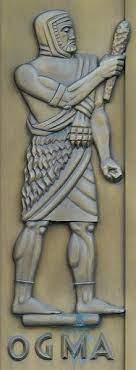
Ogma
Celtic God
In Irish-Celtic myth, Ogma is the god of eloquence and learning. He is the son of the goddess Danu and the god Dagda, and one of the foremost members of the Tuatha Dé Danann. He is the reputed inventor of the ancient Ogham alphabet which is used in the earliest Irish writings.
In the final battle at Mag Tuireadh he managed to take away the sword of the king of the Fomorians, but had to pay with his life for this feat. His Celtic equivalent is Ogmios.
Ogma or Oghma is a character from Irish mythology. A member of the Tuatha Dé Danann, he is often considered a deity and may be related to the Gaulish god Ogmios.
He fights in the first battle of Mag Tuired, when the Tuatha Dé take Ireland from the Fir Bolg. Under the reign of Bres, when the Tuatha Dé are reduced to servitude, Ogma is forced to carry firewood, but nonetheless is the only one of the Tuatha Dé who proves his athletic and martial prowess in contests before the king. When Bres is overthrown and Nuadu restored, Ogma is his champion. His position is threatened by the arrival of Lugh at the court, so Ogma challenges him by lifting and hurling a great flagstone, which normally required eighty oxen to move it, out of Tara, but Lugh answers the challenge by hurling it back. When Nuadu hands command of the Battle of Mag Tuired to Lugh, Ogma becomes Lugh’s champion, and promises to repel the Fomorian king, Indech, and his bodyguard, and to defeat a third of the enemy. During the battle he finds Orna, the sword of the Fomorian king Tethra, which recounts the deeds done with it when unsheathed. During the battle Ogma and Indech fall in single combat, although there is some confusion in the texts as in Cath Maige Tuired Ogma, Lugh and the Dagda pursue the Fomorians after the battle to recover the harp of Uaitne, the Dagda’s harper.
He often appears as a triad with Lugh and the Dagda, who are sometimes collectively known as the trí dée dána or three gods of skill, although that designation is elsewhere applied to other groups of characters. His father is Elatha and his mother is usually given as Ethliu, sometimes as Étaín. His sons include Delbaeth and Tuireann. He is said to have invented the Ogham alphabet, which is named after him.
Scholars of Celtic mythology have proposed that Ogma represents the vestiges of an ancient Celtic god. By virtue of his battle prowess and invention of Ogham, he is compared with Ogmios, a Gaulish deity associated with eloquence and equated with Herakles. J. A. MacCulloch compares Ogma’s epithet grianainech (sun-face) with Lucian’s description of the “smiling face” of Ogmios, and suggests Ogma’s position as champion of the Tuatha Dé Danann may derive “from the primitive custom of rousing the warriors’ emotions by eloquent speeches before a battle”, although this is hardly supported by the texts. Scholars such Rudolf Thurneysen and Anton van Hamel dispute any link between Ogma and Ogmios.
*
A Proto-Indo-European root *og-mo– ‘furrow, track, incised line’ may be the origin of the stem of the name. In addition, Proto-Celtic had a causative verbal suffix *-ej– ~ *-īj-. A hypothetical Proto-Celtic *Ogm-īj-o-sogm-. This agent noun would therefore mean ‘furrow-maker, incisor’ and may have had a metaphorical sense of ‘impresser.’ therefore looks very much like an agent noun derived from a verb formed by the addition of this causative suffix to the stem *
The Irish god of writing, eloquence and poetry. Ogma was credited of being inventor of the Celtic writing systems that the Druids used for their magic. These scripts were known as Ogham.
Ogma was the son of Dagda and the goddess Danu. Some other writers say that Ogma and Dagda were brothers; in this version they were the sons of Eithne. Ogma had also being called the son of Elatha, the king of the Fomorians.
Ogma was one the seven champions in the First Battle of Moytura (Mag Tuired), but when Bres became the king of Tuatha dé Danann, Ogma was degraded into working on humiliating manual job of gathering firewood.
When Lugh went to Nuada, asking for a place to serve the king, Ogma seemed to be Nuada’s foremost fighter. During the second battle of Moytura, Ogma had killed one of the Fomorian leaders, named Indech, the son of Domnu.
Ogma had married Etain, the daughter of Dian Cécht. Ogma had a son named Caipre. Some say that he was the father of MacCuill, MacCecht and MacGrené (MacGrene), the three Danann kings who ruled Ireland, during the Milesian invasion, though other say that Neit was their father.
To the Celtic Gauls he was called Ogmios. According to both Gallic and Irish myths Ogma was a warrior god, depicted as a wrinkled old man, wearing lion’s skin cloak, carrying a bow and club. The Romans considered Ogmios as the Celtic equivalent of Hercules (Greek Heracles). They also depicting Ogimos as holding people chained to his tongue by their ears, to indicate he was the god of eloquence and poetry.
Author: Agaliha
Website: Deity of the Week
And last but not least (especially if you aren’t celebrating to much) a few things you can do…

General Preparations
Beltane, May Day, May 1st, Walpurgis Nach, Neopagan Celebrations
1. Clean up your garden, rake leaves, water as needed, put down fertilizer. If you last frost date is in April, then you can begin to plant seeds and seedlings. Do work appropriate for your agricultural Zone. I live in Red Bluff, California, USDA Zone 9, Northern Hemisphere. My April gardening chores might be quite different from yours, depending upon where you live.
2. Do spring cleaning in your home. Wipe up the dust. Wash windows. Give away unneeded items. Scrub walls. Bring in some potted plants.
3. Working and meditating in the garden is an important facet of my spiritual path. I need to regularly reconnect with the earth and with the beauty and energy of the Spring season outdoors. Tend your garden daily. Water your garden each day. Weed your vegetable garden. Harvest from your late winter garden if you can grow on. Review your own lists of chores for April and May, and act accordingly.
4. Read about Beltane, May Day, Walpurgis Nacht and other mid-Spring celebrations around the world. Add notes and links to books, magazines, and webpages on the subject. See my bibliography and links above. Visit your local public library or college library to obtain access to books, media and magazines on the subject. Study about ancient Indo-European religions. I update my Months webpages on April and May.
5. Add some appropriate Beltane, May Day, Walpurgis Nacht and mid-Spring songs, chants, prayers, reflections, invocations, or poems to your Neo-Pagan Craft Journal, Book of Shadows, blog, website, or Ritual Handbook. Write in your personal journal. Most spiritual seekers keep a notebook, journal or log as part of their experimental, creative, magical and experiential work.
6. Stay at home. Improve your home, backyard, or garden. Eliminate long driving trips. Do you really need to “Go” anywhere? Do you really need to fly by airplane to another country? Explore your backyard, neighborhood, local community, nearby city, county wide area, regional area within 50-100 miles. Visit a local “sacred site.” For us, for example, this could be Mt. Shasta, the headwaters spring of the Sacramento River in Mt. Shasta City, the Sacramento River at Woodson Bridge Park, a long walk in the forest below nearby Mt. Lassen, sitting on the shore of Whiskeytown Lake, sitting in my backyard in the moonlight, or visiting a beautiful church or college or park that is nearby. Watch a DVD on a spiritual subject, sacred place, or inspirational topic. Learn more about your local environment.
7. Read solitary or group rites for Beltane, May Day, Walpurgis Nacht, Easter or other mid-spring celebrations available in books and webpages (see above). Create your own ritual for Beltane. Practice the ritual. Conduct the ritual at a convenient time for you, or your family and/or friends, as close to the day of May 1st as possible. Attend a public Beltane ritual of a local NeoPagan group.
8. Improve your indoor home altar. Clean and shine everything up on the altar. Place a fresh offering on your home altar every day in April. Add fresh flowers to the altar. Bring in branches of trees that are budding out. In Ireland, and were Celtic traditions are popular, the word “Bel” refers to a bright fire, a large bonfire, white, or bright, the month of May, and the beginning of the warm and bring summer season. Therefore, lighting candles will be an essential aspect of home piety. My home altar includes Druid, Roman, Wiccan, and Western Magickal influence.
9. Key a close eye on flowering tree and shrub branches and leaf budding tree and shrub branches in yards and gardens. This rebirth or resurrection of vegetation is essential to the meaning of this season. Many gods and goddesses are associated with this rebirth, e.g., Persephone, Attis, Osiris, Jesus Christ. Bring some of these reborn branches into your home and home altar.
Just a few ideas in case you didn’t already have enough on your plate, lol!
Healing Arts and Pagan Studies ~ Beltane/May Day

Healing Arts and Pagan Studies ~ Beltane/May Day
May Day is the ancient festival of Beltane, the midway point between the vernal (spring) equinox and the summer solstice. The days are growing longer, coaxing the earth to open to the life-giving qualities of the sun and to bring forth every kind of fruit. Beltane is a celebration of the fertility of the earth and the fertility of our own souls. It is a call to gratitude that everything in the universe is continually being re-created, including ourselves.
The air and Earth begin to warm, Spring has arrived in full force and is making way for Summer. The leaves and grass have greened and the flowers are in full bloom (as are the allergies for some!) Man and woman begin to start their lives together, new loves are born, new lives are created.
The word “Beltane” in modern Irish means May. Beltane comes from the meaning “fire of Bel”, in which Bel is the “bright or shining one”. In his honor, the Ancient Celts set two large fires made up of nine of the sacred woods:
During this time, the herds of cattle were driven through these fires to clean off the ticks and mites and also as a symbol of purification to protect them. They were left to graze in the pastures until the new year and winter. Witches’ celebrate the fruitfulness of Mother Earth in the union between Witches’ celebrate the fruitfulness of Mother Earth in the union between Her and the young Horned God. This coupling symbolizes the new fertility of the Earth, the beginnings of Spring going into Summer.
May or Beltane, has traditionally represented the sensuality and revitalization of love-making in all living things. This is why many couples traditionally marry around this time of year. In ancient Celtic days, couples would live together for a year and a day, after which they may decide to get married or part ways. The Celts believed in the idea of marriage, but understood people and nature grow, change and sometimes move apart. This is not to say they did not believe in the family unit and still remain together as a family.
In some cultures, the May pole traditionally represented a fertility symbol – specifically a phallic symbol – dancing around it in celebration was a ritual of thanks for the time of season with which all life begins the cycle. From GrannyMoon’s Morning Feast 2002
Beltane/CetSamhain/MayDay – The first day of May is celebrated in many parts of the world. It is believed it evolved from ancient agricultural and fertility rites of spring. There are signs of the first celebrations in Egypt. However, the majority of the current traditions stem from the Roman Festival, Floralia. This was a five day festival to honor the Goddess Flora with offerings of flowers, dancing, ringing bells, May Queens and erecting a Maypole.
The May Queen would oversee crops and rule the day. Some places also selected May Kings. The crowns were typical made of twigs, leaves and flowers.
The Maypole was typically fabricated the night before. The men would strip down a birch tree and plant it in the ground; this ceremony was symbolic of fertility rites. The next day both men and women danced about the Maypole. Several longs ribbons hung from the top of the Maypole holding up a crown of colorful flowers. Each dancer held an end of one of the ribbons. The dancers alternated man and women. All the women would dance in one direction and the men danced in the other direction. The dancers would go under the first person and over the next weaving the ribbons about the tree and lowering the ring to the ground. Today this tradition is still practiced but danced mostly boys and girls.
The Celts had a similar celebration known as Beltain, Beltane, or Bealtaine which in Gaelic means “Fires of Bel” or “Bright Fires”. The ceremony honored the god of the Sun and the rebirth of the earth. Feasting, games and bonfires, began on the eve of May Day and continued through the next day with a day of bonfires and merrymaking. It was customary for couples to walk through the fires smoke or leap over the flames to insure a successful relationship. Faeries were (and are) abundant on the first day of May. Windows were decorated with flowers and food was left on the doorstep to keep the mischievous faeries out.
Those traditions created a wonderful medieval holiday that is still celebrated today. We still elect May Queens and Kings and dance around Maypoles. During this time women would wash their faces with the May Day’s morning dew believing it would bring a good complexion and everlasting beauty.
“The fair maid who, the First of May, Goes to the field at break of day And washes in the dew from the hawthorn tree, Will ever after handsome be.”
People began gathering twigs and flowers to decorate their homes and the lovely tradition of May baskets began. Children would leave baskets made from twigs and filled with flowers on their neighbor’s doorstep, knock and then hide waiting to see the expression of the lucky recipient.
From Folklore, Magic and Superstitions )0(
From: GrannyMoon’s Morning Feast Archives Coventry of Healing Arts and Pagan Studies Enroll Now!
- • • •
Courtesy of GrannyMoonsMorningFeast
The Witches Almanac for Friday, May 1st, Beltane

The Witches Almanac for Friday, May 1st, Beltane
Friday (Venus): Love, friendship, reconciliation and beauty.
Beltane • May Day
Waxing Moon
The Waxing Moon is the ideal time for magick to draw things toward you.
Moon phase: Second Quarter
Moon Sign: Libra
Libra: Favors cooperation, social activities, beautification of surroundings, balance, and partnership.
Incense: Rose
Color: Coral
Did you know…..
 “Many Wiccans and Pagans celebrate Beltane. It is one of eight solar Sabbats. This holiday incorporates traditions from the Gaelic Bealtaine, such as the bonfire, but it bears more relation to the Germanic May Day festival, both in its significance (focusing on fertility) and its rituals (such as May pole dancing). Some traditions celebrate this holiday on May 1 or May day, whiles others begin their celebration the eve before or April 30th. Beltane has long been celebrated with feasts and rituals. The name means fire of Bel; Belinos being one name for the Sun God, whose coronation feast we now celebrate. As summer begins, weather becomes warmer, and the plant world blossoms, an exuberant mood prevails. In old Celtic traditions it was a time of unabashed sexuality and promiscuity where marriages of a year and a day could be undertaken but it is rarely observed in that manner in modern times. In the old Celtic times, young people would spend the entire night in the woods “A-Maying,” and then dance around the phallic Maypole the next morning. Older married couples were allowed to remove their wedding rings (and the restrictions they imply) for this one night. May morning is a magickal time for wild water (dew, flowing streams, and springs) which is collected and used to bathe in for beauty, or to drink for health.”
– Beltane by Herne
Beltane to Litha

Beltane to Litha
Beltane (a greater Sabbat named for a Celtic God, which is otherwise known as either May Eve or May Day) hails the coming-together of the Horned God, now in the Phallic Lord, and the irresistible Godddess in a rapturous celebration of light and life. It is as though all of nature—not least the birds and bees—is abuzz at this time of year, energized by a potent combination of irrestible physical attraction and an equally compelling urge to procreate.
—-The Wicca Book of Days
A Detailed History of Beltane
“…There have been many waves of Beltane festivals, each in its own generation with a different facet, but all saying ‘We Need To Celebrate’”
– Margaret Bennett, 2006
To the pastoral Celtic people’s of Europe the changing pattern of the seasons was a matter of life and death, and marking these changes key moments in the life of the community. Beltane – “bright fire” – was one such marker celebrated in various forms across Ireland, Scotland and Man as the starting point of summer. A celebration of the time of light and growth to come, Beltane was associated with a variety of practices, from the display of fresh greenery to the baking of Beltane bannocks. Perhaps the most important element, however, was the lighting of Beltane fires on the first of May, which would recall the growing power of the sun and provide an opportunity to cleanse and renew the conditions of a community – both humans and their animals – that had spent the dark months indoors. In Scotland, the lighting of Beltane fires – round which cattle were driven, over which brave souls danced and leapt – would survive into modern times, although a process of slow decline saw towns and villages slowly abandon the practice in the nineteenth century. The last Beltane fire recorded in Helmsdale took place in 1820. In the middle years of the century the fires of Fife spluttered out, and by the 1870s they would go unlit in the Shetland Isles. By the start of the twentieth century, Edinburgh, which had for time immemorial seen beacons lit on Arthur’s Seat, ceased such public Beltane celebrations.
In 1988 Edinburgh’s Beltane fires were brought to life once more, led by Angus Farquhar – then of industrial band Test Dept, who took part in the first Beltane performance, now ofNVA. The inspiration here was the idea of recreating a sense of community and an appreciation of the cyclical nature of the seasons and our connection to the environment. With the aid of choreographer Lindsay John and a folklorist Margaret Bennett of Edinburgh University’s School of Scottish Studies, this first performance drew on existing folk traditions surrounding Beltane to create a modern celebration of the festival which has continued to grow and evolve as the years have gone by.
This first modern Beltane saw only five performers take to Calton Hill, watched by an audience of fifty to a hundred people. Within five years this had grown to several hundred performers and three thousand audience members, during which time the Society came into place to support the continuation of the festival. While Arthur’s Seat had traditionally been the location for Edinburgh’s Beltane celebrations, at the time of the planning of the ‘new’ Beltane Festival a location was needed that was more accessible and central, while still maintaining an association with nature and the environment. Calton Hill also at that time had a bad reputation relating to sex and drugs and was a ‘no go’ area of the city, and part of the aim was to ‘reclaim’ that space for the local community through our celebrations.
As the Beltane Fire Festival has grown and developed, change has been inevitable. In 1992, Angus Farquhar organised his last Beltane, and the following year the Beltane Fire Society formed to take on his mantle. By 1999, audience numbers had reached ten thousand, and in 2001 the Festival took on its first paid production manager to co-ordinate the growing event, currently a part-time paid role in an otherwise volunteer organisation. Growing costs, attendance numbers and council licensing requirements meant that in 2004 the decision was made for the previously free event to be ticketed for the first time. An admission charge did little to effect the festival’s popularity, however, and in 2004 the event sold out for the first time with an audience of twelve thousand. In recent years, the audience has varied between six and twelve thousand people, experiencing a cast of around three hundred performers, plus support groups, technicians and production groups.
As “Beltane” has got bigger, it also expanded outwith the night itself, part of a cultural mileau which helped to spawn several performance groups which would move beyond the bounds of Beltane. Most notable was te POOKa, a performing arts charity which for many years had a symbiotic relationship with the festival, sharing personnel, headquarters and, in its early years, the name “Beltane Productions”. The charitable objectives of the Society, which in part seeks to raise awareness of the Quarter Days of the Scottish seasonal calendar, have also expanded its own performances to mark these complementary festivals. While the festivals of Imbolc and Lugnasadh have generally been small, informal affairs for members of the Society, the most established alternate celebration is Samhuinn – 31st October – when the coming of winter is marked by a public procession in Edinburgh city centre.
Despite these changes, BFS remains a volunteer-run community charity, with the performance on the night itself at its core. And, while the performance itself has grown and changed, it has firmly retained key elements – the procession of the May Queen, the death and rebirth of Green Man, the lighting of the bonfire – which provide a backbone of continuity while allowing a huge amount of flexibility within each group and each character as to how they wish to engage with and shape the story of our Festival. The Beltane fires have returned to Edinburgh in a vibrant, modern tradition which has become a world-renowned spectacle.
From:
Beltane Fire Society
Formed in 1988, Beltane Fire Society is a community arts performance charity that hosts the Beltane Fire Festival and Samhuinn Fire Festival in Edinburgh.
Beltane
Introduction
Beltane
Find this year’s date in the multifaith calendar
 Beltane is a Celtic word which means ‘fires of Bel’ (Bel was a Celtic deity). It is a fire festival that celebrates of the coming of summer and the fertility of the coming year.
Celtic festivals often tied in with the needs of the community. In spring time, at the beginning of the farming calendar, everybody would be hoping for a fruitful year for their families and fields.
Beltane rituals would often include courting: for example, young men and women collecting blossoms in the woods and lighting fires in the evening. These rituals would often lead to matches and marriages, either immediately in the coming summer or autumn.
Other festivities involved fire which was thought to cleanse, purify and increase fertility. Cattle were often passed between two fires and the properties of the flame and the smoke were seen to ensure the fertility of the herd.
Today Pagans believe that at Beltane the God (to whom the Goddess gave birth at the Winter Solstice) achieves the strength and maturity to court and become lover to the Goddess. So although what happens in the fields has lost its significance for most Pagans today, the creation of fertility is still an important issue.
Emma Restall Orr, a modern day Druid, speaks of the ‘fertility of our personal creativity’. (Spirits of the Sacred Grove, pub. Thorsons, 1998, pg.110). She is referring to the need for active and creative lives. We need fertile minds for our work, our families and our interests.
Fire is still the most important element of most Beltane celebrations and there are many traditions associated with it. It is seen to have purifying qualities which cleanse and revitalise. People leap over the Beltane fire to bring good fortune, fertility (of mind, body and spirit) and happiness through the coming year.
Although Beltane is the most overtly sexual festival, Pagans rarely use sex in their rituals although rituals often imply sex and fertility. The tradition of dancing round the maypole contains sexual imagary and is still very popular with modern Pagans.
The largest Beltane celebrations in the UK are held in Edinburgh. Fires are lit at night and festivities carry on until dawn. All around the UK fires are lit and private celebrations are held amongst covens and groves (groups of Pagans) to mark the start of the summer.
Edinburgh traditions
Beltane in Edinburgh
 White Woman performer ©Every year on 30th April on Calton Hill in Edinburgh thousands of people come together for a huge celebration to mark the coming of summer. The evening begins with a procession to the top of the hill led by people dressed as the May Queen and the Green Man (ancient God and Goddess figures representing fertility and growth).
The May Queen crowns the Green Man, in a ritual similar to that carried out by Wiccan Pagans (who follow a structured set of rituals). The winter ends when the Green Man’s winter costume is taken from him and he is revealed in his spring costume. A wild dance takes place and the Green Man and the May Queen are married.
The main element of any Beltane celebration is fire. On Calton Hill torchbearers carry purifying flames and fire arches are used to represent the gateways between the earthly world and the spirit world.
Most of the imagery used in the costumes and rituals comes from the Celts and from Scottish folklore. Other influences come from indeginous people world wide. For instance, the symbol of Ogun, the Yoruba god of iron, can be seen on the faces of some of the performers, and the Geisha traditions of Japan are evident in the dress of the White Women (assistants of the May Queen). Due to the ecclectic nature of the celebrations, Edinburgh’s Beltane is not recognised as a religious ritual by many practising Pagans.
 Fire arch ©
- The blue paint of the Blue Men refers to the woad used by Celtic warriors.
- The May Queen’s male consort is the Green Man, sometimes called the May King, Jack-in-the-Green, Robin Hood or the woodland faery Puck.
- The Red Men represent mischief makers, Pan-like figures who live for the moment without a care in the world or inhibitions.
- The White Woman and her handmaidens protect the May Queen and attend to her later in the evening. They are the order and discipline in the face of the Red Men’s chaos.
- Torch Bearers are an important, trusted group. Dressed from head to foot in black, with blacked out faces, their hair covered, they are protected from fire and other elements.
From: http://www.bbc.co.uk/religion/religions/paganism/holydays/beltane_1.shtml
Beltane Lore & Rites
by Selena Fox
 Also known as May Eve, May Day, and Walpurgis Night, happens at the beginning of May. It celebrates the height of Spring and the flowering of life. The Goddess manifests as the May Queen and Flora. The God emerges as the May King and Jack in the Green. The danced Maypole represents Their unity, with the pole itself being the God and the ribbons that encompass it, the Goddess. Colors are the Rainbow spectrum. Beltane is a festival of flowers, fertility, sensuality, and delight.
Celebrating Beltane Podcasts
- Beltane Ritual: Bringing in the May – upcoming April 29, 2014
- Celebrating Beltane: Old & New Ways
- Inner Journey Ritual for Beltane
- Beltane Faery Folk Magic Rite
Beltane Customs
Prepare a May basket by filling it with flowers and goodwill and then give it to someone in need of healing and caring, such as a shut-in or elderly friend. Form a wreath of freshly picked flowers, wear it in your hair, and feel yourself radiating joy and beauty. Dress in bright colors. Dance the Maypole and feel yourself balancing the Divine Female and Male within. On May Eve, bless your garden in the old way by making love with your lover in it. Make a wish as you jump a bonfire or candle flame for good luck. Welcome in the May at dawn with singing and dancing.
Going A-Maying & Bringing in the May — Merry-making and Nature communion. * Midpoint between Spring Equinox and Summer Solstice. * In Pagan Rome, Floralia, from April 27-May 3 was the festival of the Flower Goddess Flora and the flowering of Springtime. On May 1, offerings were made to Bona Dea (as Mother Earth), the Lares (household guardian spirits), and Maia (Goddess of Increase) from whom May gets its name. * Roman Catholic traditions of crowning statues of Mary with flowers on May 1 have Roman Pagan roots. * Marks the second half of the Celtic Year; one of the four Celtic Fire Festivals. Complement to Samhain, it is a time of divination and communion with Fairy Folk/Nature Spirits. * Pastoral tradition of turning sheep, cows, other livestock out to pasture. * In Pagan Scandinavia, mock battles between Winter and Summer were enacted at this time. * Building on older tradition of this time being a holiday for the masses, in the twentieth century, May Day has been a workers’ holiday in many places. * Some say that Mother’s Day, in the USA, Mexico, and elsewhere has Pagan roots.
 Maypole
Forms include pole, tree, bush, cross; communal or household; permanent or annual. * In Germany, Fir tree was cut on May Eve by young unmarried men, branches removed, decorated, put up in village square, & guarded all night until dance occurred on May Day. * In England, permanent Maypoles were erected on village greens * In some villages, there also were smaller Maypoles in the yards of households. * Maypole ribbondances, with two circles interweaving; around decorated bush/tree, clockwise circle dances.
Flowers & Greenwood
Gathering and exchange of Flowers and Greens on May Eve, pre-dawn May Day, Beltane. * Decorating homes, barns, and other buildings with Green budding branches, including Hawthorn. * Making and wearing of garland wreaths of Flowers and/or Greens. * May Baskets were given or placed secretly on doorsteps to friends, shut-ins, lovers, others. * May Bowl was punch (wine or non-alcoholic) made of Sweet Woodruff blossoms.
 Beltane Fires
Traditionally, sacred woods kindled by spark from flint or by friction — in Irish Gaelic, the Beltane Fire has been called teine eigin (fire from rubbing sticks). * Jump over the Beltane Fire, move through it, or dance clockwise around it. * Livestock was driven through it or between two fires for purification and fertility blessings. * In ancient times Druid priests kindled it at sacred places; later times, Christian priests kindled it in fields near the church after peforming a Christian church service. * Rowan twigs were carried around the fire three times, then hung over hearths to bless homes. * In the past, Beltane community fire purification customs included symbolic sacrifice of effigy knobs on the Beltane Cake (of barley) to the fire, or, in medieval times, mock sacrifice of Beltane Carline (Hag) who received blackened piece of Beltane Cake; Maypoles in Spain were each topped with a male effigy which was later burned. Contemporary Pagans burn sacred wood and dried herbs as offerings in their Beltane fires.
May Waters
Rolling in May Eve dew or washing face in pre-dawn May Day dew for health, luck, beauty. * Getting head and hair wet in Beltane rain to bless the head. * Blessing springs, ponds, other sacred waters with flowers, garlands, ribbons, other offerings. * Collecting sacred waters and scrying in sacred springs, wells, ponds, other waters.
Sacred Union & Fertility
Union with the Land focus, often with actual mating outside on the Land to bless fields, herds, home. * May Queen (May Bride) as personification of the Earth Goddess and Goddesses of Fertility. * May King (May Groom) as personification of Vegetation God, Jack-in-Green — often covered in green leaves. * At Circle Sanctuary, in addition to May Queen & May King, is May Spirit Couple, an already bonded pair. * Symbolic Union of Goddess and God in election/selection, crowning, processional, Maypole dance, feast. * Morris Dancers and pageants (with Hag & Jack-in-Green) to awaken the fertility in the Land.


You must be logged in to post a comment.