Astronomy Picture of the Day

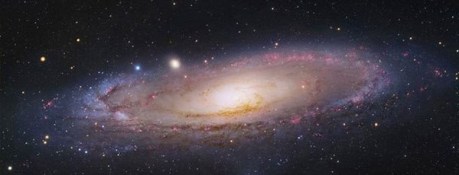
Andromeda Galaxy

The most distant object that most folks can see with the unaided eye is also the closest major galaxy to our own Milky Way. Although the Andromeda Galaxy lies a mind-bending 2.5 million light-years from Earth, its trillion stars are enough to emit a strong glow across the vast reaches of space. Despite the wide gap, the Milky Way and Andromeda are on a collision course and predicted to begin merging in roughly 4.5 billion years. (You’ve been warned.)

The Andromeda Galaxy was once thought to be a nebula. Early in the development of modern astronomy, any diffuse, undefined celestial body was called a ‘nebula,’ including what we now know to be a neighboring galaxy. Our modern definition of nebula refers to galaxies-in-training that will coalesce over cosmic time into something less…nebulous.

Astronomy Picture of the Day

Discover the cosmos! Each day a different image or photograph of our fascinating universe is featured, along with a brief explanation written by a professional astronomer.

2021 October 23

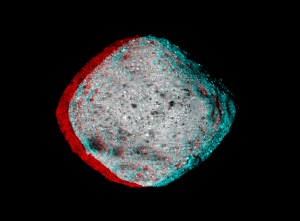
3D Bennu

Image Credit: NASAGSFCU. Arizona – Stereo Image Copyright: Patrick Vantuyne

Explanation: Put on your red/blue glasses and float next to asteroid 101955 Bennu. Shaped like a spinning toy top with boulders littering its rough surface, the tiny Solar System world is about one Empire State Building (less than 500 meters) across. Frames used to construct this 3D anaglyph were taken by PolyCam on the OSIRIS_REx spacecraft on December 3, 2018 from a distance of about 80 kilometers. With a sample from the asteroid’s rocky surface on board, OSIRIS_REx departed Bennu’s vicinity this May and is now enroute to planet Earth. The robotic spacecraft is scheduled to return the sample to Earth in September 2023.

Astronomy Picture of the Day

From NASA – Astronomy Picture of the Day Archive

Discover the cosmos! Each day a different image or photograph of our fascinating universe is featured, along with a brief explanation written by a professional astronomer.

2021 October 21

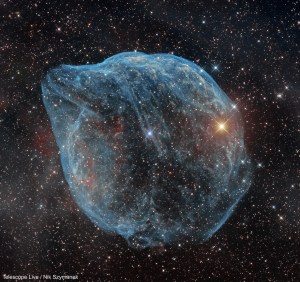
SH2-308: The Dolphin-Head Nebula

Image Credit & Copyright: Nik Szymanek

Explanation: Blown by fast winds from a hot, massive star, this cosmic bubble is huge. Cataloged as Sharpless 2-308 it lies some 5,000 light-years away toward the constellation of the Big Dog (Canis Major) and covers slightly more of the sky than a Full Moon. That corresponds to a diameter of 60 light-years at its estimated distance. The massive star that created the bubble, a Wolf-Rayet star, is the bright one near the center of the nebula. Wolf-Rayet stars have over 20 times the mass of the Sun and are thought to be in a brief, pre-supernova phase of massive star evolution. Fast winds from this Wolf-Rayet star create the bubble-shaped nebula as they sweep up slower moving material from an earlier phase of evolution. The windblown nebula has an age of about 70,000 years. Relatively faint emission captured by narrowband filters in the deep image is dominated by the glow of ionized oxygen atoms mapped to a blue hue. Presenting a mostly harmless outline, SH2-308 is also known as The Dolphin-head Nebula.

Astronomy Picture of the Day

Discover the cosmos! Each day a different image or photograph of our fascinating universe is featured, along with a brief explanation written by a professional astronomer.

2021 October 17

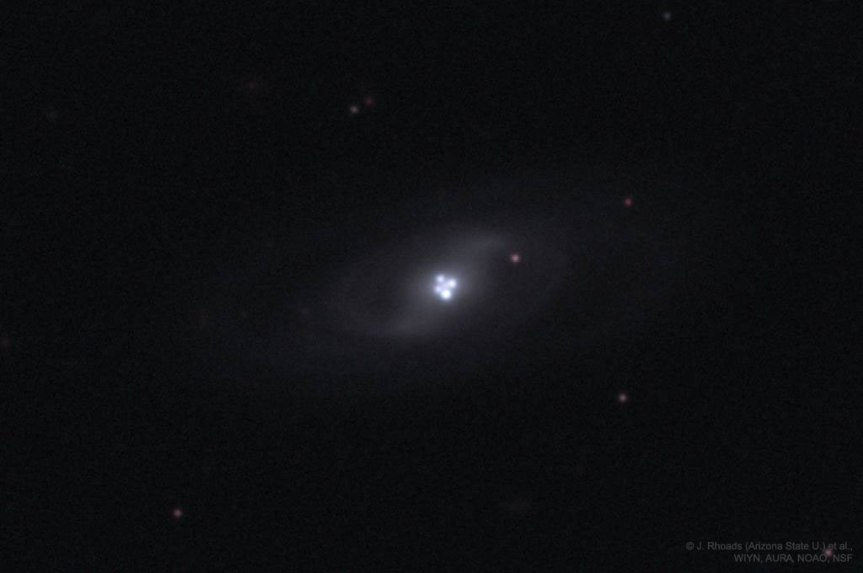
The Einstein Cross Gravitational Lens

Image Credit & LicenseJ. Rhoads (Arizona State U.) et al., WIYNAURANOIRLabNSFExplanation: Most galaxies have a single nucleus — does this galaxy have four? The strange answer leads astronomers to conclude that the nucleus of the surrounding galaxy is not even visible in this image. The central cloverleaf is rather light emitted from a background quasar. The gravitational field of the visible foreground galaxy breaks light from this distant quasar into four distinct images. The quasar must be properly aligned behind the center of a massive galaxy for a mirage like this to be evident. The general effect is known as gravitational lensing, and this specific case is known as the Einstein Cross. Stranger still, the images of the Einstein Cross vary in relative brightness, enhanced occasionally by the additional gravitational microlensing effect of specific stars in the foreground galaxy.

Astronomy Picture of the Day

Discover the cosmos! Each day a different image or photograph of our fascinating universe is featured, along with a brief explanation written by a professional astronomer.

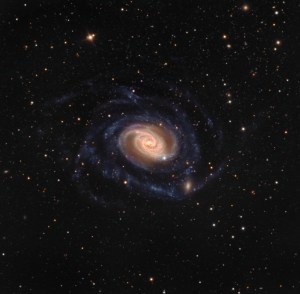
NGC 289: Swirl in the Southern Sky

Image Credit & Copyright: Mike SelbyExplanation: About 70 million light-years distant, gorgeous spiral galaxy NGC 289 is larger than our own Milky Way. Seen nearly face-on, its bright core and colorful central disk give way to remarkably faint, bluish spiral arms. The extensive arms sweep well over 100 thousand light-years from the galaxy’s center. At the lower right in this sharp, telescopic galaxy portrait the main spiral arm seems to encounter a small, fuzzy elliptical companion galaxy interacting with enormous NGC 289. Of course spiky stars are in the foreground of the scene. They lie within the Milky Way toward the southern constellation Sculptor.

Astronomy Picture of the Day

Discover the cosmos! Each day a different image or photograph of our fascinating universe is featured, along with a brief explanation written by a professional astronomer.

NGC 7293: The Helix Nebula

Image Credit & Copyright: Ignacio Diaz BobilloExplanation: A mere seven hundred light years from Earth, toward the constellation Aquarius, a sun-like star is dying. Its last few thousand years have produced the Helix Nebula (NGC 7293), a well studied and nearby example of a Planetary Nebula, typical of this final phase of stellar evolution. A total of 90 hours of exposure time have gone in to creating this expansive view of the nebula. Combining narrow band image data from emission lines of hydrogen atoms in red and oxygen atoms in blue-green hues, it shows remarkable details of the Helix’s brighter inner region about 3 light-years across. The white dot at the Helix’s center is this Planetary Nebula’s hot, central star. A simple looking nebula at first glance, the Helix is now understood to have a surprisingly complex geometry.

Astronomy Picture of the Day

Discover the cosmos! Each day a different image or photograph of our fascinating universe is featured, along with a brief explanation written by a professional astronomer.

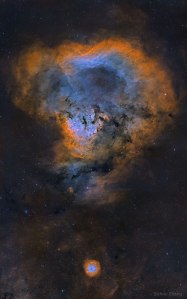
NGC 7822: Cosmic Question Mark

Image Credit & Copyright: Yizhou ZhangExplanation: It may look like a huge cosmic question mark, but the big question really is how does the bright gas and dark dust tell this nebula’s history of star formation. At the edge of a giant molecular cloud toward the northern constellation Cepheus, the glowing star forming region NGC 7822 lies about 3,000 light-years away. Within the nebula, bright edges and dark shapes stand out in this colorful and detailed skyscape. The 9-panel mosaic, taken over 28 nights with a small telescope in Texas, includes data from narrowband filters, mapping emission from atomic oxygen, hydrogen, and sulfur into blue, green, and red hues. The emission line and color combination has become well-known as the Hubble palette. The atomic emission is powered by energetic radiation from the central hot stars. Their powerful winds and radiation sculpt and erode the denser pillar shapes and clear out a characteristic cavity light-years across the center of the natal cloud. Stars could still be forming inside the pillars by gravitational collapse but as the pillars are eroded away, any forming stars will ultimately be cut off from their reservoir of star stuff. This field of view spans over 40 light-years across at the estimated distance of NGC 7822.

Astronomy Picture of the Day

Discover the cosmos! Each day a different image or photograph of our fascinating universe is featured, along with a brief explanation written by a professional astronomer.

[I cannot get the video for today to copy anywhere that I can upload it from so instead here is a link that will take you to view it) From NASA.gov – Full Moon Silhouettes

Full Moon Silhouettes
Video Credit & Copyright: Mark GeeMusic: Tenderness (Dan Phillipson)Explanation: Have you ever watched the Moon rise? The slow rise of a nearly full moon over a clear horizon can be an impressive sight. One impressive moonrise was imaged in early 2013 over Mount Victoria Lookout in WellingtonNew Zealand. With detailed planning, an industrious astrophotographer placed a camera about two kilometers away and pointed it across the lookout to where the Moon would surely soon be making its nightly debut. The featured single shot sequence is unedited and shown in real time — it is not a time lapse. People on Mount Victoria Lookout can be seen in silhouette themselves admiring the dawn of Earth’s largest satellite. Seeing a moonrise yourself is not difficult: it happens every day, although only half the time at night. Each day the Moon rises about fifty minutes later than the previous day, with a full moon always rising at sunset. This Saturday, October 16, is International Observe the Moon Night, where you observe a first-quarter Moon along with other lunar enthusiasts.

Astronomy Picture of the Day

Discover the cosmos! Each day a different image or photograph of our fascinating universe is featured, along with a brief explanation written by a professional astronomer.

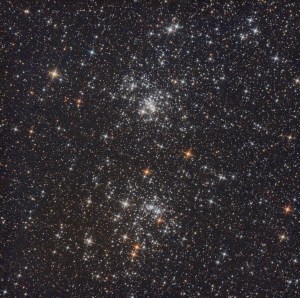
The Double Cluster in Perseus

Image Credit & Copyright: Jack Groves

Explanation: This pretty starfield spans about three full moons (1.5 degrees) across the heroic northern constellation of Perseus. It holds the famous pair of open star clusters, h and Chi Persei. Also cataloged as NGC 869 (top) and NGC 884, both clusters are about 7,000 light-years away and contain stars much younger and hotter than the Sun. Separated by only a few hundred light-years, the clusters are both 13 million years young based on the ages of their individual stars, evidence that they were likely a product of the same star-forming region. Always a rewarding sight in binoculars, the Double Cluster is even visible to the unaided eye from dark locations. But a shroud of guitar strings was used to produce diffraction spikes on the colorful stars imaged in this

International Observe The Moon Night – Global Moon Party

From NASA.gov (USA) National Aeronautics and Space Administration

Plan Your Event and Celebrate with Us

View our recorded Event Planning Webinar, and join the virtual Global Moon Party on October 9, for resources and activities that can take your International Observe the Moon Night to the next level.

Capture the moment like a pro! Check out our Moon photography tips for cell phones, professional cameras, and more.

The Moon is Earth’s constant companion, the first skywatching target pointed out to us as children. We watch its face change as the month progresses, and see patterns and pictures in its geological features.

It’s the object in the night sky that humanity knows best ― and the one that’s easiest to study. Whether your tools are a telescope, a pair of binoculars, or just your eyes, you can find plenty of features on the Moon.

We only ever see one side of the Moon from Earth. That’s because the interplay of gravity between Earth and Moon slows the Moon into a rotation that paces its own. The Moon rotates, but it rotates at the same speed that it orbits around Earth. This keeps the same side always turned toward us. We call this being “tidally locked.

The Moon has no glow of its own, but shines with the reflected light of the Sun. During its crescent phase in the twilight or dawn, you can also sometimes see the dark portion of the Moon glowing faintly in the sunlight that reflects off Earth, an effect called earthshine.

You can look at the Moon during any of its illuminated phases, but for better viewing of craters and mountains, try phases other than the full Moon. The shadows on the surface will be more pronounced, and help distinguish features you might otherwise miss.

Eyeballing the Moon

Looking at the Moon with only your eyes, you see mostly areas of white and gray. These gray patches are solidified volcanic lava flows. In the Moon’s youth, its interior was still molten, and magma would erupt onto its surface. These dark areas formed when massive asteroid or meteorite impacts on the Moon’s surface created basins. Because the impact basins were often the lowest places on the Moon’s surface, they would begin to fill with erupting lava. The lava was similar to the basalt that erupts on Earth and, like on Earth, cooled to form a relatively dark-colored rock. We call these areas the lunar seas, or maria.

The lighter-colored areas are called the highlands, and show the earliest crust on the Moon, dominated by a type of rock called anorthosite, which is primarily made up of the white mineral anorthite or plagioclase.

What you see on the Moon with your eyes only will vary depending on your eyesight. Give yourself plenty of time for your eyes to adjust and look carefully. You may be able to see some of the larger impact craters on the Moon’s surface if your vision is sharp enough, including Copernicus, Kepler, and Aristarchus and Tycho. You may even be able to see some of the bright streaks that are ray systems emanating from the Copernicus or Tycho craters, created when material was thrown outward by the force of the original impacts.

Lunar Sightseeing

Pick up a pair of binoculars, and the Moon transforms.

With binoculars, you’ll still see the entire Moon at once, but now it’ll have terrain. Smooth-looking patterns of gray and white resolve into craters and large mountain ridges. You’ll be able to tell where the Moon is relatively undisturbed and where it’s been pockmarked by impacts. Binoculars introduce texture, especially when you look at the Moon when it’s in any other phase other than full. Focus particularly along the terminator line between light and dark, where features will cast long shadows that make them clearer. Choose binoculars with a magnification of 7 at a minimum. Though a magnification of 10 or 15 will provide more detail, you may need a tripod to steady them.

Under the gaze of a telescope, the Moon becomes too big to take in at once. Now you’ll see real mountains, and not just craters but the crater chains created when impact debris splashes around the main craters. You’ll see valleys, and the cracks in the Moon’s surface called rilles, formed when the lava that once filled a basin cooled and contracted. If this is your first time looking at the Moon through a telescope, you may feel the same wonder Galileo felt seeing that familiar orb in the sky transform into another world. Be sure to examine the Moon at many different phases and on different days. Parts of the Moon near the edge of the disk come into view at some times but not others, a wobbling phenomenon known as libration. Experienced observers can take advantage of favorable librations to see about 59 percent of the lunar surface.

Published: September 20, 2021

Take on a Moon Observing Challenge from the Astronomical League. This activity challenges you to complete each of the following tasks:

  • Do an outreach activity. This could be an International Observe the Moon Night event or any activity that encourages observing the Moon in general.
  • Observe the Moon with just your eyes. No equipment is required.
  • Estimate the Moon’s percent illumination. Not illuminated at all would be 0%, half-illuminated would be 50%, and completely illuminated would be 100%.
  • Make a sketch or capture an image of the Moon that includes at least ten of the features below. Indicate your chosen features on your sketch or image:
    • Mare Crisium
    • Mare Fecunditatis
    • Mare Frigoris
    • Mare Imbrium
    • Mare Nectaris
    • Mare Nubium
    • Mare Serenitatis
    • Mare Tranquillitatis
    • Crater Copernicus
    • Crater Tycho
    • Crater Rays from Crater Copernicus
    • The Woman in the Moon

For more information about this challenge, and to learn how to submit your sketch or image, visit the Astronomical League website.

Note: You may make your observation any time between October 15, 2021 and October 22, 2021. The deadline for submission is November 22, 2021. You do not need to be a member of the Astronomical League to participate in this challenge.

A lot more Activities to do with People and Our Moon Goddess

Astronomy Picture of the Day

Discover the cosmos! Each day a different image or photograph of our fascinating universe is featured, along with a brief explanation written by a professional astronomer.

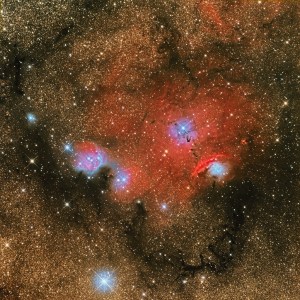
NGC 6559: East of the Lagoon

Image Credit & Copyright: Roberto SartoriExplanation: Slide your telescope just east of the Lagoon Nebula to find this alluring field of view in the rich starfields of the constellation Sagittarius toward the central Milky Way. Of course the Lagoon nebula is also known as M8, the eighth object listed in Charles Messier’s famous catalog of bright nebulae and star clusters. Close on the sky but slightly fainter than M8, this complex of nebulae was left out of Messier’s list though. It contains obscuring dust, striking red emission and blue reflection nebulae of star-forming region NGC 6559 at right. Like M8, NGC 6559 is located about 5,000 light-years away along the edge of a large molecular cloud. At that distance, this telescopic frame nearly 3 full moons wide would span about 130 light-years.

Astronomy Picture of the Day

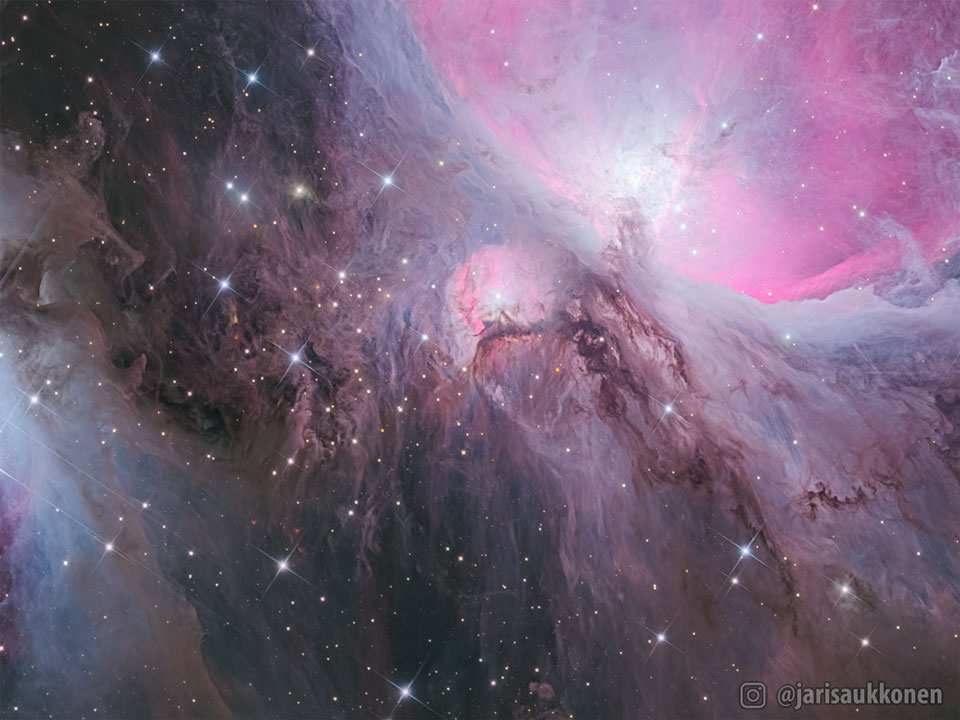
The picture the part of the Orion Nebula known as M43 
in great detail including many find streams of dust.
Please see the explanation for more detailed information.

M43: Streams of Orion

Image Credit & Copyright: Jari SaukkonenExplanation: Where do the dark streams of dust in the Orion Nebula originate? This part of the Orion Molecular Cloud ComplexM43, is the often imaged but rarely mentioned neighbor of the more famous M42. M42, seen in part to the upper right, includes many bright stars from the Trapezium star clusterM43 is itself a star forming region that displays intricately-laced streams of dark dust — although it is really composed mostly of glowing hydrogen gas. The entire Orion field is located about 1600 light years away. Opaque to visible light, the picturesque dark dust is created in the outer atmosphere of massive cool stars and expelled by strong outer winds of protons and electrons.


Astronomy Picture of the Day

Discover the cosmos! Each day a different image or photograph of our fascinating universe is featured, along with a brief explanation written by a professional astronomer.

2021 October 3

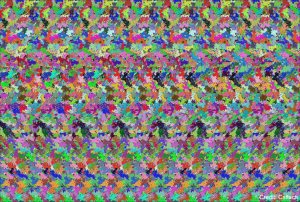
The Holographic Principle and a Teapot

Image Credit: CaltechExplanation: Sure, you can see the 2D rectangle of colors, but can you see deeper? Counting color patches in the featured image, you might estimate that the most information that this 2D digital image can hold is about 60 (horizontal) x 50(vertical) x 256 (possible colors) = 768,000 bits. However, the yet-unproven Holographic Principle states that, counter-intuitively, the information in a 2D panel can include all of the information in a 3D room that can be enclosed by the panel. The principle derives from the idea that the Planck length, the length scale where quantum mechanics begins to dominate classical gravity, is one side of an area that can hold only about one bit of information. The limit was first postulated by physicist Gerard ‘t Hooft in 1993. It can arise from generalizations from seemingly distant speculation that the information held by a black hole is determined not by its enclosed volume but by the surface area of its event horizon. The term “holographic” arises from a hologram analogy where three-dimension images are created by projecting light through a flat screen. Beware, some people staring at the featured image may not think it encodes just 768,000 bits — nor even 2563,000 bit permutations — rather they might claim it encodes a three-dimensional teapot.

Astronomy Picture of the Day

Discover the cosmos! Each day a different image or photograph of our fascinating universe is featured, along with a brief explanation written by a professional astronomer.

2021 October 2

A Light and Dusty Night

Image Credit & Copyright: Rodrigo GuerraExplanation: Posing as a brilliant evening star, Venus lies near the western horizon in this southern hemisphere, early spring, night skyscape. To create the composite view exposures tracking the sky and fixed for the foreground were taken on September 25 from Cascavel in southern Brazil. In view after sunset, Venus appears immersed in a cone of zodiacal light, sunlight scattered from dust along the Solar System’s ecliptic plane. In fact from either hemisphere of planet Earth, zodiacal light is most visible after sunset near a spring equinox, (or before sunrise near an autumn equinox) when its luminous arc lies at steep angles to the horizon. Extending above the sunset on this night, the zodiacal light reaches toward rich starfields and immense interstellar dust clouds in the bulge of the central Milky Way. Follow along the Milky Way from the central bulge back toward the horizon and you’ll spot the closest star system to the Sun, Alpha Centauri, a mere 4.37 light-years away.

October 1st Birthday Horoscope – Zodiac Sign Is Libra

Click here to read anyone’s birthday horoscope

OCTOBER 1 birthday horoscope predicts that you are a diplomatic Libra, especially during a debate. You’re creative with a lot of spirits that can’t be compromised. You are gracious in defeat and accept your mistakes.

You use this same resourceful intelligence during a disagreement. You’re the troubleshooter or peacemaker. You seek accord in group activities and are considered a leader or the one who is a dominant or key factor among everyone.

Usually, this zodiac birthday person is a calm and gracious host. You love being the center of attention. The October 1st birthday personality is sociable, and mostly, people gather around them.

However, and this is only on occasion, you tend to be impatient. Nonetheless, you can make snap decisions. You depend on your gut instinct to guide you and typically have good results.

Success-minded, you don’t mind taking the lead or being in a managerial position. Someone the October 1  Libra birthday person may think about being a freelancer or an entrepreneur in which case, you are likely to excel.

If today is your birthday, you have a way with people. They are attracted to you so; it would be straightforward for you to start your own business. However, Libra, you should display a professional attitude at all times. You are not very tolerant.

The October 1st astrology predicts that you are proud people who won’t stop to ask for directions. You’d rather take a long way around than admit you missed a couple of turns. You normally have a good head on your shoulders and want people to believe in you. You are adaptable and confident.

As your friend, this Libran will be the social expert. However, when it comes right down to it, you will only have a select few close friends. As a lover, you’ll find that a person born on October 1 is romantic, very romantic.

Being single, you are likely to be in love numerous times. You won’t have this struggle once you have decided to settle down. You know what to do to keep the fires burning.

The October 1 horoscope also predicts that as a parent, you may not be around much. Your main focus is likely to be on providing a comfortable life for your family. You will leave no stones unturned in that aspect.

Childhood memories for someone born on this birthday may have an impact on how you choose to raise your own. Although you may not be as involved physically with your offspring, you still set rules and find that there are fewer arguments between the family.

I’d like to talk about your health. Oh, don’t worry, there’s nothing for you to worry about. You have minimal problems keeping fit as you are active and follow a routine of exercising. This helps you avoid being bogged down with stress and anxiety. As long as you do things in moderation, you should be fine.

The October 1 birthday personality are people who should be employed in a career that allows them to provide assistance to others. You may even feel that your purpose is the Americorps or heading a non-profit organization to help those less privileged. This is an important career choice. You, additionally, are a generous person who would give their last dollar to someone who needed to eat.

The October 1st zodiac shows that you tend to shop! It is one of your favorite past times. Surround yourself with beautiful things and people and your world will be beautiful is what you say.

You’re a person with quite an imagination. These qualities can almost ensure you a job in retail perhaps as a buyer. Other choices are not limited to politics, business, and entertainment.

As a Libra born on October 1, you keep your mind on your money. Charming and likable, Librans born under the Scales sign are powerful people. You could be in many career fields but are likely to be in a position to help others out of poverty.

Because of this, you gain popularity but usually, have only a few close friends. You’re a proud Libra who won’t ask for help. As one of your negative birthday personality traits, you have very little patience.

Famous People And Celebrities Born On October 1

Julie Andrews, Curtis Axel, Tom Bosley, Jimmy Carter, Drew Chadwick, Walter Matthau, Randy Quaid

See: Famous Celebrities Born On October 1

This Day That Year – October 1 In History

1869 – Vienna, Austria issued the first postcards.
1893 – Mississippi placed 3rd for worst hurricane ever; 1,800 people lost their lives
1920 – The 8 hour work day proposed as a Dutch law.
1942 – First publications of “The Little Golden Books.”

October 1 Tula Rashi (Vedic Moon Sign)
October 1 Chinese Zodiac DOG

October 1 Birthday Planet

Your ruling planet is planet Venus that symbolizes the different areas in life in which you wish to be successful, spend money on and enjoy yourself.

October 1 Birthday Symbols

The Scales Are The Symbol For The Libra Zodiac Sign

October 1 Birthday Tarot Card

Your Birthday Tarot Card is The Magician. This card symbolizes that you are blessed with good powers, use it to your advantage. The Minor Arcana cards are Two of Swords and Queen of Swords

October 1 Birthday Zodiac Compatibility

You are most compatible with people born under Zodiac Sign Taurus: This will be a steady, sensual and excellent love match.
You are not compatible with people born under Zodiac Sign CancerThis is a relationship that will require a lot of hard work.

See Also:

October 1 Lucky Number

Number 1 – This number stands for independence, glory, success, and courage.
Number 2 – This number symbolizes compassion, harmony, flexibility, and gentleness.

Read about: Birthday Numerology

Lucky Colors For October Birthday

Orange: This color signifies rejuvenation of self, optimism, cheerfulness, and adventure.
Purple: This is a color that stands for imagination, perception, luxury, and dreams.

Lucky Days For October 1 Birthday

Sunday – This day ruled by the Sun helps you renew your faith in yourself and become a better person.
Friday – This day ruled by Venus is a great day to enjoy life with the people who make you feel good.

October 1 Birthstone Opal

Opal gemstone is known to improve your creative skills and helps reduce confusion.

Ideal Zodiac Birthday Gifts For People Born On October 1st

A good bottle of liqueur for the Libra man and a beautiful painting or sculpture for the woman. The October 1 birthday horoscope predicts that you love gifts that hold some value and personality.

Astronomy Picture of the Day

From NASA.gov

Discover the cosmos! Each day a different image or photograph of our fascinating universe is featured, along with a brief explanation written by a professional astronomer.

The Hydrogen Clouds of M33

Image Credit & Copyright: Luca Fornaciari

Explanation: Gorgeous spiral galaxy M33 seems to have more than its fair share of glowing hydrogen gas. A prominent member of the local group of galaxies, M33 is also known as the Triangulum Galaxy and lies a mere 3 million light-years away. Sprawling along loose spiral arms that wind toward the core, M33’s giant HII regions are some of the largest known stellar nurseries, sites of the formation of short-lived but very massive stars. Intense ultraviolet radiation from the luminous massive stars ionizes the surrounding hydrogen gas and ultimately produces the characteristic red glow. To highlight the HII regions in this telescopic image, broadband data used to produce a color view of the galaxy were combined with narrowband data recorded through a hydrogen-alpha filter, transmitting the light of the strongest hydrogen emission line. Close-ups of cataloged HII regions appear in the sidebar insets. Use the individual reference number to find their location within the Triangulum Galaxy. For example, giant HII region NGC604 is identified in an inset on the right and appears at position number 15. That’s about 4 o’clock from galaxy center in this portrait of M33.

September 29th Astronomy Picture of the Day

Gigantic Jet Lightning from Puerto Rico

Gigantic Jet Lightning from Puerto Rico
Video Credit & Copyright: Frankie LucenaExplanation: Have you ever seen a gigantic jet? They are extremely rare but tremendously powerful. Gigantic jets are a type of lightning discharge documented only this century that occur between some thunderstorms and the Earth’s ionosphere high above them. Pictured above is the middle and top of one such jet caught last week by a lightning and meteor camera from Puerto RicoUSA. The jet traversed perhaps 70 kilometers in just under one second. Gigantic jets are much different from regular cloud-to-cloud and cloud-to-ground lightning. The bottoms of gigantic jets appear similar in appearance to another type cloud-to-above strike called blue jets, while the tops appear similar to upper-atmosphere red sprites. Although the mechanism and trigger that causes gigantic jets is a topic of research, it is clear that the jets reduce charge imbalance between different parts of Earth’s atmosphere. A good way to look for gigantic jets is to watch a powerful but distant thunderstorm from a clear location.

From NASA.gov


Almost Hyperspace: Random APOD Generator
Tomorrow’s picture: open space

Astronomy Picture of the Day

Discover the cosmos! Each day a different image or photograph of our fascinating universe is featured, along with a brief explanation written by a professional astronomer.

Night of the Perseids – September 28, 2021

Video Credit & Copyright: Vikas Chander & Dorje Angchuk; Music: Tea Time via PremiumBeatExplanation: Have you ever experienced a meteor shower? To help capture the wonder, a video was taken during the peak of the recent Perseid meteor shower above the Indian Astronomical Observatory in HanleIndia, high up in the Himalayan mountains. Night descends as the video begins, with the central plane of our Milky Way Galaxy approaching from the left and Earth-orbiting satellites zipping by overhead. During the night, the flash of meteors that usually takes less than a second is artificially extended. The green glow of most meteors is typically caused by vaporizing nickel. As the video continues, Orion rises and meteors flare above the 2-meter Himalayan Chandra Telescope and the seven barrels of the High Energy Gamma Ray Telescope (Hagar). The 2 minute 30 second movie ends with the Sun rising, preceded by a false dawn of zodiacal light.

September 27th Astronomy Picture of the Day

Discover the cosmos!

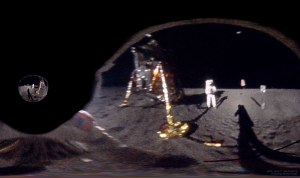
Unwrapped: Five Decade Old Lunar Selfie

Image Credit: NASAApollo 11Neil Armstrong; Processing: Michael Ranger

Each day a different image or photograph of our fascinating universe is featured, along with a brief explanation written by a professional astronomer.

Explanation: 

Here is one of the most famous pictures from the Moon — but digitally reversed. Apollo 11 landed on the moon in 1969 and soon thereafter many pictures were taken, including an iconic picture of Buzz Aldrin taken by Neil Armstrong. The original image captured not only the magnificent desolation of an unfamiliar world, but Armstrong himself reflected in Aldrin’s curved visor. Enter modern digital technology. In the featured image, the spherical distortion from Aldrin’s helmet has been reversed. The result is the famous picture — but now featuring Armstrong himself from Aldrin’s perspective. Even so, since Armstrong took the picture, the image is effectively a five-decade old lunar selfie. The original visor reflection is shown on the left, while Earth hangs in the lunar sky on the upper right. A foil-wrapped leg of the Eagle lander is prominently visible. Preparations to return humans to the Moon in the next few years include the Artemis program, an international collaboration led by NASA.

Astronomy Picture of the Day

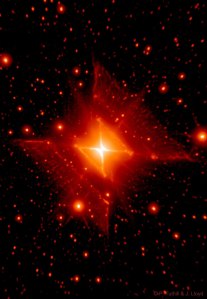
The Red Square Nebula

Image Credit & Copyright: Peter Tuthill (Sydney U.) & James Lloyd (Cornell U.)

Explanation: How did a round star create this square nebula? No one is quite sure. The round star, known as MWC 922 and possibly part of a multiple star system, appears at the center of the Red Square Nebula. The featured image combines infrared exposures from the Hale Telescope on Mt. Palomar in California, and the Keck-2 Telescope on Mauna Kea in Hawaii. A leading progenitor hypothesis for the square nebula is that the central star or stars somehow expelled cones of gas during a late developmental stage. For MWC 922, these cones happen to incorporate nearly right angles and be visible from the sides. Supporting evidence for the cone hypothesis includes radial spokes in the image that might run along the cone walls. Researchers speculate that the cones viewed from another angle would appear similar to the gigantic rings of supernova 1987A, possibly indicating that a star in MWC 922 might one day itself explode in a similar supernova.

From NASA.gov