Some of the Witchcraft/Magickal Correspondence Digest for Tuesday


From GypsyWolf.weebly.com

Tuesday is the third day of the week.  The name is derived from the Nordic sky god in charge of law, order, justice, and war, Tiw (Saxons), also known as Tyr (Scandinavians), Ziu (S. Germans), Tiuz or Tiwaz (N. Germans).  In the Roman calendar the corresponding day was Dies Martis, the day of Mars, god of war and agriculture, originally known as Ares in Greek mythology.  The sacred symbol of all of these deities is the spear.
Latin: Dies Martis, the day of Mars
French: mardi
Italian: martedi
Spanish: martes
German: Dienstag, “Assembly Day”
Netherlands-  dinsdag
Denmark-  tirsdag
Sweden-  tisdagRules: Sexual energy, courage, aggression, war, politics, healing after surgery, physical strength, exorcism, protection and defensive magic
Colors: Red and Autumn Shades
Planet: Mars
Metal: Iron, for Mars’ spear and shield; Steel
Stones: Asbestos, Bloodstone, Flint, Garnet, Jasper (red), Lava, Onyx, Pipestone, Rhodocrosite, Rhodonite, Ruby, Sard, Sardonyx, Tourmaline (red), Tourmaline (watermelon)
Herbs: Allspice, Asafoetida, Basil, Broom, Coriander, Cumin, Deerstongue, Dragon’s Blood, Galangal, Ginger, Nettle, Peppermint, Pine, Tobacco, Woodruff, Wormwood
Zodiac: Aries & Scorpio

 

A Thought for Today

Until we meet again dear sisters, brothers, and honored guests may your life be filled with all things positive!

Some of the Witchcraft/Magickal Correspondence Digest for Tuesday

From LearnReligions.com

Named for the Norse god Tyr, who was a deity of heroism and combat, Tuesday is a very martial sort of day—color associations include bright red and oranges, as well as warrior-like metals such as iron and steel.

The ancient Romans called this day Martis, after the warrior god Mars—other deities associated with Tuesday include Ares, the Morrighan, and other gods of battle and glory. Red gemstones like rubies and garnets come into play on Tuesdays, as do herbs and plants such as thistles, holly, coneflowers, and cacti—you’ll notice these are all sharp, prickly plants!

One of the interesting—and more than a little amusing—aspects of Tuesday magic is that in addition to war and conflict against your enemies, this is a day also associated with marriage. You can also use this day of the week for magical workings connected to protection and initiation. Use Tuesday to assert yourself, make a mark and stake your claims.

July 12 Astronomy Picture of the Day

Discover the cosmos! Each day a different image or photograph of our fascinating universe is featured, along with a brief explanation written by a professional astronomer.

2022 July 12

Noctilucent Clouds over Paris

Credit & Copyright: Bertrand Kulik

Explanation: It’s northern noctilucent cloud season. Composed of small ice crystals forming only during specific conditions in the upper atmosphere, noctilucent clouds may become visible at sunset during late summer when illuminated by sunlight from below. Noctilucent clouds are the highest clouds known and now established to be polar mesospheric clouds observed from the ground. Although observed with NASA’s AIM satellite since 2007, much about noctilucent clouds remains unknown and so a topic of active research. The featured image shows expansive and rippled noctilucent clouds wafting over ParisFrance. This year, several northern locations are already reporting especially vivid displays of noctilucent clouds.

Equivalent to 1,800 metric tons of TNT: What we now know about the meteor that lit up the daytime sky above New Zealand

Meteorites hit New Zealand three or four times a year, but the fireball that shot across the sky above Cook Strait last week was unusual.

It had the explosive power of 1,800 metric tons of TNT and was captured from space by U.S. satellites. It set off a sonic boom heard throughout the southern parts of the North Island.

Witnesses described a “giant bright orange fireball” and a flash that left a “trail of smoke that hung around for a few minutes”.

The fireball was most likely caused by a small meteor, up to a few meters in diameter, traversing Earth’s atmosphere. It was one of only five impacts of greater than a thousand tons of energy globally in the past year. Most meteors are tiny, creating “shooting stars” that only briefly skim the atmosphere.

The fragmentation of the meteor produced a shock wave strong enough to be picked up by GeoNet, a network of earthquake seismometers, with a…

Click here to read the rest of this article

A Laugh for Today

I bought myself a tank top that says, “More Naps.” I think this is a good day to wear it…lol

July 11 Astronomy Picture of the Day

Discover the cosmos! Each day a different image or photograph of our fascinating universe is featured, along with a brief explanation written by a professional astronomer.

2022 July 11

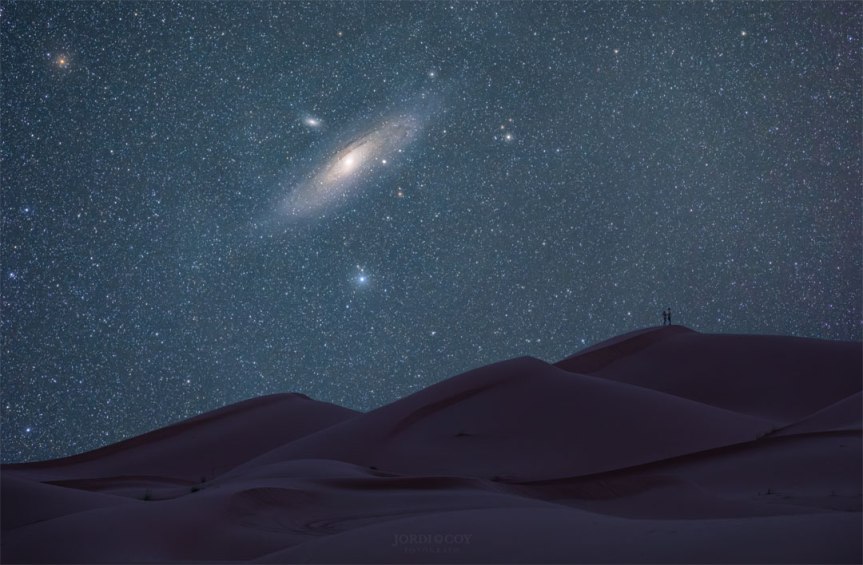
Andromeda over the Sahara Desert

Credit & Copyright: Jordi Coy

Explanation: What is the oldest thing you can see? At 2.5 million light years distant, the answer for the unaided eye is the Andromeda galaxy, because its photons are 2.5 million years old when they reach you. Most other apparent denizens of the night sky — stars, clusters, and nebulae — appear as they were only a few hundred to a few thousand years ago, as they lie well within our own Milky Way Galaxy. Given its distance, light from Andromeda is likely also the farthest object that you can see. Also known as M31, the Andromeda Galaxy dominates the center of the featured zoomed image, taken from the Sahara Desert in Morocco last month. The featured image is a combination of three background and one foreground exposure — all taken with the same camera and from the same location and on the same calendar day — with the foreground image taken during the evening blue hourM110, a satellite galaxy of Andromenda is visible just above and to the left of M31’s core. As cool as it may be to see this neighboring galaxy to our Milky Way with your own eyes, long duration camera exposures can pick up many faint and breathtaking details. Recent data indicates that our Milky Way Galaxy will collide and combine with the similarly-sized Andromeda galaxy in a few billion years.

July 10 Astronomy Picture of the Day

Discover the cosmos! Each day a different image or photograph of our fascinating universe is featured, along with a brief explanation written by a professional astronomer.

2022 July 10

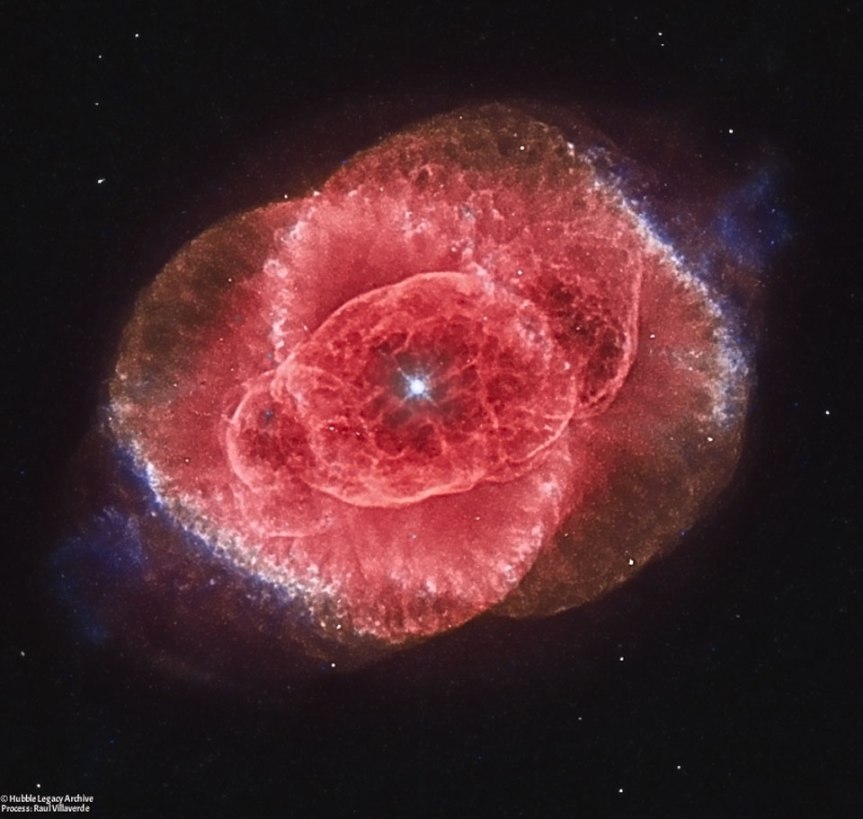
In the Center of the Cat’s Eye Nebula

Credit: NASAESAHubbleHLAReprocessing & Copyright: Raul Villaverde

Explanation: Three thousand light-years away, a dying star throws off shells of glowing gas. This image from the Hubble Space Telescope reveals the Cat’s Eye Nebula (NGC 6543), to be one of the most complex planetary nebulae known. Spanning half a light-year, the features seen in the Cat’s Eye are so complex that astronomers suspect the bright central object may actually be a binary star system. The term planetary nebula, used to describe this general class of objects, is misleading. Although these objects may appear round and planet-like in small telescopes, high resolution images with large telescopes reveal them to be stars surrounded by cocoons of gas blown off in the late stages of stellar evolutionGazing into this Cat’s Eye, astronomers may well be seeing more than detailed structure, they may be seeing the fate of our Sun, destined to enter its own planetary nebula phase of evolution … in about 5 billion years.

July 9 Astronomy Picture of the Day

Discover the cosmos! Each day a different image or photograph of our fascinating universe is featured, along with a brief explanation written by a professional astronomer.

2022 July 9

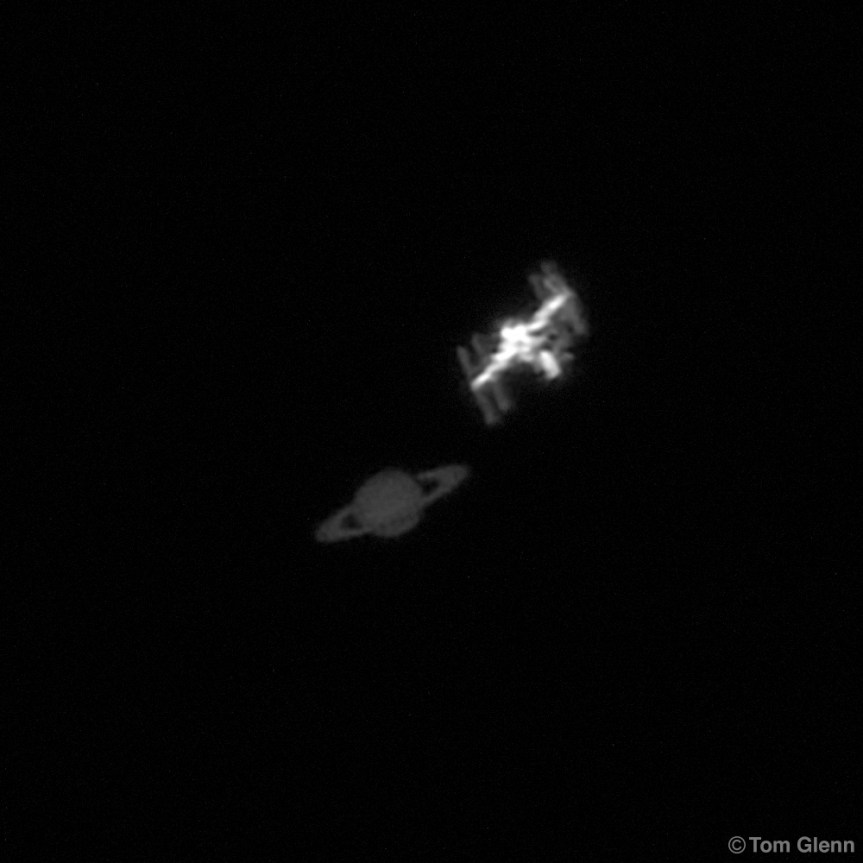
Saturn and the ISS

Image Credit & CopyrightTom Glenn

Explanation: Soaring high in skies around planet Earth, bright planet Saturn was a star of June’s morning planet parade. But very briefly on June 24 it posed with a bright object in low Earth orbit, the International Space Station. On that date from a school parking lot in Temecula, California the ringed-planet and International Space Station were both caught in this single high-speed video frame. Though Saturn was shining at +0.5 stellar magnitude the space station was an even brighter -3 on the magnitude scale. That difference in brightness is faithfully represented in the video capture frame. In the challenging image, the orbiting ISS was at a range of 602 kilometers. Saturn was about 1.4 billion kilometers from the school parking lot.

Good Day/Evening

I hope this finds you all in good health, happy, relaxed, and having a magickal day.

I am back on my cellphone again not sure whether I can do today’s regular posts in part or whole. I can still hardly sit up enough to even use my laptop.

I am finally breaking down and going to our local emergency room mainly to find out if I broke a vertebrae or if the injury is just muscle problems. Metaphysical healers have worked on me all of last week but that didn’t help much.

The pain started when I fell about 2 feet off a step ladder a week ago landing on my left hip and lower back. Usually I would feel better by now but since I am not my doctor wants me to get checked out.

A Thought for Today

Until we meet again dear sisters, brothers, and honored guests may your life be filled with all things positive!

A Laugh for Today

July 8 Astronomy Picture of the Day

Discover the cosmos! Each day a different image or photograph of our fascinating universe is featured, along with a brief explanation written by a professional astronomer.

2022 July 8

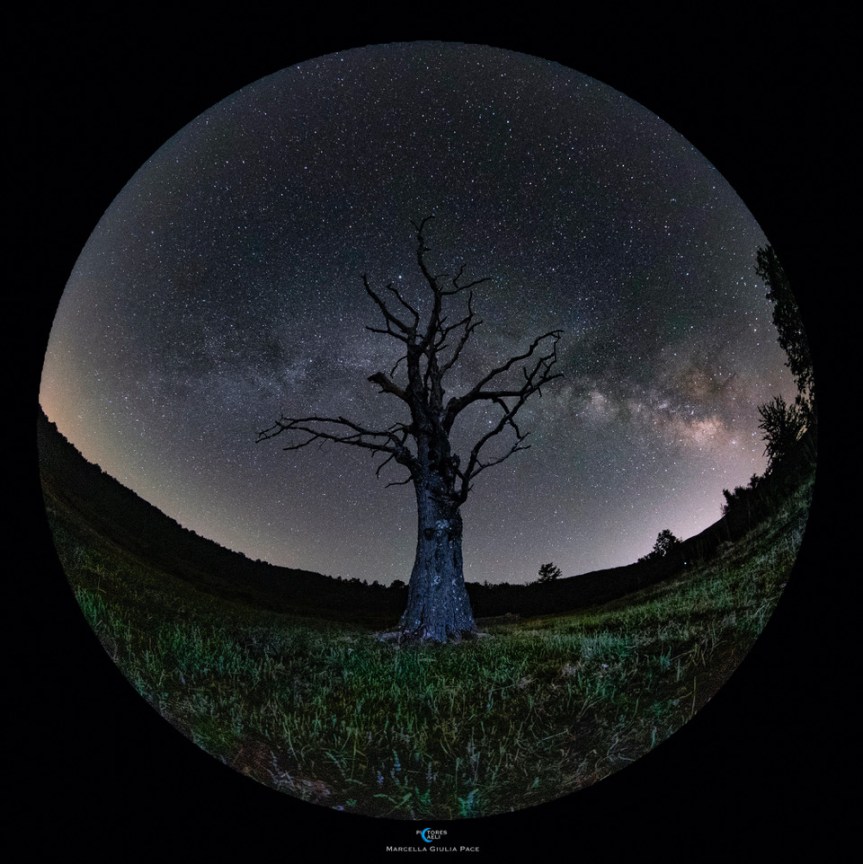
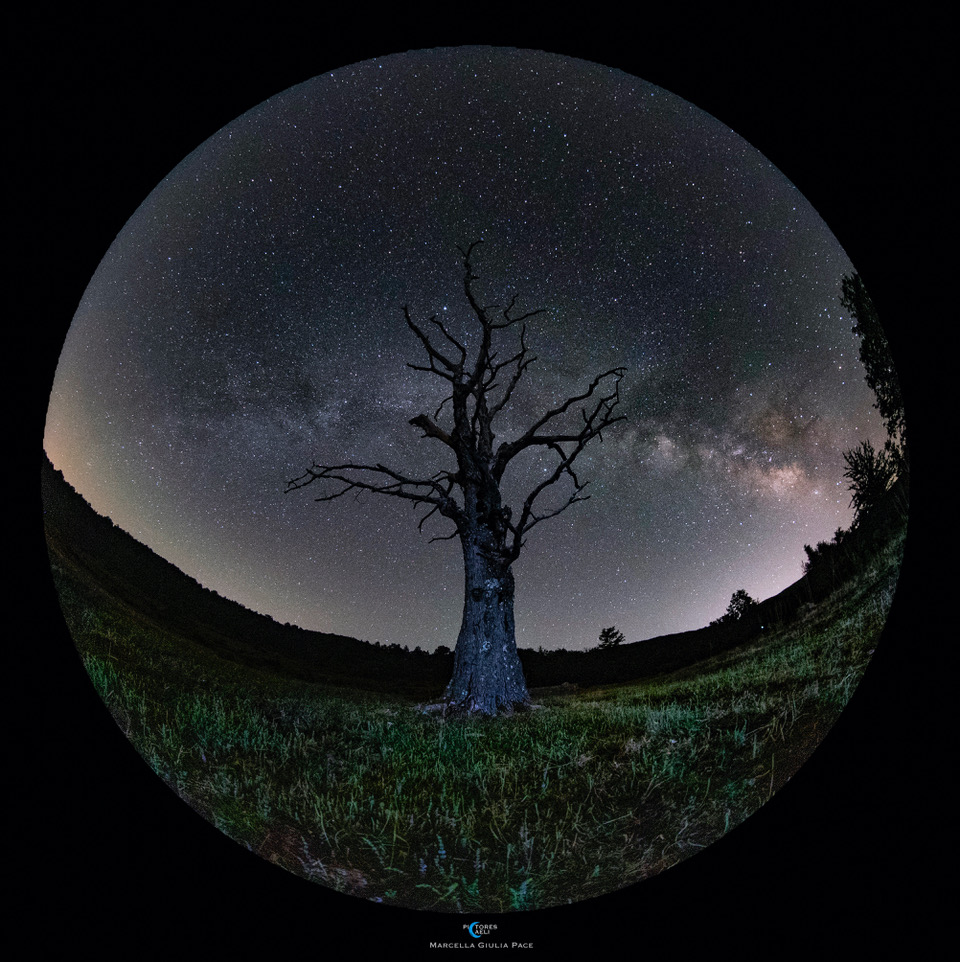
Roots on a Rotating Planet

Image Credit & CopyrightMarcella Giulia Pace

Explanation: With roots on a rotating planet, an old tree is centered in this sequence of 137 exposures each 20 seconds long, recorded one night from northern Sicily. Digital camera and fisheye lens were fixed to a tripod to capture the dramatic timelapse, so the stars trailed through the region’s dark sky. Of course that makes it easy to spot the planet’s north celestial pole. The extension of Earth’s axis of rotation into space is toward the upper left, at the center of the concentric star trail arcs. The Milky Way is there too. The plane of our galaxy stretches across the wide field of view from north to east (left to right) creating a broader luminous band of diffuse starlight.

Some of the Witchcraft/Magickal Correspondence Digest for Friday

From AncientPathway.com

Magickal Intentions:
Love, Romance, Marriage, Sexual Matters, Physical Beauty, Friendship and Partnerships, Strangers, Heart
Incense:
Strawberry
Sandalwood
Rose
Saffron
Vanilla
Planet:
Venus
Sign:
Libra
Taurus
Angel:
Colors:
Green
Pink
Aqua
Herbs/Plants:
Pink Rose
Ivy
Birch
Heather
Clematis
Sage
Violet
Water Lilly
Stones:
Rose Quartz
Moonstone
Pink Tourmaline
Peridot
Emerald
Jade

Charming Something to Use for Personal Protection Workshop

I have had more requests than usual on how to make a personal protection talisman. So, I decided to do a witchy workshop on the topic. It will cover why everyone should always carry personal protection talisman along with a discussion about the topic. We will also make a personal protection talisman during the workshop. The workshop should last about 90 minutes depending on the Q & A part. The circle to make your personal protection talisman will take no longer than 30 minutes. 

Email High Priestess Lady Beltane at ladybeltane@aol.com to reserve your place for this workshop. Workshop will be held on Saturday, July 9 at 11:00 AM CDT. Workshop limited to 10 people. The donation for this workshop will be $20.00 USD.

You can use this link to find out what YOUR local time will be.

WHAT YOU WILL NEED:

An object you will wear or carry with you daily

Bowl of water large enough to dip your object in

A red candle to run the object through the flame

Small amount of table salt or dirt to lightly sprinkle on the object

RITUAL:

Lady Beltane will cast a sacred circle and call the quarters

First, we will cleanse the object with the objects that represent the elements

Second, we will charm the object

Lastly Lady Beltane will open the circle and dismiss the quarters

July 7 Astronomy Picture of the Day

Discover the cosmos! Each day a different image or photograph of our fascinating universe is featured, along with a brief explanation written by a professional astronomer.

2022 July 7

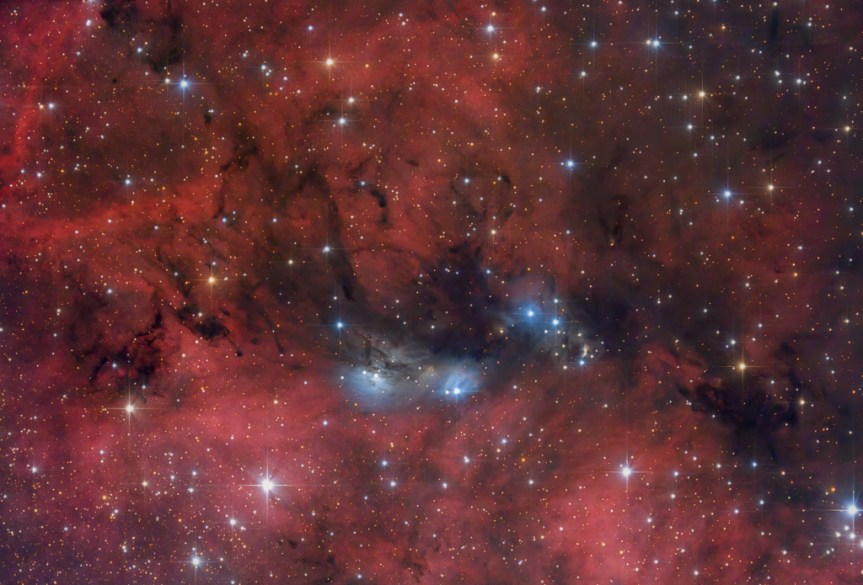
The NGC 6914 Complex

Image Credit & CopyrightGiorgio Ferrari

Explanation: A study in contrasts, this colorful skyscape features stars, dust, and glowing gas in the vicinity of NGC 6914. The interstellar complex of nebulae lies some 6,000 light-years away, toward the high-flying northern constellation Cygnus and the plane of our Milky Way Galaxy. Obscuring interstellar dust clouds appear in silhouette while reddish hydrogen emission nebulae, along with the dusty blue reflection nebulae, fill the cosmic canvas. Ultraviolet radiation from the massive, hot, young stars of the extensive Cygnus OB2 association ionize the region’s atomic hydrogen gas, producing the characteristic red glow as protons and electrons recombine. Embedded Cygnus OB2 stars also provide the blue starlight strongly reflected by the dust clouds. The over 1 degree wide telescopic field of view spans about 100 light-years at the estimated distance of NGC 6914.

A Thought for Today

Until we meet again dear sisters, brothers, and honored guests may your life be filled with all things positive!

July 6 Astronomy Picture of the Day

Discover the cosmos! Each day a different image or photograph of our fascinating universe is featured, along with a brief explanation written by a professional astronomer.

2022 July 6

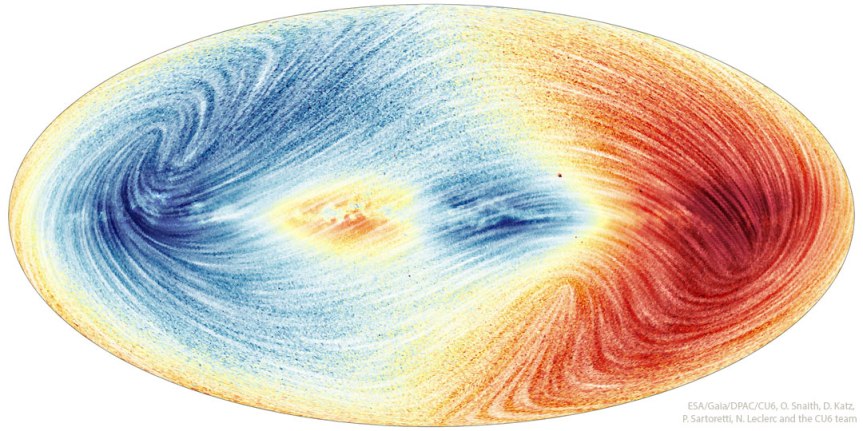
Milky Way Motion in 3D from Gaia

Credit & LicenseESAGaiaDPACText: Ata Sarajedini (Florida Atlantic U.Astronomy Minute podcast)

Explanation: Our sky is alive with the streams of stars. The motions of 26 million Milky Way stars are evident in the featured map constructed from recent data taken by ESA‘s Gaia satellite. Stars colored blue are moving toward us, while red indicates away. Lines depict the motion of the stars across the sky. The large blue on the left and red areas on the map’s right give the overall impression that stars in the Milky Way are rotating around the center. However, there is a region near the middle — caused by our own Sun’s motion relative to a rigidly-rotating central Galactic bar — that seems to reverse it. Understanding details about the motion of stars is helping humanity to better understand the complex history of our Milky Way galaxy and the origin of our Sun.

A Laugh for Today

Wishing you a whimsical Wednesday!