
Category: All Regular Daily Posts
Your Daily Influences for April 1
| Your Daily Influences April 1, 2011 |
||
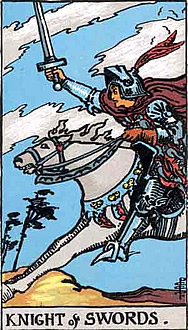 Tarot Influence |

Rune Influence |
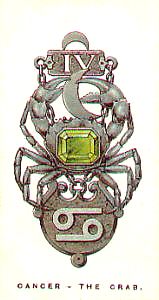 Charm Influence |
| Knight of Swords Youth and bravado. Sometimes a dominating personality, but honest and courageous. Misfortune may be coming or passing. |
||
| Ansuz Ansuz represents mankind’s spiritual connection to God and the universe. It is often referred to as the “God Rune.” This Rune embodies reason, truth and justice. It denotes the coming of knowledge and true counsel from a higher authority. |
||
| Cancer the Crab This aspect of your life will be strongly influenced by a person who is emotional, loving, intuitive, imaginative, shrewd, cautious, protective and sympathetic. This could be an elder you look up too. |
||
| Your Daily Influences represent events and challenges the current day will present for you. They may represent opportunities you should be ready to seize. Or they may forewarn you of problems you may be able to avoid or lessen. Generally it is best to use them as tips to help you manage your day and nothing more. | ||
Your Charm for 4/1
| Your Charm for Today | |||
 The Axe Head |
|||
| Today’s Meaning: As an axe comes to a complete stop when it hits the tree so you have grown motionless. You now must draw back, step away from this quadrant of your life and begin again. Set a new path into motion.General Description: This Chinese incised jade Axe head was suspended round the neck, and worn as an amulet to protect the wearer from illness, accidents, and injuries, also as a charm against witchcraft. The Chinese had great faith in the supposed medicinal powers of jade, which was recommended and prescribed by their physicians. The Axe head was always considered to be an emblem of strength and pwer among primitive races; even today small axe heads are still regarded as effective talismans against disease in many countries, and great faith is placed in their supposed supernatural powers of healing. |
|||
Your Animal Spirit for 4/1
Your Animal Spirit for Today
|
||

EagleEagle soars high enough to see the grand panorama of life, and yet has vision keen enough to spot a fish a mile away. How’s your vision? Are you seeing the big picture or are you only concentrating on the fish? Eagle is asking you to take a step back so you can once again see the whole. You’ve gotten so lost in the trees you’ve forgotten the forest. |
||
Today’s Chakra Energy Levels for 4/1
| Today’s Chakra Energy Levels
|
|||||||||||||||||||||||||||||||||||
The Chakras represent the seven primary energy hubs in the body. Life force energy is constantly flowing in and out of these centers. Just as the cosmos is constantly changing, so too are the levels of energy absorbed and radiated by our Chakra centers. The graph below is a representation of the quantities of Chakra energies available today.
Legend: |

The Planets Now for 4/1
 |
|||||||||||||||||||||||||||||||||||||||||||||||||||||||||||||||||||||||||
|
|||||||||||||||||||||||||||||||||||||||||||||||||||||||||||||||||||||||||


 Conjunction: Mars Uranus 1º
 Opposition: Jupiter Saturn 1º
 Semi-Sextile: Mars Neptune 0º
 Sextile: Venus Pluto 0º
 Square: Sun Pluto 4º
Your Deck of Ancient Symbols Card for 4/1
| Your Deck of Ancient Symbols Card for Today |
||

Creation The Creation card suggest that your creative powers are at or near their peak and that the raw material from which you can craft new and lasting creations is all around you. The question is can you free your mind from your everyday routines to take advantage of this powerful moment in your life? As Eric Fromm said, “Creativity requires the courage to let go of certainties.” The full force of Creation can only be realized by those who are prepared to sacrifice the comfort concomitant with sticking to the tried and true. As a daily card, Creation indicates your are currently bursting with creativity. Where others see chaos and waste, you see the stuff from which great things arise. If you have the courage to look beyond the comfort of your day to day life, you have the command to soar creatively at this time. |
||
Your Crowley Thoth Tarot Card for 4/1
Your Crowley Thoth Tarot Card for Today |
||
| The Star
The Star represents a strong connection to the Cosmos, an open gateway to understanding “the big picture.” It is an optimistic card that promises peace, harmony, and hope realized. For the full power of the forces behind The Star to be realized one must have faith and accept that in cosmic terms all things balance out; that disturbances are sometimes necessary to ensure overall harmony. The reward for such faith is vision on a Cosmic scale, and sense of well-being that may well radiate to those around you through your warm, untroubled heart. |
||

Your Rune For 4/1 is Eihwaz


Your Rune For Today
Eihwaz
Eihwaz represents the Yew tree and its everlasting nature. The Yew may bend, but it does not break. You are on the right course and have the strength and ability to meet your goals. Congratulations!
Feng Shui Tip for 4/1
Feng Shui Tip of the Day
Friday, April 1, 2011
Studying for a test? Put a symbol or picture of a fox in the near left corner of your work or study area.
Psychic Tip of the Day for 4/1
Psychic Tip
of the Day
Friday, April 1, 2011
FENCE MENDING
This is a good day to attempt mending the fence with an old lover. He or she will like to hear of a new idea you have about you two. Can you think one up?
Today’s I Ching Hexagram for 4/1
Today’s I Ching Hexagram for Everyone:
52: Keeping Still
Friday, April 1st, 2011

General Meaning: Regular periods of keeping still are an important aspect of personal development and forward motion. The most restful person may not be the one who sleeps twelve hours a day, but the one able to grab catnaps while cruising 600 miles-per-hour at 35,000 ft. Learning to act when it is time to act, and to keep still when it is time to keep still, is the key to obtaining the peace of mind which helps you stay focused when clear focus is needed.
Consider the spine, which serves as a switchboard for all the nerves of the body that mediate movement. When the spine is kept flexible and healthy through proper rest and relaxation, active movement can always be undertaken without strain. When the spine is held erect in a balanced sitting posture, the inner balancing of meditation can take place.
Treat your innate spark of energetic vitality like a candle in the wind you are protecting, as your only light in a dark forest on a moonless night. Avoid external conditions that threaten to snuff out the flame, and be careful not to suffocate it with your own ambitions of worries.
Time out. Relax now, take your shoes off and sit a spell. Let go of thinking. Breathe and meditate on the breathing.
Your Daily Number for 4/1: 5
Your Daily Number: 5
Exercise discipline today; social events may lead you to overindulge. There’s a possible change in your working or home office environment, and you may find yourself going on a last minute trip.
Fast Facts
About the Number 5
 Theme: Resourceful, Adventure, Speculation, Travel
 Astro Association: Taurus
 Tarot Association: Hierophant
Today’s Tarot Card for 4/1
Today’s Tarot Card for Everyone:
The Fool

This Tarot Deck: 8-Bit Tarot
General Meaning: Pamela Coleman-Smith’s artful rendition of an “innocent Fool” archetype (Rider-Waite deck) is often used to represent Tarot in general. Early classical versions of the Fool card, however, portray quite a different character — a person driven by base needs and urges, who has fallen into a state of poverty and deprivation.
In some instances, he is made out to be a carnival entertainer or a huckster. In others, he is portrayed as decrepit and vulnerable — as the cumulative result of his delusions and failures. Not until the 20th century do you see the popular Rider-Waite image of the Fool arise — that of an innocent Soul before its Fall into Matter, as yet untainted by contact with society and all its ills.
Modern decks usually borrow from the Rider-Waite imagery. Most Fool cards copy the bucolic mountainside scene, the butterfly, the potential misplaced step that will send the Fool tumbling into the unknown. Don’t forget, however, that the earlier versions of this card represented already-fallen humanity, over-identified with the material plane of existence, and beginning a pilgrimage towards self-knowledge, and eventually, wisdom. The Fool reminds us to recognize the path of personal development within ourselves — and the stage upon that path where we find ourselves — in order to energize our movement toward deeper self-realization.
Daily Horoscopes for 4/1
General Daily Horoscope
We may feel as if an old cycle is coming to an end on this last day of impetuous Mars’ visit to dreamy Pisces. The psychic Pisces Moon adds uncertainty as the mists of illusion prevent us from seeing what’s next. It’s best to finish what we can, although retrograde Mercury can make completion seem elusive. No matter what happens now, we need to be ready for an action-packed weekend since both Mars and the Moon fire into impulsive Aries tomorrow.

Aries Horoscope (Mar 21 – Apr 19)
You’re ready to explore a spontaneous feeling today, but responsibilities at work may prevent you from starting anything new. However, your intense schedule won’t necessarily put a halt to your talking about your current desires. Sharing a fantasy with someone special can be a perfect diversion now. Just remember that it’s not the same thing as actually doing it. Don’t rush into anything yet; the action could come as early as tomorrow when feisty Mars enters your sign.

Taurus Horoscope (Apr 20 – May 20)
You may not seem very enthusiastic today, especially if you’re afraid that your positive attitude will heighten other people’s expectations. At first you might present an easygoing appearance, but you won’t be able to hide your more serious demeanor for long. Your concerns about the future are understandable, but try not to unconsciously rain on someone else’s parade. Good news is likely already on the way.

Gemini Horoscope (May 21 – Jun 20)
You may need to get heavy-handed and play a parental role today, even if you don’t have any children. Handling business matters will likely take precedence over more personal activities and you could be distracted from following through on a promise to someone at home. Although you are fully aware of your recent commitments, you might not be able to come through with the goods. Don’t be too hard on yourself; set priorities and just do the best you can.

Cancer Horoscope (June 21 – Jul 22)
Today you can see glimpses of the future and realize that you may have made more commitments than you can possibly keep. Although you probably didn’t mean to mislead anyone, everything seems to be taking longer than you anticipated. Your best strategy now is to cut back on your activities voluntarily. Don’t wait for circumstances to force you to make changes while under duress. A stitch in time will save nine.

Leo Horoscope (Jul 23 – Aug 22)
You may be under pressure to make changes to your schedule today. Fortunately, the immediate solution may be as straightforward as postponing an appointment or two, but the longer-lasting issues could be more complex. Problems will resurface in a few weeks if you don’t take care of them now. Although a quick fix is surely tempting, handling the cause rather than the symptom should resolve the situation for good.

Virgo Horoscope (Aug 23 – Sep 22)
You may be extra hard on someone who isn’t living up to his or her end of a bargain. You don’t want to be the heavyweight, but if others flake out you might have to be the one to give them a reality check. Thankfully, this is something you can do with some authority because you know exactly what must be done. However, an overbearing approach won’t be the best way to make your point. Instead of issuing harsh criticism from your head, be kind and speak from your heart.

Libra Horoscope (Sep 23 – Oct 22)
You are caught in the middle of a relationship struggle and want to do the right thing. You truly want to be supportive of others today, yet you’re afraid that you might encourage behavior that’s counterproductive. It’s not easy to get to the bottom of your current ethical dilemma now; any response seems to deepen the problem. Fortunately, the urgency for immediate resolution may not be as real as it seems. You can discuss the issue with others without having to resolve it today.

Scorpio Horoscope (Oct 23 – Nov 21)
You don’t necessarily agree with your co-workers today, but might not know how much to say. Your perceptions could be more acute than theirs, yet it may not be wise to try to set them straight. Unfortunately, your high level of integrity might prevent you from simply going along with the group. Don’t give up; let your associates know where you stand and then move on. However, you won’t be able to change anyone’s mind in an instant. They will alter their opinions when they are ready, and not one moment sooner.

Sagittarius Horoscope (Nov 22 – Dec 21)
At first, controlling others appears to get you what you want today, but this strategy could backfire without any advance notice. Your friends and associates might not be so willing to go along with your plan and there may not be much you can do about it. Instead of worrying about what anyone else does now, act consistently with your goals. Taking responsibility for yourself and doing exactly as you promised will bring more progress than trying to rein in someone else’s erratic behavior.

Capricorn Horoscope (Dec 22 – Jan 19)
You may be struggling with the gulf between your sensible plan and how executing it falls short of what’s actually needed. The gap between the real and the ideal can provoke self-doubt as you begin to acknowledge that more hard work isn’t the answer. It isn’t productive to waste time with endless analysis or worry. A smarter tactic is to simply do the best you can without being attached to the outcome. You may be happily surprised with the results.

Aquarius Horoscope (Jan 20 – Feb 18)
Someone who is usually your ally may seem to be unsupportive of your efforts today. Your initial reaction might be to withdraw so you can protect yourself against this apparent defection. Unfortunately, retreat isn’t your best course of action now; you can improve your game if you’re open to hearing critical feedback. Listen to what’s being said and integrate the new information into what you are already doing.

Pisces Horoscope (Feb 19 – Mar 20)
Although you believe that you’re on the right course, you’re actually bumping into walls today. The Moon’s visit to your sign makes it easier to convince yourself that all is copacetic, but your rationalizations may not be well founded. Slow down rather than pushing harder against the resistance. Deliberation and gentle pressure work better now than bravado and grandiose gestures.
Weekend Lunar Love Horoscope for April 1 – 3

by Jeff Jawer
Sensitivity Reigns SupremeApril 1 – 3 |
There’s little room for reality this weekend, which is great for dreamers and romantics who want to escape the routine of ordinary life to embark on a quest for love. Friday finds the mood-setting Moon in imaginative Pisces where it’s easy to project our fantasies onto others and overlook their less than sterling qualities. This is fine for a fling or some innocent fun as long as we’re not concerned about long-term consequences.
Mars, the planet of impulse and passion, fires into its home sign Aries on Friday night, followed there by the Moon on Saturday. This alignment increases the tendency to act now and think later. Taking risks brings plenty of excitement but can also upset a current relationship. The need for something (or someone) new doesn’t provide comfort and stability but is bound to make life interesting.
The restless Aries Moon spurs impatience that can readily produce conflicts. Generally, this fast-moving sign makes it easy to express strong emotions and then move on. However, the Moon’s tense 90-degree square with intense Pluto can keep feelings simmering with resentment or hungry with desire. Sunday’s New Moon in Aries signals a fresh start and a re-evaluation of our relationship goals.
New Moon Report for 4/1 – Mars in Aries

Mars in Aries
Friday, April 1, 9:51 pm PDT, Saturday, April 2, 12:51 am EDT
Mars racing into its fiery home sign is another boost in this season of starting over. It joins the Sun, Jupiter and Uranus in Aries, making a quartet of race horses that can run over obstacles and people without looking back. Normally, this transit increases physical energy and spurs enterprising efforts. However, Mercury’s retrograde period in Aries is a reminder that even the fastest runners, brightest thinkers and bravest warriors benefit from a moment’s reflection every now and then.
// <![CDATA[
document.write('’);
// ]]>
the daily humorscopes for 4/1
the daily humorscope
Friday, April 01, 2011
Aries (March 21 – April 19)
A hexapod robot will run away from its laboratory today, change its name to “Bob”, and take up residence with you. Eventually, you’ll become best friends.
Taurus (April 20 – May 20)
You will hear a mysterious “whapping” sound as you are passing by a church today. Curiosity will get the better of you, and you will peek inside. To your relief you will discover it’s only the nuns, playing a quick game of dodge-ball.
Gemini (May 21 – June 20)
A hive of naked mole rats will move in with you today. You will find that they are relatively tidy creatures, but that it’s a trifle difficult to explain their presence to your friends.
Cancer (June 21 – July 22)
You’ll find more, and very “interesting”, uses for cocktail umbrellas today.
Leo (July 23 – August 22)
You will find a biography of some famous dead person, at a garage sale, and buy it on a whim. It will change your life. You will also soon take up bricklaying, as a hobby.
Virgo (August 23 – September 22)
A friend will ask you to give her a ride to Main street. You’ll forget where you’re going, though, and drive her to Distraction.
Libra (September 23 – October 22)
Ian McHarg once said, “Man is a blind, witless, anthropocentric clod who inflicts lesions upon the earth.” You will come up with a brilliant rebuttal to this, soon. You will say: “So?”
Scorpio (October 23 – November 21)
You will get a notion to become a street food-vendor, and will make yourself a food serving cart for the “Bulghur Baron”. You will sell pint containers of hot bulghur wheat, cooked with sauteed onions, garlic, and other vegetables. To everyone’s amazement, you’ll succeed fabulously, eventually making millions off the franchise rights alone.
Sagittarius (November 22 – December 21)
Good day to put strange labels on your binders and file cabinets, such as “launch codes”, “who’s been naughty”, or “Snerge”. This will be quite effective in distracting visitors, so they will often forget what ever they were preparing to bother you about.
Capricorn (December 22 – January 20)
Today you will find yourself boldly charging through life. That can actually get you in trouble, though, so you should really attempt to pay with cash.
Aquarius (January 21 – February 18)
You will finally get the television exposure you’ve been wanting, by organizing a group of protesters to block the entrance to a physics lab, holding crudely-lettered signs saying “Down With Gravity!”.
Pisces (February 19 – March 20)
Good day to get a potted plant for your office, which you should name “Throckmorton”. (The plant, not the office. Obviously, “Throckmorton” is a completely inappropriate name for an office. “Wiggins” is a good name for your office, if it doesn’t already have a name.)
When Your Altar Catches Fire
When Your Altar Catches Fire

Author: Shining Spider
In the woods of California, there are chaparral plants that have evolved to survive incredible fires. A variety has evolved coats that require the heat of fire or the acid of an animal’s digestive tract to break down. There are lessons that humans learn only from experiencing profound loss. With barriers stripped away, we can see the potential – in each one of us – for growth.
Many cultures have a myth of a bird born of fire. In the most cited – the Phoenix story – the bird is born through the death of the old Phoenix in a nest made of cinnamon. The sacrifice of the elder bird to allow the birth of the new provides a perspective many of us need when letting go of old thoughts, patterns, jobs, or relationships.
Jumping through fire has been used in many pagan rites and has a history running through numerous cultures. Animals were driven through fire to rid them of parasites, and in some circles we now leap over flame to rid ourselves of similarly draining psychic elements.
These are not the images or themes that instantly come to mind when your very physical altar catches on fire. Instead, you are panicking and putting out your candles, sighing with relief when your partner runs over with a box of baking soda. When the smoldering is done and everything is cooled, you take everything off of the altar and figure out what must be thrown away, what is salvageable. You have the chance to reflect on what that fire may mean.
Pragmatically, there was too much on my altar. I am sure that I am not the only one who finds, by years end, a rather busy set up. There were the ‘every day’ altar items such as a statue, a plate of seashells, a cauldron, and a few other small items. To this, though, I had added the family menorah. It is lovely and blue and metal, and it conducts heat so well that it melts candles from the bottom up. On the last night of Hanukkah a candle fell onto the altar cloth and the fire spread, charring the altar, some shelving, and deeming the menorah a fire hazard.
The space was too full and on it were items that did not belong to my faith or me. When it came time to inspect the damage, I removed everything from both the top of the altar and the lower shelves. With everything on the floor and nearby table I saw what I had, what was going unused, what was forgotten, and what I missed. How often do we take a mental inventory of what we have collected over the previous year? What is on our altar out of habit – rather than practice – or perhaps more importantly: sincere need?
When we are weighed down with things we are not excited about, we lose that luster and shine. When an altar begins to take on the appearance of the chores needed to maintain it – dusting, cleaning, organizing, etc. – it is something that is a little easier to avoid. I am by no means a neat freak, but I know that if I walk into a clean kitchen, living room, or bedroom I feel calmer and can keep my mind on the task at hand. My altar is no different. When clean and simple I can offer a prayer, an offering, blessing, or state that moment’s need.
Fire has real, destructive power. While some seeds do require their coating to be cooked away, entire forests can be lost from the lethal combination of fire and human neglect. Unchecked, my altar would have burned, my apartment would be gone and those in my building would have lost far more than an altar cloth.
There are goddesses and gods of fire and destruction. Like a forest fire they clear away brush and melt the barriers we keep around our cores. In Vedic Hindu mythology Kali is both a Goddess borne of the sweat from Durga’s brow and the manifestation of the destruction fire creates. She demands sacrifices of blood and animal. She takes wholly and sincerely. You do not casually invoke her or approach her without respect of the force that she carries.
We cannot keep our altars clean out of fear of fire, no more than we can spend our entire life in fear of other forces of destruction. After all, it is fear and inaction that Kali removes. Instead we must be aware, active, and engaged with the world around us. Sometimes devastation will come without reason. It is not a punishment, but a reminder that all moments are doorways and chances to learn. Do we need what was lost? If so can we re-create it, perhaps better than it was before? Or was what we lost something no longer serving our community, our Earth, or ourselves?
We have to keep our eyes open, not just to what is in front of us, but to that which is also to the side and behind us. I realized my altar was on fire from the kitchen, waiting for latkas to cool. I peeked out to see my beautiful beaded altar cloth melting from the heat of too many candles. By luck I did not lose what was most precious – after home, loved ones, and non magickal material goods – to fire. In fact, the top of the altar is now singed, a reminder of what it and I have survived.
Many of the non-Abrahamic faiths hold a deep respect for fire’s literal and metaphorical power. Pagans, Heathens, Wiccans and others invoke it in magickal space and many of us meditate on its nature. Candles, campfires, letters burned, and other sacrifices are common to rituals.
I am not the first witch who has caught her altar on fire and I will not be the last, but the next time we step towards our magickal working space let us reconsider what aspects of fire, ourselves, and our world we are taking for granted, and what we – not fire – can transform. And please, along with having a fire extinguisher and a smoke detector, keep a box of baking soda on hand.
Who is Hecate? Insight into the Goddess of the Witches
Who is Hecate? Insight into the Goddess of the Witches
Author: Helena Domenic
Who is it that we think of when we think of the Goddess Hecate? Is she the Goddesses to whom the three Wyrd sisters in MacBeth cry to? Is she a fearsome creature who aids in cursing as in Medea? From Appolonius Rhodius we get this description:
“…. Hearing from the utmost depths, the dread Goddess approached … all entwined with fearsome serpents and leaves of oak, amidst a shimmering blaze of torchlight, while all around her chthonic hounds bayed shrilly, all the meadows trembled at her footfall and the nymphs of the marshland and river cried aloud.”
A review of all the literature surrounding Hecate yields very conflicting images of Hecate. Early sources from as early as the seventh century BCE present a very different Hecate then the one described by Appolonius Rhodius. In Pre-Classical Greece, she was portrayed as a young woman in a long robe holding burning torches. Later, we find the triple formed statues – three female figures back to back. These statues were found at temple entryways and crossroads – facing three different ways so she could see in all directions.
Evidence from nearly every century can be found that presents a much gentler image of Hecate – a beneficent Deity who guarded gateways, acted as Divine Attendant to Persephone, one who presided over birth and death as well as personal interaction between humans and deities. In the Chaldean Oracles, Hecate is viewed as being synonymous with Soul and considered the Savior of humanity as she acted as intermediary between humanity and the Divine in the crossover point between life and death.
The earliest references to Hecate can be found in Hesiod’s Theogony>/I> where she shares special honors with Zeus and in Homer’s Hymn to Demeter where she hears Persephone’s abduction from her cave and assists Demeter and Persephone both.
Somehow through time, Hecate has received a very unfair bad rap. One thing that can be said for Greek cosmology is that if a Deity presided over a particular area – say birth and death – then they presided over all aspects – positive and negative – of that area. If a Goddess could heal, then it followed that she could also curse. All of the attributes associated with Hecate evolved through time from the Pre-Classical era into the late Classical era, and now she has been adopted once again by modern Neo-Pagans.
One theory of Hecate’s origin places her in Karia – actually in the hinterlands of Asia Minor and the homelands of Hesiod’s family. One theory of Hecate’s preeminence alongside Zeus in the Theogony is that Hesiod created her importance and prominence for personal reasons. (Although from the research I’ve done, I disagree with this) . Hesiod actually only mentions Hecate once – perhaps there may have been no special attachment to Her, and he only placed her in the Theogony to acknowledge his own origins.
The Theogony was not written until the 8th century BCE – knowledge and worship of Hecate was not prevalent until the 6th century BCE. Looking closely at all the evidence – both literary and archeological – presents us with a very complex Goddess of incredible depth.
As I’ve noted, there is a great deal of debate over Hecate’s true nature, from her nation of origin to her genealogy. In Hesiod’s Theogony, she is, among other things, the daughter of the Titans Asteria and Perses; she is honored by Zeus above all others; is invoked at every sacrifice; and bears the title of “Kourotrophos” – nurse to all living beings. This version of Hecate does not bear great resemblance to later versions of her – and the absence of better known traits such as torch bearing and guardianship of the crossroads – have led some scholars to believe Hesiod fabricated the whole thing for his own ends (i.e., bringing favor and honor to his hometown Karian Goddess) . Bacchylides has her as daughter of Asteria and Zeus, Euripides says she is a daughter of Leto, and Thessalian legend has it she is the daughter of Admetus and a mortal woman.
In the Chaldean oracles, Hecate has many interesting attributes that are only now being fully explored by Classical Scholars. According to Sarah Iles Johnston, “She ensouled the Cosmos and the individual men within it, forming the connective boundary between man and god as could lead eventually to the individual soul’s release. She was celestial and potentially beneficent, rather than chthonic and threatening.”
What makes Hecate so interesting are these changing attributions – whether in reference to her origins or her magickal aspects – she changed as different regions and groups adopted her worship. No Greek clan or tribe ever claimed descent from Hecate, which makes good the case she originated outside of Greece.
As mentioned before, it is likely Hecate came from Karia in southwest Asia Minor, and she was incorporated into Greek mythology around the 6th century BCE. Hecate has also been connected with the Egyptian frog goddess Heqit. In pre-dynastic Egypt, the matriarch and wise woman of the tribe was called the “Heq” which echoes the attribution of Hecate to childbirth later on. An Asian name which may have been confused with Hecate is Hekabe – the wife of King Priam of Troy.
Aristophanes and Euripides have both connected her with Hecate. Perhaps more likely is a connection to a Goddess named Hepat. Hepat was a major Goddess of the Hurrians, a Bronze Age people of eastern Asia Minor who would have had contact with the Karians.
Hecate’s name also has several possible meanings. Among them ‘She who works her will’ is most commonly accepted, but also the ‘far off one’ or ‘far darting one’ are also suggested. She has had a variety of titles attached to her name which seem to extend its meaning:
Antaia: to whom one makes supplication.
Propylaia: Guardian of Gateways – Aischylos writes of ‘Lady Hecate, the one before the doors.’ Aristophanes refers to “just as a Hekataion is everywhere before doors.”
In this form, the boundary serves three purposes: 1) to establish a boundary and to protect inside from outside; 2) helping travelers setting out or returning; and 3) to watch over the actual transition that the entrance entails.
Apotropaios: Averter of Evil
Kleidouchos: Key holder (Is she the Key Master? Oops, sorry for the tacky Ghost Busters reference) .
Kourotrophos: Nurse, possibly referring to a nurse of child rearing, not necessarily involved in childbirth. Many Goddesses who bore this title were specifically associated with a city. Hecate is the oldest known Kourotrophos, which is where the association ‘Nurse of all living things’ comes in. There is also a possible connection with this title to marriage, as Hecate presided over transitions, and marriage most definitely is a transition.
Goddess of Roads: protector of travelers at crossroads where her statues were erected.
Goddess of Transitions: Hecate helps people cross difficult boundaries of all sorts, where the significance or risk lies in the crossing.
In the Theogony, she is the intermediary link between the mortal and immortal world during sacrifices. Hecate is present at Persephone’s abduction and leads her back from the Underworld. She is also associated with young women who fail to make the transition to womanhood.
Hecate Propolos: Guide and companion. In the Hymn to Demeter, Hecate becomes Persephone’s Guide. She appears in this role on a number of artworks and vases, usually bearing torches. She may also have served an initiatory role in coming of age rituals for women.
Hecate Phosphoros: Light Bringer, Torch Bearer.
Hecate as Moon Goddess: She was sometimes paired with Helios, a Sun God, and her torches show the way at night.
Hecate Soteira: Hecate as Savior of both the Cosmos and the individual souls within it. This will be examined in more detail a little later.
Another derivation of Hecate’s name, “Most Shining One” can be seen in depictions of her as a young beautiful Goddess who carries torches and wears a head dress of stars. She has been associated with both Helios and Apollo – and Apollo sometimes bears the epithet Apollo Hekatos.
Although the Olympians adopted Hecate after defeating the Titans, she never lived among them. They dwelt in Olympus. She, on the other hand, was considered a chthonic deity – that is, of the earth. In the Theogony, Zeus gives her dominion over Heaven, Earth, and Sea, and with Zeus, she had the ability to grant or withhold gifts to humanity. Interestingly, in the Demeter/Persephone myth cycle, Hecate is always the Maiden, Persephone the Wife or Mother, and Demeter the Crone. This is just one example of Hecate’s function as a Triple Goddess. There is evidence that point to her being honored in the Rites of Eleusis – possibly in her aspect as Guide or Nurse.
Hecate’s best-known role in Greek myth is in Homer’s Hymn to Demeter. After Persephone is abducted by Hades, Hecate reveals the truth to Demeter, and together they try to rescue Persephone. Home says of Hecate, “Hecate, with the bright headband, who heard from her cave.” Once Persephone’s fate is determined, it is Hecate who acts as her guide between the worlds. This is very much a different image from the one that later developed.
In the fifth century BCE, we begin to see a new, frightening side to Hecate. She is associated with restless, violent spirits, with sacrifices of dogs and offerings of food left at the Crossroads at the Full Moon. Now she is Hecate Chthonia. Chthonic means “of the Earth” as opposed to the Olympian Gods who lived on Mount Olympus. In this aspect, we see the use of low altars on which offerings are made into the earth as opposed to the air; also the sacrifice of whole animals. Chthonic deities would have been associated with fertility, childbirth, crops, fate and death.
Another later aspect is Hecate Enodia, Hecate at the Crossroads. How did Hecate begin to be associated with the darker aspects? It is possible that there so many images of young, maidenly Goddesses that some artists felt compelled to depict her in a different way – hence the three Hecates back to back, which we see in the Hekataion statues. It was also not unusual for Greek Gods and Goddesses to have many inconsistent qualities.
The stories of Medea may have propagated a negative image of Hecate. In Euripides’ version of the tale, Medea was a priestess of Hecate – she had helped Jason get the Golden Fleece and was subsequently dumped for someone younger. She kills their children in revenge. A misogynistic concept around witches and women was built up around these stories, and around Hecate.
Another story associated with Hecate is that of Iphigenia – a young woman sacrificed by her step-father, Agamemnon at the outset of the Trojan War. Young women who died before their time were associated with Hecate, and Iphigenia is said to have been transformed into Hecate by Artemis. Hecate governs the souls of these young women who die before their time.
An epitaph from the Roman era reads, “I lie here, the Goddess Hekate, as you see. Formerly I was mortal; now I am immortal and ageless. Julia, daughter of Nikias, a great hearted man.” Perhaps because of her association with dead young women, Hecate became associated with the restless, angry dead.
As an aside, Greek mythology can be confusing in that deities can be both Chthonic and Olympian. Hecate is actually both, as are Hermes, Demeter, Zeus, and Gaia. She hears Persephone’s abduction from her cave, after all.
In later Classical times, Hecate became associated with a practice known as curse tablets. These were lead tablets inscribed with curses, which were to be taken by the dead souls to deities such as Hecate and Hermes. Most of these tablets are associated with Hermes, but Hecate is also called upon by some of them. Interestingly, her name never appears alone on these tablets – it is always in association with Hermes.
The rise of thought involving Hecate as a Savior figure came during a time when philosophy and religion were finding more common ground than previously, and Neo-Platonists became involved in discussions of theurgy, philosophy and magic. In her identification of the Platonic Cosmic Soul, some scholars have interpreted Her presence in the Chaldean Oracles as an omnipotent Goddess.
Hecate as Cosmic Soul comprised what the Platonic philosophers called the “Sensible World” – the world of the Gods and the Cosmos – and the “Intelligible World” – the world of humanity, and as such was able to cross both boundaries at will. It was thought that the Cosmic Soul generated the physical Cosmos. (Although stated explicitly in any literature I have come across, this aspect of Hecate does suggest a Creatrix of some sort at the very least) . This ability of Hecate to cross easily between the world of the Gods and the world of humanity does connect well to her earlier association with crossroads.
Platonic thought placed the Moon at the crossroads of life and death – that is, when humans died, they were thought to enter the Moon as an intermediary place before going on to their ultimate destination – either re-birth or joining with the godhead. Chaldean thought placed Hecate as being on or in the Moon as part of that intermediary process – she was called the Mistress of the Moon. Again, in this particular connection between Hecate and the Moon, we see her association as mediary between humanity and divinity. Plato saw the Moon as Hecate’s “lot” – that is – the place in the Universe most suited to her. The Moon’s role in Platonic thought was to receive and nurture and then send forth souls.
Hecate was also connected to the race known as “Daemones” – not demons as we know them today, but a golden race somewhere between the Divine and humanity that watched over humans. Traditionally, daemons were understood to be the souls of humans who had not had proper burials, and as such, wandered between the worlds – an attribute they shared with Hecate. These souls were assigned the task of watching over the recently dead and guiding them to their proper resting places. These souls, along with Hecate, could either aid the ascent, or force the descent of the recently departed.
Another interesting component to Hecate’s worship during this time was the use of the “Hecate top, ” or iynx wheel. This instrument was used in magic to aid the working at hand. A Hecate top was actually more like a bullroarer, and the sound it made while being operated was considered crucial to the success of the operation.
Iynges might also be found hanging from the ceiling around a king’s throne to symbolize man’s separation and subordination to the gods, as well as the division of the universe into human and divine portions. The revolutions of the iynges represent the turnings of Hecate herself – the whirling and sounds of an iynx serve to symbolize and strengthen the sympathetic magic invoked by the theurgist.
Hecate was involved in three major mysteries: at Eleusis, Samothrace, and Aiginia. By their nature, little has been revealed of what went on in the mysteries, but given the role in the story of Demeter and Persephone, Hecate may have been a guide to Initiates. At Eleusis, thick nails were driven into the ground or altar, piercing through a piece of parchment rolled into a flattened tub, on which was written the name of someone to be cursed – most commonly politicians. Hecate was to be invoked as the parchment was ritually burnt. Hecate had a great deal more associated with her then curses, however. There were a variety of animals that were sacred to her.
The animal most commonly associated with Hecate was the dog. In the later Hellenistic and Roman works, Hecate’s approach is heralded by the barking of dogs. Dogs have a bad reputation in Greek mythology – they were considered polluted and impure, symbols of shameless behavior. There may have been an old belief that souls of the unburied dead could appear as dogs. Dogs were sacrificed to Hecate in purification rituals. A female dog would be sacrificed to aid in childbirth, in the belief that dogs gave birth with ease. The image of these sacrificed dogs may explain the later picture of ghostly dogs accompanying Hecate.
The image of dog as guardian – a much more positive association – echoes Hecate’s role as guardian. Plutarch wrote that dogs as well as Hecate were credited with excellent night vision. Aischylos and Plutarch both wrote about dogs barking to frighten intruders, but how they were loving and loyal to those they protected.
There were also herbs attributed to Hecate. Aconite (also known as Hecateis, Monkshood, or Wolfsbane) was a highly poisonous plant that was sacred to Hecate. According to myth, the plant sprang up where drops of saliva from Cerberos fell to earth when Hercules dragged the dog beast from the Underworld.
Hecate appears as a daughter of Zeus and Hera in later myths. Hecate was sent to the Underworld after incurring the wrath of Hera for stealing a pot of rouge for Europa, one of Zeus’ lovers. Hecate fled to earth and hid in the house of a woman who had just given birth. In late Classical Greece, childbirth was impure, so Cabiri plunged Hecate into the Underworld River Acheron to cleanse her. From then on, Hecate remained in the Underworld. There may be connections between the red rouge in this myth and the red henna used by worshippers to stain their hands and feet.
In the Aeneid, Aeneas travels to the Underworld with the Sibyl of Cumae. It was Hecate who originally took Sibyl there and showed her all the punishments of Tartarus. Hecate gave Sibyl the power to control the Avernus Wood, the passageway to the entrance of the Underworld. To allow passage for Aeneas, Sibyl sacrificed four black bullocks to Hecate, who then allowed Sibyl and Aeneas passage through the entrance and across the Styx.
In the fourth book of the Aeneid, Hecate is invoked by Dido. Aeneas had left her heart broken, so she called upon Hecate to curse the Trojans before she flung herself on her dagger. Her curse was effective; not only did the Trojans wander around for many years, when they finally reached Rome, Aeneas was killed in the fighting.
Athenians were especially respectful towards Hecate and she was often invoked in midnight rituals. Her worshippers gathered at crossroads at the New Moon to share Hecate suppers and then placed leftovers outdoors as offerings. Honey, black female lambs and dogs were sacrificed to her.
The yew, cypress, hazel, black poplar and willow are all sacred to Hecate. The leaves of the black poplar are dark on one side, and light on the other, symbolizing the boundary between the worlds. The yew has long been associated with the Underworld. It is the longest living creature in Europe and naturally resurrects itself – as the central trunk dies, a new tree grows within the rotting core.
As can be seen from ancient writings and modern scholarship, Hecate is a many-faceted Goddess indeed. She is much more than the dark, dreaded “Goddess of the Witches” that we see in some television accounts of Wicca, and indeed, she may be older than the Greco-Roman origins she is usually attributed with.
However modern media may choose to paint Her, She is indeed a true “Goddess of the Witches”, a complex and interesting Goddess with many stories and rituals yet to be told and created.
Footnotes:
SOURCES:
Johnston, S. I. (1990) . Hekate Soteira: A Study of Hekate’s Roles in the Chaldean Oracles and Related Literature. Atlanta: GA: Scholars Press.
Von Rudolf, R. (1999) . Hekate: In Ancient Greek Religion. Victoria, B.C: Horned Owl Publishing.


You must be logged in to post a comment.