Incense & Oils Substitutions Chart (You Might Find Useful)

06717896dc1a6e04ddab0c5131dee095

Incense & Oils Substitutions Chart

This chart is not to be used as a magikal substitutions chart, its main focus is to replace a specific scent with something with a similar smell.


Allspice………………….Clove
Amyris…………………..Sandalwood
Anise Seed…………….Licorice, Fennel
Camphor………………Hyssop
Cassia…………………..Cinnamon
Cinnamon…………….Cassia
Citronella……………..Lemon, Lemongrass, Lemon Thyme, Lemon Balm, Elemi,Palmarosa
Clove……………………Allspice
Cypress………………..Pine, Spruce, Fir, Rosemary
Deerstongue…………Vanilla, Tonka
Easter Lily……………Ylang Ylang
Elemi…………………..Lemon, Lemongrass, Lemon Thyme, Lemon Balm, Citronella, Palmarosa
Fennel………………….Licorice, Anise Seed
Fir……………………….Pine, Spruce, Cypress, Rosemary
Geranium…………….Rose, Rosewood
Hyssop………………..Camphor
Lavandin……………..Lavender
Lavender……………..Lavandin
Lemon Thyme………Lemongrass, Citronella, Lemon Balm, Lemon, Elemi, Palmarosa
Lemon Balm…………Lemon, Lemongrass, Lemon Balm, Lemon, Elemi, Palmarosa
Lemon…………………Lemongrass, Citronella, Lemon Thyme, Lemon Balm, Elemi, Palmarosa
Lemongrass………….Lemon, Citronella, Lemon Thyme, Lemon Balm, Elemi, Palmarosa
Licorice………………..Anise Seed, Fennel
Marigold………………Tagetes
Neroli…………………..Petitgrain, Orange, Tangerine
Orange………………….Petitgrain, Neroli, Tangerine
Palmarosa…………….Lemon, Lemongrass, Lemon Thyme, Lemon Balm, Citronella, Elemi
Petitgrain……………..Neroli, Orange
Pine……………………..Cypress, Fir, Spruce, Rosemary
Rose…………………….Rosewood, Geranium
Rosemary……………..Pine, Cypress, Fir, Spruce
Rosewood……………..Rose, Geranium
Sandalwood…………..Amyris
Spruce………………….Pine, Fir, Cypress, Rosemary
Tagetes…………………Marigold
Tangerine……………..Orange, Petitgrain, Neroli
Thyme…………………Wild Marjoram
Tonka………………….Vanilla, Deerstongue
Vanilla…………………Tonka, Deerstongue
Wild Marjoram…….Thyme

Gemstone of the Day for January 15th is Galena

Gemstone of the Day

Galena  


(Color: lead to silver gray sometimes with a bluish tint)

Galena comes from the Greek word “galene”, lead ore

Hardness: 2.5+                     
Specific Gravity: approximately 7.5+                    
Chemistry: PbS, Lead Sulfide                            
Class: Sulfides                      
Crystallography: isometric                     
Cleavage: perfect in four direction forming cubes        
Fracture: uneven and rarely seen because of the perfect cleavage         
Streak: lead gray           
Luster: metallic to dull

Healing: Galena is called a Stone of Harmony. Excellent for use in grounding. Galena reduces inflammation and increases circulation of the body. Used to increase the assimilation of selenium and zinc. 

Do not use as an elixir.

Workings: Astrological sign is Capricorn. Vibrates to the master number 22 Use during meditation.

Chakra Applications: used to align the chakras

Foot Notes: Galena is the most important ore and the principal source of lead. It is found throughout the world. In the United States it is found inMissouri, Idaho, Iowa, Wisconsin, and Utah as well as in Australia, Canada, England, France, and Mexico. Galena specimens tarnish when exposed to air becoming dull in luster. Galena from certain regions is rich in silver.
Source:
Author: Crick
Website: The Whispering Woods

Herb of the Day for January 15th is Hemlock *Deadly Poisonous*

Herb of the Day

Hemlock


Socrates drank the juice of poisonous hemlock in order to commit suicide.                                                                   

Medicinal Uses: The whole plant has been used as a traditional folk cancer remedy, narcotic, sedative, analgesic, spasmolytic, anti-aphrodisiac. Hemlock has been used as an antidote for strychnine poisoning. The antidotes for Hemlock are emetics of zinc, castor oil, mustard, tannic acid and stimulants such as coffee.

Poison hemlock is a deadly poison. Ingestion can be lethal. Contact can cause dermatitis; juice is highly toxic. The young poison hemlock plant closely resembles Osha root.

Magickal uses: Once used to induce astral projections and to destroy sexual drives. Rub the juice (be sure to protect your hands) onto magickal knives and swords to empower and purify them before use. Hemlock is ruled by Saturn and associated with the Goddess Hecate.

Properties: astringent, diaphoretic, diuretic. Contains the poison alkaloid, coniine, conhydrine and methyl-coniine.

Growth: A species of evergreen plant; the volatile oil extracted from dried, unripe fruit of Conium maculatum, poison hemlock or a poison made from the hemlock. A European plant with compound umbels of small, white flowers and finely divided leaves. A branched perennial, 2-6 feet tall. Stems are hollow, grooved; purple-spotted. Leaves are carrot-like, but in overall outline more like an equilateral triangle, and with more divisions; leaves ill-scented when bruised. Leafstalks are hairless. Flowers are white, in umbels; May to August. Similar in appearance to caraway, valerian, Queen Anne’s lace, wild carrot, etc. Care should be taken in identifying the hemlock plant; Poison Hemlock is found in waste ground in most of the United States. A good way to distinguish the plant is by the fetid mouse-like smell it emits and by the dark purplish spots that pepper the stem.
Source:
Author: Crick

Deity of the Day for January 15th is Feronia

Deity of the Day

Feronia

In ancient Roman religion, Feronia was a goddess associated with wildlife, fertility, health and abundance. She was especially honored among plebeians and freedmen. Her festival, the Feroniae, was November 13, Ides of November, during the Ludi Plebeii (“Plebeian Games”), in conjunction with Fortuna Primigenia; both were goddesses ofPraeneste.

Origins and functions

Varro places Feronia in his list of Sabine gods who had altars in Rome. Inscriptions to Feronia are found mostly in central Italy. She was among the deities that Sabinemoneyers placed on their coins to honor their heritage. She may have been introduced into Roman religious practice when Manius Curius Dentatus conquered Sabinum in the early 3rd century BC.

Many versions of Feronia’s cult have been supposed, and it is not quite clear that she was only one goddess or had only one function in ancient times. Some Latins believed Feronia to be a harvest goddess, and honoured her with the harvest firstfruits in order to secure a good harvest the following year.

Feronia also served as a goddess of travellers, fire, and waters.

In Vergil’s Aeneid, troops from Feronia’s grove fight on the side of Turnus against Aeneas. The Arcadian king Evander recalls how in his youth he killed a son of Feronia, Erulus, who like Geryon had a triple body and a triple soul; Evander thus had to kill him thrice. Erulus, whom Vergil identifies as king at Praeneste, is otherwise unknown in literature.

Georges Dumézil considers Feronia to be a goddess of wilderness, of untamed nature and her vital forces, but honoured because she offers man the opportunity to put those forces to good use in acquiring nurture, health and fertility. She fecundates and heals, therefore despite her being worshipped only in the wild she receive the firstfruits of the harvest, because she permits men to domesticate the wild forces of vegetation, favouring the transformation of that which is uncouth into that which is cultivated.

Thence her shrines were all located in the wild, far from human settlements. Two stories about her sanctuary of Terracina highlight the character of Feronia as goddess of the wilderness. Servius writes that when a fire destroyed her wood and the locals were about moving the statues to another location, the burnt wood turned green all of a sudden. Pliny states that all attempts at building towers in times of war between Terracina and the sanctuary of Feronia have been abandoned because all are without exception destroyed by lightningbolts. The goddess thus refused any continuity and linkage with the nearby town.

Her lucus at Capena was a place where everybody was allowed to come for worship and trade, attracting people from different nations, Sabines, Latins, Etruscans and other even from farther away, providing everybody with a neutral territory in which peace must not be perturbed.

Dumézil compares her to Vedic god Rudra: he is similar to Feronia in that he represents that which has not yet been transformed by civilization, he is the god of the rude, of the jungle, at one time dangerous and uniquely useful, healer thanks to the herbs of his reign, protector of the freed slaves and of the outcast.

Feronia though has only the positive or useful function of putting the forces of wild nature at the service of man. Her name reveals she is one of the Roman and Italic goddesses whose name is formed by a derivate terminating with the suffix -ona, -onia of a noun denoting a difficult or dangerous state or condition: the deity is a sovereign of that danger only to help man to best avoid damage or get the greatest advantage, such as Angerona for the angusti dies near the winter solstice. Her name is to be derived from a Sabine adjective corresponding to Latin fĕrus but with a long vowel, such as the cognate words in every Indoeuropean language (e.g. Greek θήρ, θήριον). Fĕrus means “not cultivated, untamed” (Thesaurus Linguae Latinae), “of the field, wood, untamed, not mitigated by any cultivation (Forcellini Totius Latinatis Lexicon) which fits the environment of the sanctuaries of Feronia and is very close to rudis, rude, root of the name of Vedic god Rudrá as well.

Festus’s entry on the picus Feronius of Trebula Mutuesca testifies the goddess had also prophetic qualities among the Sabines, as did the picus martius of Tiora Matiena ascribed to the Aborigines.

Cult sites

Feronia had a temple at the base of Mt. Soracte which was near Capena. The Lucus Feroniae, or “grove of Feronia” (Fiano Romano) was the site of an annual festival in her honour, which was in the nature of a trade fair. The place, in the territory of Capena in southwestern Etruria, was plundered of its gold and silver by Hannibal’s retreating troops in 211 BCE, when he turned aside from the Via Salaria to visit the sanctuary; later it became an Augustan colonia. Its status as a colony is recorded in a single inscription, copied in a manuscript of the rule of the Farfa Abbey as colonia Iulia Felix Lucoferonensis.

Another important site was near Anxur (Terracina, southern Latium), in a wood three Roman miles from the town, where Servius recorded a joint cult of “the boy Jupiter” (puer Iuppiter) under the name of Anxyrus and “Juno the Virgin” (Iuno virgo), whom he identifies as Feronia. According to another tradition, slaves who had just been freed might go to the shrine at Terracina and receive upon their shaved heads the pileus, a hat that symbolized their liberty.

Her temple in the Campus Martius, in what is now Largo di Torre Argentina, was probably located in a grove as well according to an inscription found on the site. It was established before 217 BCE. It may have been dedicated by Curtius Dentatus following his victory over the Sabines. His building program also included the Anio Vetus, a major new aqueduct, and a number of fountains near the temple. Feronia’s cults at Aquileia and Terracina were near springs that were used in her rites. The Augustan poet Horace speaks of the water (lympha) of Feronia, in which “we bathe our face and hands.”

The Feralia on February 21 is a festival of Jupiter Feretrius, not Feronia.

Freedmen and Libertas

Varro identified Feronia with Libertas, the goddess who personified Liberty. According to Servius, Feronia was a tutelary goddess of freedmen (dea libertorum).A stone at the Terracina shrine was inscribed “let deserving slaves sit down so that they may stand up free.” Livy notes that in 217 BC freedwomen collected money as a gift for Feronia. Some sources state that slaves were set free at her temple near Terracina.


Source:
Wikipedia

A Little Humor for Your Day – Learning your ABC’s for Witches and Pagans

Learning your ABC’s for Witches and Pagans


To learn your letters you must start
With a clever mind and a willing heart
Each one is special, just like you
And you will learn them all by the time we are through!

  • A is Athame, the knife that we use
  • B is for Beltaine, when partners we choose
  • C is for Circle where we all are one.
  • D is for Deosil, path of the Sun.
  • E is for Esbat, when we gather round
  • F is for Fire and its crackling sound
  • G is the Goddess in beauty and love.
  • H is the Horned One, our Father above.
  • I is for Imbolg, candles light the way,
  • J is for June when it’s Midsummer’s Day
  • K is for Karma, the things that we do
  • L is for Lammas, harvest’s almost through!
  • M is for Moon, riding way up so high,
  • N is for Nighttime, which darkens the sky
  • O is for Ostara, when we hunt for eggs,
  • P is for Pan, with hairy goat legs
  • Q is the Quarters and there are just four,
  • R for the Rites when we open the Door
  • S is for Samhain, end of the year,
  • T is for Tarot cards, futures to hear
  • U is Undines from the watery West
  • V is Vervain for protection and rest
  • W’s Widdershins, the path of the moon.
  • X is the sign that’s the sign of the God
  • Y is for Yule and the sun’s return
  • Z is the Zodiac, 12 signs to learn

To learn them all you will have to try
And now it is time to say goodbye
Merry have we met, and Merry have we been
Merry shall we part and Merry meet again!


Author Unknown

Article published on Pagan Library

Astronomy Picture of the Day – Wright Mons in Color

Astronomy Picture of the Day

Discover the cosmos! Each day a different image or photograph of our fascinating universe is featured, along with a brief explanation written by a professional astronomer.

2016 January 15

Wright Mons in Color
Image Credit: NASA, Johns Hopkins Univ./APL, Southwest Research Institute


Explanation: Informally named Wright Mons, a broad mountain about 150 kilometers across and 4 kilometers high with a wide, deep summit depression is featured in this inset image captured during the New Horizons flyby of Pluto in July 2015. Of course, broad mountains with summit craters are found elsewhere in the Solar System, like the large shield volcano Mauna Loa on planet Earth or giant Olympus Mons on Mars. New Horizons scientists note the striking similarity ofPluto’s Wright Mons, and nearby Piccard Mons, to large shield volcanoes suggests the two could be giant cryovolcanoes that once erupted molten ice from the interior of the cold, distant world. In fact, found on a frozen dwarf planet Wright Mons could be the largest volcano in the outer Solar System. Since only one impact crater has been identified on its slopes, Wright Mons may well have been active late in Pluto’s history. This highest resolution color image also reveals red material sparsely scattered around the region.

Earth Sky News for Jan. 15th: How to locate Uranus on sky’s dome

How to locate Uranus on sky’s dome

Tonight and tomorrow night – January 15 and 16, 2016 – Uranus, the seventh planet outward from the sun, is near the waxing moon and floating in front of the constellation Pisces the Fishes. Although Uranus will remain within Pisces’ borders for the rest of this year, the moon will leave Pisces after a few more days.

With the moon waxing to full now, you’re not likely to glimpse Uranus with the unaided eye. But keep reading. We give you an idea of its location, and links to detailed charts, in this post.

Uranus was the first planet to be discovered by the telescope, by William Hershel on March 13, 1781. At a distance of 20 astronomical units from Earth at present, this world is pretty easy to see through binoculars – that is, if you know right where to look.

People with good vision – and good charts, like this one – do see Uranus with the unaided eye on dark, moonless nights.

But, with the moon waxing to full now, unaided eye glimpses of Uranus won’t be likely in the coming nights.

Still, you can imagine the location of Uranus on the sky’s dome. And maybe doing so will help you find Uranus later.

You can also star-hop to Uranus via the 4th-magnitude stars Delta Piscium and Epsilon Piscium, and possibly even view Uranus through binoculars on this moonlit night.

Or try your luck after the moon leaves the evening sky, starting in late January 2016.

Bottom line: As darkness falls on January 15 and 16, 2016, the moon and planet Uranus both reside in front of the constellation Pisces the Fishes.


Author

Bruce McClure

Article published on Earth Sky

Your Daily Influences for January 15

Your Daily Influences
January 15, 2016 


The Star Reversed
The Reversed Star represents pessimism, doubt and obstinacy.


Berkano
Berkano is the Rune of birth and rebirth. This may symbolize a time when you are capable of great personal growth. Love may be in the air as well.


The Frog
The reversed frog represents poor health– physically or emotionally. This aspect shall remain ill fated so long as your physical or emotional state remain low.


Your Daily Influences represent events and challenges the current day will present for you. They may represent opportunities you should be ready to seize. Or they may forewarn you of problems you may be able to avoid or lessen. Generally it is best to use them as tips to help you manage your day and nothing more.

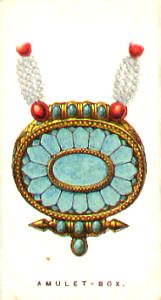
Your Charm for Friday, January 15th is The Amulet Box

Your Charm for Today


Today’s Meaning:
There are papers in your near future. This aspect is affect by legal papers of some kind–a contract, a deed or a liscense of some kind. These papers will bring improvement to your life.

General Description:
The people of Tibet are most superstitious. It is the custom for almost everyone to wear charms. The Amulet-box illustrated contains small inscribed scrolls covered with magical characters. These magical formulae are written and blessed by their Lamas. The scrolls are believed to be all powerful spells for appeasing evil spirits, keeping the wearers from all physical harm, safeguarding them from every kind of danger, and protecting them from the blighting effects of the evil eye. Many of these charm boxes are of gold elaborately chased, and encrusted with turquoise.

Your Three Dragon Reading for Friday, January 15th

Your Three Dragon Reading for Today


The Red Dragon represents success, achievement and fulfillment. The three tiles under the Red Dragon tile will influence the power your Red Dragon currently has in your life


Wan 2
Symbol: Sword

The Sword tile indicates a decision must be made before attainment of your goals can be reached.


Wan 9
Symbol: Heaven

The Heaven tile suggests completion. This tile denotes a time for you to consider moving on to your next goal.


Circles 7
Symbol: Insect

The Insect tile indicates short-term gain through a short flurry of hectic work. It is important to realize that the gains the Insect tile offers are not lasting, or of long-term importance. At best they are a stopgap until more substantial goals come along.