Your Daily Cosmic Calendar for Wednesday, August 8th

Ancient civilizations Gods--Ancient Egypt Gods Weigh Heart after Death

Your Daily Cosmic Calendar for Wednesday, August 8th


If you are looking for solace and a break from the intensity of the past two days of heavenly configurations, be patient. While a Superior Conjunction of the sun and Mercury at 17 degrees of Leo (7:07pm) signifies a great burst of intellectual and intuitive illumination, and the moon in Cancer forms a spiritually uplifting grand triangle by making trines to Jupiter in Scorpio (8:44pm) and Neptune in Pisces (10:43pm), these high-tide and exalted cosmic alliances are potentially checkmated by 9 challenging aspects. The 9 discordant link-ups include contacts between the sun and Neptune (4:11am), Mercury and Chiron (5:00am), the sun and Juno (9:24am), Mercury and Venus (10:01am), Venus and Chiron (1:41pm), Mars and Neptune (3:46pm), Pallas and Neptune (7:56pm), Ceres and Uranus (11:28pm), and Mercury and Juno (11:57pm). It is very rare to have this many anomalous sky cycles happening within a 24-hour time-period. Keep the Faith and refrain from making big decisions and long-term commitments. Meditating for peace of mind is highly recommended throughout the day.

[Note to readers: All times are now calculated for Pacific Daylight Time. Be sure to adjust all times according to your own local time so the alignments noted above will be exact for your location.]


Copyright 2018 Mark Lerner & Great Bear Enterprises, Ltd

Astrology.com


In the Sky This Month for August 8 – August 14

Egyptian God

In the Sky This Month

The Moon rolls past one bright light after another this month, including the brilliant planets Venus, Jupiter, and Mars. At the same time, two of the signature star patterns of summer, Scorpius and Sagittarius, roll low across the south. Scorpius really does look like a scorpion, while the brightest stars of Sagittarius, which represents a centaur holding a bow and arrow, form a wide teapot.

August 8: M11

The star cluster M11 is well up in the south this evening, in the constellation Scutum, the shield. Because its brightest stars resemble a flock of ducks, it’s also called the Wild Duck cluster. Through binoculars, it looks like a patch of mist.

August 9: Ara

The mythical victory of the gods of Olympus over their predecessors, the Titans, is commemorated in the stars, as the altar where they swore allegiance to each other. It’s the constellation Ara, below the tail of the scorpion.

August 10: Solar Eclipse

A partial solar eclipse will take place early tomorrow, as the Moon covers part of the Sun’s disk. It will be visible from the Arctic Ocean through Greenland, Scandinavia, and parts of Asia. The United States misses out on this one, though.

August 11: Perseids

The Perseid meteor shower should be at its best tonight. Under dark skies, you might see a dozen or so of its shooting stars per hour. The Moon isn’t around to interfere with the light show.

August 12: NGC 6397

NGC 6397 is a giant star cluster in Ara, the altar. It’s below the stinger of the scorpion. From the United States, it’s visible only from far-southern latitudes. The cluster took shape when the Milky Way galaxy was just 400 million years old.

August 13: Moon and Venus

Venus, the brilliant “evening star,” stands to the left of the Moon this evening, and even closer below the Moon tomorrow night. The star Spica is to the upper left of Venus and the Moon, with bright Jupiter farther along the same line.

August 14: More Moon and Venus

Venus is farthest from the Sun for its current “evening star” appearance. Because of the angle at which the planet sets, though, it doesn’t look far from the Sun. It’s quite low in the west as night falls. Tonight, it’s below the crescent Moon.

Source

StarDate


Party with the Perseids

Egyptian Beauty

Party with the Perseids


This meteor shower is the most famous, and in 2018 it will again be one of amateur astronomy’s great social events.
Call your friends. It’s time once again for the annual Perseid meteor shower, typically the greatest shower of the year. This event occurs during the Northern Hemisphere summer, so even many people who don’t consider themselves astronomers venture outdoors to watch it.

The Perseids feature a slow (two-week) buildup to maximum (along with an equally slow decline to zero activity), and many bright meteors that leave luminous trails visible for several seconds. The trails form because Perseid meteors are fast — their speeds top 125,000 mph (200,000 km/h). Usually, Perseid meteors appear white or bluish white.

In 2018, the New Moon fortuitously occurs August 11, so our normally brilliant satellite will be absent during the shower’s peak, which falls on the night of August 12 and the morning of the 13th. If you see the Moon at all, it will be a thin crescent low in the western sky that will set an hour or so after the Sun. Perhaps the only negative about this year’s Perseids is that the peak occurs on a Sunday night into Monday morning, so work commitments may limit the number of people who actually view the shower.

For many amateur astronomers, one of the best things about the Perseids comes from getting together with like-minded friends for fun under the stars. Few astronomical viewing sessions promise the drama of a brilliant fireball (a meteor that casts a shadow) or bolide (an exploding meteor), but meteor showers can feature such events. You’ll know real excitement if you experience a bright meteor with a group of people.

Most astronomy clubs host observing sessions either on the night of the shower’s predicted maximum or on a weekend night close to it. If you’re not doing serious meteor counting, all you’ll need to bring is a lawn chair, some snacks, and your eyes.

Telescopes do a great job of magnifying objects, but they severely restrict your field of view, a negative for meteor watching. Binoculars also restrict your view, so don’t observe the shower through them. Instead, if you have binoculars nearby, you can use them to catch a close-up view of a meteor’s smoke trail after spotting it with your naked eye.

All Perseid meteors seem to originate from a point near the Hero’s head, called the radiant. To see the maximum number of meteors, look roughly 45° away from the radiant.
What’s going on?

Meteors are tiny dust-size particles of rock and metal that Earth passes through as it orbits the Sun. Astronomers call these particles meteoroids when they are floating freely in space, but when they burn up in the atmosphere, they become meteors. If they survive the fiery ordeal of passage through our thick blanket of air to land on the ground, they are then known as meteorites. No meteorites come from meteor showers — the particles are too small.

Most meteor showers originate with comets. When a comet swings around the Sun, our star’s heat boils off ice and with it, trapped dusty debris. When the debris trail’s orbit crosses Earth’s orbit, we experience a meteor shower. The exception to the comet rule is the Geminid shower, which occurs in December. That event’s particles originate with dust coming from the asteroid 3200 Phaethon.

A Perseid meteor leaves a colorful trail over Lake Nockamixon in Quakertown, Pennsylvania, on August 13, 2016, at 3:32 a.m. EDT. The imager used a Canon 60Da with a Sigma 18–35mm lens at f/1.8. He took a 7-second exposure at ISO 800.
Astronomers designated the Perseids’ parent comet as 109P/Swift-Tuttle. The number identifies it as the 109th periodic comet whose orbit astronomers have calculated. The common name comes from the discoverers, Lewis Swift of Marathon, New York, and Horace Parnell Tuttle, who worked at Harvard Observatory in Massachusetts. Each discovered the comet in July 1862. It shone at magnitude 7.5 at the time of the discovery and brightened to about magnitude 2 by early September. It sported a tail between 25° and 30° long and was quite impressive. The comet visits our part of the solar system every 133 years. In November 1992, it brightened to 5th magnitude and was visible without optical aid only from the darkest sites. During its next close passage in 2126, it will shine slightly brighter than 1st magnitude.

By the way, astronomers call this particular shower the Perseids because if you trace all the meteor trails backward, they meet within the boundaries of the constellation Perseus the Hero. The point of origin (the direction in space toward which Earth is heading) is called the radiant. A good visual approximation of the radiant is the famous Double Cluster in Perseus (NGC 869 and NGC 884).

2018 forecast

Scientists who study meteor showers predict the Perseids will peak between 4 p.m. EDT August 12 and 4 a.m. EDT August 13. Based on these times, meteor watchers in the United States who can spend the night outdoors should begin observing at the end of astronomical twilight on the 12th and watch the sky until dawn.

August 12 isn’t the only night you can observe Perseids. This year, the shower will be active between about July 17 and August 24. Of course, you’ll see fewer meteors the further you observe from the date of the peak.

While taking a wide-field shot of the Andromeda Galaxy (M31) on August 14, 2015, this imager captured a Perseid in one of his exposures. He used a Canon T2i with a 50mm lens at f/1.4 and stacked five 13-second exposures taken at ISO 1600.
Early in the evening on August 12, set up a lawn chair (preferably one that reclines), face east, and look a third to half of the way up in the sky. Bright meteors that travel near the top of the atmosphere and leave long trails are more common at this time. As the radiant rises (remember, you can use the Double Cluster to approximate it), adjust your gaze to keep watching a point about 45° west of it. Glancing around is OK. In the early morning hours, after the radiant has crossed the meridian — the imaginary line from north to south that divides the eastern half of the sky from the west — and begins to sink lower in the northwest, you might want to change your view and look 45° east of the radiant.
A Perseid streaks between the Pleiades (M45) and the Hyades in Taurus above Pasargadae, a UNESCO World Heritage site near Shiraz, Iran, on August 12, 2015. This 20-second exposure at ISO 3200 was taken with a Canon 5D Mark II and an f/1.4 Samyang 24mm lens set at f/2.8.
If you’re observing in a group, let those around you know when you spot a bright Perseid. Some meteor trails last for several seconds, and glowing trains may remain long after the meteors’ light fades.

How many Perseids will you see? Meteor counters use a quantity called the zenithal hourly rate (ZHR). This is the number of meteors visible per hour for an observer under a dark sky with no scattered light and with the radiant positioned directly overhead. The ZHR for the Perseids is 110. This year, with the Moon out of the sky, you can expect to count between 80 and 90 meteors per hour from a dark site — a terrific rate!

All meteor showers are exciting events, but this summer’s Perseids rank at the top. Be comfortable, have fun, and get ready for some oohs and aahs.


Astronomy Senior Editor Michael E. 

Published on Astronomy Magazine

The sky this week for August 8 to 12

Vintage Beauty of Egypt

The sky this week for August 8 to 12


Planets and meteors abound in the sky this week.

Wednesday, August 8

The middle of this week finds observers caught between the peaks of two nice meteor showers. The Southern Delta Aquariid shower reached maximum July 30 and has started to diminish, while the Perseid shower is ramping up in preparation for its peak the night of August 12/13. The waning crescent Moon sheds little light in the predawn sky, and conditions improve as the week progresses and Luna’s phase wanes. You can tell meteors from the two showers apart by tracing their paths backward. Southern Delta Aquariid meteors appear to radiate from the constellation Aquarius the Water-bearer, while Perseid meteors emanate from Perseus the Hero.

Mercury reaches inferior conjunction, passing between the Sun and Earth, at 10 p.m. EDT. The innermost planet will return to view before dawn in about two weeks.

Thursday, August 9

Mars remains near its glorious peak all this week. The Red Planet reached opposition the night of July 26/27 and made its closest approach to Earth (at a distance of 35.8 million miles [57.6 million kilometers]) on the 31st. Mars appears low in the southeast as darkness falls and grows more prominent as the evening wears on and it climbs higher. By midnight local daylight time, it stands about 25° high in the south against the backdrop of stars in southwestern Capricornus. The world shines at magnitude –2.6, making it the second-brightest point of light in the night sky after Venus. When viewed through a telescope, the planet’s ocher-colored disk spans 23.9″. The global dust storm appears to be waning, and patient observers should be able to spot some subtle surface details.

Friday, August 10

Venus dominates the western sky after sunset. The dazzling object shines at magnitude –4.4 among the background stars of western Virgo. The planet appears 11° high 45 minutes after sundown and sets just before 10 p.m. local daylight time. When viewed through a telescope, Venus appears 23″ across and a hair over half-lit.

The Moon reaches perigee, the closest point in its orbit around Earth, at 2:07 p.m. EDT. It then lies 222,500 miles (358,078 kilometers) away from us.

Saturday, August 11

New Moon occurs at 5:58 a.m. EDT. At its New phase, the Moon crosses the sky with the Sun and so remains hidden in our star’s glare. At least, that’s what it will do for much of the world’s population. But if you happen to live in northern Canada, northern Europe, or parts of Asia, you can watch the Moon pass in front of the Sun and cause a partial solar eclipse. From Beijing, the Moon covers one-third of our star’s diameter just before sunset. Remember that when viewing the Sun during a partial eclipse, you need to protect your eyes with a safe solar filter.

Sunday, August 12

The annual Perseid meteor shower reaches its peak tonight under perfect conditions. The shower not only produces lots of “shooting stars” — up to 110 per hour under optimal circumstances — but it does so with the Moon out of the sky. The best views will come in the predawn hours of Monday morning when the shower’s radiant — the spot on the border between Perseus and Cassiopeia where the meteors appear to emanate — climbs highest. To see the most meteors, observe from a spot far removed from the lights of the city.

Overview of the Planets and the Stars for August 8th

Egyptian Goddess
Overview of the Planets and the Stars for August 8th


The Moon enters Cancer minutes into the day, and we can be mainly focused on our personal lives, loved ones, and the need for security. While a Cancer Moon craves some familiarity, today’s astrology is busy. Mercury, Venus, and Chiron challenge one another, the Sun aligns with Mercury, and both the Sun and Mars form minor challenging aspects to Neptune.

A Mercury-Venus semi-square can point to some difficulties focusing and getting the right message across. We can be hypersensitive, especially with Chiron involved, and we may lack mental discipline now.

This morning, we may have a hard time focusing long enough to sink our teeth into a task. There can be some difficulties with expressing ourselves or enforcing our will directly, and touchiness is possible. Fear of being ineffective can undermine our confidence in doing new things and making definite or clear decisions. We might feel that others seem to be draining our energy, especially if it’s unclear what they want from us. We can be feeling slightly off or out of sorts if we’ve neglected our spiritual needs, and it makes sense to slow down and adjust.

Venus opposes Chiron this afternoon, and we are more aware and possibly resentful of imbalances in our relationships. What emerges now, while messy, can be telling, helping us turn a corner.

Another turning point potential happens with the inferior conjunction tonight. The Sun aligns with retrograde Mercury, giving us a unique window into the past as it might impact our future. This is a good time for processing recent events and ideas, and for beginning to look at problems or issues from a new perspective and with a new understanding. Significant new ideas can be birthed at this time, and these are likely to have real staying power or importance in our lives. What we say or write now has an impact, for better or for worse. However, we should keep in mind that we may not have all the facts necessary to form a conclusion, and might later have to revise plans or decisions made now. We can be moody today, but what emerges from this bit of emotional chaos can be revealing.

The Moon ends its void period at 12:01 AM EDT when it enters Cancer.

Astrology of Today – Wednesday, August 8, 2018

 AN EGYPTIAN MOON TOP 57
Astrology of Today – Wednesday, August 8, 2018

Today’s Moon:

  • The Moon is in Gemini briefly today, and is in Cancer from 12:01 AM forward.
  • The Moon is waning and in its Last Quarter phase until 1:01 AM, after which the Moon is in its Waning Crescent phase.
  • We are in between the Last Quarter Moon (which occurred on the 4th) and the New Moon Solar Eclipse (which will happen on August 11th in the sign of Leo).

Retrogrades/Stations:

  • Mercury is retrograde (Mercury is retrograde from July 26-August 19).
  • Mars is retrograde (Mars is retrograde from June 26th to August 27th)—there are less than three weeks left of the Mars retrograde cycle.
  • Also retrograde: Saturn, Uranus, Neptune, Pluto, and Chiron.
**Times are Eastern Daylight Time (EDT).
Source

Your Daily Sun & Moon Data for Wednesday, August 8

Cleopatra

Your Daily Sun & Moon Data for Wednesday, August 8

The Sun
Sun Direction: ↑ 109.44° ESE
Sun Altitude: 48.55°
Sun Distance: 94.255 million mi
Next Equinox: Sep 22, 2018 8:54 pm (Autumnal)
Sunrise Today: 6:05 am↑ 69° East
Sunset Today: 7:54 pm↑ 291° Northwest
Length of Daylight: 13 hours, 48 minutes


The Moon
Moon Direction: ↑ 182.88° S
Moon Altitude: 73.30°
Moon Distance: 224976 mi
Next New Moon: Aug 11, 20184:57 am
Next Full Moon: Aug 26, 20186:56 am
Next Moonset: Today5:39 pm
Moon Phase: Waning Crescent
Illumination: 11.3%

Source

timeanddate.com

Wishing You & Yours A Very Blessed & Beautiful Wednesday (it ain’t Friday yet, lol!) May The Goddess Bless You & Yours Today & Always!

ankh
Song Of The White Witch Of The Gospel


Shatter my misconceptions, Oh God, the Father,
Creator of all that is moving through me,
Empty me of illusions that comfort,
So, the truth I may surely see.

And, I will transcend my limitations,
Build bridges of light to fill the gaps,
Share the love I have here deep inside me,
Walk across uncharted paths.

Transform the sorrow of unfulfillment,
By illuminating the untouched choice,
Empower the forgotten shadowed memory,
Electrify my silent voice.

And, I will transcend my limitations,
Build bridges of light to fill the gaps,
Share the love I have here deep inside me,
Walk across uncharted paths.

Connect me to Earth’s bounteous Mother,
So, each other, in balance, shall we heal,
Transmute my intent into your wisest crystals,
That this work my soul reveal.

And, I will transcend my limitations,
Build bridges of light to fill the gaps,
Share the love I have here deep inside me,
Walk across uncharted paths.

Remember me when I cross over,
I have lived my life as you, too, have done,
Return me to that precious place,
No longer separated, for we all indeed are one.

For, I have transcended my limitations,
Built bridges of light to fill the gaps,
Shared the love I had here deep inside me,
Walked across uncharted paths.

—-Author Unknown
Published on Pagan Library

As we go today…..

Let me remind you that we are either accepting donations to help pay the remainder of our $1100.00 a/c and electrical bill. We paid half of the bill yesterday and we still owe $545.41. If you would like to help us out, you can do so by two ways.

One……

Donations

donate


Two…..


Stop by Magickal Necessities and pick up a few items.


We have a new selection of 2019 Calendars and Witchy Almanac. They are in a limited supply and at great prices. Get a jump on next year, grab your almanac or calendar now.


TIll tomorrow, my sweets,

Love ya,

Lady A

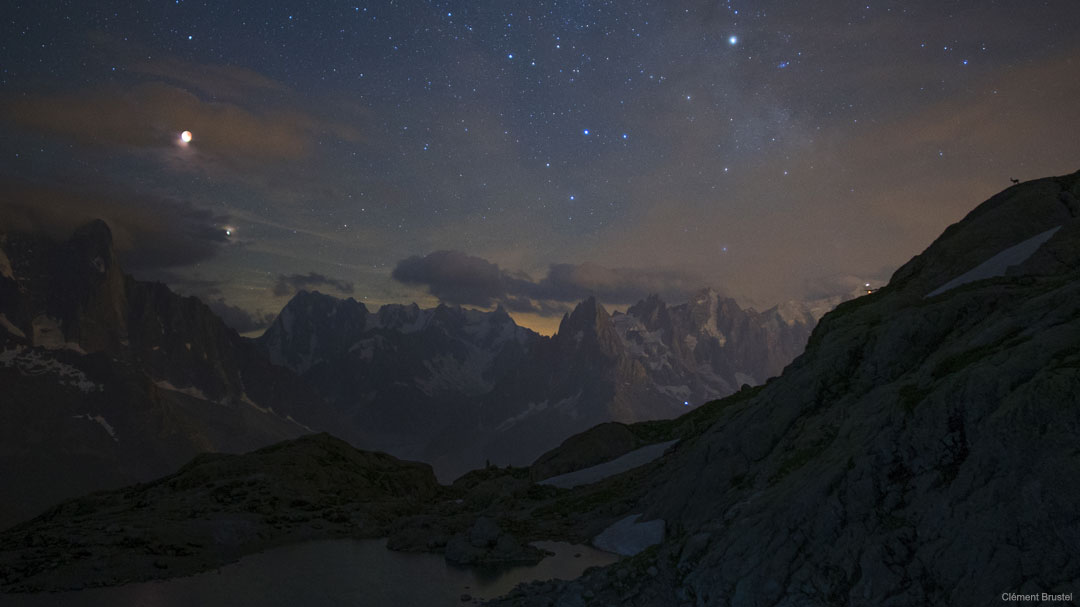
Astronomy Picture of the Day – Eclipsed Moon and Mars over Mountains 

Astronomy Picture of the Day

Discover the cosmos! Each day a different image or photograph of our fascinating universe is featured, along with a brief explanation written by a professional astronomer.

2018 August 7

Eclipsed Moon and Mars over Mountains 
Image Credit & Copyright: Clément Brustel


Explanation: There is something unusual about this astronomically-oriented photograph. It’s not obvious — it was discovered only during post-processing. It is not the Moon, although capturing the Moon rising during a total lunar eclipse is quite an unusually interesting sight. (Other interesting images also captured during last month’s eclipse can be found here.) It is not Mars, found to the lower right of the Moon, although Mars being captured near its brightest also makes for an unusually interesting sight. (Mars is visible nearly the entire night this month; other interesting images of it can be found here.) It is not the foreground mountains, although the French Alps do provide unusually spectacular perspectives on planet Earth. It is the goat.

Your Earth Sky News for August 7: Aug. 8 – 9, Moon in Gemini

August 8 and 9 before sunup: Moon in Gemini

On the mornings of August 8 and 9, 2018, you’ll find the waning crescent moon in front of the constellation Gemini the Twins. Gemini’s two brightest stars, Castor and Pollux, represent twin brothers in Greek mythology, despite the fact that these two stars don’t look alike. If you look closely, you’ll see that Pollux is slightly brighter than Castor. Pollux is also more golden in color.

There are multiple versions of the ancient tale of the Twins. In Greek mythology, both Castor and Pollux were born from the same mortal mother, Leda, with different fathers. Castor, the mortal brother, was sired by Tyndareus, a mortal king of Sparta. Pollux, the immortal brother, was the son of Zeus, the king of the gods, who was said to seduce Leda in the form of a swan.

It’s said that – when the mortal brother Castor was slain in battle – his immortal brother Pollux was inconsolable. He begged his father Zeus to relieve him of the bonds of immortality. Zeus granted his request, and so Pollux joined his brother in death, chosing togetherness with his brother over eternal life. According to the legend, Zeus allowed the brothers to live together in the heavens as the constellation Gemini the Twins.

But, it’s said, the heavenly twins must spend a portion of the year in Hades, the underworld and land of the dead in Greek mythology.

And indeed – from the vantage point of Earth – the sun annually passes in front of the constellation Gemini from about June 21 to July 21 each year. Gemini is lost in the sun’s glare for that month at least, and is not visible in our nighttime sky. Thus it could be said that the heavenly twins dwell in the underworld during that time of year.

Of course, it’s really Earth that’s doing the moving. The Earth’s yearly orbit around the sun causes the sun in our sky to travel full circle in front of the constellations of the zodiac every year.

Still, at this time of year – as we look eastward before sunrise for Gemini’s return – it’s easy to imagine the fond brothers returning from the underworld to serve as a tribute in our sky to the redemptive power of brotherly love.

Bottom line: The moon has now waned to a slim crescent phase. It’s near the stars Castor and Pollux – the legendary Gemini “twins” – on August 8 and 9, 2018.


Published on EarthSky