
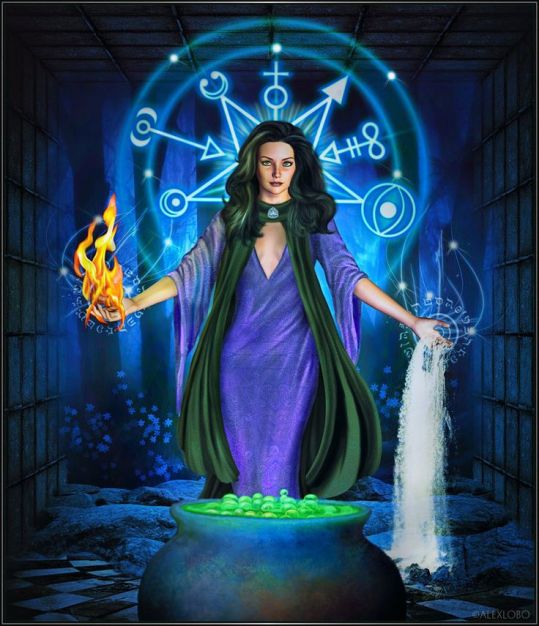
Cerridwen
Keeper of the Cauldron
The Crone of Wisdom
In Welsh legend, Cerridwen represents the crone, which is the darker aspect of the goddess. She has powers of prophecy, and is the keeper of the cauldron of knowledge and inspiration in the Underworld. As typical of Celtic goddesses, she has two children: daughter Crearwy is fair and light, but son Afagddu (also called Morfran) is dark, ugly and malevolent.
The Legend of Gwion
In one part of the Mabinogion, which is the cycle of myths found in Welsh legend, Cerridwen brews up a potion in her magical cauldron to give to her son Afagddu (Morfran).
She puts young Gwion in charge of guarding the cauldron, but three drops of the brew fall upon his finger, blessing him with the knowledge held within. Cerridwen pursues Gwion through a cycle of seasons until, in the form of a hen, she swallows Gwion, disguised as an ear of corn. Nine months later, she gives birth to Taliesen, the greatest of all the Welsh poets.
The Symbols of Cerridwen
The legend of Cerridwen is heavy with instances of transformation: when she is chasing Gwion, the two of them change into any number of animal and plant shapes. Following the birth of Taliesen, Cerridwen contemplates killing the infant but changes her mind; instead she throws him into the sea, where he is rescued by a Celtic prince, Elffin. Because of these stories, change and rebirth and transformation are all under the control of this powerful Celtic goddess.
The Cauldron of Knowledge
Cerridwen’s magical cauldron held a potion that granted knowledge and inspiration — however, it had to be brewed for a year and a day to reach its potency.
Because of her wisdom, Cerridwen is often granted the status of Crone, which in turn equates her with the darker aspect of the Triple Goddess.
As a goddess of the Underworld, Cerridwen is often symbolized by a white sow, which represents both her fecundity and fertility and her strength as a mother.
She is both the Mother and the Crone; many modern Pagans honor Cerridwen for her close association to the full moon.
Cerridwen is also associated with transformation and change in some traditions; in particular, those who embrace a feminist spirituality often honor her. Judith Shaw of Feminism and Religion says, “When Cerridwen calls your name, know that the need for change is upon you; transformation is at hand. It is time to examine what circumstances in your life no longer serve you. Something must die so that something new and better can be born. Forging these fires of transformation will bring true inspiration into your life. As the Dark Goddess Cerridwen pursues her version of justice with ceaseless energy so can you breathe in the power of the Divine Feminine She offers, planting your seeds of change and pursuing their growth with a ceaseless energy of your own.”
Cerridwen and the Arthur Legend
The stories of Cerridwen found within the Mabinogion are actually the basis for the cycle of Arthurian legend. Her son Taliesin became a bard in the court of Elffin, the Celtic prince who rescued him from the sea. Later on, when Elffin is captured by the Welsh king Maelgwn, Taliesen challenges Maelgwn’s bards to a contest of words.
It is Taliesen’s eloquence that ultimately frees Elffin from his chains. Through a mysterious power, he renders Maelgwn’s bards incapable of speech, and frees Elphin from his chains. Taliesen becomes associated with Merlin the magician in the Arthurian cycle.
In the Celtic legend of Bran the Blessed, the cauldron appears as a vessel of wisdom and rebirth. Bran, mighty warrior-god, obtains a magical cauldron from Cerridwen (in disguise as a giantess) who had been expelled from a lake in Ireland, which represents the Otherworld of Celtic lore. The cauldron can resurrect the corpse of dead warriors placed inside it (this scene is believed to be depicted on the Gundestrup Cauldron). Bran gives his sister Branwen and her new husband Math — the King of Ireland — the cauldron as a wedding gift, but when war breaks out Bran sets out to take the valuable gift back.
He is accompanied by a band of a loyal knights with him, but only seven return home.
Bran himself is wounded in the foot by a poisoned spear, another theme that recurs in the Arthur legend — found in the guardian of the Holy Grail, the Fisher King. In fact, in some Welsh stories, Bran marries Anna, the daughter of Joseph of Arimathea. Also like Arthur, only seven of Bran’s men return home. Bran travels after his death to the otherworld, and Arthur makes his way to Avalon. There are theories among some scholars that Cerridwen’s cauldron — the cauldron of knowledge and rebirth — in in fact the Holy Grail for which Arthur spent his life searching.
*****************
Cerridwen
Areas of Influence: Cerridwen’s name is derived from the Celtic word “cerru,” meaning cauldron. Like the Goddess herself, the cauldron symbolises the transformative power of magic, wisdom, rebirth and creative inspiration.
For these reasons she is seen as a patron Goddess of witches and wizards. She is also associated with the moon, fertility, science, prophecy and poetry.
Other spellings of her name include Ceridwen, Cereduin, Keridwen and Kerridwen.
I’m often asked how to pronounce Cerridwen? (Ker-RID-Wen) so I thought it would be useful to include that piece of information on this page.
Origins and Genealogy: Married to Tegid Voeland and was mother to three children: Creirwy, Morfan and Taliesin. There is no mention of her own origins in the surviving myths.
Strengths: Wise, powerful and resourceful.
Weaknesses: She tries to interfere in her children’s lives.
Cerridwen’s Symbolism
The Cauldron and the dark moon are associated with this Goddess.
Sacred Animals: This Goddess often transformed into a white sow to address her people.
In her myths she also shape shifted into a greyhound and an otter
Sacred Birds: Hawks and hens.
Sacred Plants: Corn.
Cerridwen’s Myth
The Goddess uses her knowledge of magic and herbs to create a potion to transform her ugly son Morfan into a wise boy.
The potion needs to be boiled in her cauldron for a year and a day. She leaves her servant Gwion in charge of the mixture until one day when he accidentally spilled three drops on his hand and licked it off, empowering him with the brew’s knowledge and power.
Frightened of the Goddesses reaction he turned himself into a rabbit. Cerridwen gave chase in the form of a greyhound. He then became a fish and jumped into a river and she became an otter. He turned into a bird and she followed as a hawk. Eventually Gwion transformed into a grain of corn and is eaten by the Goddess who had by then become a hen.
The grain took seed in her womb, and nine moons later, she gave birth to the Taliesin. She is unable to kill the child, instead she wraps him up in a leather bag and sets him out to sea. He survives and becomes the famous Welsh poet Taliesin
Cerridwen’s Archetypes
The Crone
The Crone represents the wise old woman whose child bearing days are behind her. Other associations with this Archetype include: compassion, transformation, healing and bawdiness death and endings. She is the respected older woman or grand parent at the heart of family who enjoys life and sharing her experience.
Unfortunately the word Crone or Hag often has negative connotations as many wise woman and midwives were persecuted as witches in the middle ages.
Shadow Crone is the bitter, old woman who has failed to learn from her life. She blames all her failings and unhappiness on a society that no longer respects the elders. As a result she becomes increasingly isolated and fearful.
This Celtic Goddess is often depicted as a Crone Goddess as she is wise and due to her cauldron’s associations with transformation and rebirth.
The Shape-shifter
The shape-shifter has the ability to change her physical appearance. They are also able to adapt easily to different environments by altering there behaviour.
Shadow shape-shifter is fickle, lacking conviction and constantly reinventing themselves like politicians to appeal to most people.
Cerridwen has the power to transform herself into many different creatures. As well as being regarded as a Crone Goddess she is also said to represent the Mother and Maiden aspects of the Triple Goddess.
How To Work With These Archetypes
The Crone: This maybe one of your Archetypes if you have gained wisdom, learning from your mistakes and showing a willingness to adapt to changing circumstances.
You are experiencing the Crone’s shadow if you have become rigid in your beliefs and have become stuck in a rut having lost all ability to let those areas of your life go that no longer serve you.
The shape-shifter is a useful archetype to have if you need to be flexible or perform lots of different roles.
The shadow side asks whether your chameleon like tendencies reflect a deep insecurity and inability to commit to any particular path.
**********
Reference
 Witches Of The Craft®
You must be logged in to post a comment.