NASA Image of the Day for Feb. 6th

 Remnant of a Supernova

Remnant of a Supernova

Vital clues about the devastating ends to the lives of massive stars can be found by studying the aftermath of their explosions. In its more than twelve years of science operations, NASA’s Chandra X-ray Observatory has studied many of these supernova remnants sprinkled across the galaxy.

The latest example of this important investigation is Chandra’s new image of the supernova remnant known as G350.1-0.3. This stellar debris field is located some 14,700 light years from the Earth toward the center of the Milky Way.

Evidence from Chandra and from ESA’s XMM-Newton telescope suggest that a compact object within G350.1+0.3 may be the dense core of the star that exploded. The position of this likely neutron star, seen by the arrow pointing to “neutron star” in the inset image, is well away from the center of the X-ray emission. If the supernova explosion occurred near the center of the X-ray emission then the neutron star must have received a powerful kick in the supernova explosion.

Data suggest this supernova remnant, as it appears in the image, is 600 and 1,200 years old. If the estimated location of the explosion is correct, this means the neutron star has been moving at a speed of at least 3 million miles per hour since the explosion.

Another intriguing aspect of G350.1-0.3 is its unusual shape. Many supernova remnants are nearly circular, but G350.1-0.3 is strikingly asymmetrical as seen in the Chandra data in this image (gold). Infrared data from NASA’s Spitzer Space Telescope (light blue) also trace the morphology found by Chandra. Astronomers think that this bizarre shape is due to stellar debris field expanding into a nearby cloud of cold molecular gas.

The age of 600-1,200 years puts the explosion that created G350.1-0.3 in the same time frame as other famous supernovas that formed the Crab and SN 1006 supernova remnants. However, it is unlikely that anyone on Earth would have seen the explosion because of the obscuring gas and dust that lies along our line of sight to the remnant.

These results appeared in the April 10, 2011 issue of The Astrophysical Journal.

Image Credits: X-ray: NASA/CXC/SAO/I. Lovchinsky et al; IR: NASA/JPL-Caltech

HERBS OF THE MOON

HERBS OF THE MOON
The energies of the Moon effect the activities of the subconscious,
the intuition, dream work and the emotions. The plants attributed to
the Moon act principally on the major fluids of the body and on the
stomach (attributed to Cancer, ruled by the Moon). Their fluidic
action is primarily regulatory and eliminative. Much of the
digestive activity seems also to influence the individual’s moods –
the emotional effect of stomach action being well known so this dual
action of several of the herbs makes a great deal of sense.

Several herbs bear marked resemblances to the Moon in her various
phases, both in color and shape of plant, fruit and flower. The
white fruits of fennel grow in pairs of curved oblong shapes that
seem to represent the waxing and waning lunar crescents. The lily,
long an associate of Lunar Goddesses, has round, bell-shaped flowers
that are frequently bright white and it bears oblong to crescent
shaped leaves. The fruit of the almond generally is also pure white
and oblong to crescent shaped.

Those herbs that deal with fluidity generally act upon water and
blood most specifically even as the Moon herself controls the tides
and the flow of blood. Cucumber helps eliminate excess water from
the body and is an anti-constipatory diuretic, particularly
effective in dissolving uric acid accumulations such as kidney
stones. Fennel and lily are eliminatives, laxatives and diuretics
and while the lily acts as a digestive antispasmodic, fennel is
commonly used to stimulate the flow of milk in nursing mothers.
Mugwort (Artemisia vulgaris) is particularly apt in its lunar
attribution in that in addition to its digestive and purgative
qualities, a decoction can be used quite effectively to regulate the
flow of menstrual blood.

Several Lunar herbs act on other fluids of the body (generally to
eliminate excess) as well as acting as digestives. Camphor, by
reducing fluid accumulation in the lungs and pleural sac, is an
excellent remedy for whooping cough and pleurisy. Bitter almond is
used as a cough remedy while sweet almond is used internally as a
soothing syrup and externally as an emollient. Meanwhile, white
sandalwood is used to reduce inflammation of mucosal tissue as well
as being a diuretic – a decoction of the wood can also be used for
indigestion.

Myrrh and Sandalwood share both astringent and stomachic properties,
but along with jasmin and bitter almond, they share qualities
ascribed to the Moon that surpass the simply medicinal. Bitter
almond and jasmin both have sedative effects, calming the nerves and
allowing a more intuitive, psychic lunar mode of brain function to
manifest. It is probably also this aspect that has earned jasmin its
reputation as an erotogen, the resultant intuitive empathy credited
with aphrodisical properties and the ability to overcome inhibition.
Almond, jasmin, sandalwood and myrrh seem when used in incense to
also possess the ability to trigger olfactorily the subtle, lunar
mode of perception that is so effective in work of intuition,
psychism and pathworking.

Magickally speaking, herbs of the Moon affect the subconscious mind.
They are a very good aid in the development of the intuition and of
psychic abilities as well as in remembering dreams. As they have
such a primary effect on the subconscious, they can be used to
successfully influence it to break old habits and to recall past
lives. Traditional Lunar herbs include anise,cabbage, camphor, cucumber,
iris, jasmine ,lettuce, lily, poppy, violet, willow,lotus, moonwort, mugwort , pumpkin and white
sandalwood.

author..unknown

Earth Correspondences

Earth Correspondences

 
Earth is considered feminine and receptive.
 
Season: Spring
 
Magickal virtue: To Keep Silent
 
Direction: North
 
Time of day: Midnight
 
Sense: Touch

Fluid: Sweat
 
Power animals: Bears, bulls, lions, rabbits
 
Places of power: Caves, fields, bridges, meadows, gardens, moutains, crossroads, the home

Commonly associated colors: Brown, green rust tones
 
Linking items: Stones, rocks, crystals, dirt, seeds, wood, pentacles, coins

NASA Photo of the Day for Jan. 5

 Festival of Lights

Festival of Lights


WISE, NASA’s Wide-field Infrared Survey Explorer, has a new view of Barnard 3, or IRAS Ring G159.6-18.5, that is awash in bright green and red dust clouds. Interstellar clouds like these are stellar nurseries, where baby stars are being born.
The green ring is made of tiny particles of warm dust whose composition is very similar to smog found here on Earth. The red cloud in the center is most likely made of dust that is more metallic and cooler than the surrounding regions. HD 278942, the bright star in the middle of the red cloud, is so luminous that it is the likely cause of the surrounding ring’s glow. The bright greenish-yellow region left of center is similar to the ring, though more dense. The bluish-white stars scattered throughout are stars located both in front of, and behind, the nebula.

Regions similar to this nebula are found near the band of the Milky Way galaxy in the night sky. This nebulas is slightly off this band, near the boundary between the constellations of Perseus and Taurus, but at a relatively close distance of only about 1,000 light-years, the cloud is a still part of our Milky Way.

The colors used in this image represent specific wavelengths of infrared light. Blue and cyan (blue-green) represent light emitted at wavelengths of 3.4 and 4.6 microns, which is predominantly from stars. Green and red represent light from 12 and 22 microns, respectively, which is mostly emitted by dust.

Image Credit: NASA/JPL-Caltech/UCLA

Astronomy Picture of the Day for Jan. 5

Astronomy Picture of the Day

Discover the cosmos!Each day a different image or photograph of our fascinating universe is featured, along with a brief explanation written by a professional astronomer.

2012 January 5
See Explanation.  Clicking on the picture will download the highest resolution version available.

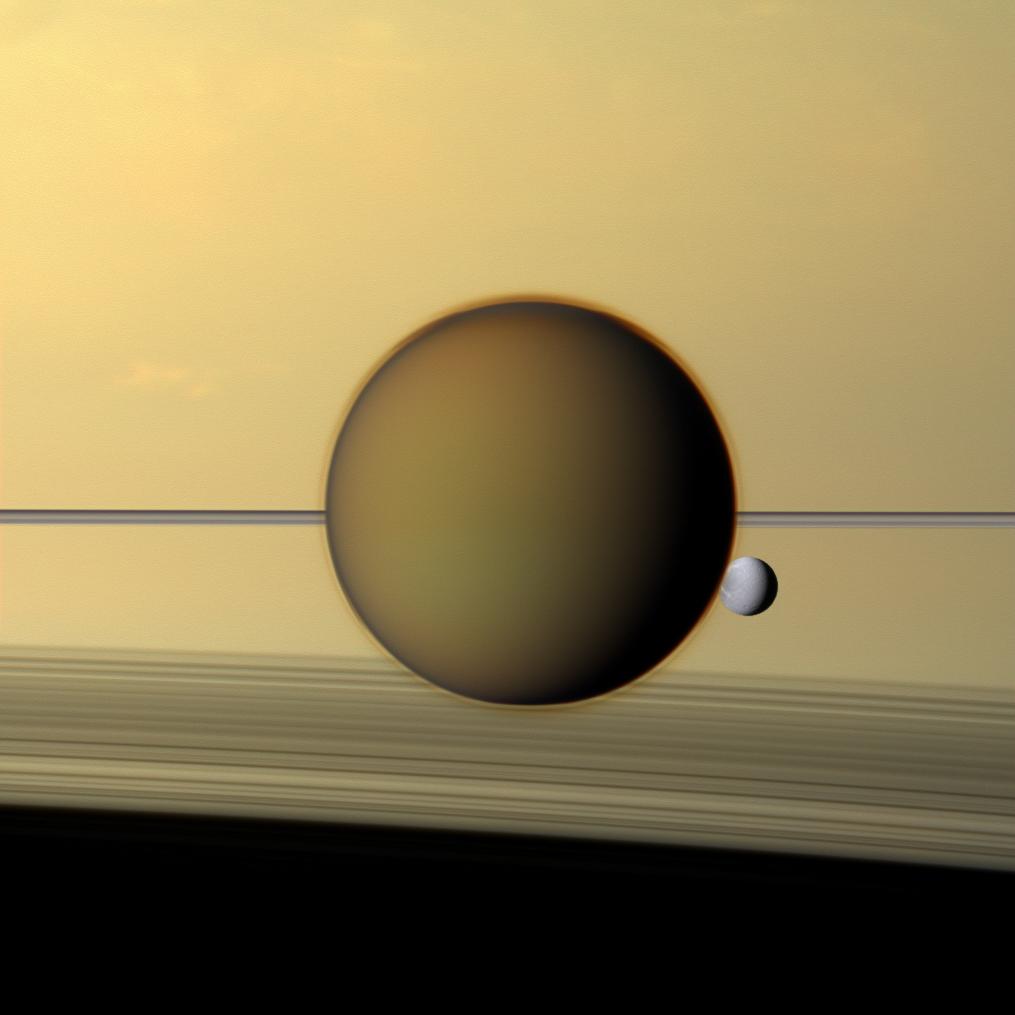
Ringside with Titan and Dione
Credit : Cassini Imaging Team, SSI, JPL, ESA, NASA  


Explanation: Orbiting in the plane of Saturn’s rings, Saturnian moons have a perpetual ringside view of the gorgeous gas giant planet. Of course, while passing near the ring plane the Cassini spacecraft also shares their stunning perspective. The rings themselves can be seen slicing across the middle of this Cassini snapshot from May of last year. The scene features Titan, largest, and Dione, third largest moon of Saturn. Remarkably thin, the bright rings still cast arcing shadows across the planet’s cloud tops at the bottom of the frame. Pale Dione is about 1,100 kilometers across and orbits over 300,000 kilometers from the visible outer edge of the A ring. Dione is seen through Titan’s atmospheric haze. At 5,150 kilometers across, Titan is about 2.3 million kilometers from Cassini, while Dione is 3.2 million kilometers away.

Astronomy Picture of the Day for January 3rd

Astronomy Picture of the Day

Discover the cosmos!Each day a different image or photograph of our fascinating universe is featured, along with a brief explanation written by a professional astronomer.

2012 January 3
See Explanation.  Clicking on the picture will download the highest resolution version available.

A Full Sky Aurora Over Norway
Image Credit & Copyright: Sebastian Voltmer 

Explanation: Higher than the highest building, higher than the highest mountain, higher than the highest airplane, lies the realm of the aurora. Auroras rarely reach below 60 kilometers, and can range up to 1000 kilometers. Aurora light results from energetic electrons and protons striking molecules in the Earth’s atmosphere. Frequently, when viewed from space, a complete aurora will appear as a circle around one of the Earth’s magnetic poles. The above wide angle image, horizontally compressed, captured an unexpected auroral display that stretched across the sky one month ago over eastern Norway.

NASA Image of the Day for Jan. 1

 Festival of Lights

Festival of Lights

WISE, NASA’s Wide-field Infrared Survey Explorer, has a new view of Barnard 3, or IRAS Ring G159.6-18.5, that is awash in bright green and red dust clouds. Interstellar clouds like these are stellar nurseries, where baby stars are being born.

The green ring is made of tiny particles of warm dust whose composition is very similar to smog found here on Earth. The red cloud in the center is most likely made of dust that is more metallic and cooler than the surrounding regions. HD 278942, the bright star in the middle of the red cloud, is so luminous that it is the likely cause of the surrounding ring’s glow. The bright greenish-yellow region left of center is similar to the ring, though more dense. The bluish-white stars scattered throughout are stars located both in front of, and behind, the nebula.

Regions similar to this nebula are found near the band of the Milky Way galaxy in the night sky. This nebulas is slightly off this band, near the boundary between the constellations of Perseus and Taurus, but at a relatively close distance of only about 1,000 light-years, the cloud is a still part of our Milky Way.

The colors used in this image represent specific wavelengths of infrared light. Blue and cyan (blue-green) represent light emitted at wavelengths of 3.4 and 4.6 microns, which is predominantly from stars. Green and red represent light from 12 and 22 microns, respectively, which is mostly emitted by dust.

Image Credit: NASA/JPL-Caltech/UCLA

Astronomy Picture of the Day for Jan. 1

Astronomy Picture of the Day

Discover the cosmos!Each day a different image or photograph of our fascinating universe is featured, along with a brief explanation written by a professional astronomer.

2012 January 1
See Explanation.  Clicking on the picture will download the highest resolution version available.

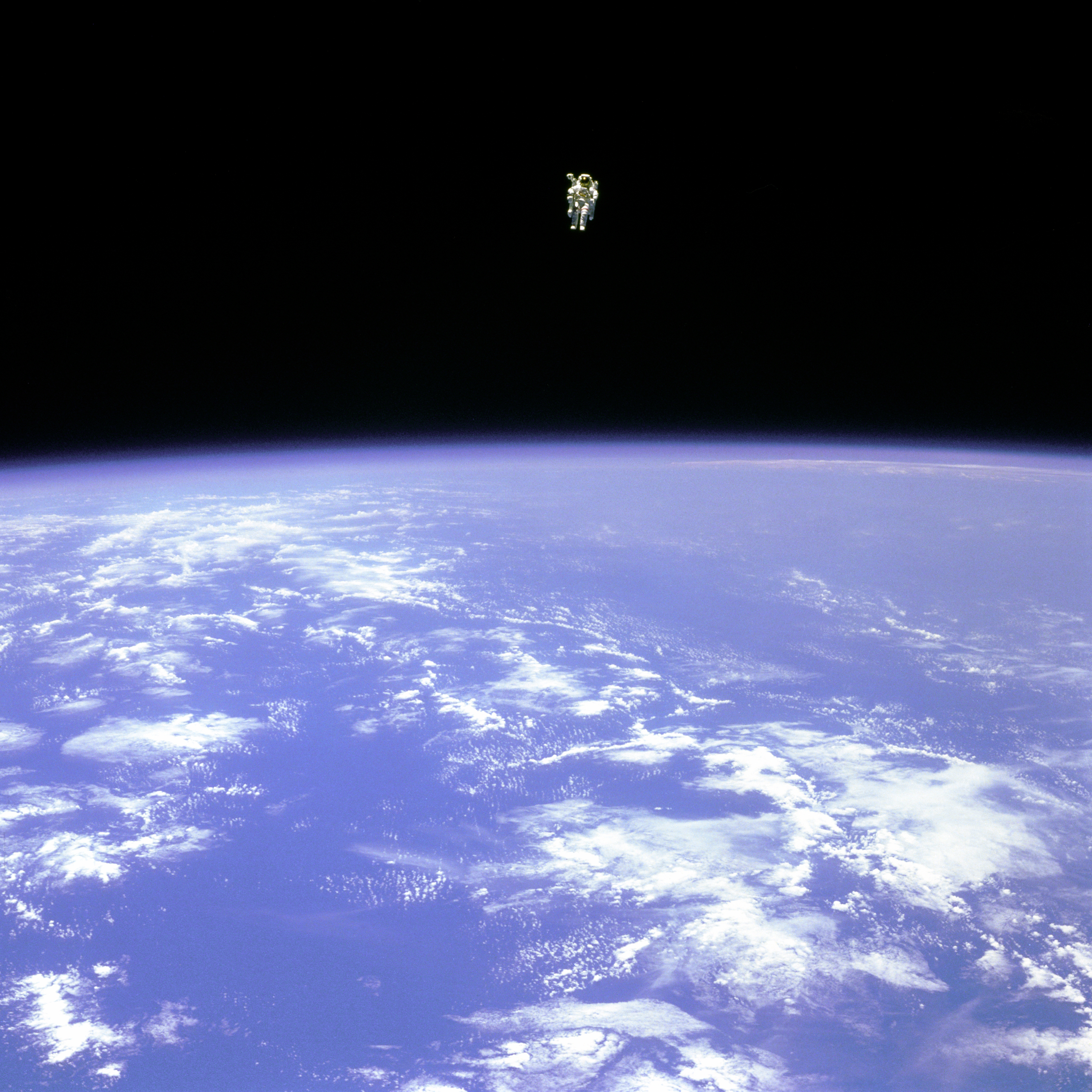
To Fly Free in Space
STS-41B, NASA 


Explanation: At about 100 meters from the cargo bay of the space shuttle Challenger, Bruce McCandless II was farther out than anyone had ever been before. Guided by a Manned Maneuvering Unit (MMU), astronaut McCandless, pictured above, was floating free in space. McCandless and fellow NASA astronaut Robert Stewart were the first to experience such an “untethered space walk” during Space Shuttle mission 41-B in 1984. The MMU works by shooting jets of nitrogen and has since been used to help deploy and retrieve satellites. With a mass over 140 kilograms, an MMU is heavy on Earth, but, like everything, is weightless when drifting in orbit. The MMU was replaced with the SAFER backpack propulsion unit.

Hubble Image Gallery for December 27th

Spiral Galaxy M100

An image of the grand design spiral galaxy M100 obtained with the second generation Wide Field and Planetary Camera (WFPC-2), newly installed in the Hubble Space Telescope. Though the galaxy lies several tens of millions of light-years away, modified optics incorporated within the WFPC-2 allow Hubble to view M100 with a level of clarity and sensitivity previously possible only for the very few nearby galaxies that compose our “Local Group.” Just as one does not learn about the diversity of mankind by conversing only with your next door neighbor, astronomers must study many galaxies in a host of different environments if they are to come to understand how our own galaxy, out star, and our earth came to be. By expanding the region of the universe that can be studied in such detail a thousand fold, the WFPC-2 will help the Hubble Space Telescope to fulfill this mission.

Astronomy Picture of the Day for December 26th

Astronomy Picture of the Day

Discover the cosmos!Each day a different image or photograph of our fascinating universe is featured, along with a brief explanation written by a professional astronomer.

2011 December 26
See Explanation.  Clicking on the picture will download the highest resolution version available.

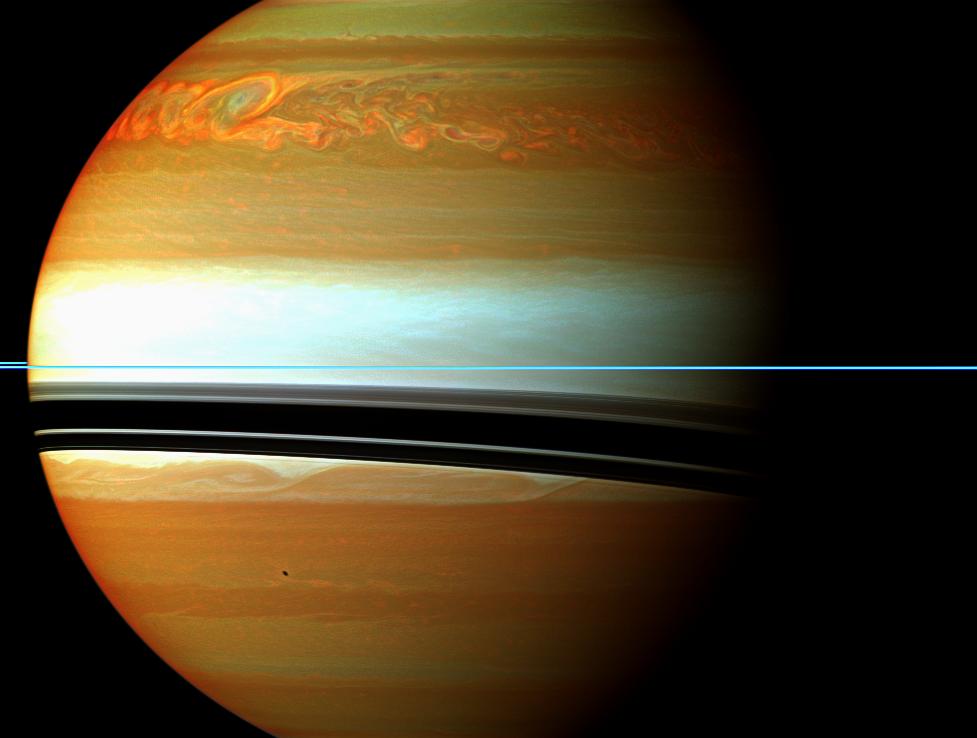
A Raging Storm System on Saturn
Image Credit: Cassini Imaging Team, SSI, JPL, ESA, NASA  


Explanation: It is one of the largest and longest lived storms ever recorded in our Solar System. First seen late last year, the above cloud formation in the northern hemisphere of Saturn started larger than the Earth and soon spread completely around the planet. The storm has been tracked not only from Earth but from up close by the robotic Cassini spacecraft currently orbiting Saturn. Pictured above in false colored infrared in February, orange colors indicate clouds deep in the atmosphere, while light colors highlight clouds higher up. The rings of Saturn are seen nearly edge-on as the thin blue horizontal line. The warped dark bands are the shadows of the rings cast onto the cloud tops by the Sun to the upper left. A source of radio noise from lightning, the intense storm may relate to seasonal changes as spring slowly emerges in the north of Saturn.

2012- A Witches View of Life and the ‘End’

2012- A Witches View of Life and the ‘End’

Author: Fayte Ravencraft

Unless you have been living under a rock, you have undoubtedly heard of the phenomenon that is 2012. The calendar of the ancient Mayan civilization ends on December 21, 2012, and many believe that it spells out disaster for our planet. Others think that it will be a time of transformation and spiritual rebirth. Here is the opinion of one humble Witch:

I won’t lie and say that the whole ‘2012 hysteria isn’t a little scary. I mean we have several extremely rare celestial occurrences, which also coincide with this exact date, which seem to add to the possibility of strange or catastrophic events occurring. The Earth and the Sun will be perfectly aligned with the ‘Great Rift, in the center of our galaxy, and this alignment is said to occur only every 21, 000 years or so. The Sun will also reach its solar maximum, the peak in its level of sunspot activity. Scientists have noticed recently that the Sun has been alarmingly weak for this point in the cycle — the lowest in over one-hundred years according to one article—, which may mean, in my own opinion, that when the Sun activity does pick up, it may cause a little trouble here on Earth.

The Sun’s own magnetic poles are supposed to switch in 2012 as well, which may cause further issues here on earth. These are simply the facts. Not even the most brilliant among us can truly say what they mean because it has never happened before in recorded history, and all theories are just that: theories. I encourage you to do your own research before coming to any assumption, and do not panic about the ‘approaching disaster, ” because there is not necessarily anything to be worried about. You do, I’m sure, remember the same mass hysteria about the supposed apocalypse in 2000, which never occurred.

I say all this simply so that you, the reader, may come to your own conclusions as to what the future may hold, and so that you know just what everyone is causing all the commotion about. I have listed as many Internet sources as possible so that you may further research them if you wish.

It is my personal feeling that December 21, 2012 will be a time of extraordinary power, a time when the veil between the worlds will be at its absolute thinnest. The Great Rift in the center of our galaxy has always been symbolic of the creative power of the Goddess, the ‘Great Womb, so to speak. The fact that the Sun, the symbol of the Lord, The Great Rift, a symbol of the Lady, and our Earth will be aligned will have a significant meaning magickally. There will never be a better time in our lives to perform magick of all types especially that of the divinatory type.

I do feel like it is a significant milestone in the history of human kind, and that, for those of us who are enlightened and willing, it is the perfect time to reach the maximum of our potential. Being a time of great power, it is also a time when we can make a powerful commitment to change things, both within and without, and to decided just where it is we want to go with our lives. Any energies set to work during this rare alignment are going to have extraordinary results, so why not use this as a time to heal the Earth, and with it, all of mankind. The Maya knew that this would be a time of immense power, and both feared and respected it.

We have a great thing here on our planet, and we too often take even the air we breathe for granted. The gifts we have received from the Universe have been greater than we could ever ask for, and it is time now to realize that. I am not convinced that 2012 marks the end of our world, but I certainly hope it marks a great change within the heart of mankind. We must learn to be grateful for all that we have; our lives and this astoundingly beautiful planet, or we might as well have never been here. I hate to say it, but if by some chance the world truly does end in 2012, I am just glad that I’ve had the blessing of spending this life on this beautiful planet. If it doesn’t end, I hope we all do our very best to be more appreciative; we have a good thing going on here, and we get too caught up in the daily grind of things to realize it sometimes.

While I do not feel that the world is truly about to end, I do think that we need to start living as though the end of the world were today, because it very well could be. We have never been guaranteed any amount of time here, and should view every second, the good and bad, as a gift. If we could truly follow ‘In perfect love and perfect trust, ” and have that love and trust towards ourselves and our fellow man, we would truly be making the absolute best of our time here.

As the great Henry David Thoreau said:

“I went to the woods because I wished to live deliberately, to front only the essential facts of life, and see if I could not learn what it had to teach, and not, when I came to die, discover that I had not lived.”

Let us learn all that we can in this life so that when the end comes, we will have the satisfaction of knowing that we have done something that few ever have: Truly lived. If we can say in all honesty that we have lived a full life, then we cannot possibly grieve at its ending. We were lucky even to have one day here, let alone an entire life of loving, laughing and learning! The Great Cycle will continue eternally and we are all but small parts of the infinite cycle. When we embrace the entire cycle, life, death, and rebirth, then there is absolutely nothing to fear.

Nothing is ever truly destroyed, simply changed; and change, my friends, is a very good thing. Embracing change is embracing life.

Blessed Be,
Fayte Ravencraft


Footnotes:
Interview with NASA Solar Scientist

http://www.npr.org/templates/story/sthttp://www.witchvox.com/vu/fms/farticle.htmlory.php?storyId=128268488

http://www.interestingfacts.org/fact/2012-interesting-facts

http://www.youtube.com/watch?v=Z4JuoBD56HQ

NASA Image of the Day for November 25th

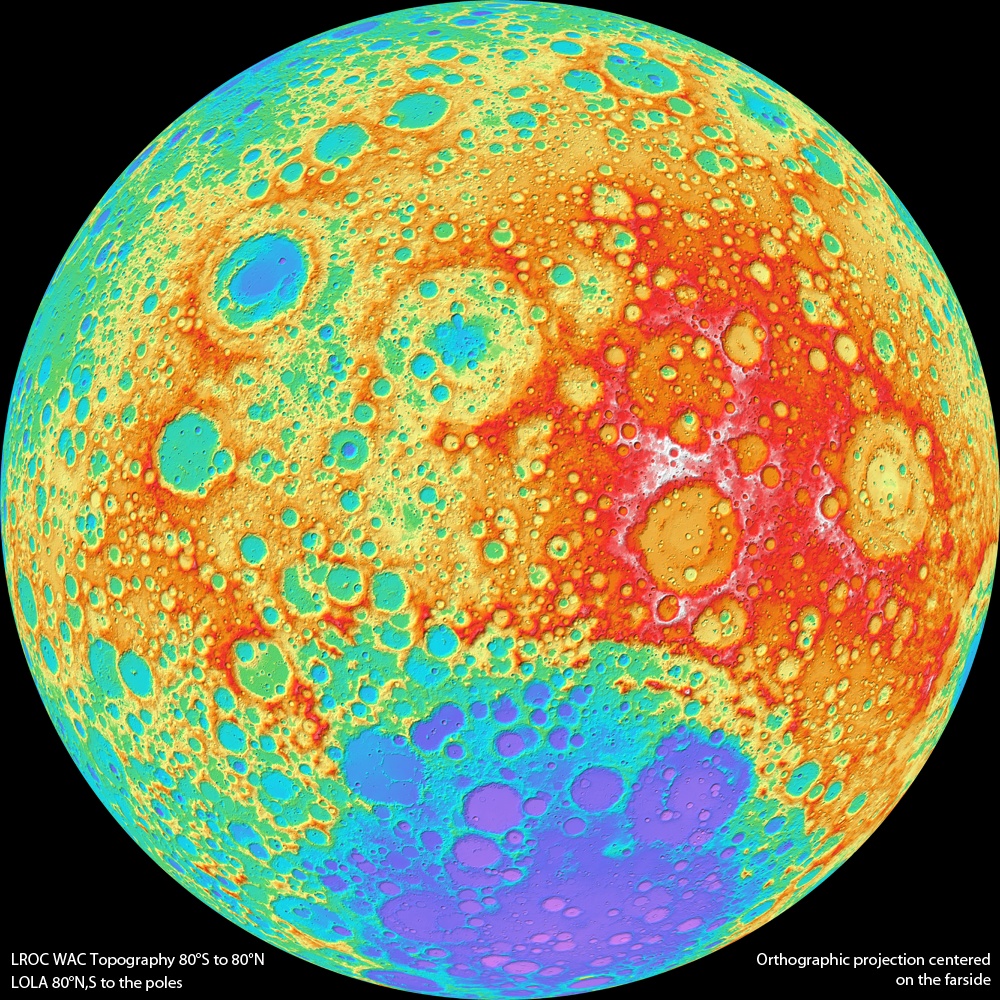
 A New Map of the Moon


A New Map of the Moon

NASA’s Lunar Reconnaissance Orbiter science team released the highest resolution near-global topographic map of the moon ever created. This new topographic map shows the surface shape and features over nearly the entire moon with a pixel scale close to 328 feet.

Although the moon is Earth’s closest neighbor, knowledge of its morphology is still limited. Due to the limitations of previous missions, a global map of the moon’s topography at high resolution has not existed until now. With LRO’s Wide Angle Camera and the Lunar Orbiter Laser Altimeter instrument, scientists can now accurately portray the shape of the entire moon at high resolution.

Astronomy Picture of the Day

Astronomy Picture of the Day

Discover the cosmos!Each day a different image or photograph of our fascinating universe is featured, along with a brief explanation written by a professional astronomer.

2011 November 23
See Explanation.  Clicking on the picture will download the highest resolution version available.

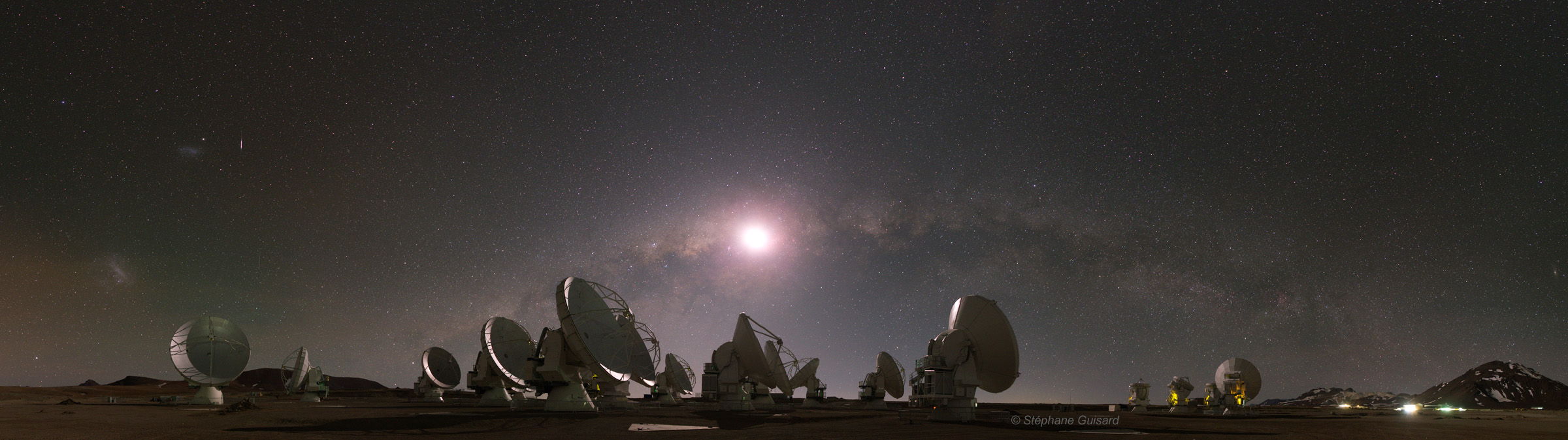
The View from Chajnantor
Image Credit & Copyright: Stéphane Guisard (Los Cielos de America), TWAN 


Explanation: From an altitude of over 5,000 meters, the night sky view from Chajnantor Plateau in the Chilean Andes is breathtaking in more ways than one. The dark site’s rarefied atmosphere, at about 50 percent sea level pressure, is also extremely dry. That makes it ideal for the Atacama Large Millimeter/submillimeter Array (ALMA) designed to explore the universe at wavelengths over 1,000 times longer than visible light. Near the center of the the panoramic scene, ALMA’s 7 and 12 meter wide dish antennas are illuminated by a young Moon nestled in the arc of the Milky Way. ALMA’s antenna configurations are intended to achieve a resolution comparable to space telescopes by operating as an interferometer. At left, a meteor’s streak and the Milky Way’s satellite galaxies, the Large (bottom) and Small Magellanic Clouds grace the night.

NASA Image of the Day for November 20th

Montage

This montage of New Horizons images shows Jupiter and its volcanic moon Io, and were taken during the spacecraft’s Jupiter flyby in early 2007. The image of Jupiter is an infrared color composite taken by the spacecraft’s near-infrared imaging spectrometer, the Linear Etalon Imaging Spectral Array. The infrared wavelengths used highlight variations in the altitude of the Jovian cloud tops, with blue denoting high-altitude clouds and hazes, and red indicating deeper clouds. The prominent bluish-white oval is the Great Red Spot. The observation was made at a solar phase angle of 75 degrees but has been projected onto a crescent to remove distortion caused by Jupiter’s rotation during the scan. The image of Io is an approximately true-color composite taken by the panchromatic Long-Range Reconnaissance Imager with color information provided by the Multispectral Visible Imaging Camera. The image shows a major eruption in progress on Io’s night side, at the northern volcano Tvashtar. Incandescent lava glows red beneath a volcanic plume, whose uppermost portions are illuminated by sunlight. The plume appears blue due to scattering of light by small particles within it.

This montage originally appeared on the cover of the Oct. 12, 2007, issue of Science magazine.

Image Credit: NASA/Johns Hopkins University Applied Physics

Astronomy Picture of the Day for November 20th

Astronomy Picture of the Day

Discover the cosmos!Each day a different image or photograph of our fascinating universe is featured, along with a brief explanation written by a professional astronomer.

2011 November 20
See Explanation.  Clicking on the picture will download the highest resolution version available.

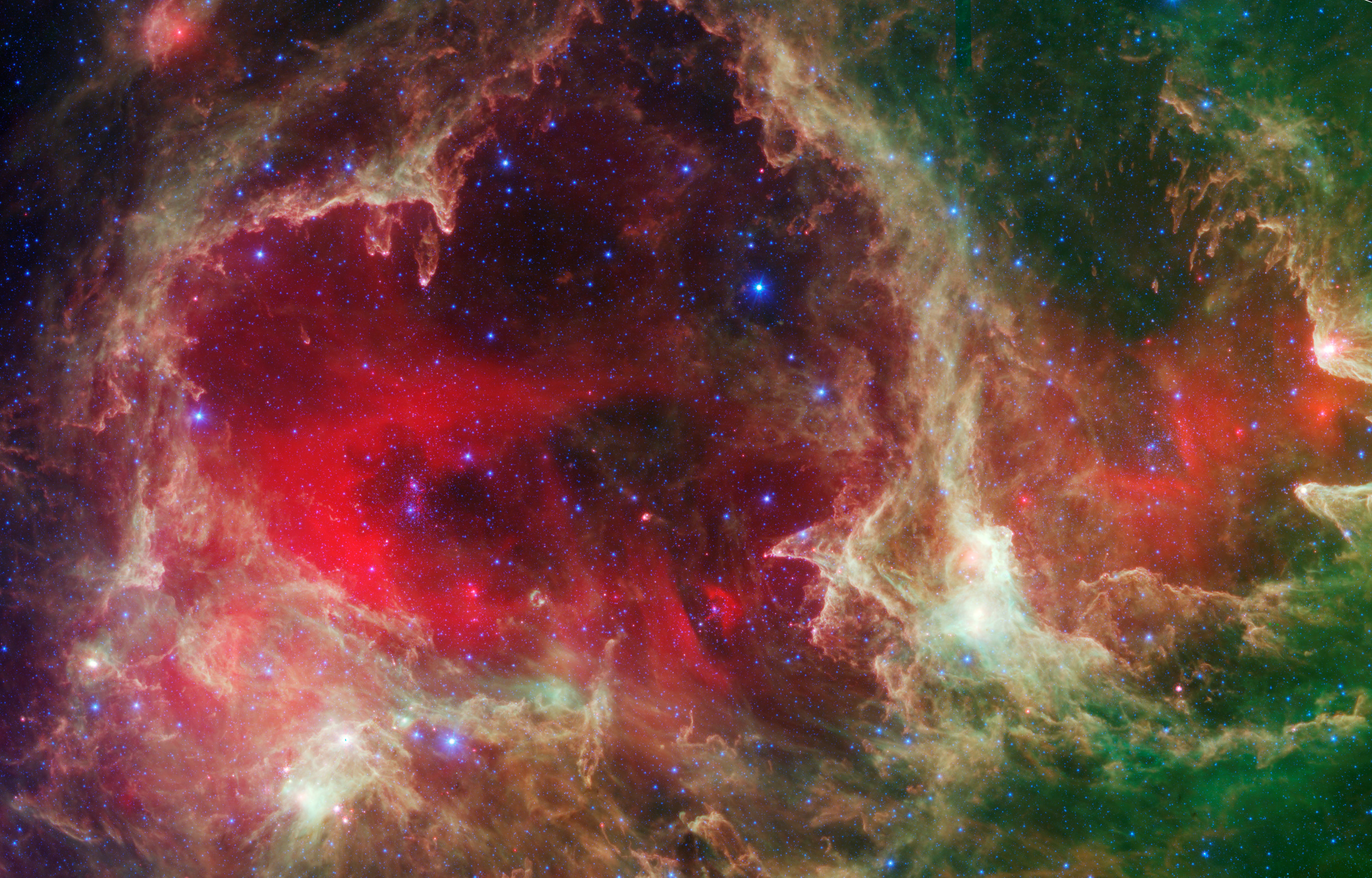
W5: Pillars of Star Formation
Image Credit & Copyright: Lori Allen, Xavier Koenig (Harvard-Smithsonian CfA) et al., JPL-Caltech, NASA  


Explanation: How do stars form? A study of star forming region W5 by the sun-orbiting Spitzer Space Telescope provides clear clues by recording that massive stars near the center of empty cavities are older than stars near the edges. A likely reason for this is that the older stars in the center are actually triggering the formation of the younger edge stars. The triggered star formation occurs when hot outflowing gas compresses cooler gas into knots dense enough to gravitationally contract into stars. Spectacular pillars, left slowly evaporating from the hot outflowing gas, provide further visual clues. In the above scientifically-colored infrared image, red indicates heated dust, while white and green indicate particularly dense gas clouds. W5 is also known as IC 1848, and together with IC 1805 form a complex region of star formation popularly dubbed the Heart and Soul Nebulas. The above image highlights a part of W5 spanning about 2,000 light years that is rich in star forming pillars. W5 lies about 6,500 light years away toward the constellation of Cassiopeia.

Astronomy Picture of the Day for November 18th – A Colorful Side of the Moon

Astronomy Picture of the Day

Discover the cosmos!Each day a different image or photograph of our fascinating universe is featured, along with a brief explanation written by a professional astronomer.

2011 November 18
See Explanation.  Clicking on the picture will download the highest resolution version available.

A Colorful Side of the Moon
NASA / GSFC / DLR / Arizona State Univ. / Lunar Reconnaissance Orbiter 

Explanation: This colorful topographical map of the Moon is centered on the lunar farside, the side not seen from planet Earth. That view is available to the Lunar Reconnaissance Orbiter though, as the spacecraft’s wide angle camera images almost the entire lunar surface every month. Stereo overlap of the imaging has allowed the computation of topographical maps with coverage between 80 degrees north and south latitude. The results have about a 300 meter resolution on the lunar surface and 10 to 20 meter elevation accuracy. Data closer to the north and south poles is filled in using the orbiter’s laser altimeter. In this map, white, red, green, and purple represent progressively lower elevations. In fact, the large circular splotch tending to purple hues at the bottom is the farside’s South Pole-Aitken Basin. About 2500 kilometers in diameter and over 12 kilometers deep, it is one of the largest impact basins in the Solar System.

NASA Image of the Day for November 18th – Saturn’s Northern Storm

S Saturn

Saturn’s Northern Storm

This false-color mosaic from NASA’s Cassini spacecraft shows the tail of Saturn’s huge northern storm. In mid-September 2004, the Cassini spacecraft chronicled a similar, but smaller, storm in the southern hemisphere called the “Dragon Storm.”

The head of this storm is beyond the horizon in this view. Saturn’s atmosphere and its rings are shown here in a false color composite made from 12 images taken in near-infrared light through filters that are sensitive to varying degrees of methane absorption. Red and orange colors in this view indicate clouds that are deep in the atmosphere. Yellow and green colors, most noticeable near the top of the view, indicate intermediate clouds. White and blue indicate high clouds and haze. The rings appear as a thin horizontal line of bright blue because they are outside of the atmosphere and not affected by methane absorption.

The oval in the upper left of this image that appears slightly blue is the same hole in the deep clouds of the planet’s atmosphere that can be seen near the tail in a larger false-color mosaic, PIA14903. The blue color comes from the high haze overlying the hole.

This view looks toward the northern, sunlit side of the rings from just above the ring plane. The shadow of the moon Enceladus is visible on the planet in the lower left of the image.

The images were taken with the Cassini spacecraft wide-angle camera using a combination of spectral filters sensitive to wavelengths of near-infrared light. The images filtered at 890 nanometers are projected as blue. The images filtered at 728 nanometers are projected as green, and images filtered at 752 nanometers are projected as red.

The images were taken on Jan. 12, 2011, over about one hour at a distance of approximately 684,000 miles (1.1 million kilometers) from Saturn and at a sun-Saturn-spacecraft, or phase, angle of 52 degrees. The images were re-projected to the same viewing geometry, so that scale in this final mosaic is 76 miles (122 kilometers) per pixel.

Image Credit:NASA/JPL-Caltech/Space Science Institute

Astronomy Picture of the Day for November 8th

Astronomy Picture of the Day

Discover the cosmos!Each day a different image or photograph of our fascinating universe is featured, along with a brief explanation written by a professional astronomer.

2011 November 8

Jumping Sundogs Over Thunderclouds
Image Credit: abrigatti, YouTube 


Explanation: What’s happening above those clouds? In the past few years, videos have appeared on the web detailing an unusual but little known phenomenon: rapid light changes over clouds. Upon inspection and contemplation, a leading hypothesis for its cause has now emerged. In sum, this hypothesis holds that a lightning discharge in a thundercloud can temporarily change the electric field above the cloud where charged ice crystals were reflecting sunlight. The new electric field quickly re-orients the geometric crystals to a new orientation that reflects sunlight differently. In other words, a lightning discharge can cause a sundog to jump. Soon, the old electric field may be restored, causing the ice crystals to return to their original orientation. To help this curious phenomenon become better studied, sky enthusiasts with similar jumping or dancing sundog videos are encouraged to share them.

NASA Image of the Day for November 7th

Astronaut McCandless in space

McCandless Orbits in Jetpack

On Feb. 12, 1984, astronaut Bruce McCandless, ventured further away from the confines and safety of his ship than any previous astronaut had ever been. This space first was made possible by a nitrogen jet propelled backpack, previously known at NASA as the Manned Manuevering Unit or MMU.

After a series of test maneuvers inside and above Challenger’s payload bay, McCandless went “free-flying” to a distance of 320 feet away from the Orbiter. This stunning orbital panorama view shows McCandless out there amongst the black and blue of Earth and space.

Image Credit: NASA

2012- A Witches View of Life and the ‘End’

2012- A Witches View of Life and the ‘End’

Author: Fayte Ravencraft
Unless you have been living under a rock, you have undoubtedly heard of the phenomenon that is 2012. The calendar of the ancient Mayan civilization ends on December 21, 2012, and many believe that it spells out disaster for our planet. Others think that it will be a time of transformation and spiritual rebirth. Here is the opinion of one humble Witch:

I won’t lie and say that the whole ‘2012 hysteria isn’t a little scary. I mean we have several extremely rare celestial occurrences, which also coincide with this exact date, which seem to add to the possibility of strange or catastrophic events occurring. The Earth and the Sun will be perfectly aligned with the ‘Great Rift, in the center of our galaxy, and this alignment is said to occur only every 21, 000 years or so. The Sun will also reach its solar maximum, the peak in its level of sunspot activity. Scientists have noticed recently that the Sun has been alarmingly weak for this point in the cycle — the lowest in over one-hundred years according to one article—, which may mean, in my own opinion, that when the Sun activity does pick up, it may cause a little trouble here on Earth.

The Sun’s own magnetic poles are supposed to switch in 2012 as well, which may cause further issues here on earth. These are simply the facts. Not even the most brilliant among us can truly say what they mean because it has never happened before in recorded history, and all theories are just that: theories. I encourage you to do your own research before coming to any assumption, and do not panic about the ‘approaching disaster, ” because there is not necessarily anything to be worried about. You do, I’m sure, remember the same mass hysteria about the supposed apocalypse in 2000, which never occurred.

I say all this simply so that you, the reader, may come to your own conclusions as to what the future may hold, and so that you know just what everyone is causing all the commotion about. I have listed as many Internet sources as possible so that you may further research them if you wish.

It is my personal feeling that December 21, 2012 will be a time of extraordinary power, a time when the veil between the worlds will be at its absolute thinnest. The Great Rift in the center of our galaxy has always been symbolic of the creative power of the Goddess, the ‘Great Womb, so to speak. The fact that the Sun, the symbol of the Lord, The Great Rift, a symbol of the Lady, and our Earth will be aligned will have a significant meaning magickally. There will never be a better time in our lives to perform magick of all types especially that of the divinatory type.

I do feel like it is a significant milestone in the history of human kind, and that, for those of us who are enlightened and willing, it is the perfect time to reach the maximum of our potential. Being a time of great power, it is also a time when we can make a powerful commitment to change things, both within and without, and to decided just where it is we want to go with our lives. Any energies set to work during this rare alignment are going to have extraordinary results, so why not use this as a time to heal the Earth, and with it, all of mankind. The Maya knew that this would be a time of immense power, and both feared and respected it.

We have a great thing here on our planet, and we too often take even the air we breathe for granted. The gifts we have received from the Universe have been greater than we could ever ask for, and it is time now to realize that. I am not convinced that 2012 marks the end of our world, but I certainly hope it marks a great change within the heart of mankind. We must learn to be grateful for all that we have; our lives and this astoundingly beautiful planet, or we might as well have never been here. I hate to say it, but if by some chance the world truly does end in 2012, I am just glad that I’ve had the blessing of spending this life on this beautiful planet. If it doesn’t end, I hope we all do our very best to be more appreciative; we have a good thing going on here, and we get too caught up in the daily grind of things to realize it sometimes.

While I do not feel that the world is truly about to end, I do think that we need to start living as though the end of the world were today, because it very well could be. We have never been guaranteed any amount of time here, and should view every second, the good and bad, as a gift. If we could truly follow ‘In perfect love and perfect trust, ” and have that love and trust towards ourselves and our fellow man, we would truly be making the absolute best of our time here.

As the great Henry David Thoreau said:

“I went to the woods because I wished to live deliberately, to front only the essential facts of life, and see if I could not learn what it had to teach, and not, when I came to die, discover that I had not lived.”

Let us learn all that we can in this life so that when the end comes, we will have the satisfaction of knowing that we have done something that few ever have: Truly lived. If we can say in all honesty that we have lived a full life, then we cannot possibly grieve at its ending. We were lucky even to have one day here, let alone an entire life of loving, laughing and learning! The Great Cycle will continue eternally and we are all but small parts of the infinite cycle. When we embrace the entire cycle, life, death, and rebirth, then there is absolutely nothing to fear.

Nothing is ever truly destroyed, simply changed; and change, my friends, is a very good thing. Embracing change is embracing life.

Blessed Be,
Fayte Ravencraft


Footnotes:
Interview with NASA Solar Scientist

http://www.npr.org/templates/story/sthttp://www.witchvox.com/vu/fms/farticle.htmlory.php?storyId=128268488

http://www.interestingfacts.org/fact/2012-interesting-facts

http://www.youtube.com/watch?v=Z4JuoBD56HQ