Magickal Goody for January 21 is Peaceful Home Potion

Magickal Goody of the Day

89e1a7bbffa27fad38a3a06a0d4f3dda

Peaceful Home Potion

1 handful of Jasmine

1 tbsp of Honey

2 Passion fruit flowers

1 handful of white Rose petals

1⁄2 cup of water

Mix it all together. While you mix the ingredients, you visualize your or the other one’s home filled with love and light. Put the mixture in a jar or bottle and place it where you can look at it every day.


—Crafty Witch, How To Make Potions & Spells That Really Work: The Beginners Guide To Real Witchcraft

Magickal Goody of the Day for Jan. 11 – Psychic Simmering Pot

Magickal Goody of the Day
89e1a7bbffa27fad38a3a06a0d4f3dda

Psychic Simmering Pot

If you wish to link your conscious mind with your psychic awareness, if you wish to use tarot cards or rune stones or other tools to glimpse possible future events, create this blend and simmer to stimulate your psychic mind.

3 tbsp of galangal

1 tbsp of star anise (or 2 whole)

1 tbsp of lemon grass

1 tbsp of thyme

1 tbsp of rose petals

A pinch of mace

A pinch of real saffron

Mix and charge the herbs in a small bowl. Visualize your psychic awareness as being under your control. Smell the fragrance rising from the herbs. Inhale the energies. Relax, chant the following words, and foretell.

‘Starlight swirls before my eyes

Twilight furls its wisdom wise

Moonlight curls within the skies

The time has come to prophesize’

(Genuine saffron is quite expensive. However just a pinch is necessary here and it may be omitted)


—Crafty Witch, How To Make Potions & Spells That Really Work: The Beginners Guide To Real Witchcraft


Magickal Goody of the Day for Jan. 8th – Non-Toxic Flying Ointment

Magickal Goody of the Day

witch potion 001

Non-Toxic Flying Ointment


Flying ointment I

1⁄4 cup of lard
1⁄2 tsp of Clover
1 tsp of chimney soot
1⁄4 tsp of Mugwort
1⁄4 tsp of Vervain
1⁄2 tsp of benzoin tincture

Use your mortar to crush the dried herbs into a fine powder. Melt the lard on a low heat in a pot or in your cauldron. Add the herbs and mix it well. Add the tincture and stir deosil for about 10 minutes. Put it in jars and let it cool.

After the mixture is cooled and ready to use, you can anoint it on a few places of your body but avoid the Chakra areas.

 *NOT TO BE USED BY PREGNANT WOMEN OR THOSE WHO MIGHT BE*

Magickal Goody of the Day for Jan. 3rd – Homemade Paper for Your Grimoire

Magickal Goody of the Day

100_1192_1210963102


Homemade Paper for Your Grimoire

The basis of a handmade paper is pulp. You can make pulp from almost any kind of paper, but avoid using any paper with a glossy surface, such as pages out of magazines. These are treated with chemicals and unsuitable for the purpose of recycled papermaking. Remember, just because something is recycled, this in no way has any adverse affect on the quality.


Materials Needed
– Paper, such as tissue, computer paper, writing or typing paper, paper bags
– A bucket
– Cold, clean water (add a few drops of Florida water or rose water)
– Two wooden frames; these can be picture frames, but the corners must be tight and secured
– A piece of mesh (net curtaining or window screen) to fit in frames; the finer the mesh, the smoother the paper
– Staples
– Blender
– Tablespoon or ladle
– Large plastic bowl (big enough to easily accommodate the frames)
– Liquid laundry starch
– Optional: dried or fresh flowers, leaves, or bits of lace; food coloring or dyes suitable for cotton fabrics; anything for added color that pleases you
– Palette knife or butter knife
– Athame
– Absorbent cloths, such dish towels or Handi-Wipes (one for each page of paper you intend to make)
– Heavy book, chopping block, or brick
– Optional: A pentacle, an ankh, an eight-pointed star, or an amulet that you normally wear on your person, to be used as an embossing tool


1. Tear the paper into postage stamp-size pieces and soak the pieces overnight in a plastic bucket of cold, clean water. You can make this first step into a magical practice by adding a few drops of Florida water or rose water to the water in the bucket and by asking the Goddess to bless your work. As you tear the paper into bits, focus your energy into the paper and make your intentions known by reciting the following: “Goddess, bless this endeavor of art. By my hand, let the transformation begin so that your presence be known in the world for the benefit of all. So mote it be.”

 
2. Stretch the mesh over one of the frames and staple it so that it’s very taut. This covered frame will be used to pick up the pulp and keep it flat. If the mesh is loose, the paper will be saggy and difficult to remove from the frame. The empty frame will be held on top of the mesh frame and will give your paper a nice edge. Set the frames aside until step 6.

 
3. After your paper has soaked overnight, pour off the excess water and begin transferring the pulp into a blender, spoonful by spoonful.

 
4. Add water until the pitcher of the blender is no more than three-quarters full. Run the blender for about fifteen seconds, and then check the pulp to make sure it is broken down evenly. If necessary, stir the pulp and then run the blender for another five seconds.

 
5. Gently pour the pulp into the plastic bowl. At this point, you can add a spoonful of liquid laundry starch to the pulp. This will make your paper absorb the ink better, so there will be less of a tendency for the ink to bleed when you are writing.

 
6. Stir the pulp gently and wait for the movement of the water to cease. At the moment when the water is still— but the pulp has not yet settled— hold the frames securely in your hands with the empty frame on top and the mesh frame with the mesh facing up directly underneath it. Slide the frames under the water in a smooth motion, scooping up a layer of pulp. It may take some practice to get the pulp evenly distributed over the mesh frame.

 
7. Keeping the frames steady and flat, lift them out of the water and allow the water to drain away. A layer of pulp should cover the mesh screen. Remove the empty frame.

 
8. Consider pressing herbs and flowers into the wet surface. Thinking about using this paper for a protection spell? Why not use a sprig of rosemary along the edges? Perhaps you have a love spell in mind. Adorn some of your pages with red rose petals. You can set aside the pages decorated with flowers and herbs for specific use within your grimoire. Use whatever your mind is inspired to create. Do you feel a special connection to the goddess Ariadne? Include some silken threads. Enchanted by faerie glamour? Sprinkle some glitter across the paper. Make it your own.

 
9. Carefully remove the paper from the frame while it is still wet. A palette knife or butter knife will be a useful tool for loosening the edges, or if you wish you can use your athame, consecrating each page as you make it.

 
10. Once you have removed the paper, lay it carefully on one half of the absorbent cloth and, without folding your page, fold the other half of the cloth over the paper to absorb the excess water. Continue stacking individual pages in this fashion, making sure layers of cloth alternate with sheets of paper.

 
11. Put something waterproof (like plastic wrap) at the top of the stack of paper, then place a heavy book or chopping block on the top. This will weigh the paper down and keep it flat while drying.

 
12. You can add magical energy to your paper by embossing magical symbols in it. Embossed paper is made by pressing an object into the paper while the paper is still wet, then removing the object. If you want a well-defined motif, leave the embossing tool there as the paper is weighted and do not remove it until the paper is completely dry.

 
Feel free to experiment. The more energy you put into creating your book of shadows, the more you will enjoy using it.
—Judy Ann Olsen, A Witch’s Grimoire, Create Your Own Book of Shadows

Magickal Goody of the Day – Make Your Own Yule Smudge Stick

Magickal Goody of the Day

Make Your Own Yule Smudge Stick

When Yule rolls around – December if you’re in the northern hemisphere, or in June for our readers below the equator – one of the most notable aspects of the season is that of the scents and smells. There’s something about our olfactory system triggering certain memories and recollections, and the Yule season is no exception. Aromas like pine needles, cinnamon, mulled spices, frankincense – all of these are reminders of the winter holidays for many of us.

One of the things I love to do once the weather gets cold is make seasonal smudge sticks. These are essentially like any other smudge stick – you bundle herbs together, tie with string, and allow them to dry out before eventually burning them – but I wanted to put together a combination of plants that evoked the scents of winter.

There’s a park near me that has an arboretum, and it’s a great location for me to go and just wander around, especially when I feel a need to get outside and reconnect with nature, but don’t have the time to dedicate to a half-day hiking trip. Although it’s right in the middle of my town, the arboretum is usually pretty well deserted, other than the occasional dog-walker – most residents use a nearby recreational park for their activities instead. And that means I’ve usually got the place to myself.

I went out for a stroll through the arboretum as the weather was beginning to get chilly – it was cold enough for a jacket, but I didn’t quite need gloves or a hat yet.

As I walked, I stopped and took the time to visit with the trees in the arboretum. Many of them had newly fallen branches lying beneath them, so I took it upon myself to gather them up. After all, it wasn’t like anyone else was going to use them! I collected pine branches and cones, some fir, and a bit of juniper as well, and decided that once I couldn’t carry any more branches in my arms, I was done. I took them home, shook out the extra bits of detritus, and got to work making seasonal smudge sticks for the upcoming Yule season. Smudging is a great way to cleanse a sacred space, and most people use smudge sticks made of sweetgrass or sage for this purpose, but why not use more seasonally appropriate plants at Yule?

Now, I’ve done a bit of experimenting and found that some types of plants definitely work better than others. For instance, certain members of the fir family begin to drop their needles as soon as they begin to dry, which means you’ll end up with needles all over your floor, and not in your smudge stick if you use them. On the other hand, the trees with the longer, softer needles seem to work really well, and lend themselves nicely to a project like this.

Here’s what you’ll need:

  • Scissors or garden clippers
  • Cotton string
  • Seasonal plants such as evergreens (pine, fir, juniper, balsam, and cedar), as well as other scents you find appealing – I used rosemary in mine in addition to the pine, fir, and juniper.

Trim your clippings down to a manageable length – I usually keep mine between six and ten inches, but if you’d like to make shorter smudge sticks, go right ahead. Cut a length of string about five feet long. Put several branches together, and wind the string tightly around the stems of the bundle, leaving two inches of loose string where you began. Tie a knot when you get to the end, and leave a loop so you can hang them for drying. Depending on how fresh your branches are – and how much sap is in them – it can take a few weeks to dry them out. Once they’re done, burn them in Yule rituals and ceremonies, or use them for cleansing a sacred space.


Source:
Author:

Website: Article published on & owned by About.com

Get Ready for Yule, Magickal Goody of the Day, Making Your Own Spell Ornaments

Magickal Goody of the Day

309;374;9bcc2802dbb8b78ddb333a270650118b95e26609

Yule Spell Ornament

As Yule approaches, the opportunities for spellwork are seemingly endless. If you have a holiday tree this year, why not use ornaments as a way of directing your magical energies? Make a spell ornament to bring prosperity, love, health, or creativity into your life.

You’ll need the following:

  • Clear plastic fillable ornament
  • Filler material associated with your purpose: herbs, small stones, colored paper or glitter, etc.
  • Colored ribbon

Fill the plastic halves of the ornament with items that are associated with your purpose. Try a couple of the following, or come up with your own combinations:

  • For a money spell, add shredded bits of play money, Bay leaf, basil, chamomile, clover, cinquefoil, tonka bean, Buckeye, pennyroyal; stones such as turquoise and amethyst; bits of green, silver or gold glitter.
  • For love magic, use Allspice, apple blossom, bleeding heart, catnip, lavender, periwinkle, peppermint, tulip, violet, daffodil; crystals such as rose quartz or emerald, coral; small heart-shaped cutouts, bits of pink or red glitter.
  • For workings related to creativity and inspiration, add feathers, sage, tobacco leaf, hazelwood or birch, symbols of artistry such as paintbrush tips, crayons, or colored thread. Add diamonds, quartz crystals, also consider colors like yellow and gold.
  • If you’re doing healing magic, use Apple blossom, lavender, barley, comfrey, eucalyptus, fennel, chamomile, allspice, olive, rosemary, rue, sandalwood, wintergreen, peppermint.

As you’re filling your ornament, focus on your intent. Think about what your purpose is in creating such a working. For some people, it helps to chant a small incantation while they work – if you’re one of those folks, you might want to try something like this:

Magic shall come as I order today,
bringing prosperity blessings my way.
Magic to hang on a green Yule tree;
as I will, so it shall be.

Once you’ve filled your ornament, place the two halves together. Tie a colored ribbon around the center to keep the halves from separating (you may need to add a dab of craft glue for stability) and then hang your ornament in a place where you can see it during the Yule season.

Gift-giving tip: Make a whole box of these with different purposes, and share them with your friends at the holidays!


Source:

Magickal Goody of the Day for Dec. 2nd – Get Ready for Yule by making Your Own Yule Log

Magickal Goody of the Day

yulelog01


Get Ready for Yule by making Your Own Yule Log

As the Wheel of the Year turns once more, the days get shorter, the skies become gray, and it seems as though the sun is dying. In this time of darkness, we pause on the Solstice (usually around December 21st, although not always on the same date) and realize that something wonderful is happening.

On Yule, the sun stops its decline into the south. For a few days, it seems as though it’s rising in exactly the same place… and then the amazing, the wonderful, the miraculous happens.

The light begins to return.

The sun begins its journey back to the north, and once again we are reminded that we have something worth celebrating. In families of all different spiritual paths, the return of the light is celebrated, with Menorahs, Kwanzaa candles, bonfires, and brightly lit Christmas trees. On Yule, many Pagan and Wiccan families celebrate the return of the sun by adding light into their homes. One of our family’s favorite traditions – and one that children can do easily – is to make a Yule log for a family-sized celebration.

A holiday celebration that began in Norway, on the night of the winter solstice it was common to hoist a giant log onto the hearth to celebrate the return of the sun each year. The Norsemen believed that the sun was a giant wheel of fire which rolled away from the earth, and then began rolling back again on the winter solstice.

As Christianity spread through Europe, the tradition became part of Christmas Eve festivities. The father or master of the house would sprinkle the log with libations of mead, oil or salt.

Once the log was burned in the hearth, the ashes were scattered about the house to protect the family within from hostile spirits.

Because each type of wood is associated with various magickal and spiritual properties, logs from different types of trees might be burned to get a variety of effects. Aspen is the wood of choice for spiritual understanding, while the mighty oak is symbolic of strength and wisdom. A family hoping for a year of prosperity might burn a log of pine, while a couple hoping to be blessed with fertility would drag a bough of birch to their hearth.

In our house, we usually make our Yule log out of pine, but you can make yours of any type of wood you choose. You can select one based on its magickal properties, or you can just use whatever’s handy. To make a basic Yule log, you will need the following:

  • A log about 14 – 18” long
  • Pinecones
  • Dried berries, such as cranberries
  • Cuttings of mistletoe, holly, pine needles, and ivy
  • Feathers and cinnamon sticks
  • Some festive ribbon – use paper or cloth ribbon, not the synthetic or wire-lined type
  • A hot glue gun

All of these – except for the ribbon and the hot glue gun — are things you and your children can gather outside. You might wish to start collecting them earlier in the year, and saving them. Encourage your children to only pick up items they find on the ground, and not to take any cuttings from live plants.

Begin by wrapping the log loosely with the ribbon. Leave enough space that you can insert your branches, cuttings and feathers under the ribbon. In our house, we place five feathers on our Yule log – one for each member of the family. Once you’ve gotten your branches and cuttings in place, begin gluing on the pinecones, cinnamon sticks and berries. Add as much or as little as you like. Remember to keep the hot glue gun away from small children.

Once you’ve decorated your Yule log, the question arises of what to do with it. For starters, use it as a centerpiece for your holiday table. A Yule log looks lovely on a table surrounded by candles and holiday greenery.

Another way to use your Yule log is to burn it as our ancestors did so many centuries ago. In our family, before we burn our log we each write down a wish on a piece of paper, and then insert it into the ribbons. It’s our wish for the upcoming year, and we keep it to ourselves in hopes that it will come true.

If you have a fireplace, you can certainly burn your Yule log in it, but we prefer to do ours outside. We have a fire pit in the back yard, and on the night of the winter solstice, we gather out there with blankets, mittens, and mugs full of warm drinks as we burn our log. While we watch the flames consume it, we discuss how thankful we are for the good things that have come our way this year, and how we hope for abundance, good health, and happiness in the next.

Source:

Making your bath salts

Making your bath salts


Commercial bath salts will do absolutely nothing on an esoteric level – they have too many chemical additives and artificial perfumes – so it is a nice touch to make your own using single essential oils, blends and/or herbs. The fact that you have mixed them yourself means they are infused with your own vibration and therefore will work on a very subtle level. Matching your bath salt perfume to your incense perfume does wonders for your inner self.


You will need

• • 3 PARTS EPSOM SALTS

• • 2 PARTS BAKING SODA

• • 1 PART ROCK SALT (or Borax)

• • BOWL FOR MIXING

• • ESSENTIAL OILS IN YOUR CHOSEN PERFUMES

• • HANDFUL OF HERBS (optional)

• • NATURAL FOOD COLOURING


Method

Mix the first three ingredients thoroughly in the mixing bowl. Use your hands as this will enable you to imbue the salts with your own energy. This is your basic mixture and can be perfumed or coloured in any way that you please.


Note: It is wise when using essential oils to mix them first if you are using a blend to allow the synergy between the oils to develop.


Add your colouring first and mix to your satisfaction, then follow with your oil or blend a drop at a time. Add the herbs to the mixture and combine thoroughly. Be generous with the oils since the salts will absorb a surprising amount without you realizing. Your nose, however, as with all oils and perfumes is the best judge – there is no right or wrong amount.

 
When you wish to use your salts, add approximately 2 tablespoons to a full bathtub and mix well.

Preparation for Spell Working – The Ritual Bath

Preparation for Spell Working – The Ritual Bath


Several processes become automatic when preparing for spell work. If you choose to wear special clothing, then this has to be prepared before you actually start your personal preparations. We give below some suggestions for personal robes which can be laid out with some ceremony before you begin.

 
Important magical workings require you to take a ritual bath which cleanses, purifies and clarifies your energy so that you are able to get the best results possible. Many practitioners prefer to take a ritual bath before performing any magical workings. For what you may consider ‘lesser’ magic you do not need to bathe, but may prefer to cleanse yourself by running your hands over your body before you embark on any working.


Ritual Bathing


Ritual bathing arose in times gone by from a perceived need to be in as ‘virgin’ – that is, unsullied – a state as possible. This is what gave rise to working skyclad, i.e. without clothes, so that there were no encumbrances between the practitioner and his or her gods or deities.


Ritual Bath


As you mix in your salts, bless the water and charge it with your intent – be that a particular magical working, a relaxing evening or a successful meeting. The candles used in this ritual can be in the colours of the Elements or those most appropriate to your purpose, for example – pink (tranquility), blue (wisdom), green (self-awareness) and red (passion). For spiritual matters, use purple.


You will need

• • HOMEMADE BATH SALTS

• • VOTIVE CANDLES ACCORDING TO YOUR NEED

• • LARGE WHITE CANDLE

• • ESSENTIAL OIL TO REMOVE NEGATIVITY (e.g. rosemary)

• • LARGE GLASS OF MINERAL WATER OR JUICE


Method

Anoint the large white candle with the essential oil and ask for positivity, health and happiness as you do so. Do the same with the votive candles according to your need. You may, if you wish, inscribe a symbol to represent your purpose on each candle.


Run your bath and mix in the bath salts.
Light the candles, first the white one followed by the votives. Place the latter safely around the bath. The white candle should be placed wherever you feel is safest. You have now created a sacred space for yourself.

 
Lie back and enjoy your bath and at some point drink your water or juice visualizing your whole system being cleansed inside as well as out. Before you get out of the bath, thank the water deities for this opportunity to prepare thoroughly for the new energies available to you. If you are to perform a magical working, then keep your mind focused on that intent.


On this occasion, for safety’s sake, when you have finished your bath, snuff out the candles.

It Just Wouldn’t Be Mabon Without….


Mabon Comments & Graphics

Mabon Incense

2 parts Frankincense
1 part Sandalwood
1 part Cypress
1 part Juniper
1 part Pine
½ part Oakmoss (or a few drops Oakmoss bouquet)
1 pinch pulverized Oak leaf


Mabon Oil

4 drops Rosemary
4 drops Frankincense oil,
2 drops apple oil,
1 drop chamomile oil.
Use almond oil as a base here
Mix well and bottle. Use in Mabon rituals


Autumn Equinox Ritual Potpourri

Recipe by Gerina Dunwich

45 drops Honeysuckle Oil
1 cup Oak Moss
6 small Acorns
2 cups dried Oak Leaves
2 cups dried Honeysuckle
1 cup dried Passionflower
1 cup dried Rosebuds and Petals
½ cup dried Pine Needles
1 tablespoon Sage
Mix the honeysuckle oil with the oak moss and then add the remaining ingredients. Stir the potpourri well and store in a tightly covered ceramic or glass container.

(The above recipe for “Autumn Equinox Ritual Potpourri” is quoted directly from Gerina Dunwich’s book “The Wicca Spellbook: A Witch’s Collection of Wiccan Spells, Potions and Recipes”, page 162, A Citadel Press Book, Carol Publishing Group, 1994/1995)

Mabon Soap

1 cup grated unscented soap
¼ cup hot water
1 tbsp. apricot oil
1 tbsp. rose petals
½ tbsp. hibiscus
6 drops myrrh oil
3 drops sandalwood oil

Place grated soap in a heat-proof non-metallic container and add the hot water and apricot oil. Leave until it is cool enough to handle, and then mix together with your hands. If the soap is floating on the water, add more soap. Leave to sit for 10 minutes, mixing occasionally, until the soap is soft and mushy. Once the soap, water, and oil are blended completely, add the dry ingredients. Once the mixture is cool, then add the essential oils (essential oils evaporate quickly in heat). Enough essential oils should be added to overcome the original scent of the soap. Blend thoroughly and then divide the soap mixture into four to six pieces. Squeeze the soaps, removing as much excess water as possible into the shape you desire, and tie in a cheesecloth. Hang in a warm, dry place until the soap is completely hard and dry.

Recipe adapted from Kate West’s The Real Witches’ Kitchen Sabbat Soap recipe.

Magickal Goody of the Day for September 14th – Magic Stress Eraser Mist

Magickal Goody of the Day

witch potion 001

Magic Stress Eraser Mist


Simple. It erases stress magickally. If stress is a challenge for you, it might be a good idea to keep a travel mister of this in your purse or at your desk.

You will need:

Bach Rescue Remedy

Essential oil of lavender

Essential oil of peppermint

Rose water in a mister

Put 4 drops of Rescue Remedy, 6 drops of lavender, and 4 drops of peppermint in the mister. Shake. Hold the bottle in both hands, and empower it with your intention to erase stress and create a peaceful, uplifting, and serene atmosphere. Visualize very bright white light filling the bottle.

Now you have the perfect way to ease all your stress away! Enjoy!


Magical Housekeeping

Tess Whitehurst

Lady A’s Specialty of the Day – Magickal Witches Bath


Native American Comments & Graphics

Magickal Witches Bath

Ingredients:
Oranges, Fresh mint leaves

This bath is guaranteed to turn you into a love Goddess!

Simply fill the tub with warm water, and add five whole navel oranges and a bunch
of fresh mint leaves. Get in the tub. Peel the oranges and squeeze the juice into the bath water.

Rub the fruit onto your hair and skin. Eat a few slices and anoint yourself. Do the same with the mint. Rub it into the body and hair and chew on a leaf or two.

(You should be physically clean before taking this bath. Do not soap off when you’re done.)
Let your body and hair air dry, now dress for your date.

The combination of orange and mint will make you irresistible!

Magickal Goody of the Day for September 4th – Make Your Own Altar Pentacle

Magickal Goody of the Day


Altar Pentacle


Making your own altar tools helps to imbue them with your personal power. Try these methods to make your own altar pentacle.

A pentacle is one of the many common tools one might find on a Witch’s altar. It is named for the pentagram, the five-pointed star, which is a common inscription found on pentacles. It is a flat, usually disc-shaped object that you lay upon the altar to represent the sacred element of earth, or used in ritual to place items for consecration and empowering. They can also be hung on the wall as a symbol of protection. Pentacles are among the altar tools that are easiest to make for oneself.

In order to make a pentacle, you will want to obtain a flat object. Ideally, it should be at least 6″ in width so that it is large enough to hold things on your altar during ritual. There are a number of materials that will suffice when you are making a pentagram.

The benefit of using wood is that it is hard to break, yet easy to decorate. Go to a craft store and obtain a flat piece of wood right from the shelf. Round is the most common shape used, however there is no reason you cannot use a square, rectangle, or any other shape you are comfortable with. A slice of a tree trunk can also make a nice pentacle. These are most easily found around Christmas time at stands that sell trees. A slice from the bottom of the trunk is freshly cut for the customer when they purchase a tree, then usually left behind and discarded. Ask the salesperson if you can have one. You’ll probably be able to walk away with several for free.

Plaster is also an easy medium to work with. Mix the plaster as directed on the package and pour it into a mold. Clean, empty plastic food containers, such as those that contain whipped creams or margarine, make great molds. They are nice and round, make unmolding easy, and can be disposed of when done. Make sure when you finish pouring the plaster into the mold you pick it up and tap the container several times on the counter. This will even out the top and remove the majority of the air bubbles. Allow the plaster to dry, release it from the mold, and leave it in the air to fully set. If the top is uneven or contains small holes from air bubbles, simply sand it down with sand paper.

Another option is clay. Be sure to get a type of clay that can be dried and hardened without becoming brittle or crumbly. Simply roll out the clay on a cookie sheet with a rolling pin until it is approximately ½” to 3/4″ thick. It is very important to get the thickness correct and even. If it is too thick, it may not dry properly. If it is not thick enough or uneven, it may be very fragile and prone to chipping. When you have rolled it to the appropriate thickness and it is smooth, use a cake pan or a bowl as a makeshift cookie cutter. Remove the excess clay around the disk, but leave the disk where it is so that you don’t warp it or make fingerprints on it. You can press shapes into the clay or set small stones or shells in it before the drying process, or you can decorate it when it is dry as you would plaster or wood.

Plaster and clay can make lovely pentacles, but the downfall is that they will be a great deal more fragile than wood. However, if you don’t worry that someone living with you will touch or move your tools around, and if you don’t expect to travel around with your pentacle, you should not be discouraged from using these materials.

A final option is to find a nice, flat stone or crystal to utilize as a pentacle. I’ve seen a nice pentacle made out of a slab of tiger eye, and one made from a slice of amethyst geode. The vibrations that come from crystals and stones are wonderfully powerful. They can’t be carved, but symbols can be painted upon them if you wish (though many people prefer to leave them natural).

Once you have your pentacle disk, you will want to decide what you are going to put on it. Though a pentagram is common and a powerful symbol, it is not necessary to use that particular symbol. You can choose any rune or symbol you feel is appropriate. Celtic knots, Germanic runes, or any personal inscriptions you wish to add will serve you well. The important thing is that your choice should be a symbol of power and hold meaning for you whenever you look at it.

Draw the symbol or design you wish to use on paper, or obtain a photocopy of it if getting it out of a book. A good way to transfer the design to the pentacle is to use carbon paper. Simply place the carbon paper over your disk, carbon-side down, place the picture of your design over it and trace it with a pencil. When you remove the paper, you will have a nice outline of your symbol that you can either paint, carve, or burn on with a wood burning tool.

You may also wish to affix small stones, crystals or sea shells around the edges of the pentacle for a finished look. A hot glue gun is the best way to do this.

Once you have decorated your pentacle, especially if you have painted it, a clear acrylic spray will seal in the design and protect its surface from scratching and peeling. These sprays can be found at most stores that sell arts and crafts. Follow the directions on the can, making sure you cover the area with newspapers and use the spray in a well-ventilated place. Set it aside until dry.

Your pentacle will then be ready for cleansing and consecration, already empowered by the work and care that you put into it.


Source:
Essortment
Your Source for Knowledge

Magickal Goody of the Day for Aug. 31 – Make Your Own Harvest Necklace

Magickal Goody of the Day

Harvest Necklace

The months of August, September and October are typically the time for harvest festivals, feasts and celebrations in the northern hemisphere. It is a time when many cultures and spiritual paths celebrate the bounty of the Earth, give thanks for the blessings of this bounty and honor their deities connected with Harvest and the plant spirits.

It is a good time for us to reconnect with the cycles of Nature and receive teachings from the nature spirits and plant spirits. Study some of the plant species in your area (foods, flowers, trees, etc) and then take a walk outdoors and try to identify these species. You will notice that some of these plants are beginning to set seed, and it is very interesting to look at all the different types of seed that exist in Nature!

You can create a necklace of seeds to wear during a Harvest celebration, or you may choose to use your “necklace” as an altar decoration or candle garland. You can collect seeds from outdoors that are large enough to string onto a necklace, or you can get seeds from the produce you buy at the grocery store. Apples, gourds, squash, and corn are all good sources for seeds. Always use uncooked seeds (for instance, never use cooked corn on the cob because the kernels will decompose on your necklace rather than drying). “Indian” corn can also be used, but since it is already dry you will need to soak the kernels in warm water until they are soft enough to string onto your necklace. Larger seeds, like buckeyes and acorns, can be used but they require the use of a thin drill bit to get a good hole in them.

Use a sturdy, sharp needle and a heavy string such as dental floss, beading string or hand quilting weight thread. I like to double my string so that the necklace is very sturdy. Once strung, the seeds will dry and they may shrink a bit so make your necklace longer than you would like to account for this shrinkage. Hang the strung seeds in a well ventilated room until the seeds are dry. You can make the necklace long enough to slip over your head or you can add a clasp on the ends of your necklace. You can also wear them wrapped around your wrists or ankles several times (bells can be added if you plan to dance at your festival). You may also wish to add bits of raffia or stripped, dry cornhusk by tying the bits around your string at different intervals. You can also add any type of charms or stones to your necklace that are used at autumn celebrations in your tradition…..perhaps half of a black walnut, to represent Owl/Wisdom/Goddess.

Source:

By ScryeWulf for the Magickal Crafts Newsletter

Magickal Goody of the Day for August 25th – Pentacle Dream catcher

Magickal Goody of the Day

Pentacle Dream catcher


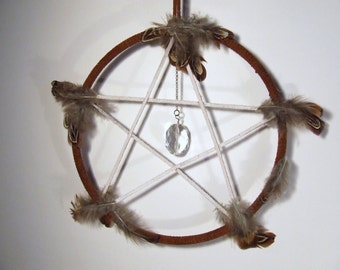
A pentacle dream catcher is not difficult to make. It requires a circular ring; even a large curtain ring will do. You will also need some thread, string, or heavy crocheting thread to weave the design upon this ring. If you really want to be decorative, you can string tiny beads on the thread and attach little feathers where the string is wound around the ring.

To begin, tie one end of the thread to the ring. Wind the thread around the opposite side of the ring three times at a slight angle from the original attachment, pulling it tight. This will be part of the left leg of the pentacle. Each time you attach the thread to the ring, wind it three times.

Now wind the thread about the ring a short distance from the 1st tying. Your design should look like an inverted V-shape. Pulling the string to the let side of the ring, wind it about the ring a little more than half-way up the side. Adjust it until it looks like the lower angle of the cross-arm of teh pentacle. Now stretch the thread across to the opposite side and wind it about the ring. For the finishing angle, pull the thread back to the point of the beginning.

If you carefully check the angle of the thread each time you prepare to wind it at another point on the ring, you can adjust the design. Make a small loop for hanging at the top of the pentacle.

If you want to string beads on the thread, do it on each section before you wind the thread around the ring. I’ve seen one pentacle dream catcher decorated with a Samhain artificial cobweb and a tiny spider in the center.

Dream catchers do work. They are symbols of personal control over dreams. And the subconscious mind which creates dreams only understands symbols.

Faery Herbal Pouch

Faery Herbal Pouch

 
Function: to establish or maintain an energy connection with the Other People, create the pillow and hang from a tree in the yard, a fence post, or place somewhere indoors:

a. to attract Faeries to dwell in yard and/or home

b. to seek Faerie aid in magick and/or divination

c. to gain Faerie companionship

d. to receive aid in travels to Faerie Realms

e. for dreams of Faeries

f. for Faerie protection of yard/home

Perform during: a Friday, Midsummer Eve, or November 11, Waxing to Full Moon
Materials: select desired herbs, material color, crystals/stones, decorative objects, ribbon color, etc. from Lists of Correspondences that you have in your magick Journal.

Create the Item:

a. select the color of cloth, herbs and stones suitable to purpose

b. sew up the cloth in thread of the chosen color, leaving an opening for the contents

c. stuff the pillow with the herb, stones, et., then sew the rest shut’

Consecrate the Item:

Have pentacle, blessed water, sea salt or burdock root, floral incense, heather sprig [optional], and wand.

a. light a lavender or light gray candle

b. pass the pillow through the Elementals

I call upon the Powers of the Elementals to enliven the magick and stir the energies into this charm that it may call Fair Ones to me! By Earth [sprinkle with salt/root], Air [pass through incense smoke], Fire [pass through candle flame}, and Water [sprinkle with blessed water using heather sprig], I consecrate this pillow [or pouch] to my use. So Mote It Be!

c. set the pillow on the pentacle, wave the wand [or power hand] overhead in a circle:

I gather thy energies to work this spell and do my will. So Mote It Be!

d. touch the pillow with the wand/power hand:

Be thou charged, pouch[or pillow] of Faery[name purpose of pillow or pouch]! It is done! So Mote It Be!

Activate the Item:

a. store in a dark place until Full Moon.

b. place the pillow in the light of the Full Moon:

Come to me Fair Ones,

By the light of thy Faerie Moon!

Bless this charm and grant my booon,

Wish this pillow, [state purpose/intent] comes,

May ye ever abide in friendship with me,

That As I Will, So Mote It Be!

c. let the pillow stay in the moonlight one hour, then place where desired.

Whispering Woods Ogham Course – Lesson Six – The Fordeda’s

Whispering Woods Ogham Course – Lesson Six 
The Fordeda’s  

og-side

Fifth Aicme (Consonants) Forfedas
The Forfedas (extra letters) were invented in the Old Irish period (725 CE to about 950 CE), several centuries after the peak of Ogham usage. They appear to have represented sounds felt to be missing from the original alphabet.

They are not found in any stone inscriptions. It is thought that the Benedictine monks added the forfedas in an effort to make ogham a more literary alphabet with which to record in.
The five forfeda are given as an additional vocalic aicme, with the values, found in Auraicept na n-Éces, (De dúilib feda) and In Lebor Ogaim.

It should be noted that the five forfeda are only known from manuscript tradition, which attributes to them a variety of values.


(ch / k) Éabhadh   (EHV-uh)

Aspen (True Tree)
Word Ogham of Morann Mac Main states:
Snamchain feda, most buoyant of wood, that is ebad, aspen, with him, for fair swimming is wood; that is a name for the great raven. Hence it was put for the letter named the Ogham ebad, for e is a name for salmon, and it is written by ea like the alphabet of the fauna:
From the word-oghams of Mac ind Oic:
Comainm carat, synonym for a friend, aspen, e, in the forest. Hence for its synonymous Ogham letter.
Cosc lobair, corrective of a sick man, woodbine for the Ogham letter, which has taken a name other than it, ebad, aspen, ea.

 
oi (th) Ór    (Oir)

Ivy
Word Ogham of Morann Mac Main states:
Sruitem aicdi, most venerable of structures, i.e., oir, oi, spindle tree, according to fact. Hence it was put for the letter owing to the identity of the name that is between them, to wit, oir is the name of each of them.
From the word-oghams of Mac ind Oic:
Silad clann, growing of plants, that is ur, heath, u with him, for it is uir, the soil of the earth, that causes the growing of the plants that are put into it. Growing of plants, again, said of the soil of the earth, is said of the Ogham letter which has taken the same name with it, each of them is ur.

 
ui (io, ph) Uilleann    (Uilen)

Honeysuckle
Word Ogham of Morann Mac Main states:
Tutmur fid uilleann, juicy wood is woodbine, that is woodbine with him, for it is a name for honeysuckle. Hence it was put for the Ogham named woodbine, ui; for hence was woodbine put for it, for it is a name for honeysuckle.
From the word-oghams of Mac ind Oic:
Cubat n-oll, great equal-length, woodbine, i.e., honeysuckle. Hence for the Ogham letter which it has taken from it, woodbine, ui.

 
ia (p / pe) Ifín     (Iphín)

Gooseberry
Word Ogham of Morann Mac Main states:
Millsem feda, sweetest of wood, that is gooseberry with him, for a name for the tree called pin is millsem feda. Gooseberries are hence named. Hence it was put for the letter named pin, for hence pin, or ifin, io, was put for it.
From the word-oghams of Mac ind Oic:
Amram blais, most wonderful of taste, pin or ifin, gooseberry. Hence for the letter that has taken its name from it, pin or iphin, io.

 
ae (x / xi) Eamhancholl    (Emancholl)

Phagos
Word Ogham of Morann Mac Main states:
Luad soethaig, expression of a weary one, i.e., ach, ah! uch, alas! that is emancoll, ae, with him, for emancoll is taken for ach, though it may be taken for something else. Finit WordOgham of Morann.
The name Eamhancholl means “twinned C”, referring to the shape of the letter, and gives no indication of sound value.
Quiz:
1. The Forfedas were invented in the ___   _____ period.
2. Comainm carat, is which Ogham?
3. Honeysuckle is called?
4. The name Eamhancholl means ________   __.


Source: Researcher & Author: Crick

Website: The Whispering Woods

Magickal Goody of the Day for August 2nd is Lammas Charm for Gathering in Abundance

Magickal Goody of the Day

besom

Lammas Charm for Gathering in Abundance


You will need:

A broom or beson

Ribbon (traditional Lammas colors, green(for abundance) or gold(for prosperity and gathering)

A Sprig of Mint

As far as the broom or beson goes, any broom/besom will do as it is always the intent of your actions that are important. If you don’t have a broom then collect a bundle of twigs and tie time at the top with your ribbon to make a hand shaped broom. The broom/besom is a potent symbo of hearth and home, found in some form in almost every home. It is a traditional magickal tool useful for everyday charms as it has the imprint of its owner firmly on it.

Next take your sprig of mint (ideally from your own garden, or dried mind – put in a pouch. The mint represents abundance and plenty and is easily accessible to obtain.

Take your broom and tie your ribbon around the top. Tie in your sprig of mint or securely fasten your pouch. Take your broom outside, place both hands on the stave and focus on your intention – gathering in the harvest for winter. Turn slowly three times in a clockwise direction then start to sweep towards your door saying:

“By one, two, three and four, sweep Lammas gifts to my door. May abundance be a constant friend by my hearth till Winter’s end.”

If you don’t have an outside space, you can sweep from your front door inwards to either you kitchen or hearth.

Repeat this three times, take your besom back into your house and put it in its usual place. You can leave the ribbon on for as long as you want to. If you have made your own broom you can place it where you consider the heart of your home to be. You can return the mint to the earth and be sure to say thank you for the use and gift of it.