February 18 Astronomy Picture of the Day

Discover the cosmos! Each day a different image or photograph of our fascinating universe is featured, along with a brief explanation written by a professional astronomer.

2022 February 18
Three Clusters in Puppis

Image Credit & CopyrightDave Doctor

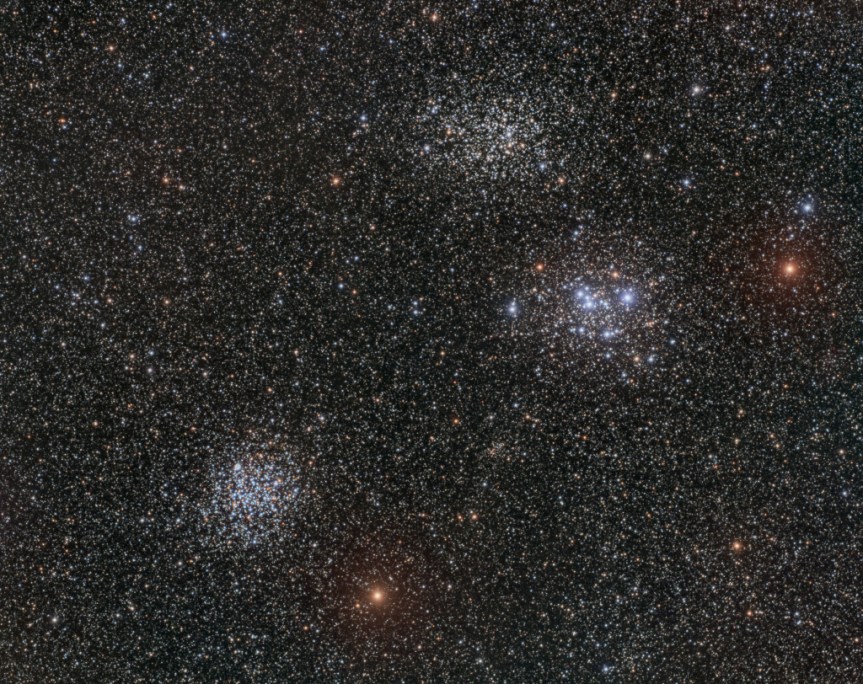
Explanation: Galactic or open star clusters are young. The swarms of stars are born together near the plane of the Milky Way, but their numbers steadily dwindle as cluster members are ejected by galactic tides and gravitational interactions. Caught in this telescopic frame over three degrees across are three good examples of galactic star clusters, seen toward the southern sky’s nautical constellation Puppis. Below and left, M46 is some 5,500 light-years in the distance. Right of center M47 is only 1,600 light-years away and NGC 2423 (top) is about 2500 light-years distant. Around 300 million years young M46 contains a few hundred stars in a region about 30 light-years across. Sharp eyes can spot a planetary nebula, NGC 2438, at about 11 o’clock against the M46 cluster stars. But that nebula’s central star is billions of years old, and NGC 2438 is likely a foreground object only by chance along the line of sight to youthful M46. Even younger, aged around 80 million years, M47 is a smaller and looser star cluster spanning about 10 light-years. Star cluster NGC 2423 is pushing about 750 million years in age though. NGC 2423 is known to harbor an extrasolar planet, detected orbiting one of its red giant stars.
February 17 Astronomy Picture of the Day

Discover the cosmos! Each day a different image or photograph of our fascinating universe is featured, along with a brief explanation written by a professional astronomer.

2022 February 17

Chamaeleon I Molecular Cloud

Image Credit & CopyrightAcquisition: Stas Volskiy (Chilescope.com), Processing: Robert Eder

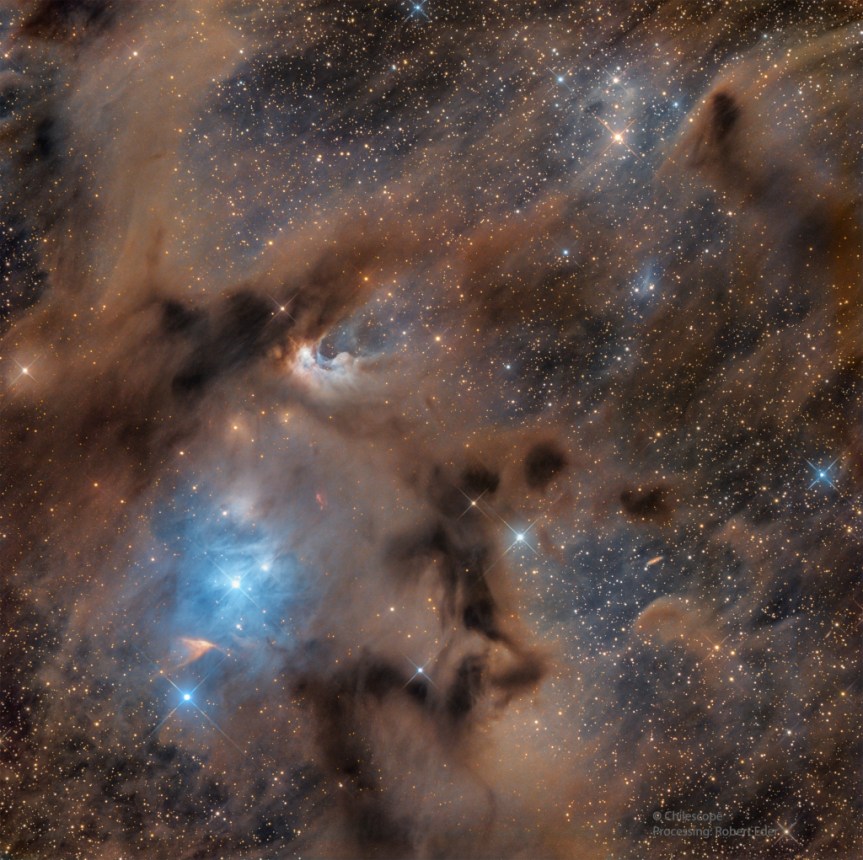
Explanation: Dark markings and bright nebulae in this telescopic southern sky view are telltale signs of young stars and active star formation. They lie a mere 650 light-years away, at the boundary of the local bubble and the Chamaeleon molecular cloud complex. Regions with young stars identified as dusty reflection nebulae from the 1946 Cederblad catalog include the C-shaped Ced 110 just above and left of center, and bluish Ced 111 below it. Also a standout in the frame, the orange tinted V-shape of the Chamaeleon Infrared Nebula (Cha IRN) was carved by material streaming from a newly formed low-mass star. The well-composed image spans 1.5 degrees. That’s about 17 light-years at the estimated distance of the nearby Chamaeleon I molecular cloud.

February 16 Astronomy Picture of the Day

Discover the cosmos! Each day a different image or photograph of our fascinating universe is featured, along with a brief explanation written by a professional astronomer.

2022 February 16

Eiffel Tower Prominence on the Sun

Eiffel Tower Prominence on the Sun
Video Credit & Copyright: Hawk WolinskiExplanation: What’s that on the Sun? Although it may look like a flowing version of the Eiffel Tower, it is a solar prominence that is actually much bigger — about the height of Jupiter. The huge prominence emerged about ten days ago, hovered over the Sun’s surface for about two days, and then erupted — throwing a coronal mass ejection (CME) into the Solar System. The featured video, captured from the astrophotographer’s backyard in HendersonvilleTennessee, USA, shows an hour time-lapse played both forwards and backwards. That CME did not impact the Earth, but our Sun had unleashed other recent CMEs that not only triggered Earthly auroras, but puffed out the Earth’s atmosphere enough to cause just-launched Starlink satellites to fall back. Activity on the Sun, including sunspotsprominences, CMEs and flares, continues to increase as the Sun evolves away from a deep minimum in its 11-year magnetic cycle.


Birthday Surprise: What picture did APOD feature on your birthday? (post 1995)

February 15 Astronomy Picture of the Day

Discover the cosmos! Each day a different image or photograph of our fascinating universe is featured, along with a brief explanation written by a professional astronomer.

2022 February 15

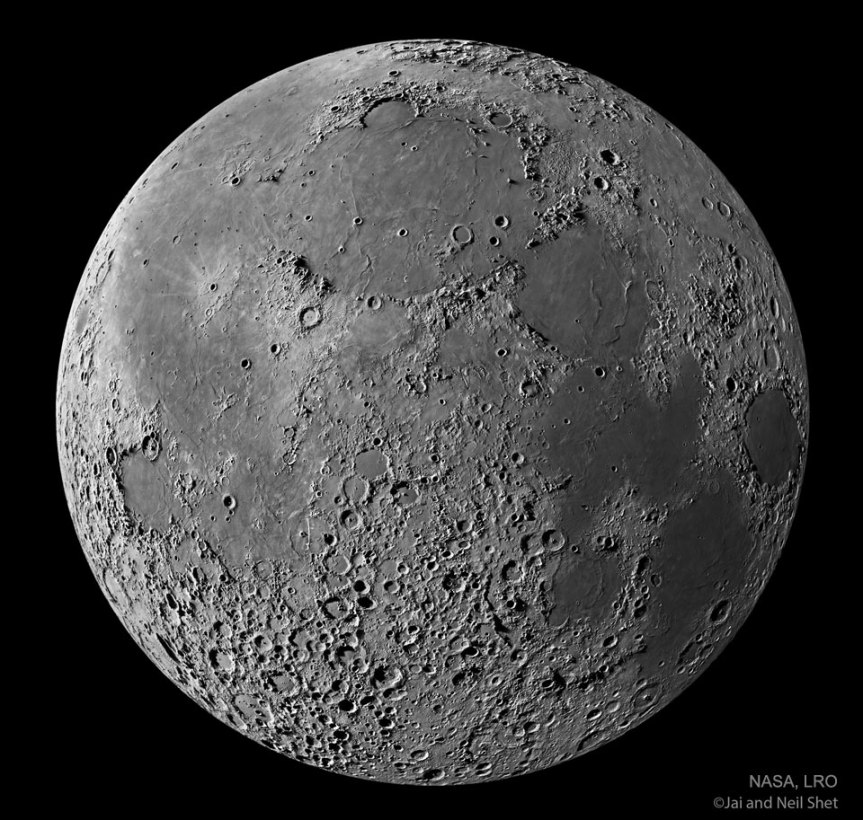
Terminator Moon

Image Credit: NASALunar Reconnaissance OrbiterSVSProcessing & Copyright: Jai & Neil Shet

Explanation: What’s different about this Moon? It’s the terminators. In the featured image, you can’t directly see any terminator — the line that divides the light of day from the dark of night. That’s because the image is a digital composite of 29 near-terminator lunar strips. Terminator regions show the longest and most prominent shadows — shadows which, by their contrast and length, allow a flat photograph to appear three-dimensional. The original images and data were taken near the Moon by NASA’s Lunar Reconnaissance Orbiter. Many of the Moon’s craters stand out because of the shadows they all cast to the right. The image shows in graphic detail that the darker regions known as maria are not just darker than the rest of the Moon — they are flatter.


Dial-A-Moon: Find the phase of the Moon on your birthday.

February 14 Astronomy Picture of the Day

Discover the cosmos! Each day a different image or photograph of our fascinating universe is featured, along with a brief explanation written by a professional astronomer.

2022 February 14

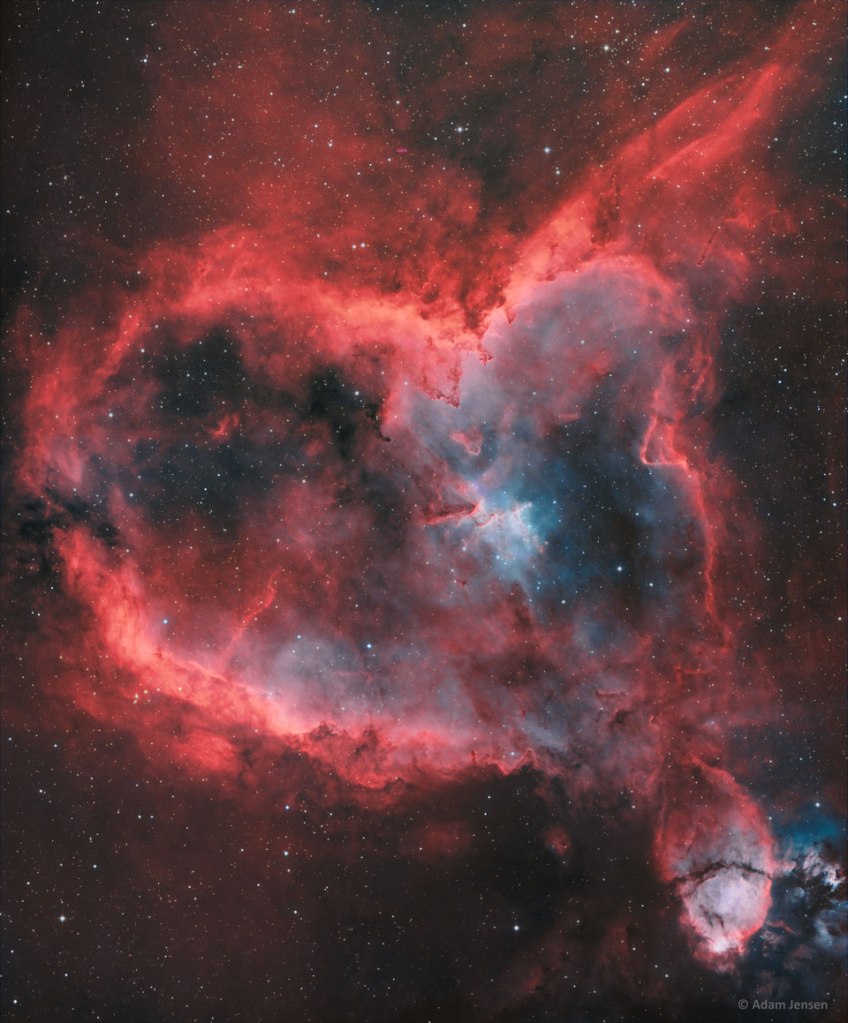
In the Heart of the Heart Nebula

Image Credit & Copyright: Adam JensenExplanation: What excites the Heart Nebula? First, the large emission nebula dubbed IC 1805 looks, in whole, like a human heart. Its shape perhaps fitting of the Valentine’s Day, this heart glows brightly in red light emitted by its most prominent element: excited hydrogen. The red glow and the larger shape are all created by a small group of stars near the nebula’s center. In the heart of the Heart Nebula are young stars from the open star cluster Melotte 15 that are eroding away several picturesque dust pillars with their energetic light and winds. The open cluster of stars contains a few bright stars nearly 50 times the mass of our Sun, many dim stars only a fraction of the mass of our Sun, and an absent microquasar that was expelled millions of years ago. The Heart Nebula is located about 7,500 light years away toward the constellation of the mythological Queen of Aethiopia (Cassiopeia).

February 13 Astronomy Picture of the Day

Discover the cosmos! Each day a different image or photograph of our fascinating universe is featured, along with a brief explanation written by a professional astronomer.

2022 February 13

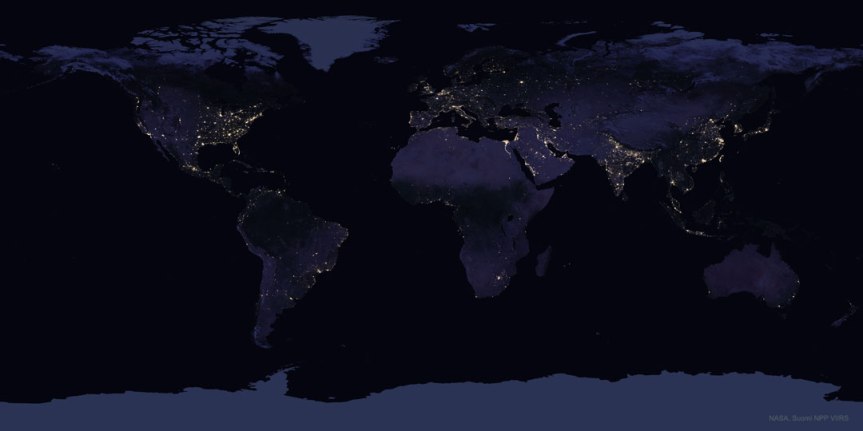
Earth at Night

Image Credit: NASASuomi NPP VIIRSData: Miguel Román (NASA GSFC); Processing: Joshua Stevens

Explanation: This is what the Earth looks like at night. Can you find your favorite country or city? Surprisingly, city lights make this task quite possible. Human-made lights highlight particularly developed or populated areas of the Earth’s surface, including the seaboards of Europe, the eastern United States, and Japan. Many large cities are located near rivers or oceans so that they can exchange goods cheaply by boat. Particularly dark areas include the central parts of South AmericaAfricaAsia, and Australia. The featured image, nicknamed Black Marble, is actually a composite of hundreds of pictures remade in 2016 from data taken by the orbiting Suomi NPP satellite.

February 12 Astronomy Picture of the Day

Discover the cosmos! Each day a different image or photograph of our fascinating universe is featured, along with a brief explanation written by a professional astronomer.

2022 February 12

Aurora by Moonlight

Image Credit & CopyrightP-M Hedén (Clear SkiesTWAN)

Explanation: The ice was singing as light from a bright gibbous Moon cast shadows across this frozen lake, about 20 kilometers north of Stockholm, Sweden, planet Earth. In the alluring night skyscape captured on February 10, shimmering auroral curtains of light dance in the evening sky. On that northern night nature’s performance included the auroral displays fostered by a minor geomagnetic storm. Stormy space weather was the result of a coronal mass ejection, erupting from a solar prominence days earlier and brushing our fair planet’s magnetosphere.

February 11 Astronomy Picture of the Day

Discover the cosmos! Each day a different image or photograph of our fascinating universe is featured, along with a brief explanation written by a professional astronomer.

2022 February 11

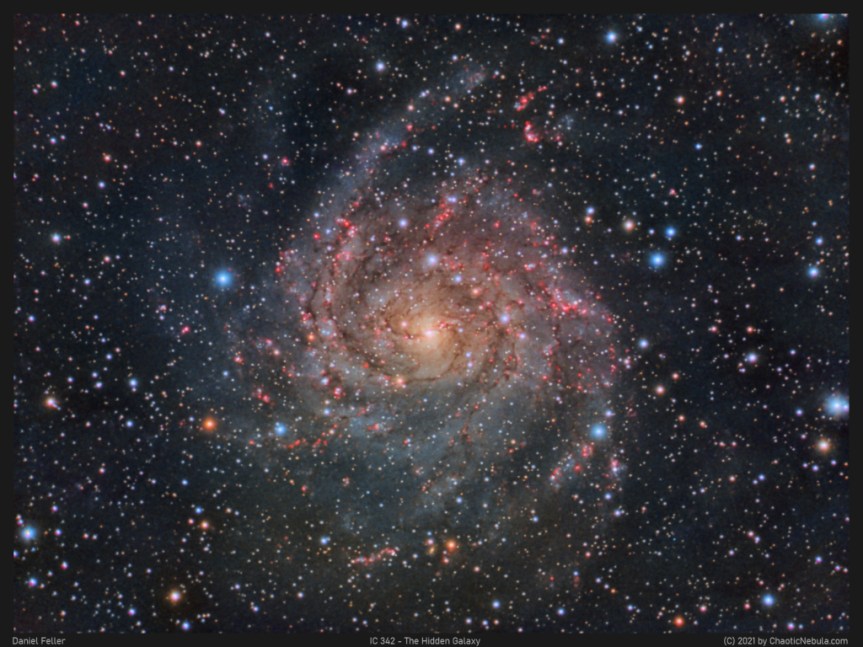
IC 342: The Hidden Galaxy in Camelopardalis

Image Credit & CopyrightDaniel Feller

Explanation: Similar in size to large, bright spiral galaxies in our neighborhood, IC 342 is a mere 10 million light-years distant in the long-necked, northern constellation Camelopardalis. A sprawling island universe, IC 342 would otherwise be a prominent galaxy in our night sky, but it is hidden from clear view and only glimpsed through the veil of stars, gas and dust clouds along the plane of our own Milky Way galaxy. Even though IC 342’s light is dimmed and reddened by intervening cosmic clouds, this sharp telescopic image traces the galaxy’s own obscuring dust, young star clusters, and glowing pink star forming regions along spiral arms that wind far from the galaxy’s core. IC 342 may have undergone a recent burst of star formation activity and is close enough to have gravitationally influenced the evolution of the local group of galaxies and the Milky Way.

February 9 Astronomy Picture of the Day

Discover the cosmos! Each day a different image or photograph of our fascinating universe is featured, along with a brief explanation written by a professional astronomer.

2022 February 9

Eta Car: 3D Model of the Most Dangerous Star Known

Video Credit: NASACXC, April Hobart; Text: Michael F. Corcoran (NASACatholic U.HEAPOW)Explanation: What’s the most dangerous star near earth? Many believe it’s Eta Carinae, a binary star system about 100 times the mass of the Sun, just 10,000 light years from earth. Eta Carinae is a ticking time bomb, set to explode as a supernova in only a few million years, when it may bathe the earth in dangerous gamma rays. The star suffered a notorious outburst in the 1840s when it became the brightest star in the southern sky, only to fade to obscurity within decades. The star was not destroyed, but lies hidden behind a thick, expanding, double-lobed structure called the Homunculus which now surrounds the binary. Studies of this ejecta provide forensic clues about the explosion. Using observations from NASA satellites we can now visualize the 3D distribution of the shrapnel, all the way from the infrared, through optical and UV, to the outermost shell of million-degree material, visible only in X-rays.

February 8 Astronomy Picture of the Day

Discover the cosmos! Each day a different image or photograph of our fascinating universe is featured, along with a brief explanation written by a professional astronomer.

2022 February 8

Aurora and Light Pillars over Norway

Image Credit & Copyright: Alexandre Correia

Explanation: Which half of this sky is your favorite? On the left, the night sky is lit up by particles expelled from the Sun that later collided with Earth’s upper atmosphere — creating bright auroras. On the right, the night glows with ground lights reflected by millions of tiny ice crystals falling from the sky — creating light pillars. And in the center, the astrophotographer presents your choices. The light pillars are vertical columns because the fluttering ice-crystals are mostly flat to the ground, and their colors are those of the ground lights. The auroras cover the sky and ground in the green hue of glowing oxygen, while their transparency is clear because you can see stars right through them. Distant stars dot the background, including bright stars from the iconic constellation of Orion. The featured image was captured in a single exposure two months ago near KautokeinoNorway.


Favorite sky half: Left half (aurora) | Right half (light pillars)

February 5 Astronomy Picture of the Day

Discover the cosmos! Each day a different image or photograph of our fascinating universe is featured, along with a brief explanation written by a professional astronomer.

2022 February 5

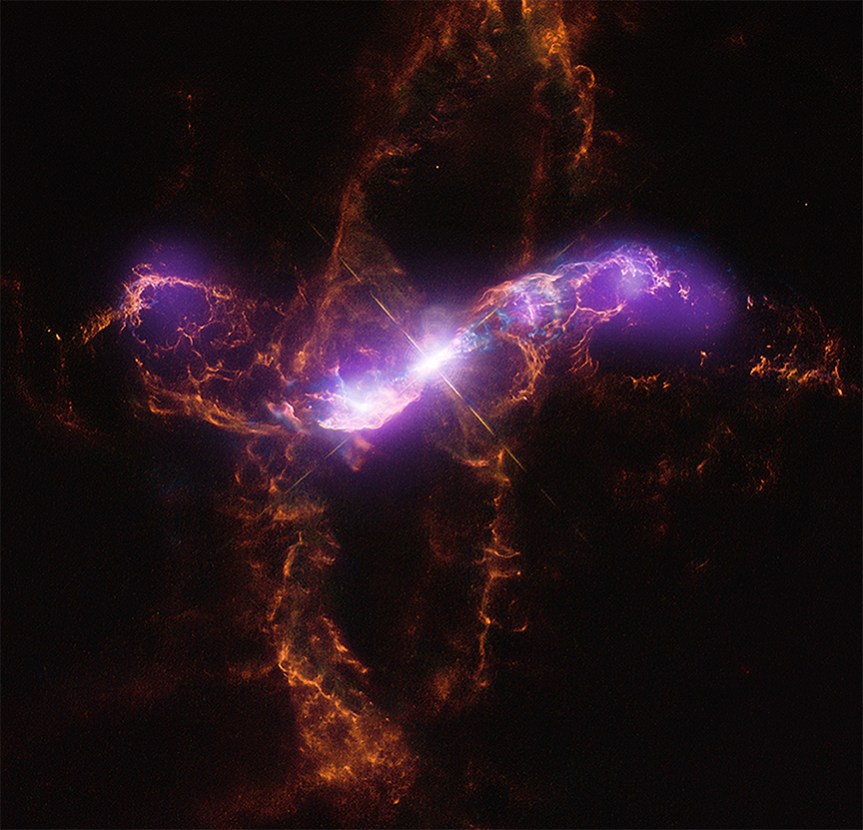
Symbiotic R Aquarii

Image Credit: X-ray: NASA/CXC/SAO/R. Montez et al.; Optical: Data: NASA/ESA/STScI, Processing: Judy Schmidt (CC BY-NC-SA)

Explanation: Variable star R Aquarii is actually an interacting binary star system, two stars that seem to have a close symbiotic relationship. Centered in this space-based optical/x-ray composite image it lies about 710 light years away. The intriguing system consists of a cool red giant star and hot, dense white dwarf star in mutual orbit around their common center of mass. With binoculars you can watch as R Aquarii steadily changes its brightness over the course of a year or so. The binary system’s visible light is dominated by the red giant, itself a Mira-type long period variable star. But material in the cool giant star’s extended envelope is pulled by gravity onto the surface of the smaller, denser white dwarf, eventually triggering a thermonuclear explosion, blasting material into space. Astronomers have seen such outbursts over recent decades. Evidence for much older outbursts is seen in these spectacular structures spanning almost a light-year as observed by the Hubble Space Telescope (in red and blue). Data from the Chandra X-ray Observatory (in purple) shows the X-ray glow from shock waves created as a jet from the white dwarf strikes surrounding material.

February 4 Astronomy Picture of the Day

Discover the cosmos! Each day a different image or photograph of our fascinating universe is featured, along with a brief explanation written by a professional astronomer.

2022 February 4

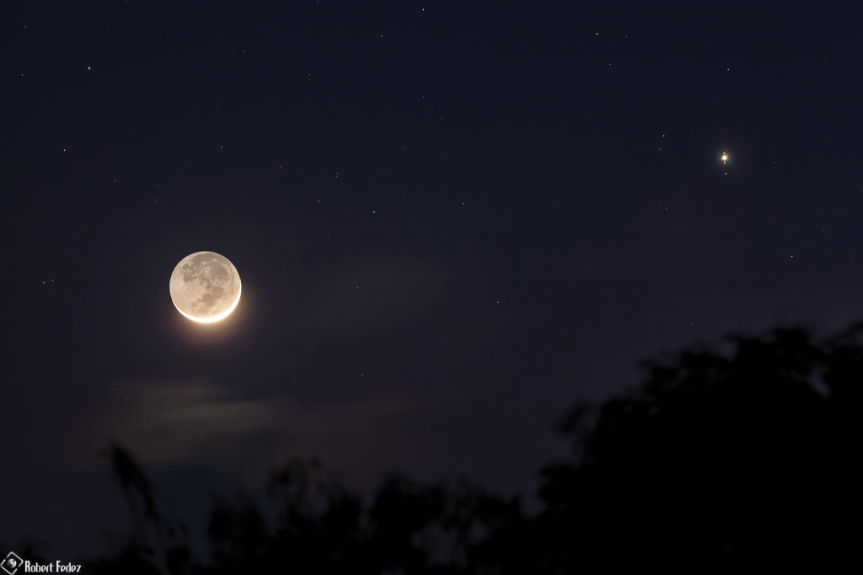
Moons at Twilight

Image Credit & Copyright: Robert Fedez

Explanation: Even though Jupiter was the only planet visible in the evening sky on February 2, it shared the twilight above the western horizon with the Solar System’s brightest moons. In a single exposure made just after sunset, the Solar System’s ruling gas giant is at the upper right in this telephoto field-of-view from Cancun, Mexico. The snapshot also captures our fair planet’s own natural satellite in its young crescent phase. The Moon’s disk looms large, its familiar face illuminated mostly by earthshine. But the four points of light lined-up with Jupiter are Jupiter’s own large Galilean moons. Top to bottom are Ganymede, [Jupiter], Io, Europa, and Callisto. Ganymede, Io, and Callisto are physically larger than Earth’s Moon while water world Europa is only slightly smaller.

February 3 Astronomy Picture of the Day

Discover the cosmos! Each day a different image or photograph of our fascinating universe is featured, along with a brief explanation written by a professional astronomer.

2022 February 3

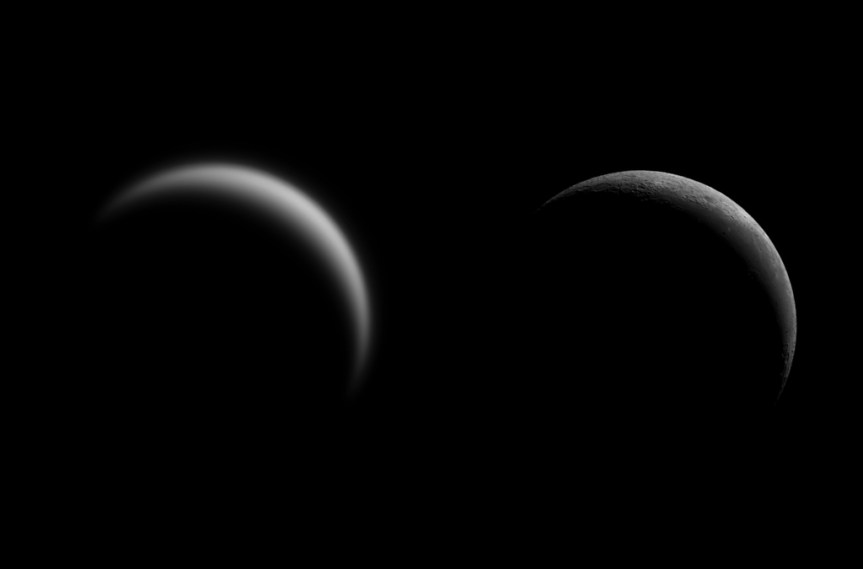
Embraced by Sunlight

Image Credit & Copyright: Juan Luis Cánovas Pérez

Explanation: Even though Venus (left) was the brightest planet in the sky it was less than 1/30th the apparent size of the Moon on January 29. But as both rose before the Sun they shared a crescent phase, and for a moment their visible disks were each about 12 percent illuminated as they stood above the southeastern horizon. The similar sunlit crescents were captured in these two separate images. Made at different magnifications, each panel is a composite of stacked video frames taken with a small telescope. Venus goes through a range of phases like the Moon as the inner planet wanders from evening sky to morning sky and back again with a period of 584 days. Of course the Moon completes its own cycle of phases, a full lunation, in about 29.5 days.

February 2 Astronomy Picture of the Day

Discover the cosmos! Each day a different image or photograph of our fascinating universe is featured, along with a brief explanation written by a professional astronomer.

2022 February 2

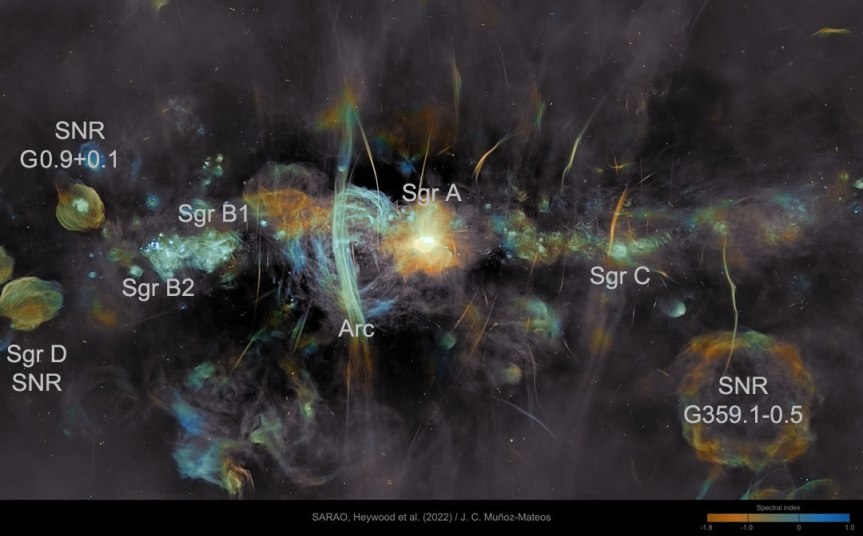
The Galactic Center in Radio from MeerKAT

Image Credit: Ian Heywood (Oxford U.), SARAOColor Processing: Juan Carlos Munoz-Mateos (ESO)

Explanation: What’s happening at the center of our galaxy? It’s hard to tell with optical telescopes since visible light is blocked by intervening interstellar dust. In other bands of light, though, such as radio, the galactic center can be imaged and shows itself to be quite an interesting and active place. The featured picture shows the latest image of our Milky Way’s center by the MeerKAT array of 64 radio dishes in South Africa. Spanning four times the angular size of the Moon (2 degrees), the image is impressively vast, deep, and detailed. Many known sources are shown in clear detail, including many with a prefix of Sgr, since the galactic center is in the direction of the constellation Sagittarius. In our Galaxy’s Center lies Sgr A, found here in the image center, which houses the Milky Way’s central supermassive black hole. Other sources in the image are not as well understood, including the Arc, just to the left of Sgr A, and numerous filamentary threads. Goals for MeerKAT include searching for radio emission from neutral hydrogen emitted in a much younger universe and brief but distant radio flashes.


Open Science: Browse 2,700+ codes in the Astrophysics Source Code Library

Astronomy Picture of the Day

Discover the cosmos! Each day a different image or photograph of our fascinating universe is featured, along with a brief explanation written by a professional astronomer.

2022 February 1

Video on the Moon phases for 2022

Moon Phases 2022

Video Credit: Data: Lunar Reconnaissance Orbiter ; Animation: NASA‘s Scientific Visualization Studio;
Music: Build the Future (Universal Production Music), Alexander Hitchens

Explanation: What will the Moon phase be on your birthday this year? It is hard to predict because the Moon’s appearance changes nightly. As the Moon orbits the Earth, the half illuminated by the Sun first becomes increasingly visible, then decreasingly visible. The featured video animates images and altitude data taken by NASA’s Moon-orbiting Lunar Reconnaissance Orbiter to show all 12 lunations that appear this year, 2022 — as seen from Earth’s northern (southern) hemisphere. A single lunation describes one full cycle of our Moon, including all of its phases. A full lunation takes about 29.5 days, just under a month (moon-th). As each lunation progresses, sunlight reflects from the Moon at different angles, and so illuminates different features differently. During all of this, of course, the Moon always keeps the same face toward the Earth. What is less apparent night-to-night is that the Moon‘s apparent size changes slightly, and that a slight wobble called a libration occurs as the Moon progresses along its elliptical orbit.

Astronomy Picture of the Day

Discover the cosmos! Each day a different image or photograph of our fascinating universe is featured, along with a brief explanation written by a professional astronomer.

2022 January 30

A Solar Prominence from SOHO

Image Credit: NASAESASOHO-EIT Consortium

Explanation: How can gas float above the Sun? Twisted magnetic fields arching from the solar surface can trap ionized gas, suspending it in huge looping structures. These majestic plasma arches are seen as prominences above the solar limb. In 1999, this dramatic and detailed image was recorded by the Extreme ultraviolet Image Telescope (EIT) on board the space-based SOHO observatory in the light emitted by ionized Helium. It shows hot plasma escaping into space as a fiery prominence breaks free from magnetic confinement a hundred thousand kilometers above the Sun. These awesome events bear watching as they can affect communications and power systems over 100 million kilometers away on planet Earth. In late 2020 our Sun passed the solar minimum of its 11-year cycle and is now showing increased surface activity.

Astronomy Picture of the Day

Discover the cosmos! Each day a different image or photograph of our fascinating universe is featured, along with a brief explanation written by a professional astronomer.

2022 January 29

The Fornax Cluster of Galaxies

Image Credit & Copyright: Marco Lorenzi, Angus Lau, Tommy Tse

Explanation: Named for the southern constellation toward which most of its galaxies can be found, the Fornax Cluster is one of the closest clusters of galaxies. About 62 million light-years away, it is almost 20 times more distant than our neighboring Andromeda Galaxy, and only about 10 percent farther than the better known and more populated Virgo Galaxy Cluster. Seen across this two degree wide field-of-view, almost every yellowish splotch on the image is an elliptical galaxy in the Fornax cluster. Elliptical galaxies NGC 1399 and NGC 1404 are the dominant, bright cluster members toward the upper left (but not the spiky foreground stars). A standout barred spiral galaxy NGC 1365 is visible on the lower right as a prominent Fornax cluster member.

Astronomy Picture of the Day

Discover the cosmos! Each day a different image or photograph of our fascinating universe is featured, along with a brief explanation written by a professional astronomer.

2022 January 27

South of Orion

Image Credit & Copyright: Vikas Chander

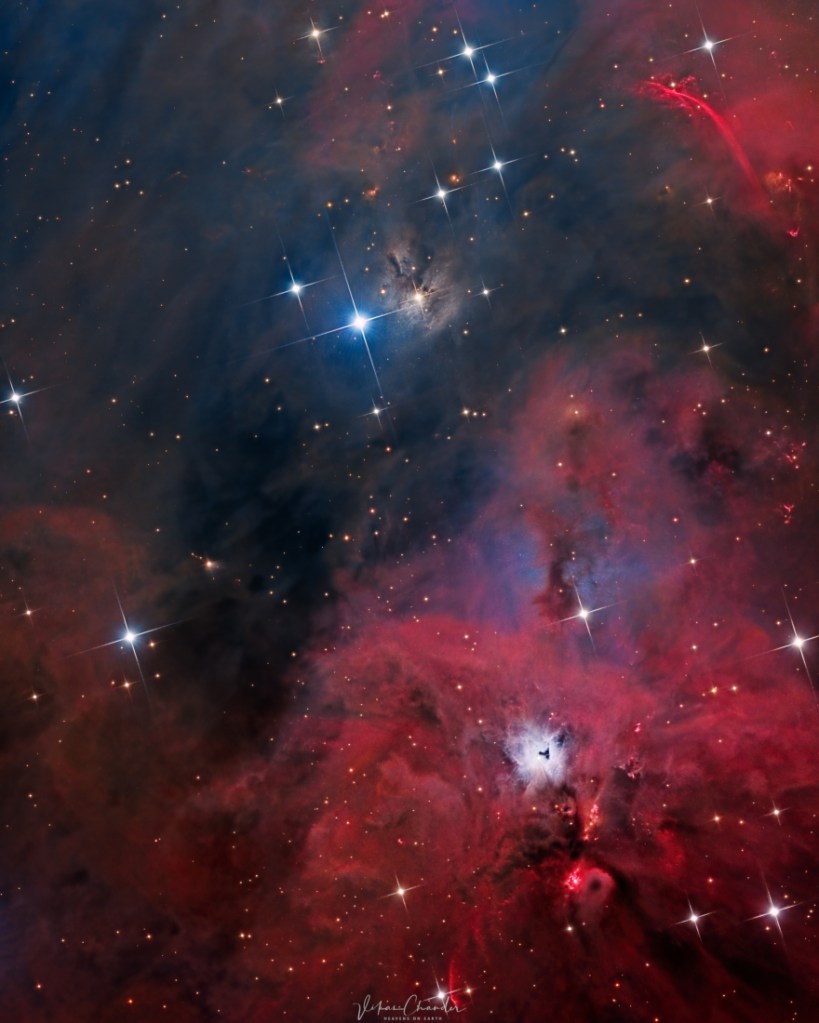
Explanation: South of the large star-forming region known as the Orion Nebula, lies bright blue reflection nebula NGC 1999. At the edge of the Orion molecular cloud complex some 1,500 light-years distant, NGC 1999’s illumination is provided by the embedded variable star V380 Orionis. The nebula is marked with a dark sideways T-shape at center right in this telescopic vista that spans about two full moons on the sky. Its dark shape was once assumed to be an obscuring dust cloud seen in silhouette. But infrared data suggest the shape is likely a hole blown through the nebula itself by energetic young stars. In fact, this region abounds with energetic young stars producing jets and outflows with luminous shock waves. Cataloged as Herbig-Haro (HH) objects, named for astronomers George Herbig and Guillermo Haro, the shocks have intense reddish hues. HH1 and HH2 are just below and right of NGC 1999. HH222, also known as the Waterfall nebula, looks like a red gash near top right in the frame. To create the shocks stellar jets push through the surrounding material at speeds of hundreds of kilometers per second.

Astronomy Picture of the Day

Discover the cosmos! Each day a different image or photograph of our fascinating universe is featured, along with a brief explanation written by a professional astronomer.

2022 January 26

Stars, Dust, and Gas Near Antares

Image Credit & Copyright: Mario Cogo (Galax Lux)

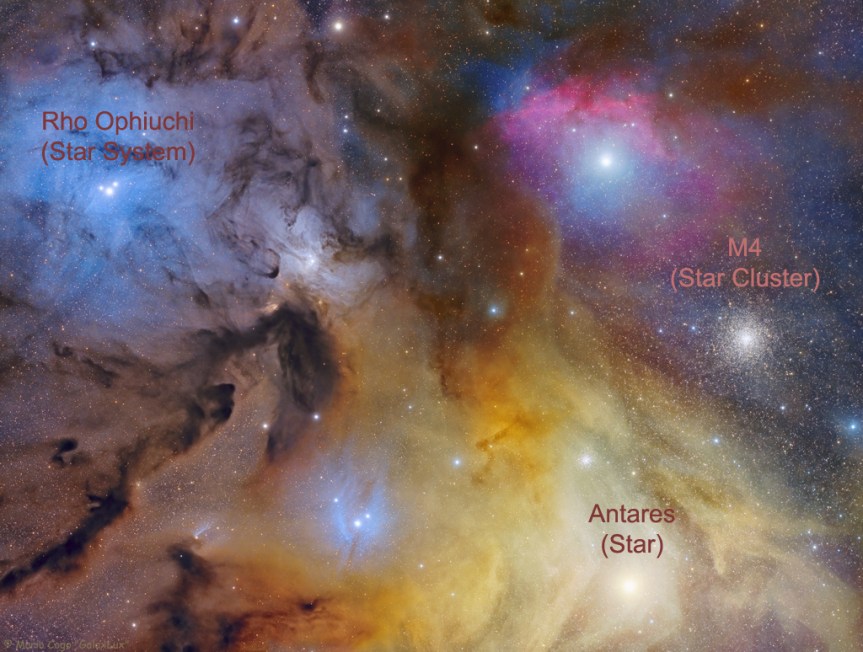
Explanation: Why is the sky near Antares and Rho Ophiuchi so dusty yet colorful? The colors result from a mixture of objects and processes. Fine dust — illuminated from the front by starlight — produces blue reflection nebulae. Gaseous clouds whose atoms are excited by ultraviolet starlight produce reddish emission nebulae. Backlit dust clouds block starlight and so appear darkAntares, a red supergiant and one of the brighter stars in the night sky, lights up the yellow-red clouds on the lower right of the featured image. The Rho Ophiuchi star system lies at the center of the blue reflection nebula on the top left. The distant globular cluster of stars M4 is visible above and to the right of Antares. These star clouds are even more colorful than humans can see, emitting light across the electromagnetic spectrum.

Astronomy Picture of the Day

Discover the cosmos! Each day a different image or photograph of our fascinating universe is featured, along with a brief explanation written by a professional astronomer.

2022 January 25

Video: Comet Leonard over One Hour

Video Credit & Copyright: Matipon Tangmatitham (NARIT); Text: Matipon TangmatithamExplanation: Which direction is this comet heading? Judging by the tail, one might imagine that Comet Leonard is traveling towards the bottom right, but a full 3D analysis shows it traveling almost directly away from the camera. With this perspective, the dust tail is trailed towards the camera and can only be seen as a short yellow-white glow near the head of the comet. The bluish ion tail, however, is made up of escaping ions that are forced directly away from the Sun by the solar wind — but channeled along the Sun’s magnetic field lines. The Sun’s magnetic field is quite complex, however, and occasionally solar magnetic reconnection will break the ion tail into knots that are pushed away from the Sun. One such knot is visible in the featured one-hour time-lapse video captured in late December from ThailandComet Leonard is now fading as it heads out of our Solar System.


Gallery: Notable images submitted to APOD of Comet Leonard in 2021