Spell to Bring About a Need

SPELL TO BRING ABOUT A NEED


You need a candle to represent the need, a card to represent yourself, 4 cards to represent your need.

Light the candle. 

Lay the card that represent you on the altar and say: 


“May this card represent thee” 


Pick up the rest of the cards and say: 


“As I place these cards at the quarters shall my need be seen” 


Lay the cards at the quarters as you go say the card’s name and the need. Then say: 


Fulfill my need as quick as can be 
by the power of three bring the (need) to me, so mote it be” 

Astronomy Picture of the Day – Stickney Crater 

Astronomy Picture of the Day

Discover the cosmos! Each day a different image or photograph of our fascinating universe is featured, along with a brief explanation written by a professional astronomer.

2018 May 5

Stickney Crater 
Image Credit: HiRISEMROLPL (U. Arizona)NASA


Explanation: Stickney Crater, the largest crater on the martian moon Phobos, is named for Chloe Angeline Stickney Hall, mathematician and wife of astronomer Asaph Hall. Asaph Hall discovered both the Red Planet’s moons in 1877. Over 9 kilometers across, Stickney is nearly half the diameter of Phobos itself, so large that the impact that blasted out the crater likely came close to shattering the tiny moon. This stunning, enhanced-color image of Stickney and surroundings was recorded by the HiRISE camera onboard the Mars Reconnaissance Orbiter as it passed within some six thousand kilometers of Phobos in March of 2008. Even though the surface gravity of asteroid-like Phobos is less than 1/1000th Earth’s gravity, streaks suggest loose material slid down inside the crater walls over time. Light bluish regions near the crater’s rim could indicate a relatively freshly exposed surface. The origin of the curious grooves along the surface is mysterious but may be related to the crater-forming impact.

Your Earth Sky News for May 5th: Don’t miss moon and Mars on May 6

Don’t miss moon and Mars on May 6

From around the world tonight – May 5, 2018 – if you’re a night owl, you might catch the moon and the red planet Mars climbing above your eastern horizon before your bedtime. From mid-northern latitudes (U.S., Canada, Europe and Russia), the twosome won’t rise until after midnight. From the Southern Hemisphere, they’ll will be up by late evening. Click here for recommended sky almanacs; they can give you the rising time of the moon and Mars in your sky.

Or … get up before daybreak to see the waning gibbous moon and Mars. They’ll be highest up for the night around dawn.

Mars is the planet to watch in 2018. By July, it’ll be brighter in our sky than it’s been since 2003. The chart below shows the cycle of oppositions for Mars, and why, every 15 or so year, we see Mars as brightest:

What’s more, you’ll see two other bright planets in the predawn sky: Saturn and Jupiter.

Golden Saturn gleams close to Mars before dawn.

Cream-colored Jupiter is farther away from Mars and the moon in the May 6 morning sky, but Jupiter is unmistakably bright. In fact, in May 2018, dazzling Jupiter shines nearly all night. Watch for Jupiter in your eastern sky at nightfall. Then watch for Jupiter to climb highest up for the night around midnight and to sit low in the west at morning dawn. Earth will fly more or less between Jupiter and the sun – bringing Jupiter to its annual opposition – on May 8-9.

If you live in the Southern Hemisphere or the northern tropics, you also have a reasonably good chance of catching Mercury, the innermost planet of our solar system. Look east, near the sunrise point on the horizon as the predawn darkness is giving way to morning dawn. The moon will be in the vicinity of Mercury on May 12 and 13, as shown on the charts below. Note that the first chart is for the Southern Hemisphere. The second chart is for the Northern Hemisphere, where the view is nowhere near as good:

You can also see Venus, the brightest planet of all, for an hour or two in the evening sky this month. Venus shines opposite of Jupiter at evening dusk in May 2018, and sets beneath the western horizon by nightfall or early evening.

Bottom line: Don’t miss the moon and Mars together in the predawn sky on May 6, 2018. Plus a word about other bright planets you can see in May.


Published on EarthSky


Your Karmic Number for Saturday, May 5th is Three

Your Karmic Number for Today

Life is a bit hard to piece together lately if you’ve drawn out a 3 in opposition like you have now. Jigsaw puzzles can be fun and relaxing. They help pass the time. It is messy when your life is in a thousand pieces. You have pieces missing, so the picture is incomplete. Change your diet. Drink more water, detox, exercise. Do some breathing techniques, journal. Confide in a good friend about your challenges. You are overdue for a purge of the toxins in your life. You will find what you need in unexpected ways.

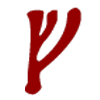
Your Daily Rune for May 5th is Fehu

Your Daily Rune for Today

Fehu

“Fay-Who” – Literally: “Cattle” – Esoteric: Mobile Property, New Beginnings, Wealth

Key Concepts: Wealth, money, food, sustenance, Hamingja, luck, personal power, circulation of power, financial strength, prosperity

Psi: Beginner’s Mind, presence, freedom, first impressions, young love

Energy: mobility, luck, charisma, dynamic power, liquid and mobile transferable energies, abundance, circulation, ‘mana’, sexual attraction

Mundane: money, recent purchases, reputation, freshness, fashionability

Divinations: New beginnings, social success, foresight, energy, travel, money, control; or greed, failure, atrophy, poverty, endings.

Governs:

  • Delegating your energy to another, power transference or projection; the sending rune
  • Drawing gravity into the personal sphere
  • Promotion of personal and social evolution, changing circumstances of importance
  • Increase in personal monetary wealth
  • Beginner’s mind and presence as a tool for consciously creating a fresh start


Your Ancient Symbol Card for May 5th is The Crystal

Your Ancient Symbol Card for Today

The Crystal

The Crystal glows with the power of mystical truths transformed into material realities. The Crystal denotes a self with a powerful connection to the spiritual world that allows them to literally soak up cosmic wisdom and apply it favorably to their everyday life. It suggest a tremendous growth of one’s spiritual self that will greatly impact the querant’s secular life.

As a daily card, The Crystal indicates a time when you are likely to be well served by allowing your spiritual self to guide your day to day behavior.


Your Past Life Tarot Card for May 5th is The Star

Your Past Life Tarot Card for Today

The Star

When you stand up for other’s rights you can stir deeply-seated past life memories in yourself. The origin of these feelings might come from having a past life experience of your own family’s struggle. At this time the civil rights leader inside you has come to the forefront. This spirit is more afraid of not standing up for what he or she believes in then fearful of what retribution one could face. This incarnation comes with an inner strength that is founded in compassion.


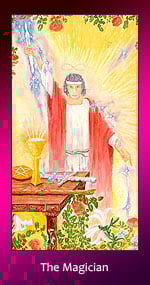
Your Daily Love Tarot Card for May 5th is The Magician

Your Daily Love Tarot Card for Today

The Magician

Do some magic of your own today, like penetrating facades and gaining insights into dubious stories that lack credibility. Hold onto your heartstrings until you know you haven’t met a fickle flirt or a trickster. The Magician makes us see what we want to see regardless of the reality of a situation. He draws us in because we love secrets and mysteries, but who wants to live with them day after day and year after year?


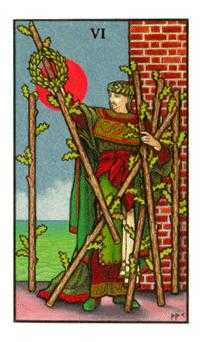
Tarot Card of the Day for Saturday, May 5th is Six of Wands

Tarot Card of the Day

Six of Wands


This suit, most often called “Wands” and sometimes called “Rods” or “Staves,” represents initiative, ambition, drive and desire. This is the suit of enterprise and risk-taking.

The Six of this suit points to the respect and acknowledgment due to you for your efforts to solve the problems of your community. The image is usually of a victory parade, after the celebrated leader helped troops win a pivotal battle.

It took the whole tribe to win the victory, of course, but it was the leader’s heroism and clarity under pressure that inspired them to overcome. The team is thrilled that the leader led them to victory. This card points to a time to let everyone relax and celebrate — if you are the leader, let them applaud you. They are seeing their better selves reflected in you — a victory indeed!

Tarot.com is Part of the Daily Insight Group ©2018

If You Were Born Today, May 5


If You Were Born Today, May 5


Determined and often stubborn, you have ambition and can work hard for what you want. You are multi-talented and somewhat restless. While you value stability, you crave stimulation and create new challenges for yourself to reach, which keeps your life in a state of flux. You are a good conversationalist, quite amorous, and especially attractive and magnetic. Famous people born today: Karl Marx, Tammy Wynette, Tyrone Power, Chris Brown, James Beard.

Your Birthday Year Forecast

With the Sun and Moon in harmony in your Solar Return chart, the year ahead should be satisfying and balanced overall. You are in comfortable demand and personally popular, and you are able to achieve a decent balance between work and play; personal and professional life. For the most part, you are on top of your game this year, and positive connections with others can be made fairly easily. With the ability to handle your emotions successfully, there is less stress on both your mind and body. Your self-confidence and positive attitude will reward you!

A Neptune transit influences you this year, softening and smoothing rough edges. You are gentler, more intuitive, spiritual, and creative with this transit, and others are drawn to these qualities. Your natural ability to help others heal and calm down is enhanced. A higher purpose to your life is what you seek, and you rely more heavily upon your intuition in order to achieve it. You could find that your intuition is subtly enhanced and that you’re often in the right place at the right time, probably because your hunches are more likely to be correct. You’re tuning into your imaginative and artistic side. It’s a good period for self-improvement programs or efforts. The need to “get away from it all” — for some peace and quiet now and again — will be strong. A more sensitive, even mysterious, persona is projected, and this can attract pleasantly unusual circumstances (and people) into your life. You will want to spend more time away from chaotic situations.

From February 2019 forward, you have a strong, protective, and stabilizing influence with you as Saturn forms a harmonious aspect to your Sun. This transit helps you stay on track and meet your responsibilities. Your popularity tends to be strong, and your leadership skills are valued. Work you have done in the past begins to pay off this year–not necessarily in dramatic ways, but in small, measurable ways. You may be recognized or rewarded in some manner for the efforts you put forth. Because you project a more responsible and credible “you”, people in authority are more inclined to appreciate you and recognize your work. During these months, you can put your life in order in some significant manner. Improved concentration, a more realistic outlook, and a practical awareness of the limits of time all help you to make steady progress, particularly in your career. Your concern for your future at this time is stronger than usual, and you may find that projects you start, or investments you make, will benefit you for years to come.

Your ambition is stimulated, and you are determined to meet or exceed your goals. You can bring great discipline and meaning to your life this year. You might totally revise an important project or area of your life, or you could be bent on getting rid of something in your life so that you can move forward. The tendency to be too willful this year should probably be avoided. You should also watch for overdoing to the point of exhaustion. This can be a compulsive time when power struggles are more likely. On the other hand, it can be a time when you enjoy a strong sense of purposefulness, focus, and determination.

You are very likely to attract loving relationships and/or new warm social contacts into your life. However, do your best to watch out for tendencies towards self-deception with both love and money. Things might look too good to be true, simply because you want to see the best! Relationship ups and downs are possible, as this could be a year when romantic mirages are more likely.

For the most part, the year ahead is good for public relations, advertising, marketing, studies, short trips, and contacts with the general public. Your judgment is sound. Exchanging ideas, intellectual pursuits, and learning are all exciting and favorable at this time. Researching cooking, health, and nutrition can be fruitful now. Meeting people who share common interests or through your studies can be rewarding.

The year ahead is a mostly steady, protected, and stable year in your life. You are bound to get important matters organized, and, for the most part, adopting a “slowly but surely” approach is your very best bet. Your love or social life is more eventful, largely due to some restlessness. You are determined and focused in the year ahead, and you can move mountains in important areas of your life. It’s a powerful year for making lifestyle changes.

2018 is a Number Three year for you. Ruled by Jupiter. This is a year of sociability. It is a friendly time when you find it natural and easy to enjoy life and other people. The focus is on personal freedom, reaching out to others, making new friends, and exploration. You are more enthusiastic and ready for adventure than you are in other years. It’s likely to be a rather lighthearted year when opportunities for “play” time are greater than usual. It’s also a favorable year for expressing your creativity. Advice – reach out and connect but avoid scattering your energies.

2019 will be a Number Four year for you. Ruled by Uranus. This is a year of work and development. It’s “nose to the grindstone” time. It’s a time to pay special attention to practical matters, and it’s not a time to be lazy or especially gregarious. Sometimes, it can be a year that feels hard, monotonous and routine, and/or lonely. Positive new relationships are often not formed in a Four personal year. However, it can be a wonderful year for building, development, and laying a solid foundation for future successes. Advice – get yourself organized, work to build your resources, keep busy.


Source

Cafe Astrology

Study of Pagan Gods and Goddesses: Loki

Study of Pagan Gods and Goddesses: Loki

In Norse mythology, Loki is known as a trickster. He is described in the Prose Edda as a “contriver of fraud.” It’s important to remember that “trickster” does not mean someone who plays fun jokes and pranks–Loki’s trickery is all about mischief and mayhem.

Origins and History
Although he doesn’t appear often in the Eddas, Loki is generally described as a member of the family of Odin.

There is little archaeological reference to Loki (pronounced LOW-key), but in the small village of Kirkby Stephen, England, there is a tenth-century stone with a carving on it.

It is believed that the bound, horned figure carved upon the stone is in fact Loki, who was likely brought to England by Saxon settlers in the area. Also, near Snaptun, Denmark, there is a stone from around the same time as the Kirkby Stephen stone; the carving on this one is identified as Loki as well, due to scarring on the lips. In a story in which he tries to get the better of the dwarf Brokkr, Loki is disfigured and earns the nickname Scar-lip.

Appearance
Although some Norse deities are often associated with symbols–such as Odin and his ravens, or Thor and his mighty hammer–Loki does not appear to have a particular item assigned to him by the Norse eddas or sagas. While there has been some speculation that he may be associated with particular runes, there is no scholarly or academic evidence to support this. Furthermore, this is an illogical argument in the context of Norse culture; keep in mind that stories and legends were passed down orally, from one generation to the next, and not written down.

Runes were used for divination, but not for written storytelling.

As to his physical appearance, Loki was a shapeshifter and could appear any way he liked. In the Gylfaginning, which is one of the Prose eddas, he is described as being “pleasing and handsome,” but there are no details as to what those words describe.

Early carvings portray him with horns on his head, but those may be a representation of one of the shapes he adopts, rather than his regular form.

Mythology
A shapeshifter who could appear as any animal, or as a person of either sex, Loki was constantly meddling in the affairs of others, mostly for his own amusement. Disguised as a woman, Loki fools Frigga into telling him about the weakness of her son Baldr. Just for fun, Loki tricks Baldr’s blind twin, Hod, into killing him with a spear made of mistletoe. At one point, Loki spent eight years disguised as a milkmaid, and got stuck milking cows because his disguise was so convincing.

Loki is typically described as the husband of the goddess Sigyn, but he seems to have procreated with just about anyone and anything that struck his fancy. Because he could take male or female form, at one point Loki turned himself into a mare and mated with a mighty stallion, so he actually was the mother of Odin’s magical eight-legged horse Sleipnir.

Loki is known for bringing about chaos and discord, but by challenging the gods, he also brings about change. Without Loki’s influence, the gods may become complacent, so Loki does actually serve a worthwhile purpose, much as Coyote does in the Native American tales, or Anansi the spider in West African lore.

Despite his divine or demi-god status, there’s little evidence to show that Loki had a following of worshipers of his own; in other words, his job was mostly to make trouble for other gods, men, and the rest of the world.

For an excellent dissertation looking at Loki in his many forms, read Shawn Christopher Krause-Loner’s paper Scar-lip, Sky-walker, and Mischief-Monger: The Norse God Loki as Trickster. Krause-Loner says,

“[H]is ability to change shape, both sex and species, makes him an ambiguous, in-between figure. He is the only Norse deity who is depicted as having the gift of flight, either by utilizing an artifact or simply through his own ability. Loki’s kenning, Sky-Walker, speaks to his mediating position, neither bound to the ground nor of the heavens.”

Honoring Loki Today

If you’ve spent any time reading Norse mythology, you know that Loki is a bit of an outcast, slightly manic, will do sneaky things for his own amusement, and doesn’t seem to have much respect for boundaries. If you invite Loki into your life, there’s a possibility you won’t be getting rid of him until he’s good and ready to leave.


****************

LOKI


Loki (pronounced “LOAK-ee;” Old Norse Loki, the meaning of which will be discussed below) is the wily trickster god of Norse mythology.

While treated as a nominal member of the gods, Loki occupies a highly ambivalent and ultimately unique position among the gods, giants, and the other kinds of spiritual beings that populate the pre-Christian Norse religion.

His familial relations attest to this. His father is the giant Farbauti (Old Norse Fárbauti, “Cruel Striker”[1]). His mother is Laufey (the meaning of which is unknown) or Nal (Nál, “Needle”[2]). Laufey/Nal could be a goddess, a giantess, or something else entirely – the surviving sources are silent on this point. Loki is the father, by the giantess Angrboda (Angrboða, “Anguish-Boding”), of Hel, the goddess of the underworld; Jormungand, the great serpent who slays Thor during Ragnarok; and Fenrir, the wolf who bites off one of the hands of Tyr and who kills Odin during Ragnarok – hardly a reputable brood, to say the least. As we’ll see below, Loki demonstrates a complete lack of concern for the well-being of his fellow gods, a trait which could be discerned, in vague outline, merely by considering these offspring of his.

With his proper wife Sigyn (“Friend of Victory”[3]), he also has a son named Nari or Narfi, whose name might mean “Corpse.”[4]

Loki often runs afoul not only of societal expectations, but also of what we might call “the laws of nature.” In addition to the progeny listed above, Loki is also the mother – yes, the mother – of Sleipnir, Odin’s shamanic horse, whom Loki gave birth to after shapeshifting into a mare and courting the stallion Svadilfari, as is recounted in the tale of The Fortification of Asgard.

In the tales, Loki is portrayed as a scheming coward who cares only for shallow pleasures and self-preservation. He’s by turns playful, malicious, and helpful, but he’s always irreverent and nihilistic.

For example, in the tale of The Kidnapping of Idun, Loki, by his recklessness, ends up in the hands of a furious giant, Thiazi, who threatens to kill Loki unless he brings him the goddess Idun. Loki complies in order to save his life, and then finds himself in the awkward position of having the gods threaten him with death unless he rescues Idun. He agrees to this request for the same base motive, shifting his shape into that of a falcon and carrying the goddess back to Asgard in his talons. Thiazi pursues him desperately in the form of an eagle, but, having almost caught up with Loki as he nears his destination, the gods light a fire around the perimeter of their fortress. The flames catch Thiazi and burn him to death, while Idun and Loki reach the halls of the gods safely. Loki ultimately comes to the aid of the gods, but only to rectify a calamity for which he himself is responsible. This theme is repeated in numerous tales, such as in The Creation of Thor’s Hammer and the aforementioned The Fortification of Asgard.

After Thiazi’s death, the giant’s daughter, Skadi, arrives in Asgard demanding restitution for the slaying of her father. One of her demands is that the gods make her laugh, something which only Loki is able to do. To accomplish this, he ties one end of a rope to the beard of a goat and the other end to his testicles. Both he and the goat squawk and squeal as one pulls one way and the other pulls the other way. Eventually he falls over in Skadi’s lap, and the giantess can’t help but laugh at such an absurd spectacle. Here, Loki once again comes to the aid of the gods, but simply by being silly and outlandish, not by accomplishing any feat that a Viking Age Scandinavian would have found to be particularly honorable.

Loki alternately helps both the gods and the giants, depending on which course of action is most pleasurable and advantageous to him at the time. During Ragnarok, when the gods and giants engage in their ultimate struggle and the cosmos is destroyed, Loki joins the battle on the side of the giants. According to one Old Norse poem, he even captains the ship Naglfar, “Nail Ship,” which brings many of the giants to their battle with the gods.[5] When the battle for the world is fought, he and the god Heimdall mortally wound each other.

Loki is perhaps best known for his malevolent role in The Death of Baldur. After the death of the beloved god Baldur is prophesied, Baldur’s mother, Frigg, secures a promise from every living thing to not harm her son. Well, almost everything – no such oath is obtained from the mistletoe, which the gods think too small and safe a thing to harm Baldur. Upon discovering this omission, Loki carves a mistletoe spear, places it in the hands of the blind god Hod, and instructs him to throw it at Baldur. Hod, not knowing the origin of the weapon, complies, and Baldur is impaled and dies. The god Hermod rides Sleipnir to the underworld and implores Hel to release Baldur, pointing out how beloved he is by all living things. Hel retorts that if this is so, then it shouldn’t be difficult to compel every being in the world to weep for Baldur, and, should this happen, the dead god would be released from the grave. Every living thing does indeed cry for Baldur’s return, with one sole exception: a frost-hearted giantess named Tokk (Þökk, “Thanks”), who is almost certainly Loki in disguise. So Baldur must remain with Hel.

For his many crimes against them, the gods eventually forge a chain from the entrails of Loki’s son Narfi and tie him down to three rocks inside a cave. A venomous serpent sits above him, dripping poison onto him. Loki’s apparently very faithful and loving wife, Sigyn, sits at his side with a bowl to catch the venom. But when the bowl becomes full, of course, she has to leave her husband’s side to pour it out. When this happens, the drops of venom that fall onto him cause him to writhe in agony, and these convulsions create earthquakes. And in this state he lies until breaking free at Ragnarok.

A fascinating variant of the tale of Loki’s being bound comes to us from the medieval Danish historian Saxo Grammaticus. In his History of the Danes, Thor, on one of his many journeys to Jotunheim, the homeland of the giants, finds a giant named Útgarðaloki (“Loki of the Utgard“). Útgarðaloki is bound in exactly the same manner as that in which Loki is bound in the tale mentioned above, which comes from Icelandic sources.[6][7] It seems that even the pagan Scandinavians themselves held conflicting views on whether Loki was a god, a giant, or something else entirely.

For the centuries that Norse mythology has been a subject of scholarly study, scholars have been unable to explain the meaning of Loki’s name in any convincing way. Most have simply thrown their hands up and declared the meaning of his name to be unknown and probably unknowable. Recently, however, the philologist Eldar Heide may have solved this puzzle. In his research into Nordic folklore from periods more recent than the Viking Age, Heide noticed that Loki often appears in contexts that liken him to a knot on a thread. In fact, in later Icelandic usage, the common noun loki even means “knot” or “tangle.” Spiders are sometimes referred to as loki in a metaphorical sense, as their webs are compared to the fish nets (which are made from a series of knots and loops) that Loki crafts in certain surviving Viking Age myths. From all of this, the most straightforward meaning of Loki’s name would seem to be “Knot” or “Tangle.”[8][9]

This proposed meaning of Loki’s name powerfully resonates with his role in Norse mythology in two ways. First, it points to his role as a maker of nets, both literal fish nets and metaphorical “nets” in the form of his cunning schemes that trap the gods in perilous situations. Second, it could indicate his being the “knot” in the otherwise straight thread of the gods and their world, the fatal flaw that ultimately brings about their demise.

Even though Loki is in some sense a god, no traces of any kind of worship of Loki have survived in the historical record.[10] Is this any wonder, given that his character is virtually the antithesis of traditional Norse values of honor, loyalty, and the like – and that he is ultimately a traitor to the divinities the Norse held in such reverence?


References:

Patti Wigington, Published on ThoughtCo.com

Second Part of this article can be found on Daniel McCoy’s website, Norse Mythology for Smart People

[1] Turville-Petre, E.O.G. 1964. Myth and Religion of the North: The Religion of Ancient Scandinavia. p. 127.
[2] Heide, Eldar. 2009. More Inroads to Pre-Christian Notions, After All? The Potential of Late Evidence. In Á austrvega: Saga and East Scandinavia: Preprint Papers of the 14th International Saga Conference. Edited by Agneta Ney et al. p. 363.
[3] Simek, Rudolf. 1993. Dictionary of Northern Mythology. Translated by Angela Hall. p. 284.
[4] Ibid. p. 228.
[5] The Poetic Edda. Völuspá, stanza 51.
[6] Saxo Grammaticus. 1905. The History of the Danes. Book VIII.
[7] Turville-Petre, E.O.G. 1964. Myth and Religion of the North: The Religion of Ancient Scandinavia. p. 138.
[8] Heide, Eldar. 2009. More Inroads to Pre-Christian Notions, After All? The Potential of Late Evidence. In Á austrvega: Saga and East Scandinavia: Preprint Papers of the 14th International Saga Conference. Edited by Agneta Ney et al. p. 363.
[9] Heide, Eldar. 2012. p. 90-91. Loki, the Vätte, and the Ash Lad: A Study Combining Old Scandinavian and Medieval Material. In Viking and Medieval Scandinavia 7.
[10] Simek, Rudolf. 1993. Dictionary of Northern Mythology. Translated by Angela Hall. p. 195.