Was Rebecca Nurse Really A Witch?

Rebecca Nurse

Early Life and Family:

Rebecca was born the daughter of William Towne and his wife Joanna Blessing Towne, in 1621. As a teenager, her parents relocated from Yarmouth, England, to the village of Salem, Massachussetts. When Rebecca was about 24, she married Frances Nurse, who made trays and other wooden household items. Frances and Rebecca had four sons and four daughters together. Rebecca and her family attended church regularly, and she and her husband were well-respected in the community.

In fact, she was considered an example of “piety that was virtually unchallenged in the community.”

Accusations Begin:

Rebecca and Frances lived on a tract of land owned by the Putnam family, and they had been involved in a number of nasty land disputes with the Putnams. In March of 1692, young Ann Putnam accused her 71-year-old neighbor Rebecca of witchcraft. Rebecca was arrested, and there was a great public outcry, given her pious character and standing in society. Several people spoke on her behalf at her trial, but Ann Putnam frequently broke into fits in the courtroom, claiming Rebecca was tormenting her. Many of the other teenage girls who were “afflicted” were reluctant to bring accusations against Rebecca.

A Verdict Reversed:

At the end of Rebecca’s trial, the jury returned a verdict of Not Guilty. However, there was much public outcry, due in part to the fact that the accusing girls were continuing to have fits and attacks in the courtroom. The magistrate instructed jurors to reconsider the verdict.

At one point, another accused woman was heard to have said “[Rebecca] was one of us.” When asked to comment, Rebecca did not reply — most likely because she had been deaf for some time. The jury interpreted this as a mark of guilt, and found Rebecca guilty after all. She was sentenced to hang on July 19.

Aftermath:

As Rebecca Nurse walked to the gallows, many people commented on her dignified manner, later referring to her as a “model of Christian behavior”. Following her death, she was buried in a shallow grave. Because she was convicted of witchcraft, she was seen as undeserving of a proper Christian burial. However, Rebecca’s family came along later and dug her body up, so that she could be buried at the family homestead. In 1885, the descendants of Rebecca Nurse placed a granite memorial at her grave at what is now known as the Rebecca Nurse Homestead cemetery, located in Danvers (formerly Salem Village), Massachusetts.

Descendants Visit, Pay Their Respects:

In 2007, over a hundred of Rebecca’s descendants visited the family homestead in Danvers. The entire group was comprised of descendants of Nurse’s parents, William and Joanna Towne. Of William and Joanna’s children, Rebecca and two of her sisters were accused of witchcraft.

Some of the visitors were descended from Rebecca herself, and others from her brothers and sisters. Because of the insular nature of colonial society, many of Rebecca’s descendants can also claim kinship with other “witch trial families”, such as the Putnams. New Englanders have long memories, and for many of the families of the accused, the Homestead is a central place where they can meet to honor those who died in the trials. Mary Towne, a great-something-granddaughter of Rebecca’s brother Jacob, probably summed things up best, when she said, “Chilling, the whole thing is chilling.”

Rebecca Nurse is featured as a major character in the play The Crucible by Arthur Miller, which depicts the events of the Salem witch trials.


Source:
Author:

Website: About.com


Bridget Bishop – The First to Die in Salem Witch Trials

Bridget Bishop – The First to Die in Salem Witch Trials


Bridget Bishop was one of nineteen people executed for witchcraft in Salem, Massachusetts, in 1692. Born some time in the 1630s, Bishop had was on her third marriage by the time the witch craze began. Bridget had one daughter, Christian Oliver, by her second husband in 1667, and married Edward Bishop, a lumber worker, in 1685.

Bridget was well-known in her neighborhood. She publicly fought with all of her husbands, dressed flamboyantly (although for Puritans, that just meant she liked to wear big hats and a red bodice with her black dress), and was the mistress not one but two taverns.

She developed a reputation for entertaining into the wee hours of the night, playing forbidden games such as shuffle board, and generally being the target of much speculation and gossip. In other words, Bridget Bishop didn’t seem to care what society thought of her – and because of that, she became a likely target when the accusations began. She was, in personality and reputation, the polar opposite of the pious Rebecca Nurse, although they both ended up on a scaffold.

In April, 1692, a warrant was issued for Bishop’s arrest on charges of performing witchcraft and consorting with the devil himself. When she entered the courthouse, a number of the “afflicted” girls, including Mercy Lewis and Ann Putnam, howled that she was causing them pain. Bishop denied any wrongdoing, swearing that she was “innocent as the child unborn,” according to Mary Norton’s In the Devil’s Snare.

Bishop’s wild ways were used as evidence against her. Certainly the town dyer’s claim that she brought him yards of lace to color was proof that she was up to something; after all, no sensible or respectable woman could need that much colored lace.

In addition to this damning testimony, and the accusations of the teenage girls, Bishop’s own brother-in-law swore he’d seen her “conversing with the Devil” who “came bodily into her.” She was executed on June 10.

After Bishop’s hanging, eighteen others were executed for the crime of witchcraft, and one man was pressed to death. Several others died in prison. Within months of Bridget Bishop’s death, her husband remarried.

Bridget’s descendants through Christian Oliver still live in New England today, and her tavern, the Bishop House, still stands.


Source:
Author:

Website: About.com

The Salem Witch Trials – The Colony and Accusers

The Salem Witch Trials – The Colony and Accusers

We often hear terrible stories of the Salem Witch Trials, and certainly, some members of the modern Pagan community toss out the Salem case as a reminder of the religious intolerance that has existed for centuries. But what really happened in Salem, back in 1692? More importantly, why did it happen, and what changes did it bring about?

The Colony

The witch trials stemmed from accusations made by a group of young girls that various townsfolk, including a black slave, were in cahoots with the Devil.

Although the list of specifics is far too detailed to go into here, it’s important to note that there were many factors that came into play at the time. First and foremost, this was an area that had been devastated by illness for a good part of the seventeenth century. Sanitation was poor, there had been smallpox epidemics, and on top of all of that, people lived in a constant fear of attack from local Native American tribes.

Salem was also a fairly litigious sort of town, and neighbors constantly battled with neighbors over things like where a fence should be put, whose cow ate whose crops, and whether or not debts were paid in a timely fashion. It was, to put it mildly, a breeding ground for fearmongering, accusations, and suspicion.

At the time, Salem was part of the Massachusetts Bay Colony and fell under British law. Consorting with the Devil was, according to British law, a crime against the Crown itself, and therefore punishable by death. Because of the Puritanical background of the colony, it was generally accepted that Satan himself was lurking in every corner, trying to tempt good people to sin.

Prior to the Salem trials, a dozen or so people had been put to death in New England for the crime of witchcraft.

The Accusers

In January 1692, the daughter of Reverend Samuel Parris fell ill, as did her cousin. The doctor’s diagnosis was a simple one – that little Betty Parris and Anne Williams had been “bewitched.” They writhed on the floor, screamed uncontrollably, and had “fits” that could not be explained. Even more horrifying, soon several neighbor girls began demonstrating the same bizarre behaviors. Ann Putnam and Elizabeth Hubbard joined in the fray.

Before long, the girls were claiming to experience “afflictions” from several local women. They accused Sarah Goode, Sarah Osborne, and a slave named Tituba of causing their distress. Interestingly, all three of these women were perfect targets for accusations. Tituba was one of Reverend Parris’ slaves, and is believed to be from somewhere in the Caribbean, although her exact origins are undocumented. Sarah Goode was a beggar with no home or husband, and Sarah Osborne was disliked by most of the community for her outrageous behavior.

Fear and Suspicion

In addition to Sarah Goode, Sarah Osbourne, and Tituba, a number of other men and women were accused of consorting with the Devil. At the height of the hysteria – and hysteria it was, with the entire town becoming involved – some hundred and fifty individuals had been accused throughout the community. Throughout the spring, accusations flew that these people had had sexual encounters with the Devil, that they had signed away their souls to him, and that they were deliberately torturing the good, God-fearing citizens of Salem at his behest. No one was immune to charges, and women were imprisoned side by side with their husbands – entire families facing prosecution together. Sarah Goode’s daughter, four-year-old Dorcas, was charged with witchcraft as well, and is commonly known as the youngest of the Salem accused.

By May, trials were underway, and in June, the hangings began.

Indictments and Executions

On June 10, 1692, Bridget Bishop was convicted and hanged in Salem. Her death is acknowledged as the first of the deaths in the witch trials of that year. Throughout July and August, more examinations and trials went on, and by September, another eighteen people had been convicted.

One man, Giles Corey, who was accused along with his wife Martha, refused to enter a plea in court.

He was pressed beneath a load of heavy stones placed upon a board, in hope of this torture causing him to enter a plea. He didn’t plead guilty or not guilty, but died after two days of this treatment. Giles Corey was eighty years old.

Five of the convicted were executed on August 19, 1692. A month later, on September 22, another eight people were hanged. A few people escaped death – one woman was granted a reprieve because she was pregnant, another escaped from prison. By the middle of 1693, it was all over, and Salem was back to normal.

Aftermath

There are a number of theories about the Salem hysteria, including that it all began with a disagreement between families, or that the girls who were “afflicted” actually suffered from ergot poisoning, or that a group of young women in a very repressive society contrived to act out their frustrations in a manner that got out of hand.

Although the hangings were in 1692, the effects on Salem were long-lasting. As adults, several of the accusers wrote letters of apologies to the families of the convicted.

A number of the executed were excommunicated from the church, and most of those orders have been reversed by Salem church officials. In 1711, the governor of the colony offered monetary compensation to a number of people who were imprisoned and later released.

Dorcas Goode was four years old when she entered prison with her mother, where she remained for nine months. Although she was not hanged, she witnessed her mother’s death and the mass hysteria that had consumed her town. As a young adult, her father expressed concern that his daughter was unable to “govern herself” and was acknowledged to have been driven mad by her experiences as a child.

Salem Today

Today, Salem is well known as the “Witch City,” and residents tend to embrace the town’s history. The original village of Salem is now actually the town of Danvers.

The following individuals were executed during the Salem trials:

  • Bridget Bishop
  • George Burroughs
  • Martha Carrier
  • Giles Corey*
  • Martha Corey
  • Mary Easty
  • Sarah Goode
  • Elizabeth Howe
  • George Jacobs, Sr.
  • Susannah Martin
  • Rebecca Nurse
  • Alice Parker
  • Mary Parker
  • John Proctor
  • Ann Pudeator
  • Wilmott Redd
  • Margaret Scott
  • Samuel Wardwell
  • Sarah Wildes
  • John Willard

*While the other men and women were hanged, Giles Corey was the only one pressed to death.

Finally, it’s important to note that while many modern-day Pagans cite the Salem trials as an example of religious intolerance, at the time, witchcraft was not seen as a religion at all. It was viewed as a sin against God, the church, and the Crown, and thus was treated as a crime. It’s also important to remember that there is no evidence, other than spectral evidence and coerced confessions, that any of the accused actually did practice witchcraft. There has been some speculation that the only person likely to have practiced any sort of magic at all was Tituba, because of her background in the Caribbean (or possibly the West Indies), but that has never been confirmed. Tituba was released from jail shortly after the hangings began, and was never tried or convicted. There is no documentation of where she may have gone after the trials.

For Further Reading

  • A Guide to the Salem Witchcraft Hysteria of 1692, by David C. Brown
  • In the Devil’s Snare, by Mary Beth Norton
  • The Salem Witch Trials – A Day by Day Chronicle of a Community Under Siege, by Marilynne K. Roach

 

Article found on & owned by About.com

What Were the Burning Times?

What Were the Burning Times?

Facts and Fiction About the European Witch Hunts

We’ve all seen the bumper stickers and the t-shirts: Never Again the Burning Times! It’s a rally cry for many born-again Pagans and Wiccans, and indicates a need to reclaim what’s ours – our rights to worship and celebrate as we choose. The phrase Burning Times is often used in modern Paganism and Wicca to indicate the era from the Dark Ages to around the nineteenth century, when charges of heresy were enough to get a witch burned at the stake.

Some have claimed that as many as nine million people were killed in the name of “witch hunts.” However, there’s a lot of discussion within the Pagan world about the accuracy of that number, and some scholars have estimated it significantly lower, possibly as few as 200,000. That’s still a pretty big number, but a lot less than some of the other claims that have been made.

For the past thirty years or so, scholars – as well as many members of the Pagan and Wiccan communities — have debated the validity of the astronomical numbers of victims cited during the Burning Times. The problem with the early estimates of numbers is that, much like in war, the victor writes the history. In other words, the only documentation we have about the European witch hunts was written by the people who actually conducted those same witch hunts!

Jenny Gibbons’ thesis, Recent Developments in the Great European Witch Hunt, goes into great depth about some of these inflated numbers. Essentially, Gibbons states, bigger numbers of witches looked better for the witch hunters, who were the ones keeping track of things in the first place.

As time progressed, countries like England eventually repealed their proscriptions against witchcraft, and the Neopagan and Wiccan movements later moved into place both in Britain and the United States. As feminist writers latched on to the Goddess-centered movement, there was a tendency to portray the healer-midwife-village wisewoman as an innocent victim of evil patriarchal Catholic oppressors.

In the past, Wiccans and Pagans were often the first to point out that the European witch hunts targeted women – after all, these poor country girls were simply the victims of the misogynistic societies of their times. However, what is often overlooked is that although overall about 80% of the accused were female, in some areas, more men than women were persecuted as witches. Scandinavian countries in particular seemed to have equal numbers of both male and female accused.

Timeline

Let’s look at a brief timeline of the witch craze in Europe:

  • 906 C.E. The Canon Episcopi is written by a young abbot named Regino of Treves. Regino’s treatise reinforces the Church’s existing stance on witchcraft, which is that it doesn’t exist.
  • Around 975 C.E. The Church decides that the penalty for witchcraft – which apparently does in fact exist, despite the Canon Episcopi’s assertions to the contrary – is fairly mild. A woman convicted of the use of “witchcraft and enchantment and … magical philters” shall be sentenced to a year-long diet of bread and water.
  • 1227 C.E. Pope Gregory IX announces that it’s time to form an Inquisitorial Court to weed out heretics, who are summarily executed.
  • 1252 C.E. Pope Innocent III carries on the Inquisitions. However, he discovers that a much higher rate of confession is obtained if torture is permitted.
  • 1326 C.E. The Church authorizes the Inquisition to go beyond the investigations of heresy. Now they are encouraged to ferret out people practicing Witchcraft. The theory of demonology is created, establishing a link between witches and the Christian Satan.
  • 1340’s C.E. Europe is pummeled by the Black Plague, and a significant amount of people die. Witches, Jews and lepers are accused of spreading disease intentionally.
  • 1450 C.E. The Catholic Church announces that witches eat babies and sell their souls to the Devil. Witch hunts begin in earnest throughout Europe.
  • 1487 C.E. Publication of Malleus Maleficarum (The Witches’ Hammer). This book describes all sorts of vile activities allegedly practiced by Witches, and also details some creative methods of getting confessions out of the accused.
  • 1517 C.E. Martin Luther leads the way to the Protestant Reformation, which in turn causes a decrease in the number of witchcraft convictions in England – because the Protestants won’t allow torture.
  • 1550 – 1650 C.E. Trials and executions reach their peak. Many of the people accused of witchcraft are actually being targeted in battles between Catholics and Protestants, and others are landowners whose property has been seized by the Church.
  • 1716 C.E. The last accused witches – Mary Hicks and her daughter Elizabeth — are executed in England. Other countries eventually follow suit and stop executing people for witchcraft.


Article found on & owned by About.com

Amazing Grace

burning_times_01

Amazing Grace

Amazing grace, how sweet the Earth
that bore a witch like me!
I once was burned, now I survive,
was hung and now I sing.

T’was grace that drew down the moon
and grace that raised the seas.
The magic in the people’s will
will set our Mother free.

We face the East and breathe the winds
that move across this earth.
From gentle breeze to hurricane
our breath will bring forth the change.

Turn towards the South and feel the fire
that burns in you and me.
The spirit’s flame will rise again
and burn eternally.

We greet the West, our souls awash
in tides of primal birth.
Our tears and blood, our pain and love
will cleanse and heal the earth.

Reach into the North and know your roots
down deep ancestral caves.
We find the wisdom of the Crone,
Of circles we are made.

Amazing earth, enduring life,
from death into rebirth.
T’is earth I am and earth I love
and earth I’ll always be.

Amazing grace, how sweet the Earth
that bore witches like we.
We once were burned, now we survive,
were hung and now we sing.

Goddess bless, so mote it be,
Our magic spirals on.
Merry meet and merry part
and merry meet again.

—Verna Knapp

Pagan Library

Astronomy Picture of the Day – Triple Conjunction Over Galician National Park

Astronomy Picture of the Day

Discover the cosmos! Each day a different image or photograph of our fascinating universe is featured, along with a brief explanation written by a professional astronomer.

2015 June 24

Triple Conjunction Over Galician National Park
Image Credit & Copyright: Fernando Rey (LuzLux)


Explanation: What are those bright objects hovering over the horizon? Planets — and the Moon. First out, the horizon featured is a shoreline of the Atlantic Ocean that occurs at the Galicia National Park in northern Spain. Next furthest out, on the left, is the Moon. Easily the brightest object on the night sky, the Moon here was in only a crescent phase. The next furthest out, on the right, is the planet Venus, while planet Jupiter is seen at the top of the triangle. The long exposure from our rapidly rotating Earth made all of celestial objects — including the far distant stars — appear as slight arcs. The featured image was taken last Sunday night. Although the Moon’s orbit has now taken it away from this part of the sky, the planets Venus and Jupiter can be seen superposed just after sunset until mid-August. The closest apparent separation of Venus and Jupiter will occur in one week, when the two planets will appear separated by less than the angular diameter of the Moon.

Your Daily Planet Tracker: Mars In Cancer, Jun 24, 2015 to Aug 8, 2015


Planet Tracker

Mars in Cancer

Jun 24, 2015 to Aug 8, 2015

Assertive Mars meets some significant challenges in the sensitive water sign of Cancer. This warrior planet prefers to charge ahead, acting on its own instincts, rather than weighing the consequences of its actions. Cancer, however, tends to blunt Mars’ pointed thrust. This nurturing sign is about protection and security, so impulsive Mars may be forced to slow down and move more carefully at this time.

An asset of this period is the ability to blend martian initiative with Cancerian concerns for preservation. This can be ideal for carefully building new structures that honor and acknowledge their connection to the past and to traditional values. The urge to move forward, then, does not cut us off from familiar patterns, but includes them to make for a gentler and more comfortable step into the future.

Cancer is like a river that moves forward, but can also turn back upon itself. This represents the reference to internal processes or feelings that are essential to this sign. Mars in Cancer can successfully combine the yang force of initiative with this awareness of subjective needs to balance action with reaction and create gentler models for progress.

The downside of this combination is defensiveness. If Mars does not have new paths to blaze, it can easily retreat to a position of vulnerability and insecurity. Overt aggression may not result, but grumpy behavior and moodiness are possible. One can easily play the victim, if that’s a familiar pattern. Nations and other organizations may circle their wagons against their perceived attackers. However, creation of circles of careful initiative that blend the best of the old and the new can be highly successful at this time.

Country music singers Naomi Judd, Dolly Parton and Tammy (“Stand By Your Man”) Wynette were all born with Mars in Cancer, as was basketball coach Phil Jackson. Having Mars in Cancer doesn’t mean that you can’t be aggressive (Sandra Bernhard, Jerry Rubin, Gary Payton) or scary (Stephen King, Gene Simmons).

JZ Knight (Ramtha) and Jane Roberts (Seth) are women born with Mars in Cancer who psychically channel male entities. General Norman Schwarzkopf expressed his Mars in Cancer in the military, director George Lucas through his films and George Stephanopoulos in the political arena.

Two of astrology’s greatest researchers, Michel Gauquelin and Dr. Eugen Jonas, were born with Mars in Cancer. They were both pioneers (Mars) delving into the origins (Cancer) of our oldest system for understanding human behavior and natural cycles.


@Tarot.com is a Daily Insight Group Site

Your Daily Influences for June 24th

Your Daily Influences
May 15, 2015


Six of Swords Reversed
Life is at a standstill. Difficulties will probably remain as they are.


Perthro
Mysteries will become known to you. You should be able to see your life’s path clearly at this time. Pethro is often thought of as “Gambler’s Rune.” You are in a lucky period right now. Chance is your ally. Take advantage of it.


Scorpio the Scorpion
This aspect of your life will be strongly influenced by a person who is determined, forceful, emotional, intuitive, powerful, passionate, exciting and magnetic. This person is probably an acquaintance you made at work


Your Daily Influences represent events and challenges the current day will present for you. They may represent opportunities you should be ready to seize. Or they may forewarn you of problems you may be able to avoid or lessen. Generally it is best to use them as tips to help you manage your day and nothing more.


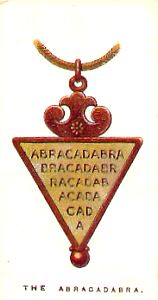
Your Daily Charm for June 24th is Abracadabra

Your Charm for Today

Abracadabra

Today’s Meaning:

The most powerful of all talisman indicating you or someone close to you will recover from an infection.

General Description:

One of the most famous of all talismans, and used as a magical formula by the Gnostics in Rome for invoking the aid of beneficent spirits against disease, misfortune and death. Sammonieus, the celebrated Gnostic physician; instructed that the letters of this magical triangle which he used for curing agues and fevers, were to be written on paper, folded into the shape of a cross, worn for nine days suspended from the neck, and, before sunrise, cast behind the patient into a stream running eastward. It was also a most popular charm in the middle ages. During the Great Plague, 1665, great numbers of these amulets were worn as supposed safeguards against infection.

Your Past, Present & Future Reading for June 24 Using Dominoes

Wild & Crazy, Your Past, Present & Future Reading for Today


That Which is Behind You

Four/Five

Now is a time for you to act on the basis of clear thought and analysis. Weigh all your choices before making any decisions. Seek solutions to your problems through logic and not emotion. To act on impulse may be very harmful to your future


Your Current Place

Blank/Blank

Your are standing before a blank canvas and have the freedom to choose how you fill it. New powers and energies will be available to you–if you are open to them. Good or bad, your choices will determine your future.


That Which is before You

Five/Six

Your troubles will soon wane. You will know true peace and harmony on both the spiritual and physical plane. Happiness and satisfaction will be yours.


Your Animal Spirit for June 24th is The Dove

Your Animal Spirit for Today

Dove

Are you going through life carrying old grief, pain or hate? If so, Dove (sometimes known as Mourning Dove) encourages you to let go of your emotional baggage so that true healing can take place. It’s time to forgive, release, and move forward. And, know that healing Dove is flying right beside you.

Your Ancient Symbol Card for June 24th is The Golden Egg

Your Ancient Symbol Card for Today

The Golden Egg


The Golden Egg denotes the opportunity for substantial material gains. However, the Golden Egg is also a reminder that unmanaged greed ensures what gains are made will be lost.

As a daily card, The Golden Egg suggest that the prospects for you to increase your financial wealth are very strong today. Seize whatever opportunities come your way, but don’t ride them too long or you may find yourself no better off than you were before they came along.

Your Witches Rune for June 24th is The Star


Today’s Witches Rune

The Star

Meaning: In many cultures, the Star is a symbol of hope, dreams and destiny, and in the Witches Runes this symbol has a similar connotation. When the Star rune appears, it’s green light for you to go after what you want.

Note that the Star does not say you’ll get everything you want without any work. No. This symbol is a not about easy success, but about having faith in what you are doing – and doing it. In fact, the goals suggested by the Star are usually the highest and most significant ones – the ones that are hardest to get. It does not matter what the dream is, but its significance in your life. This symbol also represents ideals, and they can be both individual and collective ones.

In a more down-to-earth way, the Star is related to revolutions, changes, risks, speculation and all things motivated by faith and ideals. It can represent a sudden spark on inspiration, a windfall, a sudden rise to fame or a promotion. Though the sudden changes brought by the Star are usually positive, they are also fast: you can get back to point zero as quickly as you rose. So don’t be afraid to jump forward when the opportunity arises.

The Star urges you to take the risk, to have hope and to trust. After the staleness of Crossroads, the Universe finally begins to move again. If you believe in Higher Powers, this symbol shows that They are guiding you in this moment. The Star is a very positive rune, but in a more negative context it can represent revolution for revolution’s sake and the constant idealization of people and situations. It can also stand for excessive individualism when going after a dream.

In relationship readings, this rune represents hope and an idealistic kind of love. Usually the people involved in the relationship have high expectations about the other. They easily put their partner on a pedestal, only to feel frustrated when reality strikes. The Star can also represent unrequited love, or the love for someone who is unattainable. On the other hand, this rune tells you to not give up love entirely – keep looking, because someone is coming.


Additional Information About Today’s Witches Rune courtesy of Your Spiritual Journey Australia

Your Crowley Thoth Tarot Card for June 24th is The Universe

Your Crowley Thoth Tarot Card for Today

The Universe


Like The Sun, The Universe brings good blessings. The Universe appears where all is in balance. It allows you to act effectively not only as an individual but as a member of a group too. The Universe promises contentment, fulfillment and completeness to those under its influence. It doesn’t guarantee there will not be moments of strife or discord in your life, but it does indicate that your trials and tribulations will be overcome; that ultimately you will know inner-peace and contentment. The Universe suggests you have found or will find your place in the scheme of things—that place where all is as it should be.

Casting the Stones, Your Past, Present & Future Reading for June 24th

Casting the Stones, Let’s See What In Your Past, Present & Future


bw-tiwazThe Past
Tiwaz

Tiwaz is the Warrior Rune. It represents pure, masculine power and the ability to successfully fight to meet your goals. However, you must be careful that costs of attaining your goals overshadow their values.


bw-isaThe Present
Isa

The Ice Rune, represents stagnation and a passionless existence. Your life’s course may seem blurry at the moment, but if you persevere you will move onto better days.


bw-berkanoThe Future
Berkano

Berkano is the Rune of birth and rebirth. This may symbolize a time when you are capable of great personal growth. Love may be in the air as well.

Your Daily Rune for June 24th is Mannaz

bw-mannaz

bw-mannazYour Rune for Today

June 24, 2015

Mannaz


Additional information about today’s rune, Mannaz….

mannaz : man, humankind

Phonetic equivalent: m

DIVINATORY MEANINGS:
significator, self, family, community, relationships, social concerns


MAGICAL USES:
to represent a specific person or group of people; to establish social relationships


ASSOCIATED MYTHS & DEITIES:
Ask and Embla, Midgard


ANALYSIS:
In its broadest sense, mannaz represents all of humanity, and therefore the entire realm of Midgard. In more practical terms, though, it is those with whom we have personal connections, from our immediate circle of family and friends to the wider community around us, reminding us of our nature as social animals. It also represents our connection with the Gods and with nature, through the two Norse myths of the creation of humans; the first where they sprang from Ymir’s body, and the second in which they were created from two logs by a river. It takes the raw energy of ehwaz and controls it through our social conscience, reminding us of those we affect with our deeds both magical and mundane.


The rune itself resembles gebo with its joining of masculine and feminine elements, but is much more complete. It is the entire web of human relationships, with the self at the centre, which mirrors the web of fate explored through raiðo. But while that web was more or less fixed, this one is mutable and alive. Past and present, male and female, self and other – all opposites are joined here and made whole. Mannaz is our home, and speaks for all those whose lives we touch when we use the gifts we have been given through the runes