Astronomy Picture of the Day

Astronomy Picture of the Day

Discover the cosmos!Each day a different image or photograph of our fascinating universe is featured, along with a brief explanation written by a professional astronomer.

2011 November 1
See Explanation.  Clicking on the picture will downloadthe highest resolution version available.

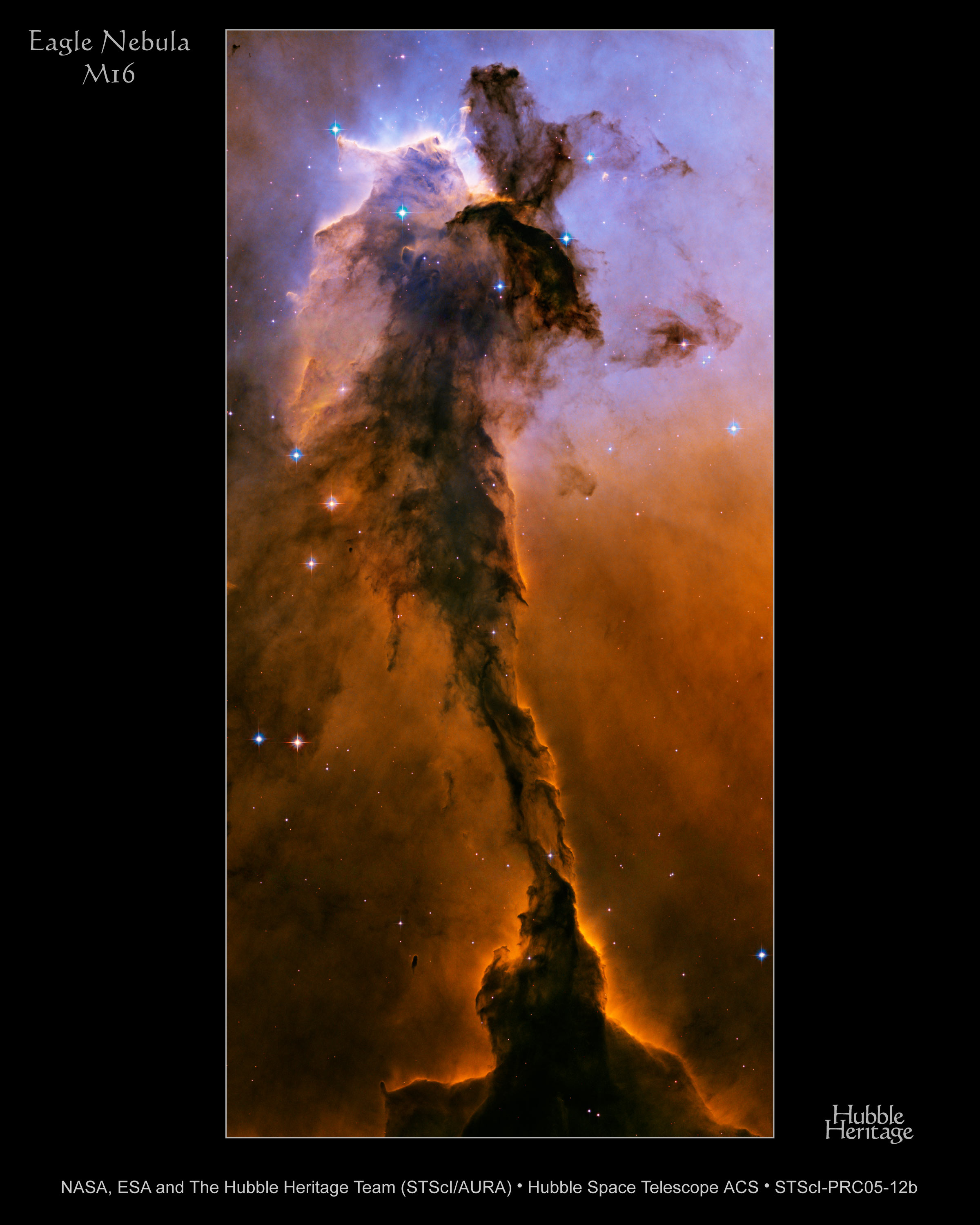
The Fairy of Eagle Nebula
Image Credit: The Hubble Heritage Team, (STScI/AURA), ESA, NASA 

Explanation: The dust sculptures of the Eagle Nebula are evaporating. As powerful starlight whittles away these cool cosmic mountains, the statuesque pillars that remain might be imagined as mythical beasts. Pictured above is one of several striking dust pillars of the Eagle Nebula that might be described as a gigantic alien fairy. This fairy, however, is ten light years tall and spews radiation much hotter than common fire. The greater Eagle Nebula, M16, is actually a giant evaporating shell of gas and dust inside of which is a growing cavity filled with a spectacular stellar nursery currently forming an open cluster of stars. The above image in scientifically re-assigned colors was released in 2005 as part of the fifteenth anniversary celebration of the launch of the Hubble Space Telescope.

Astronomy Picture of the Day for October 27th

Astronomy Picture of the Day

Discover the cosmos!Each day a different image or photograph of our fascinating universe is featured, along with a brief explanation written by a professional astronomer.

2011 October 27
See Explanation.  Clicking on the picture will download the highest resolution version available.

Young Suns of NGC 7129
Image Credit & Copyright: Johannes Schedler (Panther Observatory)Explanation: Young suns still lie within dusty NGC 7129, some 3,000 light-years away toward the royal constellation Cepheus. While these stars are at a relatively tender age, only a few million years old, it is likely that our own Sun formed in a similar stellar nursery some five billion years ago. Most noticeable in the sharp image are the lovely bluish dust clouds that reflect the youthful starlight. But the compact, deep red crescent shapes are also markers of energetic, young stellar objects. Known as Herbig-Haro objects, their shape and color is characteristic of glowing hydrogen gas shocked by jets streaming away from newborn stars. Paler, extended filaments of redish emission mingling with the bluish clouds are caused by dust grains effectively converting the invisible ultraviolet starlight to visible red light through photoluminesence. Ultimately the natal gas and dust in the region will be dispersed, the stars drifting apart as the loose cluster orbits the center of the Galaxy. At the estimated distance of NGC 7129, this telescopic view spans about 40 light-years.

Astronomy Picture of the Day for October 24th

Astronomy Picture of the Day

Discover the cosmos!Each day a different image or photograph of our fascinating universe is featured, along with a brief explanation written by a professional astronomer.

2011 October 24
See Explanation.  Clicking on the picture will download the highest resolution version available.

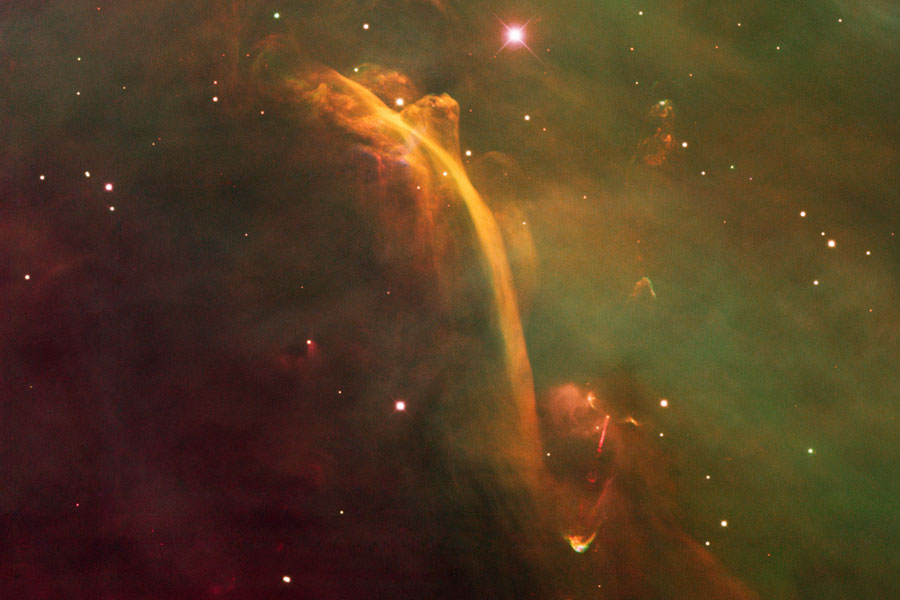
HH-222: The Waterfall Nebula
Image Credit: Z. Levay (STScI/AURA/NASA), T.A. Rector (U. Alaska Anchorage) & H. Schweiker (NOAO/AURA/NSF), KPNO, NOAO  


Explanation: What created the Waterfall Nebula? No one knows. The structure seen in the region of NGC 1999 in the Great Orion Molecular Cloud complex is one of the more mysterious structures yet found on the sky. Designated HH-222, the elongated gaseous stream stretches about ten light years and emits an unusual array of colors. One hypothesis is that the gas filament results from the wind from a young star impacting a nearby molecular cloud. That would not explain, however, why the Waterfall and fainter streams all appear to converge on a bright but unusual non thermal radio source located toward the upper left of the curving structure. Another hypothesis is that the unusual radio source originates from a binary system containing a hot white dwarf, neutron star, or black hole, and that the Waterfall is just a jet from this energetic system. Such systems, though, are typically strong X-rays emitters, and no X-rays have been detected. For now, this case remains unsolved. Perhaps well-chosen future observations and clever deductive reasoning will unlock the true origin of this enigmatic wisp in the future.

Earth Science Pic for Thursday, October 20th

Fog and Redwoods

October 20, 2011

CanyonRidgePortrait (2)
Photographer: Hugh S. Stickney
Summary Author: Hugh S. Stickney; Jim Foster
 
 
The photo above showing sunny hillsides and valleys choked with fog was snapped in Sibley Volcanic Regional Preserve, California. This view looks down into the redwoods and bay laurels (Laurus nobilis) in the direction of the town of Canyon. Redwood Park is in the distance. Typically, the biggest and oldest redwood trees (Sequoia sempervirens) are found in deep valleys and ravines. Here, in addition to the cyclonic storms of fall and winter, fog drip and condensation is a regular occurrence. Trees above the fog layer, approximately 2,300 ft (700 m), are deprived of this source of moisture and are somewhat stunted in comparison. Photo taken on January 17, 2011

Astronomy Picture of the Day for October 16th

Astronomy Picture of the Day

Discover the cosmos!Each day a different image or photograph of our fascinating universe is featured, along with a brief explanation written by a professional astronomer.

2011 October 16
See Explanation.  Clicking on the picture will download the highest resolution version available.

A Picturesque Venus Transit
Image Credit & Copyright: David Cortner 

Explanation: The rare transit of Venus across the face of the Sun in 2004 was one of the better-photographed events in sky history. Both scientific and artistic images flooded in from the areas that could see the transit: Europe and much of Asia, Africa, and North America. Scientifically, solar photographers confirmed that the black drop effect is really better related to the viewing clarity of the camera or telescope than the atmosphere of Venus. Artistically, images might be divided into several categories. One type captures the transit in front of a highly detailed Sun. Another category captures a double coincidence such as both Venus and an airplane simultaneously silhouetted, or Venus and the International Space Station in low Earth orbit. A third image type involves a fortuitous arrangement of interesting looking clouds, as shown by example in the above image taken from North Carolina, USA. The next transit of Venus across the Sun will be in 2012 June.

Astronomy Picture of the Day for October 14th

Astronomy Picture of the Day

Discover the cosmos!Each day a different image or photograph of our fascinating universe is featured, along with a brief explanation written by a professional astronomer.

2011 October 14

MAGIC Star Trails
Image Credit & Copyright: Babak Tafreshi (TWAN


Explanation: Colorful star trails arc across the night in this surreal timelapse skyscape from the Roque de los Muchachos Observatory on the Canary island of La Palma. A reflection of the Earth’s daily rotation on its axis, the star trails are also reflected in one of a pair of 17 meter diameter, multi-mirrored MAGIC telescopes. The MAGIC (Major Atmospheric Gamma Imaging Cherenkov) telescope itself is intended to detect gamma rays – photons with over 100 billion times the energy of visible light. As the high energy gamma rays impact the upper atmosphere they produce air showers of high-energy particles. A fast camera monitoring the multi-mirrored surface records in detail brief flashes of optical light, called Cherenkov light, created by the air shower particles Astronomers can then ultimately relate the optical flashes to cosmic sources of extreme gamma-rays.

Daily Astronomy Pic for October 12th

Astronomy Picture of the Day

Discover the cosmos!Each day a different image or photograph of our fascinating universe is featured, along with a brief explanation written by a professional astronomer.

2011 October 12


Saturn: Shadows of a Seasonal Sundial
Image Credit: Cassini Imaging Team, ISS, JPL, ESA, NASA  


Explanation: Saturn’s rings form one of the larger sundials known. This sundial, however, determines only the season of Saturn, not the time of day. In 2009, during Saturn’s last equinox, Saturn’s thin rings threw almost no shadows onto Saturn, since the ring plane pointed directly toward the Sun. As Saturn continued in its orbit around the Sun, however, the ring shadows become increasingly wider and cast further south. These shadows are not easily visible from the Earth because from our vantage point near the Sun, the rings always block the shadows. The above image was taken in August by the robotic Cassini spacecraft currently orbiting Saturn. The rings themselves appear as a vertical bar on the image right. The Sun, far to the upper right, shines through the rings and casts captivatingly complex shadows on south Saturn, on the image left. Cassini has been exploring Saturn, its rings, and its moons since 2004, and is expected to continue until at least the maximum elongation of Saturn’s shadows occurs in 2017.

NASA Image of the Day for October 11th

Making a Spectacle of Star Formation in Orion

Looking like a pair of eyeglasses only a rock star would wear, this nebula brings into focus a murky region of star formation. NASA’s Spitzer Space Telescope exposes the depths of this dusty nebula with its infrared vision, showing stellar infants that are lost behind dark clouds when viewed in visible light.

Best known as Messier 78, the two round greenish nebulae are actually cavities carved out of the surrounding dark dust clouds. The extended dust is mostly dark, even to Spitzer’s view, but the edges show up in mid-wavelength infrared light as glowing, red frames surrounding the bright interiors. Messier 78 is easily seen in small telescopes in the constellation of Orion, just to the northeast of Orion’s belt, but looks strikingly different, with dominant, dark swaths of dust. Spitzer’s infrared eyes penetrate this dust, revealing the glowing interior of the nebulae.

A string of baby stars that have yet to burn their way through their natal shells can be seen as red pinpoints on the outside of the nebula. Eventually these will blossom into their own glowing balls, turning this two-eyed eyeglass into a many-eyed monster of a nebula.

This is a three-color composite that shows infrared observations from two Spitzer instruments. Blue represents 3.6- and 4.5-micron light, and green shows light of 5.8 and 8 microns, both captured by Spitzer’s infrared array camera. Red is 24-micron light detected by Spitzer’s multiband imaging photometer.

Image Credit: NASA/JPL-Caltech

Astronomy Picture of the Day for October 11th

Astronomy Picture of the Day

Discover the cosmos!Each day a different image or photograph of our fascinating universe is featured, along with a brief explanation written by a professional astronomer.

2011 October 11

NGC 7635: The Bubble Nebula
Image Credit & Copyright: Larry Van Vleet 


Explanation: It’s the bubble versus the cloud. NGC 7635, the Bubble Nebula, is being pushed out by the stellar wind of massive central star BD+602522. Next door, though, lives a giant molecular cloud, visible to the right. At this place in space, an irresistible force meets an immovable object in an interesting way. The cloud is able to contain the expansion of the bubble gas, but gets blasted by the hot radiation from the bubble’s central star. The radiation heats up dense regions of the molecular cloud causing it to glow. The Bubble Nebula, pictured above in scientifically mapped colors to bring up contrast, is about 10 light-years across and part of a much larger complex of stars and shells. The Bubble Nebula can be seen with a small telescope towards the constellation of the Queen of Aethiopia (Cassiopeia).

NASA Image of the Day for October 10th

Electrical Circuit Between Saturn and Enceladus

This artist’s concept shows a glowing patch of ultraviolet light near Saturn’s north pole that occurs at the “footprint” of the magnetic connection between Saturn and its moon Enceladus. The footprint and magnetic field lines are not visible to the naked eye, but were detected by the ultraviolet imaging spectrograph and the fields and particles instruments on NASA’s Cassini spacecraft. The footprint, newly discovered by Cassini, marks the presence of an electrical circuit that connects Saturn with Enceladus and accelerates electrons and ions along the magnetic field lines. In this image, the footprint is in the white box marked on Saturn, with the magnetic field lines in white and purple.

A larger white square above Enceladus shows a cross-section of the magnetic field line between the moon and the planet. This pattern of energetic protons was detected by Cassini’s magnetospheric imaging instrument (MIMI) on Aug. 11, 2008.

The patch near Saturn’s north pole glows because of the same phenomenon that makes Saturn’s well-known north and south polar auroras glow: energetic electrons diving into the planet’s atmosphere. However, the “footprint” is not connected to the rings of auroras around Saturn’s poles (shown as an orange ring around the north pole in this image).

The Cassini plasma spectrometer complemented the MIMI data, with detection of field-aligned electron beams in the area. A team of scientists analyzed the charged particle data and concluded that the electron beams had sufficient energy flux to generate a detectable level of auroral emission at Saturn. Target locations were provided to Cassini’s ultraviolet imaging spectrograph team. On Aug. 26, 2008, the spectrograph obtained images of an auroral footprint in Saturn’s northern hemisphere.

The newly discovered auroral footprint measured about 1,200 kilometers (750 miles) in the longitude direction and less than 400 kilometers (250 miles) in latitude, covering an area comparable to that of California or Sweden. It was located at about 65 degrees north latitude.

In the brightest image the footprint shone with an ultraviolet light intensity of about 1.6 kilorayleighs, far less than the Saturnian polar auroral rings. This is comparable to the faintest aurora visible at Earth without a telescope in the visible light spectrum. Scientists have not yet found a matching footprint at the southern end of the magnetic field line.

The background star field and false color images of Saturn and Enceladus were obtained by Cassini’s imaging science subsystem.

The Cassini-Huygens mission is a cooperative project of NASA, the European Space Agency and the Italian Space Agency. NASA’s Jet Propulsion Laboratory, a division of the California Institute of Technology in Pasadena, Calif. manages the mission for NASA’s Science Mission Directorate, Washington, D.C. The ultraviolet imaging spectrograph team is based at the University of Colorado, Boulder. The magnetospheric imaging team is based at the Johns Hopkins University Applied Physics Laboratory, Laurel, Md. The Cassini plasma spectrometer team is based at the Southwest Research Institute, San Antonio, Texas.

For more information about the Cassini-Huygens mission visit http://saturn.jpl.nasa.gov and http://www.nasa.gov/cassini .

Image credit: NASA/JPL/JHUAPL/University of Colorado/Central Arizona College/SSI


Astronomy Picture of the Day For October 10th

Astronomy Picture of the Day

Discover the cosmos! Each day a different image or photograph of our fascinating universe is featured, along with a brief explanation written by a professional astronomer.

The Milky Way in Infrared
Credit: E. L. Wright (UCLA), The COBE Project, DIRBE, NASA 

Explanation: At night, from a dark location, part of the clear sky looks milky. This unusual swath of dim light is generally visible during any month and from any location. Until the invention of the telescope, nobody really knew what the “Milky Way” was. About 300 years ago telescopes caused a startling revelation: the Milky Way was made of stars. Only 70 years ago, more powerful telescopes brought the further revelation that the Milky Way is only one galaxy among many. Now telescopes in space allow yet deeper understanding. The above picture was taken by the COBE satellite and shows the plane of our Galaxy in infrared light. The thin disk of our home spiral galaxy is clearly apparent, with stars appearing white and interstellar dust appearing red.

NASA Image of the Day for October 9th

Vesta Sizes Up


This composite image shows the comparative sizes of nine asteroids. Up until now, Lutetia, with a diameter of 81 miles (130 kilometers), was the largest asteroid visited by a spacecraft, which occurred during a flyby. Vesta dwarfs all other small bodies in this image.

Asteroid Vesta also is considered a protoplanet because it’s a large body that almost became a planet and has a diameter of approximately 330 miles (530 kilometers). was the largest asteroid visited by a spacecraft, which occurred during a flyby. Vesta dwarfs all other small bodies in this image.

Asteroid Vesta also is considered a protoplanet because it’s a large body that almost became a planet and has a diameter of approximately 330 miles (530 kilometers).

Image Credit: NASA/JPL-Caltech/JAXA/ESA

2012- A Witches View of Life and the ‘End’

2012- A Witches View of Life and the ‘End’

Author: Fayte Ravencraft

Unless you have been living under a rock, you have undoubtedly heard of the phenomenon that is 2012. The calendar of the ancient Mayan civilization ends on December 21, 2012, and many believe that it spells out disaster for our planet. Others think that it will be a time of transformation and spiritual rebirth. Here is the opinion of one humble Witch:

I won’t lie and say that the whole ‘2012 hysteria isn’t a little scary. I mean we have several extremely rare celestial occurrences, which also coincide with this exact date, which seem to add to the possibility of strange or catastrophic events occurring. The Earth and the Sun will be perfectly aligned with the ‘Great Rift, in the center of our galaxy, and this alignment is said to occur only every 21, 000 years or so. The Sun will also reach its solar maximum, the peak in its level of sunspot activity. Scientists have noticed recently that the Sun has been alarmingly weak for this point in the cycle — the lowest in over one-hundred years according to one article—, which may mean, in my own opinion, that when the Sun activity does pick up, it may cause a little trouble here on Earth.

The Sun’s own magnetic poles are supposed to switch in 2012 as well, which may cause further issues here on earth. These are simply the facts. Not even the most brilliant among us can truly say what they mean because it has never happened before in recorded history, and all theories are just that: theories. I encourage you to do your own research before coming to any assumption, and do not panic about the ‘approaching disaster, ” because there is not necessarily anything to be worried about. You do, I’m sure, remember the same mass hysteria about the supposed apocalypse in 2000, which never occurred.

I say all this simply so that you, the reader, may come to your own conclusions as to what the future may hold, and so that you know just what everyone is causing all the commotion about. I have listed as many Internet sources as possible so that you may further research them if you wish.

It is my personal feeling that December 21, 2012 will be a time of extraordinary power, a time when the veil between the worlds will be at its absolute thinnest. The Great Rift in the center of our galaxy has always been symbolic of the creative power of the Goddess, the ‘Great Womb, so to speak. The fact that the Sun, the symbol of the Lord, The Great Rift, a symbol of the Lady, and our Earth will be aligned will have a significant meaning magickally. There will never be a better time in our lives to perform magick of all types especially that of the divinatory type.

I do feel like it is a significant milestone in the history of human kind, and that, for those of us who are enlightened and willing, it is the perfect time to reach the maximum of our potential. Being a time of great power, it is also a time when we can make a powerful commitment to change things, both within and without, and to decided just where it is we want to go with our lives. Any energies set to work during this rare alignment are going to have extraordinary results, so why not use this as a time to heal the Earth, and with it, all of mankind. The Maya knew that this would be a time of immense power, and both feared and respected it.

We have a great thing here on our planet, and we too often take even the air we breathe for granted. The gifts we have received from the Universe have been greater than we could ever ask for, and it is time now to realize that. I am not convinced that 2012 marks the end of our world, but I certainly hope it marks a great change within the heart of mankind. We must learn to be grateful for all that we have; our lives and this astoundingly beautiful planet, or we might as well have never been here. I hate to say it, but if by some chance the world truly does end in 2012, I am just glad that I’ve had the blessing of spending this life on this beautiful planet. If it doesn’t end, I hope we all do our very best to be more appreciative; we have a good thing going on here, and we get too caught up in the daily grind of things to realize it sometimes.

While I do not feel that the world is truly about to end, I do think that we need to start living as though the end of the world were today, because it very well could be. We have never been guaranteed any amount of time here, and should view every second, the good and bad, as a gift. If we could truly follow ‘In perfect love and perfect trust, ” and have that love and trust towards ourselves and our fellow man, we would truly be making the absolute best of our time here.

As the great Henry David Thoreau said:

“I went to the woods because I wished to live deliberately, to front only the essential facts of life, and see if I could not learn what it had to teach, and not, when I came to die, discover that I had not lived.”

Let us learn all that we can in this life so that when the end comes, we will have the satisfaction of knowing that we have done something that few ever have: Truly lived. If we can say in all honesty that we have lived a full life, then we cannot possibly grieve at its ending. We were lucky even to have one day here, let alone an entire life of loving, laughing and learning! The Great Cycle will continue eternally and we are all but small parts of the infinite cycle. When we embrace the entire cycle, life, death, and rebirth, then there is absolutely nothing to fear.

Nothing is ever truly destroyed, simply changed; and change, my friends, is a very good thing. Embracing change is embracing life.

Blessed Be,
Fayte Ravencraft



Footnotes:
Interview with NASA Solar Scientist

http://www.npr.org/templates/story/sthttp://www.witchvox.com/vu/fms/farticle.htmlory.php?storyId=128268488

http://www.interestingfacts.org/fact/2012-interesting-facts

http://www.youtube.com/watch?v=Z4JuoBD56HQ

Contact me if you would like more veritable facts.

NASA Image of the Day for October 7th

Seeing Red

This NASA Hubble Space Telescope infrared mosaic image represents the sharpest survey of the Galactic Center to date. It reveals a new population of massive stars and new details in complex structures in the hot ionized gas swirling around the central 300 x 115 light-years. This sweeping infrared panorama offers a nearby laboratory for how massive stars form and influence their environment in the often violent nuclear regions of other galaxies. The infrared mosaic was taken with with Hubble’s Near Infrared Camera and Multi-Object Spectrometer (NICMOS). The Galactic core is obscured in visible light by dust clouds, which infrared light can penetrate.

The new NICMOS data show the glow from ionized hydrogen gas as well as a multitude of stars. NICMOS shows a large number of these massive stars distributed throughout the region. A new finding is that astronomers now see that the massive stars are not confined to one of the three known clusters of massive stars in the Galactic Center, known as the Central cluster, the Arches cluster, and the Quintuplet cluster. These three clusters are easily seen as tight concentrations of bright, massive stars in the NICMOS image. The distributed stars may have formed in isolation, or they may have originated in clusters that have been disrupted by strong gravitational tidal forces.
The winds and radiation from these stars form the complex structures seen in the core and in some cases they may be triggering new generations of stars. At upper left, large arcs of ionized gas are resolved into arrays of intriguingly organized linear filaments indicating a critical role of the influence of locally strong magnetic fields.
The lower left region shows pillars of gas sculpted by winds from hot massive stars in the Quintuplet cluster. At the center of the image, ionized gas surrounding the supermassive black hole at the center of the galaxy is confined to a bright spiral embedded within a circum-nuclear dusty inner-tube-shaped torus.
The false-color image was taken through a filter that reveals the glow of hot hydrogen in space.

Image Credit: NASA, ESA, and Q.D. Wang (University of Massachusetts, Amherst)

Astronomy Picture of the Day for October 7th

Astronomy Picture of the Day

Discover the cosmos! Each day a different image or photograph of our fascinating universe is featured, along with a brief explanation written by a professional astronomer.

A Sun Pillar Over Ontario
Image Credit & Copyright: Rick Stankiewicz (Peterborough Astronomical Association) 

Explanation: What is that on the horizon? No, it’s not an alien starship battling distant Earthlings, but rather a sun pillar. When driving across Ontario, Canada in early June, the photographer was surprised to encounter such an “eerie and beautiful” vista, and immediately took pictures. When the atmosphere is cold, ice sometimes forms flat six-sided crystals as it falls from high-level clouds. Air resistance then causes these crystals to lie nearly flat much of the time as they flutter to the ground. If viewed toward a rising or setting Sun, these flat crystals will reflect sunlight and create an unusual column of light — a sun pillar as seen above. Such columns of light are not uncommon to see, and a retrospective of past APODs that have featured picturesque sun pillars can be found here.

NASA Image of the Day for Oct. 4th – Ring Holds a Delicate Flower

Ring Holds a Delicate Flower

NASA’s Spitzer Space Telescope finds a delicate flower in the Ring Nebula, as shown in this image. The outer shell of this planetary nebula looks surprisingly similar to the delicate petals of a camellia blossom. (A planetary nebula is a shell of material ejected from a dying star.) Located about 2,000 light years from Earth in the constellation Lyra, the Ring Nebula is also known as Messier Object 57 and NGC 6720. It is one of the best examples of a planetary nebula and a favorite target of amateur astronomers.

The “ring” is a thick cylinder of glowing gas and dust around the doomed star. As the star begins to run out of fuel, its core becomes smaller and hotter, boiling off its outer layers. Spitzer’s infrared array camera detected this material expelled from the withering star. Previous images of the Ring Nebula taken by visible-light telescopes usually showed just the inner glowing loop of gas around the star. The outer regions are especially prominent in this new image because Spitzer sees the infrared light from hydrogen molecules. The molecules emit the infrared light that they have absorbed ultraviolet radiation from the star or have been heated by the wind from the star.

Image credit: NASA/JPL-Caltech/Harvard-Smithsonian CfA

Astronomy Picture of the Day for Oct. 4th – QR Codes: Not for Human Eyes

Astronomy Picture of the Day

Discover the cosmos!Each day a different image or photograph of our fascinating universe is featured, along with a brief explanation written by a professional astronomer.

2011 October 4

QR Codes: Not for Human Eyes
Image Credit: Kaywa QR Code Generator (Free) 


Explanation: This communication was not meant for human eyes. It was not even meant for aliens eyes. It’s an attempt to communicate directly with your smartphone. Cameras on many smartphones can image the above Quick Response (QR) code and then common applications can tell you what it means. Sometimes the deciphered code will reveal a web site address, prompting the smartphone to then ask you if you want to access this address to learn more about the object. QR codes are two-dimensional analogs of bar codes that can be scanned in any orientation and tolerate several types of errors. These codes are being used increasingly as doors between real objects and web-based information about those objects, and so are popping up increasingly in unexpected places. Anyone can create a QR code from any of several free online services, print it out, and affix it to an object. Although not meant to communicate with aliens, QR codes employ several attributes common to famous alien communication attempts. Can you — or a local smartphone — figure out what the above QR code means?


NASA Image of the Day for October 1st

Saturn’s Silhouetted Clouds

This false-color mosaic shows deep-level clouds silhouetted against Saturn’s glowing interior. This mosaic shows the entire planet, including features like Saturn’s ring shadows and the terminator, the boundary between day and night.

The blue-green color (lower right) is sunlight scattered off clouds high in Saturn’s atmosphere and the red color (upper left) is the glow of thermal radiation from Saturn’s warm interior, easily seen on Saturn’s night side (top left), within the shadow of the rings, and with somewhat less contrast on Saturn’s day side (bottom right). The darker areas within Saturn show the strongest thermal radiation. The bright red color indicates areas where Saturn’s atmosphere is relatively clear. The great variety of cloud shapes and sizes reveals a surprisingly active planet below the overlying sun-scattering haze.

The brighter glow of the northern hemisphere versus the southern indicates that the clouds and hazes there are noticeably thinner than those in the south. Scientists speculate that this is a seasonal effect, and if so, it will change as the northern hemisphere enters springtime during the next few years.

The data were obtained in February 2006 at a distance of 1.6 million kilometers (1 million miles) from directly over the plane of Saturn’s rings, which appear here as a thin, blue line over the equator.

Image credit: NASA/JPL/University of Arizona

Astronomy Picture of the Day For October 1st

Astronomy Picture of the Day

Discover the cosmos!Each day a different image or photograph of our fascinating universe is featured, along with a brief explanation written by a professional astronomer.

2011 October 1

Asteroids Near Earth
Illustration Credit: NASA, JPL-Caltech, WISE 

Explanation: Though the sizes are not to scale, the Sun and planets of the inner solar system are shown in this illustration, where each red dot represents an asteroid. New results from NEOWISE, the infrared asteroid hunting portion of the WISE mission, are shown on the left compared to old population projections of mid-size or larger near-Earth asteroids from surveys at visible wavelengths. And the good news is, NEOWISE observations estimate there are 40 percent fewer near-Earth asteroids that are larger than 100 meters (330 feet), than indicated by visible light searches. Based on infrared imaging, the NEOWISE results are more accurate as well. Heated by the Sun, asteroids of the same size radiate the same amount of infrared light, but can reflect very different amounts of visible sunlight depending on how shiny their surface is, or their surface albedo. That effect can bias surveys based on optical observations. NEOWISE results reduce the estimated number of mid-size near-Earth asteroids from about 35,000 to 19,500, but the majority still remain undiscovered.

NASA Image of the Day for September 29th

NASA’s J-2X Engine

This image is from a 2008 cold flow test campaign conducted at NASA’s Marshall Space Flight Center for the J-2X engine program.

NASA continues to test the J-2X engine and conducted a 40-second test of the rocket engine Sept. 28, the most recent in a series of tests of the next-generation engine selected as part of the Space Launch System architecture that will once again carry humans into deep space. It was a test at the 99 percent power level to gain a better understanding of start and shutdown systems as well as modifications that had been made from previous test firing results.

Image Credit: NASA