Astronomy Picture of the Day for November 14th

Astronomy Picture of the Day

Discover the cosmos!Each day a different image or photograph of our fascinating universe is featured, along with a brief explanation written by a professional astronomer.

2011 November 14
See Explanation.  Clicking on the picture will download the highest resolution version available.

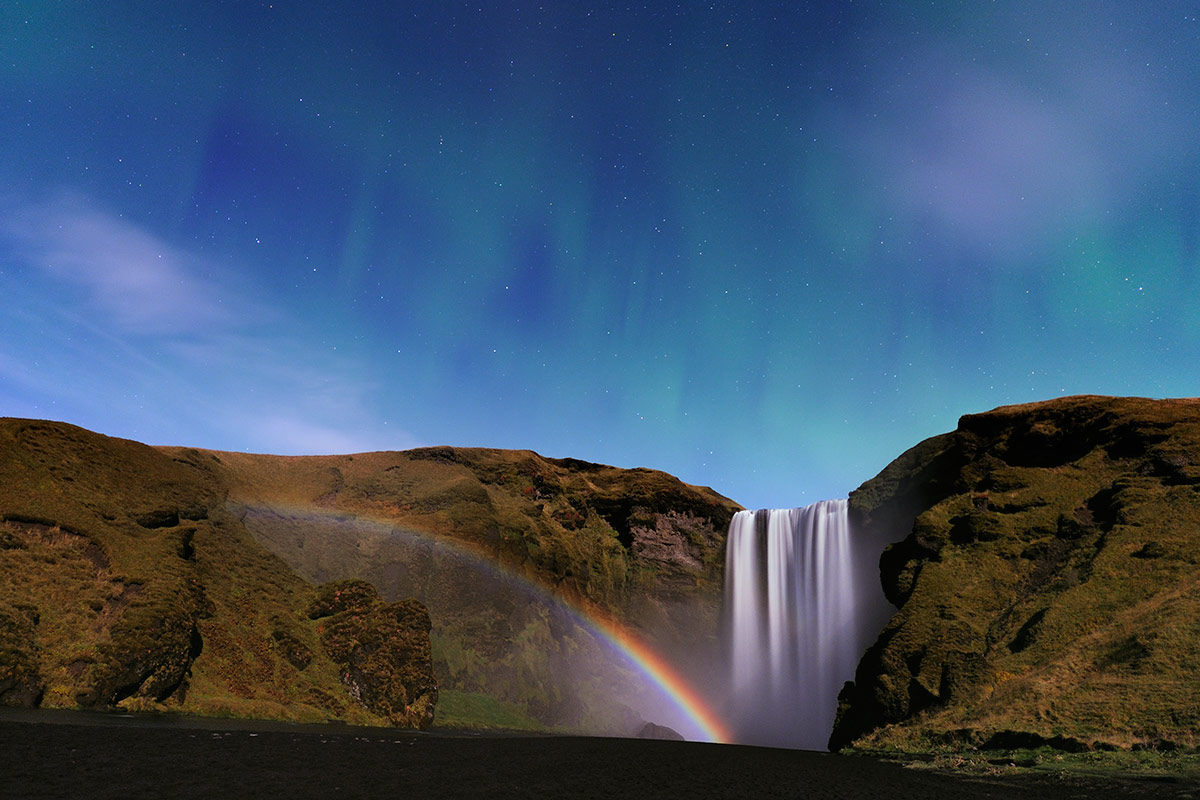
Waterfall, Moonbow, and Aurora from Iceland
Image Credit & Copyright: Stephane Vetter (Nuits sacrees


Explanation: The longer you look at this image, the more you see. Perhaps your eye is first drawn to the picturesque waterfall called Skogarfoss visible on the image right. Just as prevalent, however, in this Icelandic visual extravaganza, is the colorful arc of light on the left. This chromatic bow is not a rainbow, since the water drops did not originate in rainfall nor are they reflecting light from the Sun. Rather, the drops have drifted off from the waterfall and are now illuminated by the nearly full Moon. High above are the faint green streaks of aurora. The scene, captured one night last month, also shows a beautiful starscape far in the background, including the Big Dipper, part of the constellation of the Great Bear (Ursa Major).
Astronomy Picture of the Day for November 10th

Astronomy Picture of the Day

Discover the cosmos!Each day a different image or photograph of our fascinating universe is featured, along with a brief explanation written by a professional astronomer.

2011 November 10
See Explanation.  Clicking on the picture will download the highest resolution version available.

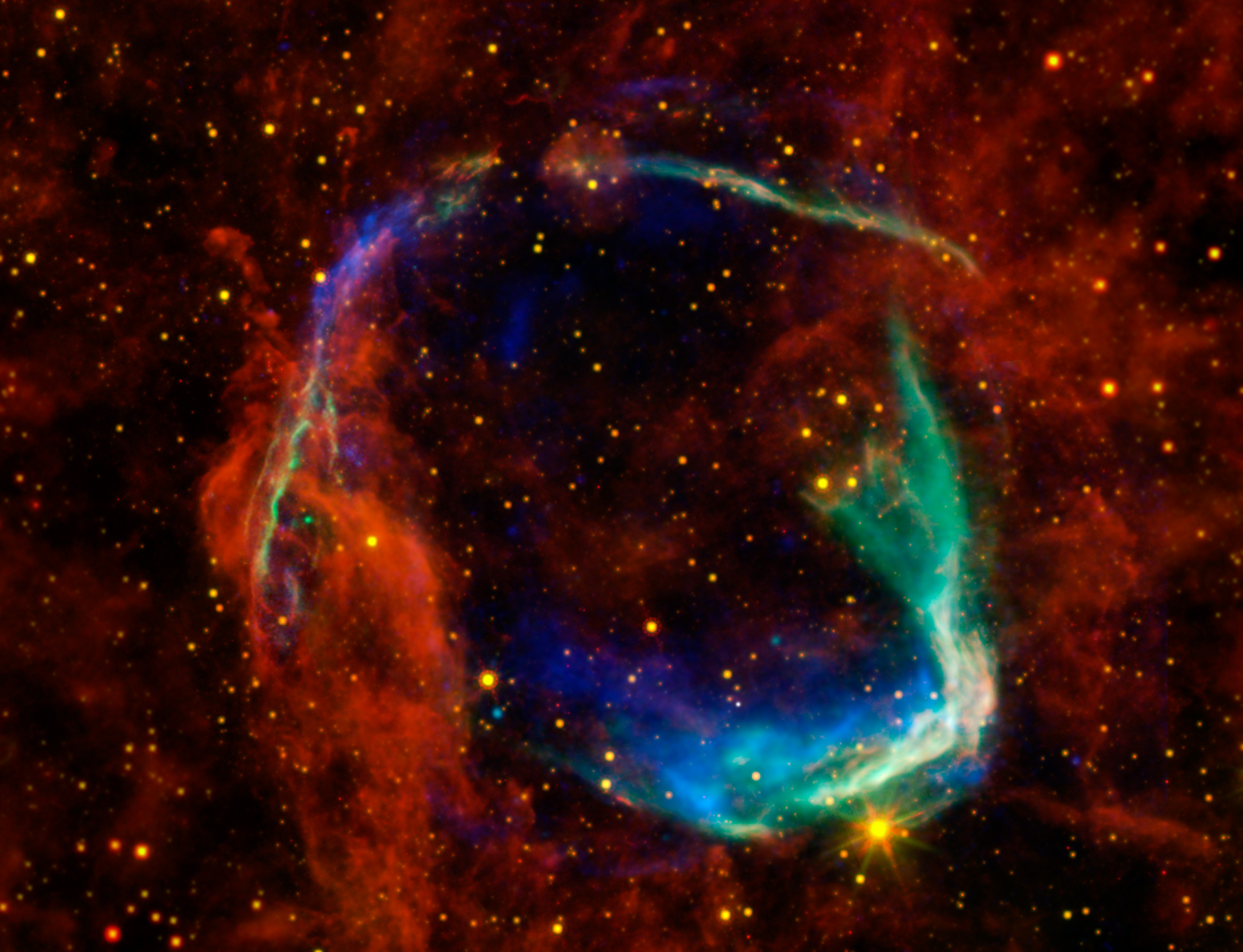
RCW 86: Historical Supernova Remnant
Credit: X-ray: XMM-Newton, Chandra / IR: WISE, Spitzer 


 Explanation: In 185 AD, Chinese astronomers recorded the appearance of a new star in the Nanmen asterism – a part of the sky identified with Alpha and Beta Centauri on modern star charts. The new star was visible for months and is thought to be the earliest recorded supernova. This multiwavelength composite image from orbiting telescopes of the 21st century, XMM-Newton and Chandra in X-rays, and Spitzer and WISE in infrared, show supernova remnant RCW 86, understood to be the remnant of that stellar explosion. The false-color view shows interstellar gas heated by the expanding supernova shock wave at X-ray energies (blue and green) and interstellar dust radiating at cooler temperatures in infrared light (yellow and red). An abundance of the element iron and lack of a neutron star or pulsar in the remnant suggest that the original supernova was Type Ia. Type Ia supernovae are thermonuclear explosions that destroy a white dwarf star as it accretes material from a companion in a binary star system. Shock velocities measured in the X-ray emitting shell and infrared dust temperatures indicate that the remnant is expanding extremely rapidly into a remarkable low density bubble created before the explosion by the white dwarf system. Near the plane of our Milky Way Galaxy, RCW 86 is about 8,200 light-years away and has an estimated radius of 50 light-years.

Astronomy Picture of the Day for November 8th

Astronomy Picture of the Day

Discover the cosmos!Each day a different image or photograph of our fascinating universe is featured, along with a brief explanation written by a professional astronomer.

2011 November 8

Jumping Sundogs Over Thunderclouds
Image Credit: abrigatti, YouTube 


Explanation: What’s happening above those clouds? In the past few years, videos have appeared on the web detailing an unusual but little known phenomenon: rapid light changes over clouds. Upon inspection and contemplation, a leading hypothesis for its cause has now emerged. In sum, this hypothesis holds that a lightning discharge in a thundercloud can temporarily change the electric field above the cloud where charged ice crystals were reflecting sunlight. The new electric field quickly re-orients the geometric crystals to a new orientation that reflects sunlight differently. In other words, a lightning discharge can cause a sundog to jump. Soon, the old electric field may be restored, causing the ice crystals to return to their original orientation. To help this curious phenomenon become better studied, sky enthusiasts with similar jumping or dancing sundog videos are encouraged to share them.

Astronomy Picture of the Day for November 7th

Astronomy Picture of the Day

Discover the cosmos!Each day a different image or photograph of our fascinating universe is featured, along with a brief explanation written by a professional astronomer.

2011 November 7
See Explanation.  Clicking on the picture will download the highest resolution version available.

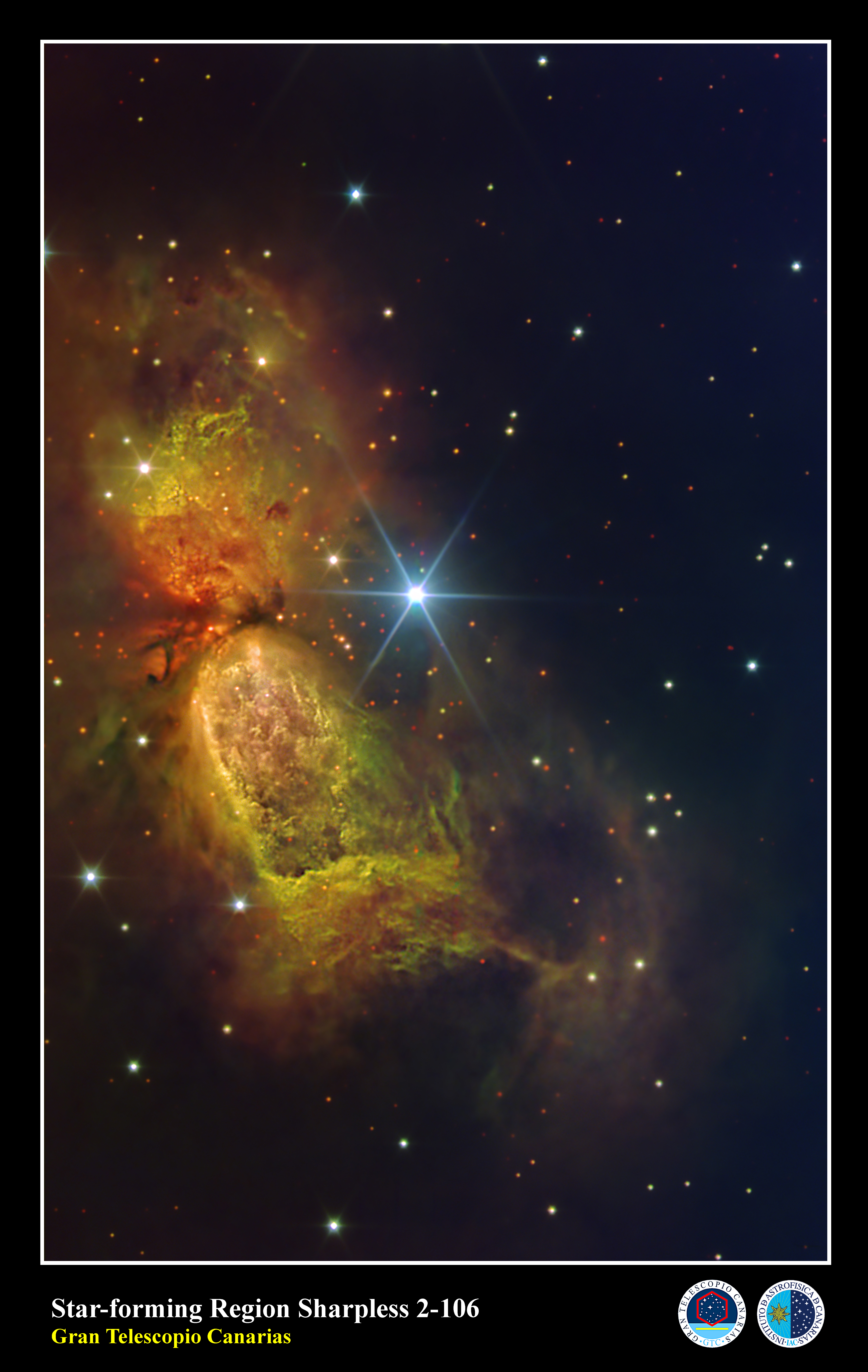
Star Forming Region S106
Image Credit: GRANTECAN and IAC 


Explanation: Massive star IRS 4 is beginning to spread its wings. Born only about 100,000 years ago, material streaming out from this newborn star has formed the nebula dubbed Sharpless 2-106 Nebula (S106), pictured above. A large disk of dust and gas orbiting Infrared Source 4 (IRS 4), visible in dark red near the image center, gives the nebula an hourglass or butterfly shape. S106 gas near IRS 4 acts as an emission nebula as it emits light after being ionized, while dust far from IRS 4 reflects light from the central star and so acts as a reflection nebula. Detailed inspection of images like the above image has revealed hundreds of low-mass brown dwarf stars lurking in the nebula’s gas. S106 spans about 2 light-years and lies about 2000 light-years away toward the constellation of the Swan (Cygnus).

Astronomy Picture of the Day for November 3rd

Astronomy Picture of the Day

Discover the cosmos!Each day a different image or photograph of our fascinating universe is featured, along with a brief explanation written by a professional astronomer.

See Explanation.  Clicking on the picture will download the highest resolution version available.

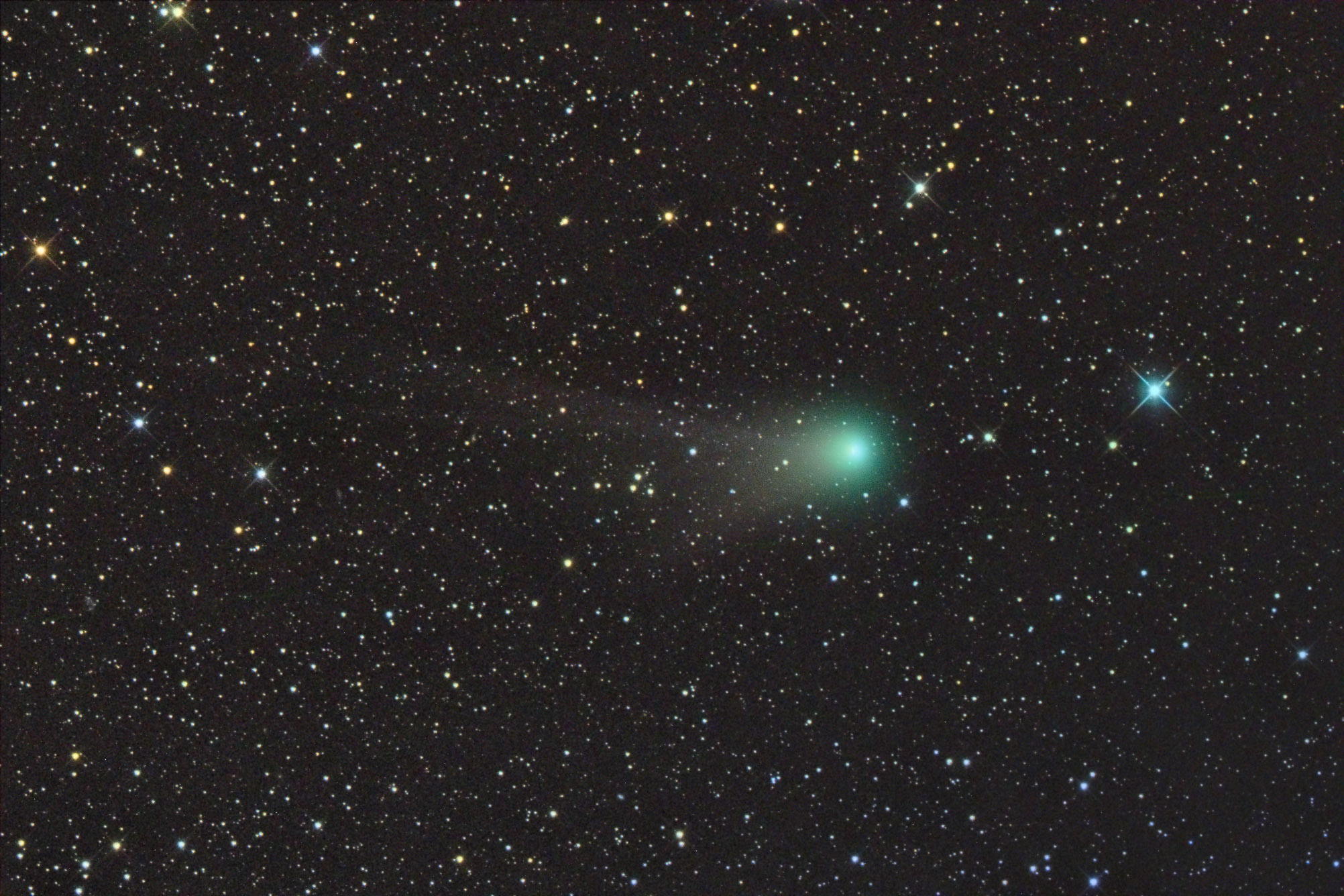
Tails of Comet Garradd
Image Credit & Copyright: Gregg Ruppel 


Explanation: A good target for binoculars and small telescopes, Comet Garradd (C/2009 P1) now shines in planet Earth’s evening skies, a steady performer but just below naked-eye visibility. Telescopic images like this composite from October 15 can find the comet with a lovely green coma, sporting multiple tails, and lingering against a background of faint stars. The field of view spans over 1 degree or about 2 full moons within the southern boundaries of the constellation Hercules. Now around 16 light minutes (2 astronomical units) away, P1 Garradd is an intrinsically large comet, but will never make a very close approach to Earth or the Sun while sweeping through the inner solar system. As a result, the comet will likely stay a sight for telescopic eyes only, moving slowly through the sky and remaining in Hercules during the coming months.

Astronomy Picture of the Day

Astronomy Picture of the Day

Discover the cosmos!Each day a different image or photograph of our fascinating universe is featured, along with a brief explanation written by a professional astronomer.

2011 November 1
See Explanation.  Clicking on the picture will downloadthe highest resolution version available.

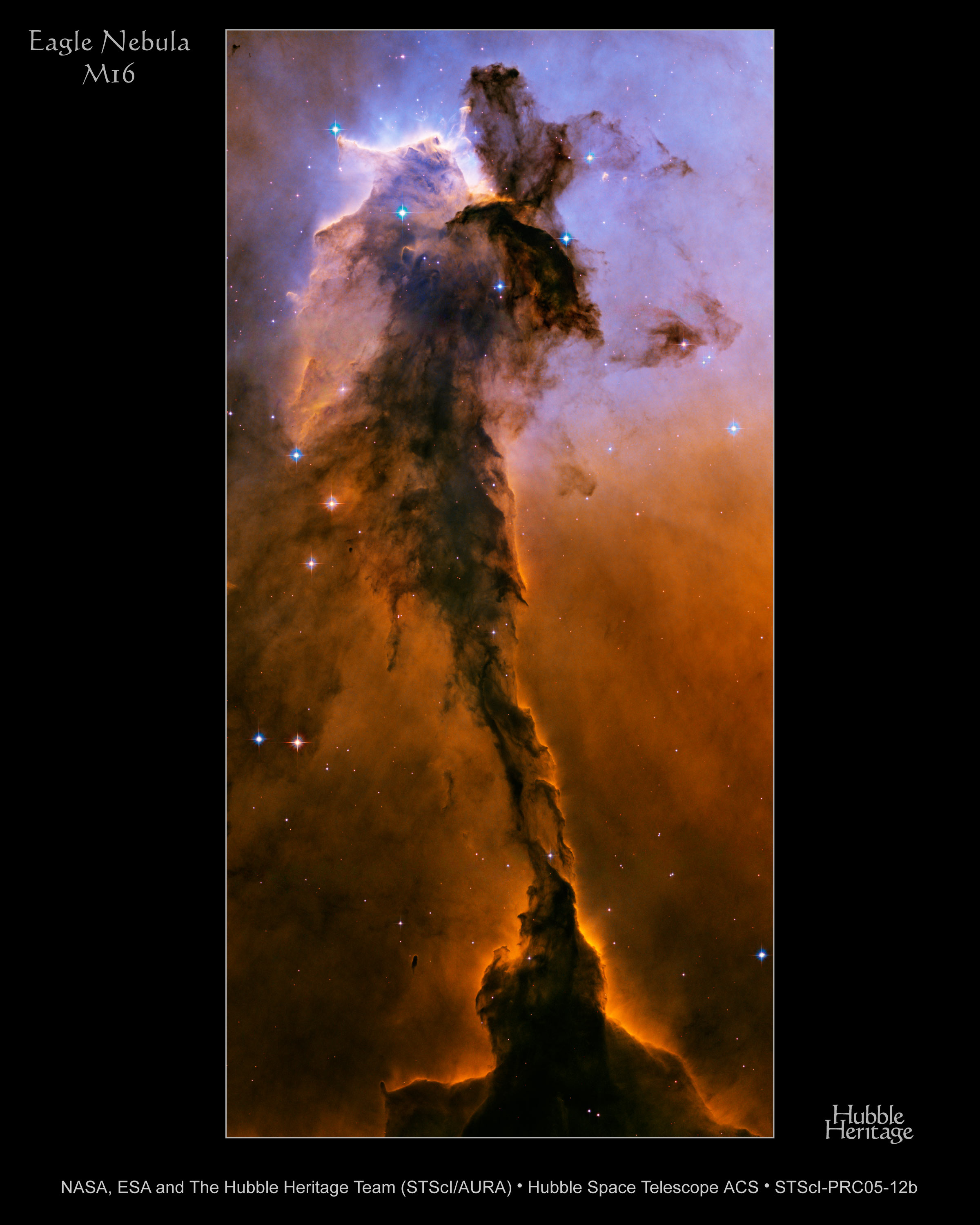
The Fairy of Eagle Nebula
Image Credit: The Hubble Heritage Team, (STScI/AURA), ESA, NASA 

Explanation: The dust sculptures of the Eagle Nebula are evaporating. As powerful starlight whittles away these cool cosmic mountains, the statuesque pillars that remain might be imagined as mythical beasts. Pictured above is one of several striking dust pillars of the Eagle Nebula that might be described as a gigantic alien fairy. This fairy, however, is ten light years tall and spews radiation much hotter than common fire. The greater Eagle Nebula, M16, is actually a giant evaporating shell of gas and dust inside of which is a growing cavity filled with a spectacular stellar nursery currently forming an open cluster of stars. The above image in scientifically re-assigned colors was released in 2005 as part of the fifteenth anniversary celebration of the launch of the Hubble Space Telescope.

Astronomy Picture of the Day for October 27th

Astronomy Picture of the Day

Discover the cosmos!Each day a different image or photograph of our fascinating universe is featured, along with a brief explanation written by a professional astronomer.

2011 October 27
See Explanation.  Clicking on the picture will download the highest resolution version available.

Young Suns of NGC 7129
Image Credit & Copyright: Johannes Schedler (Panther Observatory)Explanation: Young suns still lie within dusty NGC 7129, some 3,000 light-years away toward the royal constellation Cepheus. While these stars are at a relatively tender age, only a few million years old, it is likely that our own Sun formed in a similar stellar nursery some five billion years ago. Most noticeable in the sharp image are the lovely bluish dust clouds that reflect the youthful starlight. But the compact, deep red crescent shapes are also markers of energetic, young stellar objects. Known as Herbig-Haro objects, their shape and color is characteristic of glowing hydrogen gas shocked by jets streaming away from newborn stars. Paler, extended filaments of redish emission mingling with the bluish clouds are caused by dust grains effectively converting the invisible ultraviolet starlight to visible red light through photoluminesence. Ultimately the natal gas and dust in the region will be dispersed, the stars drifting apart as the loose cluster orbits the center of the Galaxy. At the estimated distance of NGC 7129, this telescopic view spans about 40 light-years.

Astronomy Picture of the Day for October 24th

Astronomy Picture of the Day

Discover the cosmos!Each day a different image or photograph of our fascinating universe is featured, along with a brief explanation written by a professional astronomer.

2011 October 24
See Explanation.  Clicking on the picture will download the highest resolution version available.

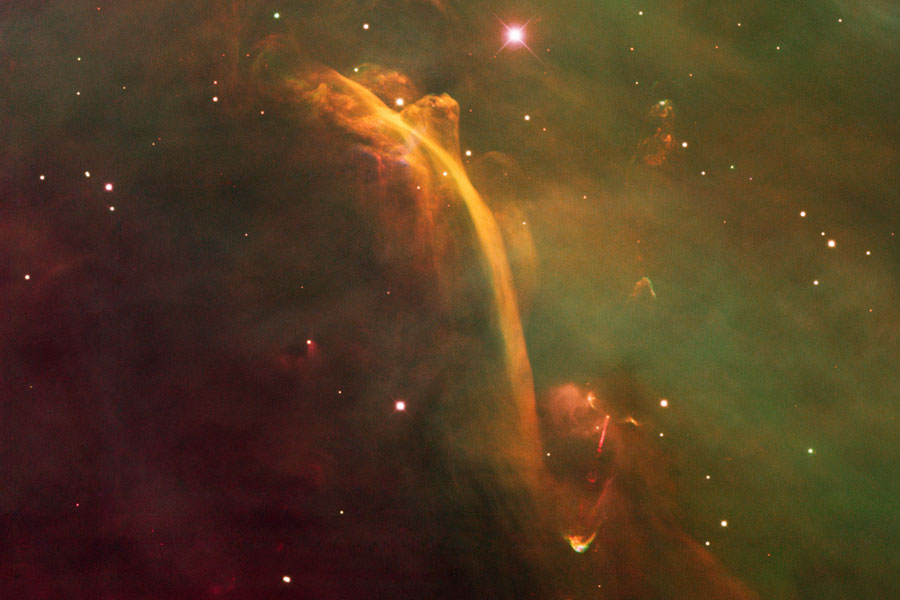
HH-222: The Waterfall Nebula
Image Credit: Z. Levay (STScI/AURA/NASA), T.A. Rector (U. Alaska Anchorage) & H. Schweiker (NOAO/AURA/NSF), KPNO, NOAO  


Explanation: What created the Waterfall Nebula? No one knows. The structure seen in the region of NGC 1999 in the Great Orion Molecular Cloud complex is one of the more mysterious structures yet found on the sky. Designated HH-222, the elongated gaseous stream stretches about ten light years and emits an unusual array of colors. One hypothesis is that the gas filament results from the wind from a young star impacting a nearby molecular cloud. That would not explain, however, why the Waterfall and fainter streams all appear to converge on a bright but unusual non thermal radio source located toward the upper left of the curving structure. Another hypothesis is that the unusual radio source originates from a binary system containing a hot white dwarf, neutron star, or black hole, and that the Waterfall is just a jet from this energetic system. Such systems, though, are typically strong X-rays emitters, and no X-rays have been detected. For now, this case remains unsolved. Perhaps well-chosen future observations and clever deductive reasoning will unlock the true origin of this enigmatic wisp in the future.

Astronomy Pic of the Day for Oct. 20th

Astronomy Picture of the Day

Discover the cosmos!Each day a different image or photograph of our fascinating universe is featured, along with a brief explanation written by a professional astronomer.


The Big Dipper
Image Credit & Copyright: Rogelio Bernal Andreo 


Explanation: The best known asterism in northern skies, The Big Dipper is easy to recognize, though some might see The Plough. Either way, the star names and the familiar outlines will appear in this thoughtfully composed 24 frame mosaic when you slide your cursor over the image. Dubhe, alpha star of the dipper’s parent constellation Ursa Major is at the upper right. Together with beta star Merak below, the two form a line pointing the way to Polaris and the North Celestial Pole off the top edge of the field. Notable too in skygazing lore Mizar, second star from the left in the dipper’s handle, forms a vision-testing visual double star with apparently close Alcor. Also identified in the famous star field are Messier catalog objects. Download the higher resolution image to hunt for exquisite views of some of Messier’s distant spiral galaxies and a more local owl.

Astronomy Picture of the Day for October 16th

Astronomy Picture of the Day

Discover the cosmos!Each day a different image or photograph of our fascinating universe is featured, along with a brief explanation written by a professional astronomer.

2011 October 16
See Explanation.  Clicking on the picture will download the highest resolution version available.

A Picturesque Venus Transit
Image Credit & Copyright: David Cortner 

Explanation: The rare transit of Venus across the face of the Sun in 2004 was one of the better-photographed events in sky history. Both scientific and artistic images flooded in from the areas that could see the transit: Europe and much of Asia, Africa, and North America. Scientifically, solar photographers confirmed that the black drop effect is really better related to the viewing clarity of the camera or telescope than the atmosphere of Venus. Artistically, images might be divided into several categories. One type captures the transit in front of a highly detailed Sun. Another category captures a double coincidence such as both Venus and an airplane simultaneously silhouetted, or Venus and the International Space Station in low Earth orbit. A third image type involves a fortuitous arrangement of interesting looking clouds, as shown by example in the above image taken from North Carolina, USA. The next transit of Venus across the Sun will be in 2012 June.

Astronomy Picture of the Day for October 14th

Astronomy Picture of the Day

Discover the cosmos!Each day a different image or photograph of our fascinating universe is featured, along with a brief explanation written by a professional astronomer.

2011 October 14

MAGIC Star Trails
Image Credit & Copyright: Babak Tafreshi (TWAN


Explanation: Colorful star trails arc across the night in this surreal timelapse skyscape from the Roque de los Muchachos Observatory on the Canary island of La Palma. A reflection of the Earth’s daily rotation on its axis, the star trails are also reflected in one of a pair of 17 meter diameter, multi-mirrored MAGIC telescopes. The MAGIC (Major Atmospheric Gamma Imaging Cherenkov) telescope itself is intended to detect gamma rays – photons with over 100 billion times the energy of visible light. As the high energy gamma rays impact the upper atmosphere they produce air showers of high-energy particles. A fast camera monitoring the multi-mirrored surface records in detail brief flashes of optical light, called Cherenkov light, created by the air shower particles Astronomers can then ultimately relate the optical flashes to cosmic sources of extreme gamma-rays.

Daily Astronomy Pic for October 12th

Astronomy Picture of the Day

Discover the cosmos!Each day a different image or photograph of our fascinating universe is featured, along with a brief explanation written by a professional astronomer.

2011 October 12


Saturn: Shadows of a Seasonal Sundial
Image Credit: Cassini Imaging Team, ISS, JPL, ESA, NASA  


Explanation: Saturn’s rings form one of the larger sundials known. This sundial, however, determines only the season of Saturn, not the time of day. In 2009, during Saturn’s last equinox, Saturn’s thin rings threw almost no shadows onto Saturn, since the ring plane pointed directly toward the Sun. As Saturn continued in its orbit around the Sun, however, the ring shadows become increasingly wider and cast further south. These shadows are not easily visible from the Earth because from our vantage point near the Sun, the rings always block the shadows. The above image was taken in August by the robotic Cassini spacecraft currently orbiting Saturn. The rings themselves appear as a vertical bar on the image right. The Sun, far to the upper right, shines through the rings and casts captivatingly complex shadows on south Saturn, on the image left. Cassini has been exploring Saturn, its rings, and its moons since 2004, and is expected to continue until at least the maximum elongation of Saturn’s shadows occurs in 2017.

Astronomy Picture of the Day for October 11th

Astronomy Picture of the Day

Discover the cosmos!Each day a different image or photograph of our fascinating universe is featured, along with a brief explanation written by a professional astronomer.

2011 October 11

NGC 7635: The Bubble Nebula
Image Credit & Copyright: Larry Van Vleet 


Explanation: It’s the bubble versus the cloud. NGC 7635, the Bubble Nebula, is being pushed out by the stellar wind of massive central star BD+602522. Next door, though, lives a giant molecular cloud, visible to the right. At this place in space, an irresistible force meets an immovable object in an interesting way. The cloud is able to contain the expansion of the bubble gas, but gets blasted by the hot radiation from the bubble’s central star. The radiation heats up dense regions of the molecular cloud causing it to glow. The Bubble Nebula, pictured above in scientifically mapped colors to bring up contrast, is about 10 light-years across and part of a much larger complex of stars and shells. The Bubble Nebula can be seen with a small telescope towards the constellation of the Queen of Aethiopia (Cassiopeia).

Astronomy Picture of the Day For October 10th

Astronomy Picture of the Day

Discover the cosmos! Each day a different image or photograph of our fascinating universe is featured, along with a brief explanation written by a professional astronomer.

The Milky Way in Infrared
Credit: E. L. Wright (UCLA), The COBE Project, DIRBE, NASA 

Explanation: At night, from a dark location, part of the clear sky looks milky. This unusual swath of dim light is generally visible during any month and from any location. Until the invention of the telescope, nobody really knew what the “Milky Way” was. About 300 years ago telescopes caused a startling revelation: the Milky Way was made of stars. Only 70 years ago, more powerful telescopes brought the further revelation that the Milky Way is only one galaxy among many. Now telescopes in space allow yet deeper understanding. The above picture was taken by the COBE satellite and shows the plane of our Galaxy in infrared light. The thin disk of our home spiral galaxy is clearly apparent, with stars appearing white and interstellar dust appearing red.

Astronomy Picture of the Day for October 9th

Astronomy Picture of the Day

Discover the cosmos! Each day a different image or photograph of our fascinating universe is featured, along with a brief explanation written by a professional astronomer.

SDSS J102915+172927: A Star That Should Not Exist
Image Credit: ESO, DSS2 


Explanation: Why does this star have so few heavy elements? Stars born in the generation of our Sun have an expected abundance of elements heavier than hydrogen and helium mixed into their atmospheres. Stars born in the generation before our Sun, Population II stars, the stars that created most of the heavy elements around us today, are seen to have some, although fewer, elements heavier than H and He. Furthermore, even the elusive never-seen first stars in the universe, so-called Population III stars, are predicted to have a large mass and a small but set amount of heavy elements. Yet low-mass Milky Way star SDSS J102915+172927, among others, appears to have fewer metals than ever predicted for any stars, including at least 50 times less lithium than came out of the Big Bang. The unusual nature of this star, initially cataloged by the Sloan Digital Sky Survey (SDSS) and pictured above, was discovered by detailed spectroscopic observations by a large VLT telescope in Chile. Many models of star formation indicate that such a star should not even form. Research is ongoing, however, with one leading hypothesis holding that fragile primordial lithium was destroyed in the star’s hot core.

Astronomy Picture of the Day for October 7th

Astronomy Picture of the Day

Discover the cosmos! Each day a different image or photograph of our fascinating universe is featured, along with a brief explanation written by a professional astronomer.

A Sun Pillar Over Ontario
Image Credit & Copyright: Rick Stankiewicz (Peterborough Astronomical Association) 

Explanation: What is that on the horizon? No, it’s not an alien starship battling distant Earthlings, but rather a sun pillar. When driving across Ontario, Canada in early June, the photographer was surprised to encounter such an “eerie and beautiful” vista, and immediately took pictures. When the atmosphere is cold, ice sometimes forms flat six-sided crystals as it falls from high-level clouds. Air resistance then causes these crystals to lie nearly flat much of the time as they flutter to the ground. If viewed toward a rising or setting Sun, these flat crystals will reflect sunlight and create an unusual column of light — a sun pillar as seen above. Such columns of light are not uncommon to see, and a retrospective of past APODs that have featured picturesque sun pillars can be found here.

Astronomy Picture of the Day for Oct. 4th – QR Codes: Not for Human Eyes

Astronomy Picture of the Day

Discover the cosmos!Each day a different image or photograph of our fascinating universe is featured, along with a brief explanation written by a professional astronomer.

2011 October 4

QR Codes: Not for Human Eyes
Image Credit: Kaywa QR Code Generator (Free) 


Explanation: This communication was not meant for human eyes. It was not even meant for aliens eyes. It’s an attempt to communicate directly with your smartphone. Cameras on many smartphones can image the above Quick Response (QR) code and then common applications can tell you what it means. Sometimes the deciphered code will reveal a web site address, prompting the smartphone to then ask you if you want to access this address to learn more about the object. QR codes are two-dimensional analogs of bar codes that can be scanned in any orientation and tolerate several types of errors. These codes are being used increasingly as doors between real objects and web-based information about those objects, and so are popping up increasingly in unexpected places. Anyone can create a QR code from any of several free online services, print it out, and affix it to an object. Although not meant to communicate with aliens, QR codes employ several attributes common to famous alien communication attempts. Can you — or a local smartphone — figure out what the above QR code means?


October 1 – Astronomy Day

October 1 – Astronomy Day

Astronomy Day is an annual event intended to provide a means of interaction between the general public and various astronomy enthusiasts, groups and professionals. The theme of Astronomy Day is “Bringing Astronomy to the People,” and on this day astronomy and stargazing clubs and other organizations around the world will plan special events. You can find out about special local events by contacting your local astronomy club or planetarium. You can also find more about Astronomy Day by checking the Web site for the Astronomical League.

NASA Image of the Day for October 1st

Saturn’s Silhouetted Clouds

This false-color mosaic shows deep-level clouds silhouetted against Saturn’s glowing interior. This mosaic shows the entire planet, including features like Saturn’s ring shadows and the terminator, the boundary between day and night.

The blue-green color (lower right) is sunlight scattered off clouds high in Saturn’s atmosphere and the red color (upper left) is the glow of thermal radiation from Saturn’s warm interior, easily seen on Saturn’s night side (top left), within the shadow of the rings, and with somewhat less contrast on Saturn’s day side (bottom right). The darker areas within Saturn show the strongest thermal radiation. The bright red color indicates areas where Saturn’s atmosphere is relatively clear. The great variety of cloud shapes and sizes reveals a surprisingly active planet below the overlying sun-scattering haze.

The brighter glow of the northern hemisphere versus the southern indicates that the clouds and hazes there are noticeably thinner than those in the south. Scientists speculate that this is a seasonal effect, and if so, it will change as the northern hemisphere enters springtime during the next few years.

The data were obtained in February 2006 at a distance of 1.6 million kilometers (1 million miles) from directly over the plane of Saturn’s rings, which appear here as a thin, blue line over the equator.

Image credit: NASA/JPL/University of Arizona

Astronomy Picture of the Day

Astronomy Picture of the Day

Discover the cosmos!Each day a different image or photograph of our fascinating universe is featured, along with a brief explanation written by a professional astronomer.

2011 September 29

Cocoon Nebula Wide Field
Image Credit & Copyright: Tony Hallas 


Explanation: In this crowded starfield spanning some 3 degrees within the high flying constellation Cygnus, the eye is drawn to the Cocoon Nebula. A compact star forming region, the cosmic Cocoon punctuates a long trail of obscuring interstellar dust clouds. Cataloged as IC 5146, the nebula is nearly 15 light-years wide, located some 4,000 light years away. Like other star forming regions, it stands out in red, glowing, hydrogen gas excited by the young, hot stars and blue, dust-reflected starlight at the edge of an otherwise invisible molecular cloud. In fact, the bright star near the center of this nebula is likely only a few hundred thousand years old, powering the nebular glow as it clears out a cavity in the molecular cloud’s star forming dust and gas. But the long dusty filaments that appear dark in this visible light image are themselves hiding stars in the process of formation, seen at infrared wavelengths.