Astronomy Picture of the Day

Discover the cosmos! Each day a different image or photograph of our fascinating universe is featured, along with a brief explanation written by a professional astronomer.

2022 October 25

Jupiter Rotates as Moons Orbit

Video Credit & Copyright: Makrem Larnaout

Explanation: Jupiter and its moons move like our Sun and its planets. Similarly, Jupiter spins while its moons circle around. Jupiter’s rotation can be observed by tracking circulating dark belts and light zones. The Great Red Spot, the largest storm known, rotates to become visible after about 15 seconds in the 48-second time lapse video. The video is a compilation of shorts taken over several nights last month and combined into a digital recreation of how 24-continuous hours would appear. Jupiter’s brightest moons always orbit in the plane of the planet’s rotation, even as Earth’s spin makes the whole system appear to tilt. The moons EuropaGanymede, and Io are all visible, with Europa’s shadow appearing as the icy Galilean moon crosses Jupiter’s disk. Jupiter remains near opposition this month, meaning that it is unusually bright, near to its closest to the Earth, and visible nearly all night long.


Almost Hyperspace: Random APOD Generator

October 24, 2022 Astronomy Picture of the Day

Discover the cosmos! Each day a different image or photograph of our fascinating universe is featured, along with a brief explanation written by a professional astronomer.

2022 October 24

Clouds Around Galaxy Andromeda

Image Credit & Copyright: Andrew Fryhover

Explanation: What are those red clouds surrounding the Andromeda galaxy? This galaxy, M31, is often imaged by planet Earth-based astronomers. As the nearest large spiral galaxy, it is a familiar sight with dark dust lanes, bright yellowish core, and spiral arms traced by clouds of bright blue stars. A mosaic of well-exposed broad and narrow-band image data, this deep portrait of our neighboring island universe offers strikingly unfamiliar features though, faint reddish clouds of glowing ionized hydrogen gas in the same wide field of view. Most of the ionized hydrogen clouds surely lie in the foreground of the scene, well within our Milky Way Galaxy. They are likely associated with the pervasive, dusty interstellar cirrus clouds scattered hundreds of light-years above our own galactic plane. Some of the clouds, however, occur right in the Andromeda galaxy itself, and some in M110, the small galaxy just below.

Astronomy Picture of the Day

Discover the cosmos! Each day a different image or photograph of our fascinating universe is featured, along with a brief explanation written by a professional astronomer.

2022 October 23

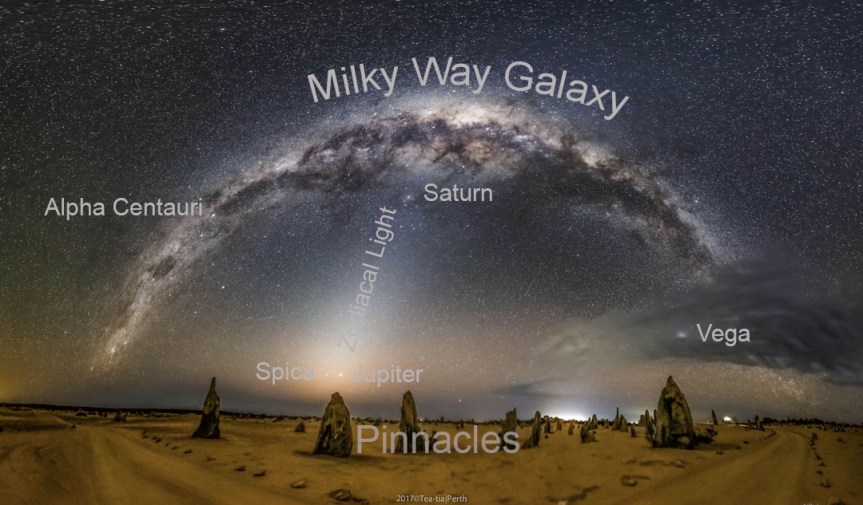
Milky Way and Zodiacal Light over Australian Pinnacles

Image Credit & Copyright: Jingyi Zhang

Explanation: What strange world is this? Earth. In the foreground of the featured image are the Pinnacles, unusual rock spires in Nambung National Park in Western Australia. Made of ancient sea shells (limestone), how these human-sized picturesque spires formed remains a topic of research. The picturesque panorama was taken in 2017 September. A ray of zodiacal light, sunlight reflected by dust grains orbiting between the planets in the Solar System, rises from the horizon near the image center. Arching across the top is the central band of our Milky Way Galaxy. The planets Jupiter and Saturn, as well as several famous stars are also visible in the background night sky.

Astronomy Picture of the Day

Discover the cosmos! Each day a different image or photograph of our fascinating universe is featured, along with a brief explanation written by a professional astronomer.

2022 October 22

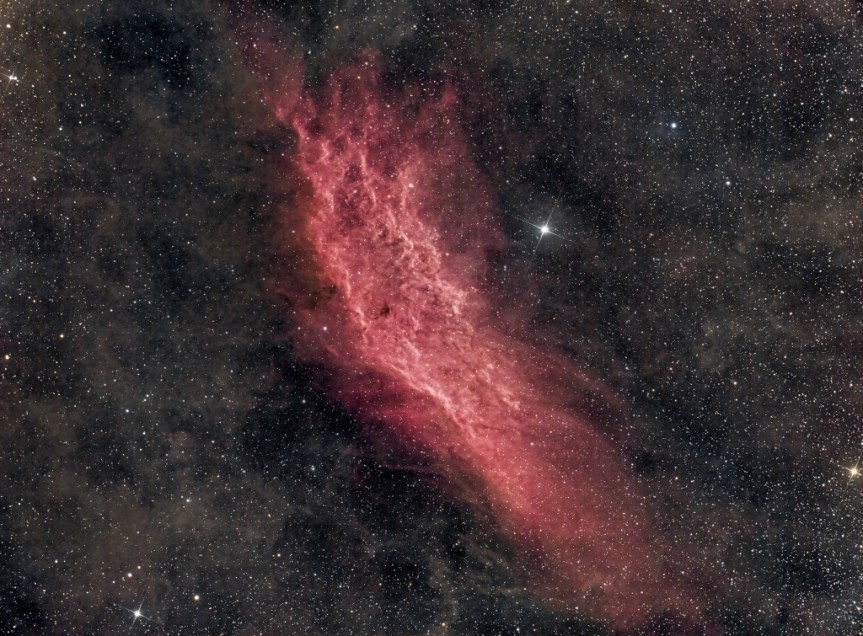
NGC 1499: The California Nebula

Image Credit & CopyrightStephen Kennedy

Explanation: Drifting through the Orion Arm of the spiral Milky Way Galaxy, this cosmic cloud by chance echoes the outline of California on the west coast of the United States. Our own Sun also lies within the Milky Way’s Orion Arm, only about 1,500 light-years from the California Nebula. Also known as NGC 1499, the classic emission nebula is around 100 light-years long. The California Nebula shines with the telltale reddish glow characteristic of hydrogen atoms recombining with long lost electrons. The electrons have been stripped away, ionized by energetic starlight. Most likely providing the energetic starlight that ionizes much of the nebular gas is the bright, hot star Xi Persei just to the right of the nebula. A popular target for astrophotographers, this deep image reveals the glowing nebula, obscuring dust, and stars across a 3 degree wide field of view. The California nebula lies toward the constellation Perseus, not far from the Pleiades.

October 21 Astronomy Picture of the Day

Discover the cosmos! Each day a different image or photograph of our fascinating universe is featured, along with a brief explanation written by a professional astronomer.

2022 October 21

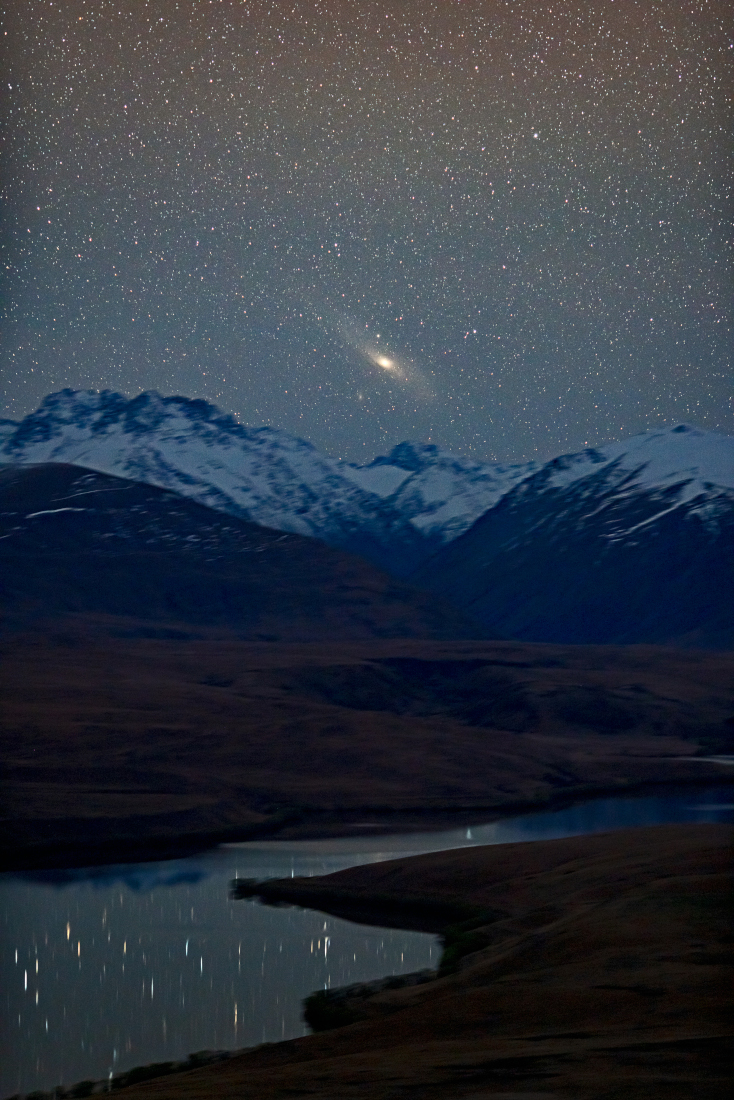
Andromeda in Southern Skies

Image Credit & CopyrightIan Griffin (Otago Museum)

Explanation: Looking north from southern New Zealand, the Andromeda Galaxy never gets more than about five degrees above the horizon. As spring comes to the southern hemisphere, in late September Andromeda is highest in the sky around midnight though. In a single 30 second exposure this telephoto image tracked the stars to capture the closest large spiral galaxy from Mount John Observatory as it climbed just over the rugged peaks of the south island’s Southern Alps. In the foreground, stars are reflected in the still waters of Lake Alexandrina. Also known as M31, the Andromeda Galaxy is one of the brightest objects in the Messier catalog, usually visible to the unaided eye as a small, faint, fuzzy patch. But this clear, dark sky and long exposure reveal the galaxy’s greater extent in planet Earth’s night, spanning nearly 6 full moons.

October 20 Astronomy Picture of the Day

Discover the cosmos! Each day a different image or photograph of our fascinating universe is featured, along with a brief explanation written by a professional astronomer.

2022 October 20

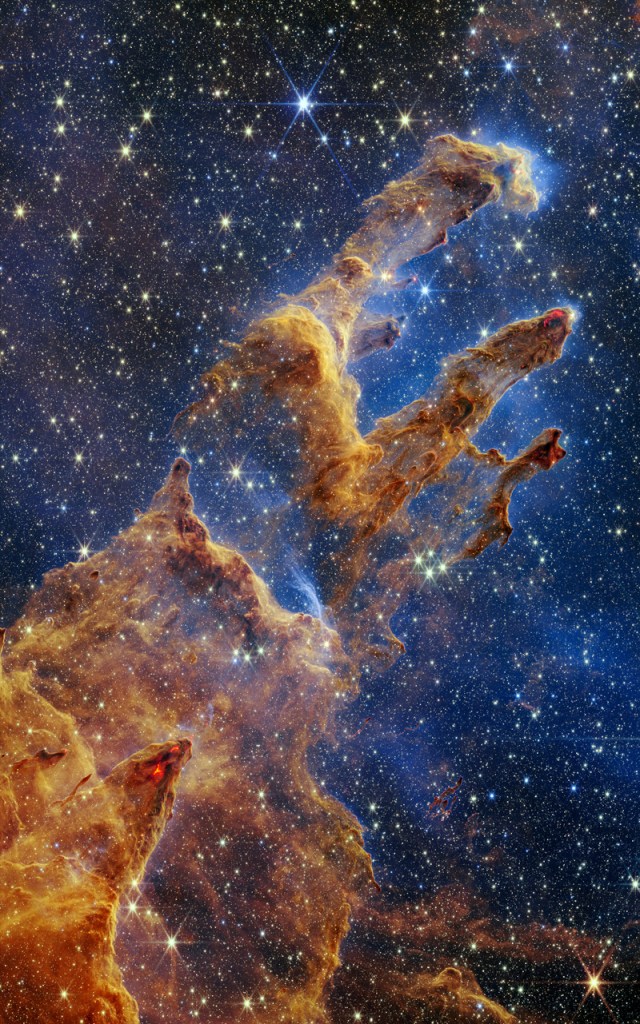
Pillars of Creation

Image Credit: Science – NASAESACSASTScINIRCam
Processing – Joseph DePasquale (STScI), Anton M. Koekemoer (STScI), Alyssa Pagan (STScI)

Explanation: A now famous picture from the Hubble Space Telescope featured these star forming columns of cold gas and dust light-years long inside M16, the Eagle Nebula, dubbed the Pillars of Creation. This James Webb Space Telescope NIRCam image expands Hubble’s exploration of that region in greater detail and depth inside the iconic stellar nursery. Particularly stunning in Webb’s near infrared view is the telltale reddish emission from knots of material undergoing gravitational collapse to form stars within the natal clouds. The Eagle Nebula is some 6,500 light-years distant. The larger bright emission nebula is itself an easy target for binoculars or small telescopes. M16 lies along the plane of our Milky Way galaxy in a nebula rich part of the sky, toward the split constellation Serpens Cauda (the tail of the snake).

Astronomy Picture of the Day

Discover the cosmos! Each day a different image or photograph of our fascinating universe is featured, along with a brief explanation written by a professional astronomer.

2022 October 19

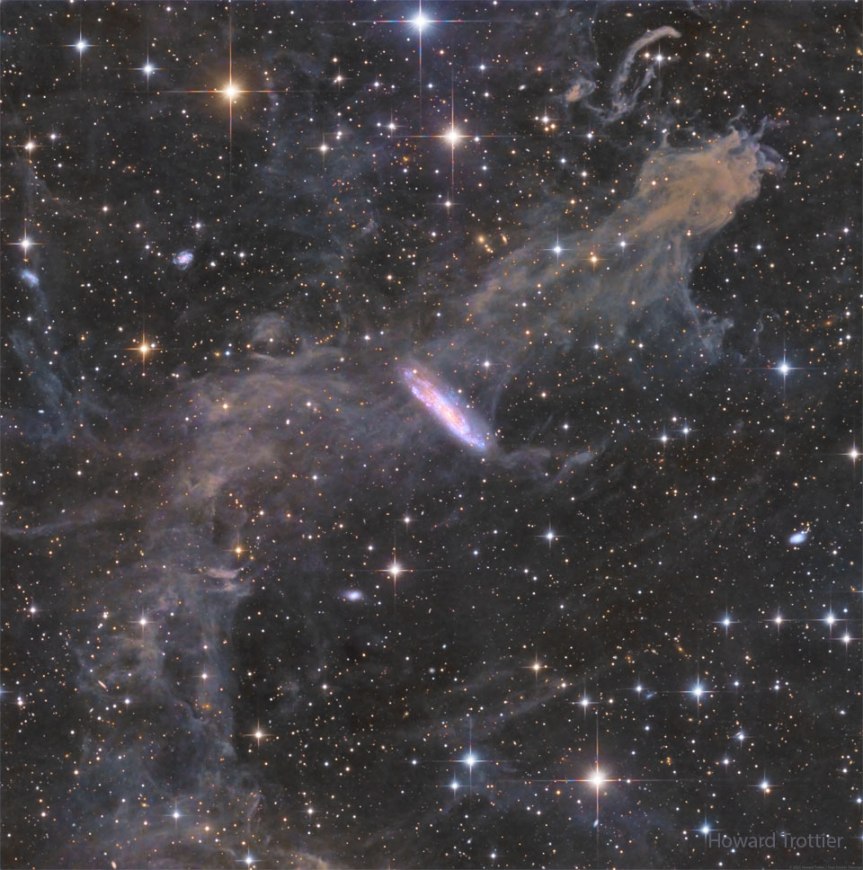
A Galaxy Beyond Stars, Gas, Dust

Image Credit & Copyright: Howard Trottier; Text: Emily Rice

Explanation: Do we dare believe our eyes? When we look at images of space, we often wonder whether they are “real”, and just as often the best answer varies. In this case, the scene appears much as our eyes would see it, because it was obtained using RGB (Red, Green, Blue) filters like the cone cells in our eyes, except collecting light for 19 hours, not a fraction of a second. The featured image was captured over six nights, using a 24-inch diameter telescope in the Sierra Nevada Mountains, in CaliforniaUSA. The bright spiral galaxy at the center (NGC 7497) looks like it is being grasped by an eerie tendril of a space ghost, and therein lies the trick. The galaxy is actually 59 million light years away, while the nebulosity is MBM 54, less than one thousand light years away, making it one of the nearest cool clouds of gas and dust — galactic cirrus — within our own Milky Way Galaxy. Both are in the constellation of Pegasus, which can be seen high overhead from northern latitudes in the autumn.

Astronomy Picture of the Day

Discover the cosmos! Each day a different image or photograph of our fascinating universe is featured, along with a brief explanation written by a professional astronomer.

2022 October 18

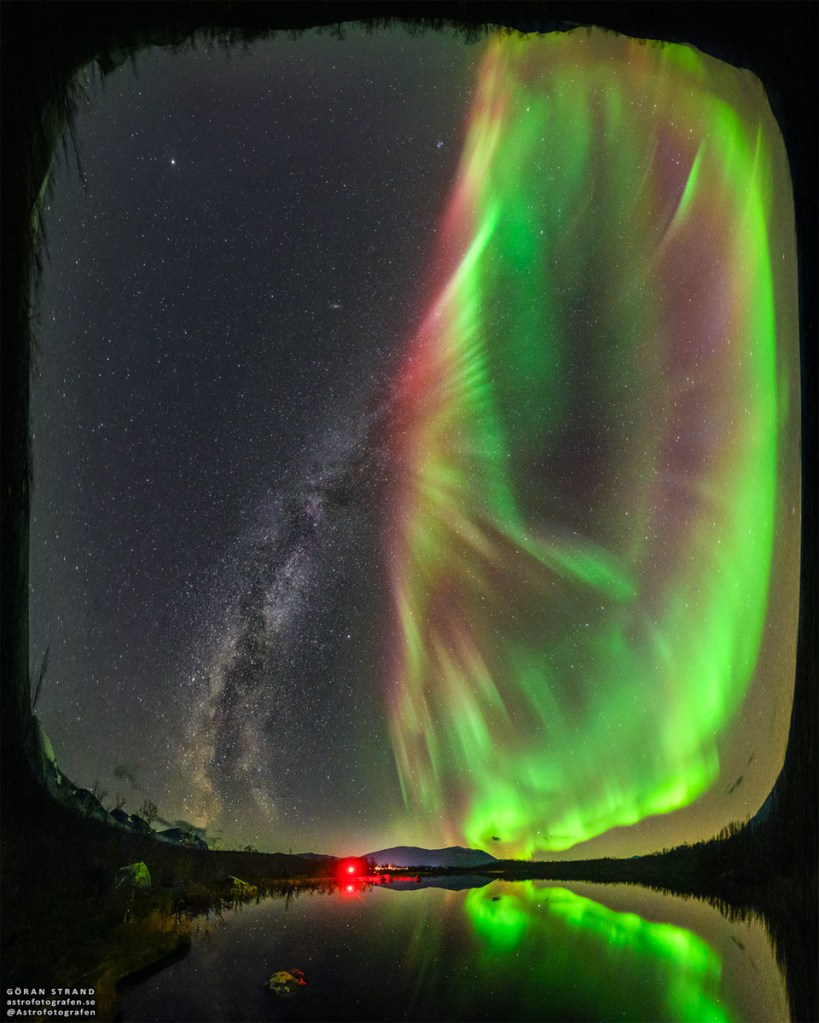
Milky Way Auroral Flower

Image Credit & Copyright: Göran Strand

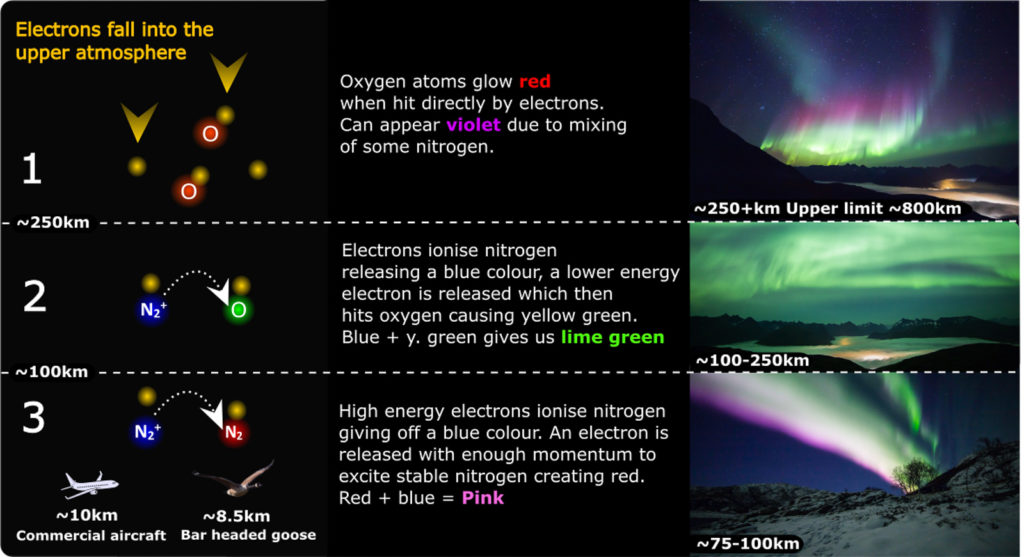
Explanation: Could the stem of our Milky Way bloom into an auroral flower? No, not really, even though it may appear that way in today’s featured all-sky image. On the left, the central plane of our home galaxy extends from the horizon past the middle of the sky. On the right, an auroral oval also extends from the sky’s center — but is dominated by bright green-glowing oxygen. The two are not physically connected, because the aurora is relatively nearby, with the higher red parts occurring in Earth’s atmosphere only about 1000 kilometers high. In contrast, an average distance to the stars and nebulas we see in the Milky Way more like 1000 light-years away – 10 trillion times further. The featured image composite was taken in early October across a small lake in Abisko, northern Sweden. As our Sun’s magnetic field evolves into the active part of its 11-year cycle, auroras near both of Earth’s poles are sure to become more frequent.

Astronomy Picture of the Day

Discover the cosmos! Each day a different image or photograph of our fascinating universe is featured, along with a brief explanation written by a professional astronomer.

2022 October 13

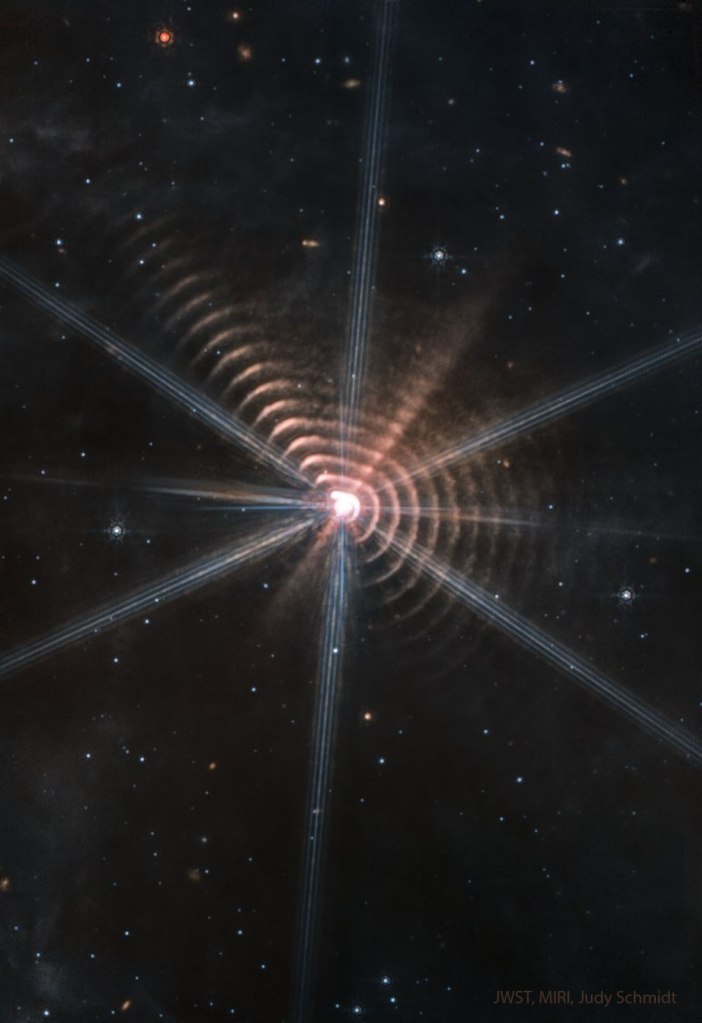
Dust Shells around WR 140 from Webb

Image Credit: NASAESACSAJWSTMIRIERS Program 1349; Processing: Judy Schmidt

Explanation: What are those strange rings? Rich in dust, the rings are likely 3D shells — but how they were created remains a topic of researchWhere they were created is well known: in a binary star system that lies about 6,000 light years away toward the constellation of the Swan (Cygnus) — a system dominated by the Wolf-Rayet star WR 140Wolf-Rayet stars are massive, bright, and known for their tumultuous winds. They are also known for creating and dispersing heavy elements such as carbon which is a building block of interstellar dust. The other star in the binary is also bright and massive — but not as active. The two great stars joust in an oblong orbit as they approach each other about every eight years. When at closest approach, the X-ray emission from the system increases, as, apparently, does the dust expelled into space — creating another shell. The featured infrared image by the new Webb Space Telescope resolves greater details and more dust shells than ever before.

Astronomy Picture of the Day

Discover the cosmos! Each day a different image or photograph of our fascinating universe is featured, along with a brief explanation written by a professional astronomer.

2022 October 12

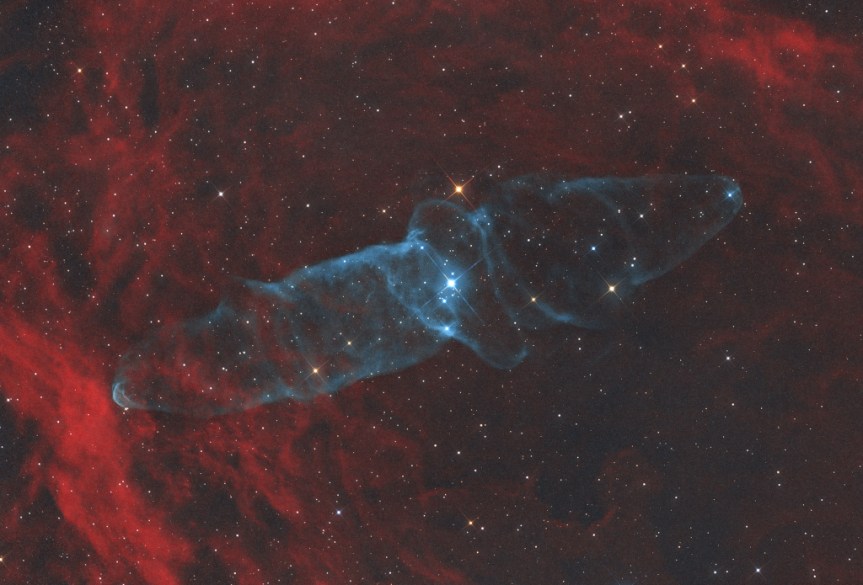
Ou4: The Giant Squid Nebula

Image Credit & CopyrightTommy Lease

Explanation: A mysterious squid-like cosmic cloud, this nebula is very faint, but also very large in planet Earth’s sky. In the image, composed with 30 hours of narrowband image data, it spans nearly three full moons toward the royal constellation Cepheus. Discovered in 2011 by French astro-imager Nicolas Outters, the Squid Nebula’s bipolar shape is distinguished here by the telltale blue-green emission from doubly ionized oxygen atoms. Though apparently surrounded by the reddish hydrogen emission region Sh2-129, the true distance and nature of the Squid Nebula have been difficult to determine. Still, a more recent investigation suggests Ou4 really does lie within Sh2-129 some 2,300 light-years away. Consistent with that scenario, the cosmic squid would represent a spectacular outflow of material driven by a triple system of hot, massive stars, cataloged as HR8119, seen near the center of the nebula. If so, this truly giant squid nebula would physically be over 50 light-years across.

Astronomy Picture of the Day

Discover the cosmos! Each day a different image or photograph of our fascinating universe is featured, along with a brief explanation written by a professional astronomer.

2022 October 11

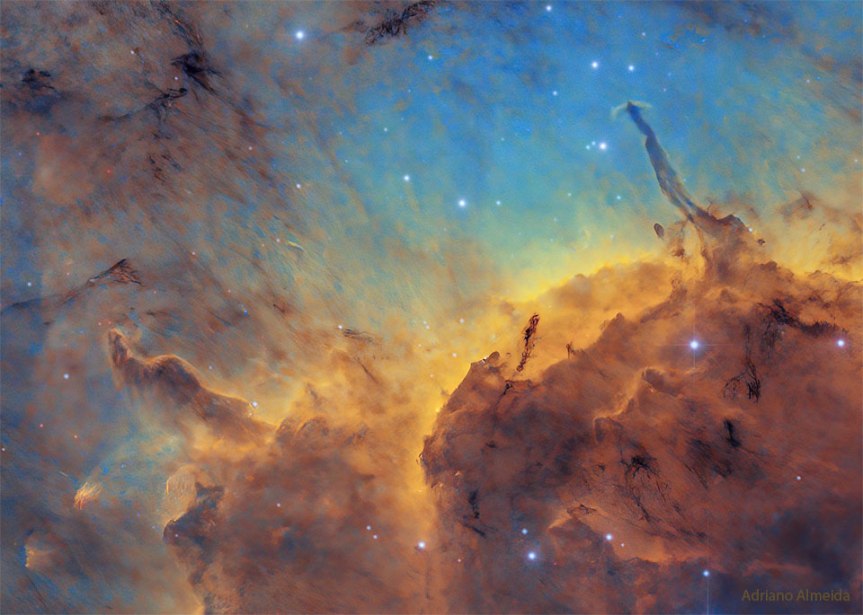
Stars, Dust, Pillars, and Jets in the Pelican Nebula

Image Credit & Copyright: Adriano Almeida

Explanation: What dark structures arise within the Pelican Nebula? On the whole, the nebula appears like a bird (a pelican) and is seen toward the constellation of a different bird: Cygnus, a Swan. But inside, the Pelican Nebula is a place lit up by new stars and befouled by dark dust. Smoke-sized dust grains start as simple carbon compounds formed in the cool atmospheres of young stars but are dispersed by stellar winds and explosions. Two impressive Herbig-Haro jets are seen emitted by the star HH 555 on the right, and these jets are helping to destroy the light year-long dust pillar that contains it. Other pillars and jets are also visible. The featured image was scientifically-colored to emphasize light emitted by small amounts of heavy elements in a nebula made predominantly of the light elements hydrogen and helium. The Pelican Nebula (IC 5067 and IC 5070) is about 2,000 light-years away and can be found with a small telescope to the northeast of the bright star Deneb.


Explore Your Universe: Random APOD Generator

Astronomy Picture of the Day

Discover the cosmos! Each day a different image or photograph of our fascinating universe is featured, along with a brief explanation written by a professional astronomer.

2022 October 10

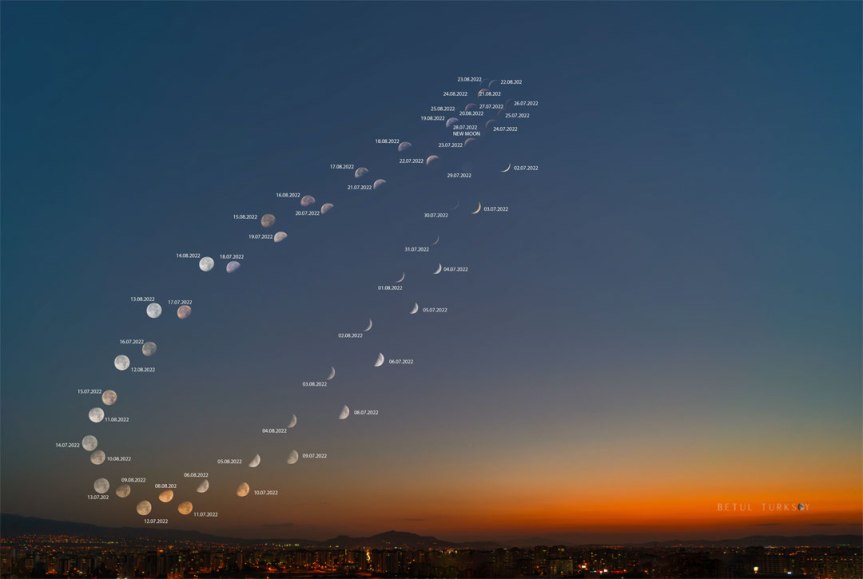
A Double Lunar Analemma over Turkey

Image Credit & Copyright: Betul Turksoy

Explanation: An analemma is that figure-8 curve you get when you mark the position of the Sun at the same time each day for one year. But the trick to imaging an analemma of the Moon is to wait bit longer. On average the Moon returns to the same position in the sky about 50 minutes and 29 seconds later each day. So photograph the Moon 50 minutes 29 seconds later on successive days. Over one lunation or lunar month it will trace out an analemma-like curve as the Moon’s actual position wanders due to its tilted and elliptical orbit. Since the featured image was taken over two months, it actually shows a double lunar analemma. Crescent lunar phases too thin and faint to capture around the New moon are missing. The two months the persistent astrophotographer chose were during a good stretch of weather during July and August, and the location was KayseriTurkey

Astronomy Picture of the Day

Discover the cosmos! Each day a different image or photograph of our fascinating universe is featured, along with a brief explanation written by a professional astronomer.

2022 October 9

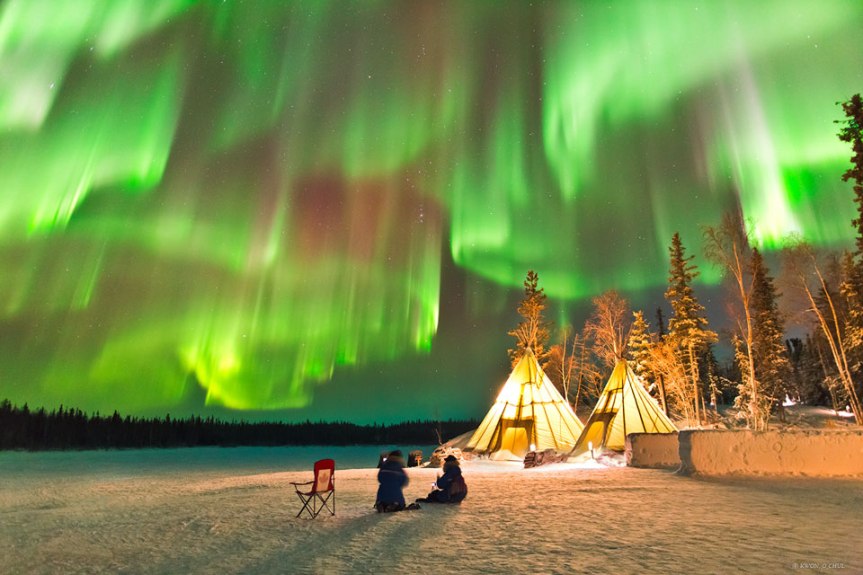
Auroras over Northern Canada

Image Credit & Copyright: Kwon, O Chul (TWAN)

Explanation: Gusting solar winds and blasts of charged particles from the Sun resulted in several rewarding nights of auroras back in 2014 December, near the peak of the last 11-year solar cycle. The featured image captured dramatic auroras stretching across a sky near the town of Yellowknife in northern Canada. The auroras were so bright that they not only inspired awe, but were easily visible on an image exposure of only 1.3 seconds. A video taken concurrently shows the dancing sky lights evolving in real time as tourists, many there just to see auroras, respond with cheers. The conical dwellings on the image right are tipis, while far in the background, near the image center, is the constellation of Orion. Auroras may increase again over the next few years as our Sun again approaches solar maximum.

Astronomy Picture of the Day

Discover the cosmos! Each day a different image or photograph of our fascinating universe is featured, along with a brief explanation written by a professional astronomer.

2022 September 30

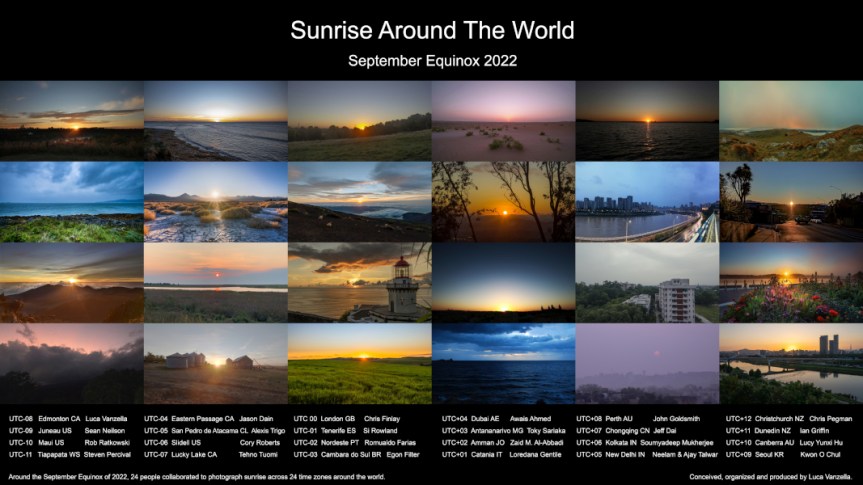
Equinox Sunrise Around the World

Collage Image Copyright: Luca Vanzella

Explanation: A planet-wide collaboration resulted in this remarkable array of sunrise photographs taken around the September 2022 equinox. The images were contributed by 24 photographers, one in each of 24 nautical time zones around the world. Unlike more complicated civil time zone boundaries, the 24 nautical time zones are simply 15 degree longitude bands corresponding to 1 hour steps that span the globe. Start at the upper right for the first to experience a sunrise in the nautical time zone corresponding to Coordinated Universal Time (UTC) + 12 hours. In that time zone, the photographer was located in Christchurch, New Zealand. Travel to the west by looking down the column and then moving to the column toward the left for later sunrises as the time zone offset in hours from UTC decreases. Or, you can watch a video of September 2022 equinox sunrises around planet Earth.

September 13 to September 29 Astronomy Picture of the Day

2022 September 29: DART Asteroid Impact from Space
2022 September 28: A Furious Sky over Mount Shasta
2022 September 27: DART: Impact on Asteroid Dimorphos
2022 September 26: All the Water on Planet Earth
2022 September 25: The Fairy of Eagle Nebula
2022 September 24: September Sunrise Shadows
2022 September 23: Ringed Ice Giant Neptune
2022 September 22: NGC 7331 Close Up
2022 September 21: The Horsehead Nebula in Infrared from Hubble
2022 September 20: Star Forming Region NGC 3582 without Stars
2022 September 19: Star Trails and Lightning over the Pyrenees
2022 September 18: Analemma over the Callanish Stones
2022 September 17: Perseverance in Jezero Crater s Delta
2022 September 16: The Tarantula Zone
2022 September 15: Harvest Moon over Sicily
2022 September 14: Waves of the Great Lacerta Nebula
2022 September 13: A Long Snaking Filament on the Sun

Astronomy Picture of the Day

Here is the list for the astronomy pictures of the day from September 1 to September 12, 2022. I will go back to posting them on their day starting tomorrow.

2022 September 12: Red Sprite Lightning over the Czech Republic
2022 September 11: Planets of the Solar System: Tilts and Spins
2022 September 10: Galaxy by the Lake
2022 September 09: Interstellar Voyager
2022 September 08: North America and the Pelican
2022 September 07: Tarantula Stars R136 from Webb
2022 September 06: An Iridescent Pileus Cloud over China
2022 September 05: Carina Cliffs from the Webb Space Telescope
2022 September 04: Sea and Sky Glows over the Oregon Coast
2022 September 03: Sun and Moon and ISS
2022 September 02: M51: The Whirlpool Galaxy
2022 September 01: The Tulip and Cygnus X-1

August 29 Astronomy Picture of the Day

Discover the cosmos! Each day a different image or photograph of our fascinating universe is featured, along with a brief explanation written by a professional astronomer.

2022 August 29

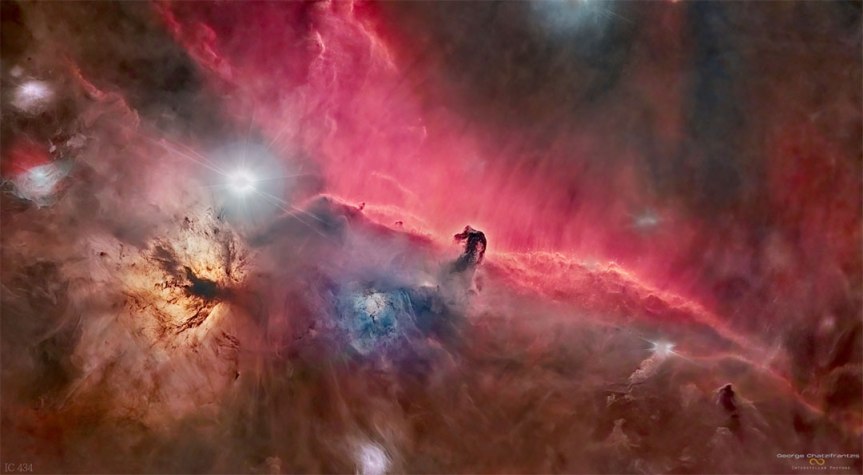
The Horsehead Nebula Region without Stars

Image Credit & Copyright: George Chatzifrantzis

Explanation: The famous Horsehead Nebula in Orion is not alone. A deep exposure shows that the dark familiar shaped indentation, visible just right of center, is part of a vast complex of absorbing dust and glowing gas. The featured spectacular picture details an intricate tapestry of gaseous wisps and dust-laden filaments that were created and sculpted over eons by stellar winds and ancient supernovas. The Flame Nebula is visible in orange just to the Horsehead’s left. To highlight the dust and gas, most of the stars have been digitally removed, although a notable exception is Alnitak, just above the Flame Nebula, which is the rightmost star in Orion’s famous belt of three aligned stars. The Horsehead Nebula lies 1,500 light years distant towards the constellation of Orion.


NASA Coverage: Artemis I Mission to the Moon
Teachers & Students: Ideas for utilizing APOD in the classroom

List of Astronomy Pictures of the Day from All of 2022 to Date

If you would like to catch up on all the Astronomy Picture of the Day from January 1 to August 28, 2022 you can click on this link From apodNASA.gov

August 29, 2022 Today in History

Today’s Important Historical Events

1526 Battle of Mohács: In a decisive battle the Hungarian Empire is conquered by the Ottoman Empire led by Suleiman the Magnificent

1825 Portugal recognizes the Independence of Brazil

1842 Great Britain and China sign Treaty of Nanking, ending the Opium war

1862 Second Battle of Bull Run, fought in Manassas, Virginia begins, Confederate victory (US Civil War)

1949 USSR performs its first nuclear test at Semipalatinsk, Kazakh SSR

2005 Hurricane Katrina makes 2nd and 3rd landfall as a category 3 hurricane, devastating much of the U.S. Gulf Coast from Louisiana to Florida Panhandle. Kills more than 1,836, causes over $115 billion in damage.

Today’s Historical Events

708 Copper coins are minted in Japan for the first time (Traditional Japanese date: August 10, 708).

1178 Anti-Pope Callistus III gives pope title to Alexander III

1261 Jacques Pantaleon elected as Pope Urban IV

1350 Battle of Winchelsea (or Les Espagnols sur Mer): The English naval fleet under King Edward III defeats a Castilian fleet of 40 ships

1475 Peace Treaty of Picquigny: King Louis XI buys English contacts

1484 Giovanni Battista Cibo elected as Pope Innocent VIII

1526 Battle of Mohács: In a decisive battle the Hungarian Empire is conquered by the Ottoman Empire led by Suleiman the Magnificent

1533 Atahualpalast Sapa Inca Emperor is suspected to have been buried in Northern Peru or in Ecuador

Today’s Historical Events in Film and TV

1952 New York premiere of history-based film “The Miracle of Our Lady of Fatima”

1953 KHSL TV channel 12 in Chico, CA (CBS) begins broadcasting

1967 Final TV episode of “The Fugitive” starring David Janssen watched by 78 million people

1969 KYUS TV channel 3 in Miles City, MT (ABC/NBC) begins broadcasting

1987 44th Venice Film Festival: “Au revoir les enfants” (“Goodbye, Children”) directed by Louis Malle wins Golden Lion

1988 45th Venice Film Festival: “The Legend of the Holy Drinker” directed by Ermanno Olmi wins Golden Lion

1992 Largest wrestling crowd outside US (75,000) at Wembley Stadium, London

1997 Netflix is founded by Marc Randolph and Reed Hasting in Scotts Valley, California as an online DVD rental business

Today’s Historical Events in Music

1958 George Harrison joins The Quarrymen, who later become The Beatles

1958 Cliff Richard and the Drifters release single “Move It”, Richards debut single. Credited as 1st British Rock n Roll song.

1964 Stephen Sondheim‘s musical “A Funny Thing Happened on the Way to the Forum”, starring Zero Mostel, and Jack Gilford, closes at Alvin Theater, NYC, after 965 performances and 6 Tony Awards

1966 The Beatles’ last public concert before a crowd of 25,000, and 7,000 unsold seats, at Candlestick Park in San Francisco, California

1977 Iggy Pop releases his second album “Lust for Life”, a collaboration with David Bowie

1982 Steve Miller’s single “Abracadabra” hits #1

1992 Irish rock band U2 plays the 1st of two sold-out nights at Yankee Stadium in The Bronx, NYC

1994 British band Oasis release their debut album “Definitely Maybe”, becomes fastest-selling album ever in UK

Today’s Historical Events in Sports

1882 Australia beat England by 7 runs – “Death of English cricket”

1882 Australian cricket fast bowler Fred Spofforth completes 14-90 (7-46 & 7-44) in one-off Test v England in London

1885 Phillies Charlie Ferguson no-hits Providence 1-0

1885 Boxing’s 1st heavyweight title fight with 3-oz gloves & 3-minute rounds fought between John L. Sullivan & Dominick McCaffrey

1889 1st American International professional lawn tennis contest (Newport, Rhode Island)

1895 The formation of the Northern Rugby Union at the George Hotel, Huddersfield, England.

1906 US National Championship Men’s Tennis, Newport, RI: William Clothier beats defending champion Beals Wright 6-3, 6-0, 6-4

1908 US Open Men’s Golf, Myopia Hunt GC: Fred McLeod defeats fellow Scot Willie Smith by 6 strokes in an 18-hole playoff to win his only major title

August 2 Astronomy Picture of the Day

Discover the cosmos! Each day a different image or photograph of our fascinating universe is featured, along with a brief explanation written by a professional astronomer.

2022 August 2

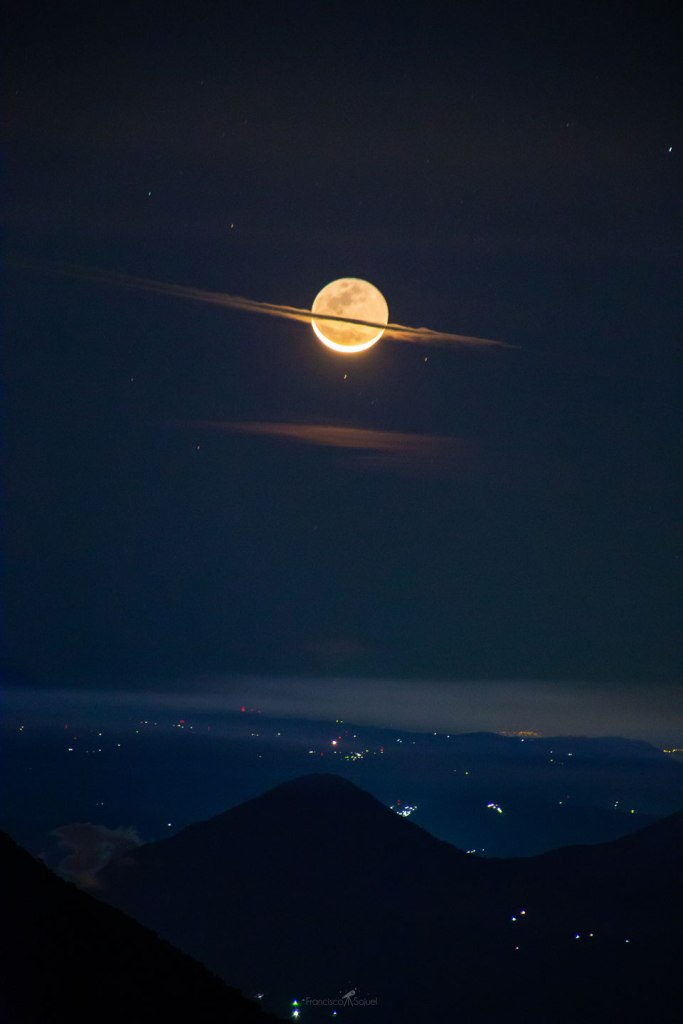
A Moon Dressed Like Saturn

Image Credit & Copyright: Francisco Sojuel

Explanation: Why does Saturn appear so big? It doesn’t — what is pictured are foreground clouds on Earth crossing in front of the Moon. The Moon shows a slight crescent phase with most of its surface visible by reflected Earthlight known as ashen glow. The Sun directly illuminates the brightly lit lunar crescent from the bottom, which means that the Sun must be below the horizon and so the image was taken before sunrise. This double take-inducing picture was captured on 2019 December 24, two days before the Moon slid in front of the Sun to create a solar eclipse. In the foreground, lights from small Guatemalan towns are visible behind the huge volcano Pacaya.


News: APOD Receives First Outreach Prize from the International Astronomical Union