Remembering Those Who Have Gone (Samhain)

Remembering Those Who Have Gone

Items needed:

1 natural candle and 1 blue candle

1 stone/pebble amethyst or quartz for every person you would like to remember on this night

1 goblet red wine (or more if you have a lot of people to remember!!)


Cast your circle or sacred space, ensuring you have a comfortable area to sit within your circle as you could be there some time. Light the two candles in the west of your circle forming a doorway by which spirit can enter should they choose to do so. Now, take one crystal in your hand, close your eyes and remember the good things about that person – those things that made you smile, laugh or cry. Then, when you have remembered the things you wanted to, simply state something like “If you are able, please come and sit with me…name….” then lay down the stone with the candles. Lift your glass and toast them and take a drink. Continue until all the people you wanted to think about had been remembered.

You may get the feeling that one is present, a few or all if you are lucky, in which case it will be a crowded circle. However, it is lovely to sit and remember and let them come should they want to. This is what Samhain is for and why the children dress as ghosts and ghouls. When you have sat for enough time and all is done (you can also do your divination within the circle as it would definitely be a powerful reading), then simply pick up each crystal individually, stating something like “…name…, thank you for your time, and I bid you hale and farewell.” and when all have been thanked, then close down your circle and keep those special crystals on your altar.


Source

The Green Witch

Samhain Ritual: 31 October

Samhain Ritual: 31 October


Materials: one cauldron, filled with water

CRONE This should be an older female.

OLD KING This should be a person chosen by lottery, or by whoever is acting as Crone. It can be enacted by the HP if needed.

BARD/GREEN MAN If the coven has no Bard available, then a Green Man should be chosen by lottery, or by whoever is acting as Maiden. It can be enacted by the HP, if needed.

The place of ritual should be set up, away from the gathered participants. This is not something that people should miss, so make sure that potty break is taken care of before the circle is cast.

HPS

Go we now to the sacred place
And stand within the sacred space
Turn your minds to sacred things
And dance with me unto the ring!

HP and HPS lead the coven to the place of ritual by a spiral dance, ending in a circle around the altar. The cauldron should be at the south. The Old King dances at the end of the line.

HPS

Come we forth, with the Spiral Dance
Within the Lady’s radiance
To mark the turning of the year
The door to Winter now is here.

Earth and Water, Fire and Air
I invoke the Goddess there!
This night we are Between the Worlds
To celebrate the year unfurled!

HP

Earth and Water, Fire and Sky
I invoke the God on high
This night we are Between the Worlds
To celebrate the year unfurled!

The corners shall be called thusly, that all may hear, but shall not be called until the HPS reaches that corner on her circumnabulation.

EAST

O Guardians of the Eastern Tower,
Airy ones of healing power
I do summon, stir and call you
See these rites and guard this circle!

Come to us and heed our call!
By the Power that made us all;
By the Power that blesses Thee
Come to us; and Blessed Be!

SOUTH

Oh fiery ones of Southern Power
Thus I invite you to this tower
I do summon, stir and call you
See these rites and guard this circle!

Come to us and heed our call!
By the Power that made us all;
By the Power that blesses Thee:
Come to us; and Blessed Be!

WEST

Western ones of water’s flow
Help to guard us here below
I do summon, stir and call you
See these rites and guard this circle!

Come to us and heed our call!
By the Power that made us all;
By the Power that blesses Thee:
Come to us; and Blessed Be!

NORTH

Earthen ones of Northern fame
Bless and guard our Power’s fane
I do summon, stir and call you

See these rites and guard this circle!
Come to us and heed our call!
By the Power that made us all;
By the Power that blesses Thee:
Come to us; and Blessed Be!

The HPS shall move to each corner, and say, following each corner’s crying as she moves to the next:

HPS

So I cast and consecrate
This Circle of the small and great:
By Fin and Feather, Leaf and Tree,
By Rock and Earth, by Land and Sea,
By Fire and Water, Earth and Air,
By the Lord, and Lady Fair!
By Love and Joy and Work and Play,
All things harmful cast away!
By lightning’s flash, and rain’s soft fall,
By the Power that made us all;
By the Power that blesses Thee:
(Cast the Circle: Blessed be!)

On her return to the first corner she shall change the last line above, and say:

The Circle’s cast; and Blessed Be!

The callers of the corners shall return their tools to the altar, and then shall join the circle at their corners.

Here begins the Samhain Mystery:

OLD KING

Thus I invoke the Lady White
To come to us this sacred night.
By Fin and Feather, Leaf and Tree,
I shall show you a Mystery!

Bard/Green Man and Maiden join hands, facing each other. The Maiden speaks to the Bard/Green Man:

MAIDEN

Lord of Life, hail Land-Master!
God of grain that grows and dies
Rising reborn, full of richness;
Fallow fields shall yet be fertile –
Spring sap runs as stirs your manhood
Bless barren earth, bear fruit again!

The Bard/Green Man speaks to Maiden:

BARD/GREEN MAN

Snow-shoes striding, hail swift Huntress!
Wild one, free and willful Goddess
Bow and blade you bear beside you,
Finding food to fend off hunger –
Winter will not leave us wanting;
Give good hunting, grant us skill.

The Old King moves to the West. The Crone moves to the North.

HP

Cunning and art he did not lack
But aye her whistle would fetch him back!

OLD KING

Yet I shall go into a trout.
With sorrow and sighing and mickle doubt
And show thee many a merry game
Ere that I be fetch-ed hame!

CRONE

Trout, take heed of an otter lank
Will harry thee close from bank to bank
For here come I in the Lady’s Name
All but for to fetch thee hame!

The Old King moves to the South. The Crone moves to the West.

HP

Cunning and art he did not lack
But aye her whistle would fetch him back!

OLD KING

Yet I shall go into a bee
With mickle fear and dread of thee
And flit to hive in the Lady’s Name
Ere that I be fetch-ed hame!

CRONE

Bee, take heed of a red, red cock
Will harry thee close through door and lock
For here come I in the Lady’s Name
All but for to fetch thee hame!

The Old King moves to the East. The Crone moves to the South.

HP

Cunning and art he did not lack
But aye her whistle would fetch him back!

OLD KING

Oh, I shall go into a hare
with sorrow, sighing and mickle care
And I shall go in the Lady’s Name
Aye, until I be fetch-ed hame!

CRONE

Hare, take heed of a swift greyhound
Will harry thee all these fields around
For here come I in the Lady’s Name
All but for to fetch thee hame!

The Old King moves to the North. The Crone moves to the East.

HP

Cunning and art he did not lack
But aye her whistle would fetch him back!

OLD KING

Yet I shall go into a mouse
And haste me unto the Miller’s House
There in his corn to have good game
Ere that I be fetch-ed hame!

CRONE

Mouse, take heed of a white she-cat
That never was balked of mouse nor rat
For here come I in the Lady’s Name
And -thus- it is I fetch thee hame!

Crone walks to Old King and takes his hand. He falls as if dead.

HPS

Cunning and art he did not lack
But aye Her Song has fetched Him back!

Summer’s gone, the Lady reigns
And Winter has returned again!

Maiden wets her hands with water from the Cauldron, and sprinkles it on the Old King, who comes to life again.

OLD KING

Cunning and art I do not lack
But aye Her Cauldron will bring me back!

The Crone and Old King shall join hands, facing each other, and say:

Note: These Norse style verses were taken from a file I got (I think) from Paul Seymour. Don’t know who author is.

CRONE

One-eye, Wanderer, God of wisdom,
Hunt-lord, hail, who leads the hosting!
Nine nights hanging, knowledge gaining,
Cloaked at crossroads, council hidden.
Now the night, your time, is near us –
Right roads send us on, Rune-winner.

OLD KING

Every age your eyes have witnessed;
Cauldron-Keeper, hail wise Crone!
Rede in riddles is your ration –
Wyrd-weaver at the World-tree’s root.
Eldest ancient, all-knowing one,
Speak unto us, send us vision!

Here the HPS should say:

HPS

We remember our dead; our loved ones gone to the Summerland before us. Give them peace and joy.

ALL

Blessed be!

READER

Never again the Burning Times! Let us remember our dead, good and bad, innocent and guilty:

HPS

Let them have peace.

ALL

Blessed be!

Here ends the Samhain Mystery.

A normal cone-of-power may be raised, for growth and healing:

HPS

In a ring we all shall stand
Pass the Power, hand to hand.

HP

As the season turns again
Power flows from friend to friend

HPS

Pass the Power, hand to hand
Bless the Lady, bless the Land

HP

Bless the Lord, and bless the Skies
Bless the Power that never dies!

The above four verses should be repeated three times, or as many times as needed, and the HPS shall then say:

HPS

By Fin and Feather, Leaf and Tree:
Let the Power flow out and free!

All should release, at this point.

Any needed coven business may be transacted here.

The Circle is opened:

HPS

Thus I release the East and West
Thanks to them from Host to Guest
Thus I release the South and North
With “Blessed Be’ I send them forth!
The Circle’s open, dance we so
Out and homeward we shall go.
Earth and Water, Air and Fire
Celebrated our desire.
We think of those in Summerland
Who dance together, hand in hand.
By Fin and Feather, Leaf and Tree,
Our circle’s done; and Blessed Be!

COVEN

Blessed Be!

All spiral dance out from the Circle, led by HP and HPS.


The White Bard, Author

Published on Pagan Library

Samhain Ritual

Samhain Ritual


This ritual was written at a time when I did not have a qualified Priest in my group. However, it may easily be adapted for those groups in which the Priestess and Priest work together. It may be just as easily adapted to solitary work.

Place an apple and pomegranate upon the altar. There should also be a “planted” pot of earth for each participant – these may be arranged on the altar as well, if there is ample space. Instruments of divination may be placed within the Circle perimeter for use during the ritual if you wish. Arrange the altar as usual and decorate with Autumn leaves, pumpkins, etc.

The Circle is cast and purified the Circle in the usual manner. Dancing around the Circle in a shuffle step (deosil), all chant three times:

The Moon is bright, the Crone is old
The body lifeless – the bones so cold
We all live and pay our dues
To die in ones and threes and twos.

Death, dance and play the harp
Piercing silence in the dark
The Woman’s old with withered limbs
Death beckons Her to dance with Him

As She accepts the Dance of Death
The Earth is cooled by ghostly breath
To lie in dormancy once more
To have Her strength and life restored

Go to the Western Quarter and draw an invoking pentagram with the athame to open the gate. Then evoke the dead by saying:

All ye spirits who walk this night –
Hearken! Hearken to my call!
I bid you in our Circle join!
Enter! Enter – one and all!

Come ye, spirits of the dead:
Be ye spirit of plant or pet
Or human being who still roams!
Into this Circle you are let!

Speak to us of things unknown!
Lend your energies to this rite!
To speed your journey, we have joined
On this sacred Samhain night!

All ye spirits who walk this night –
Hearken! Hearken to my call!
I bid you in our Circle join!
Enter! Enter – one and all!

Bestow blessings upon the dead, saying:

Oh Mighty Pan of the Summerlands:
Guardian of the beloved dead
We pour forth love on those you keep
Safely, in your peaceful stead
We bless those who have walked the path
That someday, we as well, shall rove
We offer peace unto their souls
While resting in your arms, below

Now is the time for divination (Ouija Board, pendulum, cards, etc.) and communication with those who have gone on before us. Allow plenty of time for this. [Note: I have found that it is helpful to have a tape recorder handy within the Circle for recording any communications that may be “channeled” during this time. Some people disagree with this suggestion, saying that the metal of this electronic device causes scattered energies in the Circle; however, if the recorder has been cleansed and purified as the rest of the ritual tools, the problem seems to be resolved.]

When the divinatory processes are completed, the Priestess goes to the Western Quarter and draw the banishing pentagram, saying:

Blessings be upon thee, oh wondrous Spirits of the
Summerlands. We humbly thank thee for your presence in our
Circle and honor you in celebration this sacred night. We
beseech thee, oh Pan, keeper of the sacred dead, embrace
once again those souls within your keep and hold tightly
to your breast those which have been lost and wandering.
Grant them safe passage to the Summerland, where they may
rest peacefully in your strength until they are refreshed
and reborn again in perfect love. We bid thee all a fond
farewell. So mote it be!

The gate is now closed.

The Priestess goes to the altar and hold up the pomegranate, saying:

Behold the pomegranate, fruit of Life…

The athame is plunged into the pomegranate, splitting it open to display the seeds. She says:

Whose seeds lie in the dormancy of Death!

The Priestess eats one of the seeds, saying:

I Taste the seeds of Death.

The pomegranate is then passed hand to hand through the participants of the ritual, each eating a seed and saying to the next person:

“Taste the seeds of Death.”

The Priestess then holds up the apple, saying:

Behold the apple: fruit of wisdom, fruit of Death…

She then cuts the apple crosswise, saying:

Whose symbolism rewards us with life eternal!

She holds up the apple, displaying the inner pentagram, and says:

Behold the five-fold star – the promise of rebirth!

Consecrate the fruit and wine. Each person then tastes of the apple and sips the wine, saying to the next person:

Taste the fruit of rebirth and sip from the cup of wine of Life.

After libation, the Priestess presents each member of the group with a small pot of earth, planted with three seeds [preferably rue or lavender]. She briefly explains to the group that this is the season of the seed – it is a time of dormancy, but also a time of re-generation for growth. Further, as the seed rests in the earth, they should also take time to rest and re-evaluate their lives, metaphorically planting only those values which will enrich and enhance the growth within the Divine Self. She then instructs them to name the seeds within their pots with three values they wish to incorporate into their lives, knowing that as the seeds sprout with new life, their lives will be new, as well.

After the presentation, all join hands and hold them skyward.

PRIESTESS:

Thus is the Circle of Rebirth.
All pass from this life through the great god, Pan
But through My love you are all reborn
In the cycles of nature – through the Cosmic Plan.

In living we die – in dying we live
The fruit is first seed, yet seed comes from the fruit
In the mystery of life and death and rebirth
The Circle turns ever, and I am its root.

ALL RESPOND:

The Sun conceived in Darkness, cold
In the Shadow of Death, a Life unfolds
A shred of Light begins to burn
From Death comes Life – the Circle turns.

Dismiss Quarters and Dissolve Circle.

PRIESTESS:

The rite is ended.

ALL:

Merry meet and merry part and merry meet again!

Outdoor libation to the Lord and Lady, and the spirits of the dead.


Dorothy Morrison, Author

Published on Pagan Library

Jack-O-Lantern Warding Spell (Samhain)

Jack-O-Lantern Warding Spell


If you feel you are being plagued by some malevolent spirit or energy, try this during the Samhain season to protect your home and send it away.

You Will Need:

  • Pumpkin
  • Pumpkin carving tools
  • Black votive candles
  • Clove oil
  • Black pepper
  • Garlic cloves
  1. Hollow and carve your pumpkin into a jack-o-lantern the normal way. This is no time for cutesy pictures or artsy expressions. Just carve your basic scary face into it.
  2. In meditation, talk to your jack-o-lantern. Give him a name. Tell him his purpose—to ward off evil, fend off baneful magic, or banish unwanted spirits.
  3. Anoint your votive candle with clove oil, building energy as you rub it in. Empower it with your desire by simply visualizing your desire going down your arms, through your hands, into the candle. You might chant as you do this. This is the energy-raising part of the spell, so really focus on your goal and let it build.
  4. Place the candle inside your jack-o-lantern. Drop some garlic cloves and a few pinches of black pepper around it for good measure.
  5. Put your jack-o-lantern outside your door. Light the candle to release the energy. Let it burn out.
  6. For maximum effect, do this three nights in a row (putting in a newly anointed candle each night).


About The Author

Sage has been a witch for 25 years. She enjoys writing informative articles to teach others the craft of the wise.

Published on Exemplore

Samhain Spirit-Banishing Incense

Spirit-Banishing Incense

Burn this if you are worried that baneful spirits are bothering you during this season when the veil is thin, or to follow up after burning Spirit Drawing Incense to ensure spirits return from whence they came.

3 parts Frankincense

2 parts sage

1 parts ground angelica root

1 part St. John’s Wort

1 part bay

IF you feel a particularly malevolent spirit is about, you may add one part fumitory, or a pinch of garlic powder (just a pinch—it’s strong!)

If your frankincense is not already thoroughly ground, let it air-dry overnight, then grind it in your mortar and pestle going counter-clockwise while focusing on banishing. After the frankincense is ground, add the other ingredients, one at time, to incorporate and blend them.

Burn to rid the area of unwanted spirits. If burning indoors, open all the windows.


About The Author

Sage has been a witch for 25 years. She enjoys writing informative articles to teach others the craft of the wise.

Published on Exemplore


Samhain Spirit-Drawing Incense

Spirit-Drawing Incense

This is a great incense if you are seeking to commune with spirits this season.

CAUTION: Make sure you are really ready to draw spirits before burning it.

1 part sandalwood powder

1 part ground wormwood

1 part lavender

Ground and blend in your mortar and pestle and then sprinkle on lighted incense coals. You can also throw a handful onto a burning fire, such as in your fireplace or an outdoor balefire. You can burn it to draw your ancestors, while using a divination tool, during meditation/trance work, or before sleep to promote contact during dreams.


About the Author

Sage has been a witch for 25 years. She enjoys writing informative articles to teach others the craft of the wise.

Published on Exemplore


Samhain Goddesses – Hel – Norse

Hel


In the Poetic EddaProse Edda, and Heimskringla, Hel is referred to as a daughter of Loki. In the Prose Edda book Gylfaginning, Hel is described as having been appointed by the god Odin as ruler of the realm of Niflheim. In the same source, her appearance is described as half blue and half flesh-colored and further as having a gloomy, downcast appearance. The Prose Edda details that Hel rules over vast mansions with many servants in her underworld realm and plays a key role in the attempted resurrection of the god Baldr.

Scholarly theories have been proposed about Hel’s potential connections to figures appearing in the 11th-century Old English Gospel of Nicodemus and Old Norse Bartholomeus saga postola, that she may have been considered a goddess with potential Indo-European parallels in Bhavani, Kali, and Mahakali or that Hel may have become a being only as a late personification of the location of the same name.

Domain

The gods had abducted Hel and her brothers from Angrboda’s hall. They cast her in the underworld, into which she distributes those who are sent to her; the wicked and those who died of sickness or old age. Her hall in Helheim is called Eljudnir, Home of the Dead. Her manservant is Ganglati and her maidservant is Ganglot (which both can be translated as “tardy”). She has a knife called “Famine”, a plate called “Hunger”, a bed called “Disease”, and bed curtains called “Misfortune”.

Etymology

The Old Norse feminine proper noun Hel is identical to the name of the location over which she rules, Old Norse Hel. The word has cognates in all branches of the Germanic languages, including Old English hell (and thus Modern English hell), Old Frisian helle, Old Saxon hellia, Old High German hella, and Gothic halja. All forms ultimately derive from the reconstructed Proto-Germanic feminine noun *xaljō or *haljō (‘concealed place, the underworld’). In turn, the Proto-Germanic form derives from the o-grade form of the Proto-Indo-European root *kel-, *kol-: ‘to cover, conceal, save’.

The term is etymologically related to Modern English hall and therefore also Valhalla, an afterlife ‘hall of the slain’ in Norse Mythology. Hall and its numerous Germanic cognates derive from Proto-Germanic *hallō ‘covered place, hall’, from Proto-Indo-European *kol-.

Related early Germanic terms and concepts include Proto-Germanic *xalja-rūnō(n), a feminine compound noun, and *xalja-wītjan, a neutral compound noun. This form is reconstructed from the Latinized Gothic plural noun *haliurunnae (attested by Jordanes; according to philologist Vladimir Orel, meaning ‘witches’), Old English helle-rúne (‘sorceress, necromancer’, according to Orel), and Old High German helli-rūna ‘magic’. The compound is composed of two elements: *xaljō (*haljō) and *rūnō, the Proto-Germanic precursor to Modern English rune. The second element in the Gothic haliurunnae may however instead be an agent noun from the verb rinnan (“to run, go”), which would make its literal meaning “one who travels to the netherworld”.)

Proto-Germanic *xalja-wītjan (or *halja-wītjan) is reconstructed from Old Norse hel-víti ‘hell’, Old English helle-wíte ‘hell-torment, hell’, Old Saxon helli-wīti ‘hell’, and the Middle High German feminine noun helle-wīze. The compound is a compound of *xaljō (discussed above) and *wītjan (reconstructed from forms such as Old English witt ‘right mind, wits’, Old Saxon gewit ‘understanding’, and Gothic un-witi ‘foolishness, understanding’).

Attestations

Poetic Edda

The Poetic Edda, compiled in the 13th century from earlier traditional sources, features various poems that mention Hel. In the Poetic Edda poem Völuspá, Hel’s realm is referred to as the “Halls of Hel.” In stanza 31 of Grímnismál, Hel is listed as living beneath one of three roots growing from the world tree Yggdrasil. In Fáfnismál, the hero Sigurd stands before the mortally wounded body of the dragon Fáfnir, and states that Fáfnir lies in pieces, where “Hel can take” him. In Atlamál, the phrases “Hel has half of us” and “sent off to Hel” are used in reference to death, though it could be a reference to the location and not the being, if not both. In stanza 4 of Baldrs draumar, Odin rides towards the “high hall of Hel.”

Hel may also be alluded to in Hamðismál. Death is periphrased as “joy of the troll-woman” (or “ogress”) and ostensibly it is Hel being referred to as the troll-woman or the ogre (flagð), although it may otherwise be some unspecified dís. The Poetic Edda also mentions that travelers to Hel must pass by her guardian hound Garmr.

Prose Edda

Hel is referred to in the Prose Edda, written in the 13th century by Snorri Sturluson. In chapter 34 of the book Gylfaginning, Hel is listed by High as one of the three children of Loki and Angrboða; the wolf Fenrir, the serpent Jörmungandr, and Hel. High continues that, once the gods found that these three children are being brought up in the land of Jötunheimr, and when the gods “traced prophecies that from these siblings great mischief and disaster would arise for them” then the gods expected a lot of trouble from the three children, partially due to the nature of the mother of the children, yet worse so due to the nature of their father.

High says that Odin sent the gods to gather the children and bring them to him. Upon their arrival, Odin threw Jörmungandr into “that deep sea that lies round all lands,” Odin threw Hel into Niflheim, and bestowed upon her authority over nine worlds, in that she must “administer board and lodging to those sent to her, and that is those who die of sickness or old age.” High details that in this realm Hel has “great Mansions” with extremely high walls and immense gates, a hall called Éljúðnir, a dish called “Hunger,” a knife called “Famine,” the servant Ganglati (Old Norse “lazy walker”), the serving-maid Ganglöt (also “lazy walker”), the entrance threshold “Stumbling-block,” the bed “Sick-bed,” and the curtains “Gleaming-bale.” High describes Hel as “half black and half flesh-coloured,” adding that this makes her easily recognizable, and furthermore that Hel is “rather downcast and fierce-looking.”

In chapter 49, High describes the events surrounding the death of the god Baldr. The goddess Frigg asks who among the Æsir will earn “all her love and favour” by riding to Hel, the location, to try to find Baldr, and offer Hel herself a ransom. The god Hermóðr volunteers and sets off upon the eight-legged horse Sleipnir to Hel. Hermóðr arrives in Hel’s hall, finds his brother Baldr there, and stays the night. The next morning, Hermóðr begs Hel to allow Baldr to ride home with him, and tells her about the great weeping the Æsir have done upon Baldr’s death. Hel says the love people have for Baldr that Hermóðr has claimed must be tested, stating:

“If all things in the world, alive or dead, weep for him, then he will be allowed to return to the Æsir. If anyone speaks against him or refuses to cry, then he will remain with Hel.”

Later in the chapter, after the female jötunn Þökk refuses to weep for the dead Baldr, she responds in verse, ending with “let Hel hold what she has.” In chapter 51, High describes the events of Ragnarök, and details that when Loki arrives at the field Vígríðr “all of Hel’s people” will arrive with him.

In chapter 5 of the Prose Edda book Skáldskaparmál, Hel is mentioned in a kenning for Baldr (“Hel’s companion”). In chapter 16, “Hel’s […] relative or father” is given as a kenning for Loki. In chapter 50, Hel is referenced (“to join the company of the quite monstrous wolf’s sister”) in the skaldic poem Ragnarsdrápa.

Heimskringla

In the Heimskringla book Ynglinga saga, written in the 13th century by Snorri Sturluson, Hel is referred to, though never by name. In chapter 17, the king Dyggvi dies of sickness. A poem from the 9th-century Ynglingatal that forms the basis of Ynglinga saga is then quoted that describes Hel’s taking of Dyggvi:

I doubt not
but Dyggvi’s corpse
Hel does hold
to whore with him;
for Ulf’s sib
a scion of kings
by right should
caress in death:
to love lured
Loki’s sister
Yngvi’s heir
o’er all Sweden.

In chapter 45, a section from Ynglingatal is given which refers to Hel as “howes’-warder” (meaning “guardian of the graves”) and as taking King Halfdan Hvitbeinn from life. In chapter 46, King Eystein Halfdansson dies by being knocked overboard by a sail yard. A section from Ynglingatal follows, describing that Eystein “fared to” Hel (referred to as “Býleistr’s-brother’s-daughter”). In chapter 47, the deceased Eystein’s son King Halfdan dies of an illness, and the excerpt provided in the chapter describes his fate thereafter, a portion of which references Hel:

Loki’s child
from life summoned
to her thing
the third liege-lord,
when Halfdan
of Holtar farm
left the life
allotted to him.

In a stanza from Ynglingatal recorded in chapter 72 of the Heimskringla book Saga of Harald Sigurdsson, “given to Hel” is again used as a phrase to referring to death.

Egils saga

The Icelanders’ saga Egils saga contains the poem Sonatorrek. The saga attributes the poem to 10th century skald Egill Skallagrímsson, and writes that it was composed by Egill after the death of his son Gunnar. The final stanza of the poem contains a mention of Hel, though not by name:

Now my course is tough:
Death, close sister
of Odin’s enemy
stands on the ness:
with resolution
and without remorse
I will gladly
await my own.

Gesta Danorum

In the account of Baldr’s death in Saxo Grammaticus’ early 13th century work Gesta Danorum, the dying Baldr has a dream visitation from Proserpina (here translated as “the goddess of death”):

The following night the goddess of death appeared to him in a dream standing at his side, and declared that in three days time she would clasp him in her arms. It was no idle vision, for after three days the acute pain of his injury brought his end.

Scholars have assumed that Saxo used Proserpina as a goddess equivalent to the Norse Hel.


Source

Mythology Wikia


Samhain Goddesses – The Morrigan – Celtic

The Morrígan

The Morrígan or Mórrígan, also known as Morrígu, is a figure from Irish mythology. The name is Mór-Ríoghain in Modern Irish. It has been translated as “great queen”, “phantom queen” or “queen of phantoms”.

The Morrígan is mainly associated with war and fate, especially with foretelling doom, death or victory in battle. In this role she often appears as a crow, the badb. She incites warriors to battle and can help bring about victory over their enemies. The Morrígan encourages warriors to do brave deeds, strikes fear into their enemies, and is portrayed washing the bloodstained clothes of those fated to die. She also has some connection with sovereignty, the land and livestock. In modern times she is often called a “war goddess” and has also been seen as a manifestation of the earth- and sovereignty-goddess, chiefly representing the goddess’s role as guardian of the territory and its people.

The Morrígan is often described as a trio of individuals, all sisters, called ‘the three Morrígna’.  Membership of the triad varies; sometimes it is given as Badb, Macha and Nemain while elsewhere it is given as Badb, Macha and Anand (the latter is given as another name for the Morrígan). It is believed that these were all names for the same goddess. The three Morrígna are also named as sisters of the three land goddesses Ériu, Banba and Fódla. The Morrígan is said to be the wife of The Dagda, while Badb and Nemain are said to be the wives of Neit.

She is associated with the banshee of later folklore.

Etymology

There is some disagreement over the meaning of the Morrígan’s name. Mor may derive from an Indo-European root connoting terror or monstrousness, cognate with the Old English maere (which survives in the modern English word “nightmare”) and the Scandinavian mara and the Old East Slavic “mara” (“nightmare”); while rígan translates as ‘queen’. This can be reconstructed in the Proto-Celtic language as *Moro-rīganī-s.   Accordingly, Morrígan is often translated as “Phantom Queen”. This is the derivation generally favoured in current scholarship.

In the Middle Irish period the name is often spelled Mórrígan with a lengthening diacritic over the o, seemingly intended to mean “Great Queen” (Old Irish mór, ‘great’; this would derive from a hypothetical Proto-Celtic *Māra Rīganī-s). Whitley Stokes believed this latter spelling was due to a false etymology popular at the time. There have also been attempts by modern writers to link the Morrígan with the Welsh literary figure Morgan le Fay from the Matter of Britain, in whose name mor may derive from Welsh word for “sea”, but the names are derived from different cultures and branches of the Celtic linguistic tree.

Sources

Glosses and glossaries

The earliest sources for the Morrígan are glosses in Latin manuscripts, and glossaries (collections of glosses). In a 9th century manuscript containing the Vulgate version of the Book of Isaiah, the word Lamia is used to translate the Hebrew Lilith. A gloss explains this as “a monster in female form, that is, a morrígan“. Cormac’s Glossary (also 9th century), and a gloss in the later manuscript H.3.18, both explain the plural word gudemain (“spectres”) with the plural form morrígna. The 8th century O’Mulconry’s Glossary says that Macha is one of the three morrígna.

Ulster Cycle

The Morrígan’s earliest narrative appearances, in which she is depicted as an individual, are in stories of the Ulster Cycle, where she has an ambiguous relationship with the hero Cú Chulainn. In Táin Bó Regamna (The Cattle Raid of Regamain), Cúchulainn encounters the Morrígan, but does not recognise her, as she drives a heifer from his territory. In response to this perceived challenge, and his ignorance of her role as a sovereignty figure, he insults her. But before he can attack her she becomes a black bird on a nearby branch. Cúchulainn now knows who she is, and tells her that had he known before, they would not have parted in enmity. She notes that whatever he had done would have brought him ill luck. To his response that she cannot harm him, she delivers a series of warnings, foretelling a coming battle in which he will be killed. She tells him, “it is at the guarding of thy death that I am; and I shall be.”

In the Táin Bó Cúailnge queen Medb of Connacht launches an invasion of Ulster to steal the bull Donn Cuailnge; the Morrígan, like Alecto of the Greek Furies, appears to the bull in the form of a crow and warns him to flee. Cúchulainn defends Ulster by fighting a series of single combats at fords against Medb’s champions. In between combats the Morrígan appears to him as a young woman and offers him her love, and her aid in the battle, but he rejects her offer. In response she intervenes in his next combat, first in the form of an eel who trips him, then as a wolf who stampedes cattle across the ford, and finally as a white, red-eared heifer leading the stampede, just as she had warned in their previous encounter. However Cúchulainn wounds her in each form and defeats his opponent despite her interference. Later she appears to him as an old woman bearing the same three wounds that her animal forms sustained, milking a cow. She gives Cúchulainn three drinks of milk. He blesses her with each drink, and her wounds are healed. He regrets blessing her for the three drinks of milk which is apparent in the exchange between the Morrígan and Cúchulainn, “She gave him milk from the third teat, and her leg was healed. ‘You told me once,’ she said,’that you would never heal me.’ ‘Had I known it was you,’ said Cúchulainn, ‘I never would have.'” As the armies gather for the final battle, she prophesies the bloodshed to come.

In one version of Cúchulainn’s death-tale, as Cúchulainn rides to meet his enemies, he encounters the Morrígan as a hag washing his bloody armour in a ford, an omen of his death. Later in the story, mortally wounded, Cúchulainn ties himself to a standing stone with his own entrails so he can die upright, and it is only when a crow lands on his shoulder that his enemies believe he is dead.

Mythological Cycle

The Morrígan also appears in texts of the Mythological Cycle. In the 12th century pseudohistorical compilation Lebor Gabála Érenn she is listed among the Tuatha Dé Danannas one of the daughters of Ernmas, granddaughter of Nuada.

The first three daughters of Ernmas are given as Ériu, Banba, and Fódla. Their names are synonyms for Ireland, and they were married to Mac Cuill, Mac Cécht, and Mac Gréine, the last three Tuatha Dé Danann kings of Ireland. Associated with the land and kingship, they probably represent a triple goddess of sovereignty. Next come Ernmas’s other three daughters: Badb, Macha, and the Morrígan. A quatrain describes the three as wealthy, “springs of craftiness” and “sources of bitter fighting”. The Morrígu’s name is also said to be Anand, and she had three sons, Glon, Gaim, and Coscar. According to Geoffrey Keating‘s 17th century History of Ireland, Ériu, Banba, and Fódla worshipped Badb, Macha, and the Morrígan respectively.

The Morrígan also appears in Cath Maige Tuired “Battle of Mag Tuired”. On Samhain, she keeps a tryst with the Dagda before the battle against the Fomorians. When he meets her she is washing herself, standing with one foot on either side of the river Unius. In some sources she is believed to have created the river. After they have sex, the Morrígan promises to summon the magicians of Ireland to cast spells on behalf of the Tuatha Dé, and to destroy Indech, the Fomorian king, taking from him “the blood of his heart and the kidneys of his valour”. Later, we are told, she would bring two handfuls of his blood and deposit them in the same river (however, we are also told later in the text that Indech was killed by Ogma).

As battle is about to be joined, the Tuatha Dé leader, Lug, asks each what power they bring to the battle. The Morrígan’s reply is difficult to interpret, but involves pursuing, destroying and subduing. When she comes to the battlefield she chants a poem, and immediately the battle breaks and the Fomorians are driven into the sea. After the battle she chants another poem celebrating the victory and prophesying the end of the world.

In another story she lures away the bull of a woman named Odras. Odras then follows the Morrígan to the Otherworld, via the cave of Cruachan. When Odras falls asleep, the Morrígan turns her into a pool of water that fed into the Shannon River.

Nature and role

The Morrígan is often considered a triple goddess, but this triple nature is ambiguous and inconsistent. These triple appearances are partially due to the Celtic significance of threeness.[1] Sometimes she appears as one of three sisters, the daughters of Ernmas: Morrígan, Badb and Macha. Sometimes the trinity consists of Badb, Macha and Anand, collectively known as the Morrígna. Occasionally Nemain or Fea appear in the various combinations. However, the Morrígan can also appear alone, and her name is sometimes used interchangeably with Badb.

The Morrígan is mainly associated with war and fate, and is often interpreted as a “war goddess”. W. M. Hennessy’s “The Ancient Irish Goddess of War”, written in 1870, was influential in establishing this interpretation. Her role often involves premonitions of a particular warrior’s violent death, suggesting a link with the banshee of later folklore. This connection is further noted by Patricia Lysaght: “In certain areas of Ireland this supernatural being is, in addition to the name banshee, also called the badhb“. Her role was to not only be a symbol of imminent death, but to also influence the outcome of war. Most often she did this by appearing as a crow flying overhead and would either inspire fear or courage in the hearts of the warriors. In some cases, she is written to have appeared in visions to those who are destined to die in battle by washing their bloody armor. In this specific role, she is also given the role of foretelling imminent death with a particular emphasis on the individual. There are also a few rare accounts where she would join in the battle itself as a warrior and show her favouritism in a more direct manner.

The Morrígan is also associated with the land and animals, particularly livestock. Máire Herbert argues that “war per se is not a primary aspect of the role of the goddess”. Herbert suggests that “her activities have a tutelary character. She oversees the land, its stock and its society. Her shape-shifting is an expression of her affinity with the whole living universe”. Patricia Lysaght notes that Cath Maige Tuired depicts the Morrígan as “a protectress of her people’s interests” and it associates her with both war and fertility. According to Prionsias Mac Cana, the goddess in Ireland is “primarily concerned with the prosperity of the land: its fertility, its animal life, and (when it is conceived as a political unit) its security against external forces”.[10] Likewise, Maria Tymoczko writes “The welfare and fertility of a people depend on their security against external aggression” and notes that “Warlike action can thus have a protective aspect”.[5] It is therefore suggested that the Morrígan is a manifestation of the earth- and sovereignty-goddess, chiefly representing the goddess’s role as guardian of the territory and its people. She can be interpreted as providing political or military aid, or protection to the king—acting as a goddess of sovereignty, not necessarily of war.

It has also been suggested that she was closely linked to the fianna and that these groups may have been in some way dedicated to her. These were “bands of youthful warrior-hunters, living on the borders of civilized society and indulging in lawless activities for a time before inheriting property and taking their places as members of settled, landed communities”. If true, her worship may have resembled that of Perchta groups in Germanic areas.

There is a burnt mound site in County Tipperary known as Fulacht na Mór Ríoghna (‘cooking pit of the Mórrígan’). The fulachtaí sites are found in wild areas, and usually associated with outsiders such as the fianna, as well as with the hunting of deer. There may be a link with the three mythical hags who cook the meal of dogflesh that brings the hero Cúchulainn to his doom. The Dá Chich na Morrigna (‘two breasts of the Mórrígan’), a pair of hills in County Meath, suggest to some a role as a tutelary goddess, comparable to Anu, who has her own hills, Dá Chích Anann (‘the breasts of Anu’) in County Kerry. Other goddesses known to have similar hills are Áine and Grian of County Limerick who, in addition to a tutelary function, also have solar attributes.

Arthurian legend

There have been attempts by some modern authors of fiction to link Morgan le Fay with the Morrígan. Morgan first appears in Geoffrey of Monmouth‘s Vita Merlini “The Life of Merlin” in the 12th century. In these Arthurian legends, such as Sir Gawain and the Green Knight, Morgan is portrayed as an evil hag whose actions set into motion a bloody trail of events that lead the hero into numerous instances of danger. Morgan is also depicted as a seductress, much like the older legends of the goddess and has numerous sexual encounters with Merlin. The character is frequently depicted of wielding power over others to achieve her own purposes, allowing those actions to play out over time, to either the benefit or detriment of other characters.

However, while the creators of the literary character of Morgan may have been somewhat inspired by the much older tales of the goddess, the relationship ends there. Scholars such as Rosalind Clark hold that the names are unrelated, the Welsh “Morgan” (Wales being the source of the Matter of Britain) being derived from root words associated with the sea, while the Irish “Morrígan” has its roots either in a word for “terror” or a word for “greatness”.


Source

Wikipedia

Daily Planet Tracker: Pluto in Capricorn, Now until March 23, 2023

Pluto in Capricorn

Now – March 23, 2023


The planet of transformation ends its 13-year stay in religious Sagittarius, a period when fundamentalist beliefs have radically changed the world. The next phase, Pluto’s entry into organizational Capricorn, will alter the nature of corporations, nations and international groups of all kinds. The planet Pluto and sign Capricorn share a strong sense of intention and focus that are likely to increase efficiency in many domains. However, their mutual hunger for results can repress compassion and contrary views that might slow down the inexorable march forward. The power of corporations will probably reach a tipping point during Pluto’s 15-year stay in Capricorn. It is possible that multi-nationals will grow so strong that they will supplant governments as primary sources of authority. While some believe that this has already occurred, we can expect a further erosion of state control or a strong reaction against corporations that eventually reduces their dominance. This reflects the Pluto paradox as this planet both intensifies and purifies, concentrating force and yet, eventually, breaking down structures to eliminate excess.

Pluto and Capricorn are more about collective structures than personal ones, yet we will still experience this transit as individuals. Stripping away unwieldy and outmoded ambition can challenge us to reconsider our goals, even our most treasured ones. Pluto raises the stakes in whatever game you’re playing, challenging you to increase your commitment or to leave the table. Again, there is a risk of becoming so focused on achieving results that flexibility is lost. It’s hard to keep an open mind in a tunnel, so burrowing through the boundaries of certainty is a healthy counterpoint for balancing Pluto in Capricorn’s excessive determination.

Pluto is associated with the psychological shadow, making it more common place to project negative images on authority figures. While we can hope that its transit through Capricorn may purge destructive elements from the culture, an even more productive application of this force is to question the certainty of your own beliefs. A willingness to re-examine them cuts away lazy thinking and outmoded concepts that inhibit growth and the full realization of our potential.

Ideally, Pluto brings us to the essence of issues and, in Capricorn, will lead to a transformation of the social order, one in which the extreme inequities of power and resources are overcome by a burgeoning awareness of our shared humanity. Extreme danger from environmental issues is one less than desirable way in which our priorities can become redirected. Yet as more and more individuals take responsibility for themselves, the power of transformation can come from within and be a consciously creative force for change. When each of us faces our fears and turns darkness into light we can reshape the world with love and hope rather than reacting to pain and fear.


Tarot.com is Part of the Daily Insight Group ©2018

Your Influences for the Weekend of October 26th

Your Weekend Influences


Tarot Influence

Six of Coins

Material gain, charity and justice are at the forefront. That which is earned will be given.


Astrological Influence

Gemini Reversed

Gemini reversed denotes vacillation. Decisions are not made, because all side of the issue pull with the same strength.


Element Influence

Air

Air denotes freedom and the ability to transcent the mundane. You may be, or may soon experience a spiritual or secular liberation.


Your Daily Rune for October 26 is Hagalaz

Your Daily Rune for Today

Hagalaz

“Hag-all-az” – Literally: “Hail” or “Hailstone” – Esoteric: Crisis or Radical Change

Key Concepts: hailstones, crisis and catastrophe, disruption, radical change, destructive elements of nature, severe weather, the uncontrollable, unavoidable unpleasantness, Jungian shadow, psychoanalysis, regression, acceptance of the unalterable

Psi: disruption, change, personal past

Energy:
power beyond human ability to harness, perfect pattern, seed formation, objective confrontation, destructive natural forces, chaos

Mundane: bad weather, obstacles, surprises, shelter

Divinations: Change according to ideals, changes for the long-term good, controlled crisis, corrections, completion, inner harmony; or catastrophe, crisis, stagnation, loss of power, loss of property, short-term disappointment, victim-consciousness, obsession with the past, blame.

Governs:
Completeness and balance of power, integration of unconscious shadow elements
The inevitability of Fate, Wyrd, Orlog
Evolutionary progress and operations of becoming
The outworking of a perfect pattern
Protection through banishing or exorcising disharmonious patterns, protection
Awareness of the unconscious ideas for eventual processing
Causing discomfort in others by awakening their own subconscious ‘garbage’

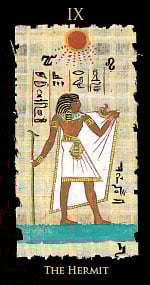
Your Egyptian Love Tarot Card for Oct. 26 is The Hermit

The Hermit


In regard to love and romance, you are advised to devote energy now to thinking about your own motivations and decisions in relationships. The Hermit card indicates that this time spent in contemplation and retreat now will pay off in the future. For, as you come to understand yourself and your own motivations better, you will find that you have more to offer others.

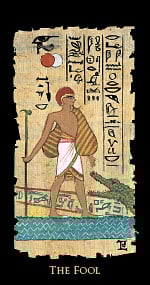
Your Egyptian Tarot Card for Oct. 26th is The Fool

The Fool


This card reflects your inner conflict between innocence, ambition and belief in yourself. Today is a good day to be free-spirited and take a chance or try something new. The tricky part with this card is to believe in yourself enough that you won’t be fooled by others. Conviction is the power of the Fool’s card, because the Fool always knows that all they have is the power of their own intention.