

Day: March 16, 2016
A Little Thought from Me to You….

Astronomy Picture of the Day – A Phoenix Aurora over Iceland
Astronomy Picture of the Day
Discover the cosmos! Each day a different image or photograph of our fascinating universe is featured, along with a brief explanation written by a professional astronomer.
2016 March 16

A Phoenix Aurora over Iceland
Image Credit & Copyright: Hallgrimur P. Helgason; Rollover Annotation: Judy Schmidt
Explanation: All of the other aurora watchers had gone home. By 3:30 am in Iceland, on a quiet night last September, much of that night’s auroras had died down. Suddenly though, a new burst of particles streamed down from space, lighting up the Earth’s atmosphere once again. This time, unexpectedly, pareidoliacally, they created an amazing shape reminiscent of a giant phoenix. With camera equipment at the ready, two quick sky images were taken, followed immediately by a third of the land. The mountain in the background is Helgafell, while the small foreground river is called Kaldá, both located about 30 kilometers north of Iceland’s capital Reykjavik. Seasoned skywatchers will note that just above the mountain, toward the left, is the constellation of Orion, while the Pleiades star cluster is also visible just above the frame center. The new aurora lasted only a minute and would be gone forever — possibly dismissed as an embellished aberration — were it not captured in the featured, digitally-composed, image mosaic.
Earth Sky News for March 16th: Moon and Winter Triangle on March 16
Moon and Winter Triangle on March 16
In our March 15 post, we spoke of the Winter Circle, a large asterism – noticeable pattern of stars – consisting of bright stars from several different constellations. The Winter Circle is so big, it dwarfs even the mighty constellation Orion the Hunter. And, in fact, Orion makes up the southwestern part of the Winter Circle. But there is also a pattern within the Winter Circle that many notice. It’s in the southeastern part of the humongous Winter Circle, and it’s called the Winter Triangle.
As darkness falls on the night of March 16, 2016, look for the three bright stars that form the Winter Triangle to the south of the moon.
In their order of brilliance, these stars are Sirius, Procyon and Betelgeuse.
If you live at northerly latitudes, the Winter Triangle appears below the moon in the southern sky; from temperate latitudes in the Southern Hemisphere, the Winter Triangle appears above the moon in the northern sky.
Bottom line: Once you find the Winter Triangle – consisting of the stars Sirius, Procyon and Betelgeuse – you can go from there to locate the larger Winter Circle pattern. Both of these patterns are asterisms – not official constellations. They’re just noticeable patterns on the sky’s dome.
Author
Bruce McClure

Bruce McClure is the chief writer for the popular EarthSky Tonight pages. Since joining EarthSky in 2004, he has written thousands of astronomy articles, enjoyed here by millions. He also writes, gives planetarium shows and hosts a wide assortment of public astronomy programs in and around his home in upstate New York. If you ask an astronomy question on our site, it’s likely to be Bruce that answers it. His love for the heavens has taken him to Lake Titicaca in Bolivia, and he has sailed the North Atlantic, earning his celestial navigation certificate through the School of Ocean Sailing and Navigation. Bruce is also a sundial aficionado. He says his number one passion – besides his wife Alice – is stargazing.
Article published on EarthSky
The Wisdom of Buddha
The Wisdom of Buddha

There are only two mistakes one can make along the road to truth; not going all the way, and not starting.
Crack the Cookie

Your Daily Influences for March 16th
Your Daily Influences
March 16, 2016
 Queen of Cups
Success and happiness are attainable in all their forms. Visions and dreams are realized. Honesty, devotion and loyalty are enjoyed.
 Isa
Isa
The Ice Rune, represents stagnation and a passionless existence. Your life’s course may seem blurry at the moment, but if you persevere you will move onto better days.
 Book of Charms
Someone will or has invaded your privacy with ill intentions, and created an atmosphere of distrust. The information they obtained will be used against you.
Your Daily Influences represent events and challenges the current day will present for you. They may represent opportunities you should be ready to seize. Or they may forewarn you of problems you may be able to avoid or lessen. Generally it is best to use them as tips to help you manage your day and nothing more.
Your Daily Charm for March 16th is The Tau Cross
Your Daily Charm for Today

Today’s Meaning:
A journey that you or someone close to you must make will have a positive influence on this aspect. This trip may be over a great distance.
General Description:
This charm was worn by the ancients to protect the wearer against disease and snake bites. The Jews used it as an amulet for epilepsy and erysipelas. It is still used in Ireland as a talisman against sickness. The Tau is one of the most ancient crosses and the forerunner of the Latin Cross. Moses used the Tau Cross with the brazen serpent attached, to save the Children of Israel in the wilderness from the attacks of the fiery serpents. The Cross has always been the symbol of life eternal. It was this mark, the Tau Cross, that was placed upon the foreheads of those exempted from Divine wrath in Jerusalem.
Your Animal Spirit for March 16th is The Raven
Your Animal Spirit for Today
March 16, 2016

Raven
Raven has long been known as the magical bird—the one who carries our messages and our prayers to spirit. Raven has been called a shape-shifter, and his message to you today is one of change—expect the unexpected, but know that Raven is flying close and will help you transform life’s challenges into life’s greatest blessings.
Your Ancient Symbols Card for March 16th is The Eastern Dragon
Your Ancient Symbols Card for Today

The Eastern Dragon
The Eastern Dragon derives its symbolism from eons of rich, Asian culture. The Eastern Dragon is a revered creature who brings good fortune and power to those under its influence. It influences situations by supplying courage, nobility and perseverance. The Eastern Dragon is the most Yang of creatures in Chinese mythology, and represents the male character at its strongest and best.
As a daily card, The Eastern Dragon foretells a period of abundant prosperity. This is a time when your goals can not only be attained but surpassed. If you use your energy wisely, your courage with discretion, and refuse to give up your ambitions will be satisfied.
Your Daily Witches Rune for March 16th is The Blank Rune
 Witches Rune for the Day
The Blank Rune
Meaning: This is a rune of difficulty and negative influences will rule your life for a time, but as all difficulties are a learning experience it will lead to improved personal perspective and progress on your life’s path. Always consult the surrounding runes with this stone. If it lies with a positive stone, it indicates that the pain of this experience will lead to a beneficial change in circumstances
Your Crowley Thoth Tarot Card for March 16th is The Emperor
Your Crowley Thoth Tarot Card for Today
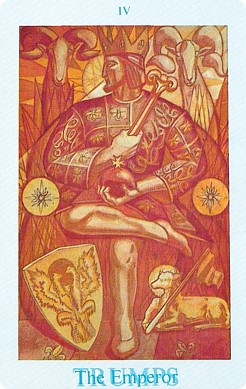
The Emperor
The Emperor is blessed with the skills to successfully lead others. He can turn chaos into order and provide structure to that which is unbound. He is quick of mind and confident in his power and right to rule, and does so in a just manner. Although stern by nature, he truly is the ultimate father figure. He will provide as needed, teach those with unanswered questions, protect the vulnerable, set and maintain boundaries. His perfect world runs on schedule and is free of any disturbances. What the Emperor must be wary of is setting boundaries and rules where none are needed. If he isn’t careful not to over use his powers he may well become a tyrant.
Casting the Stones, Your Past, Present & Future Reading for March 16th
Your Past, Present & Future Reading for Today
 The Past
Ehwaz
Ehwaz represents movement. You may be closing in on reaching your current goals. Your life may be changing for the better. Harmony with others should come easy for you at this time.
 The Present
Berkano
Berkano is the Rune of birth and rebirth. This may symbolize a time when you are capable of great personal growth. Love may be in the air as well.
 The Future
Tiwaz
Tiwaz is the Warrior Rune. It represents pure, masculine power and the ability to successfully fight to meet your goals. However, you must be careful that costs of attaining your goals overshadow their values
Your Daily Rune for March 16th is Ingwaz

The Esoteric Origins of Tarot

The Esoteric Origins of Tarot
More than a wicked pack of cards

by Dr. Lewis Keizer
Foreword
Modern Tarot is not a card game. It is a form of divination. As such, modern Tarot does not originate in medieval Italian card games, although they eventually became mediums through which cartomantic divination was done. Modern Tarot has a much more ancient derivation in the phenomenology of religions, iconography, and in Western esoteric tradition.
Christine Payne-Towler has provided me with most of the motivation and much of the research for this essay. She could have written a much more comprehensive tome, as she is an expert on Tarot iconography and symbology. But she wanted a scholar to look over her materials and lend credence to the esoteric origins of Tarot. I am honored to comply.
The so-called “Propoganda Campaign”
Decker, Depaulis, and Dummett make the following statement in Chapter One of A Wicked Pack of Cards:
“(The Tarot pack) . . . is the subject of the most successful propaganda campaign ever launched. . . . An entire false history, and false interpretation, of the Tarot pack was con-cocted by the occultists. . . .” A statement such as this is as false as the misguided histories of Tarot presented by Gebelin, Etteilla, and the other founders of Tarot occultism in Western Europe. There was no conspiracy to misrepresent Tarot–only an attempt to understand and explain it. Eighteenth- century science was at the mercy of its own limitations, just as twentieth-century scholarship will later be recognized to be.
A Wicked Pack of Cards provides us with an excellently researched history of medieval and modern Tarot schools, but it does not attempt to understand and explain its significance. It understands Tarot as part of the history of European games, but it has no appreciation of the origin of modern Tarot in the history and phenomenology of the Western esoteric tradition, or as a sophisticated development of effective divination technique. A Wicked Pack of Cards provides a great deal of information, but the authors do not have a thorough enough background in the Western mystery tradition to properly interpret their information.
This article is intended to refocus academic discussion of Tarot to its significance and meaning within the context of real historical development in the Western esoteric tradition.
The power of Tarot
When I was a young academic teaching Religious Studies at the University of California in Santa Cruz during the sixties and seventies, I was chagrined at the gullibility of students for naive occultist theories about history, scripture, and emerging new-age fads like Tarot.
Like the authors of A Wicked Pack of Cards, I knew that modern Tarot decks were merely a development of medieval Italian Tarocchi. Tarot was not the secret Urim and Thumim of the Old Testament or the hieratic Egyptian Books of Hermes described by Clement of Alexandria. Yet not only young, impressionable students, but often even intelligent, educated adults wanted to believe that the Tarot was sanctified with hoary antiquity.
As I began to have deeper experience and understanding of Eastern and Western esoteric tradition, however, I found myself using Tarot and other forms of divination to touch more deeply into my own interior life. I began to understand the spiritual phenomenology of dynamic psychism, magic, and theurgy. I found that even some of the most recent decks, like the Alchemical Tarot, were extremely helpful to me. The readings I did for myself and for others clarified the invisible currents and subtle influences associated with important decisions and life crises.
Many times the Tarot has warned me away from pathways that I later realized would have led to disaster, or it has given me confidence to pursue directions that have proven to be true to my purposes in life. At crucial times the Tarot has confronted me with hard advice that I could have never accepted from my closest friends. Again, it has cheered me with encouragement for which there seemed, at the time, no basis’ and yet, it was true. Can all this come from a pack of playing cards? Let us examine the historic esoteric influences associated with the iconography of the Tarot trumps.
The Popess
The earliest extant trump images date from the fourteenth century, and they include a female Pope. Today we know her as the High Priestess or Isis Veiled. The Popess was a remarkable image to use during an era when Knights Templar, Cathars, and other religious heretics were being tortured and burned in the Inquisition. We know that the Popess and other images fell afoul of the Catholic Church, which successfully suppressed Tarocchi for two centuries, while the game itself was often castigated by Protestant preachers. Why did the image of the Popess exist before the foutreenth century, and why was the Tarot suppressed after this period?
The issue raised by the Popess was theological dualism–the Albigensian heresy–which was the enemy that the Inquisition sought out either among the Cathars of Southern France, the Bogomils of Bulgaria, or other sects like the Patarenes. These were all survivals of a form of early Christian Gnosticism known as Manichaeism. The religion of the martyred saint Manes became anathema after St. Augus tine of Hippo, a Manichaean of the fourth century, converted to Catholicism and became a founding theologian for Roman Catholic theology.
The teachings of the “dualist” sects allowed women to be clergy and to even hold office as a Pope. During the period of European history from which the image of the Popess survives, the Bogomils were loyal to their own mysterious Pope in Bulgaria, who may well have been a woman saint. Many of the heretical communities of the time relied upon prophetesses and female channels of Spirit to guide them, just as the early Montanists had done. In the Visconte-Sforza Tarocchi deck we find a Popess dressed in the habit of the Umiliata Order of the Guglielmites whose female leader, a Bohemian Lombard, died in Milan in 1281. The image in the deck represents Popess Sister Manfreda, who was elected Pope by her sect. She was regarded as an avatar of the Holy Spirit sent to inaugurate the New Age of Spirit prophesied by Joachim of Flora. This Popess was burned at the stake in autumn of A.D. 1300, the year that the New Age ending male domination of religion was supposed to begin. Later the Inquisition started proceedings against Matteo Visconti for his slight involvement with the sect.
In addition to the dualist heretical communities, there was a great proliferation of apocalyptic and new-age theology that had occurred with the advent of the millenial year A.D. 1000. Isolated scholars translated the Latin Bible, and especially the Book of Revelations, into their vernacular languages and read them as ciphers for their own age, which was one of ecclesiastical privilege and corruption. Their insights were privately promulgated, and secret societies formed to spread reform and revolutionary religious ideas.
From seminal movements like those of Joachim Flora, the German mystics in the line of Meister Eckhart, and the Brethren of the Free Spirit, there developed the greatest political ground-swell that was ever to threaten the Roman Catholic hierarchy – Protestantism. It now dominates much of Christianity, but is still theological heresy in Rome.
The early protesting or “protestant” sects were fiercely persecuted by Rome, which lumped them together with Albigensians, keepers of pre-Christian pagan religions, and the Jewish and Islamic infidels.
All of these groups were theologically “dualist” in the perspective of Rome either because they recognized a feminine or Mother aspect of Godhead (Cathars, Jewish Kabbalists, Bogomils) or because they preserved a Gnostic cosmology and anthropology. The Christian dualists were especially targeted because their Christologies were based on the mystic Imitatio Christi, a discipleship aimed at ultimately becoming a Christ. It would have been more to call them “unarians,” because ultimately they viewed humanity as an emanation of God that contained a spark of diety and would eventually return to Godhead, rather than a mere creation of dust doomed ever to be subordinate and inferior.
The Cathars preserved the Merovingian ideal of the Wife of Jesus (Mary Magdelene) and his physical offspring through their concept of Holy Blood, against which the Carolingian revolution had presented the ideal of the Mass and Eucharist as the Holy Blood of Christ. The Eucharistic Sacrament was the priestly means through which the Church maintained authority over the laity. If personal mysticism and spiritualized allegories were to triumph over physical sacraments, the Church would lose its power. That is why later Protestantism renounced Priesthood and sacraments as “Popish” tools of Satan. But the ideal was originally that of the Gnostic heresies, who viewed human love as the Divine Sacrament par excellence and maintained the symbolism of a male and female Christ.
Under circumstances of political suppression and threat of the Inquisition, the wave of revolutionary spirituality that swept over Eastern and Western Europe in the tenth to fifteenth centuries was transmitted in heretical ballads sung by Bogomil troubadors and in other forms of art, imagery, and iconography. Very clearly, part of this trend is preserved in the iconography of the early Tarocchi trumps. The most evident aspect of this iconography is the Female Pope.
Tarot innovator Edgar Waite was the first modern scholar to propose that the trumps were originally a series of images to convey the philosophy of the Albegensians. It is ironic that Waite should make this observation, since he radically altered the images of the Tarot trumps, adhering to the sweeping changes made by the English occultists of the Golden Dawn to the traditional European images. Waite’s altered Tarot images are those most familiar to lay persons, and yet they are many steps removed from the original iconography. Perhaps the best example of the original iconography to survive the Inquisition is the Marseilles deck, which synthesizes alchemical and other imagery with an Egyptian theme that I’ll later address.
An excellent discussion of the influence of heretical religion on the original Tarot trump images is included in a book by Robert V. O’Neill entitled, Tarot Symbolism (Fairway Press, Ohio; ISBN 0-89536-936-2). His chapter on “Heretical Sects and Their Influence on the Tarot” is carefully researched and deserves a wide reading.
Tarocchi Iconography and Hermetic Philosophy Tarot was far more than entertainment during the period from the 1300’s to the 1500’s when the game was suppressed. It appears among the luminaries of the Church as a means for contemplation and deep discussion. Tarocchi cards with trump images corresponding to Hermetic philosophical and cosmological ideals were used by Pope Pius II and Cardinals Bessarion and Cusa in the mid-fifteenth century during a church council in Mantua. The images of Mantegna’s Tarocchi include Iliakos, representing the First Iliaster of Paracelsis and other metaphysicians, the Seven Planets, and other elements of the Hermetic-Platonic Hierarchy of Being. Nicho las of Cusa later wrote concerning a similar card game he had devised:
“This game is played, not in a childish way, but as the Holy Wisdom played it for God at the beginning of the world.”1 The impact of Hermetic philosophy and iconography on the Church of the Counter-Reformation was considerable. There was a time when many of the intellectuals of Europe hoped that Hermetic philosophy would be the means through which Catholic theology could be reformed to meet the challenge of Protestantism, science, and secular thought. There is still a sealed room in the Vatican belonging to the Borgia Pope that is painted with images of Hermes Trismegistus and other occult symbology. Statues and printed images of Hermes Trismegistus, Pythagoras, and other legendary adepts proliferated. Hermetic thought struggled with church theology within the Vatican itself, but was overcome by the forces of conservatism by the middle of the seventeenth century, never to surface again.
However, during the oppression of heretical sects and the evolution of the Reformation, new venues for esoteric and occult thought developed within Protestantism and Catholicism. The Knights Templar had been driven underground, but the Priory of Sion lived on as an elite Catholic secret esoteric society with Grand Masters like Botticelli and Da Vinci, whose art preserves the Hermetic cosmology and ideals. The Rosicrucian and Freemasonic movements of Protestant mysticism produced an esoteric Renaissance based on Hermetic thought and its synthesis with astrology, alchemy, magick, and a Christian version of Jewish Kabbalah that used not only Hebrew, but Greek and Latin alphabets. All this, in turn, was integrated with Greek philosophy and Pythagorean theory.
The scholar Frances Yeats’ book, Giordano Bruno and the HermeticTradition demonstrates the importance of iconography, philosophy, and Hermetic idealism during the period crucial to the development of the Tarot imagery. Alchemists and other practitioners of the esoteric arts transmitted their most profound teachings, such as the evolution of the Sophic Hydrolith or Philosopher’s Stone, by means of iconographical allegories. It would be naive to think that Tarot images were devoid of such interpretation in the fourteenth to sixteenth centuries, even though they were suppressed.
During the eighteenth century, when the Inquisition was losing its grip on most of Europe, and both Europe and the New World were rushing toward violent democratic revolution, Tarot again surfaced, not merely as an Italian card game, but as a means of divination. It became a focus of interest for occultists who, like French and English Freemasons, wished to sanctify their alternative spirituality with the authority of hoary antiquity.
Divination, Cartomancy, and the “Egyptian” gypsies
The earliest historical record we have of playing cards being used for divination is found in a memoire of the year 1765 by Casanova about the beautiful young Russian peasant girl named Zaire. She arranged twenty-five playing cards into a magical square and was able to read in them all the details of his amorous adventures of the previous evening. On the basis of this account, the authors of A wicked Pack of Cards speculate that cartomancy began with Russian peasants in the eighteenth-century. But to assign an origination date to an oral folk tradition, especially when it concerns magic, divination, or herbs and medicines, based upon the date of its first mention in European literature, is unrealistic and quite ignorant of the historical dynamics of oral tradition.
Where did Zaire get her knowledge of cartomancy? Not from books, and certainly not from the French nobility, who in the eighteenth century had just began to discover occultism, divination, and spiritualism and relate it to their previous flirtations with Hermetic science. No, Zaire’s knowledge came from an oral folk transmission totally independent of literacy and with a much greater antiquity than the literary products of Guttenberg’s revolution. The source of Zaire’s knowledge was ultimately Gypsy folk tradition.
The Gypsies were a unique nomadic nation that left India and wandered to Europe by way of Eastern Europe and Bohemia. They were erroneously considered by Europeans, including Russians, to be a survival of the ancient Egyptian people. They were also known as “Bohemians” because their annual traveling routes brought them into Europe by way of Bohemia, the Motherland of many European esoteric traditions.
Gypsies had their own kings and queens, their own initiatic traditions, and they were experts in forms of entertainment, animal training, and divination for wealthy clients. Methods of divination included “reading” various elements like tea leaves and scrying crystal globes, clouds, sand formations in stream beds, or reflections of the full moon on water. They read palms, used other physiognomic techniques, and they developed various psychic arts that were attributed to Rosicrucians, alchemists, and other occultists of Prague and Bohemia.
As interest in the Gypsy (“Egyptian”) arts developed into European spiritualist fads of the eighteen century, as the Hermetic (“Egyptian”) philosophy spread through publications of the Corpus Hermeticum and various alchemical and magical texts purchased by the nobility, and with the popularization of hieratic Egyptian artifacts like the Mensa Isiaca (Tablets of Isis) published by Kircher, all divinatory and esoteric knowledge was attributed to ancient Egypt. Everything from Freemasonry to Mesmerism claimed its roots in the hoary antiquities of Egypt. Gebelin, Etteilla, and the other eighteenth-century European popularizers of cartomancy attributed the Tarot to the ancient Egyptian Books of Thoth, and the trump images to symbolic frescoes on the walls of Egyptian temples used as part of instruction given during priestly initiation.
The iconography of Egyptian Serapian temples were familiar to Italians. The temples had been built in Italy and Asia Minor during the Roman-Hellenistic period, when Egyptian Isis religion was popular throughout the Empire. A Serapian temple had been excavated as early as the tenth century, and Italians often traveled to see it and speculate upon the meaning of its frescoes and hieroglyphics.
During the Italian Renaissance, classical culture was studied and idealized. It is quite possible that Tarocchi images were understood as allegories from the very beginning, since the game itself was a kind of medieval Game of Life with reference to archetypal human conditions. Since the Serapian temples were places of initiation into Isis cult, it is also reasonable to assume that their iconography related to initiatic journey through life. To this extent, it is not impossible that Tarot images, which had a similar purpose in Tarocchi, had some root in Egyptian temple iconography.
But cartomancy, or divination with playing cards, was not an Egyptian invention. There may have been other systems of divination parallel to the throwing of yarrow sticks for the I Ching in the ancient or Roman-Hellenistic world of Egypt, but there is no evidence of anything similar to playing cards. Fortune-telling with playing cards, or cartomancy, was popularized by the Gypsies in medieval Europe after the invention and publication of playing cards. Because the authorities and teachers of cartomancy were Gypsies, divination with Tarot cards was assumed to be “Egyptian.”
The Sanskrit-related language of the Gypsies was called Romany, erroneously related to Roumanian. The Gypsies were considered to be spiritually allied to the heretical and protesting religions of Europe, especially the Bulgarian, Roumanian, and Bohemian villagers whose folk religion preserved Manichaean and Gnostic elements, and whose preoccupations in the eighteenth century included astrology, alchemy, and esoteric speculative Freemasonry. These included the descendants of the Bogomiles, Cathars, and Albigensians, who had become the objects of persecution and attempted genocide by partisans of the Roman Catholic Church, and whose cultures had produced the wandering Troubadors, who sang mystical, heretical songs to the Magdalene and told stories of the Holy Grail.
As a bridge to Eastern mysticism, European heretics had nurtured the European consciousness that would produce the institutions of Chivalry and Courtly Love. In the heyday of the Hermetic Renaissance and amidst the social upheaval of the Protestant Reformation, the mysterious Gypsies emigrated to Europe and wandered in large bands. They brought the ways of Indian mysticism and divination with them, and when they arrived in fifteenth-century Western Europe, the romance of the vanquished European heretical cultures was associated with them. They were welcomed for the entertainment they brought, feared and avoided because of the ferocity of their fighting men and women, and often expelled or forced to move on. They were closely attuned to the animals they brought with them, developing skills in animal communication and training. They traveled in annual migration routes throughout Europe and the Slavic regions, moving South for the winters and North for the summers, providing carnivals or trained animal shows and various kinds of “fortune telling” for a fee. They stayed clear of the regions where the medieval Inquisition held sway, but were often accused of witchcraft.
By the eighteenth century the Inquisition was on the wane. Gypsy lore was much in demand by both the nobles and middle class of Europe. The Gypsies were happy to oblige credulous Europeans with stories of their ancient origins in Egypt. In fact, they called their homeland “Little Egypt.”
The Albigension paper making connection
Paper making was brought to Europe from the East by Templars and other Crusaders returning from the Holy Land or by Moors in Spain. The earliest paper making centers in Europe were in the South of France and in Lombardy and Tuscany, the areas occupied and controlled by the Albigensians or Cathari. After the massacre of the Cathari at Montsegur in 1244 by operatives of the Pope–perhaps the greatest act of genocide known to history previous to the slaughters of Armenian Chris tians by the Moslems in the twentieth century and Hitler’s Jewish Holocaust in World War II–about four thousand survivors wandered Europe like the Gypsies as troubadors, pedlars, merchants, and journeymen paper makers. The persecuted Albigensian paper makers used a secret, symbolic watermark on their “Lombardy paper” by which means they communicated and kept track of each other in different areas.
Interesting evidence of the esoteric relationship between Gypsies, hidden Albigensians, hidden Knights Templar, and the operative Masons are indicated in manuscripts on guild practices created in the Rosslyn Chapel Manuscript Manufactory of the fifteenth century, which is now in the Scottish National Museum and exhibited in facsimile at Rosslyn Chapel which, as scholars are now finding, memorializes Gypsy, Rosicrucian, Templar, Freemasonic, and other hidden esoteric institutions of the period, all of whom were in contact. The St. Claire royalty of Rosslyn were both protectors of the Gypsies and Grand Masters of the operative Masons!
Given these facts, it is quite reasonable to assume that the first manufacture of tarocchi cards was done by partisans of the persecuted Albegensian tradition who maintained close relations with the Gypsies of India, the exiled Knights Templar, and the Scottish Masonic groups out of which Scottish Rite and other “speculative” forms of Freemasonic cult were emerging. This in itself points strongly to an esoteric origin for the Tarot images from the very beginning of their appearance as playing cards manufactured by guilds of Cathari paper makers who lived in hiding.
Divination and other spiritual antiquities of the Gypsies
Gypsy tradition was Indian, but the traditions associated with the Gypsies in the European mind were directly derivative from Roman-Hellenistic Gnostic and Manichaean spirituality, which the Cathars were still practicing in the thirteenth century. The Roman Catholic polemic against magic and divination that had been successfully and brutally waged against the Greek mystery religions and the Neo-Platonic philosophical schools like that of Hypatia never influenced the Gnostic-Christian religious culture of southern France and Bulgaria. There many of the ancient divinatory practices of Greece, Asia Minor, Egypt, and the Hellenized world were not only tolerated, but developed and well integrated into daily religious practice.
We must acknowledge that Murray’s theories about the Old Religion of the Witches and its survival in the folk practices of rural Europe have been shown to be unrealistic. Modern Wicca, like modern Tarot, is a recent production with yearnings to an ancient occult history. The European romances about Egyptian Freemasonry, Christian Rosencreuz and the ancient Rosicrucian Brotherhood, or the Theosophical Masters of Tibet were also, in great part, the creations of spiritual imagination. They tell us more about the spirit of their own times than about sacred antiquities.
However, in the case of the Western esoteric tradition and its interaction with Gypsy lore, we do find strong evidence of historical continuity with ancient pagan and mystery traditions. Gypsy traditions were strongly Indo-Iranian, thus extremely compatible with Manichaean and Gnostic culture. In their oral traditions concerning magic, spells, herbs, plants, stones, psychism, and divination, Gypsy communities preserved Eastern folk- magical and divinatory traditions that were essentially and qualitatively different from those preserved in Western Christian monasticism. “There is general agreement among occult authorities that the use of the Tarot was popularized by the wandering bands of Bohemians– gypsies–who made their appearance in the late Middle Ages.” (Doctoral dissertation of Thomas Williams for the University of Alabama, quoted in A Wicked Pack of Cards, Chapter One). Not only “occult authorities,” but most scholars would agree that cartomancy and Tarot-card divination were intro-duced to Europeans by Gypsies.
In late antiquity, the Bohemians transferred and adapted their traditional forms of divination to the newly emerging form made possible by the invention of the printing press– the deck of cards. These more ancient forms of divination were compatible with a deck of cards because: they relied upon a complex set of symbols not unlike Chinese trigrams, Roman dice, Druidic runes, that could be interpreted allegorically they operated by means of randomizing these elements through throwing or casting, as with lots, dice, or yarrow stalks they had numerological associations that could be used to amplify interpretation The symbols of the Gypsies would have been pictographic, although they could have developed into more glyphic representations as did later demotic Egyptian or the Chinese trigrams of the I Ching. They would have been etched, drawn, or painted onto randomizable elements that could be cast or thrown, like runes or dice. The numerical system they used would have been similar to Pythagorean decimal number lore, as it was derived by Pythagoras from Indian Brahmin lore.
Since we can see that the original Tarot trumps were based, for the most part, upon Italian social images arranged in allegorical postures, and that only later were images altered to appear Egyptian or pre-Christian, it is easy to conclude that modern Tarot trump images have no relation to images or allegories that would have been used by the Indo-Iranian Gypsies. However, there are certain original trumps that simply do not have a basis in medieval Christian society, such as the Popess or female Pope (becomes the High Priestess).
Moreover, this image certainly does have a basis in both Indian and Albigensian religion as the Gnostic Sophia, the Magdelen, the female Christ, and the Virgin Goddess. To what extent did the cartomancy of the Gypsies influence even the earliest Tarocchi trumps? Perhaps more than we can know. According to some authorities, the Gypsy migrations began as early as the ninth century and peaked in the fifteenth century.
Although Gypsies must have made many innovations when they began to adapt European playing cards for fortune telling, it is also clear that they were able to find attributions for suits and trumps that were recognizable and correspondent to their own traditions of divination. Thus the fact that the images of the Tarocchi trumps survive in various permutations into modern Tarot decks indicates that they were congruent with Gypsy folklore that served as the basis for divination. Iamblichan Tarot Tradition in the French Occult Revival of the Eighteenth Century The occultist Court de Gebelin theorized in 1781 that the Tarot trump images originated in the initiatic halls of Egyptian temples. His ideas were popularized by Alliette, later known as Etteilla. But these men were not the originators of such speculation. It was already common undertanding in French occult circles, which were essentially Freemasonic.
In the year 1798 there were six to seven hundred Masonic lodges in France containing perhaps 30,000 of the most educated citizens. Unlike modern American Freemasonry, which after WWII became mostly blue collar workers and lost much of its great intellectual patronage, the French lodges were (and still are) subscribed to by university professors and other intellectuals.
Lodges were split between those chartered by nobility and under a Grand Master for life appointed by nobility, and the new democratic form in which Masters were elected for a term. The first form was traditional, and its premise was that the Grand Master was a true adept with all the knowledge and powers of a master. Unfortunately, princes and dukes often chartered unqualified Grand Masters, and the democratic movement in Freemasonry was causing lodges to split into factions. This same movement was attuned to the emerging American colonial revolution and closely tied to its founders. Ben Franklin, for example, was the elected Grand Master of a Lodge in Paris as well as in Philadelphia.
An extreme wing of the democratic Masons were the Fratres Lucis, Brothers of Light. Under the leadership of university free-thinkers, they were active architects of the French Revolution. They used forms of initiation that could result in death, based on their ideas of ancient Egyptian priestly initiation. A document probably translated by the nineteenth century occultist Jean-Baptiste Pitois (Christian) and published recently in English by Weiser entitled, Egyptian Mysteries, is an example of Illuminist initiatio practice in the guidance of Egyptian lore. During one part of the ordeal, in which the candidate must work his way through a dark labyrinth, he finds himself in a lighted chamber with a bed, food, and a beautiful unclad woman. He has vowed not to tarry, but if he does make the wrong choice, he is immediately set upon and killed. At this point in the eighteenth century the Lovers trump of the Tarot is reinterpreted according to the “Egyptian” initiatic ordeal, and we see a man with two women–one on his right who is chaste, and one on his left who is a coquette. Over his head is an angel aiming an arrow at him, to slay him if he makes the wrong moral choice. (I would have been dead in this situation!)
Allegorically, this represents the right-hand and left-hand paths, the Way of Life and the Way of Death of the Old Testament, the good and evil yetzerim of Kabbalah, or the Pythagorean Motion to the Left versus the Motion to the Right of Plato’s Timaeus and the Kore Kosmou of Hermetic-Gnostic tradition. But among the Fratres Lucis, it represented something quite immediate and final. It is not known how many candidates met their doom in this form of Masonic initiation, but given the proclivities of Frenchmen, I am not optimistic. Egyptian lodges were established also by Cagliostro who, according to legend, was initiated by the Grand Master, the Compte de St. Germain, in a Templar ceremony using hundreds of candles. Cagliostro introduced the Egyptian Rites, which paved the way for the later Rites of Memphis and of Mizraim, which competed with the Scottish Rite in nineteenth century America until it was finally banned or abondoned in different jurisdictions. There is now one chartered Lodge of Memphis-Mizraim in New York City that, like all of the later Ultra-Masonic orders, admits both men and women.
The Egyptian paradigm was justified by a medieval document claiming to be part of the body of writings by the NeoPlatonist Iamblichus, whose Manetho is the memoires of an Egyptian priest. The Pseudo-Iamblichan document describes initiatic images used in the hall of neophytes that correspond closely to the Tarot trump images known in the eighteenth century.
This, of course, is the Holy Grail of esoteric Tarot advocates, evidence that the Tarot images derive from ancient and archetypal Egyptian temple images. Currently there are many postings of a document by Michael Poe describing an Italian archeological description of images from a Serapian temple in Italy now under water. The images corresponde exactly to modern trumps, with Veiled Isis taking the position for the Popess or High Priestess, etc. I have been unable to contact Poe, so I contacted the Italian archeological museum in charge of the sunken Temple of Serapis at Pozzuoli and asked for any information, as this is the only Serapian temple in Italy I know that is under water. As of this writing, I have no response. But if Poe’s information is correct, we would have an excellent possible source for the earliest Italian Tarocchi images, devoid of Egyptian dress.
Pseudo-Iamblichus was part of Egyptian Freemason occultism that also revived Pythagorean theory and numerical symbolism as part of their synthesis of Christian Cabbala, usually spelled with a “C” to differentiate it from true Jewish Kabbalah. This in turn was linked to alchemical, astrological, theurgical, and magical departments of the Hermetic arts in the French occult revival.
The Cabbalistic attributions to the Tarot Trumps
During this period of intense occult innovation, the Tarot was legitimized among French practitioners as a valid ancient Egyptian divinatory tool. It is not surprising, then, that it is in this period we find Hebrew and magical alphabet attributions made to the trumps. But the Hebrew alphabet, with its twenty-two letters, became the most important system of attributions.
The letters represented the twenty-two Paths connecting the ten Sephiroth. These Paths, then, were associated with each trump image. Some of the Paths were in the Lightning Flash series leading from Malkuth back to Kether, so they were considered to be specifically associated with stages of initiation, while the others represented powers gained and obstacles surmounted at each of these stages.
The authority for the Paths was the Jewish Sephir Yetzirah, the Book of Creation. However, it existed in several redactions and versions, each differing on details. The oldest was the Gra version, but it may not have been accessible to French occultists, who depended upon Latin and French translations. However, the French occultists did have access to the Alexandrian/Hermetic attributions, those of the Renaissance magi and the Fratres Lucis document. With these, they were able to associate the correct Hebrew letter with the Cabbalistic Path number and image in the twenty-two card series.
These attribution were added to the Tarot trumps in eighteenth-century France and spread to Italian, Spanish, and other Continental decks by the nineteenth century. They were part of the general Freemasonic and Ultra-Masonic lodge occultism of all Europe. Tarot and Cabbala: Levi’s Attributions In his book, Eliphas Levi and the French Occult Revival, Christopher MacIntosh says, “Clearly Levi was in possession of no pre-Court de Gebelin material connecting the Cabala (sic. Ut.) and the Tarot. The connection was his invention.”
This is the kind of fiction about Levi that English occultists have promulgated since the days of the Golden Dawn. English Freemasons declared French Freemasonry invalid in the late nineteenth century when the Grand Orient decided to expand their definition of theism to include Buddhist, scientific, and other non-Judeo-Christian concepts of Godhead or Utimate Reality. The bad blood between English and French occultism that divided Gnosticism into English and French ecclesiae, Martinism into English Masonic and French ultra- or non-Masonic schools, and resulted in the contemporary French requirement that anyone who joins a Golden Dawn lodge be demitted from French Masonic lodges, has been clearly evident in English attitudes toward one of the greatest French occultists’ Eliphas Levi.
Divination, Cartomancy, and the “Egyptian” Gypsies
In his Conspiracy Against the Catholic Religion and Sovereigns, Levi said, “The true initiates who were Etteilla’s contemporaries, the Rosicrucians for example and the Martinists, were in possession of the true Tarot, as a work of Saint-Martin proves, where the divisions are those of the Tarot.”2 Saint-Martin had been a member of the occult lodge established by the adept Martinez de Pasqually in the mid-eighteenth century. He wrote his book divided according to the Tarot trumps before Levi’s era. Later brilliant Martinists like Papus and Oswald Wirth would reaffirm Levi’s assertion that the Tarot was the secret book of the eighteenth century Rosicrucians which existed as, “their criterion, in which they find the prototype of everything that exists by the facility which it offers for analysing, making abstractions, forming a species of intellectual world, and creating all possible things.”3
Levi elaborated on what French occultists had already created perhaps a century before, and what was to become standard in all European Tarot decks of the nineteenth century–the correct attribution of Hebrew Path letters to the Tarot trumps. In this system, the Fool was attributed to Shin and the Magician was attributed to Aleph. The Hebrew letters were properly associated with their meanings as numerals.
Just as Etteilla had popularized Tarot for fortune telling based on Gypsy lore, Levi popularized what must have been secret lodge teaching in which the Tarot cards were used as tools of philosophical divination, probably in assumed likeness to the Book T of the seventeenth- century Rosicrucian Fama.
English versus French esoteric freema-sonry: the golden dawn
The founders of the Golden Dawn fabricated German Rosicrucian adepts who had supposedly transmitted profound esoteric and initiatic knowledge to them and given a charter to teach and initiate others. In fact, however, most of what Mather and Westcott had actually received came from a French source–not German adepts–through Kenneth MacKenzie, who received it directly from Eliphas Levi. Few scholars would seriously challenge this assertion.
Mathers was a brilliant creator and synthesizer who spend untold hours at the British Museum reading magical and Kabbalistic texts. He and Westcott, like all English occultists, were Freemasons. The synthesis they created for the Golden Dawn rituals combined Rosicrucian and Christian Cabbalistic doctrine with the kind of layout used on a Masonic floor. The floor and officers represented Sephiroth, and initiation from 0=0 to 5=6 represented the upward ascent from Malkuth to Tiphareth. The initiatic instruction given to each Candidate on the Path from one Sephira to the next higher was allegorized on the Tarot trump associated with the Path number in the Hebrew alphabet. Mathers found that having the Fool in the position of Shin didn’t work for his Masonic floor plan, so he decided to retain its number of Zero, but associate it with Aleph.
To justify this, he and later English occultists claimed one of two things: Levi had given a “blind,” or purposely given a wrong Cabbalistic attribution to test people and make it possible only for adepts to discover the true attributions; or, Levi invented his own attributions and was wrong. After all, he was French, not English. How could he be right? Such were the later claims of dark luminaries like Crowley and even the American Paul Foster Case.
As a result, the Waite deck and all other English decks from that time forward have used the Golden Dawn system of Cabbalistic letter attribution to the Tarot trumps, in spite of the fact that it is blatantly inaccurate. The practice continues because very few modern occultists know how to apply true Kabbalistic principles to Tarot interpretation. Only the European decks like those of Tavaglione use the correct trump attributions, and even Tavaglione presents the Golden Dawn Path attributions rather than those of the Gra. The Tarot has a distinguished history in European esoteric tradition. It is not merely a card game that was adapted for fortune telling by Gypsies, and then sanctified with occultist illusions. It is a valid and powerful tool for divination that has roots in much older occult systems.
Author’s information and footnotes
Dr. Lewis Keizer was one of the original scholars of the religious studies faculty at the University of California in Santa Cruz in the late sixties specializing in Biblical studies, Roman-Hellenistic religion, and the Nag Hammadi Coptic Gnostic Library. He received his M.Div. from the Episcopal Divinity School and a Ph.D. from the Graduate Theological Union in Berkeley. His doctoral dissertation, The Eighth Reveals the Ninth: A New Her-metic Initiation Disclosure, has become a standard work in Hermetic studies. He and wife his Willa are presiding bishops of the Home Temple Priesthood and can be contacted through hometemple.org, where a list of his self-published writings and monographs is available. Keizer is also grailmaster of the Temple of the Holy Grail, which can be contacted at hometemple.org/THG.htm. Currently he is co-authoring an esoteric novel with Dr. Eugene Whitworth, author of The Nine Faces of Christ, and serves as academic dean for Great Western University in San Francisco, which specializes in distance-learning B.A. degree completion and graduate degrees with emphasis upon metaphysical subjects and the Western Mystery Tradition.
Lewis has written and taught widely in Western and European initiatic traditions, and he introduced male-female Freemasonry and other French initiatic societies to the U.S. Founder of the Popper-Keizer schools and Keizer Academy for gifted students (hometemple.org/ACADEMY.HTM), he also conducts orchestras and performs as an all-star jazz cornetist at international festivals. He is listed in Who’s Who in the World, Who’s Who in Religion, Who’s Who Among America’s Teachers, and many other standard reference biographies.
Tarot.com is a Daily Insight Group Site
Your Personal Desire Tarot Cards for the Week of March 14th
Your Personal Desire Cards
This reading focuses on your ambitions and dreams.
The Hanged Man
 The Hanged Man is the most enigmatic card of the Tarot. Even Tarot giants like Waite, Crowley and Levi had trouble deciphering The Hanged Man’s true meaning. Generally The Hanged Man is thought to represent the value of surrender and selfless acts. The Hanged Man embodies the notion that sometimes to lose is to win. Unlike the aggressive Chariot, The Hanged Man creates his fate through inaction and accepts his fortune passively, without resistance. He does not struggle to control the path his life takes, but rather allows events to sweep him where they will, even if he is called upon to sacrifice himself. He is so at ease with the Fate the Universe chose for him that even hanging upside down from a tree does not ruffle his inner peace.
When The High Priestess or Strength is among your personal cards, the influence of The Hanged Man may be increased. Having The Magus or Chariot in your personal cards may diminish the influence of The Hanged Man.
The Empress
 The Empress is “The Earth Mother” of the Tarot. She embodies all that is nurturing, clean and wholesome. Her powers resonate from her drive to create and care for life on a grand scale. She is in tune with Nature’s rhythm and realizes that life’s most pleasurable moments often stem from the simplest things. She is not afraid to enjoy herself–to let loose—to the point of being lavish. Abundance and luxury are important to her. The Empress is completely comfortable with her femininity and her sexuality. She is sensual, earthy, generous, and likes the good life. Still, her driving force is a need to create and nurture, and fulfilling this need overrides everything else.
When The Lover or The Star are among your personal cards, the influence of The Empress may be increased. Having the Emperor or Death in your personal cards may diminish the influence of The Empress.
Your Daily Tarot Card for March 16th is the Moon
Your Personal Daily Tarot Card

The Moon
The Moon represents those forces which remain largely hidden to us. The light of the moon provides some illumination down a path into the unknown, but not enough to brighten the landscape like The Sun, or cut through the dark shadows from which the unexpected may leap. However, The Moon is not without gifts we can use. She spurs our imagination and creativity. She can be a portal to knowledge and experience beyond the realm of our everyday lives. But Her offerings are not available to the feint of heart. To receive what The Moon offers one must have the courage to follow uncharted paths and the intelligence to find truths hidden in a bewildering setting rife with illusion. For those who can make this journey the reward may be finding the key to making their dreams come true.
Get A Jump On Tomorrow, Your Daily Horoscopes for Thursday, March 17th

Get A Jump On Tomorrow….
Your Daily Horoscopes for Thursday, March 17th
Aries

You can be feeling especially generous and compassionate today, dear Aries, and finding great benefit and reward in helping others. Use this energy to forgive and heal, to put a difficult problem behind you, or to resolve to let go of a mental burden. You might be in the position to support someone through an open or helpful conversation today. There can also be quite a bit of excitement about a longer-term plan or project, or a group endeavor. A friendship can come into strong focus and you can feel quite inspired about it.
Taurus

This a good day for getting the information you need, for test results, or for resolution to a problem that has been weighing on your mind, dear Taurus. Self-honesty is important now, and there is a pleasingly open atmosphere with friends as well. Conversations can be revealing and especially open and interesting, and this impacts friendships, both platonic and romantic. There can be a sense of liberation from a problem or a past matter. You may be feeling a sense of creative renewal, and in fact, this is a good time to begin anew on a creative level.
Gemini

There is a pleasant openness to the day, dear Gemini, and you can feel that you’re ready to move forward on a matter that may have been holding you back, particularly regarding a friendship or a goal. This can be an excellent time to learn from others and to teach something as well. Business sense is enhanced by your intuition. Focus should be on positive reinforcement today for best results, both personally and professionally. The aim is to put something behind you. Others are putting a little more faith in you than usual, which feels good and motivates you to improve. Even so, you can be holding on to your ideas and going your own way, expecting others to accept you for who you are.
Cancer

The Moon continues to transit your sign all day, dear Cancer, and despite some small feelings of blockage or opposition early today, it’s a strong time for personal influence and for enjoying some well-deserved “me time”. People are sensitive but willing to learn today, and there can be a nice feeling of liberation on a mental level. You are especially open to learning, improving, and growing, and conversations can be gateways to fascinating new information and interests. There can also be a focus on settling problems of the past. It’s a strong time to clear the air.
Leo

This is a strong day for studies, research, and deeper thinking, dear Leo, as you’re going in your own direction and thoroughly enjoying the process. You can come to some important insights now. You can come to a new way of looking at old problems, and conversations can be especially open, particularly on intimate levels. At the very least, you are being honest with yourself, and this can open doors for you. There can be unexpected benefits coming through a faraway connection or partnership. You can be especially inspired by an idea that leads you down a new path or that sets off interesting tangents of thought.
Virgo

You may get the chance to clear up a problem in a close relationship today, dear Virgo. Conversations can be especially open, and you may need to put something from the past behind you now. There is a willing spirit when it comes to learning from and through one another, and the urge to grow and mature through relationship experiences is strong now. Conversations can be revealing, perhaps a little too much so, but ultimately helpful. Be emotionally brave and encourage others to be open and honest. This is also a good time for research, work, and health matters. Problem solving is a theme now, as you’re seeing patterns that you may not typically see.
Libra

This can be an important day for discovering information or solving a problem that clears the path for new beginnings, dear Libra. Seeing patterns comes more easily, which helps you to put the pieces together. Work and health issues can be the focus now. You might come across new ways to heal or to improve your health, or rediscover a solution from the past that is relevant to you in the present. The Moon at the top of your chart puts you in a position to lead or to take charge again today. At the same time, you’re doing quite well on a personal level and coming up with great ideas when you put your head together with someone.
Scorpio

There can be cathartic release today, dear Scorpio, through creative means or an especially open conversation with someone you care about. Communications and thoughts tend to be focused on healing and resolving problems. You may be coming to a new and unique perspective on a matter, but first you need to dig up the past so that you can move forward. Your openness with others helps them to open up as well. People more readily listen to you and give you useful feedback now. Once again today you are feeling freer in self-expression and a little more courageous. You are going your own way when it comes to ideas about how to best approach matters related to romance, fun, entertainment, art, and children.
Sagittarius

There can be some matters to handle from the past that need your attention, dear Sagittarius, and strong energy for resolving a conflict or solving a problem related to your personal life, family, or home is with you now. Others’ openness and willingness to share their feelings can be infectious, and you’re likely to feel especially willing to learn more about the special people in your life. You stand to learn much through the power of conversation and a humble approach. This is also a good time for creative expression. Seeing past patterns can help bring perspective to new projects and endeavors.
Capricorn

This can be another strong day for relating and getting along, dear Capricorn, especially with an open approach to one another. Early day tensions can quickly dissipate. There can be revealing conversations that can act to open your heart. You may be supporting someone through a difficult stretch or offering helpful advice. Your words have healing power these days, and today, this can be made quite obvious to you. There can be an illuminating moment in which puzzle pieces seem to unite and you see a matter more clearly. Problem solving with family, home, and money matters can be in focus and strong.
Aquarius

This is a strong time for creative thinking, dear Aquarius, and for being recognized for your unique perspective and viewpoint. You are attracting interesting people into your life largely due to your interesting point of view and charming way of communicating. You have extra special and valuable advice to give, and you’re feeling very generous. You’re in a flexible and spirited mood and not inclined to take things too personally, although information that surfaces now can be of a sensitive nature. You are ready to come to someone’s defense if need be now. This is a good time for assessing money matters and for making responsible purchases.
Pisces

With Mercury and Chiron coming together in your sign today, dear Pisces, you’re in a good position for expressing or presenting your ideas. This influences sparks especially creative, unique, and helpful ideas. Interactions can be progressive and revealing, although perhaps a little sensitive, as is often the case when we are encouraged to grow. You want to free yourself from ideas and attitudes that have limited you in the past, and you want to distinguish yourself from others and discover what makes you special. People tend to see you for your unique mind right now. You are going your own way! This can also be a good day for thinking outside of the box about financial matters.
If You Were Born Today, March 16

If You Were Born Today, March 16
You accept little at face value, and are always looking for hidden meanings or deeper knowledge of people and circumstances in your life. You are generally very poised and charming, and have a talent for coming up with money-making ideas and creative marketing projects. Periods of solitude are absolutely essential to your well-being, as quite time is how you refresh yourself. You are self-motivated, perceptive, and versatile.
Famous people born today: Jerry Lewis, Chuck Woolery, Isabelle Huppert, Erik Estrada, Pat Nixon, John Butler Yeats.
Source
Your Celtic Astrology Sign
Your Celtic Astrology Sign
Attract the luck of the ancient Irish with your Celtic Astrology

Celtic Astrology is NOT just about a particular upcoming Irish holiday … it’s a year-round influence! So what’s your Celtic tree sign? What about your Celtic color, animal … gemstone? Learn all aboutyour Celtic Astrology now!
While Western Astrology centers around the planet Earth, the 13 signs of Celtic Astrology are based on the cycle of the Moon. Long ago, the Celts imagined the universe as a tree with deep roots and neverending branches. Around 1000 B.C. people began to designate a tree for each Moon phase in the lunar calendar.
Each Celtic tree sign has different powers and meanings, along with corresponding spirit animals, a color, gemstone, and a Celtic “ogham” — a symbolic letter of the Celtic alphabet meant to attract luck, protect from harm, and heighten each tree sign’s unique powers.
Look up your birth date on the infographic below to learn about your Celtic sign, and the lucky talismans that come with it.

Birch (Dec. 24 – Jan. 20)
You are renowned for having a fresh and unusual outlook on life. Your ogham is Beithe, which symbolizes beginnings, change, and fresh opportunities, and is therefore quite useful in times of transition. The animals associated with the Birch tree are the golden eagle and the white stag. Your color is white, and your gemstone is rock crystal (clear quartz).
Rowan (Jan. 21 – Feb. 17)
With the Rowan tree comes excellent taste. Your ogham is Luis, which represents strength in the areas of insight and discernment. The Celts linked the crane and the green dragon to the energy of the Rowan tree. Your color is gray and your gemstone is peridot.
Ash (Feb. 18 – March 17)
The Ash tree represents escape and peaceful solitude in Celtic Astrology. Your ogham is Nuin, which symbolizes peace and tranquility. The animals associated with the Ash tree are the seal, the seahorse, and the seagull. Your color is green and your gemstone is coral.
Alder (March 18 – April 14)
Under the sign of the Alder tree, you are famous for your bravado. The Alder tree’s ogham is Fearn, which represents moral and physical courage, and should be invoked when you need to make a bold move in life. The bear, the fox, and the hawk are the animals the Celts associated with the Alder tree. Your color is red and your gemstone is the ruby.
Willow (April 15 – May 12)
Represented by the Willow tree, you are known for your vivid imagination. Your Celtic ogham is Saille, which embodies the principles of intuition, creativity and artistry to support that imagination. The animals associated with the Willow sign are the adder, the hare and the sea serpent. Your color is yellow and your gemstone is moonstone.
Hawthorn (May 13 – June 9)
People born under the sign of the Hawthorn tree are patient, thoughtful and hopeful. Your ogham is Huathe, which embodies the principle of restraint, providing you with optimism and keeping you from jumping the gun. The animals associated with the Hawthorn tree are the bee and the owl. Your color is purple and gemstone is topaz.
Oak (June 10 – July 7)
Represented by the Oak tree, you stand out for your reliability, diligence and emotional strength. Your ogham is Duir, which holds the powers of protection, ideal when you’re about to undertake a difficult project. The wren, the otter, and the white horse are the animals the Celts associated with the Oak tree sign. Your color is black and your gemstone is the diamond.
Holly (July 8 – Aug. 4)
Under the Holly tree sign, you are celebrated for your physical strength and star power. Your ogham is Tinne, which represents additional strength and brilliance. The Celts associated the cat and the unicorn with the Holly tree. Your color is silver and your gemstone is carnelian.
Hazel (Aug. 5 – Sept. 1)
As a Hazel tree sign, you are prized for your intellect, maturity and perspective. Your ogham is Coll, which represents wisdom, and is therefore strongest when you are feeling tested or when you must put faith in your head over your heart. The crane and the salmon are the animals associated with the Hazel tree sign. Your color is brown and your gemstone is the amethyst.
Vine (Sept. 2 – Sept. 29)
The sign of the Vine carries an uninhibited nature and the strength of foresight. Your ogham is Muin, which symbolizes the power of prophecy and faraway thinking. The Celts linked the lizard, the hound and the white swan to the energy of the Vine. Your colors are pastels and your gemstone is the emerald.
Ivy (Sept. 30 – Oct. 27)
Represented by the Celtic tree sign Ivy, you are famous for your sheer determination and willpower. Your ogham is Gort, which symbolizes progress and aids in overcoming obstacles that stand in your path. The boar, the butterfly and the goose are the animals associated with the Ivy sign. Your color is blue and your gemstone is opal.
Reed (Oct. 28 – Nov. 24)
Under the sign of the Reed you are celebrated for your open-minded attitude and worldly sophistication. Your ogham is Ngetal, which symbolizes unity and is especially beneficial when you venture out of your comfort zone. The animals associated with the Reed sign are the hound and the owl. Your color is orange and your gemstone is jasper.
Elder (Nov. 25 – Dec. 23)
The energy of the Elder sign is wise beyond its years. Your ogham is Ruis, which represents maturity, and is beneficial when you must come to terms with a difficult situation or heal from heavy emotional pain. The Celts linked the badger, the black horse and the raven to the energy of the Elder tree. Your color is gold and your gemstone is jet.
Tarot.com is a Daily Insight Group Site
 Witches Of The Craft®
You must be logged in to post a comment.