
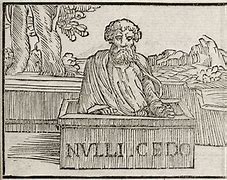
Ancient Roman God Terminus

Terminus

From Pantheon.org – For Sources and References Roman God Terminus

“Border.” A Roman divinity presiding over boundaries and frontiers. His worship is said to have been instituted by Numa who ordered that every one should mark the boundaries of his landed property by stones to be consecrated to Jupiter (Ζεὺς ὅριος), and at which every year sacrifices were to be offered at the festival of the Terminalia.1 These sacred boundaries existed not only in regard to private property, but also in regard to the state itself, the boundary of which was not to be transgressed by any foreign foe. But in later times the latter must have fallen into oblivion, while the termini of private property retained their sacred character even in the days of Dionysius, who states that sacrifices of cakes, meal, and fruit (for it was unlawful to stain the boundary stones with blood), still continued to be offered.

The god Terminus himself appears to have been no other than Jupiter himself, in the capacity of the protector of boundaries.2 The Terminus of the Roman state originally stood between the fifth and sixth milestone on the road towards Laurentum, near a place called Festi, and that ancient/boundary of the Ager Romanus (“the field of Rome“) continued to be revered with the same ceremonies as the boundaries of private estates.3 Another public Terminus stood in the temple of Jupiter in the Capitol, and above it there was an opening in the roof, because no Terminus was allowed to be under cover.4 This is another proof that Terminus was only an attribute of Jupiter, although tradition gave a different reason for this circumstance; for when that temple was to be founded, and it was necessary to exaugurate other sanctuaries standing on the same site, all the gods readily gave way to Jupiter and Juno, but the auguries would not allow the sanctuaries of Terminus and Juventas to be removed. This was taken as an omen that the Roman state would remain ever undiminished and young, and the chapels of the two divinities were inclosed within the walls of the new temple. Here we may ask, what had a Terminus to do on the Capitol, unless he was connected or identical with Jupiter?

Ancient Rome A superstitious Society

From HistoryCooperative.org – To read the rest of the article about Omens and Superstations

A superstitious Society

Compare to modern society, the Romans seem extremely superstitious. But then today’s major religions have all throughout their past discouraged, even combatted, superstitions. Also our sciences and our technological world allows little room for superstition.

The Romans lived in an era previous to this. Their world was full of unexplained phenomena, darkness and fear. To Romans these superstitions were a perfectly natural part in the relationship between gods and men.

The Roman habit of interpreting natural phenomena as signs from the beyond stemmed from the Etruscans. The Etruscans, who developed reading omens and auspices into a form of science, knew different means of divination. In their beliefs the signs they read were sent to them by a mythical boy called Tages, who in their mythology was to have been ploughed up from the earth.

They would seek to read the future by examining the entrails of sacrificial animals, the liver being of special importance for that purpose. They would observe lighting and interpret its meanings. And they would try and put meaning to any unusual phenomena which occured.

The belief that objects, or living beings could possess special spiritual properties was widespread in primitive societies. The Romans were no strangers to this idea. Stones, trees, springs, caves, lakes, swamps, mountains – even animals and furniture – were all deemed to be hosts to spirits (numina). Stones in particular were often seen to contain spirits, especially if they were boundary stones, dividing one man’s property from the other.

It is very telling that the Latin word for such a boundary is terminus and that there actually was a Roman god called Terminus. This odd deity took the form of a huge piece of rock which rested in the temple of Jupiter on the Capitoline Hill. Apparently several attempts to move the bolder when…

The Wicca Book of Days for February 23 – Blessing the Boundaries

The Wicca Book of Days for February 23

Blessing the Boundaries

February 23 was once dedicated to Terminus, the Roman Supreme God of boundary markers, and to the termini, the individual spirits that were associated with each boundary stone. During the Terminalia, as the festival that honored these deities was called, Terminus would be worshiped in Rome at the stone that embodied him in the temple of Jupiter Optimus Maximus, on the Capitoline Hill, and also at the sixth milestone of the Via Laurentia. The boundary stones that represented the lesser termini, in fields and elsewhere, were anointed with aromatic oil and garlanded with fragrant flowers, and animals were sacrificed to them.


Amazing Amethyst

The ancient Greeks – believed that February’s birthstone, amethyst, has the power to prevent intoxication, so if you are attending a function where it would be rude to refuse an alcoholic drink, but want to remain sober, wear a piece of amethyst jewelry.